





Karsten Wenzlaff, Advisor
August 26th, 2025
Karsten Wenzlaff is a Crowdfunding and Fintech Expert from Germany. He is Secretary-General of Digit[...]


July 15, 2026 | NCFA Market Activity | SME Finance And Business Banking, Embedded Finance, Payments And Money Movement, Competition And Market Structure
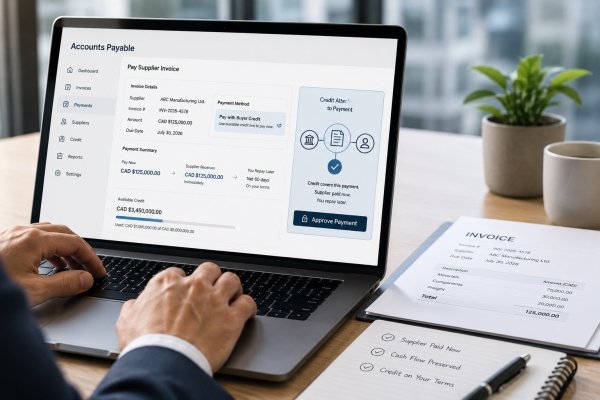
On July 15, 2026, Nasdaq Stockholm listed KEO Capital launched Workeo Canada, bringing a supplier payment and B2B working capital service to the Canadian market. Workeo lets businesses pay suppliers when an invoice is approved while extending their own payment terms to preserve cash flow. The service went live at the end of June with a Toronto team and a revolving senior loan facility of up to C$50 million from an undisclosed Big Six Canadian bank.
The product places credit inside the supplier payment decision. An approved buyer uses a revolving facility to pay an invoice or operating expense through Workeo. The supplier receives payment, while the buyer repays later under its credit terms.
That is more specific than combining payments and lending on one website. Workeo finances the buyer’s payable at the point of payment. The business doesn’t need to draw from a separate bank line, place the payment through another provider and reconcile both transactions afterward.
KEO is entering Canada with funding already attached to the operating model. That gives the company capacity to originate credit from launch rather than waiting to fund Canadian receivables from equity or offshore lending facilities.
Workeo connects buyers and suppliers through one account. Once approved, a business can use its revolving credit line to pay supplier invoices and operating expenses, extend its own payment terms and preserve cash for other needs.
The structure differs from invoice factoring. A factor generally advances money to a supplier against an outstanding receivable. Workeo primarily finances the buyer that owes the invoice. The supplier still receives payment sooner, but the credit relationship is with the purchaser.
It also differs from a standard line of credit. A conventional bank facility gives the company access to capital, but the borrower must manage the draw, supplier payment and repayment as separate steps. Workeo connects the financing to the underlying payment instruction.
The model is also different than corporate cards. Cards can extend payment time and simplify expenses, but they aren’t accepted for every supplier invoice and often require the balance to be repaid over a much shorter period. KEO hasn’t disclosed Canadian credit limits, repayment terms, pricing or underwriting requirements, so the practical advantage will depend on how those terms compare.
KEO says Workeo uses proprietary technology and blockchain infrastructure to support local payment execution. It hasn’t published enough technical information to establish which blockchain is used, how transactions settle or whether customers interact with that infrastructure directly. The payment and credit workflow is therefore more important to the Canadian launch than the blockchain claim.
The company targets midmarket and large corporate buyers in manufacturing, construction, logistics, wholesale distribution, professional services, retail and health care. It says services are available in Ontario, British Columbia, Alberta, Manitoba and Atlantic Canada, subject to provincial requirements. Quebec and Saskatchewan aren’t included at launch.
Canada offers substantial payment volume for a provider that can attach credit to commercial transactions. KEO cites more than C$9 trillion in annual domestic commercial payment value using Payments Canada data. That figure covers the value processed through several ACSS payment categories. It isn’t KEO’s addressable lending market, but it shows the scale of payment activity surrounding Canadian businesses.
The bank facility explains why KEO can launch the credit product and payment workflow together. Its Canadian subsidiary can borrow up to 80% against eligible receivables during an initial one year revolving period, with an automatic one year extension. The facility is priced at the Canadian Overnight Repo Rate Average plus about 300 basis points, or roughly 6.5% when KEO disclosed the agreement.
KEO estimates that the facility could support approximately C$375 million in annual billings. That's not booked volume or expected revenue. Actual performance will depend on customer demand, credit limits, portfolio turnover, defaults and the amount KEO draws.
The parent company guarantees KEO Canada’s obligations and must maintain at least US$60 million in tangible net worth. Those conditions show that the Canadian bank isn’t funding the portfolio without recourse to the listed company. They also make credit performance central to the economics. Losses, slower repayments or ineligible receivables could reduce the amount KEO can recycle through the facility.
KEO brings prior operating evidence. Workeo was developed by KEO World after its 2020 founding. A four year secured facility of up to US$500 million from Hayfin helped finance nearly US$1 billion in company reported credit volume, mainly in Mexico, before KEO repaid the facility in January 2026.
The company’s corporate structure also changed before the launch. Maha Capital completed its acquisition of KEO World in April 2026 and raised US$27 million through directed share issues. It then adopted the KEO Capital name and KEOC ticker in June. The transaction placed KEO World inside a Nasdaq Stockholm listed company with access to public capital and a larger balance sheet.
Canada is therefore part of a connected expansion sequence. Workeo proved credit volume in Latin America, repaid its original institutional facility, joined a listed company and secured a domestic bank line for its next market.
KEO enters an active Canadian market. It isn’t the first company to connect business spending, payments and credit.
Float’s working capital expansion combines business accounts, cards, bill payments and short term credit. Its product begins with company spending and cash management. Workeo begins with the supplier invoice and attaches revolving buyer finance to that payment.
Telpay’s acquisition of Notch connected supplier payments with receivables and cash flow software. Plooto also integrates accounts payable, accounts receivable and reconciliation. Neither publicly presents a revolving buyer credit facility attached to each supplier payment in the same way.
FundThrough’s invoice funding model addresses the opposite side of the transaction by advancing cash against supplier receivables. Banks provide lines of credit and treasury products, but often leave the business to connect financing with accounts payable operations.
KEO’s competitive position combines payment execution with credit for the buyer, funded through an institutional facility rather than customer deposits.
The commercial benefit is the SME operating relationship. Embedded working capital becomes more valuable when credit appears inside invoices, supplier payments and other operating workflows. A provider that finances the invoice can see when businesses pay, which suppliers they use and how quickly obligations are repaid. That data can improve underwriting, increase product use and make the payment account harder to replace.
Execution still needs proof. The C$50 million facility gives Workeo capacity. It doesn’t establish adoption. The next proof will come from originations, repeat use, credit performance and whether Canadian companies treat Workeo as a financing product or part of their daily payment operations.
Will Canadian businesses increasingly access working capital through the supplier payment workflow rather than managing credit and payments as separate services?
KEO entered Canada with domestic bank funding, Toronto operations and Workeo’s buyer financed supplier payment model. The launch tests the model under a different banking and regulatory structure.
Workeo CanadaOntario incorporated subsidiary · FINTRAC registered money services business
ExpansionToronto operations and five initial Canadian regions
Up To C$50MCanadian revolving senior facilityUp to 80% advance rate · CORRA plus about 300 basis points
5 RegionsOntario, British Columbia, Alberta, Manitoba and Atlantic Canada
Midmarket+Canadian corporate and enterprise buyers
Embedded Buyer FinanceCredit enters at the supplier payment instruction
Canada tests whether KEO can transfer an institutionally funded payment and credit workflow into another regulated market. The facility supplies capacity, but customer adoption, credit performance and repeat use will determine whether Workeo becomes part of daily business payments.
 The National Crowdfunding & Fintech Association (NCFA Canada) is a financial innovation ecosystem that provides education, market intelligence, industry stewardship, networking and funding opportunities and services to thousands of community members and works closely with industry, government, partners and affiliates to create a vibrant and innovative fintech and funding industry in Canada. Decentralized and distributed, NCFA is engaged with global stakeholders and helps incubate projects and investment in fintech, alternative finance, crowdfunding, peer-to-peer finance, payments, digital assets and tokens, artificial intelligence, blockchain, cryptocurrency, regtech, and insurtech sectors. Join Canada's Fintech & Funding Community today FREE! Or become a contributing member and get perks. For more information, please visit: www.ncfacanada.org
 |  |  |
|---|---|---|
 |  |  |



August 26th, 2025

January 4th, 2024

June 1st, 2021

September 9th, 2020

July 9th, 2018

January 3rd, 2018

September 25th, 2017

June 20th, 2017

May 10th, 2017

December 14th, 2016

Leave a Reply