




Karsten Wenzlaff, Advisor
August 26th, 2025
Karsten Wenzlaff is a Crowdfunding and Fintech Expert from Germany. He is Secretary-General of Digit[...]


Coinbase | June 25, 2025

Image: Freepik/macrovector
Coinbase secures a Markets in Crypto Assets (MiCA) licence in Luxembourg and unlocks access to all 27 EU member states under one regulatory framework. The licence allows Coinbase to provide regulated custody, trading, and token services across Europe without reapplying in each country.
MiCA is the EU’s first unified crypto regulation. It sets common rules for disclosures, capital requirements, and consumer protection. Coinbase is among the first major global exchanges to receive full MiCA approval, joining a wave of early adopters now operating across the EU under a unified licence. Market wide compliance in the EU is now real, and opens up a single market of 450 million people under consistent regulatory oversight.
Canada uses a mix of federal registration through FINTRAC and provincial securities oversight. While there is a securities passport system under the Canadian Securities Administrators (CSA), it's not uniformly applied across all provinces. Ontario, for example, requires dual filings. The system also does not unify crypto regulation or streamline compliance across federal and provincial levels.
In contrast, MiCA offers a single licence with direct access across all EU countries. For Canadian fintechs, this structural difference adds complexity and slows growth. Canada’s fintech sector must now compete with peers operating under unified rules, faster timelines, and lower costs.
In a June 2025 opinion piece for Cointelegraph, Jillian Friedman, COO of Symbiotic, warned that Canada risks losing ground:
“While other countries move toward integrating crypto into their financial systems, Canada is lagging, costing the country capital, talent and competitiveness.”
Crypto policy was grossly missing from all federal party platforms during the 2025 election, a “missed opportunity” at a time when early-stage VC activity is dropping and top STEM talent continues to leave. Friedman doubled down on Canada's issues including:
She argues that Canada should move quickly to unlock access to capital, offer tax incentives, and remove policy barriers if it wants to remain competitive.
Several global firms have followed Coinbase in securing MiCA licences:
While several MiCA-licensed firms also operate in Canada the split below shows how global players are prioritizing the EU as a unified growth market, while (possibly) treating Canada as a smaller fragmented market.
| Firm | MiCA Licence | Canadian Operation |
| Coinbase | Yes | Yes (OSC restricted dealer) |
| Crypto.com | Yes | Yes (OSC restricted dealer) |
| OKX | Yes | No active registration |
| Bitpanda | Yes | No active registration |
| Bybit | Yes | Previously fined in Ontario; no active registration |
| BitGo | Yes | No known retail presence |
MiCA offers a clear example of how coordinated regulation can improve access, speed, and investor confidence. Prime Minister Mark Carney’s pledge to reduce interprovincial trade barriers could open the door to change, but digital asset policy must be part of the conversation.
Without reducing regulatory burden and interprovincial barriers, Canada risks falling behind not because of lack of innovation but because of unclear rules that limit scale, delay market access, and create friction for investors.
 The National Crowdfunding & Fintech Association (NCFA Canada) is a financial innovation ecosystem that provides education, market intelligence, industry stewardship, networking and funding opportunities and services to thousands of community members and works closely with industry, government, partners and affiliates to create a vibrant and innovative fintech and funding industry in Canada. Decentralized and distributed, NCFA is engaged with global stakeholders and helps incubate projects and investment in fintech, alternative finance, crowdfunding, peer-to-peer finance, payments, digital assets and tokens, artificial intelligence, blockchain, cryptocurrency, regtech, and insurtech sectors. Join Canada's Fintech & Funding Community today FREE! Or become a contributing member and get perks. For more information, please visit: www.ncfacanada.org
 |  |  |
|---|---|---|
 |  |  |
Quantum | June 25, 2025
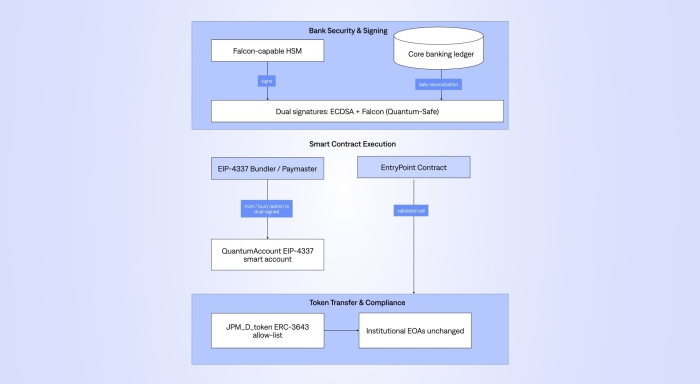
BTQ Technologies Unveils Quantum Stablecoin Settlement Network (QSSN) (CNW Group/BTQ Technologies Corp.)
On June 24, 2025, Vancouver-based public company, BTQ Technologies (CBOE:BTQ and OTC:BTQQF), announced the launch of a new system called the Quantum Stablecoin Settlement Network (QSSN). The technology is designed to help stablecoin issuers protect against future quantum computing threats while keeping their current systems unchanged.
This comes at a time when the global stablecoin market has grown to nearly US$250 billion, and regulators are starting to require stronger protections. Stablecoins are now a major part of the global economy and they are being used more often in cross border payments, lending, and digital commerce. In mid-June, the U.S. passed the GENIUS Act, mandating post quantum security standards by 2030. Canada and other countries are likely reviewing similar measures.
QSSN adds a second digital signature to important actions like creating or destroying stablecoins and updating system controls. This second signature uses Falcon 512, a new kind of security method chosen by the U.S. National Institute of Standards and Technology because it can resist attacks from future quantum computers.
This system runs alongside today’s security methods, like the ones used on Ethereum, and it doesn't require any changes to how users send or store stablecoins. QSSN already supports major programs including JPMorgan’s deposit token JPMD, Circle’s USDC, and Tether’s USDT.
QSSN is already working today. It adds quantum safe protection behind the scenes without changing how wallets, apps, or payment systems work. This helps stablecoin issuers meet future legal requirements early and avoid hasty upgrades later.
This is important because some attackers may already be collecting encrypted data today, planning to break it later when powerful quantum computers are available. QSSN protects stablecoins from this kind of risk by adding stronger encryption now.
The GENIUS Act gives financial institutions until 2030 to make these upgrades. By starting early, companies like Circle, Tether, and JPMorgan can show regulators and customers that they take long term security seriously. This also helps keep trust in stablecoins as their use grows. As demand increases, stablecoin platforms must be ready for future threats without slowing down today’s systems and QSSN gives them that option.
BTQ’s QSSN offers a practical and tested way to protect stablecoins from future quantum risks, while keeping systems simple for users and businesses today. It could help set the standard for how digital assets are secured in the years to come.
The National Crowdfunding & Fintech Association (NCFA Canada) is a financial innovation ecosystem that provides education, market intelligence, industry stewardship, networking and funding opportunities and services to thousands of community members and works closely with industry, government, partners and affiliates to create a vibrant and innovative fintech and funding industry in Canada. Decentralized and distributed, NCFA is engaged with global stakeholders and helps incubate projects and investment in fintech, alternative finance, crowdfunding, peer-to-peer finance, payments, digital assets and tokens, artificial intelligence, blockchain, cryptocurrency, regtech, and insurtech sectors. Join Canada's Fintech & Funding Community today FREE! Or become a contributing member and get perks. For more information, please visit: www.ncfacanada.org
| | |
|---|---|---|
| | |
Tokenization | June 18 2025

As covered by Retuers, Coinbase is officially asking the U.S. Securities and Exchange Commission (SEC) to approve tokenized equities (or stocks), a new class of financial product. These would be blockchain representations of traditional equities, such as Apple or Tesla, designed to trade 24/7 with almost instant settlement and lower overhead. Coinbase is seeking a no-action letter or regulatory exemption from the SEC, and if they grant it, Coinbase would be the first major U.S. exchange operating with such tokenized products, evolving well beyond just a standard crypto trading exchange.
The tokenized equity model would allow retail and institutional users to access fractional ownership of blue-chip stocks via a blockchain interface and operate largely without the constraints of traditional brokerage platforms. For example transactions could take place globally, 24 hours a day, without relying on legacy clearing infrastructure. It could mean significant improvements in market efficiency, reduce settlement risk and include new financial products natively on-chain.
While Coinbase looks to break new ground in American markets, other jurisdictions are already operating. Rival exchange Kraken has launched tokenized stock trading for non-U.S. customers through its partnership with Swiss-based Backed Finance. For example, tokenized versions of Apple and Tesla stock, bAAPL and bTSLA respectively, are live pioneering examples of tokenized equities executed issued on the Solana blockchain, backed by 1:1 real shares held in custody, and tradeable with no minimum investment size and operate legally under global regulatory frameworks with blockchain flexibility, and 24/7 trading.
Europe is ahead of the curve on regulation. The EU’s MiCA framework was fully implemented as of 2024, providing legal clarity for tokenized securities across 27 member states. In Asia, Hong Kong is piloting tokenized gold, bonds, and equities under regulatory supervision. These jurisdictions are showing that comprehensive tokenization frameworks can unlock innovation while still preserving investor protection and market integrity.
Tokenized securities may require broker-dealer registration, SEC exchange approval, and compliance with the Investment Company Act. Since, Coinbase is not currently licensed as a broker-dealer, it may need a partner or entirely new structure to support these offerings legally.
There are also questions about liquidity. The World Economic Forum has identified low secondary market trading volumes and lack of standardization as persistent challenges in real-world asset tokenization.
While the tech stack can actually enforce compliance rules directly within smart contracts using standards for Real World Assets (RWA) like ERC-3643, adoption of these instruments will depend on regulators aligning globally and investors gaining trust.
If the U.S. and EU formalize tokenized security frameworks, capital will flow toward platforms offering speed, access, and interoperability, leaving slow movers behind. Companies should be exploring how to integrate tokenized equities into their product roadmaps while remaining compliant. NCFA and its members can play a leadership role in what responsible tokenized finance, launch educational initiatives, and collaborate with global infrastructure providers. At the of the day, tokenized assets are poised to become a competitive advantage or missed opportunity.
The National Crowdfunding & Fintech Association (NCFA Canada) is a financial innovation ecosystem that provides education, market intelligence, industry stewardship, networking and funding opportunities and services to thousands of community members and works closely with industry, government, partners and affiliates to create a vibrant and innovative fintech and funding industry in Canada. Decentralized and distributed, NCFA is engaged with global stakeholders and helps incubate projects and investment in fintech, alternative finance, crowdfunding, peer-to-peer finance, payments, digital assets and tokens, artificial intelligence, blockchain, cryptocurrency, regtech, and insurtech sectors. Join Canada's Fintech & Funding Community today FREE! Or become a contributing member and get perks. For more information, please visit: www.ncfacanada.org
| | |
|---|---|---|
| | |
Crypto | March 18, 2025

On June 17, 2025, a watershed moment for digital finance and crypto with the U.S. Senate passing the GENIUS Act, bipartisan 68-30 vote, establishing the country’s first federal regulatory framework for stablecoins. This legislation is the most significant digital asset policy breakthrough to date in the United States.
The GENIUS Act stands for 'Guiding and Establishing National Innovation for U.S. Stablecoins'and lays out clear rules for the issuance, required reserves, transparency, and oversight of U.S. dollar backed stablecoins. It's expected to boost financial innovation in America by providing a coherent national policy to streamline the governance patchwork created by state-to-state rules. The stablecoin market has now surpassed $260 billion in total value (up about 22% in 2025 alone), and is growing rapidly with rising institutional demand.
As reported by WSJ, Senator Cynthia Lummis (R-WY, one of the bill's key sponsors) said:
“This is the first step in establishing trust, protecting consumers, and ensuring the dollar remains the global standard for digital finance,”
The bill outlines strict guardrails for stablecoin issuers to prevent another collapse like TerraUSD while ensuring stability, liquidity, and auditability:
The GENIUS Act delivers some legal clarity to a sector long operating under ambiguous guidance from regulators.
Notably, the issuer of USDC, Circle saw its pre-IPO share price boost nearly 10% on the news, rising from $31 to over $160 as investor confidence rebounded. The company’s CEO Jeremy Allaire explained the bill as “the foundation of dollar dominance in the digital era.”
The bill is still not without some controversy as critics flagged the exclusion of President Trump from the conflict of interest restrictions - seen as politically motivated and related to the Trump family's interests and ties to private stablecoin ventures.
The bill now moves to the House of Representatives to be reconciled with the STABLE Act, and then once approved in both chambers the bill would be sent to President Trump for signing the first major federal stablecoin bill into law.
Will Canadian regulators follow with similar national standards for fiat-backed digital assets? As OSFI and FINTRAC review their guidance, Canadian fintechs operating in cross-border payments, custody, and token issuance will begin to face rising pressure to align with U.S. rules or risk falling behind in market access and credibility. The global sector is consolidating quickly and Canadian innovators must determine whether or not to build on this momentum with their own regulatory clarity.
The National Crowdfunding & Fintech Association (NCFA Canada) is a financial innovation ecosystem that provides education, market intelligence, industry stewardship, networking and funding opportunities and services to thousands of community members and works closely with industry, government, partners and affiliates to create a vibrant and innovative fintech and funding industry in Canada. Decentralized and distributed, NCFA is engaged with global stakeholders and helps incubate projects and investment in fintech, alternative finance, crowdfunding, peer-to-peer finance, payments, digital assets and tokens, artificial intelligence, blockchain, cryptocurrency, regtech, and insurtech sectors. Join Canada's Fintech & Funding Community today FREE! Or become a contributing member and get perks. For more information, please visit: www.ncfacanada.org
| | |
|---|---|---|
| | |
Stablecoins | June 17, 2025

Image: Freepik/rawpixel.com
Retail giants Amazon and Walmart are exploring the idea of launching their own stablecoins to reduce payment processing costs and gain more control over transactions, according to a report by the Wall Street Journal. This could tip the balance toward merchant-controlled financial systems and impact how value is transferred in the digital economy.
Currently card networks like Visa and Mastercard charge merchants high fees for purchase transactions. By using stablecoins pegged to the U.S. dollar, retail companies like Amazon and Walmart could build their own payment systems, bypassing legacy rails and retain more transactional value on their platforms. However any stablecoin plans depend on whether or not the proposed Genius Act becomes law in the United States.
As reported by Reuters, stablecoins are gaining interest among corporations that want to issue or use private forms of digital cash. The goal isn't to create a new form of money, but to develop closed financial ecosystem for transactions that are faster, cheaper, and programmable than legacy payment systems used today.
Retailers aren't the only ones interested. PayPal has already launched its own stablecoin, PYUSD, which is issued through a partnership with Paxos, a licensed trust company. Amazon and Walmart could follow a similar route or choose to build in-house capabilities.
According to Crowdfund Insider, the Genius Act is currently in front of the Senate and is expected to have a floor vote on June 18 which if passed would become the first American law to set national standards for fiat-backed digital currency. Stablecoins would require 1:1 reserve backing, clear audit rules, and strong consumer protections.
The Genius Act is designed to add clarity and prevent abuse while encouraging legitimate innovation. Only regulated entities can issue stablecoins and limits will be in place for the type or size of non-financial companies that can use them. Analysts at Bernstein have warned that the Genius Act could make it “prohibitive” for retailers to issue stablecoins directly without working with financial partners.
As Business Insider explains, the bill would give federal regulators oversight of reserves, mandate asset freezes under court orders, and block big tech companies from embedding coins too deeply into their platforms. The law also prevents stablecoin issuers from tying coins to commercial loyalty programs or e-commerce activity without approval.
If Amazon and Walmart did in fact launch their own stablecoins, merchant-led payment systems could reduce friction for consumers and suppliers while creating competitive pressure on Canadian banks, fintechs, and card networks.
Global payment flows could also be affected if retailer stablecoins are used for remittances or global vendor payments. Walmart already has a fintech joint venture with Ribbit Capital in the United States to create a fintech startup Hazel (also called 'One'), and experience with blockchain patents. Amazon has explored using external stablecoins such as USDC for settlement.
Whether they issue directly or partner with licensed issuers, the genie is almost out of the bottle and moving beyond theoretical. Consider it a live business option just waiting for regulatory clarity.
Canada’s fintech ecosystem should monitor these developments closely. U.S. regulatory clarity could prompt other jurisdictions to act, and consumer expectations will grow as giant retailers redefine what payments in the near future look like.
It may create opportunities for Canadian fintechs to partner with global brands or expand the merchant-focused rails to compete with card-based infrastructure, ultimately pushing to modernize domestic payments. Stablecoins come with some real risks around consumer protection, monetary policy, and financial stability, so it's essential to get the balance right.
The National Crowdfunding & Fintech Association (NCFA Canada) is a financial innovation ecosystem that provides education, market intelligence, industry stewardship, networking and funding opportunities and services to thousands of community members and works closely with industry, government, partners and affiliates to create a vibrant and innovative fintech and funding industry in Canada. Decentralized and distributed, NCFA is engaged with global stakeholders and helps incubate projects and investment in fintech, alternative finance, crowdfunding, peer-to-peer finance, payments, digital assets and tokens, artificial intelligence, blockchain, cryptocurrency, regtech, and insurtech sectors. Join Canada's Fintech & Funding Community today FREE! Or become a contributing member and get perks. For more information, please visit: www.ncfacanada.org
| | |
|---|---|---|
| | |
Stablecoins | June 13, 2025
On June 12, 2025, Shopify announced that USDC stablecoin payments will be made available to its global merchant base via a new partnership with Coinbase and Stripe. So merchants can now accept USD Coin via Coinbase' Base Blockchain. This new payment feature is available in early access and will expand over time to offer fast, borderless payments without foreign exchange fees and integrated support for crypto wallets through Stripe.
Merchants using Shopify Payments can now accept USDC from supported crypto wallets through guest checkout and Shop Pay. By default, they receive payouts in their local currency, with no foreign exchange fees. Alternatively, they can choose to retain USDC in their own wallets. Transactions are processed using a bespoke smart contract system on the Base network, jointly developed by Shopify and Coinbase. This new payment layer is purposely built to offer similar functions as traditional card networks, allowing features such as delayed capture, tax finalization, and inventory reservation to work natively with stablecoin payments. So stablecoin checkout process will act just like normal e-comm payments but with the benefits of being faster and global.
Shopify recently acquired Privy which gives Shopify access to a wallet layer that integrates smoothly with both new and existing platforms. Stripe acquired Bridge, which provides the stablecoin rails needed to connect wallet payments to practical merchant settlements. So thanks to Stripe's backend capabilities, merchants won't have to manage blackchain infrastructure but payments will appear on their dashboard as any other transaction would.
Stablecoins offer three major benefits which allow small businesses to access global markets, receive payments quickly, and reduce reliance on expensive or delayed banking infrastructure:
Stablecoins have been all the rage recently, but there should be no doubt now that they've moved beyond hype and being adopted in real world scenarios at scale. The confluence of proven technology, incentives, and aligning regulations make stablecoin payments ready for prime time, and everyday merchants.
Shopify has widespread reach, serving millions of businesses globally every day from startups to large brands. It's somewhat clever to mimick existing card payment flows because it reduces learning curves and some friction points for retails.
Stripe's wallet to fiat infrastructure removes the complexity of crypto for every day merchants.
Stablecoin policies in the U.S. are moving forward, creating a legal pathway for this type of integration to work. The landscape was vastly different only a year ago. The GENIUS Act aims to provide clear rules for dollar-backed stablecoins like USDC.
This move will add significant competitive pressure to competing payment processors, and e-commerce merchant ecosystems. Expect Meta, Apple Pay, PayPal, Walmart, and Amazon to follow soon. Oh look, they already have started to move.
This is no longer a pilot. I repeat, this is no longer a pilot. Stablecoin infrastructure is being released into production at scale.
The National Crowdfunding & Fintech Association (NCFA Canada) is a financial innovation ecosystem that provides education, market intelligence, industry stewardship, networking and funding opportunities and services to thousands of community members and works closely with industry, government, partners and affiliates to create a vibrant and innovative fintech and funding industry in Canada. Decentralized and distributed, NCFA is engaged with global stakeholders and helps incubate projects and investment in fintech, alternative finance, crowdfunding, peer-to-peer finance, payments, digital assets and tokens, artificial intelligence, blockchain, cryptocurrency, regtech, and insurtech sectors. Join Canada's Fintech & Funding Community today FREE! Or become a contributing member and get perks. For more information, please visit: www.ncfacanada.org
| | |
|---|---|---|
| | |
Financing | June 12, 2025

Image: Freepik/rawpixel.com
On June 6, 2025, Gemini announced that it confidentially submitted a draft registration statement to the U.S. Securities and Exchange Commission (SEC) for a proposed IPO of its Class A common stock. The SEC will now review the statement subject to market conditions.
According to Coingecko, the total global crypto market cap has reached $3.5 trillion with Bitcoin holding above $107,000. Stablecoin issuer Circle's IPO debuted on the NYSE in early June with a over 170% on the first day. Coinbase joined the S&P 500 in May.
Gemini’s IPO intent follows the resolution of enforcement matters with both the SEC and CFTC, positioning itself as one of the first fully compliant crypto exchanges to go public since the FTX collapse in 2022.
If Gemini clears the IPO gate in the U.S., the flood gates will be open for a reset of crypto's place in public markets but only for compliant and credible digital asset firms that prove they are ready for institutional trust (and capital) - not just the hype.
The National Crowdfunding & Fintech Association (NCFA Canada) is a financial innovation ecosystem that provides education, market intelligence, industry stewardship, networking and funding opportunities and services to thousands of community members and works closely with industry, government, partners and affiliates to create a vibrant and innovative fintech and funding industry in Canada. Decentralized and distributed, NCFA is engaged with global stakeholders and helps incubate projects and investment in fintech, alternative finance, crowdfunding, peer-to-peer finance, payments, digital assets and tokens, artificial intelligence, blockchain, cryptocurrency, regtech, and insurtech sectors. Join Canada's Fintech & Funding Community today FREE! Or become a contributing member and get perks. For more information, please visit: www.ncfacanada.org
| | |
|---|---|---|
| | |


August 26th, 2025

January 4th, 2024

June 1st, 2021

September 9th, 2020

July 9th, 2018

January 3rd, 2018

September 25th, 2017

June 20th, 2017

May 10th, 2017

December 14th, 2016