




Karsten Wenzlaff, Advisor
August 26th, 2025
Karsten Wenzlaff is a Crowdfunding and Fintech Expert from Germany. He is Secretary-General of Digit[...]


October 29, 2026 | NCFA Story Intelligence | Capital Markets Infrastructure And Funding, Artificial Intelligence And Data, Competition And Market Structure

On October 29, 2026, the Ottawa announced plans to invest up to C$1.6 billion in Toronto based Cohere as part of a Series E financing targeting as much as C$7 billion, putting public money directly into a Toronto company that is trying to build a Canadian and European alternative to the dominant US AI platforms. The deal would make Ottawa more than a supporter of Canadian AI. It would make the federal government a shareholder in one of the country’s most valuable private technology companies, at a time when Canada is pushing for greater digital sovereignty and Cohere is expanding deeper into Europe and global enterprise markets.
The government says the investment will be made in stages. Cohere must keep its Canadian incorporation and headquarters, create at least 1,000 new Canadian technical jobs by 2030, and commit at least C$1.7 billion to additional computing infrastructure in Canada. Cohere is entering the deal from a much stronger position than it occupied two years ago. Its Series E is targeting up to C$7 billion at a stated C$35.7 billion valuation. Schwarz Group leads the round. NVIDIA, Bell Ventures, Inovia Capital, Prosperity7 Ventures and other investors are participating. Cohere says its annual recurring revenue grew 165% year over year in the third quarter of 2026 and its customer base expanded twentyfold to about 300 customers.1
Ottawa calls this a sovereignty investment. Prime Minister Mark Carney says Canada needs the ability to build, adopt and govern AI on its own terms, while taking equity lets Canadians share in Cohere’s success if the company keeps climbing.
The sovereignty case and the investment case aren’t the same thing. Canada can value domestic AI capacity even if Cohere never becomes a great financial investment. It can also make money if Cohere becomes a much larger global company. Ottawa is now trying to do both.
What follows is a story of a Canadian AI company finding a different lane, moving closer to government, crossing the Atlantic for scale, and returning to a cap table where Canada itself now wants a seat.
By early 2024, Reuters reports Cohere’s annualized revenue has climbed from about US$13 million to roughly US$35 million by the end of March. The company is growing, but the numbers also show how far it sits from the largest US AI platforms.2
Cohere leans into control instead of reach. Its pitch increasingly centres on private deployment, data security, cloud choice and enterprise customization. The company can compete without needing to win the consumer chatbot popularity contest.
The customer list gets heavier. Cohere names RBC, TD Bank, Bell, Fujitsu, PwC and other large organizations among customers. Private deployment gives the company a route into sectors where security, residency and compliance can block consumer oriented tools.
The scale gap hasn’t disappeared. Anthropic reported US$16.29 billion of revenue in the first half of 2026 in its IPO filing, while OpenAI and other US platforms remain far larger in consumer reach and capital commitments.5 Cohere is trying to win a different buying decision.
The C$240 million support is not the same as today’s equity. Federal records describe the earlier deal as a contribution tied to compute expansion. Ottawa gets economic and strategic benefits if the project succeeds, but it does not participate in Cohere’s valuation the way a shareholder does.
Cohere keeps raising privately. In August 2025 it raises US$500 million at a US$6.8 billion valuation. Cohere Raises $500M at $6.8B for Enterprise Agentic AI shows a company still relying on venture, pension and strategic investors while government support sits outside the cap table.
Europe offers customers, public sector relationships and a policy environment that already prizes data control and local infrastructure. Cohere gains another route to market without having to imitate the consumer led strategies of the largest US firms.
Europe also brings competition. France’s Mistral is raising billions around a European AI champion of its own. US platforms are selling aggressively into the same enterprise accounts. Sovereignty creates demand, but it doesn’t hand Cohere the market.
Something could go very right. If Cohere turns its enterprise and sovereign AI position into a much larger global business, Canada participates in the appreciation instead of collecting only jobs, tax revenue and infrastructure benefits. A future valuation above C$35.7 billion would make equity look very different from another contribution.
The same structure exposes taxpayers to the downside. A private valuation can reset. New rounds can dilute shareholders. Compute spending can consume capital quickly. Cohere may deliver strategic benefits to Canada while still producing a weak investment return. Sovereignty doesn’t erase price.
Canada’s new Canada Launches $1.75B Venture and Growth Capital Plan mostly uses public money to attract private investors through funds and managers. Cohere is a far more concentrated position in one company.
The price is already much higher than it was last year. Cohere raised at a US$6.8 billion valuation in August 2025. The new round points to C$35.7 billion after a year of product growth, acquisitions, European expansion and the Aleph Alpha combination. Ottawa is buying after the story has already moved.
Cohere gives Ottawa a rare chance to test two ideas at once.
The first is strategic. Canada wants more control over the AI systems that governments, banks and other critical organizations may eventually depend on. Cohere’s architecture, Canadian roots and Europe strategy fit that ambition better than handing every sensitive workload to a foreign hyperscaler or consumer AI company.
The second is financial. Instead of paying only for infrastructure, research or jobs, Ottawa wants equity. If Cohere becomes one of the few globally important enterprise AI companies outside the United States and China, taxpayers own part of the upside.
The company has earned a stronger hand than it had two years ago. Revenue has grown, the customer list has widened, North has moved into production environments, European expansion is real, and Schwarz Group has put capital and infrastructure behind the transatlantic strategy.
There is still plenty the public can’t see. Cohere doesn’t disclose net profit or cash burn. Ottawa hasn’t published the ownership percentage or shareholder protections. Nobody outside the deal can yet judge whether C$35.7 billion is an attractive entry price for taxpayers.
Canada may be right about the strategic asset and still have to prove it bought the asset well.
The investment becomes more interesting if Cohere keeps compounding from here. It becomes more difficult if the company needs repeated public support, the valuation falls, or strategic goals start masking weak investment performance.
Cohere has spent seven years trying to prove a Canadian AI company can scale without becoming another US platform. Ottawa has now put C$1.6 billion behind the next chapter.
If Canada wants to become an owner of national champions, Cohere will help show whether it can act like one.
The government has announced an equity commitment of up to C$1.6 billion, but it hasn’t disclosed the ownership percentage, share class, voting rights, board rights, liquidation preference, dilution protections or exit terms. Those details are needed before the investment economics can be judged properly.
Cohere reports rapid ARR and customer growth, and Reuters has reported strong margins around its private deployment strategy. The company does not publicly disclose net income, cash burn or complete financial statements, so profitability cannot be confirmed from public information.
Ottawa says the equity will be invested in stages with regular reporting on jobs and Canadian investment. The public announcement does not disclose the consequences for missed milestones or whether later stages can be withheld.
Ottawa has not said the Cohere structure will become a standard program. The Canada Strong Fund does point in the same direction by making commercial equity ownership a larger part of federal economic policy. Cohere may become an early test of how those strategic and financial objectives work together.
Budget 2025 Accelerates Fintech, AI, and Capital Growth
How federal AI infrastructure and growth capital policy started converging before direct Cohere equity arrived.
Canada Adds Competitiveness to Federal Regulation
A wider look at Ottawa’s push to put competitiveness more directly into federal economic and regulatory decisions.
National Security Is Now Part of Financial Supervision
Why sovereignty, infrastructure control and national security are moving deeper into financial and technology policy.
Why AI Investment Is Missing What Workers Actually Want
A reminder that capital and technical capability still have to translate into adoption, useful work and measurable outcomes.
 The National Crowdfunding & Fintech Association (NCFA Canada) is a financial innovation ecosystem that provides education, market intelligence, industry stewardship, networking and funding opportunities and services to thousands of community members and works closely with industry, government, partners and affiliates to create a vibrant and innovative fintech and funding industry in Canada. Decentralized and distributed, NCFA is engaged with global stakeholders and helps incubate projects and investment in fintech, alternative finance, crowdfunding, peer-to-peer finance, payments, digital assets and tokens, artificial intelligence, blockchain, cryptocurrency, regtech, and insurtech sectors. Join Canada's Fintech & Funding Community today FREE! Or become a contributing member and get perks. For more information, please visit: www.ncfacanada.org
 |  |  |
|---|---|---|
 |  |  |
October 27, 2026 | NCFA Industry Resource | SME Finance And Business Banking, Sustainable Finance ESG And Financial Inclusion, Capital Markets Infrastructure And Funding

Growth Loans, Regional Financing and Founder Awards
On October 22, 2026, Women's Enterprise Organizations of Canada (WEOC) and the Business Development Bank of Canada (BDC) announced up to C$200,000 in growth loans for eligible women entrepreneurs. WEOC also partnered with Quebec lender Evol to connect more founders with financing and business support. Separately, the Capital Elle Business Impact Award is accepting applications until October 28, 2026, giving Canadian women entrepreneurs three opportunities worth considering.
The new Women Entrepreneur Growth Financing programme combines WEOC loans of up to C$50,000 with BDC loans of up to C$150,000. Backed by a C$12.5 million financing commitment over two years, the pilot targets eligible women owned businesses outside Quebec that need more capital to expand. BDC is contributing C$10 million toward the programme.
For businesses ready to buy equipment, invest in technology, increase production or pursue larger contracts, the additional financing could make a meaningful difference. Regional WEOC lending partners will assess applicants and provide business advice and ongoing support. The combined C$200,000 is a maximum, subject to eligibility and lending approval.
Applications haven't opened yet. Financing is expected to begin later in 2026. Interested founders can register for WEOC growth financing updates to receive application details, eligibility requirements and loan terms when available.
WEOC's new partnership with Evol connects lending services across Canada. Evol supports entrepreneurs throughout Quebec's 17 regions, while WEOC works through lending partners elsewhere in Canada. The organizations will refer founders to suitable financing and advisory services, including businesses that may not qualify for an existing programme.
Both organizations participate in the Women Entrepreneurship Loan Fund, which offers eligible businesses loans of up to C$50,000. The partnership isn't a new grant or an extension of the C$200,000 BDC pilot into Quebec. It helps entrepreneurs find lenders and support suited to their location and financing needs.
The Capital Elle Business Impact Award offers Canadian women entrepreneurs cash awards and business support across three categories covering strategic connections, growth capital and acquisitions. The organizer advertises a combined prize package worth more than C$100,000, including C$5,000 cash for each category winner, professional services, mentoring and business connections.
The award is open to women founders across industries, subject to eligibility requirements. Applicants select the category that best fits their business goals. The application process costs C$50 for nonmembers (nonrefundable), while eligible paid Elleiance members can apply without an additional fee.
Deadline is October 28, 2026, at 9 p.m. Eastern. Founders should review the official award terms and confirm eligibility.
More financing options are welcome, and founders should match the opportunity to their business. Growth loans can fund expansion, regional lenders can provide ongoing support, and awards offer cash and business connections. The best choice depends on how much money the business needs, what it qualifies for and whether it can take on debt.
The National Crowdfunding & Fintech Association (NCFA Canada) is a financial innovation ecosystem that provides education, market intelligence, industry stewardship, networking and funding opportunities and services to thousands of community members and works closely with industry, government, partners and affiliates to create a vibrant and innovative fintech and funding industry in Canada. Decentralized and distributed, NCFA is engaged with global stakeholders and helps incubate projects and investment in fintech, alternative finance, crowdfunding, peer-to-peer finance, payments, digital assets and tokens, artificial intelligence, blockchain, cryptocurrency, regtech, and insurtech sectors. Join Canada's Fintech & Funding Community today FREE! Or become a contributing member and get perks. For more information, please visit: www.ncfacanada.org
| | |
|---|---|---|
| | |
October 26, 2026 | NCFA Market Activity | Capital Markets Infrastructure And Funding, Digital Assets Blockchain And Tokenization, SME Finance And Business Banking

On October 26, 2026, Atlanta based trade finance company PrimeRevenue announced plans to tokenize trade finance assets on Solana, bringing its Electronic Time Drafts (ETDs) to blockchain capital markets. These instruments represent corporate buyers' obligations to pay suppliers on agreed future dates and can be financed to provide suppliers with earlier cash. PrimeRevenue aims to expand beyond its established bank funding network by connecting these obligations with additional institutional and eligible blockchain investors.
PrimeRevenue reports 50,000 companies using its platform, more than 100 funding partners and over US$300 billion in annual payment transactions. That established network gives the company a strong starting point for bringing corporate payment obligations to new investors. Rather than building a financing market from scratch, PrimeRevenue can extend its existing relationships, financial instruments and distribution capabilities into blockchain capital markets.
When a corporate buyer owes a supplier money, the supplier may have to wait 30, 60 or 90 days for payment. PrimeRevenue's Electronic Time Draft allows the buyer's payment obligation to be transferred to a financing bank at a discount. The supplier receives cash early, while the bank collects the full amount from the buyer when payment comes due. Financing terms reflect factors including the buyer's credit rating and the remaining payment period.
For example, a supplier owed US$100,000 in 90 days could exchange the draft for an earlier discounted payment. A smaller supplier working with a financially stronger corporate customer may secure more attractive financing than borrowing against its own credit. The buyer retains the agreed payment date, the supplier receives working capital and the bank earns a return for providing the funding and assuming the buyer's payment risk.
ETDs aren't ordinary digital invoices. PrimeRevenue's patented process creates and signs a time draft electronically, supports its transfer to the financing bank and arranges collection at maturity. The company says the structure also removes certain lien search and release requirements that can complicate conventional receivables financing.
Over time, tokenized ETDs could support a continuously replenishing working capital market. Corporate buyers generate new payment obligations, suppliers receive early financing, and investors recover capital as drafts mature. That money could finance the next round of transactions, potentially giving suppliers more flexible access to funding without relying on a single lender. Each draft would still carry its own credit risk, but the financing network could operate more like a revolving pool of capital.
In 2018, PrimeRevenue reported US$1.78 billion in ETD financing, helping nearly 1,000 suppliers across 13 countries get paid early. The program involved 14 banks and more than 100 corporate buyer programs, showing that ETDs were already being used internationally well before the Solana initiative.
PrimeRevenue currently connects corporate payment obligations with established funding institutions. Tokenization could allow other eligible investors to finance or acquire interests in those obligations, depending on how the legal structure is implemented. Solana would provide a shared record of issuance, transfers and settlements, while PrimeRevenue continues supplying the corporate relationships and transaction activity.
PJ Bain PrimeRevenue CEO described the intended expansion in the company's announcement:
"It creates new pathways to unlock working capital and liquidity for our customers and funding partners."
A bank might gain another way to distribute its exposure instead of holding every draft until maturity. New investors could gain access to corporate credit with defined payment dates. Suppliers could benefit if competition among funding providers improves pricing or financing availability. None of these benefits is established until investors commit capital and completed transactions demonstrate the economics.
PrimeRevenue still needs to clarify what investors would actually own, how they would receive payments and what happens if a corporate buyer fails to pay. Holding a token on Solana doesn't automatically give an investor the legal right to collect the underlying debt. Investors would also need to consider whether they could sell their holdings before payment is due.
The bigger opportunity is bringing more investors into trade finance, not simply processing transactions faster. PrimeRevenue already connects corporate buyers, suppliers and banks. Tokenization could open that network to additional investors, giving suppliers access to more funding options and potentially better rates.
Unlike Fission's tokenized fund liquidity model, which helps investors access cash from existing fund holdings, PrimeRevenue is bringing corporate payment obligations to new funding markets. Both use tokenization to connect financial assets with capital, but they serve different financing needs.
Canadian businesses face similar working capital pressures. Payments Canada's 2026 research found that 37% of surveyed small and medium businesses consider payment delays a significant problem. Recent Canadian SME financing initiatives are expanding access to smaller loans and more flexible supplier payments. Tokenized ETDs could offer another option, especially for suppliers selling to large, creditworthy corporate customers.
Canadian banks, commercial lenders and financing platforms could eventually use similar models to connect corporate payment obligations with a wider pool of investors. This could give suppliers more financing choices while opening new opportunities for lenders and financial technology providers.
PrimeRevenue describes the Solana initiative as its first step toward decentralized finance (DeFi), connecting traditional trade finance with new blockchain funding markets.
PrimeRevenue already has the corporate customers, financing network and bank relationships to bring trade finance assets to new investors. Solana could help attract more capital and give suppliers better financing options. Can PrimeRevenue turn tokenized trade finance into a larger, more competitive funding market that delivers real value to businesses?
The National Crowdfunding & Fintech Association (NCFA Canada) is a financial innovation ecosystem that provides education, market intelligence, industry stewardship, networking and funding opportunities and services to thousands of community members and works closely with industry, government, partners and affiliates to create a vibrant and innovative fintech and funding industry in Canada. Decentralized and distributed, NCFA is engaged with global stakeholders and helps incubate projects and investment in fintech, alternative finance, crowdfunding, peer-to-peer finance, payments, digital assets and tokens, artificial intelligence, blockchain, cryptocurrency, regtech, and insurtech sectors. Join Canada's Fintech & Funding Community today FREE! Or become a contributing member and get perks. For more information, please visit: www.ncfacanada.org
| | |
|---|---|---|
| | |
October 23, 2026 | NCFA Insight | Capital Markets Infrastructure And Funding, Competition And Market Structure, SME Finance And Business Banking
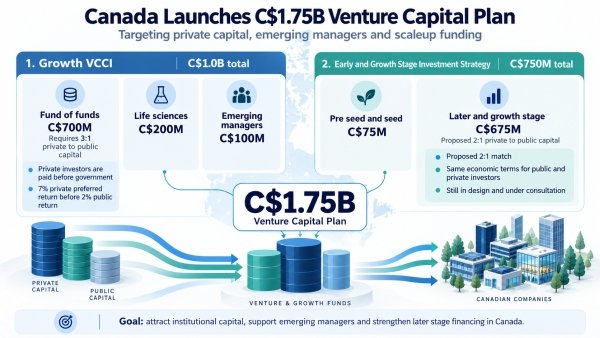
On October 22, 2026, Industry Minister Mélanie Joly launched Canada's C$1.75 billion Venture and Growth Capital Plan. It combines C$1 billion for a new Venture and Growth Capital Catalyst Initiative with C$750 million for early and growth stage investing. Ottawa expects the programs to attract at least C$3.8 billion of private investment, taking the total pool above C$5.5 billion.
Canada may be reaching an important turning point in how it supports venture capital. The plan is more targeted than another funding announcement. It uses public capital to attract institutional investors, broaden the fund manager base and strengthen later stage financing where Canadian companies often rely heavily on foreign capital.
The C$1.75 billion is federal capital, not money already invested in startups. Most of it will move through fund managers that must raise private capital before investing in venture funds or companies. The first C$700 million fund of funds competition is open now, while the largest growth stage stream is still being designed.
The plan has five funding streams.
Founders won't apply directly for most of this money. BDC will manage the federal investments, while selected fund managers raise private capital and invest through venture funds or eligible companies. The structure is meant to increase the amount of private money available across the financing cycle rather than turn C$1.75 billion into startup grants.
The C$700 million fund of funds stream is the first part with final application terms. Applications close January 21, 2027 at noon Pacific. Managers must be raising at least C$150 million, show Canadian venture investment experience and demonstrate institutional backing or a comparable track record.
The C$100 million emerging manager allocation addresses another weakness. In 2025, the five largest Canadian venture funds captured 83% of all capital raised, while emerging managers raised only C$249 million. A separate stream gives newer managers room to build track records without having to clear the C$150 million minimum used for the main fund of funds competition.
The C$675 million later and growth stage stream targets Series B and beyond, where the financing gap becomes more pronounced. Its current design covers growth equity, opportunity funds, continuation vehicles and some innovation focused buyout strategies. It isn't open for applications yet, and ISED and BDC are accepting feedback until November 23, 2026 at 5 p.m. Pacific.
The most consequential part of the plan may be how Ottawa is using public money to improve the economics for private investors. Selected fund of funds managers must raise C$3 of private capital for every C$1 of public capital. A fund receiving C$50 million from Ottawa would therefore need at least C$150 million from private investors.
The fund of funds terms give private investors priority when returns are distributed. Private investors are paid before the government. They first recover their contributed capital and receive enough additional distributions to reach a 7% internal rate of return. Federal capital is then repaid and begins earning its 2% return before remaining profits are distributed under the fund's waterfall. The 7% isn't guaranteed. Private investors still carry venture risk, but they receive better economics than the federal government when a fund performs well enough to return capital and profits.
Federal money is also put to work early. Public and private capital are generally drawn equally until the government's commitment has been used, even though federal capital represents about 25% of a fund meeting the minimum 3 to 1 private match. That can make participation more attractive to institutional investors by delaying some of their capital calls.
The program still keeps a strong Canadian investment requirement. At least 60% of fund investments must go into qualifying Canadian venture funds. Managers can invest up to 30% of a fund directly into companies, but at least 90% of those direct investments must go to Canadian based businesses.
Previous programs show that the model can attract larger pools of capital. Across VCAP and earlier VCCI programs, Ottawa reports C$1.2 billion of federal investment, C$3.7 billion raised by recipient managers and C$6.4 billion invested in Canadian companies by supported funds and other investors.
The proposed C$675 million growth stage stream takes a different approach. Its current design calls for at least C$2 of private capital for every C$1 of federal investment, but public and private investors would receive the same economic terms. That could make sense in a market where the priority is increasing the number of investors able to finance larger Canadian rounds.
The need is visible in the numbers. Canadian VC investment reached C$2.69 billion across 250 deals in the first half of 2026, but 16 financings of C$50 million or more absorbed 59% of all capital. Later stage activity fell to 18 deals, growth stage financing totalled only C$127 million across three deals and foreign investors participated in 56% of later stage rounds.
International capital is an advantage, something Canada should augment, not replace. The weakness appears when Canadian investors aren't able to lead or anchor enough of those larger rounds. More domestic growth capital can give strong companies another option when they are deciding where to raise, who joins the cap table and how much of the next stage of growth remains anchored in Canada.
Private capital is already moving into the gap. RBC recently launched a C$1.4 billion Canadian technology initiative that includes a growth fund for later stage technology companies. Public capital can widen that market by bringing more pension funds, insurers, family offices and fund managers into the same part of the financing cycle.
The emerging manager stream could broaden Canada's venture market as well. In 2025, government backed VCAP and VCCI capital represented 36% of Canadian VC fundraising. The next step is getting more pension funds, insurers, family offices and other private investors to keep investing after public capital has helped funds build a track record.
Exit markets remain a constraint. Canada recorded 18 venture backed exits worth C$716 million in the first half of 2026 and no venture backed IPOs. Funds ultimately need acquisitions, secondary sales or public markets to return money to investors and put that capital back to work.
Canada has an opportunity to use public capital differently this time. The C$1.75 billion plan can bring more institutional investors into venture, give emerging managers room to build credible track records and expand the pool of capital available when Canadian companies reach larger rounds. The turning point comes if it broadens the investor base (not just the amount of capital available), and those investors earn competitive returns and keep allocating capital after the incentives have done their job. That would move Canada closer to a venture market that compounds on its own rather than waiting for the next government program.
The National Crowdfunding & Fintech Association (NCFA Canada) is a financial innovation ecosystem that provides education, market intelligence, industry stewardship, networking and funding opportunities and services to thousands of community members and works closely with industry, government, partners and affiliates to create a vibrant and innovative fintech and funding industry in Canada. Decentralized and distributed, NCFA is engaged with global stakeholders and helps incubate projects and investment in fintech, alternative finance, crowdfunding, peer-to-peer finance, payments, digital assets and tokens, artificial intelligence, blockchain, cryptocurrency, regtech, and insurtech sectors. Join Canada's Fintech & Funding Community today FREE! Or become a contributing member and get perks. For more information, please visit: www.ncfacanada.org
| | |
|---|---|---|
| | |
October 23, 2026 | NCFA Community Opportunities | Women Entrepreneurs, Startup Funding, Business Awards, Canada

On October 23, 2026, Canada's Total Mom Pitch and Business Awards are accepting applications for the 2026–2027 programme, with a November 15 deadline approaching for Canadian mom entrepreneurs looking for funding, business support and national recognition.
The programme, operated by Sinclair Creative Agency under licence from Total Mom Inc., offers a competitive founder pitch with a $50,000 grand prize package alongside national business awards that don't require a live pitch.
NCFA is supporting the initiative as a community partner and encouraging eligible entrepreneurs across its network to explore the opportunities before applications close.
Canada's Total Mom Pitch offers one winning founder a prize package valued at approximately $50,000, consisting of $10,000 in cash and $40,000 in business services, mentorship and strategic support provided by participating sponsors and partners.
The competition selects 100 semi-finalists, who gain access to business education, funding resources, networking and national media opportunities. Five finalists advance to pitch live at the awards gala on February 10, 2027.
The Total Mom Business Awards offer a separate opportunity for entrepreneurs seeking recognition for their businesses and achievements. Applicants select from the available award categories, and no live pitch is required.
Entrepreneurs may apply for the Pitch, the Business Awards or both, subject to the eligibility requirements and separate application fees.
Application deadline: November 15, 2026, at 11:59 p.m. ET
Pitch grand prize: $10,000 cash plus approximately $40,000 in business services and support
Pitch application fee: $35 plus processing fees and applicable taxes
Business Awards application fee: $197 plus processing fees and applicable taxes
Live Pitch Finale: February 10, 2027
Pitch applicants must meet the programme's published eligibility requirements, including being a mom-identifying woman entrepreneur, having annual business sales below $2 million and meeting Canadian residency requirements. Quebec residents aren't eligible for the Pitch. Business Awards categories have their own eligibility criteria.
Founders should review the official programme rules before applying, including eligibility, fees and prize conditions.
Explore the opportunities and apply: Canada's Total Mom Pitch and Business Awards
Access to capital remains important for entrepreneurs, but funding isn't the only constraint on business growth. Experienced advisors, industry connections, market exposure and practical operating support can also make a difference, particularly for founders managing business and family responsibilities.
The Total Mom programme combines financial recognition with opportunities for participating entrepreneurs to build relationships, strengthen business plans and gain exposure beyond their existing networks.
As a community partner, NCFA encourages eligible founders to review the programme and consider applying. With the November 15 deadline approaching, interested entrepreneurs should check the requirements and submit their applications before the closing date.
The National Crowdfunding & Fintech Association (NCFA Canada) is a financial innovation ecosystem that provides education, market intelligence, industry stewardship, networking and funding opportunities and services to thousands of community members and works closely with industry, government, partners and affiliates to create a vibrant and innovative fintech and funding industry in Canada. Decentralized and distributed, NCFA is engaged with global stakeholders and helps incubate projects and investment in fintech, alternative finance, crowdfunding, peer-to-peer finance, payments, digital assets and tokens, artificial intelligence, blockchain, cryptocurrency, regtech, and insurtech sectors. Join Canada's Fintech & Funding Community today FREE! Or become a contributing member and get perks. For more information, please visit: www.ncfacanada.org
| | |
|---|---|---|
| | |
October 22, 2026

Customer acquisition is a moving target for fintech companies. A new product may need immediate visibility, while an established one may already attract visitors through search. The questions customers ask can change as the company adds features, enters new markets, or learns which audiences are most likely to convert. A search budget set at launch should be able to change along with the business.
Working with a digital marketing agency that manages both SEO and Google Ads makes those changes easier to spot and act on. The same team can see which paid searches produce qualified prospects, which website pages are gaining organic visibility, and where the next portion of the budget could have the greatest effect. Rather than treating ads and SEO as unrelated expenses, a fintech company can use them as parts of one customer acquisition plan.
Google Ads can help a company reach people searching for a relevant product today. That is useful for a launch, a new service, or a market where the company has little organic visibility. Paid campaigns can also reveal which search terms generate interest and which messages persuade visitors to take the next step.
SEO usually takes longer. A company needs pages that answer customer questions clearly, explain its products, and make its website easy to use. Those pages may gain organic visibility over time, giving prospective customers another way to discover the business. SEO still requires investment in research, content, technical work, and upkeep. Its value is that a useful page can continue attracting relevant visitors between campaign launches.
Neither channel should be expected to do every job. An ad can bring a visitor to a new product page before that page has earned an organic ranking. A well-established guide can introduce people to a problem before they are ready to request a demo. Together, the channels can reach customers at different points in their decision-making process.
A fintech company may begin with an informed guess about the words customers use. Actual search activity can challenge that guess.
Imagine a company offering expense-management software to small businesses. Its team might describe the product as an “expense automation platform,” while potential customers search for “track employee expenses” or “approve staff reimbursements.” Google Ads can help the company test these terms and see whether visitors who use them become qualified leads.
Those findings should inform the website. If a particular question repeatedly brings in the right audience, the company may need a dedicated page that answers it in detail. If visitors respond to a specific benefit in an ad, the landing page should explain that benefit just as clearly. Paid campaigns can therefore do more than generate traffic; they can help a company learn how customers describe their needs.
That learning is particularly valuable when marketing a product that takes time to understand. A prospective customer may need to compare approaches, review features, and discuss the purchase internally before making contact. Useful SEO content can support that process long after the first ad click.
As pages gain organic visibility, the role of paid search may change. Suppose the expense-management company publishes a practical guide to managing employee reimbursements. At first, it uses ads to reach people searching for that topic. Several months later, the guide and a related product page begin attracting relevant organic visitors and generating demo requests.
The company now has a decision to test. It could reduce paid spending on some of those searches and use the available budget to promote a new feature or reach a different audience. It could also keep the ads running if they continue to generate customers the organic results do not capture.
The important point is to make a measured change. A high organic ranking does not prove that an ad is unnecessary. Some people will click an ad even when the same company appears below it in search results. Others may respond to a particular ad message or arrive on a more focused landing page. Cutting spend based on rankings alone could reduce the total number of qualified leads.
A sensible test would adjust the budget gradually, then compare the combined results from paid and organic search. Did the number of qualified demos change? Did acquisition costs improve? Did the company reach customers it might otherwise have missed? Those answers should determine the next move.
Reallocating budget is more useful than simply reducing it. If organic search begins serving one established topic well, paid media can help the company pursue something new.
That might mean testing searches related to a recently released feature. It could mean reaching a new type of business, promoting a page built for a different market, or learning whether a more competitive term can produce customers at an acceptable cost. Ads provide a way to gather evidence while the company develops the content and organic presence needed for a longer-term effort.
The flow can also work in the opposite direction. If an SEO page starts attracting relevant visitors but few of them enquire, the team can test new messages and calls to action through paid campaigns. Results from those tests can guide improvements to the page.
This creates a cycle: ads provide timely feedback, SEO builds on what the company learns, and organic results help the team decide where paid spend is most useful next. The budget follows customer demand and business priorities rather than staying attached to a fixed list of keywords.
A search report can look encouraging while hiding a problem. Ads may generate clicks from people who cannot use the product. A page may rank well for a popular question but attract readers who are unlikely to become customers. For a fintech company, traffic and rankings matter most when they contribute to a worthwhile business result.
Before changing the budget, the team should agree on what a valuable conversion looks like. Depending on the product, that might be a qualified demo request, a completed application, or a new account that meets the company’s customer criteria. It should then track those outcomes across both paid and organic search.
Sales feedback adds another layer. Are the leads asking about the product the company actually offers? Do they serve the market the company can support? Are they ready to take a meaningful next step? Answers to those questions can be more useful than a lower cost per click.
Shared measurement also prevents each channel from claiming success in isolation. If the ads team reports more leads and the SEO team reports more traffic, the business still needs to know whether overall customer acquisition improved. Looking at the full picture makes budget decisions more credible.
Coordinated search marketing depends on what happens after someone clicks. A strong ad cannot compensate for a page that leaves visitors unsure what the product does. Likewise, organic visibility has limited value if the page does not help the right person decide what to do next.
The website should answer the question that brought the visitor there. A search for a specific feature should lead to a page explaining that feature, who it helps, and how it works. A broader educational search may be better served by a guide that explains the issue before introducing the product. Clear navigation can help readers move from learning to comparing and, when they are ready, to making contact.
For fintech companies, clarity is especially important. Customers may be evaluating a service that affects how they handle money or business operations. Marketing copy should explain the offer plainly and accurately. The SEO and ads teams should work from the same product information so that the promise in a search result matches the experience on the page.
A combined strategy does not require constant changes to campaigns. It requires a regular opportunity to ask whether the current allocation still makes sense.
In a monthly review, a company and its marketing team might look at the searches producing qualified customers, the pages gaining organic traction, and the areas where visibility remains weak. They can then choose a small number of changes to test: update a landing page, develop content around a proven customer question, or move part of the paid budget to a new opportunity.
NCFA Canada’s discussion of fintech startup challenges includes the cost of finding customers. That makes disciplined experimentation more valuable than maintaining two separate search plans indefinitely. Each investment should help the company understand where its next customers are coming from and how efficiently it can reach them.
SEO and Google Ads will not always rise or fall together. A new product may need more paid support; an established topic may need less. When both channels are managed against the same customer acquisition goals, a fintech company can respond to those changes deliberately—and put its budget where it has the best evidence of value.
The National Crowdfunding & Fintech Association (NCFA Canada) is a financial innovation ecosystem that provides education, market intelligence, industry stewardship, networking and funding opportunities and services to thousands of community members and works closely with industry, government, partners and affiliates to create a vibrant and innovative fintech and funding industry in Canada. Decentralized and distributed, NCFA is engaged with global stakeholders and helps incubate projects and investment in fintech, alternative finance, crowdfunding, peer-to-peer finance, payments, digital assets and tokens, artificial intelligence, blockchain, cryptocurrency, regtech, and insurtech sectors. Join Canada's Fintech & Funding Community today FREE! Or become a contributing member and get perks. For more information, please visit: www.ncfacanada.org
| | |
|---|---|---|
| | |
October 15, 2026 | Market Activity | Capital Markets Infrastructure And Funding, Digital Assets Blockchain And Tokenization, Wealthtech Investing And Trading

On October 15, 2026, New York fintech Fission announced a US$10 million Series A financing led by Pantera Capital to help investors sell tokenized fund holdings before their normal withdrawal dates. Circle Ventures, Borderless Capital, New Form, gumi Cryptos Capital and GTS CEO Ari Rubenstein also participated. Fission is building a business around buying investments from people who don't want to wait months to get their money back.
The round closed in September and follows a US$1.6 million pre-seed financing in Oct 2024. Fission plans to add more supported funds and increase the capital available for investor purchases. Its valuation and committed buying capacity haven't been disclosed.
Private investment funds often limit when investors can withdraw money. Some offer quarterly redemption dates, while others require approval before an investor can sell to someone else. Representing fund shares as digital tokens can make transfers easier, but investors still need an eligible buyer willing to pay for them.
Fission provides that buyer for supported investments. An eligible investor connects a digital wallet and requests a sale. Fission arranges the purchase and handles the required transaction steps. The investor receives cash before the fund's normal withdrawal date, while the buyer takes on the wait and the investment risk. The fund doesn't have to sell its underlying assets to complete that investor's early exit.
Founder and CEO Jonathan Shaffer told Fortune that an exit which might normally take about 200 days could settle through Fission in 90 seconds or less, for a fee. In August, Centrifuge introduced Fission liquidity for four tokenized funds linked to investment strategies from New York Life Investment Management, Apollo and Janus Henderson. The products include high yield corporate bonds, diversified credit, highly rated collateralized loan obligations and short term U.S. Treasuries.
Eligible holders can receive USDC, a stablecoin linked to the U.S. dollar, while the funds continue their usual settlement and withdrawal schedules. Those schedules range from the next business day to quarterly. For investors holding the Apollo diversified credit product, that could mean receiving money through Fission rather than waiting for the next quarterly redemption.
Shaffer described Fission's role in Centrifuge's announcement as providing "an independent liquidity layer" across different investment strategies. The company says it has processed millions of dollars in transactions, but hasn't published an exact total, transaction count or average price paid to investors. The four fund integrations show a working commercial application. They don't establish how much liquidity Fission can provide at scale.
Getting money out early has a price, and it varies considerably by fund. Research published in September 2026 estimated Fission's fees at 5.70% for Apollo's ACRDX diversified credit fund, 0.34% for New York Life's HYB high yield bond fund and just 0.02% for Janus Henderson's JTRSY Treasury fund. On a $10,000 holding, that means an estimated cost ranging from $570 to $2. These were estimates as of September 17, not fixed or guaranteed prices. The difference reflects the cost and risk of providing cash before the underlying investments settle.
That trade could appeal to an investor facing an unexpected cash need. For someone who can afford to wait until the next redemption date, paying for an earlier exit may make less sense. The service has to offer a price investors will accept while leaving enough return to compensate whoever supplies the cash.
There is also risk between the sale and the buyer's eventual exit. A fund's investments could fall in value. Withdrawals could be delayed during difficult markets. Some fund interests may require approval before being transferred. The buyer needs to understand those restrictions and price them correctly before committing capital.
Fund managers have a different concern. An outside buyer can provide liquidity without forcing the fund to sell assets early, which could make the investment more attractive to customers. But repeated sales at steep discounts could undermine confidence in the fund's reported value. Managers will want to know how Fission prices transactions and whether those prices reflect the need for quick cash or problems with the investments themselves.
Fission's growth will also depend on how much capital it can put to work. A fast sale of a small holding is one thing. Handling many large investor exits during a market downturn is a different test.
Fission's founders bring experience from institutional investing and digital securities. CEO Jonathan Shaffer previously worked at Point72, while cofounder Steve Bendit worked at Securitize. They know that making an investment easier to buy doesn't necessarily make it easier to sell. Fission's business depends on finding buyers, securing enough capital and offering prices investors will accept.
Existing tokenized fund operations already need to handle ownership records, investor eligibility and transfer restrictions. Fission must work within those rules while financing earlier exits. For Canadian private credit funds and alternative investment platforms, that could help attract investors who are reluctant to lock up their money. Any Canadian offering would still need to comply with securities laws and fund transfer requirements. Fission hasn't confirmed that its service is available in Canada.
Fission's opportunity isn't making private funds digital. It's making them easier to exit. If the company can consistently find buyers, offer fair prices and manage the risk of holding investments until redemption, it could remove an important barrier to private market investing.
The National Crowdfunding & Fintech Association (NCFA Canada) is a financial innovation ecosystem that provides education, market intelligence, industry stewardship, networking and funding opportunities and services to thousands of community members and works closely with industry, government, partners and affiliates to create a vibrant and innovative fintech and funding industry in Canada. Decentralized and distributed, NCFA is engaged with global stakeholders and helps incubate projects and investment in fintech, alternative finance, crowdfunding, peer-to-peer finance, payments, digital assets and tokens, artificial intelligence, blockchain, cryptocurrency, regtech, and insurtech sectors. Join Canada's Fintech & Funding Community today FREE! Or become a contributing member and get perks. For more information, please visit: www.ncfacanada.org
| | |
|---|---|---|
| | |


August 26th, 2025

January 4th, 2024

June 1st, 2021

September 9th, 2020

July 9th, 2018

January 3rd, 2018

September 25th, 2017

June 20th, 2017

May 10th, 2017

December 14th, 2016