



Karsten Wenzlaff, Advisor
August 26th, 2025
Karsten Wenzlaff is a Crowdfunding and Fintech Expert from Germany. He is Secretary-General of Digit[...]


Retail Banking | May 1, 2025
Retail digital banking platforms are evolving into the foundation of modern financial services driven by consumers appetite for AI driven platforms that make it easier to manage money, get personalized advice, and accessible services anytime on any device.
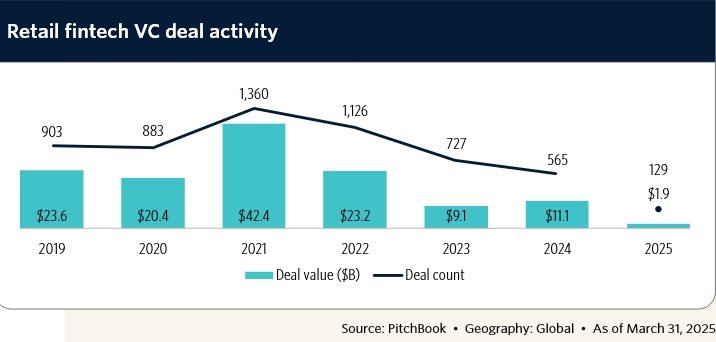
According to PitchBook Retail Fintech VC Trends, global retail fintech funding volumes reached $1.9 billion in Q1 2025, representing a 37.8% drop from Q4 2024 despite rising interest in platform-first strategies and growing AI adoption.
Although venture growth deals were the exception with median deal sizes jumping 67% to $47 million, making up 53.7% of total VC value. Klarna’s $12 billion valuation and Addi’s $170 million growth round stand out. IPO prospects for Klarna and eToro postponed listings due to market volatility ala Trump-effect.
Early stage retail fintech including median pre-seed and seed valuations fell by 50% and declined in size and count.
CCG Catalyst’s May 1 2025 snapshot of retail digital banking platforms features fintech companies are gaining traction because they stack cloud-native scale, AI tools, and modular architecture:
| U.S. Platform | Why Investors Are Interested |
| Backbase | Microservices, API-first architecture, and enterprise flexibility |
| Narmi | Open API stack and fast onboarding (under 3 minutes) |
| Lumin Digital | AI-native with strong mobile UX, cloud-native since day one |
| SoFi/Cyberbank | End-to-end infrastructure with embedded finance support |
| Temenos Infinity | Low-code platform enabling rapid interface development |
Canada’s fintech ecosystem has several growing players with potential to evolve into full service modular banking platforms or infrastructure providers:
| Canadian Company | Comparable U.S. Platform | Strategic Direction |
| Wealthsimple | SoFi | Expanding beyond investing into cash accounts, cards, and tax tools |
| Koho | Narmi | Prepaid card and banking-like functionality with open APIs |
| Neo Financial | Lumin Digital | Mobile-first, rewards-driven model with merchant integration |
| EQ Bank | Backbase | Hybrid of legacy and digital bank offering API access and high-interest accounts |
| Tandem or Brim | Apiture or Temenos | Fintechs with credit and loyalty platforms, potential to grow through partnerships |
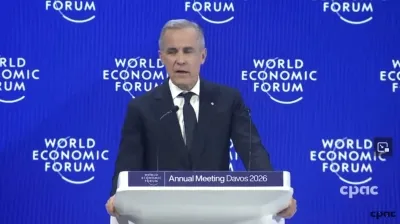
Canadian fintech is still limited by federal regulatory complexities but opportunities are increasing as consumers move away from branch-based banking, the need for increased competition amidst Trump's economic pressures, and newly elected Prime Minister Mark Carney vowing to protect Canada.
According to the Canadian Bankers Association's 2024 report, 70% of Canadians used a mobile banking app in the last year (on average 7.4 times per month), up from 65% in 2021.
VC interest in Canadian fintech remained strong in 2024, despite a global slowdown. Fintechs with platform enabling capabilities such as embedded finance, banking-as-a-service, and open API designs continue to attract interest. Plus, the rise of U.S. plug-and-play models is a playbook for homegrown infrastructure players to serve Tier 2 banks, credit unions, and niche verticals like gig economy banking.
Digital banking platforms at the forefront are meeting customer expectations and improving operational efficiency with a few key technologies:
Digital retail banking platforms are using AI, APIs, and modular designs to deliver flexible, intelligent, and ready to scale solutions. Canadian fintechs that embrace open architecture and build for partnerships can lead not just here in Canada, but globally.
 The National Crowdfunding & Fintech Association (NCFA Canada) is a financial innovation ecosystem that provides education, market intelligence, industry stewardship, networking and funding opportunities and services to thousands of community members and works closely with industry, government, partners and affiliates to create a vibrant and innovative fintech and funding industry in Canada. Decentralized and distributed, NCFA is engaged with global stakeholders and helps incubate projects and investment in fintech, alternative finance, crowdfunding, peer-to-peer finance, payments, digital assets and tokens, artificial intelligence, blockchain, cryptocurrency, regtech, and insurtech sectors. Join Canada's Fintech & Funding Community today FREE! Or become a contributing member and get perks. For more information, please visit: www.ncfacanada.org
 |  |  |
|---|---|---|
 |  |  |



August 26th, 2025

January 4th, 2024

June 1st, 2021

September 9th, 2020

July 9th, 2018

January 3rd, 2018

September 25th, 2017

June 20th, 2017

May 10th, 2017

December 14th, 2016

Leave a Reply