





Karsten Wenzlaff, Advisor
August 26th, 2025
Karsten Wenzlaff is a Crowdfunding and Fintech Expert from Germany. He is Secretary-General of Digit[...]


Report | May 20, 2025
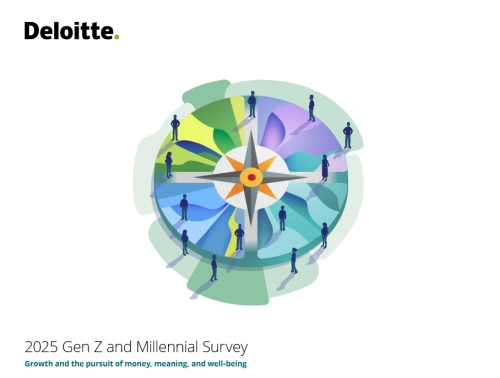
Image: Deloitte 2025 Gen Z and Millennial Survey
The 14th edition of the annual 2025 Deloitte Global Gen Z and Millennial Survey provides a global snapshot of generational attitudes towards work, money, technology and values, offering fintech founders, banks, credit unions, and policymakers core insights into what's driving the new economy and markets.
By 2030, Gen Z and millennials will represent nearly 75% of the global workforce. These generations are not just using financial technologies. They are building it, and reverse engineering what problems they should solve while establishing new expectations for how financial service tools operate.
The self-administered online survey data was collected from October 25 and December 24, 2024, gathering responses from a total of 23,482 respondents including 14,751 Gen Zs (born 1995 - 2006) and 8,731 millennials (born 1983 - 1994) across 44 countries, including regions such as North America, Latin America, Western Europe, Eastern Europe, the Middle East, Africa, and Asia-Pacific.
Young workers are very anxious about money.
- 48% of Gen Zs and 46% of millennials say they do not feel financially secure
- 52% of both groups live paycheck to paycheck, and over 33% struggle with basic monthly expenses
- 41% of Gen Zs and 44% of millennials are unsure whether they’ll be able to retire with financial comfort
These data points highlight the need for fintech products go well beyond basic budgeting dashboards. Gen Z and millennials need fintech tools to help them achieve financial resilience, such as income stabilization or smoothing, flexible savings tools, automated rent/bill buffers, and fair access to emergency funds. Financial service providers that can help reduce voltaility, and not just optimize credit scores, have an opportunity to earn trust and loyalty.
Adoption of generative AI tools is already a daily routine for young professionals.
- 57% of Gen Zs and 56% of millennials use GenAI tools in their daily work
- About 30% of each group use AI most or all of the time
- 74% of Gen Zs and 77% of millennials believe AI will significantly change how they work within the next year
These users are engaging with and building fintech products through an AI-first lens. They expect tools to respond in natural language, deliver almost instant relevant insights without friction, and adapt quickly. Static interfaces and dated workflows will lose ground quickly.
Fintech platforms in particular need to integrate GenAI not just in the back-end system but into product design and customer experience because these cohorts are fluent in AI which is quickly becoming the standard in how they source, think and consume.
Gen Z and millennials care less about climbing corporate ladders and more about doing work that aligns with their values.
- Only 6% of Gen Zs say their main career goal is to reach a leadership role
- 44% of Gen Zs and 45% of millennials have left jobs that lacked purpose
- 41% of Gen Zs and 40% of millennials have rejected employers due to ethical or values misalignment
For fintech employers, this creates both risk and opportunity. A strong mission with aligned values can attract high performers but the opposite will scare talent away quickly. To attract and retain the next generation of fintech talent, companies must offer more than good compensation. They need clear values, meaningful impact, and room for personal growth.
Formal degrees are no longer the default path into the fintech sector.
- 31% of Gen Zs and 32% of millennials chose not to pursue higher education.
- 70% of Gen Zs and 59% of millennials are building career skills at least once a week.
- The majority are doing this on their own time, outside of work hours.
There's more acceptance and shift now towards non-traditional education from bootcamps and peer networks to self-teaching, which has huge implications for hiring, funding, and human capital development. This means founders, operators and technical resources, may not originate from familiar backgrounds. Fintech leaders and investors need to adapt recruitment and due diligence models to focus more on traction, experience, and skills - and not just degrees.
Environmental and ethical values are a key part of how decisions are made.
- 65% of Gen Zs and 63% of millennials say they are willing to pay more for environmentally sustainable services
- 23% of Gen Zs and 22% of millennials have researched a company’s environmental practices before accepting a job offer
- Almost 50% say they’ve left or declined work that didn’t match their personal ethics
Social and environmental alignment is becoming a core user expectation, not a brand differentiator. Fintechs must design for transparency and shared impact from day one.
Fintech companies and financial institutions must design and deliver intelligent products with purpose and transparency that meet the moment of Gen Z and millennials who are under financial stress, fluent in AI, and prioritize values and ethics. The opportunity is to not just help these generations but to earn their trust and grow with them to create the next iteration of smart, modern, and purposeful finance.
 The National Crowdfunding & Fintech Association (NCFA Canada) is a financial innovation ecosystem that provides education, market intelligence, industry stewardship, networking and funding opportunities and services to thousands of community members and works closely with industry, government, partners and affiliates to create a vibrant and innovative fintech and funding industry in Canada. Decentralized and distributed, NCFA is engaged with global stakeholders and helps incubate projects and investment in fintech, alternative finance, crowdfunding, peer-to-peer finance, payments, digital assets and tokens, artificial intelligence, blockchain, cryptocurrency, regtech, and insurtech sectors. Join Canada's Fintech & Funding Community today FREE! Or become a contributing member and get perks. For more information, please visit: www.ncfacanada.org
 |  |  |
|---|---|---|
 |  |  |



August 26th, 2025

January 4th, 2024

June 1st, 2021

September 9th, 2020

July 9th, 2018

January 3rd, 2018

September 25th, 2017

June 20th, 2017

May 10th, 2017

December 14th, 2016

Leave a Reply