





Karsten Wenzlaff, Advisor
August 26th, 2025
Karsten Wenzlaff is a Crowdfunding and Fintech Expert from Germany. He is Secretary-General of Digit[...]


Crypto Mining | Dec 1, 2025
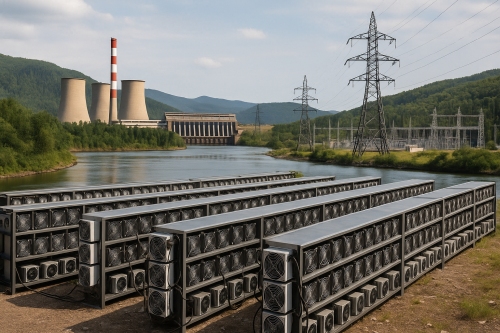
AI generated image
On November 28 2025, the Financial Post reported that the Newfoundland and Labrador Court of Appeal issued a ruling involving Blockchain Labrador Corporation (BLC) that confirmed NL Hydro can limit firm electricity service for new crypto mining operations.
BLC originally applied for 20 megawatts of guaranteed power service for a site in Wabush but NL Hydro declined to commit to that level because it needed to protect capacity for industrial, household and export priorities. Instead, NL Hydro will supply 7.75 megawatts to the company on an interim basis.
The ruling outcome confirms that NL Hydro has set boundaries on clean electricity when new digital workloads (ie. crypto mining, AI processing) add pressure to a constrained system.
Canada was once a notable player in global Bitcoin mining with national activity reaching close to 10% of global hashrate in 2021 but it's participation has since declined. Hashrate Index estimated that Canada held about 4% to 5% of global hashrate in their 2023 Canadian mining review, and then in a recent Q4 2025 global hashrate heatmap update benchmarked the country near 2.9%.
Canada's reduced footprint reflects a sector now concentrated in a few established companies. This smaller group of operators (see below and note, not exhaustive) also gives provinces more room to manage clean electricity across many competing needs.
Several provinces with hydro based systems have taken steps to manage electricity access for mining and other high demand digital activities.
British Columbia's clean electricity announcement enabled restrictions on new mining connections. The province later confirmed a permanent limit in the 2025 energy release, and the Court of Appeal supported provincial authority to set these boundaries in the Conifex ruling summary.
Manitoba adopted a pause on new mining activity when the utility raised concerns about the scale of new load requests. The province issued this direction in the 2022 guidance on electricity connections and extended the pause through 2026 in the 2024 directive on cryptocurrency operations.
New Brunswick took a more restrictive position. The provincial Electricity Act prevents a distribution utility from extending electricity to a new crypto mining business, which appears in the current consolidation of the Act and adopted through Bill 10.
Quebec continues to serve existing projects but limits new load and uses a dedicated rate class for this sector. A review commissioned by Hydro Québec found that mining produces fewer jobs for each megawatt consumed compared to data centres and industrial users, which encouraged ongoing limits.
Alberta remains an outlier, operating a deregulated, competitive market for electricity that allows mining companies and compute operators to negotiate directly for supply, supported by broader generation options.
Global research from the Cambridge Centre for Alternative Finance (CCAF) offers insight into energy use for digital mining. Cambridge estimates that Bitcoin mining draws about one hundred thirty eight terawatt hours of electricity per year, as described in CCAF's update on sustainable energy use and detailed further in a Cambridge digital mining report.
The research shows that more than half of global mining electricity comes from sustainable sources such as hydropower, wind and nuclear.
Low cost clean electricity attracts miners, data centres, industrial electrification and long term export contracts. Provinces build policies that protect available capacity for the users that advance their long term economic priorities.
Crypto mining can contribute value when it aligns with provincial priorities but utilities now apply stronger criteria when making decisions about supplying consistent clean energy.
The ruling involving Blockchain Labrador Corporation is an example of how a province evaluates new digital load against industrial development, household reliability and export duties. Informative for any Canadian fintech leaders following the developments in digital finance, compute infrastructure and national (global) ambitions for clean energy growth.
 The National Crowdfunding & Fintech Association (NCFA Canada) is a financial innovation ecosystem that provides education, market intelligence, industry stewardship, networking and funding opportunities and services to thousands of community members and works closely with industry, government, partners and affiliates to create a vibrant and innovative fintech and funding industry in Canada. Decentralized and distributed, NCFA is engaged with global stakeholders and helps incubate projects and investment in fintech, alternative finance, crowdfunding, peer-to-peer finance, payments, digital assets and tokens, artificial intelligence, blockchain, cryptocurrency, regtech, and insurtech sectors. Join Canada's Fintech & Funding Community today FREE! Or become a contributing member and get perks. For more information, please visit: www.ncfacanada.org
 |  |  |
|---|---|---|
 |  |  |



August 26th, 2025

January 4th, 2024

June 1st, 2021

September 9th, 2020

July 9th, 2018

January 3rd, 2018

September 25th, 2017

June 20th, 2017

May 10th, 2017

December 14th, 2016

Leave a Reply