




Karsten Wenzlaff, Advisor
August 26th, 2025
Karsten Wenzlaff is a Crowdfunding and Fintech Expert from Germany. He is Secretary-General of Digit[...]


Feb 10, 2026 | NCFA Fintech Market Activity | Alternative Finance and Capital Markets
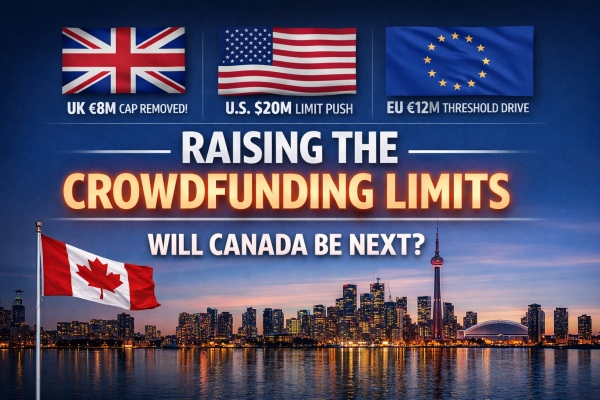
On February 10 2026, UK POP rules go live, removing the old prospectus trigger that made large public raises expensive, slow, and out of reach for many private companies.
For years, UK companies faced a hard line. If a business raised more than €8 million in securities from the public in a year, it had to produce a full prospectus (NB: the UK retained that euro-denominated threshold in its domestic framework post-brexit). Crowdcube says that prospectus costs could cost more than £250,000 and take months, which pushed many companies away from public community rounds even when demand existed.
Under the Public Offer Platform regime, raises above £5 million now run through a regulated POP, and the regime removes the upper fundraising cap for those offers (No more funding caps). Raises under £5 million remain outside the POP requirement, but regulated execution and investor protection expectations still apply.
Platforms now carry more responsibility for diligence, disclosure quality, and investor safeguards. That shifts the burden from a giant issuer document to a supervised platform process that can move faster.
The UK is not alone. In the United States, Crowdfund Capital Advisors submitted a $20M Reg CF petition asking the SEC to raise the Regulation Crowdfunding cap from $5M to $20M. In Europe, the European Digital Finance Association are pushing to increase the ECSP threshold from €5m to €12m.
After years of advocating, Canada finally harmonized nationally its startup-crowdfunding exemption in 2021, but regulators have kept the issuer cap conservative. Under National Instrument 45 110, eligible issuers can raise up to $1.5m in a 12 month period, which a growing company can quickly outgrow and end up soon looking for more funding via heavier paths for larger rounds. If the government wants to prioritize funding scape-ups, they should take another look at increasing equity crowdfunding caps in Canada to be in line with global peers.
This funding cap tension isn't new. In fact NCFA has been advocating for the OSC and CSA to raise issuer funding caps for years. In 2017 for example, NCFA petitioned to raise caps to modernize equity crowdfunding in Ontario. In 2019, $5m cap formed part of NCFA's recommendations to reduce regulatory burden and unlock growth capital. Again in 2020, during national harmonization discussions, NCFA advocated to modernize NI 45 110 including increasing caps to $5 million so the framework could match real funding needs in a digital economy.
Now with the UK FCA removing prospectus triggers and the US and EU push for higher caps, there may be a new policy window for Canada's equity crowdfunding participants to petition yet again. If other jurisdictions support $10m to $20m community rounds under platform oversight, Canada needs to decide whether it wants founders scaling here or structuring growth capital elsewhere.
A higher ceiling, including a path toward $5m and beyond, would better match growth stage reality while keeping platform level investor protection front and centre. The global direction of travel now strengthens the case for a renewed Canadian push grounded in data, experience, and competitiveness.
If regulated platforms can run larger public offers without a prospectus wall in the UK, what should Canada do next, raise the ceiling, create a platform lane for larger rounds, or keep the cap and accept that growth capital routes around Canada?
One practical takeaway stands out. POP style rules treat the platform as the compliance spine, not the issuer. That design can cut cost and time while still demanding clear disclosures, suitability controls, and due diligence at the point of sale. While Canada doesn't necessarily need to copy the UK, it does need a credible path for larger community rounds that doesn't force founders into a prospectus sized bill before they have the scale to absorb it.
 The National Crowdfunding & Fintech Association (NCFA Canada) is a financial innovation ecosystem that provides education, market intelligence, industry stewardship, networking and funding opportunities and services to thousands of community members and works closely with industry, government, partners and affiliates to create a vibrant and innovative fintech and funding industry in Canada. Decentralized and distributed, NCFA is engaged with global stakeholders and helps incubate projects and investment in fintech, alternative finance, crowdfunding, peer to peer finance, payments, digital assets and tokens, artificial intelligence, blockchain, cryptocurrency, regtech, and insurtech sectors. Join Canada's Fintech & Funding Community today FREE! Or become a contributing member and get perks. For more information, please visit: www.ncfacanada.org
 |  |  |
|---|---|---|
 |  |  |



August 26th, 2025

January 4th, 2024

June 1st, 2021

September 9th, 2020

July 9th, 2018

January 3rd, 2018

September 25th, 2017

June 20th, 2017

May 10th, 2017

December 14th, 2016

Leave a Reply