





Karsten Wenzlaff, Advisor
August 26th, 2025
Karsten Wenzlaff is a Crowdfunding and Fintech Expert from Germany. He is Secretary-General of Digit[...]


Apr 3, 2026 | NCFA Fintech Market Insight | Digital Assets Blockchain And Tokenization
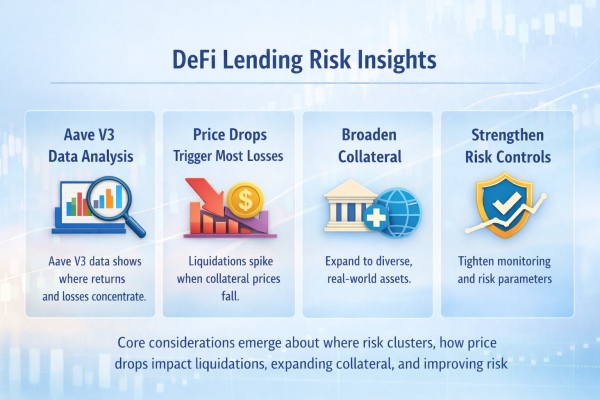
On April 2, 2026, a DeFi lending risk analysis using Aave V3 data from the Bank of Canada analyzes transaction data on Ethereum to find a market that works operationally, but depends on narrow revenue pools, heavy overcollateralization, and fast liquidation when collateral prices fall.
The paper focuses on Aave V3 because it is the largest decentralized lending protocol by total value locked. It cites about $34 billion secured in smart contracts, roughly 25% of all DeFi TVL and about 50% of lending sector TVL. The data analyzed runs from January 27, 2023 to May 6, 2025, which gives the study enough depth to study how the model behaves in live market conditions and not just theory.
The earnings base is much narrower than the deposit base. On Aave V3, WETH, USDT, and USDC generate nearly 83% of total protocol earning in the sample. That doesn't mean the same pattern holds across the entire DeFi lending market, but it does show the largest lending protocol still relies heavily on a small set of assets to produce revenue.
Supply alone does not tell you much. Utilization does. A token can hold a large share of deposits and still contribute very little if borrowing demand stays weak. So careful about judging a lending model by total deposits alone. Look at it by which assets actually generate borrow demand, spread income, and recurring usage.
The comparison with banking makes the constraint clearer. In 2024, Aave V3 posts an estimated 0.64% net interest margin, versus 2.48% for major US banks and 1.69% for major Canadian banks.
Aave V3 also shows a 40.0% loan to deposit ratio, compared with 61.2% for major US banks and 74.2% for major Canadian banks. The model runs with lower overhead, but it also runs with tighter economics and lower capital efficiency.
Repeated borrowing and redepositing of the same collateral accounts for about 20.46% of total borrowed volume and 8.20% of borrowing transactions on Aave V3.
Only about 2% of active users engage in this behaviour, but that small group borrows more often, takes larger positions, uses more flash loans, and runs closer to liquidation.
Risk isn't evenly spread across the user base, but with a relatively small group of sophisticated users who amplify exposure through repeated borrow and redeposit loops. A protocol can look healthy at the aggregate level while vulnerability builds inside a small cluster of accounts.
The largest liquidation wave in the sample reached about $258 million, and the top ten waves account for roughly 80% of total liquidated volume.
WETH, wstETH, WBTC, and weETH account for about 90% of total liquidated value. Collateral diversity on paper is not the same as resilience in practice. When account stress rises, losses still cluster around a small set of core assets.
For all liquidated users, 84.40% of health factor deterioration comes from collateral price declines. For the largest borrowers, that rises to 97.28%. Interest rate changes play only a minor role in the hour before liquidation. So do borrower actions like repaying, withdrawing, borrowing, or supplying more assets.
Immediate risk is mostly market driven. If collateral drops hard enough, the position breaks. Everything else is secondary.
Liquidation fees range from about 5% to 10% of liquidated value. When missed upside from post liquidation price recovery is added, combined borrower losses can reach roughly 10% to 30%.
Automation protects lenders and preserves solvency, but it forces borrowers out at the worst possible time. That raises a harder design question. How do you reduce forced exits before volatility does the damage?
The authors highlight tokenized real world assets as a way to broaden the collateral base and improve stability. They point to decentralized identity frameworks to support better underwriting.
They also raise the question of prudential tools such as leverage limits, capital requirements, or liquidity thresholds.
Concentration risk in DeFi isn't just exposure to a single token. It's dependence on a narrow collateral base, a narrow earnings base, and a narrow set of highly leveraged users. Broader collateral, stronger underwriting signals, and tighter limits can each address a different part of that problem.
Focus on where revenue actually comes from. If earnings depend on a small number of assets, growth is more fragile than it looks.
Track who drives leverage, not just how many users exist. A small group can shape downside risk.
Improve collateral quality, not just collateral variety. Adding assets does not reduce risk if stress still runs through the same core tokens.
Build liquidation buffers into the product. Earlier warnings, better position visibility, and automated risk controls can reduce forced selling.
The strategic takeaway is DeFi lending demand isn't the issue, but rather risk concentration is. The platforms that stand out will spread exposure across better collateral, reduce reliance on highly leveraged users, and design systems that hold up when prices drop. That's how the model can mature from access to durable growth.
 The National Crowdfunding & Fintech Association (NCFA Canada) is a financial innovation ecosystem that provides education, market intelligence, industry stewardship, networking and funding opportunities and services to thousands of community members and works closely with industry, government, partners and affiliates to create a vibrant and innovative fintech and funding industry in Canada. Decentralized and distributed, NCFA is engaged with global stakeholders and helps incubate projects and investment in fintech, alternative finance, crowdfunding, peer-to-peer finance, payments, digital assets and tokens, artificial intelligence, blockchain, cryptocurrency, regtech, and insurtech sectors. Join Canada's Fintech & Funding Community today FREE! Or become a contributing member and get perks. For more information, please visit: www.ncfacanada.org
 |  |  |
|---|---|---|
 |  |  |



August 26th, 2025

January 4th, 2024

June 1st, 2021

September 9th, 2020

July 9th, 2018

January 3rd, 2018

September 25th, 2017

June 20th, 2017

May 10th, 2017

December 14th, 2016

Leave a Reply