




Karsten Wenzlaff, Advisor
August 26th, 2025
Karsten Wenzlaff is a Crowdfunding and Fintech Expert from Germany. He is Secretary-General of Digit[...]


Jul 16, 2026 | NCFA Resource | Digital Assets, Capital Markets And Market Infrastructure
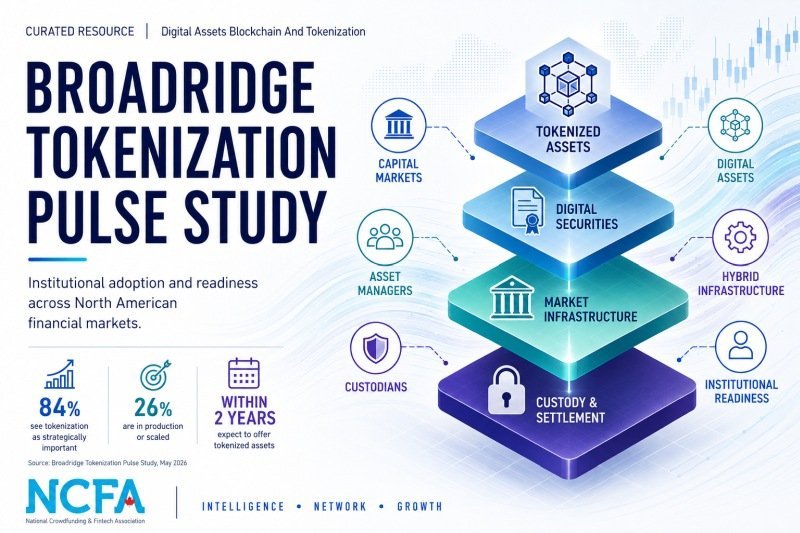
On July 16, 2026, Broadridge released its Tokenization Pulse Study, a survey of 200 senior financial services decision makers in Canada and the United States. The report examines adoption, investment, operating models, asset class priorities, and the practical barriers institutions face as tokenized assets enter production.
The findings show strong institutional interest with a wide gap between strategy and execution. While 84% of respondents consider tokenization strategically important, only 26% report being in production or operating at scale.
The study covers capital markets firms, asset managers, wealth managers, and digital asset firms. It compares their current activity, planned investment, expected adoption timelines, preferred infrastructure models, and reasons for pursuing tokenization.
Capital markets firms are furthest ahead, with 44% reporting production or scaled operations. That compares with 20% of asset managers and 9% of wealth managers. Nearly two thirds of all respondents expect to be ready to offer tokenized assets within two years.
The expected operating model is mainly hybrid. 92% believe traditional and digital assets will coexist for an extended period, while 69% plan to adapt existing infrastructure instead of building separate systems. This supports the view that tokenized financial infrastructure will need to connect with established market processes, governance, custody, distribution, and recordkeeping.
Asset classes are also developing at different rates. 80% expect tokenized mutual funds and money market funds to play a meaningful role within five years. Expectations for equities and private companies are closer to half of respondents.
This resource is useful for banks, custodians, dealers, exchanges, asset managers, wealth firms, market infrastructure providers, digital asset companies, investors, regulators, and technology teams.
It’s especially useful for organizations deciding whether to build, partner, integrate, or continue monitoring the market. The sector comparisons help readers judge how their own plans compare with North American institutions.
Strategy teams can use the report to compare stated priorities with actual production. The 84% strategic importance figure looks very different beside the 26% production rate. That gap helps identify where budgets, operating capacity, governance, and commercial demand still need work.
Product and infrastructure teams can use the asset class timelines to decide where near term demand is more credible. Mutual funds, money markets, and capital markets infrastructure currently show stronger institutional expectations than equities, private companies, or wealth distribution.
Canadian firms can also compare the findings with Canada’s stablecoin regulatory framework, securities regulation, custody requirements, and domestic market infrastructure. The survey includes Canadian respondents, but it doesn’t publish a separate Canadian data set.
The study’s main strength is its operating detail. It separates strategic interest from production, compares financial sectors, identifies preferred infrastructure models, and ranks regulatory, operational, commercial, budget, security, and organizational barriers.
Regulatory uncertainty was the most cited barrier at 33%. Operational complexity was especially important for capital markets firms, asset managers, and institutions managing more than US$250 billion. The results show that institutional interest alone isn’t enough. Firms still need workable governance, standards, controls, distribution, and a business case.
The study is commissioned by Broadridge, which provides tokenization infrastructure and related services. Readers should consider that commercial context when interpreting its conclusions. The sample is also limited to 200 North American decision makers, and the report does not provide country level results or independently test projected adoption timelines.
Broadridge Tokenization Pulse Survey Release (study findings and methodology)
Tokenization Starts Looking Like Financial Infrastructure (institutional market context)
Canada’s Stablecoin Regulatory Framework (Canadian regulatory context)
UK FCA Final Cryptoasset Rules (international regulatory comparison)
 The National Crowdfunding & Fintech Association (NCFA Canada) is a financial innovation ecosystem that provides education, market intelligence, industry stewardship, networking and funding opportunities and services to thousands of community members and works closely with industry, government, partners and affiliates to create a vibrant and innovative fintech and funding industry in Canada. Decentralized and distributed, NCFA is engaged with global stakeholders and helps incubate projects and investment in fintech, alternative finance, crowdfunding, peer-to-peer finance, payments, digital assets and tokens, artificial intelligence, blockchain, cryptocurrency, regtech, and insurtech sectors. Join Canada's Fintech & Funding Community today FREE! Or become a contributing member and get perks. For more information, please visit: www.ncfacanada.org
 |  |  |
|---|---|---|
 |  |  |
```



August 26th, 2025

January 4th, 2024

June 1st, 2021

September 9th, 2020

July 9th, 2018

January 3rd, 2018

September 25th, 2017

June 20th, 2017

May 10th, 2017

December 14th, 2016

Leave a Reply