




Karsten Wenzlaff, Advisor
August 26th, 2025
Karsten Wenzlaff is a Crowdfunding and Fintech Expert from Germany. He is Secretary-General of Digit[...]


Payments Regulation | Sep 8, 2025
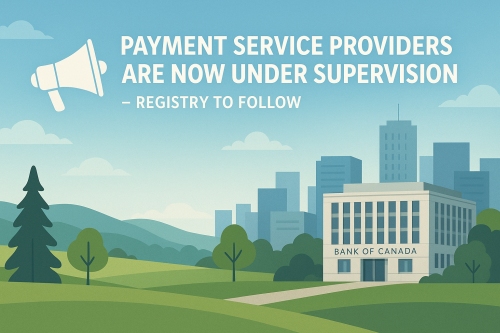
Today, September 8 2025 the Bank of Canada begins supervising payment service providers (PSPs) under the Retail Payment Activities Act (RPAA). It's the official start of Canada’s new oversight regime for retail payments. According to the Bank of Canada close to 1500 PSPs have applied for registration and those on the Applicant list are now legally required to comply with RPAA obligations.
Applicant PSPs must keep information current on PSP Connect and respond promptly to information requests from the Bank. These reporting duties now carry legal weight. The Bank has confirmed that it has the authority to deploy enforcement tools where necessary to ensure compliance and maintain the stability of Canada’s retail payments system.
The Bank will also update the Registry of PSPs on a rolling basis. This depends on the Department of Finance completing national security screenings and providing cleared names to the Bank. For applicants this means Registry inclusion will be phased over time rather than immediate.
The Bank also raised the ongoing tax issue linked to trust arrangements in a separate Letter to Industry. Some PSPs that keep interest earned on customer funds could face extra tax steps, like having to issue tax slips to customers. The Bank said it understands that PSPs may not yet be able to fully meet trust rules because of this and will accept proof that they are taking reasonable steps in the meantime.
The Bank also confirmed that PSPs will be charged supervision fees once the cost recovery rules are finalized. This will add another compliance cost when it comes into effect.
For fintech and payment firms in Canada the start of RPAA supervision is a major step. Compliance and reporting are now legal requirements and the Bank has the power to enforce them.
The phased Registry rollout highlights the national security checks that must be completed, while the temporary relief on the trust tax issue shows regulators are trying to be practical during the transition.
 The National Crowdfunding & Fintech Association (NCFA Canada) is a financial innovation ecosystem that provides education, market intelligence, industry stewardship, networking and funding opportunities and services to thousands of community members and works closely with industry, government, partners and affiliates to create a vibrant and innovative fintech and funding industry in Canada. Decentralized and distributed, NCFA is engaged with global stakeholders and helps incubate projects and investment in fintech, alternative finance, crowdfunding, peer-to-peer finance, payments, digital assets and tokens, artificial intelligence, blockchain, cryptocurrency, regtech, and insurtech sectors. Join Canada's Fintech & Funding Community today FREE! Or become a contributing member and get perks. For more information, please visit: www.ncfacanada.org
 |  |  |
|---|---|---|
 |  |  |
AI Jobs | Sep 5, 2025

Image: Freepik/Rawpixel.com
On September 4, 2025, Fidji Simo, CEO of Applications at OpenAI announced in a post called, "'Expanding economic opportunity with AI", that it is building an employment platform for AI jobs, designed to connect workers with companies more effectively than traditional hiring tools. It will use AI to match qualified candidates to employers, putting OpenAI in direct competition with Microsoft’s LinkedIn who are the dominant player in online professional networking.
To build trust between workers and employers, OpenAI is expanding its Academy to offer AI fluency certifications. These certifications will range from basic workplace AI use to advanced skills such as prompt engineering.
Training will take place within ChatGPT’s Study mode, which acts like an interactive tutor by asking questions, giving hints, and offering feedback. This training approach is designed to move beyond traditional 'click through' training methods towards real skill-building.
OpenAI’s Academy has already attracted more than two million users and has committed to certifying 10 million Americans by 2030. Launch partners include Walmart, John Deere, Boston Consulting Group, Accenture, Indeed, and several regional organizations such as the Bay Area Council and the Delaware governor’s office.
John Furner, U.S. CEO Walmart explained the company’s involvement:
“By bringing AI training directly to our associates, we’re putting the most powerful technology of our time in their hands—giving them the skills to rewrite the playbook and shape the future of retail.”
The combination of certification and hiring makes OpenAI’s model different from LinkedIn. Employers can recruit with more confidence, knowing that candidates have been assessed for AI fluency. For workers, certifications can translate into higher earning power; a recent Lightcast analysis shows that job postings requiring AI skills offer 28% higher salaries, about $18,000 more annually, compared to those that don’t.
The initiative also fits into wide scale efforts in the U.S. to expand AI literacy. OpenAI is working with the White House Task Force on Artificial Intelligence Education, part of a policy push to prepare workers for the AI economy.
The initiative also aligns with recent U.S. policy. In April 2025, the White House established the Task Force on Artificial Intelligence Education through an executive order, and also see Melania Trump's briefing on September 4 for more context.
OpenAI’s strategy combines upskilling and hiring into one ecosystem, changing how companies can screen and recruit talent. For Canada, the development raises important questions. Will Canadian workers have access to comparable certification programs? Should governments and fintechs create partnerships to ensure the workforce remains competitive? With the U.S. moving quickly to integrate AI literacy at scale, Canada will need to act decisively to avoid falling behind.
The National Crowdfunding & Fintech Association (NCFA Canada) is a financial innovation ecosystem that provides education, market intelligence, industry stewardship, networking and funding opportunities and services to thousands of community members and works closely with industry, government, partners and affiliates to create a vibrant and innovative fintech and funding industry in Canada. Decentralized and distributed, NCFA is engaged with global stakeholders and helps incubate projects and investment in fintech, alternative finance, crowdfunding, peer-to-peer finance, payments, digital assets and tokens, artificial intelligence, blockchain, cryptocurrency, regtech, and insurtech sectors. Join Canada's Fintech & Funding Community today FREE! Or become a contributing member and get perks. For more information, please visit: www.ncfacanada.org
| | |
|---|---|---|
| | |
Competition | Sep 4, 2025

The most consequential U.S. antitrust case in decades ended without a breakup. On September 2, 2025, Judge Amit Mehta ruled that Google had illegally monopolized search and search advertising markets but rejected the Justice Department’s request to spin off Chrome and Android.
Instead, the $2 trillion company was hit with six years of penalties that ban exclusive defaults, limit contract duration, and require targeted data access for rivals. As CBS news reports, Mehta emphasized the need to “gaze into a crystal ball and look to the future,” saying that conduct, not structure, was the appropriate focus this time.
Evidence showed Google spent more than $26.3 billion in 2021 to lock in default placement on devices and browsers, giving it nearly 90% market share in search. The Justice Department’s remedies announcement emphasized that the following penalties were designed to create a fairer pathway for new entrants into the market.
Judge Mehta penalized this practice by prohibiting contracts that grant exclusivity for Google Search, Chrome, Assistant, or Gemini. Also, revenue share agreements are capped at one year to prevent long term lock-in. These penalties are aimed at restricting contractual strategies that cemented Google’s dominance while still allowing manufacturers and carriers to include Google in non-exclusive deals alongside competitors.
He explained that courts must approach remedies with humility, given the fast pace of AI development, but that limits are necessary to prevent Google from transferring its search dominance into the AI sector. The Reuters summary of the decision confirmed that generative AI competition was central to the court’s reasoning.
The judgment also punishes Google for hoarding data and limiting rivals’ ability to scale. Google must now provide qualified competitors with defined portions of its search index and aggregated user data.
In addition, Google is required to offer both search syndication and search-text-ad syndication, making it possible for smaller firms to build comprehensive services and monetize queries.
Alphabet shares jumped more than 7% in the days following the decision, adding over $200 billion in market value. Apple’s stock also climbed because its profitable arrangement to feature Google as Safari’s default search engine remains intact, though it is no longer exclusive. Analysts described the outcome as pragmatic, combining enforcement with continuity.
As reported by the Guardian, expert reactions show the divide between those who see the penalties as meaningful versus those who view them as insufficient. Antitrust advocates questioned whether limited data access and one year contract caps will significantly weaken Google’s entrenched position.
Attorney General Pamela Bondi praised the decision as an important milestone in protecting consumers.
The September ruling is not the end of Google’s legal troubles. The company faces another remedies trial in Virginia later this year, after a judge found it held an illegal monopoly in ad tech. Perhaps that's one of the motivations behind Google investing $9 billion in cloud and data infrastructure in Virgina.
Additional antitrust cases are in progress against Amazon, Apple, and Nvidia. As analysis of the legal calendar shows, penalties imposed across these cases could redefine how the largest technology companies operate in both the United States and abroad.
Canada’s Competition Bureau is pressing its own case against Google’s advertising technology practices before the Competition Tribunal. Recent changes to the Competition Act expanded private access to the Tribunal and introduced financial remedies, giving publishers, advertisers, and fintech firms stronger tools to pursue claims. The U.S. penalties provide a roadmap for Canadian regulators which may follow as they judge their own enforcement strategies.
Google avoids a disruptive breakup but its ability to rely on exclusivity and hoarded data has been penalized. These changes might gradually lower barriers to entry for startups and create new chances to compete in advertising and AI services.
One of the key lessons for Canada here is that markets dominated by only one or a few players directly impacts the countries competitive balance.
The National Crowdfunding & Fintech Association (NCFA Canada) is a financial innovation ecosystem that provides education, market intelligence, industry stewardship, networking and funding opportunities and services to thousands of community members and works closely with industry, government, partners and affiliates to create a vibrant and innovative fintech and funding industry in Canada. Decentralized and distributed, NCFA is engaged with global stakeholders and helps incubate projects and investment in fintech, alternative finance, crowdfunding, peer-to-peer finance, payments, digital assets and tokens, artificial intelligence, blockchain, cryptocurrency, regtech, and insurtech sectors. Join Canada's Fintech & Funding Community today FREE! Or become a contributing member and get perks. For more information, please visit: www.ncfacanada.org
| | |
|---|---|---|
| | |
Klarna | Sep 3, 2025

Image: Klarna IPO 2025
On Sep 2, 2025, global digital bank and Klarna announced the launch of its initial public offering (IPO) targeting a $14 billion valuation, with shares expected to begin trading on the New York Stock Exchange under the symbol KLAR this week, once the SEC approves its registration. Klarna calls itself a global digital bank and flexible payments provider in its IPO filing, but buy now pay later (BNPL) is still its main business and the focus of regulatory scrutiny.
The company disclosed an offering of 34,311,274 ordinary shares, including 5,555,556 new shares from Klarna and 28,755,718 from selling shareholders. The underwriters have a 30 day option to purchase up to 5,146,691 additional shares. The expected price range is $35 to $37 per share, which would give Klarna a valuation of up to $14 billion if priced at the top end.
The majority of the shares in this deal are being sold by existing shareholders. Klarna itself will only receive proceeds from the 5.6 million new shares it issues, while selling shareholders will capture the remainder. Goldman Sachs, J.P. Morgan, and Morgan Stanley are lead underwriters.
Klarna paused its U.S. IPO in April 2025 citing tariff uncertainty and market volatility, then revived the listing as IPO conditions improved over the summer. The company had also explored a direct listing in 2021 but didn't proceed, later raising funds at a $6.7 billion valuation in 2022.
Klarna has invested directly in Canada, and deepened its roots here by opening a technology hub in Toronto focused on engineering and product development. NCFA reported on this this expansion closely in this article Klarna’s meteoric rise in the Canadian financial ecosystem. In Canada, BNPL activity is beginning to appear on credit reports.
As of June 30, 2025, Klarna reported 111 million active consumers and 790,000 merchants across 26 countries. The United States is its largest market, with 34 million users and over 30,000 merchants.
The Consumer Financial Protection Bureau issued an interpretive rule in May 2024 that classified buy now pay later lenders as credit card providers under Regulation Z, which was meant to extend credit card style protections such as dispute rights and refunds. Under the Trump administration the agency itself has been weakened through layoffs, budget cuts and rollbacks of Biden era protections. In March 2025 the CFPB announced its intent to revoke the rule, and by May 2025 it had stated it would not prioritize enforcement.
For Klarna and its 34 million American users, the 'dormant status' of the BNPL rule lowers compliance costs and regulatory risk at a critical time, as it allows the company to present a clear growth case to public investors. At the same time though, investors in Klarna's IPO should weigh both the short term relief and long term political uncertainty, given that a future administration could revive the proposed BNPL credit card style protections.
Klarna is not alone. Several fintech peers have already gone public this year, offering a snapshot of how investors are valuing the sector. The wave of fintech IPOs are after years of light activity but beyond pent up demand signals that fintech markets are maturing and scaling into evolving financial markets globally. Chime, Circle, and eToro illustrate both successes and setbacks.
| Company | Ticker | IPO Date | IPO Price | Current Price (Sep 3, 2025) | Change |
| Chime Financial | CHYM | Jun 12, 2025 | $27.00 | $24.40 | –9.6% |
| Circle Internet Group | CRCL | Jun 5, 2025 | $31.00 | $119.80 | +286.5% |
| eToro Group | ETOR | May 14, 2025 | $52.00 | $46.63 | –10.3% |
| Klarna | KLAR (pending) | Sep 2025 | $35–$37 | Not yet listed | N/A |
| Figure Technologies | FIGR (pending) | Sep 2025 (planned) | $18–$20 | Not yet listed | N/A |
Klarna’s performance will set another benchmark for how diversified platforms blending BNPL, banking, and payments are valued by public investors.
The National Crowdfunding & Fintech Association (NCFA Canada) is a financial innovation ecosystem that provides education, market intelligence, industry stewardship, networking and funding opportunities and services to thousands of community members and works closely with industry, government, partners and affiliates to create a vibrant and innovative fintech and funding industry in Canada. Decentralized and distributed, NCFA is engaged with global stakeholders and helps incubate projects and investment in fintech, alternative finance, crowdfunding, peer-to-peer finance, payments, digital assets and tokens, artificial intelligence, blockchain, cryptocurrency, regtech, and insurtech sectors. Join Canada's Fintech & Funding Community today FREE! Or become a contributing member and get perks. For more information, please visit: www.ncfacanada.org
| | |
|---|---|---|
| | |
Economy | Sep 2, 2025

Image: Projecting Federal Personnel Expenses (Aug 28, 2025, PBO)
On August 28, 2025, the Office of the Parliamentary Budget Officer published a report titled, 'Projecting Federal Personnel Expenses', projecting that personnel expenses will climb past $76B by 2029/30. While the report does not address productivity directly, rising labour costs combined with low private-sector investment risk deepening Canada’s productivity gap.
Parliamentary Budget Officer (PBO) Yves Giroux projects that total federal personnel spending to increase from $71.1B in 2024/25 to $76.2B by 2029/30. By the end of the period, the average cost per full-time equivalent (FTE) employee will reach $172,000, up from $136,345 in 2023/24. This includes salaries, pensions, overtime, severance, and extended health and disability benefits. Salaries and standard benefits alone account for about $139,000 of the cost per employee.
FTEs are expected to climb to 442,000 by 2029/30, with 87% of the workers with permanent job status (highest since 2015). Personnel costs already represent the largest federal operating expense, creating direct pressure on the government’s commitment to both cap public service employment and deliver a balanced operating budget.
In 2023, Canada’s GDP per hour worked was $74.7 compared with $97.0 in the United States, highlighting the persistent productivity gap. Business R&D spending in Canada is only 1.0% of GDP which is far lower than the 2.6% of GDP invested in the United States. Higher education R&D in Canada accounts for about 0.6% of GDP, but spillover into private sector innovation remains limited.
When media outlets report more job action in Canada is on the horizon, it makes us wonder about the structure of Canada's labour force and it's impact on key metrics like productivity. Canada’s overall unionization rate is 30.4%, far higher than the US (10%) and UK (22%), which is of course highly concentrated in the public sector.
Large strikes, such as the 155,000 worker Public Service Alliance of Canada strike in 2023, spotlight the economic impact of government and quasi-government labour actions. The risk extends beyond the core federal workforce. Many of the most disruptive strikes occur in federally regulated oligopolies such as rail, ports, airlines, telecom, and banking. These sectors are nominally private but face little competition and operate under heavy federal oversight. As a result, labour disputes in these industries have a similar impact to public sector strikes, magnifying service bottlenecks in trade, transportation, and communications. Combined with a large public workforce, the exposure of Canada’s economy to union job action(s) is amplified.
While the PBO report does not attribute rising personnel costs directly to unions, collective bargaining settlements, job actions, and the limited competition in federally regulated industries all add further pressure on expenses and productivity.
Global investors trust Canada's institutions, regulatory framework, and rule of law. These qualities explain why Canada consistently attracts foreign direct investment and maintains one of the world’s top competitiveness rankings despite low productivity.
But stability alone will not carry Canada through the next decade. The global order is shifting toward regions that pair institutional reliability with high productivity and innovation intensity. The United States is pulling ahead with business R&D at 2.6% of GDP and workforce productivity nearly 25% higher than Canada. The European Union is leveraging scale and industrial policy to anchor advanced manufacturing and clean energy. Asian economies are combining strong institutions with aggressive technology investment.
Canada cannot afford to define competitiveness only as political or financial stability. A system that prioritizes protecting incumbents in concentrated industries, expanding public payrolls, and absorbing rising labour costs may sustain trust, but it does not generate growth.
Without a structural shift toward business R&D, more open competition in regulated sectors, and productivity and innovation focused policy, Canada risks being left behind in a global economy where innovation (and not stability alone) determines long term growth and prosperity.
The implications are strong for fintech and financial services. Canada’s federally regulated banking and telecom sectors function as oligopolies, shielding incumbents while limiting space for fintech entrants to scale. High labour costs and frequent disruptions in related regulated industries, such as rail and ports, add to the overall cost base and economic drag.
At the same time, foreign direct investment continues to flow into resource and real estate sectors, while technology and financial innovation receive less priority. Without targeted policy that directs investment into sectors that can significantly boost productivity, Canadian fintechs will remain at a structural disadvantage compared to peers in the US, EU, and Asia.
Canada's competitiveness outlook in the longer term hinges on opening competition in regulated sectors, strengthening private sector R&D, and ensuring that a greater share of FDI flows into innovation rich sectors like financial technology.
The National Crowdfunding & Fintech Association (NCFA Canada) is a financial innovation ecosystem that provides education, market intelligence, industry stewardship, networking and funding opportunities and services to thousands of community members and works closely with industry, government, partners and affiliates to create a vibrant and innovative fintech and funding industry in Canada. Decentralized and distributed, NCFA is engaged with global stakeholders and helps incubate projects and investment in fintech, alternative finance, crowdfunding, peer-to-peer finance, payments, digital assets and tokens, artificial intelligence, blockchain, cryptocurrency, regtech, and insurtech sectors. Join Canada's Fintech & Funding Community today FREE! Or become a contributing member and get perks. For more information, please visit: www.ncfacanada.org
| | |
|---|---|---|
| | |
Aug 29, 2025

The Ripple vs. SEC lawsuit has been one of the most closely watched legal battles in the cryptocurrency industry. After nearly five years of uncertainty, the U.S. Securities and Exchange Commission (SEC) reached a settlement with Ripple Labs in August 2025. Ripple agreed to pay a $125 million fine, ending a prolonged dispute over whether XRP should be classified as a security. For investors, institutions, and regulators alike, this decision marked a turning point for the digital asset.
In the wake of the settlement, XRP surged above $3.30 before stabilizing slightly lower, with trading volumes and institutional interest spiking sharply. With regulatory clarity now in place, the market is assessing whether XRP is poised for sustained growth or if short-term speculation is fueling most of the momentum.
This article explores the post-settlement price action, institutional adoption trends, technical analysis, and the risks investors should keep in mind when considering XRP’s market outlook.
The legal battle began in December 2020 when the SEC accused Ripple Labs of conducting an unregistered securities offering through sales of XRP. Ripple countered that XRP was a digital asset designed for payments, not an investment contract. For years, this uncertainty suppressed investor confidence and limited XRP’s integration into mainstream financial institutions.
On August 8, 2025, the SEC and Ripple reached a final settlement. Ripple agreed to pay a $125 million fine, without admitting or denying wrongdoing. Crucially, the deal provided regulatory clarity: XRP is not classified as a security when traded on secondary markets, removing a major barrier for U.S. exchanges, institutional investors, and payment providers.
This resolution immediately influenced market sentiment, driving a strong rally in XRP and opening the door for broader adoption.
Following the announcement, XRP surged above $3.25, peaking near $3.32 before stabilizing in the $3.14–$3.22 range. Trading volumes spiked more than 200% in 24 hours, surpassing $12 billion. This surge reflects renewed confidence from both retail and institutional investors.
For investors tracking digital assets, monitoring real-time benchmarks such as XRP price USD provides valuable insight into ongoing volatility and market sentiment. The legal clarity appears to have removed a key ceiling that previously capped XRP’s growth potential.
Additionally, derivatives markets saw a 15% increase in open interest, reaching nearly $6 billion. This suggests traders are positioning for further moves, with many anticipating bullish continuation.
One of the most significant outcomes of the settlement is the restoration of institutional confidence in XRP. For years, major U.S. exchanges delisted the token due to regulatory risk. Now, with clarity from the SEC, institutions are showing renewed interest.
Trading firms and liquidity providers have increased exposure, and some payment service providers are considering XRP as a cross-border settlement tool once again. This institutional momentum mirrors broader trends in the crypto market, where regulatory clarity often leads to higher participation. For context, comparing digital benchmarks such as Bitcoin price USD against XRP can provide perspective on how investors weigh opportunities between established leaders and high-upside altcoins.
Financial institutions are particularly interested in XRP’s utility as a bridge currency for remittances and international payments. With legal uncertainty resolved, the token could see renewed integration into enterprise-level payment solutions.
From a technical standpoint, XRP faces a critical resistance zone near $3.35. Analysts argue that if the token can establish this level as new support, the next upside target could reach between $4 and $5. Several market strategists point to bullish fractal patterns reminiscent of XRP’s rally during the 2017 bull market, which saw exponential gains.
Some analysts even project medium-term targets of $8, with long-term possibilities of $10 or more, provided XRP maintains strong momentum and adoption growth. These forecasts, however, remain speculative and depend on broader crypto market conditions, including Bitcoin’s trajectory and macroeconomic factors such as interest rates and regulatory policies.
Key technical indicators to watch include:
Several factors are contributing to XRP’s momentum:
With the SEC settlement finalized, U.S. exchanges can now list XRP without fear of litigation. This regulatory green light has major implications for liquidity and adoption.
Data shows a sharp increase in institutional trading volume, with open interest in derivatives markets climbing steadily. This suggests long-term players are taking positions rather than short-term speculation alone.
XRP’s rally is occurring in a context where Bitcoin and Ethereum continue to dominate the sector. If Bitcoin remains strong, it often sets the tone for altcoin performance, providing XRP with a favorable environment.
Unlike many altcoins driven purely by speculation, XRP has practical use cases in cross-border payments and settlement. This differentiates it from tokens that rely solely on hype cycles.
While optimism is high, it is important to recognize potential risks:
Investors should view XRP’s rally with cautious optimism and remember that cryptocurrency markets carry significant risk. This analysis is for educational purposes only and does not constitute investment advice.
The conclusion of the Ripple vs. SEC lawsuit marks a watershed moment for XRP. The settlement removes years of legal uncertainty, reigniting institutional interest and sparking renewed confidence in the token’s role as a payment-focused digital asset.
In the near term, XRP’s ability to hold support above $3.35 will be critical to sustaining momentum. If successful, analysts see the potential for XRP to target $4–$5, with more ambitious projections aiming for $8–$10 in the coming months or years.
For long-term adoption, regulatory clarity could pave the way for XRP’s deeper integration into the global payments industry, aligning with Ripple’s original vision. However, investors should remain mindful of the risks associated with crypto markets, particularly volatility and regulatory changes across different jurisdictions.
In summary, while the lawsuit’s end represents a significant milestone, XRP’s next chapter will be defined by market resilience, institutional adoption, and the broader trajectory of the digital asset ecosystem.
Always conduct independent research and consult financial professionals before making investment decisions. Cryptocurrency markets are volatile and carry substantial risks.
The National Crowdfunding & Fintech Association (NCFA Canada) is a financial innovation ecosystem that provides education, market intelligence, industry stewardship, networking and funding opportunities and services to thousands of community members and works closely with industry, government, partners and affiliates to create a vibrant and innovative fintech and funding industry in Canada. Decentralized and distributed, NCFA is engaged with global stakeholders and helps incubate projects and investment in fintech, alternative finance, crowdfunding, peer-to-peer finance, payments, digital assets and tokens, artificial intelligence, blockchain, cryptocurrency, regtech, and insurtech sectors. Join Canada's Fintech & Funding Community today FREE! Or become a contributing member and get perks. For more information, please visit: www.ncfacanada.org
| | |
|---|---|---|
| | |
Aug 29, 2025

Image: Freepik/Rawpixel.com
Modern organizations face unprecedented challenges in maintaining a competitive advantage while keeping their workforce motivated and efficient. One strategic approach that consistently delivers remarkable results is investing in employee upskilling. This practice not only enhances individual capabilities but creates a ripple effect that transforms entire organizational cultures, driving both productivity gains and deeper employee engagement.
When employees acquire new skills or enhance existing ones, they become more efficient at their current tasks while gaining the ability to tackle more complex challenges. This expanded capability translates directly into improved productivity metrics.
The cumulative effect across an organization can be substantial.
Employee engagement often suffers when workers feel unprepared or inadequate for their roles. Upskilling addresses this fundamental issue by building competence, which naturally leads to increased confidence. When employees feel capable of meeting their responsibilities and contributing meaningfully to organizational goals, their intrinsic motivation increases significantly.
This confidence boost manifests in various ways: employees become more willing to take on challenging projects, share ideas during meetings, and collaborate effectively with colleagues. They develop a sense of ownership over their work that goes beyond mere task completion, leading to higher quality outputs and innovative thinking.
Professional development through upskilling sends a clear message to employees that the organization values their growth and sees them as long-term assets, and the investment in their future creates strong emotional connections to the company and its mission. Employees who see clear pathways for advancement are significantly more likely to remain engaged and committed to their roles.
When organizations provide upskilling opportunities, they demonstrate trust in their employees' potential. This vote of confidence often becomes self-fulfilling, as employees rise to meet these elevated expectations. The result is a workforce that feels valued, supported, and motivated to contribute their best efforts.
Upskilling initiatives create momentum that extends beyond individual participants, as it creates positive peer pressure that encourages others to pursue similar opportunities. This cultural shift toward continuous learning becomes embedded in the organization's DNA.
A learning-oriented culture attracts top talent and helps retain existing employees who might otherwise seek growth opportunities elsewhere. It also ensures that the organization remains adaptable and resilient in the face of industry changes and technological disruptions.
Organizations that prioritize upskilling typically see measurable improvements in key performance indicators. Employee retention rates increase, absenteeism decreases, and customer satisfaction scores often improve as more skilled employees deliver superior service. These tangible benefits, combined with the intangible advantages of improved morale and workplace culture, create a compelling business case for continued investment in employee development.
The evidence is clear: upskilling represents one of the most effective strategies for simultaneously boosting productivity and engagement, creating sustainable competitive advantages that benefit both employees and organizations.
The National Crowdfunding & Fintech Association (NCFA Canada) is a financial innovation ecosystem that provides education, market intelligence, industry stewardship, networking and funding opportunities and services to thousands of community members and works closely with industry, government, partners and affiliates to create a vibrant and innovative fintech and funding industry in Canada. Decentralized and distributed, NCFA is engaged with global stakeholders and helps incubate projects and investment in fintech, alternative finance, crowdfunding, peer-to-peer finance, payments, digital assets and tokens, artificial intelligence, blockchain, cryptocurrency, regtech, and insurtech sectors. Join Canada's Fintech & Funding Community today FREE! Or become a contributing member and get perks. For more information, please visit: www.ncfacanada.org
| | |
|---|---|---|
| | |


August 26th, 2025

January 4th, 2024

June 1st, 2021

September 9th, 2020

July 9th, 2018

January 3rd, 2018

September 25th, 2017

June 20th, 2017

May 10th, 2017

December 14th, 2016