




Karsten Wenzlaff, Advisor
August 26th, 2025
Karsten Wenzlaff is a Crowdfunding and Fintech Expert from Germany. He is Secretary-General of Digit[...]


Governance | Sep 15, 2025

Image: Freepik/Atlascompany
President Donald Trump has called for a sweeping change in how publicly listed U.S. companies report their financial results, advocating a move from quarterly disclosures to filings every six months. He argues this measure would save money and enable corporate leaders to concentrate on long term strategies rather than quarterly earnings pressure.
The requirement for quarterly reporting has been in place since 1970 under U.S. securities law, as outlined in SEC disclosure mandates introduced in the 1970s. The proposal requires approval by the U.S. Securities and Exchange Commission (SEC) and would align the U.S. with the UK and some European countries according to Reuters.
Under SEC rules now, U.S. issuers file annual 10-K reports and quarterly 10-Q updates. The 10-Q includes unaudited interim statements and disclosure about events and risks for the period. The SEC last examined reporting frequency in its 2018 request for comment, inviting views on whether the system encourages short term focus and how to reduce duplication while protecting investors.
Europe removed the quarterly mandate in 2013 through the Transparency Directive reform, and toward annual and half-year reports while preserving continuous disclosure duties. Singapore adopted a risk-based approach in 2020, ending blanket quarterly requirements for most issuers, as outlined in SGX’s 2020 change. In Canada, the CSA’s 2021 proposed amendments to NI 51-102 sought to streamline and reduce reporting obligations, including combining interim reports and MD&A, and offering electronic delivery models, but those reforms have been delayed and are not yet implemented.
Quarterly updates are great regular checkpoints when companies must reveal material issues and take questions on earnings calls. Moving to semiannual reports would reduce the frequency of these windows.
Supporters say fewer filings could lower compliance costs and ease short term pressure. Critics warn about weaker transparency and delayed red flags which could harm investors.
Any change would run through SEC rulemaking, including proposal, public comment, and cost benefit review. Smaller issuers or specific industries may require exemptions, and resistance from analysts and investors who rely on quarterly earnings can be expected. During Trump’s first term the idea didn't advance, but interest has resurfaced. Until a formal proposal appears, quarterly 10-Q filings remain in force.
Frequent disclosure reporting is at the core of how capital markets assign value and monitor risk. A move to semiannual reporting could help executives plan on a longer timeline, potentially supporting innovation and productivity. However, delayed release of material information could weaken investor confidence. Whether Trump's request stays as campaign talk or becomes an actual rule will depend on how the SEC responds and what institutional investors and company boards say.
 The National Crowdfunding & Fintech Association (NCFA Canada) is a financial innovation ecosystem that provides education, market intelligence, industry stewardship, networking and funding opportunities and services to thousands of community members and works closely with industry, government, partners and affiliates to create aa vibrant and innovative fintech and funding industry in Canada. Decentralized and distributed, NCFA is engaged with global stakeholders and helps incubate projects and investment in fintech, alternative finance, crowdfunding, peer-to-peer finance, payments, digital assets and tokens, artificial intelligence, blockchain, cryptocurrency, regtech, and insurtech sectors. Join Canada's Fintech & Funding Community today FREE! Or become a contributing member and get perks. For more information, please visit: www.ncfacanada.org
 |  |  |
|---|---|---|
 |  |  |
AI Innovation | Sep 12, 2025

Image: Freepik/DC Studio
As reported by Venture Beat, Microsoft Research has released rStar2-Agent framework, a new training model approach that demonstrates how smaller models can deliver reasoning logic and performance once reserved for massive frontier models, but doesn't require massive systems or costs. While reinforcement learning in agentic AI isn't new, Microsoft's model adds important innovations in how it carefully verifies each step with fewer resources.
A 14 billion parameter model deliver results on math and science benchmarks that matched or even outperformed much larger 600-billion-parameter systems. Astonishingly, Microsoft's own tech report explains that that rStar2-Agent, “reached state-of-the-art results in under a week of training, surpassing a 671B-parameter system despite being just 14B in size.”
This scale difference is significant. Frontier models often need entire data centres while rStar2-Agent can be quickly trained and deployed on just a few high-end servers. For businesses and regulators in Canada, the impact could mean opening up access to this type of hyper efficient reasoning AI at a fraction of the cost, making it practical for fintech startups, universities, and financial institutions to adopt.
Competing head-to-head against giant foundation models isn't realistic for most Canadian firms or government programs. Efficient reasoning models, which can operate with constrained compute while still producing transparent and auditable steps, align directly with Canadian strengths, and is a pathway that Canadian innovators are well positioned to take on.
Canadian fintechs and startups can prioritize smarter training methods with domain specific fine tuning rather than trying to match the infrastructure scale of global hyperscalers. Smaller reasoning models also lower the barrier for enterprises that want to use AI in production but can't justify the heavy infrastructure investments of the largest and latest models.
As Microsoft describes it:
"[rStar2-Agent] demonstrates advanced cognitive behaviors, such as thinking carefully before using Python coding tools and reflecting on code execution feedback to autonomously explore, verify, and refine intermediate steps in complex problem-solving.”
The Canadian regulatory environment makes verified reasoning especially valuable. Models that validate their steps provide transparency and compliance support, which are essential in sectors like finance. This type of approach matches Canada’s push for trust, accountability, and explainability in AI.
Innovation, not size, could define Canada's leadership in AI. National strategies that support funding, research, and pilot programs for efficient reasoning AI could accelerate adoption across regulated industries. Fintech and financial institutions are natural leaders in this space because they already require digital public infrastructure that balances efficiency and inclusion.
The opportunity also extends beyond finance. Healthcare systems could use efficient reasoning AI for diagnostics where transparency is vital. Universities and research labs could run experiments on smaller models without prohibitive costs, fostering local innovation.
Canada has the opportunity to turn its limitations into a competitive edge by becoming a global hub for efficient reasoning AI that is affordable, reliable, exportable expertise, and aligned with priorities in finance, governance, and inclusion.
The National Crowdfunding & Fintech Association (NCFA Canada) is a financial innovation ecosystem that provides education, market intelligence, industry stewardship, networking and funding opportunities and services to thousands of community members and works closely with industry, government, partners and affiliates to create aa vibrant and innovative fintech and funding industry in Canada. Decentralized and distributed, NCFA is engaged with global stakeholders and helps incubate projects and investment in fintech, alternative finance, crowdfunding, peer-to-peer finance, payments, digital assets and tokens, artificial intelligence, blockchain, cryptocurrency, regtech, and insurtech sectors. Join Canada's Fintech & Funding Community today FREE! Or become a contributing member and get perks. For more information, please visit: www.ncfacanada.org
| | |
|---|---|---|
| | |
Initial Public Offering | Sep 11, 2025
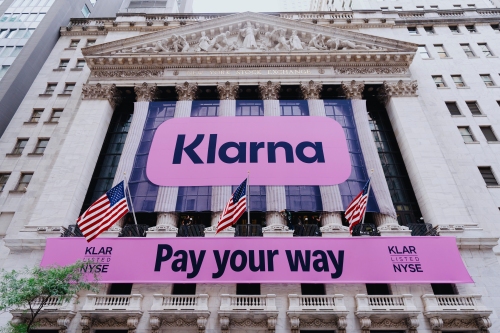
Image from Klarna IPO pricing announcement
Klarna’s debut on the New York Stock Exchange showed that investor interest in buy now pay later remains strong. The Swedish payments company priced its IPO at $40 per share, above the expected $35 to $37 range. Shares opened at $52 before closing at $46.40, a gain of about 16% on Klarna's debut, a market value of around $17.5 billion and raised proceeds of $1.37 billion, according to Reuters IPO coverage.
In 2021, Klarna was valued at $45.6 billion when SoftBank invested heavily, only to fall to $6.7 billion in a 2022 down round. The company’s new valuation is proof of a rebound and investor interest in fintech's open IPO window, although still well below its pandemic-era peak.
Klarna joins other fintechs who have jumped through the IPO window recently, such as Circle and Bullish. Klarna's registration statement filed with the SEC detailed its current scale at 111 million active consumers, 790,000 merchants, and operating in 26 countries.
Significantly, Klarna disclosed that 99% of consumer loans extended in 2024 were repaid on time, much better than the U.S. credit card delinquency rate of 3.05% for the same period. These repayment figures were key in reassuring investors about the resilience of the buy now pay later (BNPL) model.
Buy now pay later continues to expand. U.S. online purchases using BNPL services reached $82.4 billion in 2024, up 9.9% from the previous year. By August 2025, volumes had already hit $56.3 billion.
Klarna, Affirm, and Afterpay dominate the market, but the model has faced criticism that it encourages overspending and exposes providers to consumer defaults. Klarna’s repayment performance, documented in SEC filings, is now one of its key competitive advantages as it enters the scrutiny of public markets.
For fintech, Klarna’s IPO demonstrates that investors in the current climate are willing to fund growth companies with credible metrics, helping restore momentum after a period of political and market uncertainty earlier this year.
Sebastian Siemiatkowski CEO Klarna framed the IPO as a chance to build stronger ties with U.S. consumers. With a merchant base that includes major retailers, Klarna is positioning itself as a mainstream payments company rather than just a niche credit provider. Investors will be tracking closely, future quarterly financials, credit quality data, and U.S. adoption rates.
Klarna’s valuation may remain far below its 2021 peak, but the company’s NYSE IPO confirms that public market investors see value in the buy now pay later model at global scale, and are willing to back its growth.
The National Crowdfunding & Fintech Association (NCFA Canada) is a financial innovation ecosystem that provides education, market intelligence, industry stewardship, networking and funding opportunities and services to thousands of community members and works closely with industry, government, partners and affiliates to create aa vibrant and innovative fintech and funding industry in Canada. Decentralized and distributed, NCFA is engaged with global stakeholders and helps incubate projects and investment in fintech, alternative finance, crowdfunding, peer-to-peer finance, payments, digital assets and tokens, artificial intelligence, blockchain, cryptocurrency, regtech, and insurtech sectors. Join Canada's Fintech & Funding Community today FREE! Or become a contributing member and get perks. For more information, please visit: www.ncfacanada.org
| | |
|---|---|---|
| | |
Artificial Intelligence | Sep 10, 2025

Image: Freepik AI
On September 9, 2025, according to a report in The Information and as summarized by Retuers, Microsoft plans to integrate Anthropic’s Claude Sonnet 4 into Word, Excel, Outlook, and PowerPoint. It's the first time Microsoft is diversifying away from exclusive reliance on OpenAI by bringing in a new third-party AI provider into Office 365.
The decision was based on performance. Internal testing found that Claude Sonnet 4 produced stronger results in PowerPoint presentations and advanced Excel automation. For Microsoft, having access to a pool of different AI models ensures that each Office application can produce the best possible output for a specific task.
The expansion of Claude into Microsoft 365 happened just after Anthropic closed a $13 billion Series F funding round at a growing valuation of $183 billion. The capital was led by Iconiq Capital, joined by Fidelity, Lightspeed, and major institutional investors. Anthropic stated the money will support enterprise adoption, expand international reach, and strengthen AI safety research. Its annual revenue run rate has surged from $1 billion at the beginning of 2025 to more than $5 billion by August, showing the speed of its growth.
Anthropic is also managing legal pressure. The company announced a $1.5 billion settlement with authors over pirated books used in AI training, but a federal judge declined to approve the current terms and placed the agreement on hold. The case is being closely followed to learn how critical transparent data sourcing is to the credible growth of AI development and the risk of training models on unlicensed material.
On Aug 28 Anthropic announced a new consumer data retention policy that starting September 28, users of Claude Free, Pro, and Max will need to actively opt out if they do not want their conversations stored and used for training (it puts the onus on users, not the other way around). The controversial policy allows data to be held for up to five years if users don't action, which is a big extension compared to the prior 30 day limit. While enterprise and API users are not affected, the change has ignited debate over whether informed consent is clear enough for everyday consumers.
Anthropic has further updated its terms of service to block Chinese controlled firms and other entities from unsupported regions. The restriction applies to companies that are more than 50% owned by groups based in China, Russia, Iran, or North Korea, even if subsidiaries are registered elsewhere.
The policy reflects growing national security concerns and aligns Anthropic with U.S. regulatory priorities. While the change reduces revenue opportunities, the decision strengthens its positioning as a trusted AI provider in government and enterprise markets.
The Microsoft Anthropic partnership shows how AI is diversifying into all parts of the economy, everywhere and all at once. From productivity tools to infrastructure, funding to governance, competitive companies are moving towards multi model strategies and cross platform adoption. To remain competitive, Canada must improve access to growth stage financing, strengthen partnerships between fintechs and established industries, and create regulatory clarity for AI integration. Competitiveness will not be achieved through incremental independent steps but by aligning with the global strategies that are already setting the pace of change.
The National Crowdfunding & Fintech Association (NCFA Canada) is a financial innovation ecosystem that provides education, market intelligence, industry stewardship, networking and funding opportunities and services to thousands of community members and works closely with industry, government, partners and affiliates to create aa vibrant and innovative fintech and funding industry in Canada. Decentralized and distributed, NCFA is engaged with global stakeholders and helps incubate projects and investment in fintech, alternative finance, crowdfunding, peer-to-peer finance, payments, digital assets and tokens, artificial intelligence, blockchain, cryptocurrency, regtech, and insurtech sectors. Join Canada's Fintech & Funding Community today FREE! Or become a contributing member and get perks. For more information, please visit: www.ncfacanada.org
| | |
|---|---|---|
| | |
Crypto | Sep 9, 2025
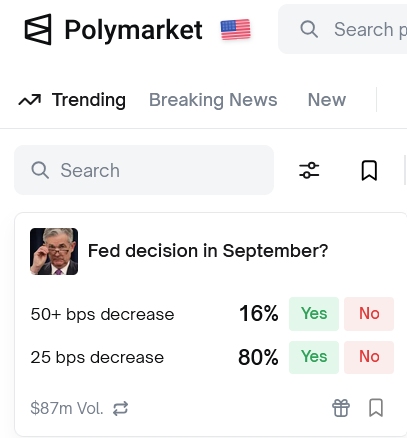
Image from Polymarket website
Polymarket has regained the ability to operate in the United States after acquiring a CFTC regulated and licensed derivatives exchange QCEX for $112 million in July 2025. Soon after the acquisition the Commodity Futures Trading Commission issued a no action letter that relaxed certain reporting and recordkeeping rules tied to event contracts, clearing the way for Polymarket to relaunch in the U.S. after being blocked since 2022 and paying a $1.4 million fine for operating without registration as part of a settlement with the CFTC.
Chief Executive Shayne Coplan highlighted the speed of the approval, writing on X that the green light from the CFTC had been 'accomplished in record timing.'
Polymarket has been given the green light to go live in the USA by the @CFTC.
Credit to the Commission and Staff for their impressive work. This process has been accomplished in record timing.
Stay tuned https://t.co/NVziTixpqO
— Shayne Coplan 🦅 (@shayne_coplan) September 3, 2025
The relaunch it seems was in a politically charged setting. Days before the approval, Donald Trump Jr. disclosed that he had invested through 1789 Capital and accepted an advisory role. The timing of Trump Jr.’s advisory role at Polymarket has raised questions about the influence of politics in a market that depends on regulatory relief.
Not all regulators support the path taken. Outgoing Commissioner Kristin Johnson argued that retail traders face significant risks and that the agency should move beyond case by case exemptions. In her view, the CFTC should create formal rules on which event contracts are permissible instead of leaving gaps in oversight.
Polymarket’s value comes from what people trade. Its most recent markets show how diverse those bets can be.
Traders currently assign about a 7% chance that Donald Trump will leave office before the end of 2025.
At the start of 2025, Polymarket listed more than 65% odds of a U.S. recession. By mid summer, that figure had fallen to 20% after a pause in new tariffs lowered fears. Economists note that these contracts reflect sentiment rather than guaranteed outcomes.
Social and sports betting examples are also trendy, such as the Taylor Swift and Travis Kelce engagement market. A trader turned $12,000 into $50,000 after betting on the couple’s announcement. Another user invested just over $2,000 the day before and made about $3,100 in profit. The odds jumped from 24% to 41% within a single day. No different in how the odds shift around in an in play betting app.
Unexpected outcomes can produce even larger returns or losses. During the papal conclave in May, Cardinal Robert Prevost was trading at only 1%. A bettor who backed him turned $1,059 into more than $63,000 after he became Pope Leo XIV. Total volume on papal betting markets reached about $40 million across Polymarket and Kalshi, another prediction marketplace.
Polymarket’s journey from fine to license shows how quickly a fintech can move from penalty to legitimacy once regulators are engaged, and the importance of building on licensed infrastructure. The markets themselves are worth monitoring, as they mirror real time sentiment. While not perfect market predictors, they are increasingly visible and sometimes a useful barometer for policymakers, investors, and punters alike.
The National Crowdfunding & Fintech Association (NCFA Canada) is a financial innovation ecosystem that provides education, market intelligence, industry stewardship, networking and funding opportunities and services to thousands of community members and works closely with industry, government, partners and affiliates to create aa vibrant and innovative fintech and funding industry in Canada. Decentralized and distributed, NCFA is engaged with global stakeholders and helps incubate projects and investment in fintech, alternative finance, crowdfunding, peer-to-peer finance, payments, digital assets and tokens, artificial intelligence, blockchain, cryptocurrency, regtech, and insurtech sectors. Join Canada's Fintech & Funding Community today FREE! Or become a contributing member and get perks. For more information, please visit: www.ncfacanada.org
| | |
|---|---|---|
| | |
Data Breach | Sep 9, 2025

Image: Freepik/Rawpixel.com
On September 5 2025, Wealthsimple (WS) confirmed that a data security breach occurred on August 30. The company emphasized that it “acted quickly and in a few hours the issue was contained. Our security team, with the help of external experts, immediately began a thorough investigation.”
The breach exposed sensitive personal data including contact details, government IDs submitted at signup, financial account numbers, IP addresses, Social Insurance Numbers, and dates of birth.
All accounts remain secure, and “no funds were accessed or stolen. No passwords were compromised… All accounts remain fully secure.” Less than 1% of clients were impacted out of WS's client base of about three million.
The breach resulted from a compromised component in a third party software package described by the company as “written by a trusted third party”. Wealthsimple confirmed the incident was not linked to any Salesforce breaches circulating in the media.
They said, “We learned that a specific software package had been compromised.” No attackers have been publicly identified, and the specific vendor has not been disclosed.
Wealthsimple detected the compromise on August 30 and contained it within hours. By 10:30 AM EST on September 5 the company had emailed all affected clients and published its public update in the Help Centre at 14:43 ET. The statement included: “If you did not receive an email from us about this, your data was not impacted.”
Wealthsimple is offering every impacted client two years of free credit monitoring, dark web monitoring, identity theft protection, and insurance. Regulators and law enforcement were notified in alignment with standard protocols.
According to the PR statement that Wealthsimple provided NCFA Canada with:
"We apologize for this incident, which happened as a result of a third-party vulnerability. We informed impacted clients as quickly as possible and set up complimentary credit and dark web monitoring, as well as identity theft protections. Significantly less than 1% of our clients were affected. We’re continually strengthening our security infrastructure and have already made improvements to prevent this type of issue from happening again."
Wealthsimple confirmed that improved protections have been implemented to better protect against similar threats.
While technical details weren't disclosed, the breach confirms that even the most advanced fintech platforms are only as resilient as their weakest external link (AKA supply chain risk).
Fintech firms must treat vendor risk management with the same rigor applied to their in house systems, including rigorous assessments of third party dependencies, continuous monitoring of software integrity, well rehearsed incident response plans, and transparent communication with clients and regulators.
For policymakers and regulators, the incident raises important questions about oversight. How can industry standards for supply chain risk be established and enforced before breaches occur?
Trust is the most vital currency. Companies of all sizes must ensure that every link from internal databases to external software is secure to protect clients and preserve consumer and business confidence.
The National Crowdfunding & Fintech Association (NCFA Canada) is a financial innovation ecosystem that provides education, market intelligence, industry stewardship, networking and funding opportunities and services to thousands of community members and works closely with industry, government, partners and affiliates to create aa vibrant and innovative fintech and funding industry in Canada. Decentralized and distributed, NCFA is engaged with global stakeholders and helps incubate projects and investment in fintech, alternative finance, crowdfunding, peer-to-peer finance, payments, digital assets and tokens, artificial intelligence, blockchain, cryptocurrency, regtech, and insurtech sectors. Join Canada's Fintech & Funding Community today FREE! Or become a contributing member and get perks. For more information, please visit: www.ncfacanada.org
| | |
|---|---|---|
| | |
Tokenization | Sep 9, 2025

AI generated
On September 8, 2025, Nasdaq announced in a Newsroom Q&A with Chuck Mack that it filed with the U.S. Securities and Exchange Commission (SEC) to allow every listed stock and exchange-traded fund on its markets to settle in tokenized form. The news is significant and was also confirmed by Reuters and if approved would be the first time a U.S. national exchange was keen to integrate blockchain settlement into the regulated equity system. If approved, the change would affect securities representing $61.6 trillion in U.S. market capitalization as of Q2 2025.
Under the 19b-4 filing to the SEC, Nasdaq proposes that each stock and ETF maintain the same CUSIP (unique 9 digit alphanumeric identifier assigned to financial instruments in the States and Canada, such as stocks, bonds, ETFs) whether traded in traditional or tokenized form. At order entry, brokers could flag trades for tokenized settlement. Execution would take place on the same order book, under the same rules, with identical rights and benefits. After execution, the Depository Trust Company (DTC) would convert the security into a blockchain token and record ownership.
Chuck Mack, Nasdaq’s Senior Vice President of North American Markets, explained the approach and stressed that from an investor’s perspective, nothing changes in how trades are placed or executed. Only the method of settlement shifts to a tokenized form:
“Our goal is to integrate digital assets into Nasdaq’s current infrastructure and systems, which will advance financial innovation while maintaining stability, fairness, and investor protection. If investors and market participants express demand for a particular approach, and we can implement it in a way that preserves market integrity, then we want to give them that choice.”
Nasdaq has indicated the first token-settled trades could occur by Q3 2026, provided that DTC’s new systems are ready. This would embed blockchain settlement directly into the most liquid equity market in the world, where average daily trading volume reached 18.4 billion shares in Q2 2025.
The filing follows the U.S. move to T+1 settlement in May 2024. Tokenization builds on that progress by layering blockchain into existing systems rather than replacing them. SEC Commissioner Hester Peirce has made clear that tokenized securities must still comply with securities laws. One way to look at tokenization is that it's not a regulatory shortcut but rather a modernization of existing infrastucture.
For the U.S., the importance lies in scale and precedent. With more than 5,400 listed companies, Nasdaq’s proposal would normalize blockchain-based settlement within the core market system. Tokenization could deliver operational savings, stronger audit trails, and new forms of fractional participation, all without fragmenting liquidity.
For Canada, Nasdaq's interest echoes the Ontario Securities Commission’s exploration of tokenized long term funds, aimed at improving investor access to complex assets. If Nasdaq’s model is approved, Canadian fintechs could explore cross-border tokenized products, while regulators will need to address custody, wallet security, and investor protections to keep pace with these developments.
Next steps is for the SEC to open the filing for public comment. If approved, tokenized settlement could begin by late 2026. For NCFAs community, this is a watershed moment as tokenization moves from pilot projects and into mainstream market regulation. The implications are significant and real with efficiency gains, lower costs, competitive pressure on other exchanges, and new opportunities for cross-border fintech innovation.
For Canada's fintech and digital asset ecosystem, aligning with these changes will be critical to remain competitive in the next phase of global capital markets.
The National Crowdfunding & Fintech Association (NCFA Canada) is a financial innovation ecosystem that provides education, market intelligence, industry stewardship, networking and funding opportunities and services to thousands of community members and works closely with industry, government, partners and affiliates to create aa vibrant and innovative fintech and funding industry in Canada. Decentralized and distributed, NCFA is engaged with global stakeholders and helps incubate projects and investment in fintech, alternative finance, crowdfunding, peer-to-peer finance, payments, digital assets and tokens, artificial intelligence, blockchain, cryptocurrency, regtech, and insurtech sectors. Join Canada's Fintech & Funding Community today FREE! Or become a contributing member and get perks. For more information, please visit: www.ncfacanada.org
| | |
|---|---|---|
| | |


August 26th, 2025

January 4th, 2024

June 1st, 2021

September 9th, 2020

July 9th, 2018

January 3rd, 2018

September 25th, 2017

June 20th, 2017

May 10th, 2017

December 14th, 2016