




Karsten Wenzlaff, Advisor
August 26th, 2025
Karsten Wenzlaff is a Crowdfunding and Fintech Expert from Germany. He is Secretary-General of Digit[...]


M&A | Aug 29, 2025

Image: Freepik/zaozaa09
As reported on Aug 28, 2025 by the Investment Executive, Desjardins buys Guardian for $1.67 billion in an all cash deal that boosts scale, fintech investment, and global ambitions. It's one of the largest Canadian asset management deals in years. Priced at $68 per share, combines about $280 billion in assets under management and advisement, and is expected to close in early 2026 pending shareholder, court, and regulatory approvals.
The deal creates a stronger national player with greater resources and market reach. For financial professionals, size matters. Larger firms can spread compliance costs, expand distribution, and withstand market volatility. Mid-sized managers will feel pressure. Some may seek mergers. Others may need to specialize in niche strategies to stay competitive.
Guardian CEO George Mavroudis will lead the new firm. The leadership continuity provides stability and a clear path forward. With greater scale, Desjardins can challenge both domestic players and global firms targeting Canadian clients. For smaller firms, competition will tighten. Larger firms are better positioned to absorb costs and push new products.
Scale gives Desjardins-Guardian room to invest in technology. AI portfolio tools, robo-advisors, and digital wealth platforms will likelycontinue to expand. This opens space for fintechs that can deliver specialized tools or integrate into broader platforms. Partnerships are not new for Desjardins. Its joint venture in Aviso Wealth and its 2022 purchase of Guardian’s Worldsource businesses for about $750 million show a consistent approach of combining acquisitions with collaborations to build reach and capability.
Guardian’s international presence gives the new platform more reach outside Canada. International products can be scaled more effectively, especially in ESG, which already accounts for the majority of Canadian managed assets.
Institutional demand for sustainable finance is rising, and the combined firm can now deepen its offerings. Alternatives and private credit strategies are also likely to expand, appealing to both domestic and global investors.
Industry consolidation has surged in 2025, and Desjardin's acquisition of Guardian Capital is the clearest sign that Canadian managers are building the scale to compete globally. The timing matters. With inflation, compliance costs, and economic uncertainty, firms with bigger reserves and wider distribution networks are better placed to grow.
 The National Crowdfunding & Fintech Association (NCFA Canada) is a financial innovation ecosystem that provides education, market intelligence, industry stewardship, networking and funding opportunities and services to thousands of community members and works closely with industry, government, partners and affiliates to create a vibrant and innovative fintech and funding industry in Canada. Decentralized and distributed, NCFA is engaged with global stakeholders and helps incubate projects and investment in fintech, alternative finance, crowdfunding, peer-to-peer finance, payments, digital assets and tokens, artificial intelligence, blockchain, cryptocurrency, regtech, and insurtech sectors. Join Canada's Fintech & Funding Community today FREE! Or become a contributing member and get perks. For more information, please visit: www.ncfacanada.org
 |  |  |
|---|---|---|
 |  |  |
AI Partnership | Aug 29, 2025

On August 28, 2025, IG Wealth Management and Canadian fintech interVal announced a new partnership to help small and medium business owners measure company value and identify opportunities for growth. The collaboration strengthens IG’s advisory network by embedding interVal’s AI driven valuation platform into client planning services, providing advisors with richer insights to guide strategic decisions.
Over the past year IG advisors have been using interVal’s software to deliver business valuations and health metrics that go beyond traditional reporting. The platform produces valuation ranges, saleability scores, and benchmarks on areas such as excess working capital, serviceable debt, and investable assets. These insights allow advisors to offer more proactive strategies for investment, credit, insurance, and succession planning, covering both business and personal wealth needs.
Damon Murchison, President and CEO, IG Wealth Management:
"Through the interVal platform, clients receive an accurate business valuation and tools to uncover what's driving, or impeding, their business value. This partnership further cements our commitment to serving business owners and helping them build better financial futures."
Founded in London Ontario, interVal was created to close the information gap between advisors and business owners. The company combines artificial intelligence, machine learning, and natural language processing to transform financial data from systems like QuickBooks and Xero into clear valuation analysis and growth indicators.
The platform is designed as a shared environment where both advisors and business owners can track value drivers, monitor benchmarks, and anticipate how changes in performance affect long term outlook. interVal’s culture emphasizes empathy, collaboration, and building tools that make advisory conversations more strategic and forward looking. Its leadership team blends expertise in finance, valuation, customer success, and technology to ensure the platform aligns with the needs of financial professionals and their clients.
The integration of interVal into IG’s services brings modern valuation technology to a national network of advisors serving nearly one million clients. With IG managing approximately $148.4 billion in assets under advisement as of July 31, 2025, the reach of this partnership has the potential to influence financial planning practices across Canada.
For small and medium business owners, the benefits are practical and beneficial. Instead of relying on static valuations or fragmented financial reports, they can now access dynamic assessments that reveal what is helping or hindering company value. This improves decision making on growth investments, cash management, and risk protection while also informing personal wealth strategies tied to the business.
The IG and interVal partnership highlights how fintech innovation is proliferating across advisory networks in Canada. As interVal’s AI powered tools scale within IG’s national network, more entrepreneurs will be able to plan with greater clarity and foresight. This improves the competitiveness of Canadian business owners and also strengthens the ability of financial advisors to deliver relevant and modern services (win-win for both parties).
Advisory practices are increasingly supported by real time data, predictive analytics, and shared insight platforms. By embedding fintech solutions like interVal, large financial institutions such as IG Wealth Management are setting new standards for integrated planning and business growth support.
The National Crowdfunding & Fintech Association (NCFA Canada) is a financial innovation ecosystem that provides education, market intelligence, industry stewardship, networking and funding opportunities and services to thousands of community members and works closely with industry, government, partners and affiliates to create a vibrant and innovative fintech and funding industry in Canada. Decentralized and distributed, NCFA is engaged with global stakeholders and helps incubate projects and investment in fintech, alternative finance, crowdfunding, peer-to-peer finance, payments, digital assets and tokens, artificial intelligence, blockchain, cryptocurrency, regtech, and insurtech sectors. Join Canada's Fintech & Funding Community today FREE! Or become a contributing member and get perks. For more information, please visit: www.ncfacanada.org
| | |
|---|---|---|
| | |
Competition | Aug 28, 2025
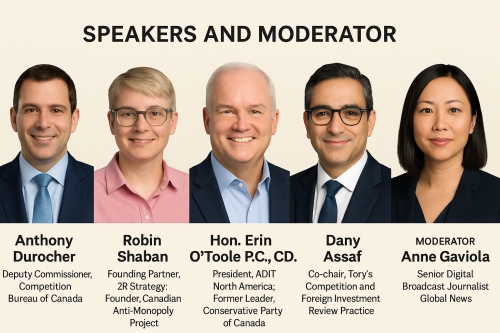
On October 8, 2025, the Rotman School of Management will host an in person debate on one of the most contested questions in Canada’s economy: Are Canada’s so called oligopolies standing in the way of a dynamic Canadian economy?
This debate is at the heart of whether concentrated industries in banking, telecom, airlines, and grocery are reducing competition and consumer choice or whether a few large firms are needed to sustain investment in a relatively small market.
Host: Rotman School of Management
Rotman Debate: Are Canada's So-Called "Oligopolies" Holding Us Back?
Date: October 8, 2025
Time/venue: 6:00 PM to 8:00 PM at Desautels Hall
Agenda: Live in-person debate followed by a networking reception
Anthony Durocher, Deputy Commissioner of the Competition Bureau, and Robin Shaban, economist and founder of the Canadian Anti Monopoly Project. They bring a competition policy and inclusive growth lens, pressing the case that concentration stifles productivity and affordability.
They will likely emphasize how concentrated markets in banking, telecom, grocery, and airlines restrict consumer choice, keep prices high, and hurt innovation. Both have deep expertise in competition policy, which will resonate with Canadians worried about affordability, productivity, rising costs, and declining foreign direct investment.
Erin O’Toole, former Leader of the Conservative Party and now President of ADIT North America, and Dany Assaf, co chair of Torys LLP’s competition and foreign investment practice. Their case focuses on the role of scale in driving resilience, capital inflows, and global competitiveness.
Expect them to argue that scale is necessary in Canada’s small market to attract global investment, maintain resilience, and provide stability. O’Toole brings political credibility and public speaking skills, while Assaf brings legal and transactional expertise from landmark competition cases.
The debate will be moderated by Anne Gaviola, senior broadcast journalist at Global News, who has more than 15 years covering Canada’s business and financial sectors.
For the NCFA Canada, this debate could not be more timely. The structure and size of Canada’s markets and levels of competition directly affects opportunities for new entrants in fintech and alternative finance. Concentrated industries can create barriers to entry. With productivity and affordability now central to Canada’s policy agenda, the insights from this debate will be directly relevant for startups, investors, and regulators. This is a ticketed event. Register now to secure your spot.
The National Crowdfunding & Fintech Association (NCFA Canada) is a financial innovation ecosystem that provides education, market intelligence, industry stewardship, networking and funding opportunities and services to thousands of community members and works closely with industry, government, partners and affiliates to create a vibrant and innovative fintech and funding industry in Canada. Decentralized and distributed, NCFA is engaged with global stakeholders and helps incubate projects and investment in fintech, alternative finance, crowdfunding, peer-to-peer finance, payments, digital assets and tokens, artificial intelligence, blockchain, cryptocurrency, regtech, and insurtech sectors. Join Canada's Fintech & Funding Community today FREE! Or become a contributing member and get perks. For more information, please visit: www.ncfacanada.org
| | |
|---|---|---|
| | |
M&A | Aug 28, 2025
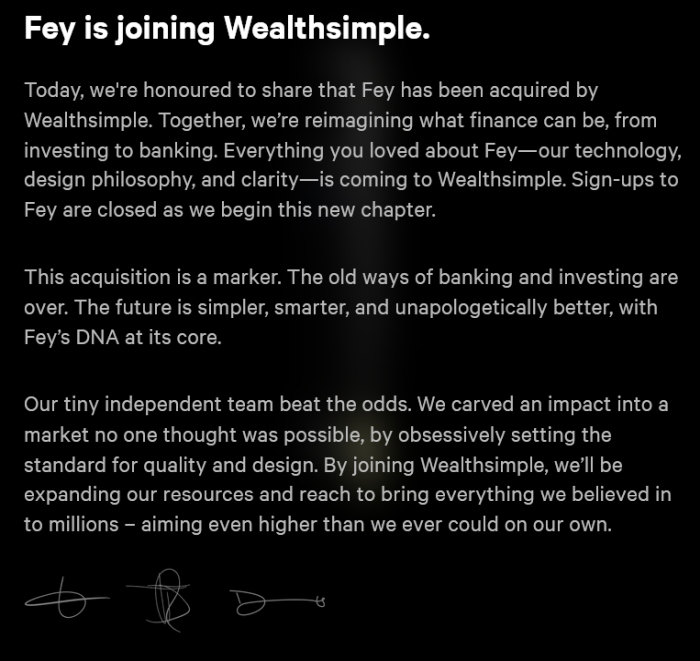
Image: Fey is joining Wealthsimple
On August 27, 2025, Wealthsimple announced the acquisition of Fey, a Montreal-based investment research startup founded in 2021 that built its reputation on elegant design and advanced AI trading tools. The financial terms of the deal weren't disclosed but it puts Wealthsimple in a position to offer millions of Canadians an enhanced trading experience, bridging the gap between simple apps and a more complex brokerage platform.
Wealthsimple now serves more than 3 million clients and manages over $84 billion CAD in assets, a 94% increase from the previous year. Earlier in 2025, Wealthsimple acquired San Francisco based platform Plenty, a wealth management platform for couples, as part of its strategy to expand capabilities and scale faster.
Fey emerged from the Montreal design studio Narative, founded by Thiago Costa, Dennis Brotzky, Thomas Russell, and Mack Mansouri. The team built Fey strategically with early venture backing from Maple VC, Inovia Capital, Yuri Sagalov of Wayfinder, and Abhinav Tiwari of Blank Ventures. Instead of a splashy launch, Fey garnished trader feedback on an invite-only access basis, which helped them refine features such as natural language stock screening, real-time earnings summaries, and a personalized news feed. Features that will soon become part of WS's self-directed investing platform.
As reported by BetaKit, Fey’s co-founders Costa, Brotzky, and Russell will join Wealthsimple’s self-directed investing group, and the Fey platform will shut down by September 30, with subscribers being refunded for any remaining balances.
For Wealthsimple’s 3 million clients, here's a look at how the integration of Fey's platform design and features will turn complex investing workflows into intuitive actions:
On Reddit, an early user described Fey as providing “a much nicer UI, the ability to sync portfolios across institutions, and quick access to key metrics when I didn’t have time to dig for them”.
Wealthsimple is aiming to create an all-in-one financial platform covering investing, trading, crypto, tax filing, and everyday banking services. Adding Fey’s research and design-first tools will help attract a younger generation of investors while strengthening its position against traditional brokerages and newer fintech challengers.
The National Crowdfunding & Fintech Association (NCFA Canada) is a financial innovation ecosystem that provides education, market intelligence, industry stewardship, networking and funding opportunities and services to thousands of community members and works closely with industry, government, partners and affiliates to create a vibrant and innovative fintech and funding industry in Canada. Decentralized and distributed, NCFA is engaged with global stakeholders and helps incubate projects and investment in fintech, alternative finance, crowdfunding, peer-to-peer finance, payments, digital assets and tokens, artificial intelligence, blockchain, cryptocurrency, regtech, and insurtech sectors. Join Canada's Fintech & Funding Community today FREE! Or become a contributing member and get perks. For more information, please visit: www.ncfacanada.org
| | |
|---|---|---|
| | |
Crypto | Aug 28, 2025

On Aug 26, 2025, the Trump Media & Technology Group, Crypto.com and Yorkville Acquisition Corp (SPAC). announced the launch of Trump Media Group CRO Strategy Inc., a new treasury firm designed to acquire, hold and actively manage large reserves of the Cronos token (CRO).
Devin Nunes, CEO of Trump Media, said:
“We continue to be bullish on cryptocurrency, and we are excited to be partnering with a leading global cryptocurrency platform and namesake of its industry in Crypto.com and one of the most sophisticated investor groups in Yorkville for this strategic initiative.”
The company will go public on Nasdaq under the ticker MCGA. The venture combines 6.3 billion CRO tokens valued at $1 billion (approx 19% of supply)+ $200 million in cash + $220 million in warrants + $5 billion equity line of credit from a Yorkville affiliate YA II PN. In total,$6.42 billion in committed resources.
Trump Media will also buy $105 million worth of cronos for its balance sheet, and Crypto.com has agreed to invest $50 million into Trump Media stock.
All told, the deal will be the first and largest publicly traded CRO treasury company and what is being described as the largest deal ever when compared to the total size of the token’s market. The business combination is being reinforced by a mandatory 1 year lock-up and 3 year release schedule on founding shares. See Form 8-K filing.
Kris Marszalek, CEO of Crypto.com, said:
“The sheer size and structure of this project will encompass more than the entire current market capitalization of CRO … this, combined with share lock-ups by each party and the treasury’s validator strategy, make it a unique and compelling offering compared to all other digital asset treasuries.”
Markets reacted immediately. Cronos spiked nearly 30% in the hours after the news (currently trading at $0.3205 on CoinGecko), while Trump Media’s stock rose 5% to $18.11. Yorkville shares fell 2.4% on the day of the announcement. This is another massive deal for crypto and boost for corporate crypto treasury strategies.
One of the most distinctive aspects of the venture is its validator strategy. Trump Media Group CRO Strategy will establish and operate a validator node on the Cronos network, delegating CRO under management to that node. This allows the company to directly participate in the security and governance of the blockchain while generating native staking rewards that will be reinvested to grow CRO holdings and offset operational expenses.
AP reported that “the Trump family is expanding its crypto empire,” adding to a series of projects that include a proposed bitcoin ETF and a $2 billion bitcoin reserve. With the White House progressing friendly crypto policies, this venture shows how closely aligned political influence and corporate strategy can be, which raises conflict of interest and transparency questions, as Trump’s family business benefits directly from a favourable regulatory climate.
The United States is moving fast with token-backed treasury vehicles and SPAC-financed listings, while Canada’s regulatory approach has been slower and more cautious. In Canada, a deal structured as a SPAC merger with a crypto corporate treasury at its core would likely not pass regulatory muster today.
That's a competitive gap. If American firms can put tokens on their balance sheets, raise capital through SPAC mergers, and connect those tokens to consumer platforms, they can innovate at a scale in a way that Canadian firms cannot match.
The question for Canada is whether to stay on the sidelines or to create the right framework for safe experimentation. That could mean regulatory sandboxes for token-based treasuries, pilot programs to test new structures, or clearer rules that give firms confidence to innovate. Without these kinds of steps, Canada risks falling further behind (skilled jobs, innovation and global capital flows) as U.S. firms set the pace in crypto finance.
The Trump Media and Crypto.com deal is an experiment to see if a token like cronos can play the same role in corporate reserves that bitcoin has for MicroStrategy. Investors jumped in quickly, but the approach still comes with the risks of big price swings and political baggage.
The National Crowdfunding & Fintech Association (NCFA Canada) is a financial innovation ecosystem that provides education, market intelligence, industry stewardship, networking and funding opportunities and services to thousands of community members and works closely with industry, government, partners and affiliates to create a vibrant and innovative fintech and funding industry in Canada. Decentralized and distributed, NCFA is engaged with global stakeholders and helps incubate projects and investment in fintech, alternative finance, crowdfunding, peer-to-peer finance, payments, digital assets and tokens, artificial intelligence, blockchain, cryptocurrency, regtech, and insurtech sectors. Join Canada's Fintech & Funding Community today FREE! Or become a contributing member and get perks. For more information, please visit: www.ncfacanada.org
| | |
|---|---|---|
| | |
Aug 26, 2025

Image: Unsplash/PiggyBank
Two of Canada’s largest banks, RBC and BMO, are currently exploring the possibility of selling their joint payments processing venture, Moneris. If the deal follows through, it could potentially be valued at around $2 billion, which would be a record-breaking transaction in Canadian history.
At the moment, no final decision has been made yet because it’s still early days and discussions are still being held. However, the potential sale has already sparked considerable interest within the industry, given the size and importance of Moneris in Canada. The banks are said to be working with top financial advisors, including PJT Partners, RBC Capital Markets, and BMO Capital Markets, to evaluate their options.
Moneris currently generates about $700 million in annual revenue and serves about 325,000 merchant locations across the country. This basically means the company processes roughly one out of every three business transactions in Canada, which is proof of just how central it is to everyday commerce. If sold, Moneris would present a rare opportunity for investors to acquire a pretty decent share of Canada’s payments market.
Retail isn’t the only sector that relies on efficient payment systems, because industries like online gaming have also highlighted the demand for fast, reliable processing. According to gambling expert Matt Bastock, part of the reason fast cashout sites have become so popular among players is the growing demand for better payment systems and instant payouts. Like online casinos and many other sectors of the economy, more and more businesses are starting to rely on fast, reliable transactions to meet customer expectations and stay competitive.
Moneris was established in 2000 as a 50/50 joint venture between the Royal Bank of Canada (RBC) and the Bank of Montreal (BMO), at a time when card payments were the go-to for merchants. In the last two decades, the company has grown into one of Canada’s largest payment processors and a trusted name for businesses of all sizes.
With a commanding market share of about 33%, Moneris is more than just a routine asset; it’s also the backbone of payments processed in and around the whole country. Today, Moneris’ offerings cover mobile payments, e-commerce platforms, and integrated point-of-sale systems, making it a one-stop shop for most businesses.
The company has also been strategic in expanding its services through partnerships and acquisitions. In 2021, Moneris acquired Quebec-based UEAT, which is a platform that provides online ordering solutions for restaurants, as a way to cement its presence in the hospitality sector. More recently, in 2025, the company went into a partnership with Cardstream to strengthen its capabilities in e-commerce.
Should RBC and BMO move forward with the sale, it would mark a turning point in Canadian fintech history. The immediate impact on businesses and consumers might not be as harsh as most people expect it to be, as payment processing services will likely continue uninterrupted. However, under new ownership, Moneris could pursue more aggressive strategies, introduce new technologies, or even go beyond Canadian borders in the hopes of finding better opportunities.
This potential sale reflects the ongoing transformation of Canada’s financial services industry, where traditional banks are adapting to an era that is defined by fintech solutions. In fact, the Canadian fintech sector is growing three times faster than traditional finance. For stakeholders across the board (consumers, investors, and competitors), the coming months will be worth watching closely. The outcome will provide valuable insights into how things are going to change and how institutions like RBC and BMO intend to position themselves in the future.
Although payment processing operations are profitable and generate reliable cash flow, they also require ongoing investment in technology, which tends to be costly. For RBC and BMO, exiting their joint venture may allow them to refocus on their core banking operations, while leaving the demands of payment technology to specialized industry players.
On the other side of the equation, potential buyers (private equity investors or established payment companies) may find new ways to scale the business even further. Comparable moves have already been seen in and outside of Canada. For instance, TD Bank recently partnered with U.S.-based Fiserv for its merchant payments operations, opting to work with a dedicated payments provider instead of maintaining the business internally. Cases like these are good examples of how banks are rethinking their role in the ecosystem, often favouring partnerships or outright sales.
The National Crowdfunding & Fintech Association (NCFA Canada) is a financial innovation ecosystem that provides education, market intelligence, industry stewardship, networking and funding opportunities and services to thousands of community members and works closely with industry, government, partners and affiliates to create a vibrant and innovative fintech and funding industry in Canada. Decentralized and distributed, NCFA is engaged with global stakeholders and helps incubate projects and investment in fintech, alternative finance, crowdfunding, peer-to-peer finance, payments, digital assets and tokens, artificial intelligence, blockchain, cryptocurrency, regtech, and insurtech sectors. Join Canada's Fintech & Funding Community today FREE! Or become a contributing member and get perks. For more information, please visit: www.ncfacanada.org
| | |
|---|---|---|
| | |
Semi Conductor Chips | Aug 25, 2025

Image: Freepik/xb100
On August 22, 2025, Intel announced a historic investment deal with the U.S. government. Washington will convert $8.9 billion of grants from the CHIPS and Science Act and funds awarded under the Secure Enclave program into an equity stake. That adds up to $11.1 billion when combined with earlier support. The U.S. will own almost 10% of Intel through the purchase of 433 million shares at $20.47 each with a five year option to buy more if Intel’s foundry control slips. Intel’s stock rose 5% after the news showing market confidence. The U.S. deal fuses industrial policy, national security, and capital markets.
If Intel executes with strength this deal could become a model for other strategic industries where similar partnerships could emerge, such as in cloud computing, artificial intelligence, and cybersecurity. The U.S. is treating advanced technology as a matter of national security and economic resilience, not just market growth.
But the risks are serious given that preferential government equity can tilt markets. Even without board seats, U.S. national security priorities are likely to influence Intel’s decision-making. Analysis from the WSJ (subscription) spotlights concerns that allies could see this move as protectionist while competitors like China are doubling down on their own state programs. For Intel, receiving public investment capital does not eliminate technical and competitive challenges.
Canada shouldn't miss this message. Our economy depends on digital infrastructure, fintech, and artificial intelligence, yet we are slipping in the basics. Labour productivity fell 1.8% in 2023, the worst among OECD countries according to OECD data. Business R&D intensity has stalled even as total spending reached $53.1 billion in 2023. The Toronto Stock Exchange has seen a collapse in new listings, with the number of operating companies falling 42.5% since 2008. In the first half of 2024 there were only 12 IPOs raising $12.9 million, the weakest in decades.
Retail investors have limited options in Canada with current crowdfunding rules cap issuers at $1.5 million per year and individuals at $2,500 per deal per CSA's NI 45-110, while American policy leaders are advocating to increase U.S. crowdfunding caps from $5M to $10M USD. Meanwhile, open banking is still not live with the government targeting early 2026 for rollout. Canada needs to recognize that leading economies are treating technology as sovereign infrastructure. But our record with national large scale projects from broadband and digital ID to defense procurement is often delayed, underfunded, or misaligned with the original vision.
Canada must respond from a position of strength while recognizing its constraints.
Capital formation is a constant constraint. IPO markets remain weak and the pool of listed operating companies continues to shrink. Without deeper domestic pathways, Canadian innovators will keep looking south. Retail access must expand. Current equity crowdfunding limits are too modest for capital intensive sectors like AI infrastructure, semiconductor packaging, and cybersecurity. Modernize equity crowdfunding and exemption rules to turn Canadians into shareholders in their own innovation economy, not passive taxpayers.
Competition must be unlocked. Canada’s banking market remains highly concentrated, and the continued delay of open banking weakens fintech growth compared to peers already live. Accelerating the rollout with clear liability rules and payments initiation is essential.
Semiconductors require realism. Canada is not building leading edge fabs, but we already host a North American advanced packaging hub at IBM Bromont. Ottawa and Quebec backed upgrades in 2024 and further support is expected. Packaging is becoming a chokepoint as chiplet designs spread across AI systems. Doubling down on this strength could anchor Canada in the supply chains funded by U.S. CHIPS investments.
Intellectual property must be treated as a strategic asset. Canada has a long history of world leading research that too often turns into patents and companies controlled abroad. In AI, for example, Canadian researchers pioneered deep learning yet most of the firms capturing that value are headquartered elsewhere. A national IP strategy that ties public research funding to commercialization in Canada, strengthens IP retention rules, and helps scale ups build patent portfolios would keep more value at home.
Public funds should be linked directly to domestic value creation. The Intel deal shows how governments can require alignment with national goals in exchange for capital. Canada can do the same, not by choosing a single corporate champion but by tying support to measurable outcomes like higher R&D intensity, Canadian patent filings, and stronger Canadian controlled firms.
Talent and immigration must become a growth engine, not just a safety valve. Canada’s immigration system is a global advantage but skilled newcomers too often become employees of foreign firms rather than founders of Canadian ones. Scaling visa programs tied to entrepreneurship and improving access to early stage capital for immigrant founded companies would unlock more homegrown innovation.
The Intel deal shows the world is changing fast. Countries are treating technology as a national asset. Canada must act too, but in our own way. We can rebuild competitiveness not through giant one off bets but by modernizing capital markets, opening doors for retail investors, and backing the companies that will define our digital future. It is a call to seize our strengths and trust Canadians to invest in them. If we act now, Canada can remain a competitive, innovative, and inclusive player in the global economy.
The National Crowdfunding & Fintech Association (NCFA Canada) is a financial innovation ecosystem that provides education, market intelligence, industry stewardship, networking and funding opportunities and services to thousands of community members and works closely with industry, government, partners and affiliates to create a vibrant and innovative fintech and funding industry in Canada. Decentralized and distributed, NCFA is engaged with global stakeholders and helps incubate projects and investment in fintech, alternative finance, crowdfunding, peer-to-peer finance, payments, digital assets and tokens, artificial intelligence, blockchain, cryptocurrency, regtech, and insurtech sectors. Join Canada's Fintech & Funding Community today FREE! Or become a contributing member and get perks. For more information, please visit: www.ncfacanada.org
| | |
|---|---|---|
| | |


August 26th, 2025

January 4th, 2024

June 1st, 2021

September 9th, 2020

July 9th, 2018

January 3rd, 2018

September 25th, 2017

June 20th, 2017

May 10th, 2017

December 14th, 2016