




Karsten Wenzlaff, Advisor
August 26th, 2025
Karsten Wenzlaff is a Crowdfunding and Fintech Expert from Germany. He is Secretary-General of Digit[...]


Aug 19, 2025

Image: Freepik
SalesAR has built its reputation on proven outreach strategies that consistently deliver measurable results for B2B companies. Specializing in outbound lead generation and appointment setting, the team focuses on precision targeting, tailored messaging, and data-backed execution.
Outreach strategies by SalesAR deliver measurable results by blending deep research, personalized messaging, and proven cold email outreach best practices within a multi-channel approach.
With more than 30,000 booked meetings and 650+ clients worldwide, they’ve shown time and again that a structured, performance-driven approach can fill pipelines faster and more reliably than guesswork.
Their strategy is multi-channel by design, blending email, LinkedIn, and direct calls to keep prospects engaged without being intrusive. This mix not only increases touchpoints but also builds familiarity and trust. The result is a consistent flow of qualified leads that directly translates into pipeline growth and predictable, repeatable sales opportunities.
Every successful campaign begins with knowing exactly who you want to reach. SalesAR defines the Ideal Customer Profile (ICP) with laser focus, mapping out industries, company sizes, geographies, and budgets that match the client’s best opportunities. From there, they pinpoint the real decision-makers—whether that’s a CMO, IT director, or procurement lead—and identify the buying triggers most likely to spark interest.
Before launching targeted outreach campaigns, the team follows cold email outreach best practices alongside a complete data verification and enrichment process. This ensures every contact is accurate, up-to-date, and worth engaging, eliminating wasted effort and keeping reply rates high from day one.
Once the right audience is defined, the next step is speaking their language. SalesAR’s copywriters craft subject lines that consistently drive open rates of 50–70%, cutting through crowded inboxes. But personalization doesn’t stop at using a first name—it’s about referencing the recipient’s industry, addressing specific pain points, and timing the outreach when it’s most relevant.
Every message is designed to deliver value quickly. Concise, actionable content helps busy decision-makers see the benefit in responding without wading through fluff, making each touchpoint more likely to move the conversation forward.
Relying on a single communication channel limits results. SalesAR uses multichannel outbound for lead generation that combines tailored email sequences, LinkedIn connection requests with ongoing engagement, and direct calls when the timing is right.
This synchronized approach ensures prospects see the message in multiple contexts, boosting familiarity and trust. By aligning touchpoints across channels, the team consistently achieves higher engagement rates and keeps momentum strong throughout the outreach cycle.
Most deals don’t happen after the first or second contact—they happen after the fifth or later. SalesAR builds in automated follow-up sequences that still feel personal, maintaining relevance while avoiding repetition.
Using cold email outreach best practices during nurturing ensures prospects stay warm until the timing is right. Whether it’s sharing valuable insights or checking back after a known trigger event, this steady communication ensures no opportunity slips away simply because it wasn’t nurtured.
Outreach success isn’t measured by replies alone—it’s about securing sales-qualified appointments that lead to real opportunities. From the first touch to the booked meeting, SalesAR’s multichannel outbound for lead generation process qualifies prospects to ensure only high-fit decision-makers make it onto the calendar.
With clear metrics like reply rates and meeting-to-close ratios, clients can see exactly how outreach performance translates into revenue. The result: fewer wasted meetings, more deals closed, and a stronger sales pipeline.
Many outreach efforts fail because they ignore cold email outreach best practices and rely on guesswork. SalesAR combines precise research, meaningful personalization, and data-backed decision-making to outperform generic campaigns consistently. Their team brings together SDRs, strategists, copywriters, and analysts who know how to align efforts for maximum impact.
The process is built to scale using multichannel outbound for lead generation without sacrificing quality. Every touchpoint is intentional, relevant, and designed to move prospects closer to a meaningful conversation.
SalesAR’s proven outreach strategies deliver measurable results by blending deep research. If you’re ready to fill your calendar with sales-qualified appointments and accelerate growth, it’s time to see what SalesAR can do for you.
 The National Crowdfunding & Fintech Association (NCFA Canada) is a financial innovation ecosystem that provides education, market intelligence, industry stewardship, networking and funding opportunities and services to thousands of community members and works closely with industry, government, partners and affiliates to create a vibrant and innovative fintech and funding industry in Canada. Decentralized and distributed, NCFA is engaged with global stakeholders and helps incubate projects and investment in fintech, alternative finance, crowdfunding, peer-to-peer finance, payments, digital assets and tokens, artificial intelligence, blockchain, cryptocurrency, regtech, and insurtech sectors. Join Canada's Fintech & Funding Community today FREE! Or become a contributing member and get perks. For more information, please visit: www.ncfacanada.org
 |  |  |
|---|---|---|
 |  |  |
Aug 18, 2025
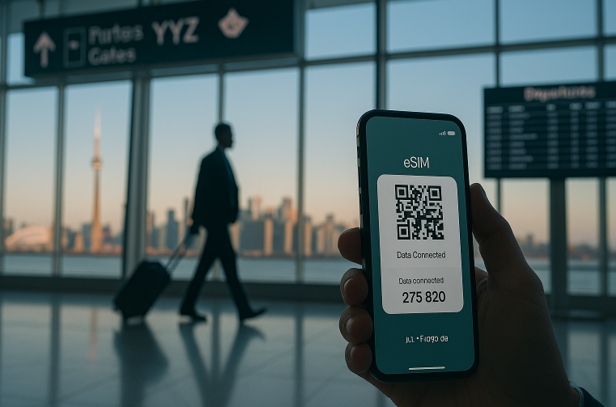
Boarding calls feel a lot like closing calls—fast, slightly chaotic, and unforgiving if you miss a step. If you’re a Canadian founder, VC, or compliance lead working across borders, your phone is the deal room in your pocket: MFA prompts, treasury dashboards, secure messengers, and data rooms all depend on an instant, stable connection. Before your next investor day or regulator meeting, install Holafly's esim for travelers so you land with data and keep business moving while everyone else is still hunting for airport Wi-Fi.
In fintech, minutes matter. Miss a multi-factor prompt and your banking session times out. Lose maps at a new venue and you miss the panel you flew in for. Drop a call and that LP introduction goes cold. An eSIM removes the fragile parts of travel:
An eSIM is a digital SIM profile your phone can download and use for mobile data. You keep your Canadian number active for calls/SMS (Dual-SIM), while all your apps route over the eSIM’s data line.
Label your lines (e.g., Home CA / Travel Data). At 6 a.m. in a security queue, that clarity is priceless.
Think of Dual-SIM as the clean split between who you are and how your apps move:
| Option | Setup at Arrival | Keep CA Number Active | Multi-Country Flex | Cost Predictability | Risk Profile |
| Travel eSIM | None (activate pre-flight) | Yes (Dual-SIM) | Excellent | High (day-based) | Low (cellular) |
| Carrier Roaming | None | Yes | Good | Low/Variable | Low–Med (cost exposure) |
| Airport SIM Kiosk | Queue, ID, swap | Only on dual-SIM phones | Low–Med | Med | Med (time, public Wi-Fi) |
| Public Wi-Fi | Find, log in, hope | N/A | Low | “Free,” time-costly | High (security) |
For board packages and budgets, the advantage is obvious: predictable spend and zero arrival downtime.
The National Crowdfunding & Fintech Association (NCFA Canada) is a financial innovation ecosystem that provides education, market intelligence, industry stewardship, networking and funding opportunities and services to thousands of community members and works closely with industry, government, partners and affiliates to create a vibrant and innovative fintech and funding industry in Canada. Decentralized and distributed, NCFA is engaged with global stakeholders and helps incubate projects and investment in fintech, alternative finance, crowdfunding, peer-to-peer finance, payments, digital assets and tokens, artificial intelligence, blockchain, cryptocurrency, regtech, and insurtech sectors. Join Canada's Fintech & Funding Community today FREE! Or become a contributing member and get perks. For more information, please visit: www.ncfacanada.org
| | |
|---|---|---|
| | |
AI | Aug 14, 2025

Image: Freepik/pikisuperstar
On August 12, 2025, AI search giant Perplexity stunned the tech world with a bold $34.5 billion bid for Chrome, adding to the mounting antitrust pressure currently facing Google. Now Chrome, the world's most widely used browser with over 3 billion users is at the center of regulatory discussions that could force Google to sell Chrome after a US federal judge ruled the company maintains an unlawful monopoly in online search.
Perplexities proposal however is unlikely to succeed immediately, as regulators weigh remedies that could drastically change the browser market, expand competition, and challenge Google’s dominance.
Founded in 2022, Perplexity is currently valued at $18 billion USD (July 2025) and built a reputation as one of the fastest growing AI companies. Its platform processes hundreds of millions of monthly queries and recently launched an AI driven web browser called Comet.
According to a term sheet seen by Reuters, Perplexity's bid promises to keep Chromium open source, invest $3 billion over two years and make no changes to Chrome’s default search engine (preserving user choice).
Aravind Srinivas, CEO Perplexity, said the offer to buy Chrome was “designed to satisfy an antitrust remedy in highest public interest by placing Chrome with a capable, independent operator.” It's certainly a bold move, highlighting AI's role in the future of internet access.
The bid is closely aligned with findings from the US Department of Justice's antitrust case where Judge Amit Mehta has ruled that Google’s agreements with device makers and carriers unlawfully entrenched its dominance in search.
Potential remedies are still being reviewed and could include a forced sale of Chrome. The possibility has already attracted interest from OpenAI, Yahoo, and Apollo Global Management.
Some analysts argue that Chrome’s integration with Google’s ad ecosystem and its dominant market share could justify a higher valuation than Perplexity’s offer. Others see the move as a calculated play to raise Perplexity’s visibility ahead of any divestiture decision. A forced sale could become one of the largest transactions in tech history and alter how billions of users access and navigate the web.
Google has offered no sign that it's prepared to sell Chrome and is expected to appeal any divestiture order, which could delay a resolution for years. Google CEO Sundar Pichai testified at a U.S. antitrust trial that forcing the company to share search data with rivals would give away its intellectual property, hurt innovation, and make it easy to copy Google Search. Google says any forced sale of Chrome would threaten user privacy and cybersecurity, and damage complementary services, partners, and competition, and it plans to appeal if it loses.
This case is a reminder that entrenched market dominance in digital infrastructure can face real legal challenges in countries that take competition seriously, and that strategic timing matters when entering regulated, high barrier markets. A forced sale of Chrome could set precedent for similar actions in fintech, payments, and AI driven services, creating risks and opportunities for companies ready for the next iteration of the internet.
The National Crowdfunding & Fintech Association (NCFA Canada) is a financial innovation ecosystem that provides education, market intelligence, industry stewardship, networking and funding opportunities and services to thousands of community members and works closely with industry, government, partners and affiliates to create a vibrant and innovative fintech and funding industry in Canada. Decentralized and distributed, NCFA is engaged with global stakeholders and helps incubate projects and investment in fintech, alternative finance, crowdfunding, peer-to-peer finance, payments, digital assets and tokens, artificial intelligence, blockchain, cryptocurrency, regtech, and insurtech sectors. Join Canada's Fintech & Funding Community today FREE! Or become a contributing member and get perks. For more information, please visit: www.ncfacanada.org
| | |
|---|---|---|
| | |
Terra | Aug 13, 2025

Image: Freepik/Wirestock
On August 12, 2025, Terraform Labs founder Do Kwon pleaded guilty in a U.S. federal court to fraud charges connected to the $40 billion collapse of TerraUSD in 2022. The plea includes forfeiting more than $19 million and a recommended sentence of up to 12 years in prison, with official sentencing set for December 11, 2025. The development comes as Bitcoin trades near its all time high, shining a light on the incredible appeal and robustness of crypto even with major scandals lurking in the shadows.
The timing is ironic, if not remarkable. While one of the most infamous fraud cases in crypto history reaches its turning point, Bitcoin is showing resilience at a price near its all time high. This resilience is grounded in its transparent design and predictable monetary policy. For fintech innovators, it is a reminder that systems with verifiable trust can withstand industry turbulence and public scrutiny.
While Bitcoin is volatile it makes no promise of price stability and operates on open, verifiable code.
TerraUSD was an algorithmic stablecoin designed to maintain a $1 peg without real world asset backing. Prosecutors said Kwon misled investors by failing to disclose the intervention of an outside trading firm to restore the peg during the May 2021 depegging. The collapse revealed a complex and fragile financial system without external audits, reserve transparency, or proven crisis controls.
The Terra collapse destroyed billions in investor wealth and caused severe personal and economic consequences. The $4.5 billion civil penalty Terraform Labs agreed to in 2024 with the U.S. Securities and Exchange Commission confirms that regulators are increasingly prepared to hold firms accountable. Also Kwon still faces criminal charges in South Korea related to the collapse of TerraUSD. If he is removed from the U.S. after serving his sentence, Seoul may pursue extradition to face those charges
For fintech builders, protecting investors should not be about checking off a regulatory box but rather a prerequisite for sustainable growth. Product design, public communications, and crisis response must all play a role in a culture of integrity.
The projects that survive and evolve into massive legacies are those that match technical innovation with foundational governance and operational integrity.
Innovation will continue to drive financial change, but trust is the asset that endures.
The National Crowdfunding & Fintech Association (NCFA Canada) is a financial innovation ecosystem that provides education, market intelligence, industry stewardship, networking and funding opportunities and services to thousands of community members and works closely with industry, government, partners and affiliates to create a vibrant and innovative fintech and funding industry in Canada. Decentralized and distributed, NCFA is engaged with global stakeholders and helps incubate projects and investment in fintech, alternative finance, crowdfunding, peer-to-peer finance, payments, digital assets and tokens, artificial intelligence, blockchain, cryptocurrency, regtech, and insurtech sectors. Join Canada's Fintech & Funding Community today FREE! Or become a contributing member and get perks. For more information, please visit: www.ncfacanada.org
| | |
|---|---|---|
| | |
Biometric Guidance | Aug 13, 2025

Image: Freepik/rawpixel.com
On August 11, 2025, the Privacy Commissioner of Canada (OPC) released final guidance on handling biometric information such as facial recognition, fingerprint scanning, and voice identification.
how federal institutions and businesses must handle biometric information such as facial recognition, fingerprint scanning, and voice identification. The new privacy guidance applies to federal institutions and businesses across all sectors and follows more than a year of public consultation that included input from 34 written submissions and 31 stakeholder meetings. The updated guidance is Canada's response to mounting privacy risks thanks to the rapid growth of using biometric technology in authentication, security, and service delivery.
Biometric data is uniquely tied to an individual’s body and remains consistent over time, making it valuable for verification and sensitive for privacy, but it can reveal health indicators, racial and gender characteristics, and other personal details. Unlike passwords, it cannot be replaced if compromised.
The permanent nature and sensitivity of biometric data increases the risk for organizations collecting, storing, and processing without special safeguards. As the OPC guidance states, "Biometric information is sensitive personal information, and in most cases, it should be treated and protected as such."
Philippe Dufresne, Privacy Commissioner stressed:
“Organizations need to approach the use of biometric information in a privacy-protective way, building privacy considerations at the beginning of any new program or initiative.”
The guidance for private sector organizations clarifies when and how biometrics can be collected, used, and disclosed under the Personal Information Protection and Electronic Documents Act (PIPEDA). Businesses must ensure there is a clearly defined and appropriate purpose for any biometric program, supported by a proportionality test to weigh benefits against privacy risks.
They must also obtain meaningful consent from individuals, be transparent about how data will be used, ensure systems are accurate through testing, and apply robust security measures to prevent unauthorized access.
Federal institutions adhere to similar principles under the Privacy Act but face additional obligations. They must identify lawful authority before collecting biometric data and conduct a formal Privacy Impact Assessment to evaluate risks and mitigation strategies.
The federal guidance simplifies the rules for doing impact and risk assessments so they are easier to follow when planning a program. It also asks federal institutions to think carefully about whether biometrics are truly needed, if the benefits outweigh the privacy risks, and whether other options could work before moving ahead.
The final guidance incorporates several adjustments based on stakeholder feedback, including clearer definitions of sensitive information, closer alignment with legal requirements, more detailed technical explanations and best practices, refined consent guidance for private sector use, and expanded discussion of lawful authority for public sector programs.
| Area | Private Sector (PIPEDA) | Federal Institutions (Privacy Act) |
| Legal authority | No specific law needed, but must have a clear, appropriate purpose | Must confirm lawful authority before collecting biometrics |
| Risk assessment | Should assess proportionality and risks, but not formally required | Must complete a formal Privacy Impact Assessment |
| Consent | Must get meaningful, informed consent | Consent may not apply if collection is legally authorized |
| Proportionality | Required to weigh benefits vs privacy risks | Required with added focus on necessity and exploring alternatives |
| Security safeguards | Must apply strong protections to prevent misuse | Same requirement, plus oversight within government frameworks |
For fintechs, payment providers, and digital identity innovators, the guidance sets a higher compliance bar for wherever biometric services may be used, such as customer on-boarding, fraud prevention, and authentication. Companies will need to integrate privacy risk analysis into early product design, justify and write-down decision-making, and ensure biometric tools are tested for accuracy and fairness.
Meeting these requirements will add compliance costs but will be important to maintain consumer trust and avoiding regulatory scrutiny as biometric use expands in financial services.
With it's latest guidance, the Privacy Commissioner is making biometric governance a core compliance area in Canada. For fintechs, this is both a regulatory obligation and a competitive opportunity. Those that build privacy into biometric solutions from the beginning can improve market credibility while remaining compliant.
The National Crowdfunding & Fintech Association (NCFA Canada) is a financial innovation ecosystem that provides education, market intelligence, industry stewardship, networking and funding opportunities and services to thousands of community members and works closely with industry, government, partners and affiliates to create a vibrant and innovative fintech and funding industry in Canada. Decentralized and distributed, NCFA is engaged with global stakeholders and helps incubate projects and investment in fintech, alternative finance, crowdfunding, peer-to-peer finance, payments, digital assets and tokens, artificial intelligence, blockchain, cryptocurrency, regtech, and insurtech sectors. Join Canada's Fintech & Funding Community today FREE! Or become a contributing member and get perks. For more information, please visit: www.ncfacanada.org
| | |
|---|---|---|
| | |
Aug 12, 2025

Image: Freepik/konstantinraketa
In today’s agile market, small-scale producers, from custom cabinetry makers to furniture artisans and self-employed tradespeople, seek ways to deliver personalized products efficiently. Simultaneously, fintech innovators explore smarter, faster ways to fund projects and manage payments. At the intersection, digital fabrication and digital finance find a powerful synergy: CNC routers enable precise, scalable customization, while fintech platforms provide flexible, real-time funding and billing solutions.
Computer Numerical Control (CNC) routers translate digital design files into exact cuts, curves, and engravings in wood. For a small workshop, that means complex geometries or one-off pieces, like bespoke furniture, unique signage, or tailored cabinetry, become accessible with minimal manual effort. A wood CNC machine reduces setup times and material waste, enabling entrepreneurs to quickly respond to customer specs. A solo artisan can offer premium customization while keeping a lean production footprint.
The ability to switch from one design to another in minutes empowers tradespeople to embrace truly customer-centric workflows. Digital design iterations happen faster. When a client asks for a tweak, like a curved edge, an inlay, or a specific dimension, the operator adjusts the CAD model, sends it to the machine, and begins production almost immediately.
Fintech platforms, especially those supporting crowdfunding, invoice financing, or embedded payments, give creators fast access to capital. There’s an opportunity for more Canadian businesses to do so, as only about 13% leverage fintech for financing. When a client commits, funding can flow before production begins. Tradespeople can unlock working capital without resorting to traditional loans.
Imagine a crowdfunding page for a limited line of custom wood furniture: backers pledge in advance, securing funding for material purchase and labour. Alternatively, invoice-financing platforms let makers issue digital invoices and receive up to 80–90% of the amount within days, sustaining cash flow as production ramps up.
Additionally, fintech billing solutions automate payments tied to production milestones. For example: 20% due upon design approval, 50% at the start of CNC routing, and 30% on delivery. Smart contracts or API-driven billing systems manage this sequencing transparently, reducing administrative burdens for solo makers and ensuring clients only pay when work progresses.
Fintech investors looking to support small-business ecosystems should take note. The convergence of CNC-driven customization and just-in-time funding opens scalable opportunities. Platforms can integrate with maker marketplaces, offering pre-financing or microloans tied to incoming orders.
Small business owners can leverage this model too. A carpentry studio, for example, could invest in a CNC router and partner with a fintech platform to take customized orders with small down payments. The system processes financing, the machine produces, and billing flows automatically, improving margins, reducing cash conversion cycles, and expanding service offerings.
The convergence of CNC-based digital fabrication and fintech-enabled funding models is transforming personalization in woodwork from a luxury into an accessible, scalable business strategy. Entrepreneurs, self-employed tradespeople, fintech investors, and small business owners can all benefit from this synergy. CNC routers unlock rapid customization and automation. Fintech platforms deliver the flexible funding and billing infrastructure needed to deliver work just in time and manage cash flow effectively.
In an industry that values both craftsmanship and speed, this integration empowers creators to bring tailored solutions to market with lean operations and encourages fintech innovators to build financial products that support the makers shaping our homes and infrastructure.
The National Crowdfunding & Fintech Association (NCFA Canada) is a financial innovation ecosystem that provides education, market intelligence, industry stewardship, networking and funding opportunities and services to thousands of community members and works closely with industry, government, partners and affiliates to create a vibrant and innovative fintech and funding industry in Canada. Decentralized and distributed, NCFA is engaged with global stakeholders and helps incubate projects and investment in fintech, alternative finance, crowdfunding, peer-to-peer finance, payments, digital assets and tokens, artificial intelligence, blockchain, cryptocurrency, regtech, and insurtech sectors. Join Canada's Fintech & Funding Community today FREE! Or become a contributing member and get perks. For more information, please visit: www.ncfacanada.org
| | |
|---|---|---|
| | |
Aug 11, 2025

Image courtesy of AI
Let’s imagine a furniture business in Montreal that receives a huge order from Europe. They want to send a container overseas with tables and chairs. Fine examples of commercial cargo — huge shipments that need special care with packing, documenting, and transporting.
Maybe you also run a business or just have a large shipment to send. Knowing how international freight shipping works can help you avoid stress and make the whole process much easier.
Commercial cargo from Canada usually means shipments that are larger, heavier, or bulkier than regular parcels. Here are some typical examples:
If your shipment is over 150 kg or requires special container space, it’s likely commercial cargo. This can be shipped as LCL (Less than Container Load), when you share container space, or FCL (Full Container Load) for big, dedicated shipments.
Sending commercial cargo requires a trusted company that understands cross border regulations and the complexity of international delivery. Here’s a quick overview of how to get started with Mees Portal:
And now about containers. The visible difference in price makes you think. But actually, it’s about your options. That is, you don’t have to pay for the whole container if you don’t have that much to ship. So, when you send container overseas, you have FCL and LCL options.
Full load means just that. You rent an entire container, usually 20 or 40 feet. Ideal for big shipments that fill or nearly fill a container.
LesslLoad is more about sharing. That is, your cargo shares a container space with other shipments. It’s cheaper and opens up more possibilities.
Loading containers properly is vital to avoid damage and extra fees. Shipping services provide guidance on packing and weight distribution to maximize space and comply with international shipping standards.
Meest Canada has been helping people send international shipments for over 35 years. If you need to send cargo from Canada overseas, a few pallets or a full container, Meest makes it simple. You can ship by sea or air, get a quick quote, and track everything online. Prices are clear, service is fast, and shipments are delivered safely worldwide.
Remember that furniture business in Montreal? They used Meest to send a container of chairs to Europe. Booked it online, packed the goods, got help with the paperwork, and the shipment arrived right on time. Want yours to go just as smoothly?
Get your international freight shipping quote today and send your commercial cargo with confidence.
The National Crowdfunding & Fintech Association (NCFA Canada) is a financial innovation ecosystem that provides education, market intelligence, industry stewardship, networking and funding opportunities and services to thousands of community members and works closely with industry, government, partners and affiliates to create a vibrant and innovative fintech and funding industry in Canada. Decentralized and distributed, NCFA is engaged with global stakeholders and helps incubate projects and investment in fintech, alternative finance, crowdfunding, peer-to-peer finance, payments, digital assets and tokens, artificial intelligence, blockchain, cryptocurrency, regtech, and insurtech sectors. Join Canada's Fintech & Funding Community today FREE! Or become a contributing member and get perks. For more information, please visit: www.ncfacanada.org
| | |
|---|---|---|
| | |


August 26th, 2025

January 4th, 2024

June 1st, 2021

September 9th, 2020

July 9th, 2018

January 3rd, 2018

September 25th, 2017

June 20th, 2017

May 10th, 2017

December 14th, 2016