




Karsten Wenzlaff, Advisor
August 26th, 2025
Karsten Wenzlaff is a Crowdfunding and Fintech Expert from Germany. He is Secretary-General of Digit[...]


Semi Conductor Chips | Aug 25, 2025

Image: Freepik/xb100
On August 22, 2025, Intel announced a historic investment deal with the U.S. government. Washington will convert $8.9 billion of grants from the CHIPS and Science Act and funds awarded under the Secure Enclave program into an equity stake. That adds up to $11.1 billion when combined with earlier support. The U.S. will own almost 10% of Intel through the purchase of 433 million shares at $20.47 each with a five year option to buy more if Intel’s foundry control slips. Intel’s stock rose 5% after the news showing market confidence. The U.S. deal fuses industrial policy, national security, and capital markets.
If Intel executes with strength this deal could become a model for other strategic industries where similar partnerships could emerge, such as in cloud computing, artificial intelligence, and cybersecurity. The U.S. is treating advanced technology as a matter of national security and economic resilience, not just market growth.
But the risks are serious given that preferential government equity can tilt markets. Even without board seats, U.S. national security priorities are likely to influence Intel’s decision-making. Analysis from the WSJ (subscription) spotlights concerns that allies could see this move as protectionist while competitors like China are doubling down on their own state programs. For Intel, receiving public investment capital does not eliminate technical and competitive challenges.
Canada shouldn't miss this message. Our economy depends on digital infrastructure, fintech, and artificial intelligence, yet we are slipping in the basics. Labour productivity fell 1.8% in 2023, the worst among OECD countries according to OECD data. Business R&D intensity has stalled even as total spending reached $53.1 billion in 2023. The Toronto Stock Exchange has seen a collapse in new listings, with the number of operating companies falling 42.5% since 2008. In the first half of 2024 there were only 12 IPOs raising $12.9 million, the weakest in decades.
Retail investors have limited options in Canada with current crowdfunding rules cap issuers at $1.5 million per year and individuals at $2,500 per deal per CSA's NI 45-110, while American policy leaders are advocating to increase U.S. crowdfunding caps from $5M to $10M USD. Meanwhile, open banking is still not live with the government targeting early 2026 for rollout. Canada needs to recognize that leading economies are treating technology as sovereign infrastructure. But our record with national large scale projects from broadband and digital ID to defense procurement is often delayed, underfunded, or misaligned with the original vision.
Canada must respond from a position of strength while recognizing its constraints.
Capital formation is a constant constraint. IPO markets remain weak and the pool of listed operating companies continues to shrink. Without deeper domestic pathways, Canadian innovators will keep looking south. Retail access must expand. Current equity crowdfunding limits are too modest for capital intensive sectors like AI infrastructure, semiconductor packaging, and cybersecurity. Modernize equity crowdfunding and exemption rules to turn Canadians into shareholders in their own innovation economy, not passive taxpayers.
Competition must be unlocked. Canada’s banking market remains highly concentrated, and the continued delay of open banking weakens fintech growth compared to peers already live. Accelerating the rollout with clear liability rules and payments initiation is essential.
Semiconductors require realism. Canada is not building leading edge fabs, but we already host a North American advanced packaging hub at IBM Bromont. Ottawa and Quebec backed upgrades in 2024 and further support is expected. Packaging is becoming a chokepoint as chiplet designs spread across AI systems. Doubling down on this strength could anchor Canada in the supply chains funded by U.S. CHIPS investments.
Intellectual property must be treated as a strategic asset. Canada has a long history of world leading research that too often turns into patents and companies controlled abroad. In AI, for example, Canadian researchers pioneered deep learning yet most of the firms capturing that value are headquartered elsewhere. A national IP strategy that ties public research funding to commercialization in Canada, strengthens IP retention rules, and helps scale ups build patent portfolios would keep more value at home.
Public funds should be linked directly to domestic value creation. The Intel deal shows how governments can require alignment with national goals in exchange for capital. Canada can do the same, not by choosing a single corporate champion but by tying support to measurable outcomes like higher R&D intensity, Canadian patent filings, and stronger Canadian controlled firms.
Talent and immigration must become a growth engine, not just a safety valve. Canada’s immigration system is a global advantage but skilled newcomers too often become employees of foreign firms rather than founders of Canadian ones. Scaling visa programs tied to entrepreneurship and improving access to early stage capital for immigrant founded companies would unlock more homegrown innovation.
The Intel deal shows the world is changing fast. Countries are treating technology as a national asset. Canada must act too, but in our own way. We can rebuild competitiveness not through giant one off bets but by modernizing capital markets, opening doors for retail investors, and backing the companies that will define our digital future. It is a call to seize our strengths and trust Canadians to invest in them. If we act now, Canada can remain a competitive, innovative, and inclusive player in the global economy.
 The National Crowdfunding & Fintech Association (NCFA Canada) is a financial innovation ecosystem that provides education, market intelligence, industry stewardship, networking and funding opportunities and services to thousands of community members and works closely with industry, government, partners and affiliates to create a vibrant and innovative fintech and funding industry in Canada. Decentralized and distributed, NCFA is engaged with global stakeholders and helps incubate projects and investment in fintech, alternative finance, crowdfunding, peer-to-peer finance, payments, digital assets and tokens, artificial intelligence, blockchain, cryptocurrency, regtech, and insurtech sectors. Join Canada's Fintech & Funding Community today FREE! Or become a contributing member and get perks. For more information, please visit: www.ncfacanada.org
 |  |  |
|---|---|---|
 |  |  |
Economy | Aug 22, 2025

Image: Freepik
On Aug 22 2025, Federal Reserve Chair Jerome Powell delivered his Jackson Hole speech that suggested an interest rate cut may be on the table as soon as September. His comments came as the central bank weighs a weakening labour market and persistent but easing inflationary pressures.
Powell described a slowing economy with payroll job growth falling to just 35,000 per month over the past three months compared with 168,000 per month in 2024. The 4.2% unemployment rate is up from lows reached last year. He noted that downside risks to employment are rising even as tariff related price increases continue to flow through supply chains.
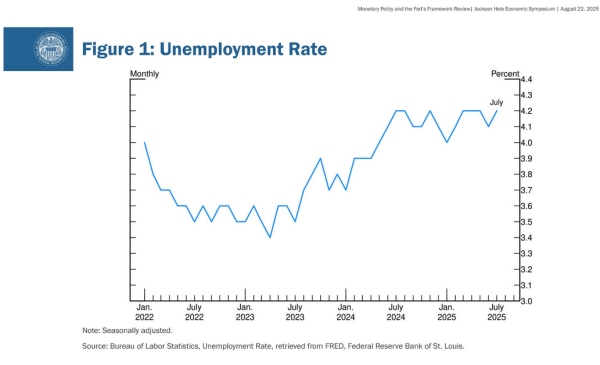
Image: US Unemployment Rate (Bureau of Labor Statistics)
Powell, Fed Reserve Chair, importantly said:
"[With policy already in restrictive territory] the baseline outlook and the shifting balance of risks may warrant adjusting our policy stance.”
Equity markets surged immediately following Powell’s comments. The S&P 500 and Nasdaq rose more than 1.5 percent by noon Friday, the Dow Jones Industrial Average climbed more than 900 points, and the Russell 2000 gained 3.8%. Treasury yields moved lower while the US dollar weakened. Crypto assets also rallied with bitcoin up 3.8% and ether jumping 13.2%.
Market participants interpreted Powell’s message as a strong hint at near term easing. The CME FedWatch tool now shows a near 90% probability of a 25 basis point rate cut in September. Analysts argue that Powell is signalling a tilt toward supporting jobs while treating tariff driven inflation as more temporary. The Fed’s tone has shifted from a singular focus on inflation to a more balanced consideration of employment risks.
The Federal Reserve’s final decision will be based on incoming data. The August employment report and mid September inflation release will be critical in determining whether the Fed follows through with a rate cut. As Powell emphasized, monetary policy will depend on how the evolving balance of risks plays out.
The bottom line is that Powell’s Jackson Hole remarks have repositioned the Fed’s policy stance. By acknowledging weakening labour conditions while downplaying longer lasting inflation threats, Powell has set expectations for a September rate cut, and markets have already pricing in an easier policy, triggering a broad a rally across stocks, bonds, and crypto.
The National Crowdfunding & Fintech Association (NCFA Canada) is a financial innovation ecosystem that provides education, market intelligence, industry stewardship, networking and funding opportunities and services to thousands of community members and works closely with industry, government, partners and affiliates to create a vibrant and innovative fintech and funding industry in Canada. Decentralized and distributed, NCFA is engaged with global stakeholders and helps incubate projects and investment in fintech, alternative finance, crowdfunding, peer-to-peer finance, payments, digital assets and tokens, artificial intelligence, blockchain, cryptocurrency, regtech, and insurtech sectors. Join Canada's Fintech & Funding Community today FREE! Or become a contributing member and get perks. For more information, please visit: www.ncfacanada.org
| | |
|---|---|---|
| | |
Aug 22, 2025

Image: Unsplash/Brooke Cagle
Learning a new language is rarely just about vocabulary and grammar. In Canada, where two official languages coexist and overlap, learning French or English carries a deeper cultural significance. Language training is not simply a tool for professional advancement but a powerful way to connect communities, foster inclusivity, and reduce barriers. For individuals preparing for official exams or seeking better communication in the workplace, structured language training becomes a bridge that links people across cultures.
Mastering a second language opens doors to broader participation in Canadian society. For anglophones, learning French makes it easier to engage with francophone colleagues, communities, and institutions. For francophones, strong English skills expand access to national networks and opportunities.
Training helps people feel included rather than isolated, especially in workplaces where bilingualism is the norm. When employees can switch between languages seamlessly, everyone feels respected and represented.
Canada’s francophone population is not limited to Quebec. Communities exist across Ontario, New Brunswick, Manitoba, and beyond. Language training offers more than exam readiness, it provides insight into traditions, histories, and perspectives that shape these communities. By learning French, professionals show a willingness to engage with these cultures authentically. This understanding can be particularly valuable in government or public service roles, where cultural sensitivity is essential.
Modern workplaces are increasingly diverse, and miscommunication can quickly become a barrier. Language training reduces misunderstandings and builds confidence. A bilingual employee can mediate between colleagues, clarify instructions, and ensure collaboration runs smoothly. Even basic training shows effort, which builds trust and rapport. Employers who encourage staff to pursue programs or prepare for SLE testing are investing not just in compliance but in smoother, more inclusive communication across the board.
Unlike quick language apps or self-study guides, structured training programs are designed for long-term results. They don’t just prepare learners for tests; they prepare them for real-life interactions where culture and language intersect. Courses often include role-play, workplace scenarios, and group discussions, which mimic real cultural exchanges. Learners gain the ability to adapt to new environments, ask meaningful questions, and build professional relationships that last. Over time, this leads to genuine integration rather than surface-level fluency.
Language learning doesn’t stop with the individual. When one person develops bilingual skills, their family, team, and community benefit. Parents who learn French, for example, often encourage their children to do the same, passing down values of inclusivity. At work, bilingual employees help create a culture where diversity is celebrated rather than seen as a challenge. The ripple effect extends outward, gradually strengthening Canada’s identity as a country built on mutual respect and cultural bridges.
Language training is more than a professional checkbox, it is a gateway to inclusion, understanding, and unity. By equipping individuals with the skills to communicate across cultures, training fosters stronger communities, smoother workplaces, and lasting integration. You can learn more about these kinds of programs on this platform. For Canadians, investing in structured language learning is not only about exams and promotions; it is about building bridges that connect people and enrich the social fabric of the country.
The National Crowdfunding & Fintech Association (NCFA Canada) is a financial innovation ecosystem that provides education, market intelligence, industry stewardship, networking and funding opportunities and services to thousands of community members and works closely with industry, government, partners and affiliates to create a vibrant and innovative fintech and funding industry in Canada. Decentralized and distributed, NCFA is engaged with global stakeholders and helps incubate projects and investment in fintech, alternative finance, crowdfunding, peer-to-peer finance, payments, digital assets and tokens, artificial intelligence, blockchain, cryptocurrency, regtech, and insurtech sectors. Join Canada's Fintech & Funding Community today FREE! Or become a contributing member and get perks. For more information, please visit: www.ncfacanada.org
| | |
|---|---|---|
| | |
Elevate Festival | Aug 22, 2025

Elevate Festival Oct 7 9, 2025, Toronto
The National Crowdfunding and Fintech Association of Canada (NCFA) is proud to be a Community Partner of Elevate Festival 2025. This is the seventh edition of Canada’s largest home grown technology and innovation gathering taking place from October 7 to 9 at Toronto’s Meridian Hall and St. Lawrence Centre. The Elevate Festival will welcome more than ten thousand attendees and over 250 speakers who are innovating the future of business, finance, and technology.
The lineup reads like a who’s who of innovation. Chris Urmson of Aurora, Clay Bavor of Sierra, and Dorothy Kilroy of Oura Health will share their visions for automation, artificial intelligence, and digital health. They will be joined by Erika Ayers Badan of Food52, Ida Tin of Clue, Althea Wishloff of Raven Capital, Harley Finkelstein of Shopify, and Hussein Fazal of Super.com. Together they represent the scale and diversity of thought that defines Elevate.
Elevate is not just a gathering, it is an experience. AI and Scale Up tracks will take the main stage for the first time, drawing thousands to conversations that matter most for Canada’s growth. Eight focused tracks will also cover fintech, moonshots, future talent, investors, and women in tech.
Attendees can join masterclasses limited to one hundred participants, connect in the Women in Tech Lounge presented by Interac, and build relationships in the Startup Lounge presented by Moneris.
One of the things that we love about Elevate is that it continues to lead in representation. More than half of attendees in 2024 identified as women or non binary, which is way above Canadian and global benchmarks for tech gatherings (big and small). The festival has also generated significant startup investment by giving founders access to curated meetings, roundtables, and pitch stages.
That momentum carries into 2025 with the Startup Open House on October 9, where entrepreneurs can open their doors to investors, partners, and future hires. There are a plethora of reasons why entrepreneurs and investors globally should attend Elevate 2025, don't miss out!
For NCFA’s community, Elevate is a fantastic opportunity to be part of Canada’s innovation story. It is where founders meet investors, where startups become scale ups, and where the fintech community can help shape Canada’s economic future. Save 20% on your Elevate Festival pass with the code NCFAELEVATE (offer valid for unlimited uses until October 9).
Register now to secure your ticket before prices rise on September 5.
The National Crowdfunding & Fintech Association (NCFA Canada) is a financial innovation ecosystem that provides education, market intelligence, industry stewardship, networking and funding opportunities and services to thousands of community members and works closely with industry, government, partners and affiliates to create a vibrant and innovative fintech and funding industry in Canada. Decentralized and distributed, NCFA is engaged with global stakeholders and helps incubate projects and investment in fintech, alternative finance, crowdfunding, peer-to-peer finance, payments, digital assets and tokens, artificial intelligence, blockchain, cryptocurrency, regtech, and insurtech sectors. Join Canada's Fintech & Funding Community today FREE! Or become a contributing member and get perks. For more information, please visit: www.ncfacanada.org
| | |
|---|---|---|
| | |
Customer Loyalty Report | Aug 20, 2025

Image: Freepik
The 2025 CustomerGauge NPS & CX Benchmarks report (120 page PDF report) helps stakeholders measure customer loyalty across the financial services landscape. The industry average NPS stands at 44, while the banking subset is at 30. Fintechs by contrast are setting new standards with NPS scores ranging from 77 to 90.
Net Promoter Score (NPS) is a widely used measure of customer loyalty. It asks customers a simple question: How likely are you to recommend this company to a friend or colleague? Answers are scored on a scale from 0 to 10.
The final NPS is the percentage of Promoters minus the percentage of Detractors, giving a score that can range from –100 to +100. Higher scores reflect stronger customer advocacy and satisfaction.
The table data below is from the CustomerGauge 2025 report, sorted high to low. These figures clearly show fintechs leading customer loyalty followed by USAA and First Republic, while many popular banks fall significantly behind.
| Company | Type | NPS |
| SoFi | Fintech | 90 |
| OnDeck | Fintech | 84 |
| Affirm | Fintech | 83 |
| LendingClub | Fintech | 79 |
| Funding Circle | Fintech | 77 |
| USAA | Financial Institution | 75 |
| First Republic Bank | Bank | 72 |
| First Direct | Bank | 66 |
| ING Luxembourg | Bank | 63 |
| American Express Bank | Bank | 52 |
| Charles Schwab | Financial Institution | 52 |
| Royal Bank of Scotland | Bank | 51 |
| ABN AMRO | Financial Institution | 30 |
| JP Morgan Bank | Bank | 31 |
| Santander UK | Bank | 27 |
| Tesco Bank | Bank | 23 |
| Bank of America | Bank | 18 |
| CitiGroup | Bank | 18 |
| Morgan Stanley | Bank | 16 |
| ANZ | Bank | 15.4 |
| National Australia Bank (NAB) | Bank | 15.4 |
| PNC Bank | Bank | 15 |
| TSB Bank | Bank | 12 |
| CBA | Bank | 10.4 |
| HSBC | Bank | 7 |
| Goldman Sachs | Bank | 5 |
| Westpac | Bank | -6.9 |
To help compare and contrast 2025 CustomerGauge NPS figures, below is some regional data points for consideration:
Loyalty is still a competitive currency in financial services. With fintechs consistently outscoring banks by wide margins, Canadian incumbents in particular face mounting pressure to address gaps that stretch beyond digital convenience into trust, personalization, and value delivery.
Put differently, improving NPS is not simply about catching up to fintechs but about meeting a global standard that modern customers expect globally. For Canada, this means that raising customer loyalty scores is directly tied to future competitiveness, investor confidence, and the ability to scale innovation in an increasingly global financial marketplace.
The National Crowdfunding & Fintech Association (NCFA Canada) is a financial innovation ecosystem that provides education, market intelligence, industry stewardship, networking and funding opportunities and services to thousands of community members and works closely with industry, government, partners and affiliates to create a vibrant and innovative fintech and funding industry in Canada. Decentralized and distributed, NCFA is engaged with global stakeholders and helps incubate projects and investment in fintech, alternative finance, crowdfunding, peer-to-peer finance, payments, digital assets and tokens, artificial intelligence, blockchain, cryptocurrency, regtech, and insurtech sectors. Join Canada's Fintech & Funding Community today FREE! Or become a contributing member and get perks. For more information, please visit: www.ncfacanada.org
| | |
|---|---|---|
| | |
Aug 19, 2025

Image: Freepik
SalesAR has built its reputation on proven outreach strategies that consistently deliver measurable results for B2B companies. Specializing in outbound lead generation and appointment setting, the team focuses on precision targeting, tailored messaging, and data-backed execution.
Outreach strategies by SalesAR deliver measurable results by blending deep research, personalized messaging, and proven cold email outreach best practices within a multi-channel approach.
With more than 30,000 booked meetings and 650+ clients worldwide, they’ve shown time and again that a structured, performance-driven approach can fill pipelines faster and more reliably than guesswork.
Their strategy is multi-channel by design, blending email, LinkedIn, and direct calls to keep prospects engaged without being intrusive. This mix not only increases touchpoints but also builds familiarity and trust. The result is a consistent flow of qualified leads that directly translates into pipeline growth and predictable, repeatable sales opportunities.
Every successful campaign begins with knowing exactly who you want to reach. SalesAR defines the Ideal Customer Profile (ICP) with laser focus, mapping out industries, company sizes, geographies, and budgets that match the client’s best opportunities. From there, they pinpoint the real decision-makers—whether that’s a CMO, IT director, or procurement lead—and identify the buying triggers most likely to spark interest.
Before launching targeted outreach campaigns, the team follows cold email outreach best practices alongside a complete data verification and enrichment process. This ensures every contact is accurate, up-to-date, and worth engaging, eliminating wasted effort and keeping reply rates high from day one.
Once the right audience is defined, the next step is speaking their language. SalesAR’s copywriters craft subject lines that consistently drive open rates of 50–70%, cutting through crowded inboxes. But personalization doesn’t stop at using a first name—it’s about referencing the recipient’s industry, addressing specific pain points, and timing the outreach when it’s most relevant.
Every message is designed to deliver value quickly. Concise, actionable content helps busy decision-makers see the benefit in responding without wading through fluff, making each touchpoint more likely to move the conversation forward.
Relying on a single communication channel limits results. SalesAR uses multichannel outbound for lead generation that combines tailored email sequences, LinkedIn connection requests with ongoing engagement, and direct calls when the timing is right.
This synchronized approach ensures prospects see the message in multiple contexts, boosting familiarity and trust. By aligning touchpoints across channels, the team consistently achieves higher engagement rates and keeps momentum strong throughout the outreach cycle.
Most deals don’t happen after the first or second contact—they happen after the fifth or later. SalesAR builds in automated follow-up sequences that still feel personal, maintaining relevance while avoiding repetition.
Using cold email outreach best practices during nurturing ensures prospects stay warm until the timing is right. Whether it’s sharing valuable insights or checking back after a known trigger event, this steady communication ensures no opportunity slips away simply because it wasn’t nurtured.
Outreach success isn’t measured by replies alone—it’s about securing sales-qualified appointments that lead to real opportunities. From the first touch to the booked meeting, SalesAR’s multichannel outbound for lead generation process qualifies prospects to ensure only high-fit decision-makers make it onto the calendar.
With clear metrics like reply rates and meeting-to-close ratios, clients can see exactly how outreach performance translates into revenue. The result: fewer wasted meetings, more deals closed, and a stronger sales pipeline.
Many outreach efforts fail because they ignore cold email outreach best practices and rely on guesswork. SalesAR combines precise research, meaningful personalization, and data-backed decision-making to outperform generic campaigns consistently. Their team brings together SDRs, strategists, copywriters, and analysts who know how to align efforts for maximum impact.
The process is built to scale using multichannel outbound for lead generation without sacrificing quality. Every touchpoint is intentional, relevant, and designed to move prospects closer to a meaningful conversation.
SalesAR’s proven outreach strategies deliver measurable results by blending deep research. If you’re ready to fill your calendar with sales-qualified appointments and accelerate growth, it’s time to see what SalesAR can do for you.
The National Crowdfunding & Fintech Association (NCFA Canada) is a financial innovation ecosystem that provides education, market intelligence, industry stewardship, networking and funding opportunities and services to thousands of community members and works closely with industry, government, partners and affiliates to create a vibrant and innovative fintech and funding industry in Canada. Decentralized and distributed, NCFA is engaged with global stakeholders and helps incubate projects and investment in fintech, alternative finance, crowdfunding, peer-to-peer finance, payments, digital assets and tokens, artificial intelligence, blockchain, cryptocurrency, regtech, and insurtech sectors. Join Canada's Fintech & Funding Community today FREE! Or become a contributing member and get perks. For more information, please visit: www.ncfacanada.org
| | |
|---|---|---|
| | |
AI | Aug 18, 2025

GitHub’s era of independence has ended.
On Aug 11 2025, Microsoft announced that GitHub will be folded into its CoreAI division, aligning with the planned departure of CEO Thomas Dohmke who confirmed with GeekWire that he will remain until the end of 2025 before starting a new venture, after leading GitHub since 2021 and driving Copilot’s rapid adoption.
Since Microsoft's acquisition of GitHub in 2018 for $7.5 billion, the platform operated under a quasi-independent model to reassure developers of neutrality. But with GitHub Copilot now reaching 20 million users and enterprise adoption up 75% quarter over quarter, the platform is now key to Microsoft’s AI strategy. Microsoft CEO Satya Nadella even noted last year that Copilot had grown into a larger business on its own than all of GitHub was at the time of acquisition.
Analysts at IDC argue that embedding GitHub into CoreAI will allow Microsoft to keep Copilot at the forefront in an increasingly competitive market for AI-assisted software development, and natural extension of Copilot’s trajectory. Adding AI engineer resources into CoreAI will also accelerate Microsoft's ability to commercialize breakthroughs.
But the change has courted warnings from analysts and media outlets. Runtime News called it “the end of an era,” referring to the erosion of GitHub’s independence that once made it the world’s trusted open source commons. Tom’s Hardware editors are drawing comparisons to Microsoft’s earlier acquisitions of Skype and Xamarin, which lost relevance after deeper integration, warning that GitHub’s unique identity is at risk.
Enterprises and Microsoft partners view the GitHub consolidation as a win. Consulting executives quoted by CRN argue that GitHub’s alignment with CoreAI will deliver tighter synergies across Azure, Copilot, and enterprise developer tools, unlocking greater efficiency for corporate teams.
Analysts are being pragmatic saying that the integration ensures GitHub is positioned to compete against quickly advancing rivals such as Google’s agentic coding efforts and startups like Cursor and Windsurf.
Developers and open source advocates are far more skeptical. Reddit threads reflect concerns over Microsoft leveraging public repositories for training AI, frustration that GitHub marketing focuses almost exclusively on Copilot, and fear that openness and independence will erode. One top voted comment lamented, “AI everywhere, no mention of Git anymore”.
The GitHub integration into Microsoft will likely accelerate competition. Developer-first AI powered coding editors like Cursor are growing rapidly. If GitHub continues to tilt heavily toward AI and corporate adoption, it could create an opportunity for a decentralized or community-owned “GitHub 2.0.” Whether that becomes mainstream will depend on whether GitHub balances its role as Microsoft’s AI flagship with its responsibility as the global repository of open source code.
Enterprises will benefit from richer integrations across the Microsoft stack, but the open source community faces the challenge of trusting a platform that is no longer arm’s-length from its parent. For Microsoft, the move cements GitHub as a strategic pillar of its AI ecosystem.
GitHub must now prove it can remain the world’s trusted commons while advancing as a commercial AI platform. The outcome will determine not only the trajectory of Copilot, but also whether a new generation of developer platforms rises to challenge GitHub’s dominance.
The National Crowdfunding & Fintech Association (NCFA Canada) is a financial innovation ecosystem that provides education, market intelligence, industry stewardship, networking and funding opportunities and services to thousands of community members and works closely with industry, government, partners and affiliates to create a vibrant and innovative fintech and funding industry in Canada. Decentralized and distributed, NCFA is engaged with global stakeholders and helps incubate projects and investment in fintech, alternative finance, crowdfunding, peer-to-peer finance, payments, digital assets and tokens, artificial intelligence, blockchain, cryptocurrency, regtech, and insurtech sectors. Join Canada's Fintech & Funding Community today FREE! Or become a contributing member and get perks. For more information, please visit: www.ncfacanada.org
| | |
|---|---|---|
| | |


August 26th, 2025

January 4th, 2024

June 1st, 2021

September 9th, 2020

July 9th, 2018

January 3rd, 2018

September 25th, 2017

June 20th, 2017

May 10th, 2017

December 14th, 2016