




Karsten Wenzlaff, Advisor
August 26th, 2025
Karsten Wenzlaff is a Crowdfunding and Fintech Expert from Germany. He is Secretary-General of Digit[...]


Enforcement | May 12, 2025

Image: AI Freepik
On May 9, 2025, U.S. President Trump signed an executive order called 'Fighting overcriminalization in federal regulations' that changes how federal agencies can or cannot pursue criminal enforcement for regulatory violations, redefining risk for fintech and crypo leaders. The policy order says prosecutors must now show clear evidence that a person or company intended to break the law before charging them criminally.
This move targets the issue of overcriminalization and aims to reduce legal risk for businesses that unknowingly violate complex or technical rules. It could reshape how enforcement decisions are made in fintech, crypto, and other innovation-driven sectors.
Here's a link the fact sheet published by the White House. Essentially the order mandates all federal agencies to:
1. A good example may be former Binance CEO, Changpeng Zhao (CZ) who was sentenced to four months in prison in 2023 for violating the Bank Secrecy Act. The case focused on compliance gaps, not fraud. Similar enforcement actions in the future might be handled differently if there was no evidence of intent.
2. These two former Coinbase employees, Ishan and Nikhil Wahi, were convicted of insider trading using confidential listing information. Since their actions were deliberate, the order may not directly apply to them but it might influence how prosecutors approach future cases involving gray areas in trading conduct.
3. Fintech and crypto companies operating in complex and evolving regulatory environments may benefit the most. The new policy could limit criminal risk for teams that unintentionally violate reporting, registration, or compliance rules.
4. Sam Bankman-Fried was convicted in 2023 and sentenced to 25 years in prison. The FTX founder was found guilty of fraud, conspiracy, and misuse of customer funds. Courts found that his actions were intentional and deceptive, so the order likely does not apply in his case.
5. Alex Mashinsky former Celsius CEO pleaded guilty to fraud and market manipulation and recently received a 12 year prison sentence for crypto fraud and knowingly misleading customers. As a result, his case also likely falls outside the scope of the new enforcement policy.
The new policy directive places the burden on agencies to prove intent before pursuing criminal charges. The change may protect founders, operators, and teams from facing prison time over technical mistakes or unclear compliance rules in an ever evolving regulatory environment.
While the order does not affect past convictions, it may influence how courts and prosecutors handle ongoing investigations. It also gives legal teams a new foundation to challenge charges that lack clear evidence of intentional wrongdoing.
 The National Crowdfunding & Fintech Association (NCFA Canada) is a financial innovation ecosystem that provides education, market intelligence, industry stewardship, networking and funding opportunities and services to thousands of community members and works closely with industry, government, partners and affiliates to create a vibrant and innovative fintech and funding industry in Canada. Decentralized and distributed, NCFA is engaged with global stakeholders and helps incubate projects and investment in fintech, alternative finance, crowdfunding, peer-to-peer finance, payments, digital assets and tokens, artificial intelligence, blockchain, cryptocurrency, regtech, and insurtech sectors. Join Canada's Fintech & Funding Community today FREE! Or become a contributing member and get perks. For more information, please visit: www.ncfacanada.org
 |  |  |
|---|---|---|
 |  |  |
AI | May 9, 2025

Image: Freepik/iconicbestiary
On May 8, 2025 during a U.S. Senate testimony on 'Winning the AI Race', Microsoft Vice Chair Brad Smith said the company blocked employees from using the DeepSeek AI app because of the app’s data collection practices, risks of propaganda, and Chinese state censorship. Smith confirmed that DeepSeek “is not available on the Microsoft store” and cannot be used by staff. The full hearing coverage can be found at TechCrunch.
But at the same time Microsoft continues to offer DeepSeek’s open source AI models through its Azure cloud platform, raising questions for both the public and business users alike. According to Dataconomy, Microsoft claims that it has audited, changed, and sandboxed the models before release to remove parts they deem are risky or unsafe.
This mixed approach has raised some concerns since the AI model can be used by others without Microsoft's internal protections. Some smaller companies may also not have the tools or awareness to even evaluate these risks, whether they be related to security or reputation.
It's the same underlying tech. Even if Microsoft tweaks the model, the core code base still comes from DeepSeek, so any unknown, unspottable, or embedded risk could still be present.
The open source models that Microsoft offers via its Azure cloud platform, could have been adversely modified by bad actors for risks like surveillance, disinformation or phishing campaigns.
It's a double standard for Microsoft to say it's unsafe for employees but okay for customers to use it. It sends a mixed message and in certain cases a reputational or regulatory risk could grow for companies that adopt it.
If governments and regulator tighten controls around AI supply chains, especially foreign ones from China, then companies could face compliance, or import/export restrictions in the the future. The State of New York has already banned DeepSeek on official devices earlier this year due to data privacy and censorship concerns.
Fintechs and financial institutions need to verify AI model origins and audit what is under the hood, and understand how its being deployed while staying aware of compliance risks. Microsoft’s internal controls may reduce risk for its own teams, but the public and smaller firms are left more exposed.
The National Crowdfunding & Fintech Association (NCFA Canada) is a financial innovation ecosystem that provides education, market intelligence, industry stewardship, networking and funding opportunities and services to thousands of community members and works closely with industry, government, partners and affiliates to create a vibrant and innovative fintech and funding industry in Canada. Decentralized and distributed, NCFA is engaged with global stakeholders and helps incubate projects and investment in fintech, alternative finance, crowdfunding, peer-to-peer finance, payments, digital assets and tokens, artificial intelligence, blockchain, cryptocurrency, regtech, and insurtech sectors. Join Canada's Fintech & Funding Community today FREE! Or become a contributing member and get perks. For more information, please visit: www.ncfacanada.org
| | |
|---|---|---|
| | |
Enforcement | May 9, 2025

Image: Freepik
Alex Mashinsky, Founder of the crypto lending platform Celsius, has been sentenced to 12 years in prison for defrauding customers and manipulating the price of his company’s digital token.
According to a press release issued May 8, 2025 from the U.S. Department of Justice, Mashinsky promised people their money would be safe and earn high rewards on Celsius. However, courts found that instead he used customer deposits to make risky bets and secretly boost the price CEL, Celsius’s own token. At the company’s peak, Celsius held about $25 billion in customer assets. When Celsius collapsed in July 2022, around 600,000 customers lost access to $4.7 billion worth of crypto. The sentence came from a U.S. court after Mashinsky admitted in December 2024 that he committed fraud and misled investors.
Jay Clatyon, U.S. Attorney said:
“Mashinsky made tens of millions of dollars while his customers lost billions... The rules against fraud still apply.”
As reported by Reuters, Mashinsky also said publicly that he wasn’t selling CEL tokens, but in fact he was and made about $48 million in profit from doing so. Further, he took out $8 million of his own money just before the company blocked customer withdrawals. He told customers that Celsius was financially strong even that he knew it was failing.
In addition to 12 years prison time, Mashinsky must pay a fine and give up his profits from the token sales.
Crypto companies must follow the same rules as everyone else. Misleading customers and manipulating markets has serious consequences. As more and more people engage with digital assets, trust and transparency is critical for the future of finance.
The National Crowdfunding & Fintech Association (NCFA Canada) is a financial innovation ecosystem that provides education, market intelligence, industry stewardship, networking and funding opportunities and services to thousands of community members and works closely with industry, government, partners and affiliates to create a vibrant and innovative fintech and funding industry in Canada. Decentralized and distributed, NCFA is engaged with global stakeholders and helps incubate projects and investment in fintech, alternative finance, crowdfunding, peer-to-peer finance, payments, digital assets and tokens, artificial intelligence, blockchain, cryptocurrency, regtech, and insurtech sectors. Join Canada's Fintech & Funding Community today FREE! Or become a contributing member and get perks. For more information, please visit: www.ncfacanada.org
| | |
|---|---|---|
| | |
Crypto Regulation | May 8, 2025

Image: Freepik/jcstudio
The Financial Conduct Authority (FCA) just dropped Discussion Paper 25/1 'Regulating Cryptoasset Activities' (83 page PDF) for industry and stakeholder feedback, following the HM Treasury’s draft rules shared on April 29, 2025 that propose bringing crypto activities under the Financial Services and Markets Act. The FCA is now seeking feedback on how to regulate trading platforms, intermediaries, lending, staking, and decentralized finance. The discussion proposals look to reduce consumer harm, improve market fairness, and align with global standards.
Firms that run crypto trading platforms and serve UK retail customers will need FCA approval. Platforms will not be allowed to trade against their own customers. All trades must be handled through fair and consistent rules. The platform must stay neutral and cannot lend to customers or carry risk between buyers and sellers.
Foreign crypto platforms that want to serve UK customers must have a UK branch and/or a UK-based legal entity. The FCA is not extending the Overseas Persons Exclusion to crypto.
Many retail investors use bots or automated strategies. The FCA wants platforms to take responsibility for monitoring this activity and managing any risks that come with it.
Platforms often rely on market makers to provide liquidity. Some market makers are tied to the platform operator or its affiliates. The FCA wants stronger controls and greater transparency.
Some platforms be able to list tokens that they or their affiliates have issued. This can create conflicts of interest and make it harder to ensure fair trading. The FCA is considering rules that would separate the platform operator from the token issuer.
The FCA says neutral platforms should not act as lenders or clearing houses; they should not extend credit or carry risk between users. However, platforms must still make sure that trades are settled safely and on time.
The FCA proposes clear rules on pre trade and post trade transparency. Platforms may be required to publish order book data and store transaction records for five years. This could include transactions by individual retail users.
The FCA is asking for feedback on discussion paper 25/1 by 13 June 2025. You can respond by using the form on the FCA website or email: dp25-1@fca.org.uk. These ideas and subsequent discussions could influence regulators around the world. Canada’s fintech sector and policymakers should review how the proposed UK rules could affect global competitiveness, partnerships, and innovation pathways.
The National Crowdfunding & Fintech Association (NCFA Canada) is a financial innovation ecosystem that provides education, market intelligence, industry stewardship, networking and funding opportunities and services to thousands of community members and works closely with industry, government, partners and affiliates to create a vibrant and innovative fintech and funding industry in Canada. Decentralized and distributed, NCFA is engaged with global stakeholders and helps incubate projects and investment in fintech, alternative finance, crowdfunding, peer-to-peer finance, payments, digital assets and tokens, artificial intelligence, blockchain, cryptocurrency, regtech, and insurtech sectors. Join Canada's Fintech & Funding Community today FREE! Or become a contributing member and get perks. For more information, please visit: www.ncfacanada.org
| | |
|---|---|---|
| | |
Payments | May 7 2025
Image from Shakepay joins Payments Canada
Canadian fintech just took a significant step forward. On May 5, 2025, Shakepay Inc, a Montreal-based crypto platform and CIRO-regulated securities dealer announced that they are the first crypto-native company to officially join Payments Canada, an independent public-purpose organization that owns and operates Canada's core payment infrastructure under federal oversight including the systems that clear and settle over $120 trillion annually.
This move could open the door for deeper integration of digital assets into Canada's regulated financial system, which in turn could accelerate innovation, competition, and consumer access to key fintech services including crypto and digital assets more broadly.
Shakepay’s blog announcement:
"Not only are we joining an exclusive group of fintechs, but it marks a significant step towards bridging the gap between the crypto industry and traditional finance in Canada."
Shakepay’s access to the national payment infrastructure is about more than speed. It aligns with their vision to make 'bitcoin more accessible to Canadians', and as member they can work directly with banks, fintechs, and other financial institutions under the same rules and protections as traditional players. This includes faster and more reliable fiat payment options to its customers, and access to the Real-Time Rail system when it's expected to rollout in 2026.
This is the same infrastructure that open banking will rely on, so it gives Shakepay critical access, aligning its services with evolving standards for instant payments, data access, and interoperability.
It also gives them a seat at the 'parents table', allowing them to participate in key discussions, collaborate with key industry leaders, and bridge the gap between digital assets and traditional finance, while setting the stage for future participation in Canada's open banking framework.
It does raise several questions though, such as will this move make it easier for other fintechs to gain access to the same payments infrastructure? Will their ability to educate, advocate, and generate significant banking partnerships accelerate regulatory clarity for expanding crypto services in Canada? Will this lead to a direct crypto to fiat payment service via the national payments infrastructure?
While the answers will no doubt take time to emerge, the line between traditional financial institutions and digital asset platforms continues to blur. And this is the first time that a crypto-native firm is running through the heart of Canada's payment system.
The National Crowdfunding & Fintech Association (NCFA Canada) is a financial innovation ecosystem that provides education, market intelligence, industry stewardship, networking and funding opportunities and services to thousands of community members and works closely with industry, government, partners and affiliates to create a vibrant and innovative fintech and funding industry in Canada. Decentralized and distributed, NCFA is engaged with global stakeholders and helps incubate projects and investment in fintech, alternative finance, crowdfunding, peer-to-peer finance, payments, digital assets and tokens, artificial intelligence, blockchain, cryptocurrency, regtech, and insurtech sectors. Join Canada's Fintech & Funding Community today FREE! Or become a contributing member and get perks. For more information, please visit: www.ncfacanada.org
| | |
|---|---|---|
| | |
Regulation | May 5, 2025

Image: Freepik/fabrikasimf
On April 29, 2025 during UK Fintech Week, the UK government published draft rules to bring cryptoasset firms under its financial services regulatory framework. The rules have been in the works for many years with the goal to protect consumers and stop fraud while giving fintech firms clear rules to innovate. If adopted, the new rules would apply to crypto companies based in the UK and also overseas if they serve UK customers including crypto trading, custody, brokering and marketing related firms operating in the sector. Read the 'Future financial services regulatory regime policy note (accessible)'.
The draft version is being published for technical feedback only (not policy direction) with stakeholder comments due by May 23, 2025. Rules around market abuse and token listings are not yet included, and will be published later.
The UK's crypto legislation follows years of planning. In 2018, the UK created the Cryptoassets Taskforce to better understand how crypto fits into financial markets. By 2022, the government committed to becoming a global crypto hub. In 2023, it launched a consultation to bring crypto into the Financial Services and Markets Act.
The Regulated Activities Order (RAO) is being expanded to cover crypto, and will replace the lighter anti-money laundering registration model currently in place.
The draft legislation doesn't include separate rules for decentralized finance (DeFi) but it makes clear that authorization is still required if a person or entity is in fact effectively controlling or operating a regulated activity, such as governance, interfaces, and service providers connected to decentralized trading platforms, staking, custody, or stablecoin models.
Interestingly, if a DeFi protocol is truly autonomous and doesn't have an identifiable party conducting business activity, it may fall outside the scope. However in reality, most DeFi projects today that offer user interfaces, save admin keys, touch fees or tokens could be subject to UK regulation.
In the UK, cryptoassets will be regulated under the same legal framework used for mainstream financial services. The new rules bring crypto into the Financial Services and Markets Act 2000 (FSMA), which currently oversees banking, securities, and insurance. Crypto firms must be authorized by the FCA and meet detailed standards for conduct, custody, and consumer protection.
In Canada, regulation falls under securities law. The Canadian Securities Administrators (CSA) and provincial regulators such as the Ontario Securities Commission (OSC) treat many crypto tokens as securities or derivatives. Platforms are expected to register as dealers or marketplaces, but there isn't a separate regime for stablecoin issuers or crypto payments.
The UK has introduced a dedicated framework for qualifying stablecoins. While Canada does not have a separate regime for stablecoin issuers, they refer to them as value-referenced crypto assets (VRCAs) and certain trading conditions apply for registered platforms only.
The FCA is planing to ban retail from purchasing cryptocurrencies using borrowed funds. Canada has not gone that far but Canadian platforms must conduct suitability and risk assessments.
Both countries operate sandboxes. The UK launched a Digital Securities Sandbox (DSS) on Sep 30, 2024, see joint policy statement by the Bank of England at the FCA. DSS allows firms to test new financial market technologies, such as distributed ledger technology (DLT) in a real world environment under a temporarily modified legal and regulatory framework to support innovation.
The UK and US are exploring closer cooperation on digital assets, including a potential joint transatlantic sandbox for digital securities. The initiative was discussed by Chancellor Rachel Reeves and US Treasury Secretary Scott Bessent, and will be taken advanced through the UK–US Financial Regulatory Working Group with the goal of supporting responsible innovation across both markets.
Canada has had a regulatory sandbox since 2017, which helped firms like Wealthsimple Digital Assets gain conditional approval. However Canada’s sandbox is domestically focused on exemptions, while the UK is pushing for global coordination.
The differences between the UK's approach and Canada's is structural. The UK is building crypto into its core financial regulation while Canada continues to fit crypto into its existing securities regime.
UK rules will influence global standards. For Canadian firms with UK clients, the operating requirements and costs are about to get a lot more challenging and rise. The UK's approach also puts pressure on all global regulators including Canada to clarify and modernize their own crypto frameworks. The final version of the UK's crypto rules is expected later this year. The UK also said they would release a Financial Services Growth Strategy on 15 July 2025 to outline its long term financial technology priorities.
The National Crowdfunding & Fintech Association (NCFA Canada) is a financial innovation ecosystem that provides education, market intelligence, industry stewardship, networking and funding opportunities and services to thousands of community members and works closely with industry, government, partners and affiliates to create a vibrant and innovative fintech and funding industry in Canada. Decentralized and distributed, NCFA is engaged with global stakeholders and helps incubate projects and investment in fintech, alternative finance, crowdfunding, peer-to-peer finance, payments, digital assets and tokens, artificial intelligence, blockchain, cryptocurrency, regtech, and insurtech sectors. Join Canada's Fintech & Funding Community today FREE! Or become a contributing member and get perks. For more information, please visit: www.ncfacanada.org
| | |
|---|---|---|
| | |
Payments Regulation | May 1, 2025
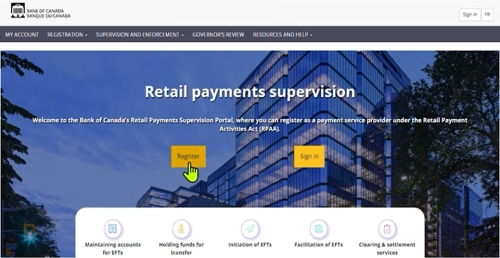
Image: PSP Connect, Retail Payments Supervision (Bank of Canada)
On April 30, 2025, the Bank of Canada (BoC) shared a new update on how it will enforce the Retail Payment Activities Act (RPAA). Payment service providers, known as PSPs, had until November 15, 2024 to register. Those who failed to do so are now being urged to act immediately or face enforcement.
BoC message:
“If you missed this deadline, you must apply immediately and at least 60 days before starting any retail payment activities. Failure to register may result in enforcement action,” the Bank stated in its April 30 message.
The Bank has updated its enforcement process outlining they may contact a PSP that is under investigation. Communication methods may include phone calls, encrypted email, courier delivery, and other secure channels. The approach is inline with the enforcement tools at their disposal published in June 2024, which include monetary penalties and compliance orders.
The BoC is also sending a reminder of how to submit a registration application through PSP Connect, the Bank's secure online portal.
1. Create a PSP Connect account
Here's a handy step by step tutorial and video available on the Bank of Canada's website to help you with the process.
2. Enter the required information and upload all documents
You can save your progress and return later if needed.
3. Submit your completed application and pay the fee
There's a $2500 application fee that must be paid in full by either credit card or debit. Alternative payment arrangements such as direct deposit or wire transfer may be arranged if several card payment attempts fail.
If you are new to the process or need further help, and have missed the workshops/tutorials, the Bank encourages PSPs to use its general inquiries form.
This update signals that the BoC is shifting from education to enforcement, as they are making it clear they are ready to take action against unregistered PSPs. Regulatory oversight of retail payments will only become more structured from here, and payment providers must meet their legal obligations or face financial and operational consequences.
The National Crowdfunding & Fintech Association (NCFA Canada) is a financial innovation ecosystem that provides education, market intelligence, industry stewardship, networking and funding opportunities and services to thousands of community members and works closely with industry, government, partners and affiliates to create a vibrant and innovative fintech and funding industry in Canada. Decentralized and distributed, NCFA is engaged with global stakeholders and helps incubate projects and investment in fintech, alternative finance, crowdfunding, peer-to-peer finance, payments, digital assets and tokens, artificial intelligence, blockchain, cryptocurrency, regtech, and insurtech sectors. Join Canada's Fintech & Funding Community today FREE! Or become a contributing member and get perks. For more information, please visit: www.ncfacanada.org
| | |
|---|---|---|
| | |


August 26th, 2025

January 4th, 2024

June 1st, 2021

September 9th, 2020

July 9th, 2018

January 3rd, 2018

September 25th, 2017

June 20th, 2017

May 10th, 2017

December 14th, 2016