








Karsten Wenzlaff, Advisor
August 26th, 2025
Karsten Wenzlaff is a Crowdfunding and Fintech Expert from Germany. He is Secretary-General of Digit[...]


NCFA Canada | Jan 7, 2022

Bio: Anne-Marie Fannon is the director of the Work-Learn Institute. In this role, she sets the research and innovation agenda for the Work-Learn team. Anne-Marie is passionate about leveraging Work-Learn’s research insights to inform the practice and pedagogy of WIL. For the last ten years, Anne-Marie was director of Work-Integrated Learning Programs at the University of Waterloo. In this role, she oversaw the development and delivery of curriculum that supported students in a variety of work-integrated learning opportunities including the new (WE) Accelerate program, the EDGE program and the WatPD courses. Anne-Marie is actively engaged with Co-operative Education and Work-Integrated Learning (CEWIL) Canada and serves as co-chair of CEWIL’s Government and External Relations Committee. She was president of the association in 2016/2017 during which time she led the association through an expansion of its mandate from co-op to work-integrated learning. To get in touch via email: Amfannon@uw.ca
The future of work is changing. The University of Waterloo’s commitment to the value of work-integrated learning makes it a global leader in co-operative and experiential education. With more than 25,000 co-op students and 7,500 employers in over 60 countries, Waterloo’s co-op program is recognized as one of the pre-eminent institutions in work-integrated learning.
Our talent pool boasts skill sets for all your business needs with thousands of future-ready students, fresh graduates, and alumni available for work. Tap into bright, entrepreneurial candidates with technical skills, who are also prepared to utilize communication, critical thinking, problem solving and self-assessment in the workplace. Future-proof your organization and claim your space at the forefront of innovation by hiring Waterloo talent.
On this Season 4 kickoff episode, NCFA Founder Craig Asano sits down with the incredible Anne-Marie Fannon, Director, Work-Learn Institute at the University of Waterloo, to better understand the motivations and needs of the next major human capital resource - Gen Z. If you're a start-up, scale-up or HR professional seeking intel on an emerging tech savvy, innovative, and talent asset class then this podcast is for you. Tune in now and learn not just the how but also the why you should be building relationships with Gen Z today. Enjoy!

Intro: Welcome to fintech Friday's a weekly podcast brought to you by the National Crowdfunding and Fintech Association of Canada and partners. Covering all things fintech, blockchain, AI and alternative finance.
Craig Asano: [00:00:00] Hello, everyone, my name is Craig Asano, the founder and CEO of NCFA Canada, welcoming you to season four of Fintech Fridays, which is episode 55. It's a weekly podcast brought to you by NCFA and partners, where we sit down with the incredible people in the fintech and funding community and talk about trends, product innovations, developments and challenges. Today we have very special guests with us, Anne-Marie Fannon, who is the director of the Work Learn Institute at the University of Waterloo, which is the only research unit of its kind. Researching the development of talent through quality work-integrated learning programs. They have done extensive research and attracting, engaging and retaining Gen Z talent, which should be a very interesting topic in discussion today, as well as what it takes for employers to be future ready. Of course, the University of Waterloo is one of Canada's leading research institutions and universities and produces a plethora. And I'm telling you, I'm talking from experience, a plethora of top grads across the board, especially in tech, science, engineering. They also operate a world renowned co-op program with, I believe, twenty or twenty five thousand students enrolled, which is the largest in the world. So I think that's absolutely remarkable. Anne-Marie we're thrilled that you can join us today to share your knowledge and experience. Thanks so much and welcome to the show.
Anne-Marie Fannon: [00:01:28] Thanks so much, Craig. I'm very excited to be here today and to have this conversation.
Craig Asano: [00:01:33] Yeah, I think it's a topic that we've certainly not covered here on the show, and I think it's very relevant to many companies who are building in the space. Obviously, sourcing talent and really understanding the motivations and what it's all about is is critical to building a successful product and business. So I'm very excited. So let's get into this. So just to kick things off, a bit of an intro question, maybe you can elaborate a little bit about the work you're doing and tell us a little bit about yourself. How did you get involved at UW and the talent development and experiential learning space?
Anne-Marie Fannon: [00:02:15] Yeah, absolutely. So I've been at Waterloo for over 20 years now, but specifically in the work integrated learning space for the last 13 years, and my passion for it grows each and every year. And that's really because it is so easy to see the efficacy of this educational model. So the ways in which our students so quickly develop these critical competencies and the impact that they have on our employers and our community partners, my work for the last ten years was really in the development of new work-integrated learning programs and developing the curriculum that supports students learning during those work-integrated learning experiences, and I've recently moved to the Work Learning Institute, which, as you mentioned, is the world's only research center specifically focused on quality work-integrated learning and school to work transitions. And there really is no better place in the world to be studying work-integrated learning than at the University of Waterloo. I feel incredibly privileged to do this work and to be here today to share a little bit of it with you and your listeners.
Craig Asano: [00:03:30] Yeah, everything is about a journey. When you're building something new, you're approaching innovation, the ability to learn and foster something novel and tak it on board and develop it and implement it and nurture it. That's the language of a lot of venture startups. Does it matter actually what sector they're in? And so I think it's it's hand and parcel. It's a perfect fit for our podcast. I'm really pleased that you're here to talk about this. In the world of of sort of let's just begin off with the workforce and what's going on from a trends perspective and how it's shaping the job market and the world. And just can you explain a little bit what's happening and the trends of the workforce?
Anne-Marie Fannon: [00:04:15] Absolutely. So first and foremost, we have to acknowledge COVID and Covid's impacts on the workforce, particularly with respect to considerations of remote work and hybrid work and what this means in terms of access to global talent. So as as everyone has seen, COVID 19 really accelerated the workforce trends that were well underway and pushed us to think about how we are going to respond in a really efficient and thoughtful manner. The work-learned team recently completed a review of the literature of the future of work, and in that we identified six specific workforce trends that again were already underway before COVID, but has accelerated. So the first one is top of mind for many of us. Advances in AI and technology and really at the core, what that means in terms of ensuring that our employees have an appropriate mix of those human and technical skills and how we're going to be able to really quickly respond to technology's impacts on our day to day work. The next trend that emerged is really the increasing need for employees to have skill agility and transferability. So with the rapid changes, the rapid impacts of technology, our day to day work is changing so quickly and that means as employees, we need to know how our skills transfer to different tasks, to different roles and sometimes even to industries as new industries emerge. So how can you take those skills that you learned in school or that you've developed through 10, 15 years of a career in one industry and think about how to leverage them in an entirely new context. The next one is sort of hand in hand with that, and that's the need for all employees to be those lifelong learners, so constantly up-skilling and re-skilling, identifying their own gaps and taking the initiative to fill them.
Anne-Marie Fannon: [00:06:35] And of course, this isn't just on the individual worker. This is something where we're going to need solutions at an ecosystem level, both employers and government. But there really will be quite an imperative that each employee really understand what is happening in the world of work and taking the ownership to make sure that they are individually prepared to respond. The fourth trend relates to diverse workplaces. So once again, going back to this idea of global talent and how we might think about an international workforce, but also what it means to tap into the entire labor market and to build inclusive workplaces that support diverse employees. Because we need all of our workers, it's not just a nice to have, it's it's an imperative for all organizations to really be thinking about talent in different ways and much more inclusive ways. The gig economy, of course, continues to grow. So how do we manage this? How do we protect worker rights, create strong employment experiences in a gig economy? And then another trend that is emerging and we'll probably talk about quite a bit later as this gap between employee and organizational values. And I think that's really epitomized by the 'Great Resignation' and organizations needing to think about whether or not they really live their stated values. Are they really encouraging Wellness Work-Life Balance in their employees? And this is top of mind for Gen Z. So not only is it something that employers need to think about for all of their employees, but if they really want to access this emerging talent, they're going to need to change work structures to live those values and understand the values of their employees.
Craig Asano: [00:08:49] Wow, that is a lot to take in. I mean, every single one of those five trends, whether it's the tech moving online and, we've seen growth in the gig economy, of course, in all sorts of others. The diversity point, the lifelong learning, the gap in the values like what this is at a time when you have the Great Resignation, yet governments around the world, they need to get their economies back on track, get everyone back to work. So this is the timing of this conversation it's ideal. So in terms of these skills or trends really what or how is Canada doing a good job? Is there one area that we've got it or there's a gap and we need a lot of work, and how do we rank globally? Are we doing a good job or do we need to go back to the drawing board?
Anne-Marie Fannon: [00:09:40] Mm-hmm. Yeah, I mean, I think we should be very proud of our educational systems in Canada. Canadian graduates consistently rank in the top five of the world, and we also have a highly educated population with sixty two percent of adults age twenty five to sixty four with post-secondary degrees. So this does mean that Canadian talent is highly sought after, and all employers, especially our domestic employers, really need to think strategically about how to build those workplaces that are going to attract Canadian talent. So this is a problem in many sectors. But as I am sure you know, it's felt very acutely in the tech industry where oftentimes our salaries fail to compete with, say, our American competitors. So not only do our employers need to think about how they're going to attract the talent, but especially how to retain it within their organizations. And as mentioned earlier, and we can get into a little bit later, this really means rethinking what work looks like and ensuring that staff find it meaningful. And for employers, this might mean a lot of individualization of work, and that butts up against many of our existing practices. But we need to see the value and the specific ways that we can engage each individual employee sort of solve for the individual as I heard someone once say so that we can really build this human capital within our organizations. In terms of challenges with the Canadian educational system. I think one of the things that's emerging is really making sure that we are indeed imbuing those future ready capabilities in our students. And obviously, I will be an evangelist for work-integrated learning and the ways in which it can help to develop those competencies in our learners because that's what we need them to know that the future of work is going to be volatile, uncertain, complex, ambiguous. They're going to have to shift. It's not, you know, learn and earn as as we had in the past. We're going to have to be constantly evolving. So that's the thing we need to keep our eye on and the Canadian educational system that we build lifelong learning capabilities in our students and think about constant connection between education and work throughout life.
Craig Asano: [00:12:22] Yeah, experential. I mean, I look at my own case, although I graduated many years ago. But the co-op experience, that was what it was about and fast forward all those years later, I just can't imagine how the experience has changed so much but for the listeners, you heard it first...you've got 25000 amazing co-op students that absolutely need this experiential education because we've got to close the gaps. There can't be any gaps in what industry is needing. It's evolving very quickly and it really works hand in hand with the leading universities like the University of Waterloo. So if you need a co-op student, connect with with me or we'll connect you on with the experiential co-op department at University of Waterloo. And we're very thankful that NCFA has a partnership with UW, so that's excellent. So. I know we've got a number of questions in the gaps area but let's just divert for a second here to define the workforce. You mean you're developing exponential programs for students and I guess it's Gen Z. I mean, I find it tough to keep track of it. We had millennials now we got Gen Z. Many of us are Gen X and different generations ourselves. So when we're talking about Gen Z and the talent that they represent, can you just describe who exactly are we talking about? What is their life like? Are there stereotypes that shouldn't be out there? Can you describe a little bit about Gen Z?
Anne-Marie Fannon: [00:14:04] Absolutely. So as with all of these generation categories, there's some debate about the specific age range of Gen Z, but roughly we're talking about those who were born in the latter half of the nineteen nineties through to the early teens. So really the age range of those that are roughly between nine and twenty four years old. And in terms of their profile, they they tend to be categorized as flexible and adaptable with a real appreciation for diversity. They value their independence, as well as the ability to express and to have their opinions recognized. They're incredibly skilled at multitasking. They are those true digital natives as well. And so one thing that's really interesting about Gen Z is they're really strong at moving between technology and and in person or real experiences. This sort of that fluidity that will work incredibly well for these remote and hybrid work forces. They certainly prioritize financial stability, and they're also seen as highly competitive and entrepreneurial in terms of some specific stereotypes that might emerge from that profile, sometimes we hear that Gen Z has a short attention span that they prioritize, say, hedonism over hard work and that they really do require more flexibility in their work. And I think, well, there's some truth to some of those stereotypes or generalizations. Sometimes that's more us older folks sort of having notions of what effective work looks like or what worker engagement looks like that just don't hold true for this generation, but that in no way shape or form limits their ability to contribute to our organizations in incredible ways. It just means, as we've already talked about, that we need to think about how to bridge that gap.
Craig Asano: [00:16:18] So speaking of bridging the gap, we're working with all sorts of start up and scale up companies. They're experiencing right now a resource like a strain of resources and resource allocation, and they're competing across the board. I was just having a conversation with my brother, who's leading a transportation tech company. I think there's 24 developers, and it seems like every week I get on the phone, there's another, talented developer being plucked away for a higher salary and things. So I just the strategies that a company might employ to retain that talent and you know what are some tips and how should an organization, whether they're smaller, nimble and agile startup or, an emerging scale up someone that's closed a few rounds and probably north of 100 employees approaching, two-three-four hundred and even even enterprise. What's the latest thinking?
Anne-Marie Fannon: [00:17:20] Mm hmm. Absolutely. So this is something that work-learn has studied extensively. Maybe I will start with recruitment. So how do we attract Gen Z candidates to our organization? And we recently did a study with some of our students to better understand why they would or wouldn't apply to a specific job posting. And the advice for employers is this so job ads need to go beyond tasks, pay and benefits. Those job ads really need to be explicit about the skills that an employee is going to learn. The job ads need to help the employee see the ways in which they'll be able to make a positive impact, and those job ads should articulate the organization's values. And students were even more compelled to apply to a job if it was clear in that ad actually how the employer was going to make these things a reality. You know, Gen Z and this applies, particularly in a work-integrated learning context. They want to know how they're going to be given opportunities to grow and to contribute. And we can talk about this a little bit more. But that really comes down to structuring job tasks differently with a rich balance of, of course, getting the day to day job done, but also really carving out space for those Gen Z ers to innovate, to stretch themselves and to make an impact and that goes oftentimes beyond the job description itself. And then there's there's also some work that we've done in terms of how to motivate Gen Z. So again, they're more likely to be attracted to positions where they enjoy their work, where they have a chance to make a positive impact for the organization, but also for society where they have a strong social network at work. That's really, really important for Gen Z and that they're able to receive recognition for that work and there's some job stability. So instantaneously you might begin to see some gaps between these values and, say, the future of work trends that we just talked about. You know, with the increase in the gig economy and our remote workplaces where we're still trying to figure out how to replicate those social networks. So this is something for us to bear in mind as we think about evolving our organizational structures. It doesn't mean upending everything, but it really does require an understanding of these values of Gen Z and being really thoughtful in how we structure day to day work, how we build social networks and how we recognize and reward the efforts of Gen Z.
Craig Asano: [00:20:28] Wow, we've got a challenge, the great resignation, it's not going to be easy to get back to work You can't treat them like a number, right. And I think the larger the organizations are, even though they have an ingrained culture, that's a big challenge because however many hierarchies away from those that are making the ultimate decisions, and I heard instead of the task, you really need to show the value, the road-map, the culture and all the things that would be great to know as you're assessing various employer prospects. And so I think that is a gap. I think that might come out in the interviews and maybe if the due diligence were done by Gen Z or anyone for that matter looking for new job, they they might have an opportunity to talk to, another employee and just an employee, an employee and compare notes. So I think it's fascinating. So from an organizational perspective, we're working with a lot of innovation sectors and that's everything from all the new technologies and how they apply to various use cases and sectors. It's not always the, finance apps, let's say, but are there certain roles and there are certain opportunities that would be best matched with Gen Z's capacity to innovate? Do you think there's a good fit there?
Anne-Marie Fannon: [00:22:00] Yeah, great question. And I think it's really important for us to emphasize that youth, so our Gen Z right now have specific traits that make them uniquely innovative, and some of that has to do with the stage that they're at in their lives. And even with their their neural, their brain development. And so I don't think it's it's limited to specific roles. But I do think what all organizations need to do as they bring Gen Z talent into their companies is to think again about creating the space and the structures that allow and empower Gen Z to innovate. So this is drawing upon some of the work of our colleagues at Waterloo, Amilia Clarke and Ilona Dougherty. They study youth and innovation, and they've found that, among other things, some of the really strong traits that you would see in Gen Z. So youth, as we might remember, are still visionaries. They're they're still able to dream big and believe in the art of the possible. They're at their neurobiological peak of creative thinking, and they are just not as bound by social rules and hierarchy. There are also experimenters who are curious, and they're really, as I said, willing to challenge the status quo. So in order to capitalize on this, employers need to first give space and flexibility for that innovation to occur. And so again, maybe it's one of those models that we hear about with the 10 percent of the work time on an innovation project or a stretch project for that employee. Maybe it's not something that is mission critical, but that could have a significant impact on the organization's bottom line. And that can be really inspirational for a Gen Z to be able to contribute in that kind of meaningful way. But most importantly and fundamentally, it actually requires a willingness on the part of the employer, the supervisor, the organization to hear, to listen to the ideas, to be open to the questions and the potential criticisms that would come from our Gen Z talent and to empower them to bring forward their questions and their ideas.
Craig Asano: [00:24:38] So I'm hearing we need new organizational structures, we need to do this idea of space. We're not talking physical space. They need room in a road-map for growth and one thing that I guess I can tackle it through a question, a couple of different perspectives but maybe the thing that popped into my mind that our listeners might be thinking about is that organizations, they're not all filled with Gen Z employees. So, the founders might be a little bit older (they might be young too). How can Gen Z with these new organizational structures...so I sort of have a two pronged question comparing and contrasting with maybe some of the organizational structures of a startup or scale up compared to what the ideal Gen Z organizational structure might be but then what is the impact on everyone else because we might have some older employees in there as well, and they're providing a different experience and they're collectively as a team, building and innovating products and commercializing them to market. Yeah. Any thoughts on that?
Anne-Marie Fannon: [00:25:50] Yeah, absolutely. And I, you know, it is one of those things where particularly as we think about Gen Z or, you know, early talent, early employees, yes, it means that some changes to organizational structures are necessary. But I don't think it means that sort of complete upheaval that changes how you and I do work. So maybe I'll sort of put a little bit more specificity on that point and then talk about how it how those changes might interact with other generations. So, you know, for organizations to really maximize engagement at work from a Gen Z perspective, as we've always already talked about, it really is giving that space for innovation and for skill development but oftentimes those things already exist in our roles. What we need to do for Gen Z is make it really explicit. So learning has always been closely integrated with work. The two are inextricable, but what can be really helpful for young talent is for them to have their attention drawn to those explicit learning opportunities. We're doing this project or we're doing this training, and here's why we're doing it, and here's how it's going to help you. And so it's it's not necessarily saying, Oh, the way that we've been doing work for the last 50 years is wrong. And this is, I don't even think Gen Z specific. It's just youth specific and really making a few more intentional efforts to, as you've already said, show them that career road-map, show them the impact and being a little bit more open to what might be seen as criticisms of why do we do this process this way? So maybe just want to temper that a little bit that I don't think it means we don't know how to create effective organizations for our employees or for our youth, just that it can be really helpful for all of us to think about how we are developing our skills and then that's kind of a best practice across the board. And then in terms of sort of the impact on other generations, and I'm going to maybe draw upon just work-integrated learning. Specifically, I think that's where the magic happens, when you can create a little bit of that space and where youth can be seen as mentors and mentees to their colleagues. So, you know, oftentimes the new graduate or the work integrated learning student is going to be bringing some of the newest ideas in their field. Or they they are those digital natives. They've got that technology in hand and so they can mentor their colleagues at the same time that they are learning from their colleagues about their own career journeys. And, you know, the the best practices in the organization and the best practices for finding fulfillment in work and work life balance. So I don't see it....we talk about generational sort of pushes against one another. I think what the magic of work-integrated learning is that when you bring someone with these fresh perspectives into your organization. And you're really willing to listen. There can be this beautiful collaboration that happens and that challenges you to really see things through their eyes and evolve your organization accordingly.
Craig Asano: [00:29:55] I love it. Drop all those stereotypes and just collaborate and get the best that everyone can offer. And that's the whole workplace, the whole thing. Let's move on and widen the lens a little bit from Gen Z and talk about the global hiring future because we're seeing and we have heard for decades but I think now it's here, there might be some concern about job loss through automation trends, autonomous workers and robots as not just employees, they're also customers now, as we've learned through some of our metaverse contacts. And what is the impact of the the raw automation and autonomous workforce future look like?
Anne-Marie Fannon: [00:30:52] Mm hmm. Right. So it's such an interesting question, isn't it? And particularly, as you've just said, as we really start to see it play out in organizations in response to the pandemic and labour shortages, we've already seen that the technology is here and it's advancing quickly. On the other hand, I don't think it's quite meeting the predictions about the speed to which it would disrupt broadly disrupt as many roles or industries. Nevertheless, I believe that the cautions about the impact of AI and robots are true, and those cautions are really that we need to think differently about how we train our workers, and as I've already shared, how we develop the lifelong learning skills that are going to be so critical for their continuous development and employability. Because, as has always been, the case, technology can help us tremendously with productivity. And even though this means our jobs will change and yes, some jobs will be lost, this isn't necessarily a bad thing, if we can find ways to upskill our existing workforce to allow them to make more meaningful contributions using those uniquely human skills. So with with respect to AI and robots, this is of course going to be particularly important with low wage earners who are always vulnerable but many of the predictions with respect to AI and machine learning are noting that knowledge workers are going to be quite vulnerable as well, and vulnerable is probably not the right word, that many knowledge workers are going to have their jobs dramatically changed as a result of AI, and that doesn't have to be a bad thing. It can make our jobs easier, remove those mundane tasks and and even increase demand or availability for services. But we do need to ensure that we are building the structures where when the technology comes in and you have those dedicated employees that have spent their careers with your organizations that we are there to help them evolve their work accordingly, and that's the key thing. And that's what we're hearing from industry as they start to think about how to do their training differently right now before the technology has come in and completely removed 80 percent of someone's job. How do we train our workers, not in a technology, not on a specific skill, but very holistically to take the initiative to learn the human skills that are going to let them take that specific area and do more meaningful work in it because the technology has helped to remove those sort of rote or routine tasks.
Craig Asano: [00:34:02] look at the supermarket checkout, I never go in the line, I check myself out. It's the DIY checkouter every time, you know. So you touched upon skills and I can only think like about being future ready and I've got two kids trying to raise them the best we can and regardless of age, young or old, like, what are the skills that are required to be ready for these global changes in automation that is happening? What are the core skills?
Anne-Marie Fannon: [00:34:35] Yeah, absolutely. So this is something that we've studied extensively at Waterloo as well, and we've developed what we call our future ready talent framework to provide our students with guidance on what those skills are going to be and how they can specifically develop them. So the Future Ready Talent framework consists of 12 competencies that are divided into four sort of clusters or buckets. And first, we have this idea of expanding and transferring expertise. So that includes competencies like the domain or technical skills that you need to do your day to day job. But it also includes technological agility. So the ability to not just learn specific software, but to be really comfortable with technology and to be an advocate for technology. And it also includes information and data literacy as something that's going to be core in just about every job in every industry. And then we also have a category that is really about developing self. And this is kind of how I think the future ready talent framework differs from some existing competency frameworks because it focuses on self-management, so resilience and emotional intelligence, and it focuses on self-assessment, really understanding where your strengths are and also what areas you have for development as an employee and as a human in this world. And then the third competency in this bucket is lifelong learning and career development. And again, that idea that we are all going to have to take responsibility for managing our own careers and making sure that we're staying abreast of the changes within our field. The third category in our future ready talent framework is one that has always been critical for work and you'll probably find in any competency framework. So we have communication, we have collaboration and then we have intercultural effectiveness and understanding what it means to work within a global workforce. And then the last category is really design and deliver solutions. All of these previous competencies are absolutely critical, but we have to be able to take them and move from concept to execution. So in that category, we have an innovation mindset, we have critical thinking and then we have implementation. And I what I absolutely love about the future ready talent framework is that these competencies span all domains, all careers, and they really do think about the evolution of the human and how we can sort of be using this framework even as myself. What am I doing to improve my critical thinking skills these days? And how does that align with my day to day work? What does it really mean for me? And so I think as our learners move through their work-integrated learning experiences and really start to understand what these competencies are and how they're developing them. This gives them the resilience, the adaptability to navigate these, this rapidly changing future of work.
Craig Asano: [00:38:06] That is a ton to absorb. I'm also conscious at the time, I'm trying to keep us on track here, but I love what I'm hearing. I'm learning a ton and it's certainly a different type of conversation than we've been having here on Friday's podcast, so the last question before we get into our, you know, every, every podcast, we try to do that I'm hosting anyway, try to do some rapid fire questions. But the last question is just the trends in education and is there any intel to pluck from your immense knowledge base and experience in what's happening. Are we missing any pieces here with regards to preparing not just our future workforce, but ourselves for for the future from an educational perspective?
Anne-Marie Fannon: [00:39:00] Mm hmm. Mm hmm. Yeah, thanks so much. It might not surprise you that I want to talk a little bit about work-integrated learning, so it's certainly not new, but we're seeing such huge interest in it these days. And I think again, it really does boil down to its effectiveness as an educational model to meet the changing needs of industry and society. And so that's what I see happening in a work integrated learning space. I mean, if you look at the co-op model, it's been around a Waterloo for over 60 years and in some ways there's some really cool stuff about it that is, you know, preparing students for a gig economy. You work for four months, you go to school for four months and you try out different industries in different organizations. But one of the things that I see happening in the educational space is just this continued partnership between industry and education and thinking about what those connections look like in a different way. And so that could mean an educational institution working really closely with a specific employer or with an industry association to really better understand what is happening out there and to co-create programming, to adapt programming to meet those needs. That's what's super exciting to me about what's happening in the Canadian educational context. I think the kind of the walls of the ivory tower are coming down in and certainly in work-integrated learning there's real interest in understanding how we need to evolve as educational institutions to meet the needs of industry, but then more broadly as society.
Craig Asano: [00:40:52] I'd absolutely love to figure out how NCFA and our partnership with UW can really take it to the next level and figure out how can we implement that innovation to get whole capacity, and I think it's very exciting. I don't have all the answers, and I certainly did come up through that more traditional co-op program, which was great but I think we're at a period in sort of the journey of education and people can get access to things immediately but yet from a skills perspective, they need so much more to be future ready. So I'm certainly excited to take that conversation forward another time but this brings us to the my favourite part of the discussion, although I've really enjoyed the entire dialogue today is the rapid fire questions. So I'm going to ask five short questions, and we're looking for short answers and rapid questions and answers. You ready for that?
Anne-Marie Fannon: [00:41:57] Ready.
Craig Asano: [00:41:58] Ok, let's do it. And then we'll we'll wrap things here. So number one, what is your favorite Christmas cookie?
Anne-Marie Fannon: [00:42:05] Ginger snaps.
Craig Asano: [00:42:07] Oh, I love those. Number two, what is one piece of advice you'd give yourself if you went back in time to when you were a university student?
Anne-Marie Fannon: [00:42:17] Yeah, stop worrying so much.
Craig Asano: [00:42:19] Let it happen, right? Ok. Number three, what motivates you each and every day?
Anne-Marie Fannon: [00:42:25] Absolutely. I am in love with my work and I just feel so lucky to get to do it.
Craig Asano: [00:42:31] Love the passion. So number four, what's your favourite holiday destination, whether it's a city or country?
Anne-Marie Fannon: [00:42:38] Anywhere in the Caribbean.
Craig Asano: [00:42:40] Nice. I don't know if you're going to be getting there this year, though. Last rapid-fire question what's one thing Canadians can do to make the world a better place?
Anne-Marie Fannon: [00:42:52] Yeah, I think we are so, so fortunate and as Canadians, we need to know what is happening in this world. I think the UN SDGs are a great thing for us to be focusing on and to really extend our internal domestic capacity for the betterment of the world. So learn the SDGs, know what they mean and think about that global workforce.
Craig Asano: [00:43:22] Amazing. So just in closing here, Anne-Marie, how can listeners anyone who to the podcast get in touch with you if they have any follow up questions, they'd like to learn more or they'd like to, you know, integrative work, learning, or they'd like to hire some students? How do they get in touch with you?
Anne-Marie Fannon: [00:43:40] Oh, absolutely great questions. So they can look us up online at the Work-Learn Institute. They can send me an email directly. Amfannon@uw.ca would love to hear from the listeners and to explore some collaborations.
Craig Asano: [00:43:58] Absolutely. So with that in mind, thank so much, Anne-Marie, for sharing your valuable time, knowledge and expertise with us. It was an absolute pleasure. I learned a ton. And you're welcome back absolutely any time.
Anne-Marie Fannon: [00:44:11] Thank you so much, Craig. It was a blast…
Craig Asano: [00:44:19] Perfect. Thank you very much. So if you're new to Fintech Fridays, please check out some of the incredible past episodes on the site. You'll be surprised, I think, with what you'll find. We look forward to seeing you next Friday for another episode of Fintech Fridays. Have a great weekend, everyone.
Outro : you've been listening to Fintech Fridays brought to you by NCFA and partners. Tune in weekly for the latest fintech Friday podcast by subscribing to this channel. The National crowdfunding and Fintech Association of Canada is a non-profit actively engaged with social and investment fintech sectors around the globe and provide education research industry stewardship services and networking opportunities to thousands of members and subscribers. For more information please visit ncfacanada.org. Oh yeah.
 The National Crowdfunding & Fintech Association (NCFA Canada) is a financial innovation ecosystem that provides education, market intelligence, industry stewardship, networking and funding opportunities and services to thousands of community members and works closely with industry, government, partners and affiliates to create a vibrant and innovative fintech and funding industry in Canada. Decentralized and distributed, NCFA is engaged with global stakeholders and helps incubate projects and investment in fintech, alternative finance, crowdfunding, peer-to-peer finance, payments, digital assets and tokens, blockchain, cryptocurrency, regtech, and insurtech sectors. Join Canada's Fintech & Funding Community today FREE! Or become a contributing member and get perks. For more information, please visit: www.ncfacanada.org
 |  |  |
|---|---|---|
 |  |  |
Welcome to Season 4 of NCFA Canada's Fintech Fridays podcast, your comprehensive guide to the ever-evolving landscape of fintech and funding. This season, we continue our storytelling journey, delving into a wide array of topics that are shaping the future of finance. Interested in participating? Contact us: info@ncfacanada.org


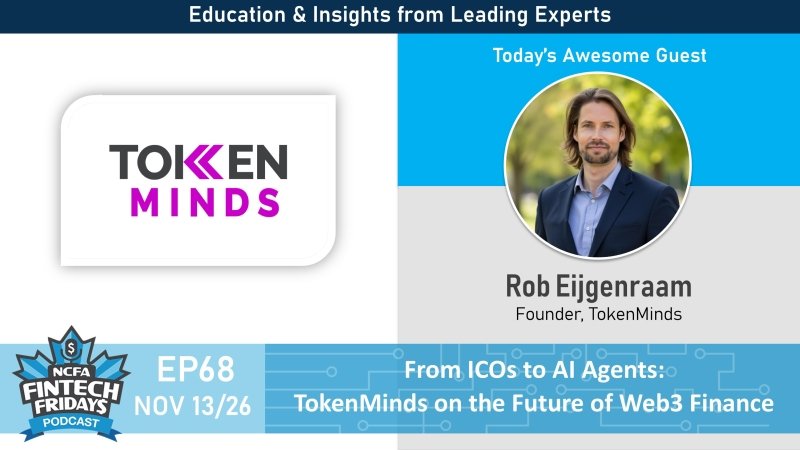
Rob Eijgenraam is the Founder of TokenMinds and Creator of TMX, a suite of blockchain and AI technology products. Based in Singapore, Rob helps established businesses outside the crypto industry develop token launches, fundraising strategies and Web3 products, with each project designed around a clear return on investment. An experienced entrepreneur with a background spanning Europe and Asia, Rob founded TokenMinds in 2017 during the early ICO boom. Over nearly a decade, he has navigated major crypto market cycles while expanding the company's capabilities in tokenization, blockchain development and AI-powered financial applications. Rob combines deep entrepreneurial experience with hands-on blockchain and AI execution. Working closely with CEOs, business owners and their advisors, he focuses on finding practical solutions that fit each company's commercial objectives and growth opportunities.
TokenMinds is an award-winning blockchain and AI firm that helps established businesses raise growth capital through token launches without giving up equity. Founded in 2017, TokenMinds has worked with more than 200 companies worldwide, supporting end-to-end solutions for token fundraising through innovative Web3 and AI strategies. Its services span tokenomics, fundraising strategy, investor outreach, blockchain development, token launches and post-launch support. Beyond consulting, TokenMinds has developed TMX, a suite of blockchain and AI technology products supporting token sales, vesting, staking and emerging financial applications. The company focuses on practical implementation and measurable commercial results, helping businesses explore new financing opportunities and build blockchain-based products. TokenMinds has been voted the #1 blockchain firm by HackerNoon, MSN and Finbold.
What if businesses could raise millions without giving up equity? Could token sales eventually compete with traditional stock offerings? And what happens when AI agents start managing wallets, trading assets and even launching their own cryptocurrencies?
In Season 4, Episode 68 of Fintech Fridays, NCFA Founder and CEO Craig Asano sits down with Rob Eijgenraam, Founder of TokenMinds, to explore what's happening at the intersection of tokenized fundraising, blockchain, artificial intelligence and capital markets. Drawing on nearly a decade of experience through crypto booms, market crashes and regulatory uncertainty, Rob shares how TokenMinds helps businesses assess token fundraising opportunities, attract investors and build token economies that have a purpose beyond speculation.
The conversation gets practical, examining a hypothetical $5 million token raise, the costs and risks involved, what investors actually want, and why some businesses should stick with conventional financing. Rob also challenges assumptions about real-world asset tokenization and explains why putting an asset on a blockchain doesn't automatically create investor demand.
Looking ahead, they explore tokenized stocks, secondary market liquidity, stablecoin payments, AI-powered financial services and autonomous crypto agents. Rob also discusses TokenMinds' work integrating AI and crypto payments with a major bank and shares his prediction for how token fundraising could evolve over the next five years.
Could tokens become a mainstream alternative to traditional capital raising? Tune in for a candid conversation about the opportunities, limitations and innovations that could define the next chapter of Web3 finance. Enjoy!
Duration: 1 hr 8 mins | Full Transcript
Checkout this not to be missed episode with NCFA Founder Craig Asano and Zach Smith, CEO and Co-Founder of Funded Today. In 2017, Zach delivered a keynote at NCFA's Canadian Crowdfinance Summit in Toronto after raising $150 million dollars. Fast forward to today, and the Funded Today machine has raised north of $426 million USD and counting. In this episode, learn what it takes to be a serial entrepreneur -- "It's not really about how much money you raise on the platform, it's about what you learn from the money that you've raised." They discuss the story of Funded Today, pivoting, diversifying investments, being strategic, doing what you love, and of course how to raise millions of dollars with rewards-based crowdfunding including a couple of real life examples. If you have an innovative project, gadget or piece of hardware, or have an app or board game and want to know if you can crowdfund dollars for it in 2022, tune in now....grab a cup of your favourite and dig in. Enjoy! (FULL TRANSCRIPT)
On this Season 4 kickoff episode, NCFA Founder Craig Asano sits down with the incredible Anne-Marie Fannon, Director, Work-Learn Institute at the University of Waterloo, to better understand the motivations and needs of the next major human capital resource - Gen Z. If you're a start-up, scale-up or HR professional seeking intel on an emerging tech savvy, innovative, and talent asset class then this podcast is for you. Tune in now and learn not just the how but also the why you should be building relationships with Gen Z today. Enjoy! (FULL TRANSCRIPT)
10 years ago in 2012, the Jumpstart Our Business Startups Act (JOBS Act) was signed into law in the U.S. (and eventually a similar exemption was approved in Canada) to encourage more capital to flow to startups, support innovation, and, create jobs. It's significance cannot be understated as the rule change allowed private companies to raise capital by selling securities digitally for the first time via registered online platforms and dealer-brokers. Regulation crowdfunding also democratized previously excluded retail investors (non-accredited) by allowing them to invest directly in startup ventures empowering a new era of digital finance.
A tremendous amount of advocacy and regulatory change efforts took place to make this happen, and since then, the original JOBS Act rules were improved for investment crowdfunding in the U.S., such as increasing the fundraising cap from US$1 million to US$5 million (not in Canada though, we've asked for years ahem). But there are still many challenges and myths to be debunked. While venture financings are at an all time high in sectors like fintech, it does not mean that startups are awash with capital. While there is growing interest among retail investors to participate directly in these offerings, and take control of their investment future, education and awareness still remains a top priority if industry is to grow in the right ways. Having said that, in the United States, RegCF recently surpassed $1billion raised. Canadian figures are more modest with at least CA$100 million in equity financings raised on a leading platform.
Today there's also a JOBS Act 2022 proposal on the table but will these changes be sufficient to support evolving technologies and their capabilities while also protecting investors? Regulatory change is slow and regulators should support innovation and competition. All stakeholders need to continue to support efforts to make capital markets whole, so EVERYONE can benefit from the advancements in technology or the wealth gap will continue to widen.
This is a not to be missed episode for anyone interested in the past or future of digital finance and capital markets. Join investment crowdfunding pioneers in both Canada and the U.S. who discuss the 10 year journey from a wide variety of perspectives including the evolution of first generation marketing platforms to the arrival of second generation decentralized finance models powered by blockchain technologies.
Duration: 92mins
For anyone who needs to make complex decisions or wants to add more clarity into their lives by applying modern risk management techniques, then this one is for you. Join NCFA Founder, Craig Asano, who sits down with Alex Sidorenko, the CEO and Chief Risk Officer of the Risk Academy and Founder of Risk Awareness Week, one of the largest risk management conference programs in the world. They discuss the commoditization of science, horoscope fairy tales, beating the bear and how intuition may not always be your best friend (in some scenarios). Understand the difference between risk management for ‘box tickers’ vs modern techniques, generators vs users, virtual data, and how to think about risk management to electrify decision-support for any problem in your business or life. Enjoy!
Duration: 69mins
On this week's episode of the Fintech Friday Podcast, our host Manseeb Khan sits down with Maria Konikov, Director of Operations at York Entrepreneurship Development Institute (YEDI). They talk about why education is crucial for entrepreneurs, how YETI offers tuition-free programs for Canadians, and what makes their diploma so special? Could it be because they have diploma program allows entrepreneurs to apply their learnings directly to their business and is taught by experienced professors who are also successful entrepreneurs? Enjoy!! (Full Transcript)
Duration: 25mins
In this insightful episode of "Fintech Fridays," we dive into the evolving landscape of small business financing with David Souaid, the Chief Revenue Officer of OnDeck Canada. David brings over two decades of experience in the fintech industry and shares his journey from co-founding Evolocity Financial Group to its merger with OnDeck Canada, illustrating his role in transforming small business lending. The discussion delves into the challenges and innovations in the industry, highlighting OnDeck's customer-centric approach, technological advancements, and future trends. David's insights reveal how OnDeck Canada is not just financing businesses but also empowering them to thrive in a dynamic economic environment. This episode provides a valuable perspective on the transformative world of fintech, especially in the realm of small business lending, and is a must-listen for entrepreneurs and industry enthusiasts seeking to understand the future of financial services. Enjoy!! (Full Transcript and Video)
Duration: 45mins
In this enlightening episode 61 of Fintech Fridays, NCFA Founder, Craig Asano, sits down with Kay Khemani, an investment professional based in London, UK, the Co-Founder of the Phoenix App, and Managing Director of Hatchworks. Kay shares his journey from high finance at Goldman Sachs to the forefront of fintech innovation. Explore the revolutionary Phoenix app, a platform that simplifies market making in the crypto world, allowing users to become liquidity providers and earn from transaction fees, all simplified through smart contract technology. Learn about the risks and rewards of DeFi, the impact of ETFs on crypto markets, and gather essential insights for both new and seasoned investors. Enjoy!! (Full Transcript and Video)
Duration: 62mins
In this enlightening episode of Fintech Fridays, Season 4, Episode 62, host Craig Asano, founder and CEO of NCFA Canada, sits down with the distinguished Sherwood 'Woodie' Neiss, a pioneer in the investment crowdfunding industry and an advisor to NCFA. Together, they delve into the evolution of investment crowdfunding, its impact on startups and investors alike, and the potential for future growth. Woodie shares his journey, from the inception of crowdfunding regulations to leading the charge with data-driven insights and AI technology in investment strategies. Listeners will gain an insider's perspective on the latest developments, the significance of data in shaping the industry, and the role of technology in advancing investment opportunities. Whether you're an investor, entrepreneur, or fintech enthusiast, this episode offers a comprehensive look into the dynamic world of investment crowdfunding, revealing how it's reshaping the landscape of finance and opening new doors for innovation and growth. Enjoy!! (Full Transcript and Video)
Duration: 45 mins
In this episode of Fintech Fridays, host Craig Asano sits down with Marcia Dawood, an influential angel investor, author, and advisor who serves on the SEC's Small Business Capital Formation Advisory Committee. Marcia shares her journey from her first angel investing meeting to becoming a key figure in the industry, supporting over 50 early-stage companies. The conversation dives into the differences between angel investing and venture capital, strategies for successful investments, and the evolving landscape of early-stage investing. Marcia also discusses her new book, Do Good While Doing Well, which guides readers through the balance of achieving financial returns while making a positive impact. Tune in to hear expert insights, the importance of fostering diverse investment ecosystems, and how new investors can start their journey with confidence. Enjoy!!
Duration: 57 mins | Full Transcript
In this episode of Fintech Fridays, Craig Asano sits down with Shael Weinreb, Founder and CEO of The Home Equity Partners, to unpack a financing gap that hits many Canadian homeowners hard. Shael explains how HEQ’s Home Equity Sharing Agreement (HESA) gives homeowners another way to access equity without taking on a traditional loan, monthly interest payments, or the pressure that comes with a refinancing decision. He also shares the personal story that sparked the business after his father, despite holding substantial home equity, could not access the funds he needed through a bank.
The conversation goes beyond product basics. Shael breaks down how the HESA model works in practice, where it may fit better than a HELOC or reverse mortgage, and why education remains one of the biggest challenges when introducing a new financial category to the market. He also talks candidly about founder pressure, resistance to innovation, and why he believes Canadians need more choice as rigid lending practices leave too many homeowners stuck between valuable assets and weak cash flow. Enjoy!!
Duration: 53 mins | Full Transcript
Most entrepreneurs focus on building the business. Far fewer understand that a single signature on a loan agreement could put their personal savings, investments, and even their home at risk. In Season 4 Episode 65 of Fintech Fridays, Craig Asano sits down with Craig Arnatt, Founder and CEO of PGI Cover, to unpack one of the most overlooked risks in entrepreneurship: the personal guarantee. Craig explains why lenders require them, how they affect founders, business owners, and acquisition buyers, and what can happen when a business loan goes into default. The conversation explores the launch of Personal Guarantee Insurance in Canada, why the product has gained traction internationally, and how Canada's growing business succession wave could create new demand as entrepreneurs, search fund acquirers, and M&A buyers increasingly rely on leveraged financing to acquire businesses. Craig also shares insights from more than two decades in commercial insurance and insurtech, discusses the role of AI in underwriting and risk assessment, and explains how embedded insurance and fintech partnerships could help bring protection directly into financing workflows. Whether you're raising capital, buying a business, advising clients, or lending to entrepreneurs, this episode offers a practical look at a risk that is often buried deep inside loan agreements but can have life changing consequences when things go wrong. Enjoy!!
Duration: 108 mins | Full Transcript
What does it take to build a lending business that has deployed nearly $1.5 billion to small businesses over 17 years?
David Gens is the Founder and CEO of Merchant Growth, a Canadian digital financing platform for small businesses. After graduating from UBC with a Bachelor of Commerce in Finance, David began his career as an analyst at private equity firm CAI Capital Partners. In 2009, at just 22 years old and in the aftermath of the global financial crisis, he founded Merchant Growth to help address the gap in access to capital for Canadian small businesses. Over the past 15 years, Merchant Growth has helped more than 15,000 businesses access over $1 billion in financing through technology enabled lending solutions. David also leads Merchant Opportunities Fund and has been recognized as a Business in Vancouver Top 40 Under 40, BC Business Top 30 Under 30, and an EY Entrepreneur Of The Year finalist. Enjoy!!
Duration: 1 hr 10 mins | Full Transcript
What happens when AI starts collecting debt? Could a machine make better decisions than a human, and would you trust it with your financial future?
In Episode 67 of NCFA Fintech Fridays, host Craig Asano sits down with Chris Maranis, Deputy CEO of EXUS, a global leader in debt collection and credit risk software, to explore how AI is changing the way banks recover debt, engage with customers and manage financial hardship. With over 20 years of international experience, Chris explains what's actually changing in debt collection as banks introduce predictive analytics, generative AI and autonomous agents. From AI negotiating repayments to detecting customers in financial difficulty, there's plenty happening already. But where should banks draw the line between automation and human judgment? Through practical scenarios, Chris tackles some tough questions about AI, fairness and accountability. He also shares EXUS's expansion into Canada, its work with a major Canadian bank and what's coming next from the company's AI innovation team. It's a fascinating look at how far AI can go in banking, what lenders are willing to automate, and why the toughest decisions may be the ones they can't hand over to a machine. Tune In!!
Duration: 1 hr 6 mins | Full Transcript
General enquiries: m.legat@exus.co.uk
Headquarters: 4 Felstead Gardens, Cubitt Town, London E14 3BS, UK.
EP1-Jul 20: Global Crypto Payments and the Future of Digital Assets (CoinPayments)
EP2-Jul 27: Canada's Role in the Global Fintech Ecosystem (Fintech Growth Syndicate)
EP3-Aug 3: Doubling Down on Female Founders (Roar Ventures)
EP4-Aug 10: Importance of a Smart Contract Safety Net (Sagewise)
EP5-Aug 17: First Coin's M&A Story - Wall street meets Crypto (Galaxy Digital Canada)
EP6-Aug 24: Asian Crypto Markets meet Canadian talent (Fintech Association of Hong Kong)
EP7-Aug 31: Structuring an ICO and the Mind of a Fintech-preneur (Pegasus Fintech)
EP8-Sep 7: Institutionalization of Crypto, China’s Ban and the Potential of Blockchain Decentralization (NexChange)
EP9-Sep 14: New SmartPay Product & Front-line of Global Digital Payments (Curexe)
EP10-Sep21: A Regtech-based Blockchain KYC Solution for Document Custody (Commercial Passport)
EP11-Sep 28: How Amazon Bank is Dominating and Risks of a Digital Bifurcated World (Schulte Research)
EP12-Oct 5: Building Blockchain Products & Decentralizd Solutions for Enterprise and Start-ups (Northern Block)
EP13-Oct 12: Road to Fintech IPO: Capital Networks, Scalable Solutions, Putting People First (Progressa)
Ep14-Oct 19: The Convergence of Data Intelligence and Money Algorithms (Senso.ai)
Ep15-Oct 26: Gearing up Hyperion Exchange, Hybrid Models and Security Tokens (Hyperion Technologies)
EP16-Nov 2: Envisioning the Future of Open Banking for Consumers and Businesses (Lending Loop)
Ep17-Nov 9: How Artificial Intelligence is Optimizing Sales and the Future of Business AI (Fortuna.ai)
Ep18-Nov 16: Bridging the AML/ATF Gap with Financial Institutions and the New Economy (Coinsquare)
Ep19-Nov 23: Future of Business Tokenization and How Blockchain Challenges Concept of Money (TokenFunder)
Ep20-Jan 11: Bitcoin Backed Loans and 2x Credit - Putting Your Crypto to Work (Mauricio Di Bartolomeo)
Ep21-Jan 18: Meritocracy, Decentralized Innovation and the Power of Collaboration (Hussein Hallak)
Ep22-Jan 25: Reducing Regulatory Burden by 25% in Ontario (Amar Nijjar)
Ep23-Feb 1: Getting Smart About Crypto and Insurtech Snapchat Models (Justin Hartzman)
Ep24-Feb 8: Re-imagining Philanthropy (Daryl Hatton)
Ep25-Feb 15: Unlock the World (Kate Guimbellot and Jason Sosnowski)
Ep26-Feb 22: Investing in Private Canadian Companies (Peter-Paul Van Hoeken)
Ep27-Mar 1: Blockchain Gaming and esports (Shidan Gouran)
Ep28-Mar 8: Rethinking Brokers (Muhammad Rashid)
Ep29-Mar 22: The Future of Securities (Richard Carleton)
Ep30-Apr 12: The Future of Canadian Crypto (Andrei Poliakov)
Ep31-May 14: Blockchain Law (Jason Saltzman)
Ep32-May 24: Rallying behind Bitcoin (Frederick T. Pye)
Ep33-May 31: Indexing Consumer Loans and Financial Literacy (Phillip Postrehovsky)
Ep34-Jul 6: Accelerating Fintech Growth (Brendan Holt Dunn)
Ep35-Aug 9: Autonomous Alternative Lending (Vit Arnautov)
Ep36-Aug 22: Techfins (Michael King)
Ep37-Sep13: Funding is Female (Jill Earthy)
Ep38-Mar25: Why Identity Matters in an Evolving Online Environment (David Lucatch)
Ep39-Apr23: The Power of Digitization and How to Get Exponential (James Wallace)
Ep40-May22: Why Bitcoin Exists and Education for the Masses (Austin Hubbell)
EP41: 40% pandemic growth, taking risks and innovating Insurtech in Canada (Danish Yusuf, Zensurance)
EP42: Insights into the Teen Banking Sector and Improving the Financial Well-being of Families (Rim Charkani, WALO)
EP43: Taking the Mortgage Process From 40 Days to Minutes (Chris Gries, FundMore.ai)
EP44: The Vanguard of Digital Innovation and Ecosystems in Canada (Various NCFA Advisors)
EP45: Mission-driven and Consumer-centric Financial Services (Keith Taylor, DUCA Impact Lab)
EP46: Making Business Borderless: International Payments and Partnerships (Alastair Thompson, TransferWise)
EP47: How to Change the World: Risk Culture and Work-life Balance (Michelle Beyo, Finavator)
EP48: How to Connect and Resonate with Customers Through Podcasting (Fatima Zaidi, Quill Inc.)
EP49: Managing Private Placements Has Never Been Easier (Brock Murray and Karan Khiani, Katipult)
EP50: Compliance to the moon (Mark Binns, Digital Assets Inc.)
EP51: Bacon and Eggs (Julien Brault, Hard Bacon)
EP52: Technology Due Diligence Process and Cyber Security Risks (Forward Security, CIBC, RiskAware Group)
EP53: Staying True to Bitcoin (Chris Naprawa, TAAL)
EP54: How Digital Identity will Transform Human Potential (David Lucatch, Liquid Avatar Technologies)
EP55: Global hiring trends: How Gen Z Talent Thrives (Anne-Marie Fannon, Work-Learn Institute, University of Waterloo)
EP56: How We Raised $426 million Using Rewards Crowdfunding (Zach Smith, Funded Today)
EP57: 10 Years of Investment Crowdfunding: Past, Present, and Future Since the Act (Expert Advisors)
EP58: Using Risk Management to Improve Your Business and Life (Alex Sidorenko)
EP59: Master Entrepreneurship with YEDI! (Maria Konikov)
EP60: Revolutionizing Small Business Lending and Empowering Entrepreneurs (David Souaid)
EP61: Making Markets and Investing in Crypto with the Phoenix App (Kay Khemani)
EP62: The Future of Investment Crowdfunding: Innovations, Data, and Opportunities (Sherwood 'Woodie' Neiss)
EP63: From Angel Investor to Change-Maker: Investing with Impact (Marcia Dawood)
EP64: House Rich Cash Poor And The New Home Equity Playbook (Shael Weinreb)
EP65: Personal Guarantees: The Most Expensive Autograph an Entrepreneur Can Sign (Craig Arnatt)
EP66: What It Takes To Build $1.5 Billion In Small Business Lending (David Gens)
EP67: Can AI Replace Debt Collectors? (Chris Maranis)

The National Crowdfunding & Fintech Association (NCFA Canada) is a financial innovation ecosystem that provides education, market intelligence, industry stewardship, networking and funding opportunities and services to thousands of community members and works closely with industry, government, partners and affiliates to create a vibrant and innovative fintech and funding industry in Canada. Decentralized and distributed, NCFA is engaged with global stakeholders and helps incubate projects and investment in fintech, alternative finance, crowdfunding, peer-to-peer finance, payments, digital assets and tokens, blockchain, cryptocurrency, regtech, and insurtech sectors. Join Canada's Fintech & Funding Community today FREE! Or become a contributing member and get perks. For more information, please visit: www.ncfacanada.org
| | |
|---|---|---|
| | |
OBIE UK | Jan 6, 2022
 As part of new research conducted for the Open Banking Implementation Entity (OBIE) by independent research agency Marketing Means, we interviewed a small number of UK consumers, from a wide range of age groups and income brackets, who shared their experience of the market-leading savings apps.
Open banking savings apps offer a handy, ‘low impact’ way of helping individuals to save.
This works in two ways: providing an additional means of saving for more established savers, or in some cases, provide a way of saving to individuals who have otherwise struggled to do so.
A. “I really like the saving round-up feature. I’d say overall they’ve met my expectations and exceeded them. And using it, I’ve matured as a saver.”
A. “It’s all very easy. How much goes in varies, as it runs itself in the background, but I really like the way I can slow down or speed up the savings rate through the app. It really gives me confidence that if I’m having a heavy week, I can adjust it.”
A. “I save through two apps. One has a fairly standard account but there are some issues with getting money out of that one. I’ve had some delays on withdrawals, so I tend just to leave the money in there. On the other app, I’m more engaged as I’ve got money going into two funds. One is a standard one but the other one has a higher risk rating. I enjoy doing that one. It’s satisfying seeing what happens with it, and fun as well.”
A. “The advantage was, I didn’t want to replace my bank account, so I didn’t want to go down a Monzo route. I wanted an additional savings facility that would link to different accounts I have.”
A.”I really like how the app slows me down. Because it’s a restricted access, I can’t just dip into it as I have done in the past with others. But also, that makes me reflect and means I can think about my money more. It’s changed the way I am with money, for the better.”
A. “I like the flexibility. You can dial the savings rate up and down. You can boost a payday. I can use it flexibly to save when I’ve had a bonus. And I like the way they describe the investment plans – ‘standard’, ‘balanced’ – I think that’s a useful way to explain them, easy to understand. The app has a really good dashboard, it almost feels as if you’re getting a bespoke savings service that’s easy to use.”
A. ” I was attracted by the way it saves in the background, so you hardly notice it’s happening. When I started, I thought I’d build up a substantial fund really quickly. I’ve got a more realistic view now, but I’m still really happy with it.”
The National Crowdfunding & Fintech Association (NCFA Canada) is a financial innovation ecosystem that provides education, market intelligence, industry stewardship, networking and funding opportunities and services to thousands of community members and works closely with industry, government, partners and affiliates to create a vibrant and innovative fintech and funding industry in Canada. Decentralized and distributed, NCFA is engaged with global stakeholders and helps incubate projects and investment in fintech, alternative finance, crowdfunding, peer-to-peer finance, payments, digital assets and tokens, blockchain, cryptocurrency, regtech, and insurtech sectors. Join Canada's Fintech & Funding Community today FREE! Or become a contributing member and get perks. For more information, please visit: www.ncfacanada.org
| | |
|---|---|---|
| | |
Rich Thinking | Jan 6, 2022

Businesses focused on fintech are hardwired to fulfill customer needs, reduce customer pain points, and introduce new ideas that shape a better experience. Early stage startups may have more flexibility to shape their brand, product, or culture, but even larger organizations that are looking to make a similar pivot are finding value in making a change from the norm.
Startups are fast at testing and iterating. As a product marketing consultant for fintech startups, validating product-market fit is essential for hypergrowth and sustainability. Once achieved, it takes smart, customer-focused decisions to drive ultimate success, starting from product to brand, and from customer service to culture. These mechanisms also include rigorous reassessments to ensure they’re adapting to a continuously evolving landscape.
Successful financial businesses, regardless if it’s a large organization or an early-stage startup, adhere to these core elements.
Your customer wants to work with other humans.
It’s unfortunate, but for customers in modern times, placing trust in businesses is at an all-time low. Modern brands are focusing on enabling human emotions within their business. It reflects on virtually every aspect of their public-facing self: ad headlines, PR, packaging, content marketing, and “meet the team” segments from the top down. Customers feel greater trust when they can see the people working behind the scenes.
One important takeaway: humanize the brand, brand the human. Ultra successful organizations brand their management team as experts themselves. That may be why more fans follow Elon Musk or Mike Novogratz on Twitter over their respective company brand accounts.
Your customer wants an easier life.
It’s no secret that AI tools, such as robo-advisors, have taken market share from traditional financial institutions. A product should make the customer experience simple without sacrificing time or money, and at best, minimizes the customers' need to think. It begins by answering questions for them. If your customers have a preferred communication channel, make the necessary changes to accommodate that.
In most cases, ideas that simplify your customers' lives may be deemed as too much of a resource hog internally. However, a closed mindset will inevitably lead to another company stealing market share from you.
Your customer wants honesty.
From a customer POV, offering greater transparency during financial transactions has become a standard.
Hidden fees have always been a crux for customers. Wise (formerly Transferwise) made the smart move to not only offer lower fees for currency conversion, but their transfer screen also includes a detailed breakdown of where each dollar is going (while simultaneously showing how much they’re saving compared to competitors like PayPal). It’s the little things that count.
Your customer wants to be heard.
Better service is always a primary motivator for retention. However service-driven initiatives need to continually evolve to keep up with customer expectations. Scrap initiatives that are outdated.This can only be achieved by creating a feedback loop in your customer lifecycle that is repeatable and actionable.
Lastly, take ownership when bad service is apparent. Accountability and humility can go a long way to not only those affected, but those watching from the sidelines.
Your customer isn’t a number.
Digging deeper into your customer personas can help your product and marketing efforts. While it’s easier to see your customer base as defined by a few lines of text, defining your audience into numerous segments and increasing granularity will better define your scope as a business. Never default to treating your customers like a number. Focus on developing better segmentation in your CRM to optimize your customer funnels.
Your customer wants to work with a winner.
Thought leadership is essential in building a successful business. Budget planner Mint revolutionized the industry by focusing on delivering content that educated prospective and current customers with the knowledge needed to plan and meet their financial goals. Your content team, which consist of content creators and subject matter experts, need a sound strategy that focuses on answering customer questions - whether they’ve thought it up first or not.
Your customer wants to work with good companies.
Having an organizational structure and strategy that supports diversity and inclusion is imperative. Embedding D&I initiatives into a company culture begins with recurring training sessions and fostering open communication, but it also means changes to hiring practices from both management and non-management roles. Organizations that support D&I in its foundation unlock greater hiring capacities, stronger customer onboarding and retention, and a healthy work culture.
Financial organizations are continuing to fine-tune their culture and product/marketing strategy to reflect the changing directions of their customer base. In order to succeed, startups and large organizations in financial services need to adopt a mindset that is adaptive, open-minded, and forward thinking.

Reggie Tan, Founder of Rich Thinking, is a senior growth hacker and marketing strategist, with specialization in fintech, cryptocurrency, and blockchain applications.

The National Crowdfunding & Fintech Association (NCFA Canada) is a financial innovation ecosystem that provides education, market intelligence, industry stewardship, networking and funding opportunities and services to thousands of community members and works closely with industry, government, partners and affiliates to create a vibrant and innovative fintech and funding industry in Canada. Decentralized and distributed, NCFA is engaged with global stakeholders and helps incubate projects and investment in fintech, alternative finance, crowdfunding, peer-to-peer finance, payments, digital assets and tokens, blockchain, cryptocurrency, regtech, and insurtech sectors. Join Canada's Fintech & Funding Community today FREE! Or become a contributing member and get perks. For more information, please visit: www.ncfacanada.org
| | |
|---|---|---|
| | |
Coindesk | Michael Bellusci | Jan 4, 2022
 The deal gives WonderFi one of Canada’s fastest-growing crypto platforms, adding 357,000 registered users.
DeFi platform WonderFi Technologies Inc. agreed to buy Canadian crypto exchange Bitbuy for C$206 million ($161.8 million) in cash and shares, bringing the ability to purchase crypto and access to decentralized finance (DeFi) under one roof.
WonderFi will pay with 70 million new shares and C$50 million ($39 million) in cash, the company said in a statement Tuesday.
The deal gives WonderFi one of Canada’s fastest-growing crypto platforms, adding 375,000 registered users. The combination will allow it to provide retail customers with an integrated system for buying and investing crypto as it seeks to become an end-to-end consumer platform.
“A licensed marketplace serves as a crucial gateway to the digital asset economy, and facilitates a robust end-to-end, unified client experience,” WonderFi CEO Ben Samaroo said in the statement. “The integration of Bitbuy’s product suite will accelerate and expand the reach and scope that WonderFi can offer to the market, and will drive long-term growth and value.”
Vancouver-based WonderFi closed a financing round in June that included strategic investor Kevin O’Leary. The company rebranded to WonderFi from Defi Ventures in a nod to O’Leary’s nickname as “Mr. Wonderful” from television shows “Shark Tank” and “Dragon’s Den.” WonderFi also credits the billionaire founder of crypto exchange FTX, Sam Bankman-Fried, as a strategic investor, according to its latest presentation.
O’Leary has been an advocate for crypto in recent months and said in a 2022 outlook that his largest position is in ether, the token of the Ethereum blockchain. He also said he owns Polygon (MATIC) and Solana, in addition to bitcoin.
Bobby Halpern, principal of Toronto-based Halpern & Co., acquired Bitbuy toward the beginning of 2018, when the exchange had about 500 customers and bitcoin prices were crashing. The company generated over C$31 million ($24 million) in revenue during the 12-month period ended Sept. 30, according to the statement.
The National Crowdfunding & Fintech Association (NCFA Canada) is a financial innovation ecosystem that provides education, market intelligence, industry stewardship, networking and funding opportunities and services to thousands of community members and works closely with industry, government, partners and affiliates to create a vibrant and innovative fintech and funding industry in Canada. Decentralized and distributed, NCFA is engaged with global stakeholders and helps incubate projects and investment in fintech, alternative finance, crowdfunding, peer-to-peer finance, payments, digital assets and tokens, blockchain, cryptocurrency, regtech, and insurtech sectors. Join Canada's Fintech & Funding Community today FREE! Or become a contributing member and get perks. For more information, please visit: www.ncfacanada.org
| | |
|---|---|---|
| | |
CBC Docs | Dec 30, 2021

Dead Man's Switch: a crypto mystery unpacks the mysterious and improbable story of Canadian CEO Gerald Cotten and his failed cryptocurrency exchange, QuadrigaCX. It's part of Hot Docs on CBC, a multiplatform festival-at-home experience providing Canadians with front-row access to titles from the 2021 Hot Docs Festival.
On November 30, 2018, 30-year-old Cotten travelled to India to open an orphanage and celebrate his honeymoon. Nine days later, he was allegedly dead due to Crohn's disease, and $215 million in cash and cryptocurrency were suddenly missing.
A month later, when his widow, Jennifer Robertson, announced his death to the world with a post on the Quadriga exchange website, creditors, journalists, regulators and cryptocurrency enthusiasts all jumped on the story. They were determined to get to the bottom of what happened to Cotten and who held the keys to the fortunes of 115,000 creditors.
Filmmaker Sheona McDonald fleshes out the story of Cotten's life, death and business dealings through interviews with skeptics like crypto-activist Mitch Airey and author David Gerard, independent journalists and financial analysts Amy Castor, Alexandra Posadzki and Taylor Monahan plus compliance regulators, friends and creditors suffering real and sometimes significant financial losses.
Every player has a different perspective on what happened, what didn't happen or what needed to happen. But with over $200 million worth of Canadian fiat and cryptocurrency lost, there is one question they all ask:
"Where's the money, Gerry?".
QuadrigaCX is not the first exchange to be hacked or go under, and it won't be the last. Questionable activity is a constant threat in a contemporary industry growing quickly in an unregulated environment. The fact that more than 100,000 clients trusted QuadrigaCX with their money and left their funds and coins on the exchange shows that we are used to trusting a regulated system of banking and securities. But what happens when there is no system to trust?
 The National Crowdfunding & Fintech Association (NCFA Canada) is a financial innovation ecosystem that provides education, market intelligence, industry stewardship, networking and funding opportunities and services to thousands of community members and works closely with industry, government, partners and affiliates to create a vibrant and innovative fintech and funding industry in Canada. Decentralized and distributed, NCFA is engaged with global stakeholders and helps incubate projects and investment in fintech, alternative finance, crowdfunding, peer-to-peer finance, payments, digital assets and tokens, blockchain, cryptocurrency, regtech, and insurtech sectors. Join Canada's Fintech & Funding Community today FREE! Or become a contributing member and get perks. For more information, please visit: www.ncfacanada.org
| | |
|---|---|---|
| | |
AIAuthority | | Dec 17, 2021
 Artificial intelligence is being used in an increasing number of industries and business categories, leading to a record year of revenues and investment in 2021. That trend will only accelerate in the coming year as the race to apply the technology to new industries and new purposes within leading industries leads to record numbers in venture capital and acquisitions.
It’s difficult to overstate the importance of AI as a systematic force; according to a Statista report, the AI industry generated some $35B in revenue in 2021, and is likely to increase that by 50 percent or more in 2022. On the other hand, it’s quite easy to overstate its effect in any single application. That it is a considerable part of the future of any software-based business is inarguable, but its power comes from being almost universally helpful, not a miracle solution for a particular problem.
Interested parties are looking beyond the hype and realizing the actual limits and potentials presented by the technology as a whole. The opportunities for advancing it fall into three general categories.
1. DATA which one might think of as the raw material for machine learning systems, is arguably the most important and one where we will see increasingly sophisticated competition and investment. Software has always been limited by the “garbage in, garbage out” idea and AI is no exception — and its designers are learning how much data is needed to avoid that trap. The US and China in particular have begun siloing their precious data stores and companies are hoarding wherever possible; the EU, with its tighter regulations on collection and storage of data, will likely lag in this respect due to fear of violating frameworks like the GDPR.
2. INTELLECTUAL PROPERTY in the form of actual models or machine learning engines and platforms is the next most important. One way to track this is in numbers of patents filed, a metric that puts US companies like IBM, Google, Microsoft, and Intel well out in front, with Korea’s Samsung and the EU’s Siemens behind. However, this picture is incomplete due to China’s unique approach to IP, and the shrewd observer will assume that, as in other measures, the country is likely competitive on the level of the US even if it’s difficult to reliably quantify its presence.
3. FUNDING: The last area of the competition is funding, which is, of course, important but hard to summarize. AI startups attracted some $36 billion in venture capital in 2020, and that number was surpassed within the first six months of 2021. This growth is impressive, but so is the investment by governments and research institutions that fund basic research and open-source projects often cited or iterated on in private research. China especially has dedicated tens and likely over a hundred billion towards AI research through direct funding or through corporations under government influence. Whatever the real numbers, they will only increase in the near and medium-term.
According to a Deloitte survey, half of all companies asked were bringing AI processes into their operations, and this number is likely to increase to 75 percent by 2023. But increasingly these companies are realizing that AI is a game-changer in a broad, systematic sense rather than a magic bullet.
The National Crowdfunding & Fintech Association (NCFA Canada) is a financial innovation ecosystem that provides education, market intelligence, industry stewardship, networking and funding opportunities and services to thousands of community members and works closely with industry, government, partners and affiliates to create a vibrant and innovative fintech and funding industry in Canada. Decentralized and distributed, NCFA is engaged with global stakeholders and helps incubate projects and investment in fintech, alternative finance, crowdfunding, peer-to-peer finance, payments, digital assets and tokens, blockchain, cryptocurrency, regtech, and insurtech sectors. Join Canada's Fintech & Funding Community today FREE! Or become a contributing member and get perks. For more information, please visit: www.ncfacanada.org
| | |
|---|---|---|
| | |


August 26th, 2025

January 4th, 2024

June 1st, 2021

September 9th, 2020

July 9th, 2018

January 3rd, 2018

September 25th, 2017

June 20th, 2017

May 10th, 2017

December 14th, 2016