





Karsten Wenzlaff, Advisor
August 26th, 2025
Karsten Wenzlaff is a Crowdfunding and Fintech Expert from Germany. He is Secretary-General of Digit[...]


Fundraising | Jan 22, 2026
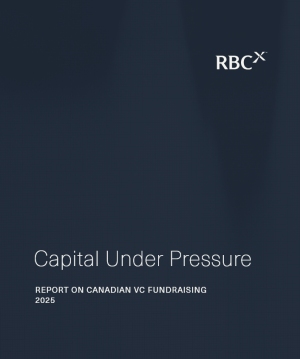
Image: RBCx Capital Under Pressure Canadian VC Fundraising Report 2025
In January 2026, RBCx released the Capital Under Pressure report on Canadian VC fundraising in 2025 (42 page PDF), with data analysis that examines how capital flows from investors into Canadian venture funds, and how those fundraising dynamics affect fund sizes, investor concentration, and the amount of capital available for new investments in founders.
The report shows Canadian VC firms raised just over $2.1B in 2025. This level sits well below the long term average of roughly $3.1B and places 2025 among the weakest fundraising years since 2016. A brief rebound in 2024 did not continue, indicating sustained pressure rather than a short term disruption.
Even with lower fundraising totals, 21 new venture funds completed their fundraising process in 2025. In plain terms, these funds finished raising investor commitments and became active for investing. The data shows that while total capital declined sharply, the number of new funds coming to market remained relatively steady with the adjustment occurring through smaller fund sizes rather than fewer funds being formed.
Capital concentration increased materially in 2025. The five largest Canadian venture funds captured 83% of all capital raised during the year, the highest level recorded in the dataset. This reflects investor behaviour in lower liquidity environments, where commitments concentrate around established managers rather than being spread across a broader range of funds.
Emerging managers raised $249M in 2025, the lowest annual total recorded in the report. In contrast, established managers accounted for the majority of new capital raised. The data shows fewer new and early stage funds accessing capital, narrowing the range of investors available to back companies at the earliest stages.
Reliance on federal capital programs has declined but remains significant. Capital linked to VCAP and VCCI accounted for 36% of total Canadian VC fundraising in 2025, down from 53% in 2015. While the share has fallen, government backed capital continues to anchor a meaningful portion of venture fundraising activity.
The composition of available capital shifted materially in 2025. Only 42% of remaining dry powder is available for new investments, with the majority reserved for follow on funding in existing portfolio companies. This is the lowest share of initial investment capital recorded and directly limits the amount of domestic venture capital available for new company formation.
Fund size compression accelerated in 2025. The median Canadian VC fund size declined to $29M, while the top quartile fell to $43M. Both figures represent the lowest levels observed since 2013, confirming that less capital is available per fund even as fund formation continues.
With less venture capital raised overall, higher concentration among a small number of large funds, and only 42% of remaining dry powder available for new investments, fintech founders should expect slower fundraising processes, narrower investor funnels, and higher expectations around proof of traction. In practical terms, this environment favours companies that can demonstrate clear revenue quality, customer retention, regulatory readiness, and capital efficiency earlier than in prior cycles.
In a climate where traditional VC funding is contracting, fintechs benefit from widening their capital strategy beyond venture capital alone. Non-dilutive programs that support technical development and commercialization, such as Eurostars international R&D collaboration programs, can extend runway without ownership dilution when equity capital is scarce. At the same time, alternative finance models, including equity crowdfunding, can provide more aligned and patient capital from users, customers, and sector participants when institutional funds slow initial investments.
These approaches do not replace venture capital, but they can strengthen balance sheets, validate market demand, and reduce dependency on a single capital source at a time when venture capital is increasingly selective.
For fintech founders, the takeaway is not to pause growth plans but to adapt capital strategies to the realities of the market. Stronger evidence, clearer execution, and diversified funding paths matter more than ever. Companies that treat capital raising as a multi channel strategy rather than a single event will be better positioned to navigate this cycle and remain competitive as conditions evolve.
 The National Crowdfunding & Fintech Association (NCFA Canada) is a financial innovation ecosystem that provides education, market intelligence, industry stewardship, networking and funding opportunities and services to thousands of community members and works closely with industry, government, partners and affiliates to create a vibrant and innovative fintech and funding industry in Canada. Decentralized and distributed, NCFA is engaged with global stakeholders and helps incubate projects and investment in fintech, alternative finance, crowdfunding, peer-to-peer finance, payments, digital assets and tokens, artificial intelligence, blockchain, cryptocurrency, regtech, and insurtech sectors. Join Canada's Fintech & Funding Community today FREE! Or become a contributing member and get perks. For more information, please visit: www.ncfacanada.org
 |  |  |
|---|---|---|
 |  |  |
Global R&D Funding Program | January 22, 2026

Image: Freepik
The Eurostars Call 10 is a live international R&D funding program open to small-and-medium-sized enterprises in participating countries, with applications due March 19, 2026. Described by the National Research Council of Canada as the world’s largest international R&D funding program for SMEs, Eurostars focuses on collaborative projects that lead to commercialization. Canadian SMEs can participate and receive advisory services and non-dilutive funding through NRC IRAP when collaborating with eligible partners abroad.
For Canadian fintech companies, this creates an opportunity to collaborate internationally on core technology development while keeping operations and control in Canada. The key question is not whether fintech qualifies as a category, but whether a specific project involves building technical solutions that cannot be resolved with routine engineering and fits the program’s collaboration and commercialization requirements.
The focus is practical. Build new technology, solve real technical problems, and bring the results to market. The program operates under the European Partnership on Innovative SMEs and is co-funded through Horizon Europe, with each country supporting its own participants under national rules.
Eurostars is sector neutral. It supports companies developing new technology through structured R&D and doesn't fund general business expansion or product launches on their own. Eligibility depends on whether the project involves real R&D effort, not on how the company or sector is labeled.
For Canadian companies, NRC IRAP provides advisory services and funding support under Canadian eligibility rules.
Fintech projects tend to fit when teams are building technology rather than assembling existing components. Projects may qualify when they involve developing technical solutions around performance, security, scalability, or governance that go beyond standard implementation.
This can include new payment or settlement infrastructure, fraud or risk systems that require experimentation to reach acceptable accuracy, secure identity or data architectures, or AI driven financial systems where existing approaches fall short. In each case, R&D must be central to whether the project succeeds.
In practice, fintech work that focuses mainly on integrating existing platforms, launching commercial products using off the shelf systems, or scaling operations without new technology development usually falls outside scope.
Canadian SMEs seeking funding through Eurostars must be NRC IRAP clients and meet both Eurostars and Canadian eligibility requirements. At a minimum, companies must be incorporated and profit-oriented in Canada, have 500 or fewer full time equivalent employees, and have been operating for at least 12 months. By the NRC IRAP registration deadline, companies must also have at least five full time equivalent employees on Canadian payroll.
Applicants must demonstrate the financial and operational capacity to carry out a multi year international R&D collaboration while maintaining regular operations, along with a credible plan to commercialize the results in global markets. For Canadian participants, NRC IRAP funding is capped at $500,000 CAD per project over a maximum duration of 36 months.
Full eligibility rules and call requirements are outlined on the official Eurostars Call March 2026 program page.
An official Eurostars information webinar for applicants takes place on January 22, 2026 and will be recorded.
Canadian SMEs must be eligible for support through NRC's Industrial Research Assistance Program. Canadian firms that are not yet NRC IRAP clients must complete registration by February 17, 2026. Contact 1-877-994-4727
Canadian SMEs that are already registered with NRC IRAP, or that have confirmed eligibility with an NRC IRAP advisor, must submit their registration of interest and application for the Eurostars call through the NRC IRAP international expression of interest form.
The Eurostars application deadline is March 19, 2026 at 2 pm CET.
Eurostars gives Canadian fintech companies a structured way to collaborate internationally on R&D while accessing non-dilutive funding through NRC IRAP, without relocating operations or shifting governance outside Canada. Canadian participants work with European partners to build technology with global commercial potential while remaining funded under Canadian rules.
For fintech teams with global ambitions, Eurostars can help turn locally built innovation into internationally relevant technology. The program looks at what is actually being built. Companies that understand this distinction early save time and approach the opportunity with realistic expectations.
The National Crowdfunding & Fintech Association (NCFA Canada) is a financial innovation ecosystem that provides education, market intelligence, industry stewardship, networking and funding opportunities and services to thousands of community members and works closely with industry, government, partners and affiliates to create a vibrant and innovative fintech and funding industry in Canada. Decentralized and distributed, NCFA is engaged with global stakeholders and helps incubate projects and investment in fintech, alternative finance, crowdfunding, peer-to-peer finance, payments, digital assets and tokens, artificial intelligence, blockchain, cryptocurrency, regtech, and insurtech sectors. Join Canada's Fintech & Funding Community today FREE! Or become a contributing member and get perks. For more information, please visit: www.ncfacanada.org
| | |
|---|---|---|
| | |
Canada | January 20, 2026
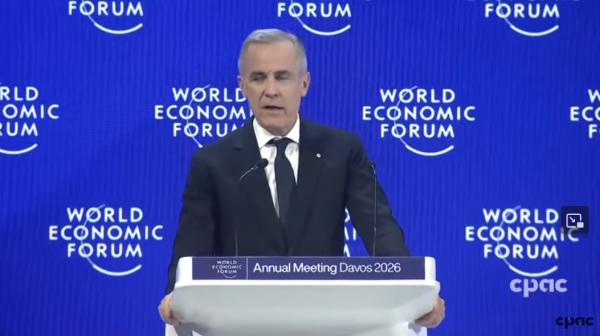
Image: PM Mark Carney, WEF 2026 at Davos
Some speeches try to calm markets. Others try to project confidence. Prime Minister Mark Carney’s special address at the 2026 World Economic Form in Davos does neither. Instead, it speaks plainly about where the world actually is, and Canada's place in it.
Carney doesn't describe today’s global system as temporarily strained or waiting to reset. He treats fragmentation, pressure, and mistrust as conditions we are already living with. Economic openness no longer guarantees cooperation. Integration no longer guarantees stability. For countries like Canada, assuming otherwise is not optimism. It is exposure.
That is why this speech lands with unusual weight. It is not aspirational. It is not dressed up. It is grounded in reality.
A central message running through the address is uncomfortable but clear. The idea that a neutral, rules based international order reliably protects middle powers no longer holds in practice.
Trade becomes leverage. Markets get weaponized. Finance turns into a geopolitical arena. In that environment, scale matters, and countries without it cannot rely on habit or goodwill.
Carney does not try to soften this. He acknowledges directly that economic integration itself can be used as a tool of pressure. That recognition marks a break from the language Canada has leaned on for decades.
For Canadians, the message touches jobs, prices, housing, supply chains, energy, investment, and long term growth. For fintechs and financial institutions, it goes even deeper.
Payments infrastructure, capital markets, data flows, compliance frameworks, and cross border operations all depend on trust based systems. When those systems weaken, risk shows up in cost, friction, and constraint.
Ignoring geopolitics does not insulate innovation. It makes it more fragile.
Another core message in PM Carney's address is that in a fractured world, drift is a decision. It means allowing outcomes to be set by external forces through inaction, habit, or default choices rather than deliberate strategy.
Canada cannot assume that openness will persist by default or that others will protect shared systems out of principle. It has to participate actively in building coalitions, standards, and partnerships that still value predictability and accountability.
That kind of leadership is less comforting than the past. It requires clarity, coordination, and follow through rather than rhetoric.
The delivery matters. Carney speaks without inflated promises. No slogans. Just a steady assessment of risk, responsibility, and constraint shaped by experience inside global financial systems.
PM Mark Carney's speech is candid acknowledgement of a new phase of Canadian engagement with the world. One that names limits, acknowledges pressure, and treats resilience as something that must be designed rather than assumed. That is the work ahead, to modernize Canada’s financial systems and infrastructure with purpose and impact, at scale and with urgency.
The National Crowdfunding & Fintech Association (NCFA Canada) is a financial innovation ecosystem that provides education, market intelligence, industry stewardship, networking and funding opportunities and services to thousands of community members and works closely with industry, government, partners and affiliates to create a vibrant and innovative fintech and funding industry in Canada. Decentralized and distributed, NCFA is engaged with global stakeholders and helps incubate projects and investment in fintech, alternative finance, crowdfunding, peer-to-peer finance, payments, digital assets and tokens, artificial intelligence, blockchain, cryptocurrency, regtech, and insurtech sectors. Join Canada's Fintech & Funding Community today FREE! Or become a contributing member and get perks. For more information, please visit: www.ncfacanada.org
| | |
|---|---|---|
| | |
January 20, 2026
Want to Accept Credit Cards Without Getting Rejected?
Needless to say, every business needs payment processing to function.
But there's a problem…
Not every business gets approved for a merchant account. Some businesses are immediately deemed "high-risk".
These companies face large obstacles when applying for merchant accounts.
The good news?
Learning how risk classification works will help any business understand how payment processing truly works.
Let's take a look!
Processors and banks evaluate every business before approving them.
They want answers to one question…
How likely is this business to cost me money?
With this question in mind, banks assign your business a risk level. Every business falls into one of three categories.
Your risk level determines your processing rates, contract terms, and if you get approved at all.
Specialised high-risk business payment solutions have become necessary for certain industries. Finding the right high-risk merchant account provider can mean the difference between growing your business or getting denied payment processing completely.
But here's the kicker…
The fintech industry is huge.
According to Research and Markets, fintech services reached $1.86 trillion in 2025 and will grow to $2.93 trillion by 2030. The report estimates that fintechs (segmented by payment methods such as card) continues to benefit from the amount of consumers and businesses who need payment processing.
Millions of new businesses apply for merchant accounts every year. That means more businesses than ever need specialized high-risk processing solutions.
Alright, let's dig in…
Payment processors review businesses based on several different criteria. Below are the most important factors.
Bear with us…
Industry: Some industries are immediately considered high risk. Gambling, CBD, nutraceuticals, adult, travel, and subscription based businesses often get flagged.
Chargebacks: High chargeback amounts and ratios indicate a problem. When customers dispute charges frequently, processors take notice.
Credit History: Processor's will run your business and personal credit when approving your account. Poor credit = red flag.
Transaction Style: Riskier transaction styles include high ticket sales, card not present, and international businesses.
Age of Business: New businesses with little to no processing history are scrutinized more.
Did you know…
According to Mastercard's chargeback report, chargeback volume worldwide is projected to increase 24% from 2025-2028. High-risk industries with the highest average chargeback amounts are gambling ($143) and crypto currency exchanges ($124).
This is why your risk level matters.
Not all payment processors work with all business types.
When searching for a processor, look for ones that work with your specific industry.
Below are 4 of the top providers:
Compare all 4 Providers
| Provider | Approval Speed | Monthly Payout | Payment Methods | Once Offered |
|---|---|---|---|---|
| 2Accept | Fast | Instant | All Major Cards | Yes |
| PaymentCloud | Varies | Daily | All Major Cards | Yes |
| Durango | Varies | Weekly/Ach | All Major Cards | Limited |
| Host | Fast | Instant | All Major Cards | No |
Our money is on 2Accept.
2Accept specializes in working with high-risk merchants. While other payment processors turn away high-risk businesses, 2Accept focuses solely on these types of businesses.
Pros:
Need help with Payment Processing?
Contact our experts at (800) 220 – 4619 to see if 2Accept is right for you!
PaymentCloud was created with high-risk merchants in mind. Whether you're listed on MATCH or not, PaymentCloud can help your business. PaymentCloud is proud to offer 24/7 customer support.
Durango is one of the oldest providers catering to high-risk businesses. Durango loves to work with businesses rejected by other payment processors.
Host Merchant Services offers high-risk processing for numerous industries. From nutraceuticals to CBD, Host has got you covered.
Here's a little secret that business owners might not know.
High-risk merchant accounts cost more.
The alternative would be no processing at all.
Here are common fees associated with high-risk accounts.
| Fee | Rates |
|---|---|
| Processing Fees | 3% – 10% Per Transaction |
| Rolling Reserve | 5% – 10% of Monthly Processing Volume |
| Chargeback Fees | $20 – $100 Per Dispute |
| Contract Terms | Stricter / Varied |
Regular processing accounts pay between 1.5% to 3%. When doing the math, those few extra percentage points really add up.
It's worth paying more for a seamless payment solution.
Here are some common ways businesses can combat high risk.
Businesses don't want to be high-risk. These steps help reduce chargebacks and promote healthy processing habits.
When review business applications, banks look for common traits.
If your business meets the criteria, you're likely to receive low-risk status.
Below are some things that banks love to see.
Payment card networks have set a definitive standard. Businesses that exceed a 1% chargeback-to-transaction ratio are automatically classified as high risk. Both Visa and Mastercard require merchants to be under 1%, or ideally .5%.
If your business is deemed high-risk, don't fret.
Businesses can lower their risk levels by following some simple steps.
The key is to build a clean history over time.
Now you know how merchant account risk classification works.
The entire classification system is set in place to prevent risk to processors and the payment industry as a whole.
Here are some key takeaways:
The fintech industry is constantly changing and growing.
As more businesses begin to accept payments, high-risk merchants will have more processing options than ever.
Don't let being high-risk scare you away from growing your business.
There's plenty of payment processing companies that work with high-risk all the time.
Find the right payment processing partner and watch your business thrive.
The National Crowdfunding & Fintech Association (NCFA Canada) is a financial innovation ecosystem that provides education, market intelligence, industry stewardship, networking and funding opportunities and services to thousands of community members and works closely with industry, government, partners and affiliates to create a vibrant and innovative fintech and funding industry in Canada. Decentralized and distributed, NCFA is engaged with global stakeholders and helps incubate projects and investment in fintech, alternative finance, crowdfunding, peer-to-peer finance, payments, digital assets and tokens, artificial intelligence, blockchain, cryptocurrency, regtech, and insurtech sectors. Join Canada's Fintech & Funding Community today FREE! Or become a contributing member and get perks. For more information, please visit: www.ncfacanada.org
| | |
|---|---|---|
| | |
Stablecoins | January 20, 2026
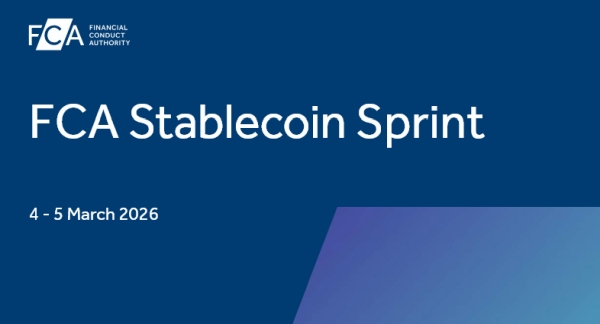
Image: FCA Stablecoin sprint participation pack, March 4-5, 2026
The UK Financial Conduct Authority is hosting a Stablecoin Sprint on March 4 and 5, 2026 in London. Applications are open until February 4, 2026. The Sprint feeds directly into the FCA’s work to finalize stablecoin payment rules later in 2026 and focuses on retail payments and remittances, including point of sale payments, ecommerce, domestic transfers, and cross border payments. A smaller roundtable planned for May will focus on trade payments, including trade finance and B2B payment flows.
The Stablecoin Sprint follows a series of FCA consultations in 2025 covering stablecoin issuance, safeguarding of cryptoassets, prudential capital and liquidity requirements, disclosure for UK issued qualifying stablecoins, and application of the FCA Handbook to regulated crypto activities. The FCA has also opened a stablecoins cohort within its Regulatory Sandbox to allow issuers to test UK issued stablecoins.
The FCA has structured the Sprint around three policy questions that go directly to how stablecoin payments would operate in practice. Full details are set out in the 16 page PDF, FCA Stablecoin Sprint participation pack.
The first problem statement asks what business models firms could use to deliver stablecoin payment use cases. Participants are expected to map payment flows end to end and explain how roles and responsibilities sit across issuers, wallets, payment providers, banks, and infrastructure firms.
The second problem statement examines where opportunities and risks arise within those models. This includes identifying where consumer harm, financial crime exposure, operational failure, or business weakness could appear, as well as where stablecoin payments could offer real improvements over existing payment systems.
The third problem statement focuses on priorities. Participants are asked to consider what regulation is needed, what may not be needed, and where risks could be addressed through business practices or technical design rather than new rules.
Across all three problem statements, the FCA asks participants to test stablecoin payment models against cost, speed, interoperability, certainty of settlement, and consumer protection.
Canadian regulators have already consulted publicly on payment functions through the Retail Payment Activities Act and on stablecoins through federal and securities frameworks. What the FCA Sprint adds is a use case driven exercise that brings those questions together around live payment flows. For Canadian fintechs, it offers a clear view of the practical issues regulators may still need to address as stablecoins move from trading into everyday payments.
As stablecoins move from trading and settlement into everyday payment use, regulators are under pressure to explain how these models fit within existing payment rules. The FCA Stablecoin Sprint shows that key questions around business models, risk ownership, and consumer protection remain open. For fintechs, payment firms, and infrastructure providers, the Sprint offers a clear view of where policy attention now sits and where practical clarity will matter most as stablecoin payment rules take shape. Apply Now
The National Crowdfunding & Fintech Association (NCFA Canada) is a financial innovation ecosystem that provides education, market intelligence, industry stewardship, networking and funding opportunities and services to thousands of community members and works closely with industry, government, partners and affiliates to create a vibrant and innovative fintech and funding industry in Canada. Decentralized and distributed, NCFA is engaged with global stakeholders and helps incubate projects and investment in fintech, alternative finance, crowdfunding, peer-to-peer finance, payments, digital assets and tokens, artificial intelligence, blockchain, cryptocurrency, regtech, and insurtech sectors. Join Canada's Fintech & Funding Community today FREE! Or become a contributing member and get perks. For more information, please visit: www.ncfacanada.org
| | |
|---|---|---|
| | |
RPAA | January 20, 2026

Image: Freepik
On September 8 2025, the Bank of Canada published a letter to PSPs on a trust tax issue, that said safeguarding end-user funds in “trust” accounts, a requirement under the Retail Payment Activities Act (RPAA), could create unintended tax obligations under the Income Tax Act. The impact threatened to burden PSPs with additional tax filings and compliance complexity for simply holding user funds.
For fintech founders, investors and advisors building or backing PSPs, safeguarding end-user funds is a core requirement of the RPAA. If standard trust arrangements triggered full trust tax treatment, PSPs could end up doing extra tax filings simply to meet payments rules. That would force teams to spend time and money on tax compliance instead of building products, serving customers, or growing the business.
On December 23 2025, the Bank of Canada issued an update that confirmed the Department of Finance proposed changes to the Income Tax Act so that RPAA safeguarding trust arrangements would not be treated as formal trusts for tax purposes. Instead, qualifying arrangements would be treated as deemed loans from end users to PSPs, removing the risk that PSPs would face extra trust tax filings requirements.
The change is intended to apply retroactively to September 8 2025, subject to legislative approval.
The lesson here is that staying engaged with regulators, raising issues early, and participating in public comment or industry groups can help outcomes that materially affect operations and capital efficiency.
The National Crowdfunding & Fintech Association (NCFA Canada) is a financial innovation ecosystem that provides education, market intelligence, industry stewardship, networking and funding opportunities and services to thousands of community members and works closely with industry, government, partners and affiliates to create a vibrant and innovative fintech and funding industry in Canada. Decentralized and distributed, NCFA is engaged with global stakeholders and helps incubate projects and investment in fintech, alternative finance, crowdfunding, peer-to-peer finance, payments, digital assets and tokens, artificial intelligence, blockchain, cryptocurrency, regtech, and insurtech sectors. Join Canada's Fintech & Funding Community today FREE! Or become a contributing member and get perks. For more information, please visit: www.ncfacanada.org
| | |
|---|---|---|
| | |
AI | January 20, 2026

Image: Freepik
On January 19, 2026 via Reuters, OpenAI's Chief Financial Officer Sarah Friar confirmed that its annualized revenue exceeded US $20B in 2025. Reported figures show revenue was $6B in 2024 and about $2B in 2023, meaning revenue more than tripled this past year alone, mirroring the scale of paid demand for OpenAI services.
Annualized revenue describes what a company would generate over twelve months if current sales levels stayed constant, and is a widely measure to assess momentum in subscription and usage-based businesses. For OpenAI, the number reflects sustained growth in paid ChatGPT subscriptions, enterprise contracts, and API usage across multiple industries.
OpenAI’s revenue growth closely follows its infrastructure expansion. Reuters reports that the company increased its computing capacity from roughly 0.6 gigawatts in 2024 to about 1.9 gigawatts in 2025, nearly tripling in one year. That level of scale requires access to capital, power, chips, and long-term supplier agreements that only a handful of firms can sustain.
As scale increases, it begins to set the rules of the market.
Infrastructure capacity now determines who can offer AI services at competitive prices, who can guarantee availability during peak demand, and who can absorb cost volatility without disrupting customers. Performance expectations increasingly reflect what the largest providers can deliver, not what smaller firms can economically support.
This trajectory does not mean startups disappear overnight, but it raises the survival bar.
Startups that rely on thin margins face the earliest pressure. This includes companies that resell model access, wrap generic AI features into existing products, or compete primarily on convenience rather than control over data or distribution. As OpenAI captures more value directly through subscriptions, enterprise contracts, and advertising, profit margins for intermediaries narrows.
The pressure shows up first in functions that scale with usage rather than revenue, such as customer support automation, fraud monitoring, transaction screening, onboarding workflows, and real time decisioning. In these areas, AI costs rise with activity even when revenue does not.
By contrast, startups with proprietary data, embedded customer relationships, or regulated market access retain leverage. The dividing line is no longer access to AI. It is control over economics, customers, and accountability.
AI pricing is typically usage based. As fintech products scale, AI expenses scale with them, often faster and with less predictability than revenue. This creates margin pressure, particularly in Canada where fintechs operate with smaller domestic scale, tighter capital markets, and higher regulatory expectations. What appears manageable during early deployment can become material at scale.
In regulated financial services, vendor dependency becomes operational risk, and operational risk becomes regulatory exposure.
There is also a governance reality. When AI influences credit decisions, disclosures, complaints, or customer outcomes, fintechs remain fully accountable even when they do not control model behaviour, pricing changes, or service limits.
Pricing power in AI is concentrating upstream. Intelligence is becoming a metered utility controlled by a small number of providers with the capital and infrastructure to set terms. Large global firms can absorb cost swings, negotiate volume discounts, and manage vendor risk across portfolios. Many Canadian fintechs cannot.
The strategic question is not whether to use AI, but how tightly to bind core operations to any single supplier. Fintechs that preserve provider flexibility, constrain AI use to high impact functions, and tie spending directly to measurable outcomes retain an advantage (for now). Those that treat AI as an invisible background feature risk discovering too late that it has become a fixed dependency with variable costs.
OpenAI’s $20B annualized revenue growth is about market structure limits. Scale now determines who sets prices, who absorbs volatility, and who carries risk. For Canadian fintech, AI decisions now belong alongside cloud infrastructure, payments rails, and core systems as board level considerations.The firms that stay competitive will be the ones that manage AI like any other core cost, with clear oversight and control.
The National Crowdfunding & Fintech Association (NCFA Canada) is a financial innovation ecosystem that provides education, market intelligence, industry stewardship, networking and funding opportunities and services to thousands of community members and works closely with industry, government, partners and affiliates to create a vibrant and innovative fintech and funding industry in Canada. Decentralized and distributed, NCFA is engaged with global stakeholders and helps incubate projects and investment in fintech, alternative finance, crowdfunding, peer-to-peer finance, payments, digital assets and tokens, artificial intelligence, blockchain, cryptocurrency, regtech, and insurtech sectors. Join Canada's Fintech & Funding Community today FREE! Or become a contributing member and get perks. For more information, please visit: www.ncfacanada.org
| | |
|---|---|---|
| | |


August 26th, 2025

January 4th, 2024

June 1st, 2021

September 9th, 2020

July 9th, 2018

January 3rd, 2018

September 25th, 2017

June 20th, 2017

May 10th, 2017

December 14th, 2016