




Karsten Wenzlaff, Advisor
August 26th, 2025
Karsten Wenzlaff is a Crowdfunding and Fintech Expert from Germany. He is Secretary-General of Digit[...]


December 9, 2025

Image: Freepik/rawpixel.com
Market volatility is unsettling when your retirement plans, investment portfolios, and business growth depend on stability. But there is a silver lining to market downturns: tax strategy is one of the few tools Canadians can actively control. Proper planning softens losses and positions wealth to recover faster and potentially grow when markets rebound.
When investments fall below their adjusted cost base, strategic selling can unlock capital losses. These losses are not wasted. They can be used to offset capital gains realized in the year or carried back three years to recover taxes already paid. If gains are scarce in a tax year, unused losses can carry forward indefinitely. The timing matters, though. Superficial loss rules prevent claiming a loss when a substantially identical investment is repurchased within 30 days in affiliated accounts. Canadians who want to maintain exposure often turn to alternative holdings that provide similar market exposure without triggering compliance problems.
Thoughtful loss harvesting can also enhance portfolio rebalancing. Crystallizing losses during downturns allows investors to re-enter positions with a cleaner tax slate once the market recovers, turning an otherwise painful decline into a strategic asset.
Most Canadians benefit from expert guidance at this stage. Market downturns interact with tax laws in ways that are not always intuitive, and navigating capital losses, superficial loss rules, and timing strategies requires strict adherence to tax laws. Guidance from the finance and investing tax lawyers at TaxLawyer.com provides the legal and structural clarity you need to make these moves confidently, especially for higher net worth individuals, incorporated professionals, and multi-asset investors.
Downmarkets often shift household income levels, which creates planning opportunities. Spousal RRSPs, pension income splitting for retirees, and prescribed rate loans to family members can reduce tax burdens when incomes are uneven. Lower-income years allow individuals to withdraw from registered accounts, intentionally triggering taxable income at favourable rates. This strategy can prevent future tax burdens when both market performance and account values recover.
Meanwhile, dividend income generated in a spouse’s lower tax bracket preserves cash flow, provides flexibility during downturns, and improves overall household tax efficiency. Even modest reallocation between spouses can significantly change the after-tax outcome over time.
A downturn magnifies the value of tax-advantaged accounts. RRSP contributions generate deductions now, deferring tax until retirement, when many Canadians expect to be in a lower bracket. TFSAs, however, offer permanent tax-free growth that shines in volatile markets. Reinvesting within a TFSA after markets decline allows any recovery to occur shielded from taxation.
Canadians planning for a first home should consider the First Home Savings Account. Even in weak housing or investment markets, FHSA contributions provide deduction benefits similar to RRSPs, while later withdrawals can be tax-free when used for a qualifying home purchase. The compounding effect of contributing during a downturn can accelerate future purchasing power.
For incorporated business owners, downturns generate planning windows that rarely exist in expansion periods. Lower business values can make estate freezes more tax efficient, transferring future growth to the next generation at today’s depressed valuations. Corporate reorganization can also be more favourable when passive income streams dip below thresholds that normally reduce the small business deduction.
Losses at the corporate level can carry back or carry forward to reduce taxes in profitable years. Strategic alignment between corporate and personal tax planning allows owners to weather downturns while positioning their businesses for a faster recovery.
Donating publicly traded securities with unrealized gains remains one of the most effective strategies. Even in volatile markets, this eliminates capital gains tax while generating donation credits that reduce personal or corporate tax.
For investors with charitable goals, downturns present an opportunity to reset holdings while achieving philanthropic objectives.
Market downturns are intimidating, but they rarely last forever. Tax planning transforms uncertainty into a toolkit for resilience. Smart strategy does not stop the storm, but it helps to ensure that you are better positioned to thrive once calmer conditions return.
 The National Crowdfunding & Fintech Association (NCFA Canada) is a financial innovation ecosystem that provides education, market intelligence, industry stewardship, networking and funding opportunities and services to thousands of community members and works closely with industry, government, partners and affiliates to create a vibrant and innovative fintech and funding industry in Canada. Decentralized and distributed, NCFA is engaged with global stakeholders and helps incubate projects and investment in fintech, alternative finance, crowdfunding, peer-to-peer finance, payments, digital assets and tokens, artificial intelligence, blockchain, cryptocurrency, regtech, and insurtech sectors. Join Canada's Fintech & Funding Community today FREE! Or become a contributing member and get perks. For more information, please visit: www.ncfacanada.org
 |  |  |
|---|---|---|
 |  |  |
December 8, 2025

If you ask Canadian retailers what changed most in recent years, the answer is almost universal: shoppers expect to follow their orders from the moment they hit “buy.” Even for everyday items, people want updates that feel honest, timely, and reassuring. It’s no longer about simply receiving a package—it’s about staying informed every step of the way.
But Canada is a challenging landscape for deliveries. A parcel leaving Toronto may travel through snowstorms in Manitoba, a sorting hub in Calgary, and multiple regional partners before reaching a doorstep in British Columbia. Each handoff brings different scanning habits. Some carriers update quickly. Others scan only at major facilities. A single slow update can make a customer believe something is wrong, even if the parcel is still on track.
Cross-border orders complicate this even further. Many Canadian merchants depend on U.S. suppliers or fulfilment centres. One order might move across three carriers, pass through customs, and transition between different systems—all of which record data differently. To a customer watching the tracking page, it can feel like the parcel disappears and reappears without explanation.
This gap is exactly why more businesses are turning to a parcel tracking platform that unifies data from different couriers into one clean timeline. Instead of guessing or checking multiple tracking pages, teams get a single, steady view of the parcel’s journey. For brands trying to grow without overwhelming their support teams, that kind of clarity isn’t optional anymore—it’s becoming foundational.
A missing scan might look minor, but Canadian e-commerce teams know how quickly it spirals. Customers refresh their tracking page repeatedly. WISMO tickets start filling support inboxes. Agents jump between carrier sites searching for clues. Operations teams get pulled into investigations that shouldn’t require them at all.
Carrier transitions are one of the biggest issues. When a parcel crosses from a Canadian network into a U.S. carrier, the tracking environment changes completely. If the receiving carrier takes hours—or days—to issue its first scan, the entire order looks frozen.
Customs delays add another layer of uncertainty. Parcels may arrive at the border on schedule, then sit unscanned during document checks. Customers don’t see the paperwork or the review process; they only see silence. Without context, that silence feels like a lost shipment.
These visibility gaps create costs across the business:
The real problem isn’t the delivery—it’s the lack of information.
In today’s Canadian e-commerce market, real-time visibility is becoming just as important as delivery speed. Customers are surprisingly forgiving about delays when communication is honest and consistent. What they dislike is uncertainty.
Real-time visibility gives retailers a true picture of what’s happening across their network. Teams can spot delays early, communicate proactively, and see patterns—like winter slowdowns on certain lanes or carriers that struggle in specific provinces. This makes planning more realistic and reduces last-minute surprises.
It also reduces friction internally. Support teams no longer rely on operations for updates. Operations no longer scramble to check every question. Everyone sees the same information, which leads to faster and more confident decisions.
Over time, visibility becomes something customers notice. They remember which brands keep them informed and which ones leave them guessing. That impression quietly shapes loyalty—often more than speed alone.
Real-time visibility isn’t just about better customer experience; it has tangible financial benefits.
When customers can clearly follow their parcel, they ask fewer questions. That means:
With a unified view inside a parcel tracking platform, teams can see instantly whether a parcel is waiting at customs, stuck at a hub, delayed by weather, or simply in transition. No more juggling multiple carrier dashboards.
Accurate visibility helps businesses staff based on real delivery patterns, not rough estimates. Warehouses, support teams, and logistics departments operate more efficiently.
When tracking is unclear, brands often send replacements to protect customer relationships. With real-time data, fewer orders fall into the “unknown” category—keeping costs down and revenue intact.
Cross-border shipping—especially between Canada and the United States—is a major growth channel for Canadian retailers. But it’s also where tracking confusion becomes most severe.
A parcel can arrive at the border quickly, then sit unscanned while documents are reviewed. From the customer’s perspective, the parcel simply stopped moving. Without explanation, frustration grows, and the pressure lands on the retailer.
An order might start on a Canadian network, then move to a U.S. carrier, then end with a regional last-mile provider. Each has different scanning habits. Without unified visibility, the delivery timeline looks broken and inconsistent.
Some international carriers scan infrequently or use unfamiliar tracking messages. A visibility platform translates these into clear, understandable updates.
With consistent visibility, retailers can:
Cross-border shipping becomes less stressful for both the business and the customer.
As visibility technology evolves, it no longer looks like a simple tracking tool. It begins to resemble a data infrastructure layer—similar to how fintech systems centralize financial information to enable smarter decisions.
Every scan, location update, and delay becomes a data point. Across millions of events, businesses gain an incredibly accurate picture of how their logistics network actually behaves.
This data helps companies:
Automation builds on top of this data. Alerts can trigger when a parcel is idle too long or when a route repeatedly experiences issues. Predictive analytics can anticipate delays during certain seasons or holidays, allowing businesses to adjust communication in advance.
The result? A logistics operation that feels informed rather than reactive.
Looking forward, real-time visibility will anchor many of the next major innovations in Canadian e-commerce.
None of this works without visibility. No system can optimize what it cannot see.
Real-time parcel visibility is becoming one of the most important tools in Canadian e-commerce. Customers feel informed. Support teams regain time. Businesses reduce costs. And operations become more predictable instead of reactive.
As cross-border volume grows and expectations rise, clarity becomes a competitive advantage. Retailers that embrace a modern parcel tracking platform gain steadier communication, fewer surprises, and stronger customer loyalty.
In a market where trust drives repeat business, visibility is no longer just technology—it’s part of the customer experience itself.

Emmanuel Fornillos is a logistics content specialist at Instant Parcels, a universal parcel-tracking platform connecting over 600 couriers worldwide. He writes about international shipping, freight visibility, and the latest innovations in global eCommerce logistics.
The National Crowdfunding & Fintech Association (NCFA Canada) is a financial innovation ecosystem that provides education, market intelligence, industry stewardship, networking and funding opportunities and services to thousands of community members and works closely with industry, government, partners and affiliates to create a vibrant and innovative fintech and funding industry in Canada. Decentralized and distributed, NCFA is engaged with global stakeholders and helps incubate projects and investment in fintech, alternative finance, crowdfunding, peer-to-peer finance, payments, digital assets and tokens, artificial intelligence, blockchain, cryptocurrency, regtech, and insurtech sectors. Join Canada's Fintech & Funding Community today FREE! Or become a contributing member and get perks. For more information, please visit: www.ncfacanada.org
| | |
|---|---|---|
| | |
Funding | December 8, 2025

Image: Freepik/rawpixel.com
On December 8 2025, Canadian payment fraud fintech Tuhk announced a US$6 million seed round led by FINTOP (US), with particiation from Lloyds Banking Group (UK), and Capital One Ventures (US), to transform fragmented information into a shared intelligence network that improves approval rates, reduces disputes, and strengthens real time decisioning for financial institutions and merchants.
Tuhk is planning an imminent launch in the United Kingdom, the United States, and Canada and is offering an early access program while it refines its product ahead of the broader rollout, which you can confirm on the Tuhk early access page.
Andre Edelbrock, Tuhk Co-Founder and CEO:
"This funding round represents an important milestone for Tuhk, and we are grateful for the support from partners like Lloyds Banking Group, Capital One Ventures, and FINTOP. With these resources, we look forward to expanding the platform's reach and delivering practical, scalable solutions that strengthen the global payments ecosystem."
Cybersecurity Ventures projects global cybercrime losses at US$10.5 trillion in 2025. This projection appears in the cybercrime cost estimate report. The figure includes financial loss from fraud, digital attacks, and misuse across global markets.
The scale of the projected loss shows the size of the problem that payment systems, banks, merchants, and financial platforms must work collaboratively to address in real-time, rather than isolated tools.
The release says Tuhk’s founding team includes veterans of Ethoca and NuData Security, two Canadian companies that helped define collaboration based fraud intelligence before Mastercard acquired NuData Security in 2017 and then acquired Ethoca in 2019.
Tuhk builds on this experience as it prepares for a full commercial launch in early 2026. The company named Andre Edelbrock as CEO and appointed Stewart McIntosh as Chief Revenue Officer to lead global commercial strategy.
Tuhk's US$6 million funding will go a long way as the company prepares to show financial institutions and merchants that by working together in sharing real-time shared fraud intelligence, improves approval accuracy, reduces misuse, and strengthens fraud outcomes for institutions that manage rising digital payment volumes.
Lloyds Banking Group framed the direction clearly saying that “collaboration is the only way we combat the increasing global threat of fraud and stop it from happening in the first place.”
The National Crowdfunding & Fintech Association (NCFA Canada) is a financial innovation ecosystem that provides education, market intelligence, industry stewardship, networking and funding opportunities and services to thousands of community members and works closely with industry, government, partners and affiliates to create a vibrant and innovative fintech and funding industry in Canada. Decentralized and distributed, NCFA is engaged with global stakeholders and helps incubate projects and investment in fintech, alternative finance, crowdfunding, peer-to-peer finance, payments, digital assets and tokens, artificial intelligence, blockchain, cryptocurrency, regtech, and insurtech sectors. Join Canada's Fintech & Funding Community today FREE! Or become a contributing member and get perks. For more information, please visit: www.ncfacanada.org
| | |
|---|---|---|
| | |
Crypto | December 4, 2025

On December 4 2025, Tokenwell Platforms Inc announced an expanded partnership with Talos to develop a proprietary crypto basket using the Coin Metrics Multi Asset Series Methodology, which uses clear data rules to help the basket protect value and adjust to different market conditions. It uses trends, price ranges and strength signals to guide monthly updates and remove guesswork from how the basket changes over time. The strategy is in development and the company expects to complete backtesting in January 2026 before releasing the basket on its platform in the first quarter of 2026.
Tokenwell Platforms Inc (TWEL) trades on the Canadian Securities Exchange and focuses on diversified crypto baskets built from institutional data while keeping all assets in user exchange accounts in a non-custodial structure, as outlined on its investor overview page.
In August 2025, Trilogy AI Corp acquired WealthAgile Inc, which appears in the fundamental change listing statement. That filing describes WealthAgile as a financial technology business focused on structured cryptocurrency investing. After completing the acquisition, Trilogy changed its name to Tokenwell Platforms Inc and advanced a platform built around data-driven portfolio tools for retail investors.
Tokenwell uses the Talos Coin Metrics platform to design a new crypto basket that uses a rules-based model that updates monthly and follows clear technical criteria supported by institutional data.
The company laid the foundation for this approach in July 2025 when it licensed Coin Metrics data to build benchmarking tools and index models which led to the CMBI 10 Even basket (CMBI10e). Users can already access the CMBI10E and CoinDesk 20 baskets inside the Tokenwell app.
Then Talos acquired Coin Metrics and Tokenwell gained a unified data environment that now supports the development of its proprietary strategy.
In September 2025, Tokenwell announced the launch of its retail crypto investing app in the United States that connects users to structured crypto baskets without taking custody of assets. Users invest through existing Coinbase or Crypto.com accounts while the Tokenwell app provides the portfolio layer.
In October 2025, Tokenwell announced its first major exchange partnership with Crypto.com who integrated its platform so investors could access and trade Tokenwell's crypto baskets.
The leadership team also expanded earlier in the year, adding Abraham Theodore NDAX's former Head of Product (COO), Darryl Irwin (accounting/tax expertise), and Matthew Lee Morgan as strategic advisor to help scale.
2025's been a big year for Tokenwell, including structured platform development, fundamental change transaction, a corporate rebrand, leadership expansion, a United States app launch, exchange infrastructure integration and multiple index baskets designed with Coin Metrics and CoinDesk Indices. The Talos partnership now anchors the next growth phase of Tokenwell’s product strategy with a proprietary institutional model designed for retail access.
The National Crowdfunding & Fintech Association (NCFA Canada) is a financial innovation ecosystem that provides education, market intelligence, industry stewardship, networking and funding opportunities and services to thousands of community members and works closely with industry, government, partners and affiliates to create a vibrant and innovative fintech and funding industry in Canada. Decentralized and distributed, NCFA is engaged with global stakeholders and helps incubate projects and investment in fintech, alternative finance, crowdfunding, peer-to-peer finance, payments, digital assets and tokens, artificial intelligence, blockchain, cryptocurrency, regtech, and insurtech sectors. Join Canada's Fintech & Funding Community today FREE! Or become a contributing member and get perks. For more information, please visit: www.ncfacanada.org
| | |
|---|---|---|
| | |
Capital Raising | Dec 2, 2025
On November 27 2025, Canadian securities regulators released CSA Multilateral Staff Notice 31-367, confirming that the temporary rule under Coordinated Blanket Order 31-930 will end on December 20, 2025 (see release). The consultation remains open until January 26, 2026, which creates a timing gap that matters for exempt market dealers, founders and investors who want clarity on whether a revised model may support stronger capital raising across Canada.
The EMD Selling Groups exemption started in June 2024. It enabled exempt market dealers to join selling groups in prospectus offerings. The policy goal looked straightforward. Most Canadian companies start in the exempt market. Many later raise growth capital under a prospectus. Allowing exempt market dealers to stay involved as companies advance could strengthen continuity, expand distribution and support investor access.
The results did not match that intent:
According to the Staff Notice, only 3 exempt market dealers filed the required notice to participate, and only 2 of those exempt market dealers actually joined selling groups. Each took part in two prospectus offerings. That means the entire pilot produced four transactions nationally. The low participation explains why regulators want to close the temporary rule and collect feedback on the structural issues that affected the outcome.
Regulators identified four barriers that influenced participation, according to the Staff Notice.
1. Exempt market dealers cannot access electronic settlement through the Canadian Depository for Securities. Issuers that chose to work with exempt market dealers needed to use paper certificates. This added time and cost to prospectus stage financing.
2. Exempt market dealers cannot advise clients on securities purchased under a prospectus. This restriction makes it difficult for them to support clients after closing.
3. Compensation limits created a barrier. Exempt market dealers faced a scale back on economics when compared with other activities available to them.
4. Issuers and investment dealers were not fully aware that exempt market dealers could participate. Some exempt market dealers reported that investment dealers did not understand the conditions required to include them in selling groups.
Although most issues seem like practical challenges, companies and intermediaries tend to choose the path with the fewest obstacles. Any friction at the distribution or settlement layer reduces interest in a new route, especially if the upside is limited.
Regulators also outlined the questions they want the market to address during the consultation. They want to understand whether the compensation limits reduced interest in the exemption and whether a different structure could support fair incentives. They also want feedback on how the lack of electronic settlement access affects issuer decisions, how the advice restrictions affect client relationships, and whether issuers and investment dealers need clearer guidance on how to include exempt market dealers in selling groups.
Founders want financing routes that feel clear and predictable. Investors value trusted relationships and efficient execution.
Exempt market dealers want a model that supports their clients as they grow, along with fair compensation.
The exemption tried to bridge the exempt market with the prospectus market but with only four completed transactions under the temporary exemption, data suggests that the approach wasn't sustainable for both issues and dealers who want reliable access to distribution during growth stage financing.
For founders, this means they will need to continue to rely on investment dealers when they reach the prospectus stage.
For investors, this means their EMD cannot guide them through a prospectus purchase because the rules doesn't allow exempt market dealers to advise clients on prospectus securities.
Regulators are now looking for feedback that reflects what founders, investors and dealers experience on the front line to better understand incentives, bottlenecks and market behaviour.
The Ontario Securities Commission recently launched a program offering $30,000 in grant support to academic researchers for new research work on Ontario capital markets. This program encourages research that helps regulators understand how companies raise capital and how the market supports growth. Note, NCFA previously wrote about how wider participation may better unlock the kind of innovative policies required in 2026 and beyond to support a dynamic and competitive capital market while protecting investors.
The combination of the CSA consultation and the OSC research program are signs that regulators want practical input grounded in real activity. The pilot produced limited use, so regulators now want to hear from market participants before they consider any new approach.
Canada needs rules that help companies raise growth capital and help investors access opportunities backed by clear standards. The temporary EMD selling group exemption didn't move the needle enough in the practical world to support extension.
The CSA consultation now gives the market a chance to highlight what helps and what slows down capital formation. Founders, investors and dealers have an opportunity to provide inputs that supports growth and strengthens Canada’s competitiveness in capital markets innovation. Submit your consultation comments to the CSA here before January 26, 2026.
The National Crowdfunding & Fintech Association (NCFA Canada) is a financial innovation ecosystem that provides education, market intelligence, industry stewardship, networking and funding opportunities and services to thousands of community members and works closely with industry, government, partners and affiliates to create a vibrant and innovative fintech and funding industry in Canada. Decentralized and distributed, NCFA is engaged with global stakeholders and helps incubate projects and investment in fintech, alternative finance, crowdfunding, peer-to-peer finance, payments, digital assets and tokens, artificial intelligence, blockchain, cryptocurrency, regtech, and insurtech sectors. Join Canada's Fintech & Funding Community today FREE! Or become a contributing member and get perks. For more information, please visit: www.ncfacanada.org
| | |
|---|---|---|
| | |
Crypto Mining | Dec 1, 2025
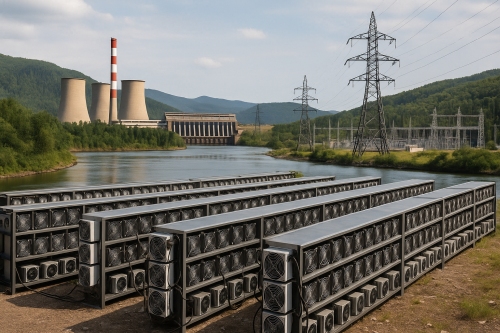
AI generated image
On November 28 2025, the Financial Post reported that the Newfoundland and Labrador Court of Appeal issued a ruling involving Blockchain Labrador Corporation (BLC) that confirmed NL Hydro can limit firm electricity service for new crypto mining operations.
BLC originally applied for 20 megawatts of guaranteed power service for a site in Wabush but NL Hydro declined to commit to that level because it needed to protect capacity for industrial, household and export priorities. Instead, NL Hydro will supply 7.75 megawatts to the company on an interim basis.
The ruling outcome confirms that NL Hydro has set boundaries on clean electricity when new digital workloads (ie. crypto mining, AI processing) add pressure to a constrained system.
Canada was once a notable player in global Bitcoin mining with national activity reaching close to 10% of global hashrate in 2021 but it's participation has since declined. Hashrate Index estimated that Canada held about 4% to 5% of global hashrate in their 2023 Canadian mining review, and then in a recent Q4 2025 global hashrate heatmap update benchmarked the country near 2.9%.
Canada's reduced footprint reflects a sector now concentrated in a few established companies. This smaller group of operators (see below and note, not exhaustive) also gives provinces more room to manage clean electricity across many competing needs.
Several provinces with hydro based systems have taken steps to manage electricity access for mining and other high demand digital activities.
British Columbia's clean electricity announcement enabled restrictions on new mining connections. The province later confirmed a permanent limit in the 2025 energy release, and the Court of Appeal supported provincial authority to set these boundaries in the Conifex ruling summary.
Manitoba adopted a pause on new mining activity when the utility raised concerns about the scale of new load requests. The province issued this direction in the 2022 guidance on electricity connections and extended the pause through 2026 in the 2024 directive on cryptocurrency operations.
New Brunswick took a more restrictive position. The provincial Electricity Act prevents a distribution utility from extending electricity to a new crypto mining business, which appears in the current consolidation of the Act and adopted through Bill 10.
Quebec continues to serve existing projects but limits new load and uses a dedicated rate class for this sector. A review commissioned by Hydro Québec found that mining produces fewer jobs for each megawatt consumed compared to data centres and industrial users, which encouraged ongoing limits.
Alberta remains an outlier, operating a deregulated, competitive market for electricity that allows mining companies and compute operators to negotiate directly for supply, supported by broader generation options.
Global research from the Cambridge Centre for Alternative Finance (CCAF) offers insight into energy use for digital mining. Cambridge estimates that Bitcoin mining draws about one hundred thirty eight terawatt hours of electricity per year, as described in CCAF's update on sustainable energy use and detailed further in a Cambridge digital mining report.
The research shows that more than half of global mining electricity comes from sustainable sources such as hydropower, wind and nuclear.
Low cost clean electricity attracts miners, data centres, industrial electrification and long term export contracts. Provinces build policies that protect available capacity for the users that advance their long term economic priorities.
Crypto mining can contribute value when it aligns with provincial priorities but utilities now apply stronger criteria when making decisions about supplying consistent clean energy.
The ruling involving Blockchain Labrador Corporation is an example of how a province evaluates new digital load against industrial development, household reliability and export duties. Informative for any Canadian fintech leaders following the developments in digital finance, compute infrastructure and national (global) ambitions for clean energy growth.
The National Crowdfunding & Fintech Association (NCFA Canada) is a financial innovation ecosystem that provides education, market intelligence, industry stewardship, networking and funding opportunities and services to thousands of community members and works closely with industry, government, partners and affiliates to create a vibrant and innovative fintech and funding industry in Canada. Decentralized and distributed, NCFA is engaged with global stakeholders and helps incubate projects and investment in fintech, alternative finance, crowdfunding, peer-to-peer finance, payments, digital assets and tokens, artificial intelligence, blockchain, cryptocurrency, regtech, and insurtech sectors. Join Canada's Fintech & Funding Community today FREE! Or become a contributing member and get perks. For more information, please visit: www.ncfacanada.org
| | |
|---|---|---|
| | |
Stablecoins | Dec 1, 2025
On November 26 2025, Visa announced an expansion of stablecoin settlement across Central and Eastern Europe Middle East and Africa through a new partnership with Vancouver-based fintech, Aquanow. The integration gives issuers and acquirers on the Visa network the ability to settle transactions in approved stablecoins such as USDC and introduces a settlement rail that clears value faster at lower cost and with fewer operational steps than traditional systems that rely on closing hours and multi-party workflows.
Visa first used USDC for settlement in 2023 and now records an annualized settlement volume above $2.5 billion proving that institutions are already incorporating stablecoin settlement in daily operations, moving transaction flow across markets and supporting teams that seek real-time settlement, instead of fixed windows.
Aquanow supports Visa's stablecoin expansion with digital asset infrastructure that processes billions of dollars in monthly activity. The company works with banks neobanks brokerages and payment firms, reporting a four year revenue growth rate of 3022%, earning it multi-year recognition as the 8th best Deloitte Technology Fast 50 top companies in 2024.
Many institutions still work around systems that close on weekends, rely on several intermediaries, and delay the release of funds. These delays hold capital in transit and create uncertainty for teams that manage liquidity each day. Visa and Aquanow address this gap by offering a rail that runs at all hours and clears transactions faster than older cross border settlement paths.
This model reduces operational drag and gives financial institutions, banks and credit unions a clearer view of cash position in markets with uneven settlement conditions.
This supports services that rely on dependable settlement such as global ecommerce platforms marketplace payouts and remittance flows.
Aquanow launched in Vancouver, Canada and built a global digital asset platform that now powers part of Visa’s settlement expansion. The company maintains a publicly stated money services business registration with FINTRAC on its own website and operates a regulated entity in the United Arab Emirates through Aquanow ME FZE. The UAE entity received approval from the Virtual Assets Regulatory Authority for broker-dealer services, lending and borrowing, and management and investment services.
This structure shows how a Canadian born fintech can scale global settlement infrastructure by operating in markets that provide clear digital asset licensing. It's another great example of the capability of Canadian firms to contribute to global payment modernization, delivering digital settlement capacity within a regulated international environment. It also provides policymakers a reference point for how digital settlement can operate at production scale within clear regulatory frameworks.
Visa's stablecoin settlement expansion across CEMEA, in partnership with Canadian fintech Aquanow, sets a new expectation for settlement speed and efficiency. Companies and institutions want faster movement of value, lower cost, and better control over liquidity. Digital asset rails deliver these results in ways legacy systems struggle to match. This partnership offers a clear example of modern settlement infrastructure that supports live cross border operations and works inside a regulated environment at scale.
The National Crowdfunding & Fintech Association (NCFA Canada) is a financial innovation ecosystem that provides education, market intelligence, industry stewardship, networking and funding opportunities and services to thousands of community members and works closely with industry, government, partners and affiliates to create a vibrant and innovative fintech and funding industry in Canada. Decentralized and distributed, NCFA is engaged with global stakeholders and helps incubate projects and investment in fintech, alternative finance, crowdfunding, peer-to-peer finance, payments, digital assets and tokens, artificial intelligence, blockchain, cryptocurrency, regtech, and insurtech sectors. Join Canada's Fintech & Funding Community today FREE! Or become a contributing member and get perks. For more information, please visit: www.ncfacanada.org
| | |
|---|---|---|
| | |


August 26th, 2025

January 4th, 2024

June 1st, 2021

September 9th, 2020

July 9th, 2018

January 3rd, 2018

September 25th, 2017

June 20th, 2017

May 10th, 2017

December 14th, 2016