




Karsten Wenzlaff, Advisor
August 26th, 2025
Karsten Wenzlaff is a Crowdfunding and Fintech Expert from Germany. He is Secretary-General of Digit[...]


Crypto Regulation | Feb 6, 2025

Image: Commissioner Hester M. Peirce
On Jan 21, 2025, the U.S. Securities and Exchange Commission (SEC) announced the formation of a Crypto 2.0 Task Force dedicated to the development of a comprehensive and clear regulatory framework for digital assets. The task force, led by Commissioner Peirce (aka Crypto Mom), has recently published a post on the SEC's website titled 'The Journey Begins' that serves as the starting point of much work ahead, and sets the tone and direction of a new chapter of crypto regulations in the United States.
For years, the SEC has been criticized for its "regulation by enforcement" approach and thumbing down innovative crypto firms without providing a clear regulatory framework. The result has been a train wreck that caused frustration among crypto entrepreneurs and investors who were forced to walk down a path of uncertainty and unnecessary risk.
Peirce acknowledged these challenges in her new role:
"It took us a long time to get into this mess, and it is going to take us some time to get out of it."
The newly formed Crypto Task Force is chaired by Peirce with Richard Gabbert serving as Chief of Staff and Taylor Asher as Chief Policy Advisor. They are charting a new course with a mandate that includes:
In her post, Commissioner Peirce laid out the following ten priorities that will guide the task force's work:
All told, the task force is a welcomed policy shift in how in the SEC approaches crypto. One that is moving from a reactive enforcement by regulation approach to one that is a proactive regulatory framework. One of transparency and stakeholder engagement. However in her note, Commissioner Peirce stresses the need for patience:
"We need to do this in an orderly, practical, and legally defensible way."
The SEC has launched a consultation process, inviting crypto industry participants such as startups, investors, developers, and policymakers to share their insights and help create the future of digital asset regulation (i.e., voice concerns, suggest improvements), and engage directly with regulators to build a robust and effective framework. Crypto Mom and the Task Force highlight that successful regulation requires collaboration.
The SEC has launched a dedicated webpage for the crypto task force and welcomes feedback via email (crypto@sec.gov). Industry participants are encouraged to submit written comments, request meetings, and take part in discussions about potential regulatory changes. With active participation from the crypto community, we're hopeful that the final destination benefits all stakeholders in the digital asset ecosystem.
 The National Crowdfunding & Fintech Association (NCFA Canada) is a financial innovation ecosystem that provides education, market intelligence, industry stewardship, networking and funding opportunities and services to thousands of community members and works closely with industry, government, partners and affiliates to create a vibrant and innovative fintech and funding industry in Canada. Decentralized and distributed, NCFA is engaged with global stakeholders and helps incubate projects and investment in fintech, alternative finance, crowdfunding, peer-to-peer finance, payments, digital assets and tokens, artificial intelligence, blockchain, cryptocurrency, regtech, and insurtech sectors. Join Canada's Fintech & Funding Community today FREE! Or become a contributing member and get perks. For more information, please visit: www.ncfacanada.org
 |  |  |
|---|---|---|
 |  |  |
Launch | Feb 5, 2025

Image from Build Canada's website
As Canada faces a tense period of trade disputes and tariffs from the U.S. and with growing concerns over competitiveness, productivity, investment and innovation, leading Canadian tech entrepreneurs have launched a new initiative called 'Build Canada', a public platform to push forward policy solution ideas to strengthen Canada's economy. Waiting for government is no longer an option. Build Canada aims to provide concrete, actionable policy recommendations to help the the country remain globally competitive and adapt to economic challenges.
Build Canada is a public platform that releases weekly policy proposals that offer actionable ideas and practical solutions that government officials and policymakers can use to address Canada’s most pressing economic challenges such as exporting to new markets, encouraging investment via smarter policies, strengthen innovation but supporting entrepreneurs and nurturing a culture that celebrates ambition and success.
Build Canada is led by experienced entrepreneurs and business leaders who want to help Canada thrive:
And backed by some of Canada’s top tech leaders:
And many more as the initiative grows...
The group has already published four policy proposals called 'memos', each addressing an economic or social issue:
Encourages Canadians to take more pride in their country by recognizing and celebrating achievements in business, technology, and innovation.
The goal is to create a culture where innovation, ambition, and success are celebrated, inspiring more Canadians to build and contribute to the country’s future.
This proposal suggests having one set of national rules for transportation that would be managed by Transport Canada, making it easier for new technology to be approved and used across the country. Now, businesses face different rules in each province and city, which makes it harder to launch innovations like electric vehicles, self-driving cars, and drones. A single, national system would speed up approvals and help Canada become a global leader in transportation technology.
This proposal suggests changing Canada’s immigration system to focus more on bringing in highly skilled workers who can help grow the economy. The goal is to attract the best talent and business leaders to help Canada stay competitive and drive innovation. It recommends:
This proposal suggests fixing Canada’s disconnected health record system to make healthcare more connected, convenient, and better and more efficient for everyone, recommending:
Build Canada is launching alongside another major policy initiative recently announced, The Canadian SHIELD Institute, founded with a $10 million donation from Jim Balsillie, co-founder of the Council of Canadian Innovators, focused on:
As Canada navigates economic uncertainty, shifting trade relationships, and increasing global competition, waiting for government action is no longer enough. Build Canada is just getting started with more entrepreneurs and business leaders joining the initiative. Help strengthen Canada's economy, one policy at a time.
The National Crowdfunding & Fintech Association (NCFA Canada) is a financial innovation ecosystem that provides education, market intelligence, industry stewardship, networking and funding opportunities and services to thousands of community members and works closely with industry, government, partners and affiliates to create a vibrant and innovative fintech and funding industry in Canada. Decentralized and distributed, NCFA is engaged with global stakeholders and helps incubate projects and investment in fintech, alternative finance, crowdfunding, peer-to-peer finance, payments, digital assets and tokens, artificial intelligence, blockchain, cryptocurrency, regtech, and insurtech sectors. Join Canada's Fintech & Funding Community today FREE! Or become a contributing member and get perks. For more information, please visit: www.ncfacanada.org
| | |
|---|---|---|
| | |
Tariffs | Feb 3, 2025

Image: Freepik/master1305
The 25% tariffs on Canadian imports into the U.S. (and 10% on energy) have been temporarily paused following a phone call between U.S. President Donald Trump and Canadian Prime Minister Justin Trudeau. The decision comes after Canada agreed to strengthen border security and take further action against fentanyl trafficking, which the U.S. cited as a key justification for the tariffs. The 30-day suspension gives both countries time to negotiate a broader economic and security agreement.
Justin Trudeau, Prime Minister of Canada shared on X:
"I just had a good call with President Trump. Canada is implementing our $1.3 billion border plan — reinforcing the border with new choppers, technology and personnel, enhanced coordination with our American partners, and increased resources to stop the flow of fentanyl. Nearly 10,000 frontline personnel are and will be working on protecting the border.
In addition, Canada is making new commitments to appoint a Fentanyl Czar, we will list cartels as terrorists, ensure 24/7 eyes on the border, launch a Canada- U.S. Joint Strike Force to combat organized crime, fentanyl and money laundering.
I have also signed a new intelligence directive on organized crime and fentanyl and we will be backing it with $200 million. Proposed tariffs will be paused for at least 30 days while we work together."
Following the agreement, Canada is temporarily suspending its planned counter-tariffs on U.S. goods. Ontario Premier Doug Ford confirmed that retaliatory tariffs would not proceed for now, advising that Canada should focus on strengthening trade ties with other partners, including China and the European Union. Ontario was set to remove U.S. alcohol from LCBO shelves Monday night. The province was also going to rip up a $100 million deal with Elon Musk’s Starlink for satellite internet service in Northern Ontario.
With a 30-day deadline, Canada must work quickly to secure a long-term resolution. The next phase of negotiations will likely center on border security measures, trade adjustments, and economic incentives to satisfy U.S. concerns without triggering further trade disruptions. If no agreement is reached within the 30-day period, the tariffs could still take effect, escalating tensions between the two countries. For now, the agreement provides relief for Canadian businesses and consumers, but the outcome remains uncertain as negotiations continue.
We're all consumers. Here are just a few links you may be interested in. Do your research and make the right choice and support/buy Canadian products:
The National Crowdfunding & Fintech Association (NCFA Canada) is a financial innovation ecosystem that provides education, market intelligence, industry stewardship, networking and funding opportunities and services to thousands of community members and works closely with industry, government, partners and affiliates to create a vibrant and innovative fintech and funding industry in Canada. Decentralized and distributed, NCFA is engaged with global stakeholders and helps incubate projects and investment in fintech, alternative finance, crowdfunding, peer-to-peer finance, payments, digital assets and tokens, artificial intelligence, blockchain, cryptocurrency, regtech, and insurtech sectors. Join Canada's Fintech & Funding Community today FREE! Or become a contributing member and get perks. For more information, please visit: www.ncfacanada.org
| | |
|---|---|---|
| | |
Tariffs | Feb 3, 2025

Image: Freepik/kjpargeter
*Update Feb 3: Canada-US Agree to 30 Day Pause on Tariffs
On February 1, 2025, U.S. President Donald Trump announced sweeping tariffs on Canada, Mexico, and China to begin February 4, 2025. The White House claims that the move was necessary to offset illegal drug trafficking (specifically fentanyl) and stop illegal immigration crossings at the U.S. North and South borders. Trump framed the tariffs as a national security emergency under the International Emergency Economic Powers Act (IEEPA), which grants the President authority to regulate international commerce in response to national emergencies. Trump’s executive order alleges that Canada has a growing presence of drug labs producing fentanyl and that Mexican cartels are operating within Canada’s borders, claims that Ottawa has denied.
The new U.S. tariffs include:
Hours after the U.S. tariffs were announced, Prime Minister Justin Trudeau announced a $155 billion Canadian tariff package imposing retaliatory 25% tariffs on $30 billion worth of U.S. goods, effective immediately February 4, with a second round of $125 retaliatory tariffs to take effect in the following 21 days. See list of U.S. products subject to 25% tariffs
An article from CSIS points out that Canada is the largest supplier of minerals to the U.S. ($47 billion USD in 2023) like uranium, aluminum, and nickel which are key to defense, nuclear energy, and manufacturing sectors. The U.S is trying to reduce it's reliance on China's minerals for national and economic security and Canadian tariffs on these goods would cost U.S. buyers billions more.
Also note that the Canadian government is offering a remission process, which allows businesses to request relief from paying tariffs or to receive a refund for tariffs already paid, if a business can prove it can’t source the goods from Canada or other countries and that the tariffs would cause serious harm to operations or the Canadian economy. Businesses must submit detailed evidence, and exemptions will only be granted in exceptional cases.
In a strong speech, Trudeau condemned the tariffs as "reckless, unjustified, and an attack on one of America’s closest allies." He reminded Americans that Canada has stood beside the U.S. in every major conflict for over 150 years and accused Trump of “putting political games ahead of economic stability.” He also announced that Canada would explore legal action under the USMCA and the WTO.
The U.S. is Canada’s largest trading partner, buying 77% of Canada’s total exports. New tariffs will raise costs, cut jobs, and put massively disrupt impacted sectors. Financial markets immediately dropped on the news of an imminent trade war.
Canada needs to offset the economic damage, keep trade moving and avoid long-term financial instability.
The researchers at Scotiabank published these facts about 'getting up to speed with Canada-U.S. trade', which tells Canada's trade story:
Canada is a trading country. In fact, 67% of Canada's economy comes from trade. That's far more than the U.S. (24%) or even China (37%). Canada represents only 2% of the world’s GDP but punches above its weight handling 2.5% of global trade. So when trade slows down, it hurts Canada's economy and makes us more vulnerable.
Canada exported in total:
$768 billion CAD of goods (things like cars, metals, and oil)
$197 billion CAD of services (such as banking, technology, and consulting)
It means that most of Canada’s trade is physical goods while services are still a growing part of the economy. Canadian businesses that rely on exports like cars, metals, oil, manufacturing will be hit with higher costs to sell into U.S.markets which makes Canadian products less competitive (more expensive) which hurts sales and leads to job losses, production cuts and slower economic growth. Canada and the U.S. are deeply integrated with many raw materials passing the borders multiple times before finalizing the production of a good.
As you might expect, Canada's energy (oil) is currently the country's largest export, totalling $174 billion CAD in 2023 (18% of all exports). Without exporting energy/oil, Canada's trade deficit would be massive. Oil, gas, and electricity sales keeps thousands of jobs alive and brings in crucial government revenue.
Energy represents 18% of total trade—removing it would cause a serious economic hit at the moment. In 2023, Canada bought more from other countries than it sold, leading to a trade deficit of $13.1 billion CAD. However if we exclude selling energy to other countries like the U.S. Canada's trade deficit in 2023 would jump to $187 billion CAD, showing that Canada leans on its energy sector to balance trade.
U.S. tariffs on Canadian oil and gas will increase prices for U.S. consumers at the gas pump and shrink demand for Canadian energy, cutting billions from the economy. It means lower revenue for the government which could lead to reduced spending in other sectors like healthcare, infrastructure or innovation.
The U.S. is Canada’s biggest customer who buys 77% of all our Canadian exports. No other country is that reliant on the U.S. China the second largest customer of Canadian exports buys less than 5%. U.S.-Canada trade accounted for 19% of Canada's total Gross Domestic Product in 2023.
One major concern is the potential exodus of companies currently operating/manufacturing in Canada who decide to move operations to the U.S. to avoid tariff taxes. Canada should diversify export markets to sell goods and services to reduce the reliance on the U.S.
Here's a chart from the Council on Foreign Relations:

Canada and Mexico rely on the US (Council foreign relations)
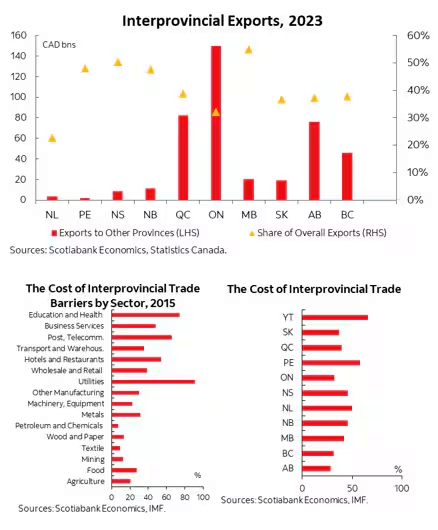
Image: Interprovincial Exports Canada 2023 (Scotiabank / IMF)
Canadian provinces don’t trade with each other as much as they should. Internal trade was $418 billion CAD in 2023, but it hasn’t kept pace with international trade growth. Utilities face a 91% trade barrier and healthcare faces 74%. A 2019 IMF study called 'Internal Trade in Canada: A Case for Liberalization" found that provinces face an inter-provincial trade barrier equivalent to a 21% tariff!
Today, internal trade only makes up 36% of Canada's overall trade which is down from 55% in the early 1980s. If U.S. tariffs hit companies hard they will look to sell more within Canada but internal red tape and varying provincial regulations makes it more difficult. The government should work to remove interprovincial trade barriers to support a team Canada approach.
Foreign investors once saw Canada as a top destination but investment trends are changing. While Foreign Direct Investment (FDI) in Canada grew 425% since 2000, the sources of that investment have changed. FDI from the U.S. dropped from 61% to 45% as a total of Canada's FDI.
On the other hand, FDI from Europe and Asia has grown since 2000:
But to put it in perspective, see the 2022, notable FDI positions in Canada by comparing dollar values:
Also worth noting is that Canada's key investment sectors are shifting. In 2011, energy, mining, and manufacturing attracted 92% of total FDI but by 2023 the same sectors fell and attracting 68% of total FDI with transportation and services seeing the fastest growth. Canada needs to continue to attract FDI from non-U.S. allied countries and also adjust for any sector by sector shifts.
Tariffs will make it harder for Canadian export businesses selling to the U.S., especially key export sectors like auto, oil/energy, and manufacturing who will feel near immediate pressure, job losses and production cuts. Businesses should actively explore various strategies to mitigate the impact of these tariffs, such as seeking alternative suppliers, renegotiating contracts, adjusting supply chains, and considering price adjustments.
Canada also faces shrinking U.S. investment in Canada while capital from Europe and Asia is rising, representing new opportunities and markets to focus on and grow. Countries like the Netherlands, Switzerland, and the U.K. are increasing their investments in Canada. If the Canadian government makes it easier (i.e. removing unnecessary regulatory barriers) and more attractive for investors (i.e., better tax incentives and policy support), businesses will have better access to funding and the economy will be stronger and more resilient.
The National Crowdfunding & Fintech Association (NCFA Canada) is a financial innovation ecosystem that provides education, market intelligence, industry stewardship, networking and funding opportunities and services to thousands of community members and works closely with industry, government, partners and affiliates to create a vibrant and innovative fintech and funding industry in Canada. Decentralized and distributed, NCFA is engaged with global stakeholders and helps incubate projects and investment in fintech, alternative finance, crowdfunding, peer-to-peer finance, payments, digital assets and tokens, artificial intelligence, blockchain, cryptocurrency, regtech, and insurtech sectors. Join Canada's Fintech & Funding Community today FREE! Or become a contributing member and get perks. For more information, please visit: www.ncfacanada.org
| | |
|---|---|---|
| | |
Conference | Jan 31, 2025

We’re excited to announce that NCFA is a Community Partner for Consensus Toronto 2025, the premier global conference for blockchain, AI, Web3, and digital assets hosted by Coindesk. The flagship event is happening May 14-16, 2025, in Toronto Canada, and is anticipating 15,000+ industry leaders, investors, developers, policymakers, and visionaries to explore the most pressing topics and innovations driving the future of technology and finance.
With world class speakers, innovative showcases, hackathon and awesome networking, Consensus Toronto promises to be an unparalleled opportunity for companies and innovators looking to get ahead in the world of crypto and digital finance. Attendees will gain exclusive insights into Bitcoin, Ethereum, DeFi, NFTs, DAOs, metaverse advancements, AI integration, regulatory developments, and investment strategies. The conference also features workshops, side events, and investor meetups, making it a great platform for forging connections and discovering new opportunities in the blockchain and emerging tech space. .
✅ Connect with 15,000+ industry leaders, developers, and visionaries
✅ Explore cutting-edge advancements in blockchain, AI, and decentralized finance
✅ Network at exclusive side events and investor meetups
✅ Gain insights from leading speakers shaping the future of tech
This is the last chance to take advantage of early discounts. Take advantage of our 15% discount before ticket prices go up!
How to Claim Deal
🔗 Register now: https://go.coindesk.com/NCFA
💰 Use promo code: NCFACANADA15 at checkout
Don’t miss this opportunity to be part of the conversation that’s driving the future of digital innovation. Secure your tickets today! 🚀
📢 Tag us and let us know if you’re attending! #ConsensusTO #NCFACanada
📲 Follow @consensus2025 and @NCFACanada on X and @Coindesk on LinkedIn for updates!
The National Crowdfunding & Fintech Association (NCFA Canada) is a financial innovation ecosystem that provides education, market intelligence, industry stewardship, networking and funding opportunities and services to thousands of community members and works closely with industry, government, partners and affiliates to create a vibrant and innovative fintech and funding industry in Canada. Decentralized and distributed, NCFA is engaged with global stakeholders and helps incubate projects and investment in fintech, alternative finance, crowdfunding, peer-to-peer finance, payments, digital assets and tokens, artificial intelligence, blockchain, cryptocurrency, regtech, and insurtech sectors. Join Canada's Fintech & Funding Community today FREE! Or become a contributing member and get perks. For more information, please visit: www.ncfacanada.org
| | |
|---|---|---|
| | |
Capital Gains Tax | Jan 31, 2025

Image: Freepik/pvproductions
According to Reuters and CBC, the federal government is delaying the proposed increase to the controversial capital gains tax until January 1, 2026. This is good news (at least temporarily) for innovation and investment in Canada. The changes to the capital gains tax policy received immense push back from many business groups, economists and the investment community, all warning the federal government that the policy would discourage investment in Canada and adversely affect economic growth.
The temporarily relief, also comes at a time when Canada is facing potential 25% tariffs from the U.S., and some tax payers are also challenging the Canadian Revenue Agency (CRA) legally, arguing that the the agency is enforcing tax changes when the changes have not yet been approved by Parliament.
With this delay, the decision on whether to implement the tax hike will now fall to the next government. The Conservative Party who is currently dominating the polls have already come out and said they strongly oppose the capital gains tax increase. Further, the Liberal Party of Canada leadership race front-runners have also come out and said they would reverse the proposed tax changes. Needless to say that the future of Canada's proposed capital gains tax policy is uncertain, it also wasted a lot of productivity in the process.
In case you missed it, Prime Minister Trudeau prorogued government until March 24, 2025 (he also resigned), and as a result the new tax policy wasn't legislatively approved by Parliament which meant that the policy was in limbo.
The problem was that the CRA decided to begin collecting the higher tax rate before it was formally enacted, leaving may taxpayers facing unwarranted burden. So multiple legal cases spawned challenging the CRA arguing taxpayer rights and the rule of law. Tax experts warn that if courts rule against the CRA, it could lead to refunds for those who overpaid taxes under the higher rate.
The fate of the proposed capital gains tax increase is now postponed to 2026 and will be decided by the outcome of the next federal election.
The National Crowdfunding & Fintech Association (NCFA Canada) is a financial innovation ecosystem that provides education, market intelligence, industry stewardship, networking and funding opportunities and services to thousands of community members and works closely with industry, government, partners and affiliates to create a vibrant and innovative fintech and funding industry in Canada. Decentralized and distributed, NCFA is engaged with global stakeholders and helps incubate projects and investment in fintech, alternative finance, crowdfunding, peer-to-peer finance, payments, digital assets and tokens, artificial intelligence, blockchain, cryptocurrency, regtech, and insurtech sectors. Join Canada's Fintech & Funding Community today FREE! Or become a contributing member and get perks. For more information, please visit: www.ncfacanada.org
| | |
|---|---|---|
| | |
Report | Jan 30, 2025

Image: State of UK Equity Crowdfunding (Beauhurst)
According to the latest Beauhurst post on "State of Equity Crowdfunding in the UK", £324 million was raised in 2024, tracking a notable decline from its peak of £773 million in 2021. The total number of crowdfunding rounds also dropped to 297 last year, the lowest on record since 2014. Despite these challenges, investment crowdfunding is still an essential funding source for startups, and new innovations are arriving to adapt to this reality and change investor behaviours.
It's been over a decade since the crowdfunding sector hit markets to provide both companies and investors with access and opportunity to invest in private companies via regulated platforms like Crowdcube and Seedrs. The chart below shows the last decade in equity crowdfunding investment volumes:
Arguably, several factors have contributed to the downturn in UK equity crowdfunding, such as:
New incentives and innovations are emerging to help rejuvenate the sector.
1. Regulatory Adjustments for Easier Fundraising
The Financial Conduct Authority (FCA) approved changes last year after consulting on the new Public Offers and Admissions to Trading Regulations regime (POATRs) aimed at making it easier for companies to raise funds to be implemented by H1 2025. One key change is increasing the threshold for issuing prospectuses in secondary fundraisings from 20% to 75% of a company’s issued share capital. Before, if a company wanted to issue new shares and raise funds from investors, they had to provide a detailed legal prospectus if they were selling more than 20% of their existing shares. Now, that threshold has been raised to 75% so fewer companies will need to go through the costly and time consuming process. This change will help growing businesses to attract more investment more efficiently, helping them scale. Also see new regime for public offer platforms.
2. Growth of Secondary Markets
Investors are increasingly gaining access to more liquidity and deals on secondary markets. Platforms such as Crowdcube and Republic Europe now facilitate secondary sales, which allows early investors to sell (some of) their equity before a company reaches an IPO or acquisition. This change is aimed at addressing the lack of liquidity, one of the biggest challenges in equity crowdfunding markets.
3. Crowdfunding as a Strategic Scale-up Expansion Tool
Some types of established companies use equity crowdfunding for not just capital but also as a way to engage their customers. For example, Gocycle used equity crowdfunding to introduce its new range of e-bikes to secure investment and strengthen brand loyalty at the same time.
1. Sunswap raised £17.3 million (Developing zero emission transport refrigeration systems)
2. Plum raised £2.7 million then raised £16 million series B shortly after (Fintech platform helping users automate saving and investments)
3. MishiPay raised £3.3 million (Retail payment solution, scan and pay via mobile devices)
4. WatchHouse raised £7.17 million (High-end coffee chain expanding across London)
The UK equity crowdfunding sector is in a period of transition. Even though capital and deal volumes have declined in recent years, new regulatory changes and evolving incentives offer potential for renewed growth. The FCA’s changes to fundraising rules, the rise of secondary markets, and the strategic use of crowdfunding by more established companies could reinvigorate investor interest.
The National Crowdfunding & Fintech Association (NCFA Canada) is a financial innovation ecosystem that provides education, market intelligence, industry stewardship, networking and funding opportunities and services to thousands of community members and works closely with industry, government, partners and affiliates to create a vibrant and innovative fintech and funding industry in Canada. Decentralized and distributed, NCFA is engaged with global stakeholders and helps incubate projects and investment in fintech, alternative finance, crowdfunding, peer-to-peer finance, payments, digital assets and tokens, artificial intelligence, blockchain, cryptocurrency, regtech, and insurtech sectors. Join Canada's Fintech & Funding Community today FREE! Or become a contributing member and get perks. For more information, please visit: www.ncfacanada.org
| | |
|---|---|---|
| | |


August 26th, 2025

January 4th, 2024

June 1st, 2021

September 9th, 2020

July 9th, 2018

January 3rd, 2018

September 25th, 2017

June 20th, 2017

May 10th, 2017

December 14th, 2016