




Karsten Wenzlaff, Advisor
August 26th, 2025
Karsten Wenzlaff is a Crowdfunding and Fintech Expert from Germany. He is Secretary-General of Digit[...]


June 18, 2025

Image: Freepik
One of the first surprises in any crash game is this: not all vehicles break the same way. Some fold in half with satisfying fluidity. Others resist impact, barely denting. A lightweight sports car might flip wildly. A heavy van might crash into the pavement and stop dead. These define the entire experience.
And they aren’t random. Each outcome is rooted in design. The way a car’s mass is distributed, how its frame is built, the shape of its front end — all of it influences how it crashes. In crash games listed on crashgamblers.com, vehicle design becomes a language. Players learn to read it.
The vehicle is a character, and it expresses itself in how it breaks.
Design determines destruction. When a car hits a wall, what happens next depends entirely on how it’s built. Some deform slowly, like a wave of bending metal. Others shear apart instantly. The result is about structure.
Key factors that shape crash behavior:
These variables combine to create unique crash profiles. A sedan crashes differently than a pickup. A hatchback reacts differently from a truck. And that variety gives the player choices of experiences.
In traditional racing games, players choose cars for speed, grip, or handling. In crash games, they choose for the break. One model might fold neatly into itself. Another might launch skyward when hit just right. The question becomes not "how fast can I go?" but "how will this collapse?"
This shift turns design into gameplay. The player begins to think about structure — not just for performance, but for effect. Some may seek symmetry in damage. Others may want total chaos. Vehicle selection becomes creative, even expressive.
And here’s the twist: if breaking is the goal, then every design choice becomes part of that pursuit.
What if destruction is the decision?
Crash games often allow customization. Suspension height, tire pressure, weight balance, even body type — all of these can be altered. And unlike traditional games, where upgrades aim for speed or control, here the aim is different. You're tuning for impact.
A soft suspension might absorb more energy, dulling the crash. A low center of gravity might prevent a roll. A stiffer frame might resist collapse, while a lightweight roof might crumple satisfyingly on contact. Every tweak changes the shape and rhythm of destruction.
This approach flips conventional tuning on its head. You’re not optimizing for victory — you’re sculpting failure. Some players experiment endlessly, crafting the perfect wreck. Not because it earns points, but because it looks, sounds, and feels right.
And that kind of experimentation, grounded in physics but driven by creativity, gives the game surprising depth.
Each crash tells a story. The angle of approach, the speed, the terrain, the design — they all combine to create a sequence that unfolds like a short film. Was it a slow-motion rollover? A brutal front-end smash? A roof collapse followed by a bounce?
The vehicle becomes the narrator. Its structure decides the pacing. Its reaction shapes the mood. And because every design behaves differently, every crash feels personal.
But these aren’t just visual stories — they’re mechanical ones. A perfect deformation arc or a jagged rupture says something about engineering, about choices made in the moment. The absence of a soundtrack or narration makes space for physical drama. The only voice is steel against asphalt.
Players remember certain crashes not because they scored high, but because the impact felt right. It surprised them, moved them, or satisfied some unspoken expectation. That’s what turns a simulation into something more than a system.
A crash is only as good as the machine that breaks.
 The National Crowdfunding & Fintech Association (NCFA Canada) is a financial innovation ecosystem that provides education, market intelligence, industry stewardship, networking and funding opportunities and services to thousands of community members and works closely with industry, government, partners and affiliates to create a vibrant and innovative fintech and funding industry in Canada. Decentralized and distributed, NCFA is engaged with global stakeholders and helps incubate projects and investment in fintech, alternative finance, crowdfunding, peer-to-peer finance, payments, digital assets and tokens, artificial intelligence, blockchain, cryptocurrency, regtech, and insurtech sectors. Join Canada's Fintech & Funding Community today FREE! Or become a contributing member and get perks. For more information, please visit: www.ncfacanada.org
 |  |  |
|---|---|---|
 |  |  |
BNPL | June 17, 2025
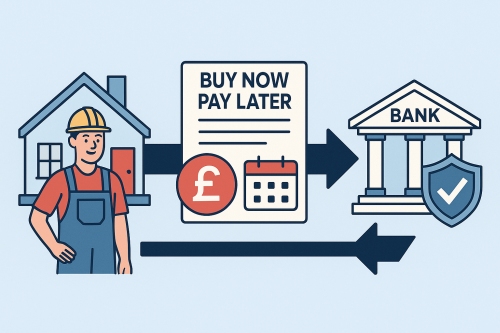
On June 16, 2025, the UK HM Treasury published a policy update that says 'domestic premises suppliers' (aka door to door vendors or companies that provide goods or services in a customer's home) no longer need to be licensed as credit brokers to offer Buy Now Pay Later (BNPL) services. The change to BNPL regulation is aimed at supporting smaller businesses without weakening consumer protections. This exemption includes services like home improvement consultations, kitchen installations, in-home services like cleaning or fitness, or any other sale that takes place during a visit to the customer's home.
Many industry stakeholders warned that requiring a credit broker license for these types of businesses isn't necessary and overly burdensome. The government agreed because these in-home suppliers do not offer financial services as their primary business activity. Instead, the typically introduce customers to a single BNPL lender as part of a product or service sale. Additionally, regulators realized that the risk of consumer harm in these cases is relatively low since the financial exposure sits with the BNPL lender who is regulated, not the seller, and felt that requiring small businesses to apply and maintain broker requirements is disproportionate to their role.
While the sellers are now exempt, BNPL lenders will still be fully regulated under the new rules, and must perform creditworthiness and affordability checks and comply with FCA Consumer Duty requirements. They must also ensure that purchases made using BNPL are protected under Section 75 of the Consumer Credit Act 1974, and that customers have access to the UK’s Financial Ombudsman Service to address complaints.
The full BNPL regulatory framework in the UK is expected to come into force by mid-2026, including secondary legislation to implement the exemption for in-home sellers.
Canada doesn't currently have a dedicated national BNPL regulatory framework. It also doesn't require BNPL sellers to have a credit-brokering license. The Financial Consumer Agency of Canada (FCAC) continues to monitor the sector but doesn't directly regulate BNPL lending. Oversight is through a mix of provincial consumer protection laws and federal rules related to money laundering and data privacy.
In Ontario as an example, BNPL offerings must comply with the Consumer Protection Act, which requires clear disclosures and restricts misleading marketing. If a provider handles payments, they may also need to register as a money services business under federal law.
As BNPL continues to grow, pressure is building for regulators to provide clearer guidance. The UK’s model may offer a useful reference for policymakers looking to balance access to BNPL services while protecting Canada's evolving credit sector.
The National Crowdfunding & Fintech Association (NCFA Canada) is a financial innovation ecosystem that provides education, market intelligence, industry stewardship, networking and funding opportunities and services to thousands of community members and works closely with industry, government, partners and affiliates to create a vibrant and innovative fintech and funding industry in Canada. Decentralized and distributed, NCFA is engaged with global stakeholders and helps incubate projects and investment in fintech, alternative finance, crowdfunding, peer-to-peer finance, payments, digital assets and tokens, artificial intelligence, blockchain, cryptocurrency, regtech, and insurtech sectors. Join Canada's Fintech & Funding Community today FREE! Or become a contributing member and get perks. For more information, please visit: www.ncfacanada.org
| | |
|---|---|---|
| | |
Stablecoins | June 17, 2025

Image: Freepik/rawpixel.com
Retail giants Amazon and Walmart are exploring the idea of launching their own stablecoins to reduce payment processing costs and gain more control over transactions, according to a report by the Wall Street Journal. This could tip the balance toward merchant-controlled financial systems and impact how value is transferred in the digital economy.
Currently card networks like Visa and Mastercard charge merchants high fees for purchase transactions. By using stablecoins pegged to the U.S. dollar, retail companies like Amazon and Walmart could build their own payment systems, bypassing legacy rails and retain more transactional value on their platforms. However any stablecoin plans depend on whether or not the proposed Genius Act becomes law in the United States.
As reported by Reuters, stablecoins are gaining interest among corporations that want to issue or use private forms of digital cash. The goal isn't to create a new form of money, but to develop closed financial ecosystem for transactions that are faster, cheaper, and programmable than legacy payment systems used today.
Retailers aren't the only ones interested. PayPal has already launched its own stablecoin, PYUSD, which is issued through a partnership with Paxos, a licensed trust company. Amazon and Walmart could follow a similar route or choose to build in-house capabilities.
According to Crowdfund Insider, the Genius Act is currently in front of the Senate and is expected to have a floor vote on June 18 which if passed would become the first American law to set national standards for fiat-backed digital currency. Stablecoins would require 1:1 reserve backing, clear audit rules, and strong consumer protections.
The Genius Act is designed to add clarity and prevent abuse while encouraging legitimate innovation. Only regulated entities can issue stablecoins and limits will be in place for the type or size of non-financial companies that can use them. Analysts at Bernstein have warned that the Genius Act could make it “prohibitive” for retailers to issue stablecoins directly without working with financial partners.
As Business Insider explains, the bill would give federal regulators oversight of reserves, mandate asset freezes under court orders, and block big tech companies from embedding coins too deeply into their platforms. The law also prevents stablecoin issuers from tying coins to commercial loyalty programs or e-commerce activity without approval.
If Amazon and Walmart did in fact launch their own stablecoins, merchant-led payment systems could reduce friction for consumers and suppliers while creating competitive pressure on Canadian banks, fintechs, and card networks.
Global payment flows could also be affected if retailer stablecoins are used for remittances or global vendor payments. Walmart already has a fintech joint venture with Ribbit Capital in the United States to create a fintech startup Hazel (also called 'One'), and experience with blockchain patents. Amazon has explored using external stablecoins such as USDC for settlement.
Whether they issue directly or partner with licensed issuers, the genie is almost out of the bottle and moving beyond theoretical. Consider it a live business option just waiting for regulatory clarity.
Canada’s fintech ecosystem should monitor these developments closely. U.S. regulatory clarity could prompt other jurisdictions to act, and consumer expectations will grow as giant retailers redefine what payments in the near future look like.
It may create opportunities for Canadian fintechs to partner with global brands or expand the merchant-focused rails to compete with card-based infrastructure, ultimately pushing to modernize domestic payments. Stablecoins come with some real risks around consumer protection, monetary policy, and financial stability, so it's essential to get the balance right.
The National Crowdfunding & Fintech Association (NCFA Canada) is a financial innovation ecosystem that provides education, market intelligence, industry stewardship, networking and funding opportunities and services to thousands of community members and works closely with industry, government, partners and affiliates to create a vibrant and innovative fintech and funding industry in Canada. Decentralized and distributed, NCFA is engaged with global stakeholders and helps incubate projects and investment in fintech, alternative finance, crowdfunding, peer-to-peer finance, payments, digital assets and tokens, artificial intelligence, blockchain, cryptocurrency, regtech, and insurtech sectors. Join Canada's Fintech & Funding Community today FREE! Or become a contributing member and get perks. For more information, please visit: www.ncfacanada.org
| | |
|---|---|---|
| | |
Innovation Award | June 16, 2025

Image from the Tokyo Financial Award 2025 website
Applications are now open for the Tokyo Financial Award 2025, a global competition organized by EY Strategy and Consulting on behalf of the Tokyo Metropolitan Government. The award targets financial technology companies at the edge of financial services, and also those working on sustainable finance problems. Canadian fintechs with global ambitions are encouraged to apply.
The Tokyo Financial Award is part of Tokyo’s push to become Asia’s financial innovation hub. Selected firms will gain visibility, mentorship, funding, and direct support for business expansion in Japan.
This category is for fintech companies and financial service providers offering innovative solutions that address the real needs of Tokyo’s citizens and businesses. This includes everything from digital payments to inclusive finance, automation, regtech, and more.
Deadline to apply: July 31, 2025 (23:59 JST) - Apply here
This category rewards companies using finance to support the transition to a sustainable society and has 3 subcategories:
Deadline to apply: August 31, 2025 (23:59 JST) - Apply here
The Tokyo Financial Award connects emerging fintech and sustainability leaders to one of Asia’s most dynamic financial markets. This is a great opportunity for Canadian fintech companies to diversify to new markets and gain recognition, funding, and in-market support while contributing to real world impact in Tokyo, Japan and beyond.
Visit the website to learn more or email: tfa@jp.ey.com.
The National Crowdfunding & Fintech Association (NCFA Canada) is a financial innovation ecosystem that provides education, market intelligence, industry stewardship, networking and funding opportunities and services to thousands of community members and works closely with industry, government, partners and affiliates to create a vibrant and innovative fintech and funding industry in Canada. Decentralized and distributed, NCFA is engaged with global stakeholders and helps incubate projects and investment in fintech, alternative finance, crowdfunding, peer-to-peer finance, payments, digital assets and tokens, artificial intelligence, blockchain, cryptocurrency, regtech, and insurtech sectors. Join Canada's Fintech & Funding Community today FREE! Or become a contributing member and get perks. For more information, please visit: www.ncfacanada.org
| | |
|---|---|---|
| | |
M&A | June 16, 2025

Image: Freepik
Another high growth Canadian founded tech startup exits on foreign soil. U.S. giant Qualcomm has agreed to acquire Toronto-founded semiconductor designer Alphawave Semi (Alphawave) for US$2.4 billion. The acquisition strengthens Qualcomm's data center and AI capabilities but also raises recurring questions about Canada's ability to retain and scale its homegrown innovators.
Alphawave was founded in Toronto in 2017 by Canadian engineer Tony Pialis. The company builds technology that helps computers move large amounts of data quickly and efficiently. Qualcomm plans to use Alphawave's technology alongside its own processors to support the growing demand for AI and energy efficient data centers.
In 2021, Alphawave chose to go public on the London Stock Exchange instead of listing on a Canadian stock exchange like the TSX. The decision was widely viewed as a sign that Canada's capital markets were not deep enough to support large scale semiconductor or hardware IPOs. At the time, Alphawave raised roughly US$500 million in its debut, validating London as a preferred launchpad for global visibility.
Alphawave is legally incorporated in the United Kingdom as Alphawave IP Group plc (AWE.L), with its official registered office in Leeds, England. The company is listed on the London Stock Exchange and governed by UK corporate law.
However, since the firm was founded in 2017 in Toronto, it maintains significant operations in Canada. Its main office still remains in Toronto, and it continues to operate major engineering and R&D facilities in Kanata, Ottawa, employing over 250 staff in the country. Alphawave recently opened a 20,000 square foot R&D lab in Kanata and actively recruits from Canadian universities.
So, while the public listing and legal structure are based in the UK, Alphawave's tech development and leadership talent are deeply rooted in Canada. The decision to list in London was based on the availability of semiconductor capital and deeper markets for advanced technology, according the company's leadership.
Alphawave is one of the most prominent Canadian-founded technology firms to exit internationally in recent years. The company's core IP and chiplet designs power data centers, AI infrastructure, and cloud platforms, foundations for fintech, e-commerce, and cybersecurity services, which are increasingly built with low latency, high performance hardware.
For policymakers and Canadian fintech leaders, it's clear that without stronger later stage funding mechanisms, global scale listings, and/or targeted supports, more Canadian firms are at risk of scaling elsewhere and being acquired prematurely.
Alphawave's story is another wake up call that Canada needs to continue to invest in Canadian tech companies to be globally competitive, from capital to commercialization, or risk a further drain of companies that need to look elsewhere to support their growth and success.
The National Crowdfunding & Fintech Association (NCFA Canada) is a financial innovation ecosystem that provides education, market intelligence, industry stewardship, networking and funding opportunities and services to thousands of community members and works closely with industry, government, partners and affiliates to create a vibrant and innovative fintech and funding industry in Canada. Decentralized and distributed, NCFA is engaged with global stakeholders and helps incubate projects and investment in fintech, alternative finance, crowdfunding, peer-to-peer finance, payments, digital assets and tokens, artificial intelligence, blockchain, cryptocurrency, regtech, and insurtech sectors. Join Canada's Fintech & Funding Community today FREE! Or become a contributing member and get perks. For more information, please visit: www.ncfacanada.org
| | |
|---|---|---|
| | |
Stablecoins | June 13, 2025
On June 12, 2025, Shopify announced that USDC stablecoin payments will be made available to its global merchant base via a new partnership with Coinbase and Stripe. So merchants can now accept USD Coin via Coinbase' Base Blockchain. This new payment feature is available in early access and will expand over time to offer fast, borderless payments without foreign exchange fees and integrated support for crypto wallets through Stripe.
Merchants using Shopify Payments can now accept USDC from supported crypto wallets through guest checkout and Shop Pay. By default, they receive payouts in their local currency, with no foreign exchange fees. Alternatively, they can choose to retain USDC in their own wallets. Transactions are processed using a bespoke smart contract system on the Base network, jointly developed by Shopify and Coinbase. This new payment layer is purposely built to offer similar functions as traditional card networks, allowing features such as delayed capture, tax finalization, and inventory reservation to work natively with stablecoin payments. So stablecoin checkout process will act just like normal e-comm payments but with the benefits of being faster and global.
Shopify recently acquired Privy which gives Shopify access to a wallet layer that integrates smoothly with both new and existing platforms. Stripe acquired Bridge, which provides the stablecoin rails needed to connect wallet payments to practical merchant settlements. So thanks to Stripe's backend capabilities, merchants won't have to manage blackchain infrastructure but payments will appear on their dashboard as any other transaction would.
Stablecoins offer three major benefits which allow small businesses to access global markets, receive payments quickly, and reduce reliance on expensive or delayed banking infrastructure:
Stablecoins have been all the rage recently, but there should be no doubt now that they've moved beyond hype and being adopted in real world scenarios at scale. The confluence of proven technology, incentives, and aligning regulations make stablecoin payments ready for prime time, and everyday merchants.
Shopify has widespread reach, serving millions of businesses globally every day from startups to large brands. It's somewhat clever to mimick existing card payment flows because it reduces learning curves and some friction points for retails.
Stripe's wallet to fiat infrastructure removes the complexity of crypto for every day merchants.
Stablecoin policies in the U.S. are moving forward, creating a legal pathway for this type of integration to work. The landscape was vastly different only a year ago. The GENIUS Act aims to provide clear rules for dollar-backed stablecoins like USDC.
This move will add significant competitive pressure to competing payment processors, and e-commerce merchant ecosystems. Expect Meta, Apple Pay, PayPal, Walmart, and Amazon to follow soon. Oh look, they already have started to move.
This is no longer a pilot. I repeat, this is no longer a pilot. Stablecoin infrastructure is being released into production at scale.
The National Crowdfunding & Fintech Association (NCFA Canada) is a financial innovation ecosystem that provides education, market intelligence, industry stewardship, networking and funding opportunities and services to thousands of community members and works closely with industry, government, partners and affiliates to create a vibrant and innovative fintech and funding industry in Canada. Decentralized and distributed, NCFA is engaged with global stakeholders and helps incubate projects and investment in fintech, alternative finance, crowdfunding, peer-to-peer finance, payments, digital assets and tokens, artificial intelligence, blockchain, cryptocurrency, regtech, and insurtech sectors. Join Canada's Fintech & Funding Community today FREE! Or become a contributing member and get perks. For more information, please visit: www.ncfacanada.org
| | |
|---|---|---|
| | |
Financing | June 12, 2025

Image: Freepik/rawpixel.com
On June 6, 2025, Gemini announced that it confidentially submitted a draft registration statement to the U.S. Securities and Exchange Commission (SEC) for a proposed IPO of its Class A common stock. The SEC will now review the statement subject to market conditions.
According to Coingecko, the total global crypto market cap has reached $3.5 trillion with Bitcoin holding above $107,000. Stablecoin issuer Circle's IPO debuted on the NYSE in early June with a over 170% on the first day. Coinbase joined the S&P 500 in May.
Gemini’s IPO intent follows the resolution of enforcement matters with both the SEC and CFTC, positioning itself as one of the first fully compliant crypto exchanges to go public since the FTX collapse in 2022.
If Gemini clears the IPO gate in the U.S., the flood gates will be open for a reset of crypto's place in public markets but only for compliant and credible digital asset firms that prove they are ready for institutional trust (and capital) - not just the hype.
The National Crowdfunding & Fintech Association (NCFA Canada) is a financial innovation ecosystem that provides education, market intelligence, industry stewardship, networking and funding opportunities and services to thousands of community members and works closely with industry, government, partners and affiliates to create a vibrant and innovative fintech and funding industry in Canada. Decentralized and distributed, NCFA is engaged with global stakeholders and helps incubate projects and investment in fintech, alternative finance, crowdfunding, peer-to-peer finance, payments, digital assets and tokens, artificial intelligence, blockchain, cryptocurrency, regtech, and insurtech sectors. Join Canada's Fintech & Funding Community today FREE! Or become a contributing member and get perks. For more information, please visit: www.ncfacanada.org
| | |
|---|---|---|
| | |


August 26th, 2025

January 4th, 2024

June 1st, 2021

September 9th, 2020

July 9th, 2018

January 3rd, 2018

September 25th, 2017

June 20th, 2017

May 10th, 2017

December 14th, 2016