




Karsten Wenzlaff, Advisor
August 26th, 2025
Karsten Wenzlaff is a Crowdfunding and Fintech Expert from Germany. He is Secretary-General of Digit[...]


Crypto Policy | June 11, 2025
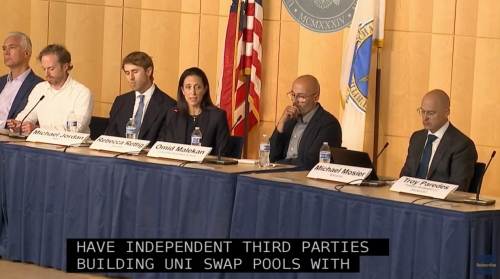
Image: June 9, 2025 DeFi Crypto Roundtable (Coindesk via youtube)
On June 9, the U.S. Securities and Exchange Commission (SEC) hosted another crypto task force roundtable series session called, "DeFi and the American Spirit", bringing together together regulators, legal experts, DeFi protocol developers, and investors to discuss how to the potential of regulating decentralized financial systems in ways that protects users without stifling innovation.
From the get-go, Chair Paul Atkins set the tone by opening the event by clearly stating that publishing code should not be treated as a crime:
“We will not regulate the act of writing open-source software. We do not prosecute the author of a hammer manual when someone misuses a hammer.”
The rest of the session built on this idea and focused on how the SEC can provide safe ways for DeFi projects to operate legally while still addressing investor risks.
In his remarks, Chair Atkins introduced the idea of a “conditional exemptive relief framework” which would allow DeFi innovators to build and launch on-chain products under limited conditions without triggering enforcement right away. This type of framework is similar to a regulatory sandbox that provides time-bound relief as long as participants meet specific safeguards.
“We are exploring a conditional exemptive relief framework that would allow experimentation under defined boundaries, similar to an innovation safe harbor.”
Commissioner Hester Peirce (aka Crypto mom) echoed this sentiment saying without a structured pathways to compliance, many innovators will either operate in legal uncertainty or offshore their projects out of the United States.
“Without a clear, conditional pathway, we are telling innovators you are on your own. That is not a message we want to send if we value the benefits of decentralized systems.”
In addition to the DeFi safe harbour, Chair Atkins also called upon his staff to modernize the current SEC rules to accommodate traditional issuers and intermediaries who want to use on-chain infrastructure.
This move shows that the SEC is looking to facilitate both new DeFi entrants and existing market players who are building tokenized products or using smart contracts to manage trading, issuance, or custody.
“I have asked the staff to consider whether amendments to the Commission’s rules and regulations would be better suited to provide needed accommodation for issuers and intermediaries who seek to administer on-chain financial systems.”
Atkins also discussed that on-chain systems can bring real benefits to the market, such as lower transaction costs, faster settlement, broader access, and the ability to create entirely new asset classes.
“I also am excited about the use of on-chain software systems by issuers and intermediaries to eliminate economic frictions, increase capital efficiency, enable new types of financial products, and enhance liquidity.”
It's clear support and endorsement of blockchain as a tool for economic growth, not just a solution for compliance challenges.
Several panelists, including Rebecca Rettig of Polygon Labs, warned that some of the most serious risks in DeFi happen off-chain. These include hidden liquidity deals, token allocations to insiders, or governance control partnerships.
“It is not always what is on-chain that creates the risk. It is often what is not disclosed, like side agreements, control over governance tokens, or preferential liquidity deals.”
Panelists argued that DeFi projects need better disclosure on how protocols are governed, how tokens are distributed, and whether any third parties receive special treatment or not.
Legal and industry experts said regulators should stop focusing on whether a token is a security and start regulating based on what the product or service actually does.
Angela Angelovska-Wilson of DLx Law said:
“We waste enormous energy litigating over whether X token is a security. The better path is regulating the activity, such as staking, custody, or lending, regardless of the label.”
Michael Jordan of the Digital Dollar Foundation agreed, saying:
“If we regulate the technology, someone will build around it. If we regulate the activity, we have a chance at real consumer protection.”
Important to understand the growing consensus that rules should distinguish between different types of financial behaviour even when the technology is similar.
Josh Garcia of Ketsal pointed out that some interfaces like custodial front ends that take custody of user funds or routes trades on behalf of users may require stricter oversight whereas protocols without admin control may require lighter regulation. Advocating for a layered regulatory approach that differentiates on function and control.
“A protocol with no privileged admin keys is not the same as a custodial front end that routes retail funds. The obligations differ, and so should the rules.”
After several Crypto Task force roundtable sessions, the SEC and participants are finally getting on the same page while focusing on conditional exemptions, regulatory modernization, and functional oversight. All together, it's a series effort to balance investor protection with lawful DeFi innovation. For fintech founders and digital asset platforms in Canada and globally, it's an important benchmark. If the U.S. begins providing clear compliance pathways and policy support for tokenized systems, then other jurisdictions will need to keep up or risk flight of builders and capital.
 The National Crowdfunding & Fintech Association (NCFA Canada) is a financial innovation ecosystem that provides education, market intelligence, industry stewardship, networking and funding opportunities and services to thousands of community members and works closely with industry, government, partners and affiliates to create a vibrant and innovative fintech and funding industry in Canada. Decentralized and distributed, NCFA is engaged with global stakeholders and helps incubate projects and investment in fintech, alternative finance, crowdfunding, peer-to-peer finance, payments, digital assets and tokens, artificial intelligence, blockchain, cryptocurrency, regtech, and insurtech sectors. Join Canada's Fintech & Funding Community today FREE! Or become a contributing member and get perks. For more information, please visit: www.ncfacanada.org
 |  |  |
|---|---|---|
 |  |  |
AI | June 9, 2025

Image: Freepik
On June 4, 2025, Reddit filed a lawsuit against Anthropic, alleging that the AI tech system conducted more than than 100,000 unauthorized data scraping events since last July, violating Reddit's user terms. It comes at a time when Anthropic is expanding the reach of Claude, its AI model family, across enterprise and government sectors. The legal, ethical, and commercial stakes are high.
Reddit's lawsuit is a critical test of Anthropic’s values and the public credibility of responsible AI branding. As Claude advances deeper into sensitive sectors like national security, it'll be more important than ever to define what real accountability with regards to data use looks like, and for Claude/Amodei to deliver on his ethical promise.
The National Crowdfunding & Fintech Association (NCFA Canada) is a financial innovation ecosystem that provides education, market intelligence, industry stewardship, networking and funding opportunities and services to thousands of community members and works closely with industry, government, partners and affiliates to create a vibrant and innovative fintech and funding industry in Canada. Decentralized and distributed, NCFA is engaged with global stakeholders and helps incubate projects and investment in fintech, alternative finance, crowdfunding, peer-to-peer finance, payments, digital assets and tokens, artificial intelligence, blockchain, cryptocurrency, regtech, and insurtech sectors. Join Canada's Fintech & Funding Community today FREE! Or become a contributing member and get perks. For more information, please visit: www.ncfacanada.org
| | |
|---|---|---|
| | |
DeFi Policy | June 5, 2025

Image: Freepik/rawpixel.com
On June 9, the U.S. Securities and Exchange Commission is hosting a policy roundtable titled “DeFi and the American Spirit” to have an open and structured policy dialogue with decentralized finance developers, innovators, and legal experts alongside SEC legal and regulatory voices. The roundtable is part of the SEC's Crypto Task Force's ongoing series of crypto asset regulation events.
These gatherings are not 'hearings', nor are they 'policy announcements' but rather conversations with people who have actually built defi systems, in fact many who have publicly challenged the SEC's approach. It’s a live forum where ideas about risk, innovation, and policy design can be tested in real time. So in that way, it's a rare and important event for DeFi in the U.S. and fintechs watching from other jurisdictions like Canada.
The speaker lineup is a mix of founders, researchers, lawyers, and advocates who all have somewhat different views on how DeFi should work and be handled from a regulatory and practical perspective.
Erik Voorhees, founder of ShapeShift (and now Venice AI) is known for arguing that decentralized tools and open-source software should not be regulated like traditional financial intermediaries. His participation ensures that the case for user autonomy and protocol neutrality will be represented without compromise.
Michael Mosier, former acting director of FinCEN who founded Arktouros is focused on financial crime and compliance. He's likely to advocate for more robust frameworks for identifying illegal flows through permissionless systems. He'll ensure that AML and systemic risk questions are part of the core conversation.
Rebecca Rettig, general counsel at Jito Labs and formerly with Polygon, brings first-hand experience in understanding protocol development and legal structure, and is well positioned to bring up solutions that don’t rely on full centralization, such as voluntary disclosures or protocol guardrails.
Kevin Werbach, a professor at Wharton, has spent years studying how decentralized systems intersect with regulation. He tends to advocate for layered frameworks that separate software, governance, and commercial activity to provide a way to regulate outcomes without halting innovation.
There are several other panelists including Jill Gunter (Espresso Systems), Peter Van Valkenburgh (Coin Center), Omid Malekan (Columbia Business School), Gabe Shapiro (MetaLeX), and others who will no doubt have ample to contribute in helping the SEC understand as well as framing the policy of decentralized systems.
It’s a great cross-section of people trying to answer the same question from different angles: how should decentralized finance be understood and governed?
Here are some core questions that may come up during the discussions:
At the end of the day, the SEC should be commended for their willingness to engage with key foundational questions in effort to both understand at a deeper level, as well as inform future policy making. Leaps and bounds better than regulate by enforcement under the SEC's ex-Chair, Gary Gensler and a commission that would rather assume that every DeFi project is either a rug-pull or disguised as a securities platform.
If the roundtable opens the door to more flexible or fit-for-purpose regulation, Canadian regulators will face growing calls to follow suit. It also offers Canadian founders a window into how U.S. regulators are thinking, what they are worried about, what they may be willing to tolerate, and where they are open to compromise. It's clear proof that the SEC is finally recognizing that DeFi isn't going away and that series policy design needs inputs from the people building it.
The National Crowdfunding & Fintech Association (NCFA Canada) is a financial innovation ecosystem that provides education, market intelligence, industry stewardship, networking and funding opportunities and services to thousands of community members and works closely with industry, government, partners and affiliates to create a vibrant and innovative fintech and funding industry in Canada. Decentralized and distributed, NCFA is engaged with global stakeholders and helps incubate projects and investment in fintech, alternative finance, crowdfunding, peer-to-peer finance, payments, digital assets and tokens, artificial intelligence, blockchain, cryptocurrency, regtech, and insurtech sectors. Join Canada's Fintech & Funding Community today FREE! Or become a contributing member and get perks. For more information, please visit: www.ncfacanada.org
| | |
|---|---|---|
| | |
Fintech IPO | June 5, 2025
June 5, 2025 will be on the record books as Circle's IPO, making history as the first stablecoin issuer to go public. Trading under the symbol CRCL, Circle’s shares opened at $69 and surged as high as $103.75 (235% above the IPO price of $31 that institutional investors access) before closing at $83.23.
The listing raised $1.1 billion, giving Circle a fully diluted market value of more than $22 billion. Lead underwriters included JPMorgan, Citigroup, and Goldman Sachs, with major investors including BlackRock and ARK Invest.
The scale and speed of Circle's pricing surge can only mean one thing; regulated crypto finance has arrived on Wall Street. This could be one of the most important public listings in the transformation and growth of digital finance and could open the door a steady stream of fintech IPOs who have been waiting for this very moment to arrive.
Circle reported $1.68 billion in revenue and $156 million in profit in 2024. Over 99% of that revenue came from interest earned on the reserves backing USDC, primarily in USD and short-term treasuries. According to Circle Internet Group's S1 filing, a 1% drop in interest rates could reduce annual revenue by $441 million.
Notably, Circle has begun monetizing blockchain services, subscription products, and network fees. These newer offerings brought in $20.7 million in Q1 2025 and are expected to scale.
Distribution costs remain a challenge however with Circle paying $1 billion in distribution fees in 2024, with the majority of that going to Coinbase. It's main stablecoin competitor, Tether, pays zero distribution fees.
USDC is the second largest stablecoin globally (27% market share). Circle’s IPO means that stablecoins are no longer niche tools for crypto trading but they are becoming key infrastructure for digital payments, cross-border flows, and mainstream financial innovation.
Circle has gone through some twists and turns in recent years, including cancelling a $9 billion SPAC deal in 2022, surviving the Silicon Valley Bank crisis in 2023, and rejecting a $4-5 billion acquisition offer from Ripple earlier this year (Coinbase also expressed interest). But Circle played their cards right and chose the full IPO route which created value of over 4 x those private offers. Circle's IPO also shows that the market rewards companies that take a regulated approach.
Circle’s public debut could jumpstart other fintech listings. Companies reportedly preparing IPOs include:
With Circle’s success, the IPO window appears to be opening again.
Circle’s IPO proves that regulated digital asset companies can scale and go public. It’s a reminder that Canada needs to ensure there's a clear framework for stablecoins. Without one, high-growth companies will continue to launch and grow within U.S. markets instead.
The National Crowdfunding & Fintech Association (NCFA Canada) is a financial innovation ecosystem that provides education, market intelligence, industry stewardship, networking and funding opportunities and services to thousands of community members and works closely with industry, government, partners and affiliates to create a vibrant and innovative fintech and funding industry in Canada. Decentralized and distributed, NCFA is engaged with global stakeholders and helps incubate projects and investment in fintech, alternative finance, crowdfunding, peer-to-peer finance, payments, digital assets and tokens, artificial intelligence, blockchain, cryptocurrency, regtech, and insurtech sectors. Join Canada's Fintech & Funding Community today FREE! Or become a contributing member and get perks. For more information, please visit: www.ncfacanada.org
| | |
|---|---|---|
| | |
Reg CF Data | June 5, 2025

Image: Freepik/rawpixel.com
On May 28, 2025, the U.S. Securities and Exchange Commission (SEC) released new data on Regulation Crowdfunding (Reg CF) as part of a broader update on capital formation and private funds. The Reg CF analysis studied regulation crowdfunding activity between 2016 and 2024 and reported that 8,492 offerings were launched by 7,134 issuers, excluding withdrawn campaigns.
But there's a data tracking issue with the SECs data. Of a total of 8,492 campaigns, only 3,869 of these crowdfunding offerings were reported as proceeds to the SEC, totaling about $1.3 billion. That means less than half of all campaigns included final results in the public record.
Even the SEC admits the numbers are incomplete in the report:
“This is likely to be a lower-bound estimate due to variance in Form C-U filing practices.”
This data gap has real consequences because it's harder for regulators, investors, and anyone interested in tracking crowdfunding capital flows, as industry evolves.
Sherwood “Woodie” Neiss, principal at Crowdfund Capital Advisors (CCA) and long time advisor to NCFA Canada, says this is a structural issue.
“The SEC’s numbers are based on what companies file, not what they actually raise. Most offerings don’t report final results, so the public sees less than half the full picture.”
To solve this problem, CCA built CCLEAR, a real time database that tracks every Reg CF campaign in the U.S. Instead of relying on incomplete filings, CCA collects live data daily from every platform and tracks/records the life of each campaign from launch to close.
Reg CF investors are putting more money into healthcare, energy, industrial and manufacturing. Sectors like tech, financial services, and real estate slowed down, while consumer categories like fashion and sports grew modestly.
Unlike the SEC who tracks capital by state, CCLEAR tracks it by postal code so it's at a more granular city level, which helps government, funders, and issuers gain deeper insights into crowdfunding capital flows and the startup ecosystem. During the reporting period, Austin, Miami, and New York City experienced growth, while San Francisco and Los Angeles saw declines.
Instead of only reporting how much a campaign raised at the end, CCLEAR tracks activity daily.
This type of platform data is important because it helps manage expectations and lawyers can better align campaign structures with investor interest.
The number of investors has gone down but the average check size is rising, signalling that a smaller group of confident investors are staying engaged:
Regulation Crowdfunding is growing fast, but the SEC only captures less than 50% of the the funding actually raised because they rely on form filings which mostly aren't filed, as their data source. Thankfully, tools like CCA's CCLEAR exist with real time tracking daily at granular levels of a campaign, so markets can understand where the capital is going, who is funding, and how best to optimize the structure of the funding rounds.
The implications of the SECs data reporting gap has implications that Canada can learn from as it reviews its own exempt market data practices. Platforms, regulators, and ecosystem leaders need better data infrastructure to best support early stage capital formation. Transparent, real time data is the foundation of market trust, policy design, and smarter investor participation, and is essential.
The National Crowdfunding & Fintech Association (NCFA Canada) is a financial innovation ecosystem that provides education, market intelligence, industry stewardship, networking and funding opportunities and services to thousands of community members and works closely with industry, government, partners and affiliates to create a vibrant and innovative fintech and funding industry in Canada. Decentralized and distributed, NCFA is engaged with global stakeholders and helps incubate projects and investment in fintech, alternative finance, crowdfunding, peer-to-peer finance, payments, digital assets and tokens, artificial intelligence, blockchain, cryptocurrency, regtech, and insurtech sectors. Join Canada's Fintech & Funding Community today FREE! Or become a contributing member and get perks. For more information, please visit: www.ncfacanada.org
| | |
|---|---|---|
| | |
Taxes and Investing | June 4, 2025

Image: Freepik/gstudioimagen1
U.S. President Donald Trump has progressed the "Big, Beautiful Bill", which recently passed the House and is now in front of the Senate, spanning over 1,000 pages about economic deregulation, tax restructuring, and retaliatory trade measures for certain countries including Canada. Among its most controversial elements is Section 899.
If enacted, the U.S. withholding tax rate on dividends paid to Canadian investors could increase from the current 15% to as high as 50%, which would affect retail as well as institutional investors like the Canada Pension Plan (CPP).
Tensions are rising over Canada's digital service taxes, and retaliatory U.S. trade policies including tariffs, and bill if implemented could inadvertently boost investment back into Canadian companies and markets.
Under the Canada-U.S. Tax Treaty, Canadians currently pay a 15% withholding tax on dividends from U.S. stocks. Section 899 proposes a 5% annual increase up to 50%, starting in 2026. While investors can claim foreign tax credits in Canada, the higher upfront U.S. withholding tax would significantly reduce net income from U.S. dividend paying investments.
Although exact rates vary by province and income level, the combined tax on eligible Canadian dividends for higher income earners is generally lower than the proposed 50% U.S. withholding (consult your accountant). This tax gap would force investors to rethink the risks and adjusted value of investing in U.S. dividend exposure.
The tax drag from a 50% U.S. withholding rate would leave just 50 cents on the dollar before any Canadian tax credits or additional taxation is applied. Compare and contrast this potential reality with a Canadian dividend that would be taxed at an effective rate of around 39% or less would generate more net income for the investor. The result may be a growing appeal to invest capital back into Canadian equities after many years of continual decline.
Canadian pension funds manage more than $3 trillion in assets. CPP Investments alone had $632.3 billion in assets as of March 2024, with only 11.7% invested in Canada (See: CPP Annual Report 2024). The Ontario Teachers’ Pension Plan (OTPP), managing over $266 billion, had 33% allocated to U.S. markets (See: OTPP Annual Report). So, if U.S. withholding rates rise, institutional portfolios will likely need to be rebalanced and optimized given that higher taxes would reduce net yields.
There's also a policy push for pensions to invest more domestically. In December 2024, the federal government appointed former Bank of Canada Governor Stephen Poloz to lead a review on increasing pension investment in Canada. The Fall Economic Statement mentioned the need to align institutional capital with domestic productivity and infrastructure priorities.
If more institutional capital is newly diverted into Canadian assets, it will benefit not just large scale infrastructure projects but fintech, innovation, AI, blockchain, and green finance sectors, to name a few.
Trump’s 'Big, Beautiful Bill' could have significant unintended consequences for Canada that encourages investors to prioritize Canadian opportunities for tax efficiency and building national economic resilience. There's no need to panic but you should speak with your investment and tax advisors now to evaluate the potential impact and prepare to rebalance your U.S. cross-border investments.
The National Crowdfunding & Fintech Association (NCFA Canada) is a financial innovation ecosystem that provides education, market intelligence, industry stewardship, networking and funding opportunities and services to thousands of community members and works closely with industry, government, partners and affiliates to create a vibrant and innovative fintech and funding industry in Canada. Decentralized and distributed, NCFA is engaged with global stakeholders and helps incubate projects and investment in fintech, alternative finance, crowdfunding, peer-to-peer finance, payments, digital assets and tokens, artificial intelligence, blockchain, cryptocurrency, regtech, and insurtech sectors. Join Canada's Fintech & Funding Community today FREE! Or become a contributing member and get perks. For more information, please visit: www.ncfacanada.org
| | |
|---|---|---|
| | |
Crypto | June 2 ,2025

Image: Freepik/bearfotos
On June 2, 2025, as reported by Coindesk, Sberbank, Russia’s largest and majority state-owned bank, quietly launched a structured bond tied to the performance of Bitcoin and the US dollar against the ruble. The bond is the first financial product of its kind in Russia to offer legal, state-backed exposure to cryptocurrency without requiring investors to hold or trade Bitcoin directly.
The bond is only accessible by qualified investors in Russia and is offered over the counter. It's designed to deliver returns (1) if Bitcoin rises in value, or (2) if the US dollar gains strength against the ruble. In doing so, investors can potentially receive higher yields than standard fixed income products within Russia's domestic financial system.
The bond is the first major financial product under new Bank of Russia rules that allow crypto-linked investments for qualified investors. For years Russia maintained a strict stance against cryptocurrencies, banning most forms of trading and prohibiting retail access to digital assets. Even after the rule change, everyday investors are not allowed to buy or sell digital assets through local exchanges or banks.
Will Sberbank's new bond change the landscape? Well it shows that Russia is willing to allow certain investors crypto exposure but only if it can fully control participation and on its own terms. Since the bond's settlement is in rubles and all transactions are managed/controlled by a government-backed institution, Russia can offer these types of investment options without stressing capital controls or monetary policy.
Sberbank also announced that it plans to list crypto-linked instruments on the Moscow Exchange. A Bitcoin futures product is expected to go live through its SberInvestments platform on June 4, 2025. These moves are all part of a broader push to establish legal, regulated channels for digital asset exposure inside the Russian economy.
As of today, there is no official data on the uptake or demand of the new bond issuance. Given that the product is new and restricted to accredited investors, detailed information may not be released until trading volumes develop. While the bond's dual exposure to Bitcoin price movements and to the USD/RUB forex rate, introduces volatility but institutional investors are looking for returns beyond traditional instruments, and the new bond option arrives at time when crypto adoption and exposure continues to grow globally.
Prior to now, most Russian investors looking for crypto exposure have relied on offshore accounts, informal P2P markets, or restricted access to foreign exchanges. All of these pathways come with geopolitical, legal and financial risks and challenges. Western sanctions, domestic regulations, and banking restrictions make cross-border crypto activity increasingly difficult.
Sberbank’s bond changes the equation. For the first time, investors can gain access to Bitcoin-based returns through a compliant, state backed product inside the Russian system. No private wallets are needed. No foreign currency leaves the country. The bond is fully backed by a government aligned financial institution and built to comply with Russian regulations. Sberbank’s bond may become a model for how other emerging markets experiment with digital assets while retaining full oversight and domestic control.
The National Crowdfunding & Fintech Association (NCFA Canada) is a financial innovation ecosystem that provides education, market intelligence, industry stewardship, networking and funding opportunities and services to thousands of community members and works closely with industry, government, partners and affiliates to create a vibrant and innovative fintech and funding industry in Canada. Decentralized and distributed, NCFA is engaged with global stakeholders and helps incubate projects and investment in fintech, alternative finance, crowdfunding, peer-to-peer finance, payments, digital assets and tokens, artificial intelligence, blockchain, cryptocurrency, regtech, and insurtech sectors. Join Canada's Fintech & Funding Community today FREE! Or become a contributing member and get perks. For more information, please visit: www.ncfacanada.org
| | |
|---|---|---|
| | |


August 26th, 2025

January 4th, 2024

June 1st, 2021

September 9th, 2020

July 9th, 2018

January 3rd, 2018

September 25th, 2017

June 20th, 2017

May 10th, 2017

December 14th, 2016