




Karsten Wenzlaff, Advisor
August 26th, 2025
Karsten Wenzlaff is a Crowdfunding and Fintech Expert from Germany. He is Secretary-General of Digit[...]


June 6, 2025

Image: Freepik
Getting a tattoo is an exciting experience, but it can also be a costly one. Whether you're planning your first tattoo or adding to your collection, saving money is essential to ensure you can afford the design of your dreams. In this article, we'll explore seven smart ways to save money for your next tattoo, so you can confidently walk into the studio without breaking the bank.
Before you start saving, determine how much your desired tattoo will cost. Research tattoo artists in your area and get quotes based on the size, complexity, and placement of your design. Once you have a realistic budget in mind, you can create a savings plan to reach your goal.
Consider opening a separate savings account specifically for your tattoo fund. This way, you can easily track your progress and avoid the temptation to spend the money on other expenses. Look for a high-yield savings account to maximize your savings potential.
Make saving a habit by automating your contributions. Set up automatic transfers from your checking account to your tattoo savings account each payday. Even small amounts, such as $20 or $50 per paycheck, can add up quickly over time.
Take a close look at your monthly expenses and identify areas where you can cut back. Consider reducing your cable package, dining out less frequently, or canceling subscriptions you don't use. Redirect the money you save towards your tattoo fund.
Declutter your space and boost your tattoo savings by selling items you no longer need or use. Host a garage sale, list items on online marketplaces, or sell to consignment shops. Not only will you earn extra cash, but you'll also create a more organized living environment.
Increase your income by taking on a side hustle. Consider freelancing, tutoring, pet-sitting, or driving for a ride-sharing service. Dedicate the extra earnings to your tattoo savings account to reach your goal faster. Who knows, you might even discover a new passion or skill along the way.
Throughout the year, you may receive unexpected money, such as tax refunds, bonuses, or gifts. Instead of splurging on impulse purchases, allocate these windfalls to your tattoo savings account. You'll be surprised at how quickly these one-time influxes of cash can boost your progress.
It's important to remember that while saving for your tattoo, you should also consider the potential need for professional Brisbane QLD tattoo removal in the future. Although it may not be on your mind now, tastes and circumstances can change over time. Knowing that you have the option to remove or modify your tattoo can provide peace of mind as you embark on your tattoo journey.
Saving money for your next tattoo doesn't have to be a daunting task. By setting a realistic budget, automating your savings, cutting back on unnecessary expenses, and exploring additional income streams, you can make your tattoo dreams a reality without financial stress.
Remember, the key to success is consistency and patience. Stay focused on your goal, and before you know it, you'll be ready to book your appointment with the tattoo artist of your choice.
 The National Crowdfunding & Fintech Association (NCFA Canada) is a financial innovation ecosystem that provides education, market intelligence, industry stewardship, networking and funding opportunities and services to thousands of community members and works closely with industry, government, partners and affiliates to create a vibrant and innovative fintech and funding industry in Canada. Decentralized and distributed, NCFA is engaged with global stakeholders and helps incubate projects and investment in fintech, alternative finance, crowdfunding, peer-to-peer finance, payments, digital assets and tokens, artificial intelligence, blockchain, cryptocurrency, regtech, and insurtech sectors. Join Canada's Fintech & Funding Community today FREE! Or become a contributing member and get perks. For more information, please visit: www.ncfacanada.org
 |  |  |
|---|---|---|
 |  |  |
Global Fintech Report | Jun 2, 2025
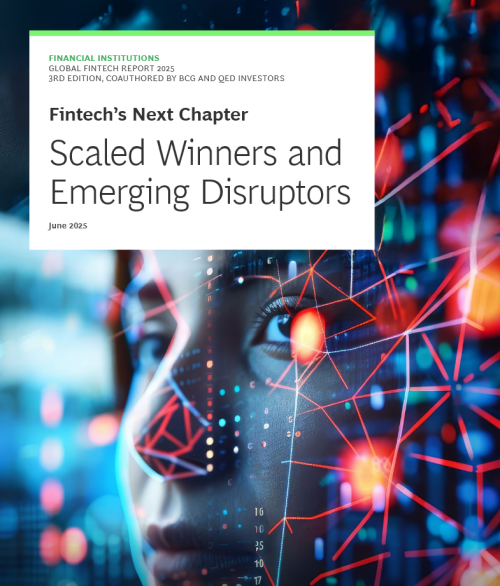
Image: Cover of Scaled Winners and Emerging Disruptors (June 2025, BCG and QED Investors)
The Boston Consulting Group (BCG) and QED Investors, just published a June 2025 report titled, "Fintech’s Next Chapter: Scaled Winners and Emerging Disruptors" (38 page PDF), highlighting that global fintech revenues rose 21% in 2024 compared to 6% for traditional financial institutions. That confirms fintech showed a strong rebound across sectors, accelerating from the prior year, after a couple of years of tightening capital markets and heightened regulatory scrutiny.
In 2024, fintechs generated $378 billion in revenue, while traditional banks and insurers earned $12.7 trillion. Fintechs have captured just 3% of this revenue, so 97% is still in the hands of incumbent financial institutions.
There are roughly 100 scaling fintechs earning over $500 million annually of which these 5 verticals dominate revenue generation:
These five sectors represent most of the $231 billion in scaled fintech revenue. Payments alone represent 55% of that total. Challenger banks and crypto platforms hold a smaller but growing share.
There are 150 global fintechs founded before 2016 that have raised over $500 million in equity and remain private. Many are waiting for improved conditions in the capital markets, such as Stripe and other scaling fintechs expecting to IPO
Fintech’s revenue share remains small across all verticals. Insurance accounts for less than 1% of fintech penetration. Deposits stand at just 2%. Lending, despite strong activity in personal loans and buy now pay later, accounts for only 3% of global lending revenues.
Agentic AI where AI powered systems are capable of logic and taking actions independently is a game changer. AI native fintechs have already gobbled up 49% of fintech equity funding yet only represent 23% of the sector.
Blockchain-based on-chain finance is also gaining traction. Tokenization of assets like bonds, private credit, and money market funds is growing at a double-digit rate. While tokenized asset volume remain under $1 trillion today, major institutions like Goldman Sachs and the European Investment Bank are piloting large-scale tokenization programs.
Private credit funds are also becoming essential to fintech lending models. With $1.7 trillion in assets under management, these funds are stepping in where traditional bank funding is constrained. The report estimates a $280 billion untapped opportunity for private credit participation in fintech-originated lending. In 2024 and early 2025, several billion-dollar forward flow deals were announced, including SoFi, Klarna, and Pagaya.
Fintech is rebounding and growing faster than traditional banks but has only unlocked 3% of global banking and insurance revenue, so the opportunity is still massive. Fintechs that can deliver sustainable growth, expand into new customer segments, and integrate new technologies like AI and tokenization will be well positioned to capture the next iteration of financial services tech.
The National Crowdfunding & Fintech Association (NCFA Canada) is a financial innovation ecosystem that provides education, market intelligence, industry stewardship, networking and funding opportunities and services to thousands of community members and works closely with industry, government, partners and affiliates to create a vibrant and innovative fintech and funding industry in Canada. Decentralized and distributed, NCFA is engaged with global stakeholders and helps incubate projects and investment in fintech, alternative finance, crowdfunding, peer-to-peer finance, payments, digital assets and tokens, artificial intelligence, blockchain, cryptocurrency, regtech, and insurtech sectors. Join Canada's Fintech & Funding Community today FREE! Or become a contributing member and get perks. For more information, please visit: www.ncfacanada.org
| | |
|---|---|---|
| | |
AI | June 2, 2025

Image: Screengrab of Google DeepMind Veo 3 AI generated video demo
On May 20, 2025 at Google I/O 2025, Google DeepMind announced Veo 3, its most advanced generative video model to date. Veo 3 can currently create up to 8 seconds of high quality footage that looks and sounds like it came from a professional photo shoot. By just using text prompts, a user can create realistic videos with motion, characters, camera angles, synchronized audio to impress.
Here's a demo of Veo 3 by Google DeepMind on Youtube:
As you can see from the demo above, Veo 3 is a big improvement over earlier AI video tools that produced silent, low motion clips or avatar videos. The tech is leaping forward and approaching AI native storytelling. Yes, that means AI's will soon be infiltrating the minds of everyone including our kids. If you want to dig deeper with more practical examples, datacamp shows the actual text prompts used and the output videos to compare.
Compared to existing models like Runway or Pika, Veo sands out as it handles visuals, pacing, tone, and audio in a single pipeline.
Veo 3 also requires Google AI Pro ($19.99 USD/month) which will get you a trial setup of 10 videos, after which you revert back to Veo 2). It's also not currently available in Canada.
While Veo isn't ready to handle fintech compliance training or regulated product videos just yet, it does hint at where fintech communication may be heading. Marketing use cases are obvious, however given that finance is a trust-first industry and errors can damage reputation and credibility, AI tools are not yet reliable for public facing key content. Having said that, they can offer real value for internal use today. Teams can build product mockups, pitch materials, and explainer concepts in hours rather than weeks. This could reduce creative bottlenecks, especially for startups or global teams. This increased productivity will also save costs.
Veo could also help visualize complex systems like token flows, credit models, or blockchain processes, which are harder to explain with charts. Video can simplify them without losing nuances or the experience.
Longer term, tools like Veo could become part of smart assistants in apps. Imagine a finance tool that could show spoken and visual demonstrations and summaries of their spending or investment performance. That vision is still early as they are focusing on empowering creator needs, but as Veo tech begins to commercialize, all kinds of corporate use cases could appear.
1. The latest AI video tech is jaw dropping but it's not yet trustworthy for regulated content. It can generate false visuals or misleading narration, making it risky where it counts. It also lacks transparency since there's no clear way to trace how or why a given output was created. That makes auditing difficult, especially for compliance teams or legal departments.
2. Content ownership also remains a grey area. If a fintech firm uses Veo to create a branded explainer, does it own the video fully? Terms of use vary and are still evolving.
3. There's also massive potential for misuse. These tools could generate fake interviews, impersonate key executives, or mislead investment stories. Even with watermarks, the damage could happen before detection.
Google DeepMind's latest AI text-to-video generator Veo 3 is impressive and best used for entertainment, marketing, or internal use in it's current form, as it's not ready for anything tied to legal, financial or regulatory claims just yet. One to watch, it won't be long.
The National Crowdfunding & Fintech Association (NCFA Canada) is a financial innovation ecosystem that provides education, market intelligence, industry stewardship, networking and funding opportunities and services to thousands of community members and works closely with industry, government, partners and affiliates to create a vibrant and innovative fintech and funding industry in Canada. Decentralized and distributed, NCFA is engaged with global stakeholders and helps incubate projects and investment in fintech, alternative finance, crowdfunding, peer-to-peer finance, payments, digital assets and tokens, artificial intelligence, blockchain, cryptocurrency, regtech, and insurtech sectors. Join Canada's Fintech & Funding Community today FREE! Or become a contributing member and get perks. For more information, please visit: www.ncfacanada.org
| | |
|---|---|---|
| | |
Crypto Regulation | June 2, 2025

AI Image, SEC says crypto staking not a security
On May 29, 2025, the U.S. Securities and Exchange Commission (SEC) published new guidance, "Statement on certain protocol staking activities". The Corporation Finance Division said that staking crypto assets on proof-of-stake networks does not count as offering or selling a security under federal law.
The SEC guidance says these 3 models do not involve the kind of for profit structure that securities law covers, which shows how the SEC is now approaching proof-of-stake blockchain systems in practice: (1) staking by individuals (solo staking), (2) delegating staking rights to a non-custodial third party, and (3) custodial staking done by platforms that hold assets on behalf of users.
The Division stated, “Protocol staking does not involve entrepreneurial or managerial efforts by third parties." Meaning it does not meet the Howey Test which the SEC uses to determine what counts as an investment contract (or not).
Two SEC commissioners published separate statements that highlight the ongoing debate inside the agency.
Commissioner Hester Peirce (Crypto mom) supports the new staking guidance, saying it was long overdue and provides clarity that developers and users have been asking for:
“Today’s statement is a step in the right direction. Market participants have long sought guidance on staking, and this statement, although overdue, provides helpful clarity.”
“Staking is not a financial investment in a business venture. It is a technical function essential to many blockchain networks.”
Commissioner Caroline Crenshaw raised concerns over the staking guidance, warning that it may weaken protections for retail users and was issued without a formal public process.
“This Staff statement attempts to draw lines in a complex and evolving ecosystem without the benefit of a Commission vote or notice and comment. That is not the kind of transparency or rigor that investors or market participants deserve.”
Crenshaw also said staking programs can still involve risk, especially when intermediaries are holding customer assets.
“Even assuming the best of intentions, staking programs can pose meaningful risks, especially when intermediaries custody or manage assets.”
Canadian regulators already have clear guidance on when staking may fall under securities law. According to CSA Staff Notice 81-336, the key trigger is custody. If a platform takes control of client crypto assets and stakes them on the client’s behalf, this may be considered a securities or derivatives activity and could require registration or compliance under existing rules.
However by contrast, individuals who stake their own crypto assets directly or delegate staking rights without giving up custody are generally not subject to regulation, as long as the activity does not involve other investment features or representations.
“Depending on how it is conducted, staking of crypto assets may involve the issuance of a security or derivative and/or may raise other investor protection concerns.”
The U.S. position is different becomes it frames protocol staking itself as a technical service (even when done by custodians), and not an investment contract. At the end of the day, U.S. firms will now face less friction when offering staking services, while Canadian platforms still operate under stricter conditions if custody is involved.
The question now is whether Canada will maintain this more cautious approach or align with emerging U.S. standards. If many firms start moving operations to the U.S. to take advantage of fewer barriers, then regulators may feel pressure to change.
Be aware that the guidance reflects the views of the SEC's Corporate Finance Division staff. It's not a new law or exempt from any activity from enforcement but it does offer helpful insight into current staff interpretations under existing U.S securities law (but it's not binding or the full Commission or court). It was raised that some common staking features like pooled assets, slashing protection, or enhanced reward mechanisms could till meet the criteria for an investment contract under Howey.
Further, the staff statement doesn't include liquid staking, restaking, or other models that add financial structuring, which is outside the scope of the guidance and could still raise regulatory concerns. See this A&O Shearman article for deeper analysis.
Staking is one of the core functions of proof-of-stake blockchains, including Ethereum. For developers and users, the ability to stake without regulatory risk is essential to network growth and security.
The SEC's staking guidance removes barriers, adds clarity, and will certainly give the market a boost. It will be interesting to see if staking adoption is slower here in Canada and if domestic platforms can compete or are overly restricted, due to the different approaches.
The National Crowdfunding & Fintech Association (NCFA Canada) is a financial innovation ecosystem that provides education, market intelligence, industry stewardship, networking and funding opportunities and services to thousands of community members and works closely with industry, government, partners and affiliates to create a vibrant and innovative fintech and funding industry in Canada. Decentralized and distributed, NCFA is engaged with global stakeholders and helps incubate projects and investment in fintech, alternative finance, crowdfunding, peer-to-peer finance, payments, digital assets and tokens, artificial intelligence, blockchain, cryptocurrency, regtech, and insurtech sectors. Join Canada's Fintech & Funding Community today FREE! Or become a contributing member and get perks. For more information, please visit: www.ncfacanada.org
| | |
|---|---|---|
| | |
AI Regulation | May 29, 2025

Image: Freepik/luis molinero
In March 2024 last year, the European Union adopted the AI Act, the world’s first comprehensive regulatory framework on artificial intelligence. It follows a risk-based approach, categorizing AI systems into four tiers based on risk with the highest risk systems facing strict requirements around data governance, transparency, human oversight, and cybersecurity. Fines for noncompliance can reach up to €35 million or 7% of global revenue.
However, according to Sifted the European Commission's President Ursula von der Leyen's team is now considering to delay enforcement of the EU's AI Act to introduce changes that will simplify the law. The delay was triggered by concerns from startups, global tech firms, and even non-EU governments, highlighting tensions between innovation and oversight in AI regulation. It also puts renewed pressure on countries like Canada, where formal legislation remains stalled, to clarify their position on AI governance in an industry moving faster than light.
One of the core controversies is how AI systems are categorized, since higher risk systems face the most rigorous requirements. For example, when AI is used to perform a type of 'social scoring' it's banned outright. Many firms warned at this framework could backfire.
Earlier this year, Capgemini CEO Aiman Ezzat warned that "the EU went too far" making the deployment of AI too difficult compared to other jurisdictions like the U.S and Asia.
Others, including some lawmakers in the European Parliament cursed the delay as a capitulation to Big Tech. A letter from several MEPs called any move to make compliance optional “dangerous and undemocratic”.
Adding to the pressure, the U.S. Trump administration submitted a letter challenging the EU Commission's guidelines for advanced AI systems saying that the framework would create regulatory burdens and stifle innovation.
In 2022, Bill C-27 or the Artificial Intelligence and Data Act (AIDA) was introduced to regulate high impact AI systems but the AIDA bill died on the order paper when Parliament was prorogued in January 2025. So instead of an AI law, the Canadian government issued a Voluntary Code of Conduct for Advanced GenAI Systems. While this level of guidance is useful, it's not enforceable so it lacks the 'stick and carrot' that these global AI firms need.
Regulatory Comparison: EU vs Canada
| Feature | EU AI Act (2024) | Canada’s AIDA (Status: Dead Bill) |
| Legal Status | Enacted March 2024 | Died in January 2025 |
| Enforcement | Mandatory with fines up to €35M / 7% of turnover | Voluntary code; no penalties |
| Risk Classification | 4 levels: banned, high, limited, minimal | Focus on “high-impact systems” (undefined) |
| Implementation Timeline | Staggered from 2025 to 2027 | Not applicable |
| Market Reach | Extraterritorial (global firms included) | Focused on domestic AI systems |
The EU’s AI Act framework has extraterritorial reach, meaning Canadian firms offering services in Europe could fall under its scope regardless of where they’re based. So Canadian fintechs developing credit risk scoring models, biometric ID systems, or fraud detection tools for European markets, are breathing a sigh of relief given the current pause.
At the same time, Canada’s lack of enforceable AI legislation creates uncertainty. Without clear national rules, companies must operate in a fragmented environment of global regulatory expectations. With PM Carney now at the helm, Canada could update its regulatory approach to a more innovation-friendly framework. One that's interoperable with Europe but grounded in domestic market needs.
The EU AI Act’s pause is a warning that global AI regulations are still up in the air. So companies need to be agile, stay informed and proactive. Canadian fintechs and AI developers operating globally should use this strategic window of time to impact emerging norms while preparing for stricter enforcement ahead.
The National Crowdfunding & Fintech Association (NCFA Canada) is a financial innovation ecosystem that provides education, market intelligence, industry stewardship, networking and funding opportunities and services to thousands of community members and works closely with industry, government, partners and affiliates to create a vibrant and innovative fintech and funding industry in Canada. Decentralized and distributed, NCFA is engaged with global stakeholders and helps incubate projects and investment in fintech, alternative finance, crowdfunding, peer-to-peer finance, payments, digital assets and tokens, artificial intelligence, blockchain, cryptocurrency, regtech, and insurtech sectors. Join Canada's Fintech & Funding Community today FREE! Or become a contributing member and get perks. For more information, please visit: www.ncfacanada.org
| | |
|---|---|---|
| | |
Report | May 29, 2025

Image: Freepik
On May 15, 2025, the UK government announced a new capital markets pilot called PISCES (Public Intermittent Securities and Capital Exchange System), a public market model designed to help high growth private companies raise money from investors without going fully public. Backed by the UK Treasury and the Financial Conduct Authority, PISCES offers qualifying issuers a new way to raise funds with more flexibility and less burden than a traditional stock exchange public listing, while keeping investor protections in place.
The goal is to close the funding gap for companies that have outgrown early stage venture capital but aren't yet ready or suitable for an IPO. The UK government said this new model will be tested with select scale-ups in 2025, and if successful could become a long term option that strengthens capital markets and keeps fast-growing businesses in the UK.
Key features of PISCES include:
Unlike a regular public company that remains on a stock exchange after it's initial listing, a company in the PISCES model can only raise money during specific time windows. So, they don't have to meet ongoing reporting or trading requirements in between those times. This creates more flexibility for companies that need capital but don’t want (or can’t manage) the cost and complexity of being fully public company.
Right now, Canada does not have a similar program like PISCES. Some similar options exist but they aren't the same:
The UK’s PISCES pilot is a good example of how policy and tech can work together to create smarter capital markets. It offers private companies more options for raising money at scale, while giving investors access to early-stage growth opportunities in a safe and structured way. If it means keeping more home grown Canadian scale-ups in the country then that's a good thing. With the right mix of regulatory support, infrastructure, and industry input, Canada could create its own version of PISCES to strengthen domestic capital formation and innovation. This is another one to watch.
The National Crowdfunding & Fintech Association (NCFA Canada) is a financial innovation ecosystem that provides education, market intelligence, industry stewardship, networking and funding opportunities and services to thousands of community members and works closely with industry, government, partners and affiliates to create a vibrant and innovative fintech and funding industry in Canada. Decentralized and distributed, NCFA is engaged with global stakeholders and helps incubate projects and investment in fintech, alternative finance, crowdfunding, peer-to-peer finance, payments, digital assets and tokens, artificial intelligence, blockchain, cryptocurrency, regtech, and insurtech sectors. Join Canada's Fintech & Funding Community today FREE! Or become a contributing member and get perks. For more information, please visit: www.ncfacanada.org
| | |
|---|---|---|
| | |
May 28, 2025

Image: Freepik
As digital innovation continues to transform how we live, the concept of connected homes is no longer futuristic, it's a growing reality. From energy management to enhanced safety, technology is reshaping the expectations homeowners have from their living spaces.
In this evolving landscape, many are turning to intelligent home automation for future-proofing systems. By deploying smart electrical devices and equipment that can learn, adapt, and self-optimise, homeowners are not just improving convenience but actively preparing their homes to meet long-term functional and sustainability goals.
One of the most compelling advantages of home automation and its capacity to enhance operational efficiency makes it a valuable asset. By employing programmable schedules and smart sensors, home systems can adjust temperature settings, lighting levels, and appliance usage.
These automated adjustments reduce wastage, extend the life of electrical devices, and contribute to lower utility bills. Its ability to manage Moreover, the ability to remotely monitor and manage systems adds an extra layer of convenience and resource optimisation.
The move towards sustainable building practices is gaining momentum, and home automation plays a central role in this transition. Advanced automation systems can integrate with renewable energy sources like solar panels and smart meters to track consumption patterns and shift usage to off-peak hours.
This not only supports national sustainability goals but also enables homeowners to make more informed decisions regarding their energy use. Homes equipped with smart systems can reduce energy consumption.
Incorporating home automation also enhances safety and security. From motion-sensor lighting and automated door locks to surveillance systems and smoke detectors, these devices can be programmed to alert homeowners and emergency services instantly in case of suspicious activity or hazards.
The feature to receive real-time alerts and control safety systems remotely ensures that occupants are protected, whether they are at home or away. This level of proactive security management makes home automation in smart homes a crucial component of modern living.
Another critical feature of home automation is its scalability. As technologies evolve and user needs change, these systems can be updated or expanded without requiring significant infrastructure changes. This modularity supports future innovations such as AI integration, voice control, and interoperability with new devices or platforms.
For example, integrating Human-Machine Interfaces HMIs with home automation systems allows users to interact more intuitively with their home environment, improving usability and accessibility.
The data collected by automated systems offers valuable insights into user behaviour and equipment performance. Analysing this data can help identify inefficiencies, predict maintenance needs, and inform system upgrades.
By incorporating predictive analytics and machine learning capabilities, home automation can evolve into a self-optimising ecosystem.
The success of any home automation setup relies not just on innovation, but on the reliability and quality of the systems integrated. High-grade electrical equipment and smart devices ensure that automation delivers consistent results, even as household demands evolve.
Well-engineered systems are more likely to:
In today's fast-paced and energy-conscious world, home automation in connected living environments is more than a convenience; it's a long-term investment. It enhances energy management, boosts safety, supports sustainability, and adapts to technological change.
By deploying the right systems and partnering with a reputable electrical brand, homeowners can create efficient, future-proof spaces that evolve with their lifestyles. Such collaboration ensures that the electrical devices incorporated into the home automation setup are not only of high quality but also compliant with the latest safety and energy standards.
The National Crowdfunding & Fintech Association (NCFA Canada) is a financial innovation ecosystem that provides education, market intelligence, industry stewardship, networking and funding opportunities and services to thousands of community members and works closely with industry, government, partners and affiliates to create a vibrant and innovative fintech and funding industry in Canada. Decentralized and distributed, NCFA is engaged with global stakeholders and helps incubate projects and investment in fintech, alternative finance, crowdfunding, peer-to-peer finance, payments, digital assets and tokens, artificial intelligence, blockchain, cryptocurrency, regtech, and insurtech sectors. Join Canada's Fintech & Funding Community today FREE! Or become a contributing member and get perks. For more information, please visit: www.ncfacanada.org
| | |
|---|---|---|
| | |


August 26th, 2025

January 4th, 2024

June 1st, 2021

September 9th, 2020

July 9th, 2018

January 3rd, 2018

September 25th, 2017

June 20th, 2017

May 10th, 2017

December 14th, 2016