




Karsten Wenzlaff, Advisor
August 26th, 2025
Karsten Wenzlaff is a Crowdfunding and Fintech Expert from Germany. He is Secretary-General of Digit[...]


Crypto Regulation | July 31, 2025
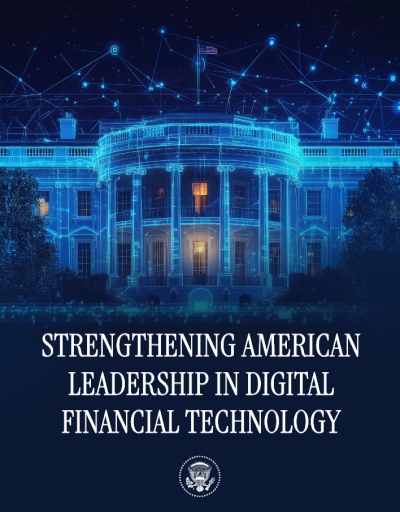
Image: Strengthening American Leadership in Digtal Financial Technology, White House report
On July 30, 2025, the White House released a major 160 page PDF report from the President’s Working Group on Digital Asset Markets called, "Strengthening American Leadership in Digital Financial Technology". The document lays out how the United States plans to build a clear rulebook for crypto and position itself as a leading global hub for blockchain technology, a huge change in direction from a government that previously relied on regulation by enforcement.
The White House report says the US needs a stronger framework for digital asset markets. It calls on Congress to pass the Digital Asset Market Clarity Act to remove gaps in oversight. The plan would give the Commodity Futures Trading Commission authority over trading in digital assets that are not securities, while the Securities and Exchange Commission would focus on those that are securities. The two agencies are asked to provide clear guidance on custody, registration, and record keeping so that new products can launch faster without long delays.
For fintech companies and investors, a more predictable environment is welcomed, and means that developers and platforms would know in advance what licenses they need and how to stay compliant instead of risking enforcement.
A large part of the report focuses on modern banking regulation. It urges federal banking regulators to stop blocking lawful digital asset companies from access to banking, a practice that was known as Operation Choke Point 2.0.
It also suggests a clear process for banks to gain approval for activities such as custody of crypto, tokenization of assets, issuing stablecoins, and using blockchains in financial services. If these changes are implemented, banks will have a clearer path to offer blockchain based products and services, which could expand customer access to digital assets directly through mainstream banks.
The report confirms the importance of stablecoins that are backed by the US dollar. It points to the GENIUS Act, signed into law on July 18, 2025, as the foundation for a federal framework for stablecoins. It also calls for a law to ban central bank digital currencies in the United States, emphasizing that the private sector should lead innovation in payments.
It suggests that the U.S. views private stablecoins as a way to maintain the dollar’s global role. It could lead to faster payments and new payment rails, but it's also a policy preference against government issued digital money.
The Working Group recommends updating anti money laundering rules to reflect how digital assets work. The plan would clarify the reporting obligations for different types of actors, including those in decentralized finance, and protect the right of law abiding citizens to hold their own digital assets. This could make it easier for compliant companies to operate while still giving regulators more effective tools against bad actors.
The report asks the Treasury and IRS to publish clear guidance on how taxes apply to crypto, including on staking, mining, and small day to day transactions. It also calls for Congress to adjust the tax code so that digital assets are treated consistently with other assets such as securities or commodities. Simplified tax rules could lower the cost of compliance and help bring more participants into the market.
If the recommendations are carried out, the US could become a more attractive market for crypto investment and product development. Other countries, including Canada, need to watch closely, as competition for talent and venture funding heats up.
For Canadian fintechs and blockchain companies, this development could open up opportunities for cross border partnerships but also create a more competition.
 The National Crowdfunding & Fintech Association (NCFA Canada) is a financial innovation ecosystem that provides education, market intelligence, industry stewardship, networking and funding opportunities and services to thousands of community members and works closely with industry, government, partners and affiliates to create a vibrant and innovative fintech and funding industry in Canada. Decentralized and distributed, NCFA is engaged with global stakeholders and helps incubate projects and investment in fintech, alternative finance, crowdfunding, peer-to-peer finance, payments, digital assets and tokens, artificial intelligence, blockchain, cryptocurrency, regtech, and insurtech sectors. Join Canada's Fintech & Funding Community today FREE! Or become a contributing member and get perks. For more information, please visit: www.ncfacanada.org
 |  |  |
|---|---|---|
 |  |  |
Financing | July 31, 2025

Image from RAMP $500M financing announcement blog post
On July 31, 2025, New York-based expense management platform Ramp announced that it secured $500 million dollars in a Series E 2 round led by Iconiq Capital (just 45 days after raising $200M in March). The new funding places the company’s valuation at $22.5 billion dollars.
Ramp says it now serves more than 40,000 businesses including companies Shopify, Notion and Quora, and that it became cash flow positive in early 2025. TechCrunch previously reported that Ramp crossed $700 million dollars in annualized revenue as of January.
Eric Glyman, Co-founder/CEO of Ramp explained the purpose of the new capital and wrote:
“45 days ago I said let the robots chase receipts. Today, they’re not just chasing receipts. They’re filing your expenses, booking your travel, paying your invoices and closing your books. And we’ve raised another $500M at a $22.5 billion valuation to pick up the pace.”
"The year is 2025: pick your poison"
Glyman described two types of finance teams. The first is focused on day to day tasks with no time to change the way they work. The second is already testing tools that automate as much manual work as possible. He noted that more companies are moving into the second group and that once teams use agents that can automatically handle travel or expense tasks they rarely return to the old way of working.
"By 2026: agents take over the busywork"
Ramp’s plan for 2026 is to let its agents manage low risk expenses, answer employee policy questions over text, and flag unusual transactions for review. Glyman explains how one small expense can interrupt people three times and take 14 minutes of time.
Teams in the beta program are now doing 85% fewer manual reviews. These agents have already caught 15 times more policy violations and processed ten thousand transactions automatically.
"By 2027: finance starts running in parallel"
Today's financial workflow tends to happen in a strict order where one department waits for another to finish before it begins its part. In the near future, when software agents are doing the work these steps can happen in parallel. Legal, risk and procurement copilots could review the same request at the same time and prepare approvals before anyone asks.
“Right now, Ramp users are getting 3× more done per minute compared to two years ago. By 2027 as our agents start working in parallel we’re aiming for 30×.”
"By 2028: autonomous AI with human oversight"
Looking ahead to 2028 Glyman describes a model where fintech AI agents think and act on their own with human supervision. These agents will optimize cash positions, clear most transactions without manual review, and produce live forecasts so that people can spend less time on admin work and more on analysis and strategy.
Ramp has raised $1.9 billion dollars since its launch in 2019, and increased its valuation from $13 billion in March to $22.5 billion in less than five months. To say there's investor appetite for automating finance is an understatement.
Although the company has not disclosed exact revenue figures, it says its income comes from interchange fees, transaction fees on bill payments, software subscriptions, foreign exchange and affiliate fees on travel. We're truly witnessing transformational and rare times of opportunity.
The National Crowdfunding & Fintech Association (NCFA Canada) is a financial innovation ecosystem that provides education, market intelligence, industry stewardship, networking and funding opportunities and services to thousands of community members and works closely with industry, government, partners and affiliates to create a vibrant and innovative fintech and funding industry in Canada. Decentralized and distributed, NCFA is engaged with global stakeholders and helps incubate projects and investment in fintech, alternative finance, crowdfunding, peer-to-peer finance, payments, digital assets and tokens, artificial intelligence, blockchain, cryptocurrency, regtech, and insurtech sectors. Join Canada's Fintech & Funding Community today FREE! Or become a contributing member and get perks. For more information, please visit: www.ncfacanada.org
| | |
|---|---|---|
| | |
Fintech Report | July 30, 2025

Image: BCG QED Report Scaled Winners, Emerging Disruptors (Cover)
The latest analysis from BCG and QED Partners in a report titled, "Fintech's Next Chapter: Scaled Winners and Emerging Disruptors" (38 page PDF), shows that fintech companies currently capture just 3% of global banking and insurance revenues, leaving substantial room to grow.
The study frames this stage around two groups. The scaled winners are fewer than 100 companies generating more than $500 million in annual revenue. They account for most of the sector’s revenues and are now focused on profitability, compliance and expansion into adjacent services.
The emerging disruptors are thousands of smaller companies between $50 to $500 million in revenue. They are fast moving, often AI native, and are working in underserved markets and niches. Some of these emerging disruptors are well on their way to becoming the next generation of scaled winners.
In 2024, global fintech revenues increased 21% compared with 13% the previous year. Segments such as deposits grew 23%, trading and investment 21% and insurance 40%. This growth is happening while valuations and funding have recovered. In the first quarter of 2025, equity funding was 34% higher than a year earlier and valuations improved by 10%.
Earnings margins improved by 4% points to reach 16% in 2024. 69% of public fintechs are profitable, up from less than half the year before, and 35% now meet the rule of 40. Valuations are being driven by these fundamentals. Forward revenue growth and profitability explain half of the variation in valuations. Size and research and development spending explain another 39%.
Fintechs generate 3% of banking and insurance revenues. Penetration is as high as 14% in payments but under 1% in insurance, leaving a large gap for future growth. Payments still make up 55% of scaled fintech revenues (see image below), followed by challenger banks at 15%, crypto trading at 7% and buy now pay later at 4%.

Image: Distribution of Scaling fintechs 2024 BCG report 'Scaled Winners, Emerging Disruptors'
New AI models can act as autonomous agents that execute payments, preapprove loans, rebalance portfolios and anticipate risk exposures. Fintechs that are AI native receive 49% of all equity funding even though their seed rounds are smaller. Over the past three years, $32 billion has gone to B2B fintechs and $30 billion to financial infrastructure providers, with most of this capital flowing to AI powered models.
Large institutions are piloting tokenized bonds and funds. Tokenizing assets can remove up to $20 billion in intermediary costs every year, shorten settlement times and broaden access. Progress depends on clear regulatory frameworks and infrastructure ready for institutional standards.
After years of rapid expansion, challenger banks are focusing on core markets. 92 of them are now profitable and 24 generate more than $500 million in revenue. Geographic distribution of scaled fintech revenue remains uneven with 52% from the United States, 10% each from Asia Pacific excluding China and from Latin America, and 1% from the Middle East and Africa.
Fintech originated loans total $500 billion while private credit funds manage $1.7 trillion. There is a $280 billion gap in capital deployment, and partnerships between private credit funds and fintech lenders are set to grow quickly. Strong funding conditions in early 2025 support this trend.
B2B payments, treasury and workflow automation are still underdeveloped. Deposit related revenues grew 23% in 2024, ahead of the 21% industry growth rate. Insurtech fintechs grew by 40% over the same period, driven by distribution and brokerage models. These segments are becoming the growth engines for disruptors.
There are still 150 private fintechs founded before 2016 that have each raised more than $500 million and have not yet gone public, showing that investors are still ready to back scale-up stories.
The report highlights fintechs need to choose whether they are on a path to becoming a scaled winner or emerging disruptor. Canadian fintechs and NCFA members should prioritize sustainable growth in home markets before pursuing global expansion.
AI native products will be the key differentiator. Companies that engage early with regulators on AI and digital asset rules will be better positioned as these markets evolve. Partnerships with private credit funds can provide growth in lending. B2B automation and modernization of financial infrastructure are major opportunities.
The National Crowdfunding & Fintech Association (NCFA Canada) is a financial innovation ecosystem that provides education, market intelligence, industry stewardship, networking and funding opportunities and services to thousands of community members and works closely with industry, government, partners and affiliates to create a vibrant and innovative fintech and funding industry in Canada. Decentralized and distributed, NCFA is engaged with global stakeholders and helps incubate projects and investment in fintech, alternative finance, crowdfunding, peer-to-peer finance, payments, digital assets and tokens, artificial intelligence, blockchain, cryptocurrency, regtech, and insurtech sectors. Join Canada's Fintech & Funding Community today FREE! Or become a contributing member and get perks. For more information, please visit: www.ncfacanada.org
| | |
|---|---|---|
| | |
Banking Partnership | July 29, 2025

Image: Freepik
Global payments fintech powerhouse, Fiserv announced on July 23, 2025 that they signed a multi year strategic managed services agreement with TD Bank Group, where TD Merchant Solutions will use Fiserv technology, including the Clover point of sale platform, to support its merchant clients. Fiserv will also acquire a part of TD’s merchant processing business, adding about 3400 merchant relationships and 30000 locations to its Canadian portfolio. These merchants will migrate to Fiserv’s systems and to Clover, combining hardware with software services for payment processing and business management.
This partnership shows how large Canadian banks are choosing to work with fintech providers rather than invest heavily in building merchant processing systems internally, and competing head to head on technology development. It gives TD a way to focus on core banking while gaining access to modern tools for business clients. For Fiserv it offers a faster route into the Canadian market and expands the reach of its Clover platform.
The agreement changes the competitive landscape in the Canadian merchant services market. Clover will now compete more directly with Moneris, which is jointly owned by BMO and RBC, as well as Shopify and Square. Moneris processes more than 3.5 billion transactions a year in Canada, and this new partnership increases pressure on providers to improve technology and pricing.
Canadian fintech firms such as Nuvei, Paystone and Moneris already play important roles in payments. Nuvei in particular now offers Smart POS solutions with hardware, cloud dashboards, loyalty and reporting tools, and integrates with partners like PushPOS. However, Clover remains unique because of its full stack approach, proprietary POS hardware, merchant acquiring, a unified SaaS dashboard, an integrated loyalty and lending ecosystem, and a global developer marketplace.
| Feature / Capability | Fiserv Clover | Nuvei | Moneris | Paystone |
| Core service focus | Full-stack merchant acquiring & SaaS | Global payments acquiring & e‑commerce platform | Canada’s leading card acquiring platform | SME card processing & customer engagement |
| Integrated POS hardware | Yes. Clover Flex, Mini, Station, Go | Yes. Smart POS hardware and partner-integrated terminals (PushPOS) | Yes. Moneris Go + basic POS terminals | Basic hardware via third-party partners |
| Cloud dashboard & analytics | Yes, unified realtime analytics | Partial, merchant control panel with analytics (Nuvei terminal management) | Yes, reporting dashboards | Limited reporting tools |
| Omni-channel payments | Yes, unified in-store & online commerce | Yes, omni‑channel and cross‑border | Yes, in-store and ecommerce support | Primarily in-store, emerging online tools |
| Merchant base size (Canada) | 30 000+ locations via TD deal | Tens of thousands merchants globally | Over 350 000 merchant locations | Tens of thousands of SMEs in Canada |
| Ecosystem (loyalty, lending, inventory) | Yes, integrated loyalty, lending, inventory | Limited, primarily payment-focused, relies on partners | Limited, some value-added tools but less integrated | Customer engagement (loyalty, gift cards) |
| Developer marketplace | Yes, Clover AppMarket | No, no open app marketplace | No, limited developer ecosystem | No, no broad app marketplace |
According to a Barrons write-up, Fiserv's merchant services growth under-performed in Q2-2025 (subscription) coming in at 9% instead of analyst expected 12%. Adding the TD merchant base and rolling out Clover in Canada gives Fiserv a chance to build revenue and expand its client reach, but the impact will depend on how quickly the migration is completed and how effectively these new clients adopt Clover’s tools.
For Canadian small and medium businesses, the benefit is gaining access to a modern business platform that combines payments with inventory, reporting and data tools. Clover offers a range of devices such as Clover Flex, Mini and Station that connect to a single cloud based dashboard, allowing merchants to handle in store and online payments from a single Clover POS platform.
As SMEs grow they need integrated platforms that go beyond payments to support operations and decision making. If the Fiserv and TD Bank partnership succeeds, it could lead to other banks forming similar alliances with fintech companies, setting a new bar for merchant services in Canada.
The National Crowdfunding & Fintech Association (NCFA Canada) is a financial innovation ecosystem that provides education, market intelligence, industry stewardship, networking and funding opportunities and services to thousands of community members and works closely with industry, government, partners and affiliates to create a vibrant and innovative fintech and funding industry in Canada. Decentralized and distributed, NCFA is engaged with global stakeholders and helps incubate projects and investment in fintech, alternative finance, crowdfunding, peer-to-peer finance, payments, digital assets and tokens, artificial intelligence, blockchain, cryptocurrency, regtech, and insurtech sectors. Join Canada's Fintech & Funding Community today FREE! Or become a contributing member and get perks. For more information, please visit: www.ncfacanada.org
| | |
|---|---|---|
| | |
Listing | July 28, 2025

On July 23 2025, xTAO Inc announced that it raised $23 million financing round to support the growth of Bittensor decentralized AI network, and that xTAO will begin trading on the TSX Venture Exchange under the symbol XTAO.U.
The funding included $22.8 million dollars through subscription receipts and an additional 200000 shares sold at one dollar each in a private placement on July 21 (shares are subject to a hold period of four months and one day). The company also said that a portion of the proceeds will be used to acquire TAO tokens for its treasury.
Bittensor is a blockchain network built specifically for artificial intelligence. Instead of keeping AI models locked inside single companies, it allows developers and organizations to share models and computing power on an open system. The network uses a digital token called TAO to reward those who contribute useful models and resources.
xTAO’s role is to run the infrastructure that keeps this network running smoothly. Its systems check how well each model performs, and it helps other companies plug into the network so they can use or add to it. The better the network grows and performs, the more value xTAO earns because its operations generate TAO tokens that become part of the company’s own reserves.
The company was founded by Karia Samaroo who previously led WonderFi before its sale to Robinhood. The new capital will be used to expand beyond core infrastructure into tools and services that make it easier for enterprises to build on Bittensor. This approach aims to provide a bridge between the blockchain based network and companies looking to work with decentralized AI.
This listing marks the first time a company focused entirely on Bittensor has entered public markets. It gives investors a regulated way to take part in the growth of decentralized AI without having to hold crypto assets directly.
Investors need to consider the risks of an early stage network and the volatility of the TAO token which will affect the value of xTAO as the company holds TAO as a reserve asset.
The listing puts xTAO in a position to act as a gateway between public market investors and a developing decentralized AI ecosystem. It now has new capital to expand infrastructure and create tools that could make Bittensor easier to use. The company’s arrival on the public market is another sign that blockchain projects and capital markets are overlaping as new technologies move into public investment channels.
The National Crowdfunding & Fintech Association (NCFA Canada) is a financial innovation ecosystem that provides education, market intelligence, industry stewardship, networking and funding opportunities and services to thousands of community members and works closely with industry, government, partners and affiliates to create a vibrant and innovative fintech and funding industry in Canada. Decentralized and distributed, NCFA is engaged with global stakeholders and helps incubate projects and investment in fintech, alternative finance, crowdfunding, peer-to-peer finance, payments, digital assets and tokens, artificial intelligence, blockchain, cryptocurrency, regtech, and insurtech sectors. Join Canada's Fintech & Funding Community today FREE! Or become a contributing member and get perks. For more information, please visit: www.ncfacanada.org
| | |
|---|---|---|
| | |
AI | July 25, 2025

Image courtesy of Mantle Starter website
On July 24, 2025, Toronto-based fintech Mantle announced the launch of a new free AI cap table management platform called 'Mantle Starter' for founders to track ownership and raise their first round of capital. The service gives startups a way to automate equity records without paying for expensive software in the earliest stages of growth.
Mantle Starter allows unlimited users, such as founders, employees, investors and advisors, access to use an AI featured called Extract to read documents such as SAFEs, option grants and share certificates to build a structured cap table automatically. This automation eliminates the need to manually enter each transaction, which is both time consuming and often prone to mistakes.
The platform also supports one click export of data in the Open Cap Table Format (OCX), which is a standard that law firms and investors are adopting for easier sharing of ownership data. Mantle says that the free Starter plan will cover the needs of most early stage companies and that more complex features such as 409A valuations, preferred share classes and Nasdaq Private Market integrations will remain part of its paid tiers.
Until Mantle's free offering, many small teams have to choose between manual spreadsheets or paid cap table software, but Mantle Starter removes this barrier. There are some alternatives in market but mostly with caps or less functionality such as Carta Launch, Pulley Pricing, and Gust Equity Management.
Early users have responded positively on Product Hunt and other review platforms like G2, highlighting simplicity and customer support, though some reviewers on G2 have pointed out that advanced reporting and additional workflows remain on the roadmap.
“Unlimited stakeholders for free? That’s wild, tbh. Setting up cap tables always felt like a pain—love how you’re making it actually founder-friendly. Big win fr!”
— Joey Zhu“As a founder who’s battled cap table chaos myself, your AI‑driven approach to unlimited stakeholders + flat‑fee pricing feels like a breath of fresh air.”
— Comment on launch page discussion
For the NCFA community, Mantle Starter is significant because it lowers the cost and effort of creating clean equity records, which directly supports capital formation, investor readiness and founder education. By using AI to remove tedious setup and by adopting an open data standard, Mantle is making ownership tracking easier at a time when startups need every advantage to attract funding and talent. It's a good way to get early control of your funding outreach plan, and establish a clean cap table from day 1.
Can't get more affordable than free, so there's no excuses to figure out your approach to early stage equity management. As more Canadian founders take advantage of these tools, it will help improve record keeping quality, improve transaction friction with investors and broaden access to capital markets. Those interested can explore Mantle Starter at withmantle.com/free.
The National Crowdfunding & Fintech Association (NCFA Canada) is a financial innovation ecosystem that provides education, market intelligence, industry stewardship, networking and funding opportunities and services to thousands of community members and works closely with industry, government, partners and affiliates to create a vibrant and innovative fintech and funding industry in Canada. Decentralized and distributed, NCFA is engaged with global stakeholders and helps incubate projects and investment in fintech, alternative finance, crowdfunding, peer-to-peer finance, payments, digital assets and tokens, artificial intelligence, blockchain, cryptocurrency, regtech, and insurtech sectors. Join Canada's Fintech & Funding Community today FREE! Or become a contributing member and get perks. For more information, please visit: www.ncfacanada.org
| | |
|---|---|---|
| | |
Release | July 24, 2025

Image: Freepik
On July 24, 2025, Flashy Finance announced a sponsorship with AuCan Gold to launch a new Play for Gold game model that bridges real world assets and Web3 entertainment.
The first title, Dig It, will let users earn digital Nuggets tokens that can be redeemed for tokenised gold prizes backed by physical reserves. Up to $10 million in gold will be distributed across Flashy's game ecosystem, creating one of the largest real world asset reward pools in crypto gaming to date.
The collaboration builds on AuCan Gold’s July 22 launch of a US$2.5 billion tokenised gold platform for accredited investors. This expansion into the gaming market brings that same infrastructure to a new demographic of Web3 users while offering a way to win verified gold exposure through gameplay. Tokens earned in Dig It will be linked to physical gold via redemption programs supported by AuCan’s reserve-backed vault infrastructure.
Flashy’s upcoming suite of gold games will reward attention, creativity, and community engagement with real world value. The launch title Dig It is designed as a viral, tap-to-dig mobile experience.
A follow-up AR title called Go For Gold is also in development. In both games, players collect Nuggets tokens, which can be redeemed through licensed programs for tokenised gold ownership. Redemption is governed by smart contracts tied to audited reserves, ensuring that value earned in game corresponds to real gold in storage.
According to Flashy CEO Michael Gord, this model turns gold into a reward for participation. “Through Flashy and its sponsorship program with AuCan, we’re democratizing access to gold by turning it into a reward for creativity, skill, and participation.” The aim is to blend gaming, financial literacy, and decentralised infrastructure into a unified experience that makes asset ownership feel accessible and engaging.
The partnership with AuCan gives it access to compliant, asset-backed instruments that can support meaningful rewards and global scalability.
By integrating tokenised gold into gaming, firms like AuCan are unlocking new ways to distribute real assets at scale. It also allows Canadian companies to tap into global liquidity, not just through institutional channels but through viral, consumer driven platforms.
The National Crowdfunding & Fintech Association (NCFA Canada) is a financial innovation ecosystem that provides education, market intelligence, industry stewardship, networking and funding opportunities and services to thousands of community members and works closely with industry, government, partners and affiliates to create a vibrant and innovative fintech and funding industry in Canada. Decentralized and distributed, NCFA is engaged with global stakeholders and helps incubate projects and investment in fintech, alternative finance, crowdfunding, peer-to-peer finance, payments, digital assets and tokens, artificial intelligence, blockchain, cryptocurrency, regtech, and insurtech sectors. Join Canada's Fintech & Funding Community today FREE! Or become a contributing member and get perks. For more information, please visit: www.ncfacanada.org
| | |
|---|---|---|
| | |


August 26th, 2025

January 4th, 2024

June 1st, 2021

September 9th, 2020

July 9th, 2018

January 3rd, 2018

September 25th, 2017

June 20th, 2017

May 10th, 2017

December 14th, 2016