




Karsten Wenzlaff, Advisor
August 26th, 2025
Karsten Wenzlaff is a Crowdfunding and Fintech Expert from Germany. He is Secretary-General of Digit[...]


Jun 20, 2026 | NCFA Resource | Risk Compliance And Regtech, Artificial Intelligence And Data

On June 18, 2026, IOSCO published a Supervisory Tech (SupTech) report called 'Mapping the Use of Technology in Financial Supervision', a global survey of 49 authorities on how regulators are using technology to improve financial supervision. The report maps where SupTech is already being used, what is driving adoption, and which barriers are slowing progress.
SupTech is becoming part of regular ongoing supervision, and is no longer an experiment. Regulators are using technology to improve efficiency, receive and analyze information faster, and strengthen oversight across investor protection, market conduct, capital markets, and emerging areas such as digital assets.
The report gives regulators, fintech firms, and regtech providers a global benchmark for how supervisory technology is being adopted. It covers strategy, budgets, leadership, data, cloud infrastructure, AI, cybersecurity, digital assets, cooperation, and workforce planning.
IOSCO found that efficiency is the main driver of SupTech adoption, followed by faster access to information and stronger supervisory capabilities. AI applications, improved data access, and cloud infrastructure are the leading technology enablers.
Consumer and investor protection and capital markets supervision are the most developed use cases. Digital assets are less mature today, but interest is rising. That gap matters because market activity is moving faster than many supervisory tools.
The report also shows why implementation is hard. Cyber risk, third party dependencies, operational risk, funding gaps, and skills shortages remain major constraints. Many authorities have strategies under way, but full implementation is still uneven.
This resource is useful for securities regulators, policy teams, regtech firms, fintech compliance teams, financial institutions, digital asset platforms, market surveillance teams, and researchers tracking regulatory modernization.
It is especially useful for organizations building or assessing tools for market monitoring, fraud detection, complaints analysis, digital asset oversight, supervisory analytics, data collection, and AI enabled supervision.
The strength of this resource is its global scope. The survey covers authorities across all IOSCO regions and gives readers a baseline for comparing SupTech maturity, priorities, and constraints.
It is also useful because it avoids hype. The report shows that many regulators are still using mid level technologies and practical tools. Advanced analytics and machine learning are important ambitions, but funding and implementation capacity remain real limits.
The limit is that it's survey based, not a product guide. It doesn't rank vendors, provide implementation playbooks, or prove which tools produce the best supervisory outcomes. Its value is in the benchmark, the use cases, and the policy signals.
IOSCO SupTech Report (primary report)
IOSCO SupTech Media Release (announcement summary)
AI Agents Enter Governed Financial Workflows (AI governance and controls)
MIT AI Risk Repository For Fintech Governance (AI risk taxonomy resource)
 The National Crowdfunding & Fintech Association (NCFA Canada) is a financial innovation ecosystem that provides education, market intelligence, industry stewardship, networking and funding opportunities and services to thousands of community members and works closely with industry, government, partners and affiliates to create a vibrant and innovative fintech and funding industry in Canada. Decentralized and distributed, NCFA is engaged with global stakeholders and helps incubate projects and investment in fintech, alternative finance, crowdfunding, peer-to-peer finance, payments, digital assets and tokens, artificial intelligence, blockchain, cryptocurrency, regtech, and insurtech sectors. Join Canada's Fintech & Funding Community today FREE! Or become a contributing member and get perks. For more information, please visit: www.ncfacanada.org
 |  |  |
|---|---|---|
 |  |  |
Jun 25, 2026

After a crash, stop your vehicle and turn on your hazard lights. Check everyone for injuries and call 911 if anyone is hurt. Move out of traffic if it's safe, then exchange names, licence, and insurance details with the other driver. Take photos of the scene, the damage, and any visible injuries. Collect contact info from witnesses. See a doctor within a day or two, even if you feel fine, and report the collision promptly.
You're driving home along Crowchild Trail when the car ahead stops short, and suddenly your morning turns into a screech of brakes and crumpled metal. Your heart is pounding, your hands are shaking, and your mind goes blank. What now? Those first rattled moments are the hardest, and that's the whole reason a plan helps.
Knowing what to do after a car accident in Calgary can protect your health, your wallet, and your legal standing long after the tow truck leaves. What you do at the scene, and in the days that follow, tends to shape your insurance payout and any claim you might file. If injuries are involved, a Richard Edwards car accident lawyer can walk you through your options once the dust settles.
This guide breaks the process into plain, manageable steps. We'll start at the scene, work through the first critical days, and cover how to handle insurers and protect your rights from there.
A collision throws your day into chaos, but the actions that follow have a clear order. Think of it as three phases: securing the scene, gathering proof, and looking after your health. Working through these steps to take after a car accident keeps you safe, satisfies Alberta law, and lays the groundwork for any claim down the road.
Your first job is to avoid a second collision and tend to anyone who's hurt. Leaving before you've handled the basics can lead to demerit points or worse under Alberta law, so stay where you are until the essentials are done.
Memories blur, and stories shift over time, so good documentation pays off later. The more you gather now, the smoother things go with insurers or lawyers.
One thing to skip: don't apologize or admit fault, even casually. A simple "I'm sorry" can be twisted later. Fault gets sorted out through proper investigation, not roadside conversation.
Alberta sets clear thresholds for reporting. You're legally required to file a report if anyone is injured or if total property damage tops $5,000, a figure the province has confirmed stays unchanged for 2026.
| Situation | What to Do |
| Injuries or a death | Call 911 immediately; police will attend |
| Damage over $5,000, no injuries | Report at a Collision Reporting Centre |
| Suspected impaired or hit-and-run driver | Call 911 right away |
| Minor damage under the threshold | Exchange info; reporting may not be required |
Here's the catch with adrenaline: it can hide real pain for hours. Injuries like whiplash, concussions, and soft-tissue damage often surface a day or two later, so a prompt medical visit guards both your health and your record.
Your health and the scene are squared away. Now comes the part most people dread: money and paperwork.

Once you're safe and checked over, attention turns to recovering your losses. This stage feels the murkiest, since it mixes paperwork, deadlines, and conversations with adjusters whose goals don't always line up with yours. A bit of preparation makes a real difference.
The sooner you notify your insurer, the better. Most Alberta policies give you a window to report, often around 30 days, though checking your own policy beats guessing. Knowing how to file a car accident insurance claim keeps you organized from day one.
A word of caution: your insurer may ask for a recorded statement. You're expected to cooperate, but you don't have to give a recorded statement before getting advice. Those recordings can resurface during settlement talks, so it's smart to pause first.
Every standard auto policy in Alberta includes Section B, or "no-fault" accident benefits. These pay out regardless of fault and kick in quickly, covering early costs while any larger claim works its way through. They come straight from your own insurer.
| Benefit | Typical Coverage |
| Medical and rehabilitation | Up to $50,000 over two years |
| Physiotherapy, massage, chiropractic | Capped sub-limits per discipline |
| Disability/income replacement | Up to $400 per week, if eligible |
| Death and funeral benefits | Limited support for families |
Section B handles immediate costs, but it doesn't replace a claim against an at-fault driver. The car accident claim process Alberta drivers navigate gets more involved here, with two moving parts to track:
Sorting out fault, future care costs, and lost income can quickly outgrow a do-it-yourself approach. So how do you know when it's time to bring in a professional?
A crash is jarring, but the path forward gets manageable once you break it into steps: secure the scene, document everything, look after your health, and handle the paperwork with care. Calm decisions early on tend to pay off when claims and deadlines arrive.
Some situations call for a steadier hand. Knowing when to hire a car accident lawyer usually comes down to the stakes:
You don't have to sort through all of it alone, and you don't have to decide everything today. Take the first steps, protect your health, keep good records, and reach out for guidance when the situation calls for it. Handled thoughtfully, even a rough day on the road becomes something you can recover from, both physically and financially.
The National Crowdfunding & Fintech Association (NCFA Canada) is a financial innovation ecosystem that provides education, market intelligence, industry stewardship, networking and funding opportunities and services to thousands of community members and works closely with industry, government, partners and affiliates to create a vibrant and innovative fintech and funding industry in Canada. Decentralized and distributed, NCFA is engaged with global stakeholders and helps incubate projects and investment in fintech, alternative finance, crowdfunding, peer-to-peer finance, payments, digital assets and tokens, artificial intelligence, blockchain, cryptocurrency, regtech, and insurtech sectors. Join Canada's Fintech & Funding Community today FREE! Or become a contributing member and get perks. For more information, please visit: www.ncfacanada.org
| | |
|---|---|---|
| | |
June 24, 2026 | NCFA Insight | Capital Markets And Funding, Venture Funding And Building, Fintech And Innovation
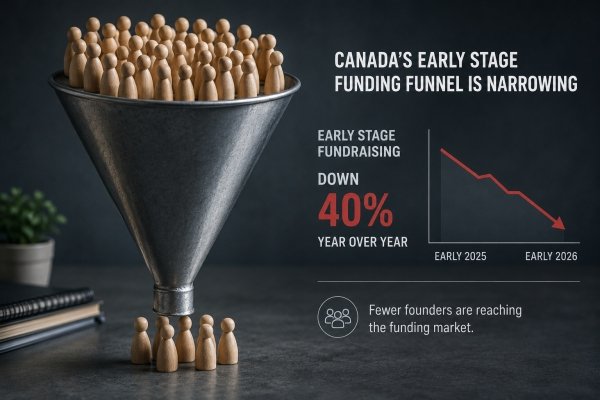
On June 24, 2026, RBCx published its Canadian VC 2026 Mid-Year report, showing that Canada’s early stage funding squeeze at venture funds is now also a startup company reality. RBCx says its Early Stage Banking team works with more than 1,200 pre seed and seed stage companies headquartered in Canada each year, and its current dataset covers more than 2,100 founder conversations.
The figures report that not only less capital is being raised, but fewer founders appear to be reaching the market at all. RBCx tracked 162 companies raising a combined $510.7 million in January 2025. By March 2026, only 61 companies were actively raising, with total capital sought down to about $189.8 million.
Average raise size held near $3 million from September 2024 to March 2026. That makes the data more troubling, not less. The market is not simply producing smaller seed rounds. It appears to be producing fewer founders who can raise them.
RBCx’s data suggests that early stage capital, which is often treated as the entry point into the venture system, is becoming harder to reach.
If fewer pre seed and seed companies are actively raising while average round size holds steady, the impact affects breadth of market.
Stronger or better connected founders may still complete rounds, but the number of companies entering the funding conversation appears to be shrinking.
A smaller early stage funnel means fewer companies get the chance to test markets, build traction, reach Series A, or become future scaleups. The risk is not only lower fundraising volume. It is a thinner innovation pipeline.
The company level data also connects back to the fund level pressure NCFA covered earlier this year in Canadian VC Fundraising Contracts And Concentrates In 2025. RBCx previously found that Canadian venture firms raised just over $2 billion in 2025, while the top five funds captured 83% of total capital raised.
RBCx’s mid year update says the top five funds captured 80% of total capital raised by 2025, while all other funds combined dropped from $4.5 billion at the 2021 peak to $444 million, close to a 90% decline.
When capital concentrates around fewer funds, founders face fewer decision makers, narrower investor funnels, and less room for non consensus ideas. That is especially important at the earliest stages, where conviction often depends on relationships, sector belief, and willingness to take risk before the metrics are obvious.
RBCx estimates that emerging managers raised about $2.8 billion over the past three years, compared with an expected $4.3 billion based on historical averages. That leaves a 36% funding shortfall.
Matt Roberts, Managing Director, Venture Coverage at RBCx, described the issue directly:
“Emerging managers are the engine of early-stage innovation in Canada. They’re willing to take on the riskier bets by backing first-time founders solving problems the market hasn’t fully recognized yet.”
His quote explains why this is a capital formation issue, not only a venture industry issue. Emerging managers often fund the companies that don't yet fit the pattern recognition of larger funds. When those managers cannot raise successor funds, Canada loses part of the market that is most willing to back first time founders, new categories, and early signals.
Canadian VC fundraising contracted and concentrated in 2025, with less new capital available for initial investments.
A built in Canada startup moved to the U.S., showing how capital access, customer depth, and market scale can influence where promising companies choose to grow.
Canada’s productivity challenge increasingly connects to capital formation, innovation scale, and the ability to turn new companies into durable economic output.
Targeted entrepreneurship funding remains an active policy tool as Canada tries to close founder capital gaps across underrepresented groups.
NCFA’s Financial Innovation Map tracks capital formation, alternative funding, venture infrastructure, and founder financing opportunities across Canada’s innovation ecosystem.
If Canada rebuilds early stage breadth, more founders can test markets, attract first capital, and create the next set of Series A candidates. That requires more than headline capital. It requires LP support for emerging managers, stronger growth stage confidence, and funding pathways that let founders raise before they fit the safest investor pattern.
Fewer funded companies may improve selectivity, but it can also remove the messy experimentation that produces outlier companies. If the ecosystem only funds the obvious companies, Canada may reduce failure rates while also reducing the number of breakout opportunities.
If average seed rounds remain stable but far fewer founders are raising, is Canada becoming more selective or simply losing the breadth and risk appetite needed to build the next generation of scaleups?
The National Crowdfunding & Fintech Association (NCFA Canada) is a financial innovation ecosystem that provides education, market intelligence, industry stewardship, networking and funding opportunities and services to thousands of community members and works closely with industry, government, partners and affiliates to create a vibrant and innovative fintech and funding industry in Canada. Decentralized and distributed, NCFA is engaged with global stakeholders and helps incubate projects and investment in fintech, alternative finance, crowdfunding, peer-to-peer finance, payments, digital assets and tokens, artificial intelligence, blockchain, cryptocurrency, regtech, and insurtech sectors. Join Canada's Fintech & Funding Community today FREE! Or become a contributing member and get perks. For more information, please visit: www.ncfacanada.org
| | |
|---|---|---|
| | |
June 23, 2026 | NCFA Fintech Market Activity | Wealthtech, Capital Markets And Funding, Fintech And Innovation

On June 2, 2026, Questrade launched Custom Indexing, describing it as Canada’s first personalized index investing product with no management fees. The product lets self directed investors build a customized index portfolio, own the underlying stocks through fractional shares, and rebalance in one click.
The product page positions Custom Indexing as a middle ground between ETFs and stock picking. Investors can start with a template, adjust stocks or sectors, receive drift alerts, and rebalance when their index moves away from target weights.
Wealthtech competition is evolving beyond low cost trading and into portfolio controls. Questrade is betting that some DIY investors want the simplicity of index investing without giving up control over what they actually own.
ETFs give investors diversified exposure, but the investor owns units of a fund rather than the individual holdings inside it. Questrade’s Custom Indexing gives users direct ownership of the securities in their index through fractional shares.
Investors can remove or adjust holdings, change sector exposure, and maintain a customized portfolio without building every position manually. Questrade says the product has no management fees, no MERs, and no commissions, although all indexes are held in US dollars and foreign exchange fees still apply.
Custom Indexing currently supports US securities only, with Canadian fractional shares expected later. It also requires a dedicated Custom Indexing account, available through TFSA, RRSP, FHSA, or Cash account types, so the index remains separate from other holdings.
Custom Indexing doesn't try to replace every ETF or every advisor.
It targets investors who want more control than a pooled fund gives them, but less manual work than managing a basket of individual stocks.
The product uses templates, stock and sector level customization, drift notifications, and one click rebalancing. Questrade says investors can start with as little as $10, then edit the index over time as their preferences change.
Custom indexing brings Questrade closer to one of the key retail wealth question. How much personalization can digital investing platforms give users before the product becomes too complex for everyday investors?
Envestnet expanded direct indexing in Canada, giving registered firms more control over tax treatment, exclusions, personalization, and security level portfolio design.
Wealthsimple launched IPO access, adding another retail investing feature that shifts competition toward access, loyalty, and differentiated wealth products.
Wealthsimple acquired Fey to add AI research tools and strengthen its trading platform.
OSFI cleared Questrade to open Questbank, pointing to a broader move from brokerage into banking and deeper financial relationships.
DIY investing continues gaining traction in Canada as more investors seek control, personalization, and lower cost access.
If custom indexing gains traction with self directed investors, more wealth platforms may have to compete on portfolio design, not only fees, access, or trading tools. The product could also make direct indexing feel less like an advisor only capability and more like a retail wealth feature.
More control can create better fit, but it can also create more responsibility. Investors still need to understand concentration, sector exposure, currency costs, taxes, and when customization improves a portfolio versus simply making it more complicated.
NCFA's Financial Innovation Map tracks wealthtech opportunities including personalized investing, direct indexing, portfolio automation, investor intelligence, and digital advisory models.
If personalized indexing becomes easy for retail investors, will the next wealthtech fight be about fees, access, or who gives investors the best control without adding confusion?
The National Crowdfunding & Fintech Association (NCFA Canada) is a financial innovation ecosystem that provides education, market intelligence, industry stewardship, networking and funding opportunities and services to thousands of community members and works closely with industry, government, partners and affiliates to create a vibrant and innovative fintech and funding industry in Canada. Decentralized and distributed, NCFA is engaged with global stakeholders and helps incubate projects and investment in fintech, alternative finance, crowdfunding, peer-to-peer finance, payments, digital assets and tokens, artificial intelligence, blockchain, cryptocurrency, regtech, and insurtech sectors. Join Canada's Fintech & Funding Community today FREE! Or become a contributing member and get perks. For more information, please visit: www.ncfacanada.org
| | |
|---|---|---|
| | |
June 23, 2026 | NCFA Community Announcement | Fintech And Innovation, Artificial Intelligence And Data, Capital Markets And Funding

Canada's innovation economy needs more than ideas. It needs active deal flow, customer discovery, capital conversations, policy signal, and founder-to-founder learning.
That's why NCFA is pleased to return as a Community Partner for Elevate Festival 2026 in Toronto (#ElevateFest2026), taking place September 22-24 at Meridian Hall. Elevate brings Canada's tech ecosystem together for three days of speakers, content tracks, startup programming, investor access, and curated networking.
Elevate expects approximately 10,000 tech professionals, entrepreneurs, founders, CEOs, and investors to attend, with programming that spotlights Canadian innovation and connects people working across technology, capital, and company building.
Elevate Festival 2026 puts founders, investors, operators, and builders at the center of the experience. The program features more than 250 speakers, seven content tracks, curated networking, crash courses, founder and investor programming, and startup opportunities.
Investor programming is a major draw this year. Elevate points to curated one-to-one meetings, live pitch competitions, investor-focused networking, and more than 750 meeting opportunities for founders and investors.
For fintech founders, the value goes beyond fintech sessions. A founder working on fraud, lending, payments, compliance, or capital access may find the most useful conversation with an AI operator, enterprise buyer, infrastructure partner, or investor looking across sectors.
Before heading to Toronto, explore NCFA's Innovation Map to identify emerging opportunity areas, market gaps, and technology themes that may shape founder, investor, and partnership conversations at Elevate.
Register for Elevate Festival 2026 tickets and use code NCFAELEVATE20 at checkout for 20% off General Pass tickets.
Limited time: Women+ in Tech can also access an additional 20% off Early Bird pricing through July 3. Visit the Women+ in Tech Elevate ticket offer for details.
Explore the Elevate Festival 2026 speaker lineup and 2026 Elevate content tracks as more speakers and sessions during the show's run up to September.
We look forward to connecting with Canada's fintech, funding, AI, and innovation community in Toronto!
If you are building, funding, regulating, scaling, or studying innovation in Canada, Elevate is a strong place to meet the people and ideas shaping what comes next.
The National Crowdfunding & Fintech Association (NCFA Canada) is a financial innovation ecosystem that provides education, market intelligence, industry stewardship, networking and funding opportunities and services to thousands of community members and works closely with industry, government, partners and affiliates to create a vibrant and innovative fintech and funding industry in Canada. Decentralized and distributed, NCFA is engaged with global stakeholders and helps incubate projects and investment in fintech, alternative finance, crowdfunding, peer-to-peer finance, payments, digital assets and tokens, artificial intelligence, blockchain, cryptocurrency, regtech, and insurtech sectors. Join Canada's Fintech & Funding Community today FREE! Or become a contributing member and get perks. For more information, please visit: www.ncfacanada.org
| | |
|---|---|---|
| | |
June 23, 2026 | NCFA Fintech Market Activity | Capital Markets And Funding, SME Finance And Business Banking, Regulation And Policy

On June 22, 2026, Minister Rechie Valdez announced $173.7 million in renewed funding for the Women Entrepreneurship Strategy. The funding supports women entrepreneurs across Canada through the Women Entrepreneurship Loan Fund, the WES Ecosystem Fund, the Women Entrepreneurship Knowledge Hub, and program operations.
Capital gaps only disappear when financing, networks, and support actually reach the founders who face the gaps. The announcement isn't just another program renewal. It shows that Ottawa still sees access to capital, networks, data, and growth support for women entrepreneurs as an active market gap rather than a solved policy file.
The new funding includes $59 million for the Women Entrepreneurship Loan Fund, which supports partner organizations delivering loans of up to $50,000 to women business owners and entrepreneurs. It also includes $100 million for the WES Ecosystem Fund, $7 million for the Women Entrepreneurship Knowledge Hub, and nearly $8 million over five years for program operations.
The Loan Fund has already delivered more than 1,600 loans through partner organizations. Since its 2018 launch, the broader WES initiative has supported more than 500,000 women entrepreneurs. The federal WES program page also notes that only 17.8% of Canadian small and medium sized businesses are owned by women.
Those numbers give the announcement its real weight. The funding isn't meant to be only a social inclusion measure. It's capital infrastructure for a founder segment still underrepresented in business ownership, financing access, and growth networks.
Minister Valdez said women entrepreneurs “create jobs, strengthen communities and contribute to a Canada that is strong for everyone.” That is the public message. The operating issue is more specific: growth requires more than a loan.
Women founders need access to credit, but they also need buyers, mentors, procurement routes, export support, investor relationships, and data that helps programs see what is working. That's why the WES package includes ecosystem funding and the Women Entrepreneurship Knowledge Hub alongside loan capital.
This connects directly to NCFA’s long running focus on women partners, women entrepreneurs, and capital access. When women are missing from capital decision making, financing gaps can persist even when the quality of founders isn't the problem.
BDC launched a $250 million inclusive entrepreneurship initiative to support entrepreneurs facing systemic barriers, including women, Indigenous, and Black led firms.
Canada renewed the $189 million Black Entrepreneurship Program as a separate targeted initiative for Black entrepreneurs and Black owned businesses.
BKR Capital raised a $20 million first close for Black Innovation Fund II, targeting a $50 million final close.
J.P. Morgan’s women powered business report showed rising women led growth companies, equity investment, exits, and crowdfunding activity in the U.K.
Research on female entrepreneurship has long pointed to financial capital, human capital, and network access as connected growth constraints.
If WES funding reaches women entrepreneurs with real growth potential, the payoff may go beyond business starts. It could strengthen regional innovation pipelines, improve founder diversity in high growth sectors, and give more women led companies access to the networks they need to scale.
The challenge is execution. Loan capital can help, but it doesn't automatically solve procurement access, export readiness, investor networks, revenue growth, or later stage financing. The strongest test is whether renewed WES funding helps more women owned businesses move from support programs into durable commercial growth.
If targeted entrepreneurship funding continues, how should Canada measure whether women founders are gaining growth capital, not just program access?
The National Crowdfunding & Fintech Association (NCFA Canada) is a financial innovation ecosystem that provides education, market intelligence, industry stewardship, networking and funding opportunities and services to thousands of community members and works closely with industry, government, partners and affiliates to create a vibrant and innovative fintech and funding industry in Canada. Decentralized and distributed, NCFA is engaged with global stakeholders and helps incubate projects and investment in fintech, alternative finance, crowdfunding, peer-to-peer finance, payments, digital assets and tokens, artificial intelligence, blockchain, cryptocurrency, regtech, and insurtech sectors. Join Canada's Fintech & Funding Community today FREE! Or become a contributing member and get perks. For more information, please visit: www.ncfacanada.org
| | |
|---|---|---|
| | |
Jun 22, 2026

A reliable financial institution, able to help in solving financial issues, is a key request for newcomers to Canada. A strong Ukrainian credit union in Toronto is a flexible service with personalized support and a deep understanding of community needs. BCU Financial is one of the most recognized institutions which combine online access with numerous convenient online digital options for members across Canada.
The institution provides solutions to different financial goals, whether clients need deposits, investing opportunities, or credit cards.
A trusted credit union for Ukrainians in Canada is more than a standard financial product, but a solution which creates strong relationships between members and the institution. It provides the clients with financial guidance, giving them all the benefits of the advanced banking technologies. The key advantages include:
Credit union for Ukrainian customers provides trust and financial stability with personalized communication and practical assistance.
Buduchnist Credit Union was created to simplify the overall process of financial management. The membership provides an opportunity to control finances from anywhere in Canada. Financial products, available within the institution, are designed to fit into any lifestyle and cover any financial objectives:
Experienced specialists of the Ukrainian credit union in Canada have a deep understanding of the needs of the Ukrainian community, being ready to provide professional consultations.
The credit union actively supports educational programs, humanitarian projects, youth organizations, and cultural initiatives across Canada through available investing services, personalized approach, and competitive rates to solve issues related to education, property purchases, retirement, and business development, keeping its position as one of the leading choices in Canada.
Thousands of members nationwide are attracted by the balance of innovation, tradition and customer-oriented approach.
The National Crowdfunding & Fintech Association (NCFA Canada) is a financial innovation ecosystem that provides education, market intelligence, industry stewardship, networking and funding opportunities and services to thousands of community members and works closely with industry, government, partners and affiliates to create a vibrant and innovative fintech and funding industry in Canada. Decentralized and distributed, NCFA is engaged with global stakeholders and helps incubate projects and investment in fintech, alternative finance, crowdfunding, peer-to-peer finance, payments, digital assets and tokens, artificial intelligence, blockchain, cryptocurrency, regtech, and insurtech sectors. Join Canada's Fintech & Funding Community today FREE! Or become a contributing member and get perks. For more information, please visit: www.ncfacanada.org
| | |
|---|---|---|
| | |


August 26th, 2025

January 4th, 2024

June 1st, 2021

September 9th, 2020

July 9th, 2018

January 3rd, 2018

September 25th, 2017

June 20th, 2017

May 10th, 2017

December 14th, 2016