




Karsten Wenzlaff, Advisor
August 26th, 2025
Karsten Wenzlaff is a Crowdfunding and Fintech Expert from Germany. He is Secretary-General of Digit[...]


June 5, 2026 | NCFA Resource | Financial Innovation
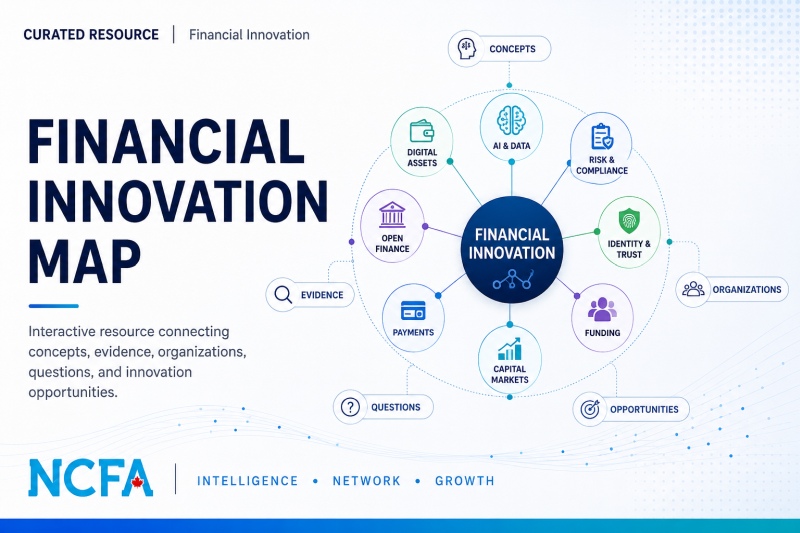
NCFA launched a Financial Innovation Map on June 5, 2026, as a practical resource for founders, investors, financial institutions, policymakers, researchers, and ecosystem builders. The map connects financial innovation concepts, use cases, featured organizations, evidence, questions, and innovation opportunities across fintech, funding, AI, digital assets, open finance, payments, capital markets, compliance, cybersecurity, and trust.
The Financial Innovation Map helps users move from concept awareness to opportunity discovery. Users can select a category, choose a concept, review sample use cases, scan featured organizations, explore innovation questions, and review resources tied to practical financial innovation activity.
The opportunity cards are practical and will continue to evolve. They show where adjacent concepts could combine into practical opportunities, supported by early, growing, or strong evidence. This helps users think beyond definitions and ask where an idea may create real value.
The need for better financial innovation intelligence is global. The BIS Innovation Hub works with central banks on technology trends that affect the global financial system, including digital finance, payments, market infrastructure, regtech, suptech, and financial stability. NCFA’s map gives Canada’s innovation ecosystem a practical way to explore many of the same themes from a founder, investor, policy, and market building lens.
Founders can use the map to test ideas, find adjacent concepts, and sharpen market theses. Investors can scan emerging areas before they become obvious sectors. Financial institutions can explore where new technology may reduce friction, improve workflows, or open new product opportunities.
Regulators, policymakers, researchers, and ecosystem builders can use the map to understand how technologies, rules, organizations, and unanswered questions connect across Canada and global financial innovation markets.
The strength of the Financial Innovation Map is structure. It brings concepts, organizations, resources, questions, and opportunity cards into one place so users can explore financial innovation with more context and less noise.
The first release is intentionally focused. Some concepts have more evidence and opportunity cards than others. That's by design. Opportunities are not added to meet a fixed count. They are added when there is enough evidence, friction, thesis strength, funding interest, or market activity to support inclusion.
The map isn't investment advice, legal advice, or a forecast. It's a curated intelligence resource that will improve as new evidence, resources, organizations, and opportunities are added. Stay tuned for future iterations.
Start with the Financial Innovation Map and explore the categories most relevant to your work.
For related NCFA coverage, see how AI agents, wallets, and financial identity are starting to connect, how agentic AI in banking is moving into practical workflows, and how tokenized infrastructure is changing market operations.
 The National Crowdfunding & Fintech Association (NCFA Canada) is a financial innovation ecosystem that provides education, market intelligence, industry stewardship, networking and funding opportunities and services to thousands of community members and works closely with industry, government, partners and affiliates to create a vibrant and innovative fintech and funding industry in Canada. Decentralized and distributed, NCFA is engaged with global stakeholders and helps incubate projects and investment in fintech, alternative finance, crowdfunding, peer-to-peer finance, payments, digital assets and tokens, artificial intelligence, blockchain, cryptocurrency, regtech, and insurtech sectors. Join Canada's Fintech & Funding Community today FREE! Or become a contributing member and get perks. For more information, please visit: www.ncfacanada.org
 |  |  |
|---|---|---|
 |  |  |
June 5, 2026 | Last Updated October 3, 2026 | NCFA Financial Innovation Map
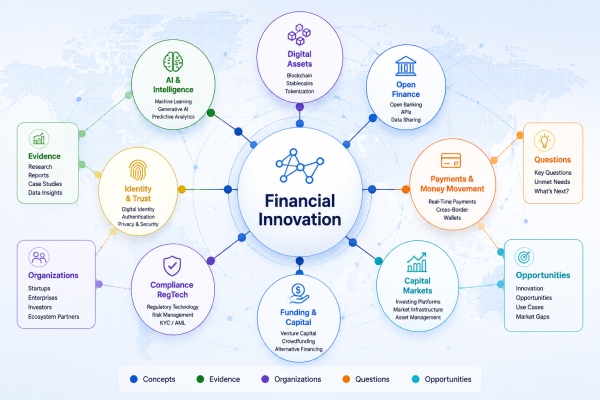
Financial innovation is creating new language faster than most teams can absorb it.
The National Crowdfunding & Fintech Association of Canada's Financial Innovation Map connects concepts, use cases, featured organizations, evidence, questions, and innovation opportunities across fintech, funding, AI, digital assets, open finance, payments, capital markets, compliance, cybersecurity, and trust.
Select a category, choose a concept, and explore how the idea works, who is involved, and where practical opportunities may emerge.
The National Crowdfunding & Fintech Association (NCFA Canada) is a financial innovation ecosystem that provides education, market intelligence, industry stewardship, networking and funding opportunities and services to thousands of community members and works closely with industry, government, partners and affiliates to create a vibrant and innovative fintech and funding industry in Canada. Decentralized and distributed, NCFA is engaged with global stakeholders and helps incubate projects and investment in fintech, alternative finance, crowdfunding, peer-to-peer finance, payments, digital assets and tokens, artificial intelligence, blockchain, cryptocurrency, regtech, and insurtech sectors. Join Canada's Fintech & Funding Community today FREE! Or become a contributing member and get perks. For more information, please visit: www.ncfacanada.org
| | |
|---|---|---|
| | |
June 5, 2026 | NCFA Insight | Artificial Intelligence And Data

On June 4, 2026, Prime Minister Mark Carney launched AI for All, Canada’s new national artificial intelligence strategy. It targets $200 billion in additional economic growth, 250,000 new AI related jobs over five years, and a rise in AI adoption from just over 12% today to 60% by 2034.
The strategy also aims to create up to 90,000 AI related jobs and work placements for young Canadians. It supports AI skills, trust and safety, sovereign compute and cloud infrastructure, and Canadian company scale up. Canada’s AI challenge is no longer research. It is deployment.
Canada helped build the modern AI era. The country has three National AI Institutes, Vector Institute in Toronto, Mila in Montréal, and Amii in Edmonton. It also has a long record of public investment in AI research and talent.
Yet the harder problem is in the AI economy. The federal government says Canada remains among the slowest countries to adopt AI at scale. Only slightly more than 12% of Canadian businesses use AI today. AI for All sets a target of 60% adoption by 2034.
Canada has AI credibility, but it lacks broad deployment. Research output can attract talent and capital. Still, productivity gains only show up when companies redesign workflows, train workers, improve operations, and build commercial products around the technology.
This connects directly to Canada’s AI adoption gap. The next phase depends less on model breakthroughs and more on whether firms can put AI to work across finance, healthcare, manufacturing, energy, agriculture, transportation, and public services.
AI for All is a strategy with announced investments, but it’s not positioned as one simple funding package. It sets out an implementation plan built around trust, opportunity, and sovereignty.
The plan includes stronger privacy and online safety rules, AI transparency measures, expanded AI Safety Institute capabilities, entry level AI training for all Canadians, trusted AI agents for post secondary students, SME adoption support, and an AI Missions Program that starts with health.
Canada needs more firms, workers, and public institutions using AI in ways that raise productivity, improve services, and create Canadian owned economic value.
For fintech leaders, the strategy reads like an implementation roadmap. AI adoption will depend on infrastructure, skills, procurement, privacy rules, data governance, and trust. These are the same issues affecting open finance, digital identity, fraud prevention, payments modernization, and smart data infrastructure.
Financial services may offer one of the clearest adoption tests. Banks, credit unions, insurers, wealth management firms, payment companies, and fintechs already run data heavy businesses. They also rely on repeatable workflows, compliance controls, customer records, and risk systems.
AI can support fintech use cases from fraud detection and credit assessment to investment research and operational risk monitoring. That creates an opening for Canadian regtech firms, AI infrastructure companies, payment providers, lending platforms, and wealthtechs that can help institutions move from pilots to production.
The same issue appears in AI and non traditional data in financial services. Financial institutions can use AI to improve decisions, but they need governance that protects consumers and supports regulatory trust.
The strategy pushes AI into national competitiveness policy. It names compute, cloud, connectivity, data, and talent as foundations of sovereign Canadian AI.
At the company level, that infrastructure question reaches down to practical decisions about where applications and workloads run. A VDS server / virtual dedicated server can provide dedicated virtual computing resources for businesses that need greater control over hosting configurations, performance and resource allocation.
Canada’s national AI strategy also says the federal government will continue delivering more than $2 billion in existing investments in Canadian AI compute capacity, including through the AI Compute Challenge. This isn't a single new $2 billion package in the Prime Minister’s release. It's an existing compute investment stream tied to Canada’s wider sovereignty strategy.
It also connects directly to Canada’s recent debate over cloud concentration and AI sovereignty. Compute capacity and cloud control can determine whether domestic firms can scale without deeper platform dependence.
Countries don’t capture AI value only by producing researchers. They capture value when companies scale, retain key talent, own intellectual property, and sell into global markets from a domestic base.
For Canadian fintechs and investors, sovereign AI infrastructure affects who controls data, how firms access compute, how procurement supports domestic companies, and whether Canadian AI companies can scale before larger foreign markets pull them away.
AI for All sets ambitious targets. The proof will come from adoption, scale, productivity, and trust.
Can Canadian business adoption rise from just over 12% to 60% by 2034? Can Canadian AI firms scale while keeping meaningful operations, talent, and intellectual property in Canada? Can regulated sectors deploy AI with enough transparency and accountability to earn public trust?
Canada already proved that it can build AI research strength. Yet it hasn’t proved that it can turn that strength into widespread productivity gains and globally scaled companies at the same pace as larger markets.
For NCFA members, the opportunity lies in execution. Founders can build AI tools that solve costly financial sector problems. Investors can look for firms with real workflow adoption, not only technical claims. Policymakers can reduce friction where regulation, procurement, data access, and capital formation slow responsible deployment.
AI for All is a clear shift in Canada’s AI policy. Ottawa now looks at AI as an adoption, productivity, sovereignty, and scale up challenge, not just a research agenda. Canada’s AI advantage will come from helping more Canadian firms use AI, sell AI, govern AI, and keep more of the value created by AI in Canada.
The National Crowdfunding & Fintech Association (NCFA Canada) is a financial innovation ecosystem that provides education, market intelligence, industry stewardship, networking and funding opportunities and services to thousands of community members and works closely with industry, government, partners and affiliates to create a vibrant and innovative fintech and funding industry in Canada. Decentralized and distributed, NCFA is engaged with global stakeholders and helps incubate projects and investment in fintech, alternative finance, crowdfunding, peer-to-peer finance, payments, digital assets and tokens, artificial intelligence, blockchain, cryptocurrency, regtech, and insurtech sectors. Join Canada's Fintech & Funding Community today FREE! Or become a contributing member and get perks. For more information, please visit: [www.ncfacanada.org](http://www.ncfacanada.org)
| | |
|---|---|---|
| | |
June 4, 2026 | NCFA Market Activity | Capital Markets And Funding

On June 1, 2026, FrontFundr launched the Back The Next Canadian Startup Challenge, a national initiative inviting investors, founders, advisors, partners, supporters, and startup operators to nominate Canadian companies ready to raise capital.
The challenge targets founders building innovative or high growth businesses with early traction, strong market potential, and plans to raise within the next 3 to 6 months. Companies can apply directly or be nominated by someone in the ecosystem. All participating companies must still submit an application.
Applications require a pitch deck, an overview of the business and fundraising goals, and an explanation of why the company fits community investment. Founders can also submit an optional 45 to 60 second video explaining their story, mission, and motivation to raise on FrontFundr.
FrontFundr will review applications based on business innovation, market opportunity, founder strength, execution capability, readiness to raise, and alignment with community investing. Nominations and applications run from June 1 to 30. Shortlisted companies advance to a live pitch competition in early July, where the top 3 to 5 companies will deliver a 5 minute pitch followed by 5 minutes of Q&A.
One selected company receives a free opportunity to launch a FrontFundr campaign and raise from its own supporters and FrontFundr’s investor community. FrontFundr values the package at $13,000. It includes a free campaign listing, due diligence and campaign preparation, and complimentary documentation drafting. Standard closing costs and trade fees still apply.
Finalists and high potential applicants may also continue through an accelerated pathway toward launching a FrontFundr campaign, based on fit, readiness, and alignment with community investing.
Referrers may earn $1,250 when a referred company signs and launches a campaign. Eligible companies must be new to FrontFundr, Canadian, raise at least $250,000, and launch within 6 months of introduction. Rewards can be paid as cash or platform credit upon milestone completion.
FrontFundr says companies on its platform have raised more than $367M across more than 300 campaigns, supported by more than 73,000 investors across Canada.
The winner reduces upfront campaign costs and receives support with preparation, documentation, and platform launch. Finalists may still gain visibility and a faster review process.
The National Crowdfunding & Fintech Association (NCFA Canada) is a financial innovation ecosystem that provides education, market intelligence, industry stewardship, networking and funding opportunities and services to thousands of community members and works closely with industry, government, partners and affiliates to create a vibrant and innovative fintech and funding industry in Canada. Decentralized and distributed, NCFA is engaged with global stakeholders and helps incubate projects and investment in fintech, alternative finance, crowdfunding, peer-to-peer finance, payments, digital assets and tokens, artificial intelligence, blockchain, cryptocurrency, regtech, and insurtech sectors. Join Canada's Fintech & Funding Community today FREE! Or become a contributing member and get perks. For more information, please visit: www.ncfacanada.org
| | |
|---|---|---|
| | |
June 3, 2026 | NCFA Insight | Artificial Intelligence And Data, Regulation And Policy

On June 2, 2026, the Canadian Anti Monopoly Project released Parting Clouds: Creating A Competitive Marketplace For Compute that says three American companies control 85% of Canada's public cloud market. Canada wants sovereign AI. It's a gap that Ottawa needs to address before it commits more public money to AI infrastructure.
Globally, those same three firms Amazon, Microsoft, and Google, hold about 66% of the public cloud market. AI runs on compute, but most firms access that compute through cloud platforms. The more difficult it becomes to move data, workloads, and AI services between providers, the more dependent organizations become on a small number of platforms.
Compute means the physical capacity. Think data centres, chips, GPUs, servers, storage, power, cooling, and networks. Cloud is the commercial aspect that packages that capacity into services like APIs, software tools, security controls, and platform ecosystems.
Canada can fund more compute and still leave firms locked into the same cloud stacks. That concern connects to NCFA’s earlier analysis of Canada’s AI capital flight problem, where public AI investment doesn't always translate into long term domestic value especially if customers cannot move their data, workloads, models, and services without high technical and financial costs.
The CAMP report makes that point clearly. The goal isn't simply Canadian ownership. The goal is a market where customers can switch providers without rebuilding core systems. Most Canadian firms cannot replace that stack overnight.
Federal spending tells the same story. From 2019 to 2020 through 2022 to 2023, Shared Services Canada spent $310.4M on cloud services. The report says 66% went to Microsoft, 16% to Amazon, 14% to Salesforce, and 4% to other providers.
Cloud concentration already creates switching barriers through proprietary services, opaque pricing, and weak interoperability.
AI makes those barriers harder to manage. A fraud model, compliance agent, lending workflow, or payment risk tool can become tied to a provider’s data services, model tools, security layer, and deployment environment.
Moving clouds then means more than moving storage. It can mean rebuilding how the product works.
Five firms control about 75% of global AI compute power, with Google alone controlling about 31%. That concentration shows why AI sovereignty is not only about funding more capacity. It's also about keeping customers mobile before AI markets harden around the same platforms.
The name of this section is the report's strongest warning and it should affect Ottawa's strategy.
More Canadian data centres can help. Domestic compute can support sensitive workloads, national resilience, and local AI capacity. Ottawa has already backed 44 Canadian AI compute projects, but if public funding only creates protected local gatekeepers, Canada may replace one dependency with another.
The better goal is customer mobility. Can a Canadian fintech move workloads from one provider to another? Can a public agency compare cloud pricing easily? Can a startup use AI tools without being trapped inside one ecosystem? Can sensitive workloads use Canadian infrastructure without sacrificing portability?
Ottawa should fund infrastructure, but also change the market around portability, interoperability, transparent pricing, and competition.
The CAMP report recommends using public procurement to require portable data, interoperable services, and common technical standards. It also calls for closer scrutiny of egress fees, bundling, tying, discriminatory licensing, cloud credits, and acquisitions that absorb Canadian talent and intellectual property.
This approach has tradeoffs. Procurement can move faster than legislation, but it needs technical discipline. Competition enforcement can target lock in, but cases take time. Interoperability can lower switching costs, but it will not instantly match the full global scale of AWS, Azure, or Google Cloud. Domestic infrastructure can improve resilience, but only if it avoids new lock in.
Will Canada measure AI sovereignty by domestic capacity, or by real customer choice?
Will public funding require portability, open standards, and transparent pricing?
Will Canadian fintechs and AI startups be able to move workloads across providers without rewriting core systems?
Will the strategy treat cloud concentration as a competition issue, not only an innovation issue?
Will Canada build a market where providers compete on price, performance, trust, and service quality, or one where customers stay trapped because switching costs are too high?
If a Canadian fintech cannot realistically move its AI stack from one provider to another, who holds the leverage?
The National Crowdfunding & Fintech Association (NCFA Canada) is a financial innovation ecosystem that provides education, market intelligence, industry stewardship, networking and funding opportunities and services to thousands of community members and works closely with industry, government, partners and affiliates to create a vibrant and innovative fintech and funding industry in Canada. Decentralized and distributed, NCFA is engaged with global stakeholders and helps incubate projects and investment in fintech, alternative finance, crowdfunding, peer-to-peer finance, payments, digital assets and tokens, artificial intelligence, blockchain, cryptocurrency, regtech, and insurtech sectors. Join Canada's Fintech & Funding Community today FREE! Or become a contributing member and get perks. For more information, please visit: www.ncfacanada.org
| | |
|---|---|---|
| | |
June 2, 2026 | NCFA Fintech Market Activity | Capital Markets And Market Infrastructure, SME Finance And Business Banking

A New York City sports bar has turned a Knicks NBA Finals promotion into a practical prediction market case study. According to NY Sports Day coverage of the promotion, The Jeffrey ('The bar') offered customers free drinks if the Knicks won Game 1 and placed a $5,000 position on a Knicks win through Kalshi, which could pay roughly $13,500 if the Knicks won.
The sports hook is fun. The business logic is better. The bar isn't simply betting on the Knicks with a local sportsbook. It's using a prediction market 'event contract' to run a promotion with a clear downside. If the Knicks win, the contract helps fund the free drinks. If the Knicks lose, customers pay their tabs and the bar loses the $5,000 position. The owner knows the maximum contract cost before the campaign starts.
The promotion creates two linked outcomes.
If the Knicks win, qualifying drink tabs become free and the bar gives up revenue it would otherwise collect. The Kalshi position pays on that same outcome, helping offset the waived tabs.
If the Knicks lose, the Kalshi position expires worthless, but the bar keeps normal drink revenue from customers who came in to watch the game.
It's a different use case from the prediction market stories NCFA has tracked around private market valuation odds and public market sentiment. Here, the contract supports a real world promotion with a known maximum contract cost.
This second outcome is what makes the structure interesting. The bar isn't left with only a $5,000 loss. It may also have a packed room, paid tabs, food orders, longer visits, and new customers. People may spend more because the tab could become free. That excitement is part of the promotion’s value.
The key business question is did the promotion generate enough incremental gross profit to justify the $5,000 contract cost if the Knicks lost? If yes, the losing contract is a campaign expense. If the Knicks won, the payout could help cover the free drinks liability (and possibly more). Either way, the owner puts a known price on the risk.
A traditional hedge normally offsets an existing risk. The bar created the risk by offering free drinks, then used Kalshi to offset part of that exposure.
The hedge quality depends on numbers that haven't been shared publicy like expected crowd size, average tab, food sales, qualifying drink costs, gross margin, and incremental revenue created by the promotion. If free drink liability reached $15,000 and the contract paid $13,500, the bar still carries some cost (of course the owner could choose to cap the number/cost of free drinks). If the room filled up and customers paid their tabs after a Knicks loss, the $5,000 contract loss may still be covered by extra business.
A patio restaurant could run a long weekend rain campaign. Customers get 25% off if rain exceeds a defined threshold during peak patio hours. The restaurant buys a weather contract tied to the same outcome. If it rains, the contract helps fund the discount. If it stays dry, the restaurant keeps full patio revenue and treats the contract cost as part of the campaign budget.
An event organizer could offer partial refunds if a transit strike disrupts attendance. A $3,000 event contract tied to the strike outcome could help cover refunds if the strike happens. If the strike doesn't happen, attendees pay full price and the organizer loses only the known contract cost.
A tourism operator could sell a “city wins, you save” package tied to a major festival or sports bid. If the city wins and the discount triggers, the event contract helps offset the promotion. If the city loses, customers still paid for the trip and the operator knows the campaign cost in advance.
Most prediction market coverage focuses on politics, sports, forecasting, or trading activity. The bar example points to a different use case of outcome based promotions where a business knows the most it can lose before launching the campaign.
It could make a difference for small businesses. Most small operations don't have access to custom insurance, futures contracts, or sophisticated risk tools. Prediction markets are easier to understand. A business can tie a campaign to a public event, cap the contract cost, and create a promotion customers want to talk about.
The risk is that promotion design can slide into speculation if owners do not size the contract properly. As prediction market controls tighten, businesses need clearer guardrails around contract sizing, customer disclosures, and whether the activity manages a real exposure or simply adds another bet. A useful campaign starts with the business exposure, not the excitement of the event. The bar example works as a test case because the contract ($5,000), the customer offer (free drinks), and the revenue opportunity ($13,500 + promo boost) all point to the same outcome.
If prediction markets can help small businesses run outcome based promotions with a known maximum contract cost, where should regulators draw the line between practical risk management and promotional trading?
The National Crowdfunding & Fintech Association (NCFA Canada) is a financial innovation ecosystem that provides education, market intelligence, industry stewardship, networking and funding opportunities and services to thousands of community members and works closely with industry, government, partners and affiliates to create a vibrant and innovative fintech and funding industry in Canada. Decentralized and distributed, NCFA is engaged with global stakeholders and helps incubate projects and investment in fintech, alternative finance, crowdfunding, peer-to-peer finance, payments, digital assets and tokens, artificial intelligence, blockchain, cryptocurrency, regtech, and insurtech sectors. Join Canada's Fintech & Funding Community today FREE! Or become a contributing member and get perks. For more information, please visit: www.ncfacanada.org
| | |
|---|---|---|
| | |
Jun 3, 2026

Modern businesses exist in an environment where the speed and reliability of transport are primary factors for customer satisfaction and operational success. Both consumers and corporate clients expect that products, documents and necessary supplies are delivered quickly. Same day courier services are a central component of business logistics across many sectors.
Organizations in retail, healthcare, legal and manufacturing sectors increasingly use rapid delivery solutions to meet deadlines and maintain operations - these services are helpful for businesses to respond to customer needs and to lower delays that might impact revenue or public perception.
The expectations of customers are different now than in previous years. Many buyers expect fast delivery options to be a standard part of the purchasing process. Companies that provide same day delivery often have an advantage over others because they are able to fulfill urgent requirements.
Fast delivery is also a factor in customer loyalty - When customers receive products on the promised date, they are more likely to make future purchases. Consistent service is a method to build trust and encourage positive feedback, which helps a business maintain its market position.
Many organizations are dependent on the timely movement of equipment and documents to ensure daily tasks continue without pause. Same day courier services are useful for avoiding disruptions - ensuring that items reach their destination without delays.
Rapid transportation is a tool to prevent expensive interruptions in industries that require time sensitive materials. If a company is in need of replacement parts, legal paperwork or inventory transfers, same day delivery is a way to maintain productivity and lower the time when systems are not functioning.
Businesses that are responsive to customer demands often distinguish themselves from others. Offering same day delivery is a demonstration of a commitment to convenience, which is a factor that influences purchasing decisions.
Strong delivery capabilities are also a way to create new growth opportunities. Companies that fulfill urgent requests are in a better position to attract customers who prioritize speed - this flexibility is what allows businesses to adapt to changing market conditions.
Efficient logistics are the reason for a more adaptable supply chain. Same day courier services are a means to move goods quickly between suppliers, warehouses and customers - this reduces delays that might affect the performance of the entire chain.
Faster transportation is also a support for inventory management. Instead of keeping a high volume of stock, businesses are able to rely on rapid delivery when a need arises - this method is a way to lower storage costs while ensuring products are available when there is demand.
Access to reliable courier solutions is useful for smaller organizations. Many small firms use small business shipping services to compete with larger businesses that possess extensive logistics networks.
Rapid delivery options are a way for smaller firms to provide high levels of service without a large investment in their own vehicles - this creates opportunities for growth and is a method to maintain customer satisfaction and operational efficiency.
Unexpected delays are often the cause of financial losses, missed deadlines and damaged relationships. Same day courier services are a way to lower these risks - providing dependable transportation for urgent shipments.
Businesses are also able to benefit from improved tracking capabilities. Many courier providers offer real time updates so that companies can monitor deliveries and share accurate information with customers - this transparency is a way to build confidence and support better decisions.
Reliable delivery performance is a foundation for stronger relationships with customers, suppliers and partners. When organizations meet their commitments, they establish a reputation for being dependable.
Timely transportation is a support for collaboration between different parts of a business network. Suppliers are able to deliver materials faster and partners can exchange documents more efficiently - these advantages are contributors to long term success.
The growth of digital business models is the reason for the increased importance of fast logistics. Customers often compare delivery options before they make a purchase, which makes speed a factor in the buying process.
Many organizations combine same day courier solutions with other shipping services to create a flexible strategy - this approach is a way for businesses to serve both urgent and standard needs while improving the experience of the customer.
Same day courier services are an essential resource for modern businesses that seek to improve customer satisfaction and streamline operations. By allowing for the rapid delivery of products, these services are a way for organizations to respond to the demands of the current marketplace.
As customer expectations continue to change, businesses that invest in efficient delivery solutions are in a better position for long term growth. Same day courier services provide the speed and flexibility that are necessary for success in a fast paced environment.
The National Crowdfunding & Fintech Association (NCFA Canada) is a financial innovation ecosystem that provides education, market intelligence, industry stewardship, networking and funding opportunities and services to thousands of community members and works closely with industry, government, partners and affiliates to create a vibrant and innovative fintech and funding industry in Canada. Decentralized and distributed, NCFA is engaged with global stakeholders and helps incubate projects and investment in fintech, alternative finance, crowdfunding, peer-to-peer finance, payments, digital assets and tokens, artificial intelligence, blockchain, cryptocurrency, regtech, and insurtech sectors. Join Canada's Fintech & Funding Community today FREE! Or become a contributing member and get perks. For more information, please visit: www.ncfacanada.org
| | |
|---|---|---|
| | |


August 26th, 2025

January 4th, 2024

June 1st, 2021

September 9th, 2020

July 9th, 2018

January 3rd, 2018

September 25th, 2017

June 20th, 2017

May 10th, 2017

December 14th, 2016