




Karsten Wenzlaff, Advisor
August 26th, 2025
Karsten Wenzlaff is a Crowdfunding and Fintech Expert from Germany. He is Secretary-General of Digit[...]


Feb 27, 2026 | NCFA Fintech Market Activity | Digital Assets And Token Economics

On February 24 2026, Flow Foundation completed a 50,343,896.87 FLOW buyback and burn, equal to about 3% of total supply (approx CAD $2.7M), and committed to buy at least another 50,000,000 FLOW over the coming months for treasury holdings.
The burn took place on February 23 at 12:00 PM PT. The tokens came from a mix of open market purchases and treasury funds collected between December 27 2025 and February 22 2026. The Foundation says the burn is permanent, irreversible, and verifiable on chain.
The next part of the plan is just as important. Flow says it will keep buying tokens in the open market and is working on better liquidity support and market making partnerships across multiple platforms. So, this isn't a one time burn. The Foundation is putting more treasury capital behind the token through 2026.
Three figures drive the story. First, roughly 3% of total supply is removed from circulation. Second, at least 50,000,000 more tokens are now part of the stated treasury buying plan. Third, Flow says the network is built to become net deflationary at a sustained 250 transactions per second, the point where fees collected rise above new tokens issued for staking rewards.
Flow also says staking rewards stay unchanged at about 9% APY and that token holders do not need to take any action. It's important because the Foundation is trying to reduce supply pressure without changing the current staking setup for users.
Earlier this month, 40 million users and 950 million transactions gave Flow a stronger scale story heading into this treasury move. Meaning the Foundation is supporting a token tied to a network with real usage, not just future plans.
Flow is also pushing a speed and utility case. In a recent developer update, 4 second soft finality and 10 second hard finality became part of its case for more serious onchain apps that need faster confirmation and less settlement uncertainty.
Also another update pegs Flow moving beyond earlier collectibles identity to consumer DeFi infrastructure. Taken together, the buyback, burn, liquidity support, faster settlement, and DeFi positioning all point in the same direction. Flow is trying to tighten supply while backing a larger push for deeper usage.
It is a direct treasury move backed by clear numbers and a longer runway. Flow is reducing circulating supply now, adding another minimum purchase target, and pointing to a fee model that aims to lower inflation as network usage rises. That gives the market a clearer picture of how the Foundation wants to support the token.
For builders and investors, the takeaway is simple. Token value does not depend only on ecosystem growth. It also depends on how clearly a foundation manages supply, supports trading conditions, and explains the path to a more durable network economy. In this case, Flow is putting real treasury capital behind that message.
When a blockchain foundation burns 3% of supply and commits to buy at least 50,000,000 more tokens, does treasury policy start to matter as much as product growth?
 The National Crowdfunding & Fintech Association (NCFA Canada) is a financial innovation ecosystem that provides education, market intelligence, industry stewardship, networking and funding opportunities and services to thousands of community members and works closely with industry, government, partners and affiliates to create a vibrant and innovative fintech and funding industry in Canada. Decentralized and distributed, NCFA is engaged with global stakeholders and helps incubate projects and investment in fintech, alternative finance, crowdfunding, peer-to-peer finance, payments, digital assets and tokens, artificial intelligence, blockchain, cryptocurrency, regtech, and insurtech sectors. Join Canada's Fintech & Funding Community today FREE! Or become a contributing member and get perks. For more information, please visit: www.ncfacanada.org
 |  |  |
|---|---|---|
 |  |  |
Feb 26, 2026 | NCFA Fintech Market Activity | Payments And Market Structure

On February 26 2026, Block reported in its Q4 2025 shareholder letter that it is reducing its workforce from over 10,000 people to just under 6,000, which means more than 4,000 people are leaving or entering consultation as the company resets how it operates around AI.
The timing of the news is strategic given that cuts arrive alongside stronger operating results, not a weak quarter. Block reports Q4 gross profit of $2.87 billion, up 24% year over year, with Cash App gross profit at $1.83 billion, up 33%, and Square gross profit at $993 million, up 7%.
The company also reported $485 million in operating income, $588 million in adjusted operating income, and adjusted diluted EPS of $0.65. Block's XYZ stock popped 25% in after hours trading after the announcement.
Block also raised its 2026 outlook. The company says it now expects $12.20 billion in gross profit for 2026, up 18% year over year, and $3.20 billion in adjusted operating income, up 54%. It says the workforce changes should begin to affect adjusted operating income more meaningfully in Q2, with the full impact of the new cost structure improving profitability in the second half of the year.
So the layoff headline doesn't tell the whole story. The story of a scaling fintech that's using AI to push for higher product velocity and stronger operating leverage at the same time.
Jack Dorsey, CEO Block:
“Intelligence tools have changed what it means to build and run a company. We’re already seeing it internally. A significantly smaller team, using the tools we’re building, can do more and do it better. And intelligence tool capabilities are compounding faster every week.”
Block isn't cutting from a position of visible deterioration or weakness. It's cutting while growth accelerates, guidance rises, and management claims a smaller team can execute faster. That raises a harder question for the market. If a large payments platform can protect growth while resetting headcount this aggressively, investors may start to reward AI led efficiency gains faster than many teams expect.
If stronger fintech earnings now come with smaller teams, does AI start to reset the valuation premium around operating discipline and execution speed?
The National Crowdfunding & Fintech Association (NCFA Canada) is a financial innovation ecosystem that provides education, market intelligence, industry stewardship, networking and funding opportunities and services to thousands of community members and works closely with industry, government, partners and affiliates to create a vibrant and innovative fintech and funding industry in Canada. Decentralized and distributed, NCFA is engaged with global stakeholders and helps incubate projects and investment in fintech, alternative finance, crowdfunding, peer-to-peer finance, payments, digital assets and tokens, artificial intelligence, blockchain, cryptocurrency, regtech, and insurtech sectors. Join Canada's Fintech & Funding Community today FREE! Or become a contributing member and get perks. For more information, please visit: www.ncfacanada.org
| | |
|---|---|---|
| | |
Feb 26, 2026 | NCFA Fintech Market Activity | Lending Consumer Credit And Private Credit

Image: Freepik/Credit
On February 25 2026, Toronto headquartered public fintech lender Propel Holdings (TSX PRL) announced a US $60 million forward flow commitment from Mesirow managed funds to purchase loans originated through its new Freshline product to be provided by Column N.A, as the company builds out its next phase of U.S. product expansion.
Propel uses AI driven underwriting and brands including Fora Credit, CreditFresh, MoneyKey, and QuidMarket to deliver over one million loans and more than $2B in credit to consumers underserved by traditional institutions.
Freshline is set to launch in Q1 and will offer unsecured personal loans to a new underserved customer segment and additional geographies not currently served by Propel. Under the structure,
Propel provides the technology, underwriting, and servicing, while Mesirow purchases eligible receivables. That gives Propel a committed capital channel to support origination growth without forcing every new loan onto its own balance sheet.
Consumer lenders can grow demand for loans but still struggle if funding cannot keep up with new originations. A forward flow program (arrangement where an investor agrees to buy a set of loans originated by another party) helps solve that by connecting loan production to a committed institutional buyer. That steady funding source can make planning easier and allow lenders to grow without relying as much on one off fundraising or their own balance sheet capacity.
Propel is aligning product expansion with committed institutional purchasing capacity at the same time. For operators, that can mean smoother scaling if underwriting and servicing stay within expectations.
This structure fits private credit on the funding side. The borrower receives an unsecured consumer loan, but the capital backing that loan comes from private investment funds rather than deposits or a public market issuance. In a forward flow arrangement, the investor agrees to buy newly originated loans that meet defined criteria, creating direct exposure to loan performance through a private bilateral program.
That makes this meaningfully different from a warehouse line or a securitization. A warehouse line usually provides secured financing against receivables, while securitization packages loans into a broader capital markets transaction. Forward flow sits closer to programmatic private credit because the investor buys production directly as it is originated. Simply put, this is fintech originated consumer credit funded through institutional private credit capital.
Canadian fintechs should watch this because it shows how a local platform can pair product expansion with a U.S. funding structure built for repeat origination. In lending, distribution may open the door, but stable capital is what keeps a product moving once volume rises.
It also raises the bar for what matters operationally. When funding becomes more committed and programmatic, long term advantage may depend less on pure marketing reach and more on underwriting consistency, servicing quality, and the ability to keep institutional buyers confident through multiple credit cycles.
If more fintech lenders lock in forward flow capital, does the real moat move away from customer acquisition and toward underwriting discipline, servicing execution, and funding durability?
The National Crowdfunding & Fintech Association (NCFA Canada) is a financial innovation ecosystem that provides education, market intelligence, industry stewardship, networking and funding opportunities and services to thousands of community members and works closely with industry, government, partners and affiliates to create a vibrant and innovative fintech and funding industry in Canada. Decentralized and distributed, NCFA is engaged with global stakeholders and helps incubate projects and investment in fintech, alternative finance, crowdfunding, peer-to-peer finance, payments, digital assets and tokens, artificial intelligence, blockchain, cryptocurrency, regtech, and insurtech sectors. Join Canada's Fintech & Funding Community today FREE! Or become a contributing member and get perks. For more information, please visit: www.ncfacanada.org
| | |
|---|---|---|
| | |
Feb 26, 2026 | NCFA Fintech Market Activity | Payments And Market Infrastructure
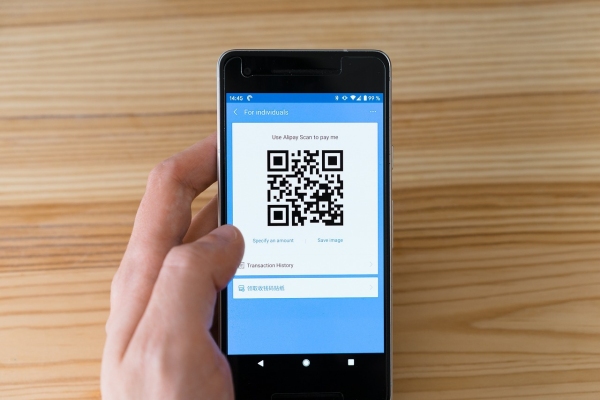
Image: Pixabay/viarami
On February 25 2026, Peoples Group announced a partnership with Fiserv to develop a next generation payments platform intended to serve financial institutions and fintechs across Canada.
The initiative combines Fiserv’s Enterprise Payments Platform with DNA core banking technology and represents one of Peoples Group’s largest technology investments. The infrastructure is designed to improve payment processing connectivity, support unified orchestration across card, account to account, and real time payment flows, and prepare for Payments Canada’s Real Time Rail environment.
The platform focuses on backend modernization rather than a consumer product launch. Peoples Bank of Canada, part of Peoples Group, continues to expand its role as a sponsor bank supporting fintech programs that rely on regulated balance sheet access, settlement infrastructure, and program management. Strengthening this capability can improve launch readiness for embedded finance, prepaid, and digital wallet partnerships while reducing reconciliation friction across payment channels.
Canadian payment modernization continues to advance in parallel to global peers, creating opportunities for infrastructure providers that invest early. Sponsor banks capable of supporting fintech scale with resilient payment processing and real time connectivity often become key enablers of ecosystem growth.
Peoples Group’s investment reflects how smaller specialized banks can play an outsized role in fintech enablement by focusing on platform capabilities rather than retail distribution.
Will deeper bank-fintech infrastructure partnerships accelerate Canada’s payment modernization timeline and expand the range of fintech products available to businesses and consumers?
The National Crowdfunding & Fintech Association (NCFA Canada) is a financial innovation ecosystem that provides education, market intelligence, industry stewardship, networking and funding opportunities and services to thousands of community members and works closely with industry, government, partners and affiliates to create a vibrant and innovative fintech and funding industry in Canada. Learn more.
| | |
|---|---|---|
| | |
February 26, 2026

Image: Freepik/wavebreakmedia micro
In recent years, the business environment in Quebec has been evolving rapidly due to technological innovation, the growth of strong SMEs, and increasing global trade.
Firms in this region, including Montreal startups and Quebec City multinationals, are increasingly inclined to engage consulting firms to address growth, digital transformation, and strategic issues.
With so many advisory firms competing for attention, which ones truly stand out? This article discusses the top ten consulting firms in Quebec and guides on selecting the right consultant to meet your business needs.
The correct consulting firm can prove to be a transformational asset. It may also become a competitive advantage that your Quebec-based organization requires. The following ten business consulting companies, based on their highest ratings and industry reputation in Quebec, are listed below.
Montreal-based consulting firm specializing in HR Advisory and Business Profitability, with 17+ years of expertise serving firms across Quebec. ACM Canada delivers structured solutions, including Marketing and Strategic Planning, to guide businesses through expansion or restructuring, backed by a 2-for-1 ROI guarantee.
Alithya is a significant technology and digital strategy consultant that originated in Quebec. They are experts in business intelligence, ERP/CRM implementation, data analytics, and cloud transformation. Their advantage lies in integrating business advice with the latest technological solutions.
RCGT is one of the largest advisory and accounting firms in Quebec, offering a comprehensive range of services that includes business consulting, risk management, restructuring, and M&A advisory. Their excellent financial consulting qualifications and extensive geographical reach in Quebec would ensure that they are a suitable partner for both corporate and middle-income firms.
Although it is primarily an engineering and environmental consultancy, WSP Global (which also has a large office in Montreal) provides advice to companies on infrastructure development strategy, sustainability, and project development, all areas where Quebec is striving to develop green and built-environment industries.
This firm is listed on Clutch as a consulting provider, offering a two-fold advantage in accounting and advisory services. They are typically contracted to provide strategic financial planning, cost management, and performance enhancement services.
ProMerit is a combination of management consulting and a local presence in Quebec. They are designed to optimize business processes, facilitate change management, and enhance operational efficiency, offering flexible engagement models for evolving companies.
This company, based in Quebec, provides consulting services in accounting, with a focus on serving nonprofit organizations and the public sector. They are advised to be strong in financial planning, governance, and compliance.
Lemieux Nolet, based in Lévis, Quebec, draws on substantial financial experience to provide strategic advice, particularly to family businesses and SMEs. Their services usually encompass succession planning, economic restructuring, and growth strategy.
This is a multifaceted consultancy company located in Quebec City. Although they offer conventional business advisory services, they are also recognized for their effectiveness in ERP consulting, systems integration, and IT-related transformation, helping firms modernize their businesses and align their business objectives.
Interestingly, Deloitte has its roots in the consulting industry a long time ago. Furthermore, they are among the largest Canadian-owned consulting and services firms in Quebec and Canada at large. You should consider using their services based on Deloitte’s track record.
The selection of the consultant is as significant as the selection of the strategy. The six important criteria to consider potential partners are below:
Find consultants with actual, applicable experience in your business or size. When companies such as Proaction International and Alithya are involved, they have decades of field experience, meaning that they are aware of what your market is like.
A good consultant not only provides recommendations but also listens. Empathy refers to seeing beyond your financial objectives and knowing your business culture, emotional distress, and aspirations. Larger boutiques, such as Pyonnier Developpement, are usually competent in this aspect due to their personalized service.
Openness in charges, output, and reporting fosters confidence. Established companies, such as Raymond Chabot Grant Thornton, are typically very articulate about their engagement models. Request that potential consultants provide a clear breakdown of costs and milestones before signing any agreement.
Not only should you find solutions to your problems, but your consulting friend must also develop action plans. Find companies with a roadmap that has distinct stages, quantifiable KPIs, and a roadmap time. Alithya, as an example, tends to combine strategy and implementation in a single plan.
Versatility implies that a company will be able to deal with various forms of challenges, whether it is digital transformation, financial restructuring, or market expansion. Companies such as WSP Global or Genius Solutions can counsel on a variety of strategic questions due to their multidisciplinary staff.
Strategic acumen is key. An excellent consultant must be able to understand both macro trends (such as sustainability or digital disruption) and micro-level issues (including cash flow and operations). This two-fold approach provides a balanced perspective on advice, as it is both visionary and practical.
Quebec has a highly varied business consulting talent pool. You are a local company that needs to grow. You are a startup company that needs to digitalize. You are a larger company that needs to focus on governance and restructuring. Ideal consulting companies are right for the task. Finally, look for a consulting firm that has a business diagnostic service.
The National Crowdfunding & Fintech Association (NCFA Canada) is a financial innovation ecosystem that provides education, market intelligence, industry stewardship, networking and funding opportunities and services to thousands of community members and works closely with industry, government, partners and affiliates to create a vibrant and innovative fintech and funding industry in Canada. Decentralized and distributed, NCFA is engaged with global stakeholders and helps incubate projects and investment in fintech, alternative finance, crowdfunding, peer-to-peer finance, payments, digital assets and tokens, artificial intelligence, blockchain, cryptocurrency, regtech, and insurtech sectors. Join Canada's Fintech & Funding Community today FREE! Or become a contributing member and get perks. For more information, please visit: www.ncfacanada.org
| | |
|---|---|---|
| | |
February 18 2026 | NCFA Market Insight | Digital Assets And Payments
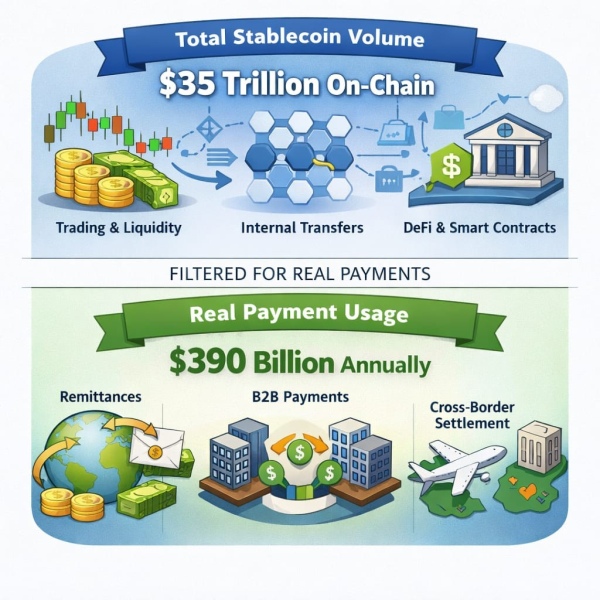
On February 18 2026, McKinsey stablecoin transaction analysis reported that stablecoins accounted for up to $35T in annual on chain transaction volume, yet most of that activity doesn't represent real world payments.
McKinsey and Artemis estimate that actual stablecoin payments run at about $390B annually (about 0.02% of global payments volume), after filtering out trading, internal exchange movements, liquidity management, and automated smart contract loops.
Public blockchains record value movement with precision, but they don't label intent. A single economic action can trigger multiple on chain steps, and large pools of stablecoins can move between wallets inside the same exchange or custodian without representing end user commerce. McKinsey uses raw volume as a starting point, not a proxy for adoption, and the methodology section explains how the team tags payment like patterns while excluding activity that reflects market structure rather than payments.
CoinDesk echoes the same measurement problem by reporting that stablecoins moved about $35T in transfers while only about 1% ties to genuine payments such as remittances and payroll. Payments industry coverage also confirms that stablecoin usage in payments is growing, yet most current activity still concentrates in internal or trading adjacent flows.
Market trackers help validate scale but they don't classify intent. CoinMarketCap aggregates stablecoin market cap and trading volume across listed tokens, which helps you track stablecoin liquidity concentration and market growth, not payments versus non payments.
Stablecoin payments represent one slice of stablecoin utility, so a payments only lens understates what stablecoins do across trading, treasury movement, DeFi collateral, and settlement workflows.
At the same time, a raw volume lens overstates payment adoption. The right reporting approach breaks stablecoin activity into functional buckets and tracks each bucket with the data source that fits it. For payments, intent classification and tagging matter. For liquidity and market structure, market cap and trading metrics matter. For payment segmentation, the underlying research partner publishes its own breakdowns that support the McKinsey approach.
If you build payment rails, you should not pitch adoption using raw on chain volume. You should show where real payment flows concentrate, how fast those flows grow, and what integration path turns that activity into revenue.
If you sell to financial institutions, you should map stablecoin opportunity to specific payment problems such as cross border B2B settlement, payroll, and corridor based remittances, then quantify addressable volume using intent filtered benchmarks like the McKinsey and Artemis estimates.
If you track policy or competitiveness, you should treat stablecoins as a measurement case study. Blockchain data looks transparent, yet it still requires more granular classification, assumptions, and cross checks to translate value movement into economic activity.
If the market keeps quoting $35T as proof of payment adoption, who sets the standard for intent based stablecoin reporting so Canada can measure real productivity and competition impact with confidence
The National Crowdfunding & Fintech Association (NCFA Canada) is a financial innovation ecosystem that provides education, market intelligence, industry stewardship, networking and funding opportunities and services to thousands of community members and works closely with industry, government, partners and affiliates to create a vibrant and innovative fintech and funding industry in Canada. Decentralized and distributed, NCFA is engaged with global stakeholders and helps incubate projects and investment in fintech, alternative finance, crowdfunding, peer-to-peer finance, payments, digital assets and tokens, artificial intelligence, blockchain, cryptocurrency, regtech, and insurtech sectors. Join Canada's Fintech & Funding Community today FREE! Or become a contributing member and get perks. For more information, please visit: www.ncfacanada.org
| | |
|---|---|---|
| | |
Feb 25, 2026 | NCFA Fintech Market Activity | Identity Privacy And Data Governance

Image: Freepik
On February 24 2026, SLC Digital and Tracer Labs announced a partnership that links SIM or eSIM backed device proof with portable digital identity and consent credentials.
The goal is to reduce account takeover exposure and strengthen approvals for high risk actions by proving the authorized device is present and the right person approves the action. SLC Digital says it anchors device trust to the SIM or eSIM and mobile network signals. Tracer Labs says its Trust ID layer supports identity verification, consent, and authorization workflows without repeatedly exposing personal data.
The FBI Internet Crime Complaint Center says that since January 2025 it has received more than 5,100 complaints reporting account takeover fraud, with losses exceeding $262 million
It's an interesting partnership because many platforms still separate identity from authorization. Identity checks often happen at onboarding while authorization often relies on an in app prompt or an SMS one time code. The solution describes a combined workflow that ties a sensitive action to a trusted device and a verified identity and consent credential, so the platform can show stronger evidence that the real user approved the change.
It fits best where one compromised session creates immediate damage. Think bank account changes, payout destination edits, payroll modifications, admin role changes, high value transfers, and merchant settlement rerouting. Those flows also create regulatory and audit exposure when firms cannot clearly prove who approved what and from which trusted endpoint.
Travis McGregor, CEO, SLC Digital:
“This partnership strengthens how organizations defend against modern digital fraud,”
Pete Hayes, CEO, Tracer Labs:
“Digital ecosystems can’t rely on one-time authentication in a world of autonomous agents and sophisticated threats,”
The companies will begin with a joint pilot and expand into enterprise deployments. It also lists SLC Digital partnerships and affiliations that signal an infrastructure grade route to market, including work with GSMA, IDEMIA, and Monogoto, plus membership in the NVIDIA Inception program.
If account takeover losses keep climbing, do banks and fintechs start treating device rooted authorization plus portable consent credentials as a baseline requirement for high risk actions, not an optional upgrade?
The National Crowdfunding & Fintech Association (NCFA Canada) is a financial innovation ecosystem that provides education, market intelligence, industry stewardship, networking and funding opportunities and services to thousands of community members and works closely with industry, government, partners and affiliates to create a vibrant and innovative fintech and funding industry in Canada. Decentralized and distributed, NCFA is engaged with global stakeholders and helps incubate projects and investment in fintech, alternative finance, crowdfunding, peer-to-peer finance, payments, digital assets and tokens, artificial intelligence, blockchain, cryptocurrency, regtech, and insurtech sectors. Join Canada's Fintech & Funding Community today FREE! Or become a contributing member and get perks. For more information, please visit: www.ncfacanada.org
| | |
|---|---|---|
| | |


August 26th, 2025

January 4th, 2024

June 1st, 2021

September 9th, 2020

July 9th, 2018

January 3rd, 2018

September 25th, 2017

June 20th, 2017

May 10th, 2017

December 14th, 2016