




Karsten Wenzlaff, Advisor
August 26th, 2025
Karsten Wenzlaff is a Crowdfunding and Fintech Expert from Germany. He is Secretary-General of Digit[...]


Crypto | Oct 10, 2025

Image: Freepik
On October 9, 2025, Luxembourg’s Finance Minister Gilles Roth confirmed that the Luxembourg's Intergenerational Sovereign Wealth Fund (FSIL) will invest 1% of its portfolio in Bitcoin ETFs. Symbolic and strategic, this is the first time a Eurozone state wealth fund has officially allocated capital to Bitcoin. According to a June 2025 FSIL report, the fund is valued around €764 million (US$887 million) and will allocate roughly €7–9 million to Bitcoin exposure through exchange traded funds as part of the 2026 national budget plan.
The FSIL was created in 2014 to preserve national wealth for future generations and currently maintains a conservative allocation of 53% in government bonds and 46% in equities. A 2025 amendment to its framework allowed up to 15% in alternative assets including crypto.
Treasury Director Bob Kieffer said, “To avoid operational risks, the exposure to Bitcoin has been taken through regulated ETF products,” a compliant structure that's transparency while reducing custody risk. He described the 1% allocation as a balance between innovation and prudence. The move supports Luxembourg’s goal to position itself as a European hub for digital finance under the EU’s Markets in Crypto Assets (MiCA) framework, a key policy area for fintech competitiveness. In 2022, the BIS advised banks to limit Bitcoin exposure at 1% of reserves.
Luxembourg’s decision sets it apart from other Eurozone nations. While European central banks have avoided holding Bitcoin directly, smaller countries like Georgia and non EU members such as Bhutan have included Bitcoin in sovereign portfolios. Norway’s $1.9 trillion wealth fund holds indirect exposure through public companies, and the United States recently allowed seized Bitcoin into the federal strategic reserve. Luxembourg’s ETF approach is a practical signal for governments seeking regulated crypto exposure.
Bitcoin ETFs worldwide now manage over US$164.79 billion (about 7% of total Bitcoin market capitalization) as a result of growing institutional participation through regulated products.
Luxembourg’s ETF investment is aligned with its reputation for financial innovation and prudent governance. For crypto stakeholders, it's validation that Bitcoin can be treated as an investable reserve asset under regulatory supervision. This precedent could influence policy approaches across Europe as sovereign funds explore digital diversification within ESG and MiCA frameworks.
 The National Crowdfunding & Fintech Association (NCFA Canada) is a financial innovation ecosystem that provides education, market intelligence, industry stewardship, networking and funding opportunities and services to thousands of community members and works closely with industry, government, partners and affiliates to create aa vibrant and innovative fintech and funding industry in Canada. Decentralized and distributed, NCFA is engaged with global stakeholders and helps incubate projects and investment in fintech, alternative finance, crowdfunding, peer-to-peer finance, payments, digital assets and tokens, artificial intelligence, blockchain, cryptocurrency, regtech, and insurtech sectors. Join Canada's Fintech & Funding Community today FREE! Or become a contributing member and get perks. For more information, please visit: www.ncfacanada.org
 |  |  |
|---|---|---|
 |  |  |
Oct 9, 2025

Image: Freepik
When most people think about investing, they picture stock tickers, market swings, and the rush of watching their portfolio rise and fall. What rarely gets the spotlight is the quiet factor that can make or break a lifetime of financial growth: taxes. In Canada, where the tax landscape is as complex as the investments themselves, learning to think tax smart is not just an advanced strategy. It is the difference between chasing returns and actually building real, lasting wealth.
According to the Canada Revenue Agency’s Overall Federal Tax Gap Report, billions of dollars in tax revenue go uncollected every year due to underreporting or noncompliance. For individual investors, this underscores a broader reality: missed opportunities and poor tax planning can quietly erode wealth over time.
At the same time, emerging wealth technology platforms and independent advisory models are pushing tax efficiency into mainstream conversation. Together, these trends show why tax smart investing is no longer niche. It is becoming the foundation for building wealth in Canada’s evolving financial system.
It is tempting to believe that a few big wins on the stock market will set you up for life. But the truth is, gross returns do not equal net gains. Without careful tax planning, a healthy looking portfolio can lose value year after year.
Capital gains, dividends, and interest income are all taxed differently. The problem is, most investors do not think about this until tax season, when it is too late to adjust. A dollar earned in one type of investment may be worth far less than a dollar earned somewhere else once taxes are factored in. Wealthy Canadians and institutions have known this for decades. The rest of us are just starting to catch up.
Think of taxes as a silent partner. They take a cut whether you like it or not. The real skill is learning how to minimize their share while still growing your wealth responsibly. That means more than stuffing money into RRSPs or TFSAs, although those matter. It is about positioning investments where they make the most sense from a tax perspective.
For example, interest income is heavily taxed, while capital gains and Canadian dividends are more efficient. Holding bonds inside registered accounts, while keeping eligible dividends outside, can help maximize what you keep. The best investors do not just diversify across asset classes. They diversify across tax treatments.
Investors who want a clear explanation of registered versus non-registered accounts can turn to the Financial Consumer Agency of Canada’s savings and investment products guide.
Two investors could earn the exact same return, but the one with the smarter tax strategy will always come out ahead. Over decades, those differences compound dramatically.
Take a simple case: an investor who earns an annual return of 6 percent but loses 1.5 percent to taxes every year is not really earning 6 percent at all. Compare that to someone earning the same 6 percent but only losing 0.5 percent to taxes. Over 25 years, the second investor ends up with significantly more wealth, not because of higher risk taking, but because of lower tax drag. That is the quiet power of tax smart investing.
The Ontario Securities Commission’s GetSmarterAboutMoney resource includes calculators and tools that illustrate how taxes impact long term investing.
More Canadians are realizing that off the shelf investment products do not cut it anymore. They are looking for advisors who can manage not just portfolios, but the bigger picture: how wealth is preserved, passed on, and optimized for the next generation.
Firms such as Tacita Capital represent this shift. As a Canadian family office, they are fully independent and privately owned, offering authentic multi-family office experience supported by an active founding family. With open architecture, they are not tied to proprietary products or restricted fund menus, which allows for greater flexibility and alignment with client needs. Most importantly, they prioritize after tax returns, focusing on tax conscious investing as the foundation for lasting wealth. For families who want to keep more of their wealth in their own hands rather than handing it over to taxes, this approach is becoming essential.
The rise of WealthTech platforms in Canada is making tax smart strategies more accessible. Digital platforms now offer automated tax loss harvesting, personalized portfolio allocation, and even AI driven insights that can optimize for after tax returns in real time.
This is not just about convenience. It is about democratization. What was once the exclusive domain of high net worth families is slowly becoming available to everyday investors. With the right platforms, even small portfolios can be managed with the kind of tax efficiency once reserved for those with entire teams of advisors.
For further reading, see the Bank of Canada’s PIVOT Program initiative, which collaborates with innovators in fintech and AI to explore new tools and technology in Canada’s financial system.
Tax smart investing does not end with stocks and bonds. Alternative assets, such as real estate, private equity, infrastructure, and even impact investments, are playing a growing role in Canadian portfolios. Many of these vehicles come with unique tax considerations, some favorable, others complex.
What makes them powerful is how they can diversify both returns and tax exposure. For example, real estate investment structures can offer depreciation benefits, while private equity gains may be deferred or taxed differently than public market income. The challenge is access and expertise, knowing when these investments make sense, and how to structure them correctly.
The ultimate goal of tax smart investing is not simply to boost returns. It is about building a financial legacy that outlasts the investor. For Canadian families, this often means thinking about succession, estate taxes, charitable giving, and how wealth aligns with values.
Wealth without strategy can create as many problems as it solves. By contrast, wealth that is carefully structured for taxes, inheritance, and long term planning does not just preserve money. It preserves freedom. It gives families the ability to support causes they care about, invest in new ventures, or provide security across generations.
Canada’s tax system can feel punishing at times, but it also offers unique opportunities. Tools like TFSAs and RRSPs, along with carefully designed trust structures, give Canadians more flexibility than many investors abroad enjoy. The challenge is that navigating these opportunities requires knowledge and discipline.
The good news is that more Canadian investors are waking up to the fact that building wealth is not just about buying the right stock at the right time. It is about structuring every decision in a way that minimizes tax erosion. And in today’s world, with both digital platforms and specialized advisors available, this approach is more achievable than ever.
The path to real wealth in Canada is not about flashy trades or beating the market. It is about keeping more of what you already earn. Taxes will always take their share, but how much they take is something you can control with smart strategies, careful planning, and the right guidance.
The National Crowdfunding & Fintech Association (NCFA Canada) is a financial innovation ecosystem that provides education, market intelligence, industry stewardship, networking and funding opportunities and services to thousands of community members and works closely with industry, government, partners and affiliates to create aa vibrant and innovative fintech and funding industry in Canada. Decentralized and distributed, NCFA is engaged with global stakeholders and helps incubate projects and investment in fintech, alternative finance, crowdfunding, peer-to-peer finance, payments, digital assets and tokens, artificial intelligence, blockchain, cryptocurrency, regtech, and insurtech sectors. Join Canada's Fintech & Funding Community today FREE! Or become a contributing member and get perks. For more information, please visit: www.ncfacanada.org
| | |
|---|---|---|
| | |
FT Partners Crypto and Blockchain Update | Oct 9, 2025
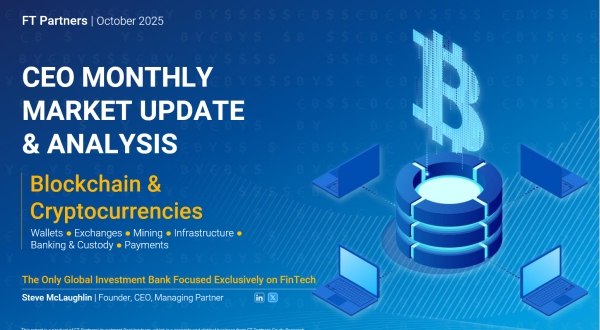
Source: Financial Technology Partners
Financial Technology Partners (FT Partners) October 2025 Crypto and Blockchain Update shows that capital is flowing back into regulated digital asset infrastructure.
The Financial Technology Partners (FT Partners) October 2025 Blockchain and Cryptocurrencies Monthly report shows that digital asset M&A and financing activity has rebounded, led by exchanges, custody networks, and compliance technology. Institutional demand is piling into the market as regulated entities capture a growing share of capital and deal flow, with climbing valuations across regulated segments.
The FTP report data indicates that infrastructure remains the strongest and most resilient part of the market. Custody systems, settlement networks, and tokenization technology are attracting the largest investments as firms position to meet higher institutional and compliance standards. Transactions through 2025 is proof of how global players are consolidating around regulated platforms, liquidity access, and cross-border interoperability.
Ripple Labs acquired Standard Custody & Trust for $120 million in January, expanding its regulated tokenization and trust charter capabilities.
In April, Fireblocks raised $150 million at a $10 billion valuation to scale enterprise-grade custody and settlement systems. Komainu attracted $25 million in strategic investment during the same month to strengthen its institutional custody platform and compliance integrations.
May brought a $100 million raise for Anchorage Digital to expand its regulated digital asset banking and custody operations.
BitGo followed in June with a $100 million Series C round at a $1.75 billion valuation to deepen institutional tokenization services.
By September, Galaxy Digital acquired GK8 for $44 million, adding institutional self-custody and wallet management capabilities.
WonderFi completed a $100 million merger with Coinsquare and Bitbuy in January, forming one of Canada’s largest regulated crypto trading platforms.
Then later in March, Robinhood acquired WonderFi for C$250 million (around US$179 million), uniting Coinsquare and Bitbuy under its global exchange network.
Coinbase expanded twice, acquiring Circle’s European operations in February to enhance stablecoin settlement systems, then Deribit in August for $2.9 billion in cash and stock to extend crypto derivatives trading and clearing.
Chainalysis closed a $200 million Series F in June at a $4.2 billion valuation to expand blockchain intelligence and compliance monitoring.
A month later, Elliptic raised $50 million in a Series D extension to develop new anti–financial-crime tools for banks and exchanges.
Circle completed its acquisition of Archblock in February, integrating cross-chain USDC routing and compliance layers.
In May, Tether acquired Bitfinex Securities’ minority stake to reinforce its regulated token issuance network.
Ripple invested $285 million in August to expand global tokenization and CBDC settlement projects.
Kraken Ventures launched a $200 million fund in July focused on blockchain infrastructure and fintech platforms.
FT Partners’ 2025 data confirm that regulated infrastructure has become the foundation of digital finance. Valuations for infrastructure and compliance platforms now exceed eight times revenue, while consumer trading firms remain below four.
That spread shows that investors see real value in predictable, institutionally integrated systems rather than volatile retail flows. Institutional adoption continues through regulated products such as spot Bitcoin ETFs, tokenized funds, and custody-integrated settlement rails.
These channels represent a transition from speculative trading to reliable yield generation. Capital is rewarding throughput, compliance, and interoperability the same factors that define successful cross-border fintech models.
Growth will continue through robust compliance-oriented networks linking tokenized assets, stablecoins, and regulated exchanges. 2025 transactions signal global alignment toward clearer regulatory frameworks across Canada, Europe, and the United States. Taken together, these developments are building a more mature, data-driven digital finance ecosystem that's preparing for institutional scale.
The National Crowdfunding & Fintech Association (NCFA Canada) is a financial innovation ecosystem that provides education, market intelligence, industry stewardship, networking and funding opportunities and services to thousands of community members and works closely with industry, government, partners and affiliates to create aa vibrant and innovative fintech and funding industry in Canada. Decentralized and distributed, NCFA is engaged with global stakeholders and helps incubate projects and investment in fintech, alternative finance, crowdfunding, peer-to-peer finance, payments, digital assets and tokens, artificial intelligence, blockchain, cryptocurrency, regtech, and insurtech sectors. Join Canada's Fintech & Funding Community today FREE! Or become a contributing member and get perks. For more information, please visit: www.ncfacanada.org
| | |
|---|---|---|
| | |
Oct 8, 2025

In today's world, where the majority of sales are now online, it is the speed of development that determines whether a company will be successful in selling online. For a large corporation, a delay of literally minutes or an error in the process can turn into a loss of several millions. That's why large-scale businesses choose Shopify Plus - a platform that not only gives the business a sense of stability, but is also ready for daily updates and upgrades.
In this article, we'll look at what challenges Shopify Plus can handle for large businesses.
When the store increases sales from several hundred to several thousand per day, the usual steps cease to bring the same result as before. The workload on employees increases, as a result of which errors may occur during the processing of orders.
Shopify Plus Solution: the platform, thanks to powerful tools, is ready to withstand tens of thousands of payments every day. Automation of the load on the servers is a guarantee of stable operation even at the time when the most purchases are made.
Result: customers are served quickly and without interruptions, and the company saves budget that could have been lost due to technical errors.
The ambitions of large corporations are always to enter the international market. But the language barrier, different currencies and payment systems often become an obstacle to the realization of this idea.
Shopify Plus Solution: built-in multicurrency and multilingualism allow you to serve customers from different parts of the world and not create a separate site for one or another country. The platform also integrates with local payment systems.
Result: the company quickly starts working on an international scale and develops new markets, without spending a lot of time and resources on it.
Marketing in large corporations is not only about banners and promotional offers. This is about complex work on many levels, thanks to which offers are built to meet the needs of different segments of customers.
Shopify Plus Solution: automation tools (Flow, Launchpad) help plan, launch and monitor campaigns. They allow you to segment customers according to their needs, automatically adjust discounts for them, and launch promotions at the right time.
Result: the company keeps the resource of its employees, but at the same time gets the desired result from each marketing strategy.
Flexible pricing and multi-level accounts are important to B2B companies.
Shopify Plus Solution: client orientation – individual conditions, personalized discounts, special conditions of cooperation. And also access to different representatives of the corporation with different rights.
Result: loyal relations with strategic partners and transparent conditions of cooperation are formed.
Big brands need to get accurate numbers to make certain decisions. Analytics makes it possible to understand which internal processes are slowing down and inhibiting development.
Shopify Plus Solution: integrations with analytical systems and advanced reports allow you to analyze customer behavior, conversions and profitability.
Result: the business quickly receives all the necessary data and quickly adjusts processes.

To fully utilize the Shopify Plus functionality, you need a team that knows not only technical parameters, but also is competent in business processes. It is this assistant Binary Future – experts in shopify ecommerce development, capable of creating scalable online platforms and integrating advanced analytics and marketing tools."
The team helps large corporations:
Binary Future's mission is to create seamless and intuitive shopping experiences that convert visitors into repeat customers and deliver measurable growth.
The National Crowdfunding & Fintech Association (NCFA Canada) is a financial innovation ecosystem that provides education, market intelligence, industry stewardship, networking and funding opportunities and services to thousands of community members and works closely with industry, government, partners and affiliates to create aa vibrant and innovative fintech and funding industry in Canada. Decentralized and distributed, NCFA is engaged with global stakeholders and helps incubate projects and investment in fintech, alternative finance, crowdfunding, peer-to-peer finance, payments, digital assets and tokens, artificial intelligence, blockchain, cryptocurrency, regtech, and insurtech sectors. Join Canada's Fintech & Funding Community today FREE! Or become a contributing member and get perks. For more information, please visit: www.ncfacanada.org
| | |
|---|---|---|
| | |
Agentic AI Framework | Oct 6, 2025
iMAGE: Unlocking the right Agentic AI use cases (Deloitte, Sep 2025)
In September 2025, Deloitte released a research report titled, "Unlocking the Right Agentic AI Use Cases", outlining a structured way for evaluating where autonomous AI systems can deliver the most value. The report emphasizes that agentic AI is less about replacing jobs and more about transforming how organizations reason, decide, and learn at scale.
In this article, NCFA applies the framework to several common fintech processes from transaction monitoring to smart contract audits, and ranks how suitable they are for agentic AI adoption today and in the future as governance, transparency, and learning systems evolve.
Deloitte’s research includes 7 criteria to help developers determine how suitable agentic ai is for automating a particular process - see the table below.
| Criterion | Definition | Low End (Less Ideal) | High End (More Ideal) |
| 1. Reasoning and context | How much the process requires understanding across variables | Follows strict rules or thresholds | Requires judgment and context (e.g., fraud review) |
| 2. Autonomy and escalation | Degree of independent decision-making | Executes instructions only | Decides next actions, knows when to involve humans |
| 3. Goal orientation | Clarity of outcome or success metric | No clear endpoint | Defined goal (e.g., complete onboarding) |
| 4. Multistep nature | Whether multiple systems or tasks must be performed | Single-step task | Coordinates multiple systems sequentially |
| 5. Cyclic repetition | Frequency and feedback loops | One-time task | Repeats with measurable feedback loops |
| 6. Explainability | Transparency of reasoning | Opaque or black-box logic | Traceable reasoning with audit trails |
| 7. Continuous learning | Ability to learn and adapt | Static model | Improves through ongoing data input and correction |
Each process is scored out of ten points using Deloitte’s agentic AI use case suitability framework. The first score reflects current use case suitability in today’s environment. A second estimate indicates how use case suitability could rise in the future as digital governance, explainable systems, and automation standards mature over time.
Identity checks, risk screening, and document verification already rely on structured rules and data. Agentic AI fits naturally here, automating repetitive verification while escalating edge cases. As more jurisdictions adopt digital ID systems, this process could / will reach full autonomy with minimal human input.
Fraud detection already uses machine learning but agentic AI adds reasoning and adaptive responses. It can correlate patterns across payments, wallets, and behavioural data in real time.
With digital audit trails and explainable decision logs this process could operate fully autonomously under continuous supervision frameworks.
Matching incoming and outgoing payments is structured but still requires manual exception handling. Agentic systems can monitor ledgers, spot mismatches, and self-correct using feedback loops. As accounting platforms integrate autonomous verification standards, reconciliation could become a closed-loop agentic process with automated approvals.
Preparing reports for regulators involves collecting, validating, and submitting structured data. Agentic AI can manage workflows and track compliance deadlines. As regulators adopt machine-readable filing systems and trust frameworks, the need for human review will decline, allowing safe automation of most submissions.
Auditing blockchain contracts involves reasoning through logic and risk. Agentic AI can already identify anomalies and test execution scenarios. When standards for autonomous assurance and self-certifying code mature, agents could perform initial audits before human validation.
Today, human advisors must ensure advice suitability and fairness. Agentic AI can model goals and risk preferences, but oversight rules limit autonomy.
As explainability improves and regulators enable digital fiduciary models, these systems could autonomously generate and monitor recommendations.
Managing liquidity involves reasoning across cash flows, forecasts, and risk exposure. Agents can simulate scenarios and suggest rebalancing actions. Once real-time regulatory supervision and audit logs are common, agentic systems could adjust positions within safe parameters.
Tracking, transferring, and redeeming digital tokens are structured, rules-driven tasks. Agentic AI can monitor compliance and manage lifecycle events. As token standards and programmable compliance mature, these agents could manage portfolios with built-in governance.
Support interactions often follow clear procedures with measurable outcomes. Agentic AI can handle queries, resolve issues, and escalate complex cases. As conversational transparency and emotion modeling improve, these agents could manage most client interactions autonomously.
Scenario modelling tests business resilience under stress or uncertainty. Agentic AI can run continuous simulations, adjusting parameters as markets shift. In the future, these systems could interface with policy dashboards to flag emerging risks automatically.
This use case suitability assessment highlights how agentic AI can strengthen the efficiency, accuracy, and competitiveness of financial operations. Processes with structured data and repeatable outcomes like KYC, transaction monitoring, and reconciliation show the highest use case suitability today. These are areas where autonomous systems can already perform safely under human oversight.
For policymakers and regulators, the above examples demonstrate the importance of establishing auditable, explainable AI frameworks that allow more automation without compromising accountability.
For startups and financial institutions, the opportunity lies in targeting 'low lying fruit' (high-use case suitability functions) first to achieve measurable productivity and risk-management gains.
As data ecosystems become more interoperable and governance standards mature, the next stage of AI adoption will evolve from task-level automation to agentic collaboration. In this model, autonomous agents interact with systems, policies, and humans to drive continuous decision-making improvements.
This evolution could redefine the boundaries between financial service providers, regulators, and technology developers. Canada’s leadership potential lies in balancing innovation with responsible oversight, establishing itself as a trusted hub for explainable and accountable AI-driven finance.
The National Crowdfunding & Fintech Association (NCFA Canada) is a financial innovation ecosystem that provides education, market intelligence, industry stewardship, networking and funding opportunities and services to thousands of community members and works closely with industry, government, partners and affiliates to create aa vibrant and innovative fintech and funding industry in Canada. Decentralized and distributed, NCFA is engaged with global stakeholders and helps incubate projects and investment in fintech, alternative finance, crowdfunding, peer-to-peer finance, payments, digital assets and tokens, artificial intelligence, blockchain, cryptocurrency, regtech, and insurtech sectors. Join Canada's Fintech & Funding Community today FREE! Or become a contributing member and get perks. For more information, please visit: www.ncfacanada.org
| | |
|---|---|---|
| | |
Fintech | Oct 3, 2025
Image: Freepik/newelement
On September 26, 2025, the Globe and Mail released its 2025 Report on Business ranking of Canada’s Top Growing Companies. The annual list tracks Canadian firms based on three-year revenue growth, offering a quick snapshot of where innovation is scaling fastest (think revenue, headcount, growth).
This year’s ranking features a great group of fintech and digital finance firms that are impacting how Canadians borrow, pay, invest, insure, and embed financial services into everyday life.
| Rank | Company | Sector | Description |
| #3 | Gearlay | Web3 / Blockchain | Blockchain-based enterprise financial software |
| #4 | Float | Lending & Embedded Finance | SME finance and corporate card platform |
| #5 | veritree | ESG & Green Finance | Digital carbon credits and reforestation finance |
| #11 | Novisto | ESG & Green Finance | ESG disclosure, data, and reporting platform |
| #24 | FundMore | Lending & AI | Automated mortgage underwriting |
| #32 | Quandri | AI & Automation / Insurtech | Insurance automation bots |
| #39 | Autocorp.ai | AI & Lending | AI-powered auto retail finance |
| #44 | Helcim | Payments | Merchant payment processing |
| #57 | CapIntel | WealthTech | Digital platform for advisors and wealth managers |
| #62 | PomeGran | Digital Infrastructure | Broadband and connectivity backbone |
| #65 | BOXX Insurance | Insurtech | Cyber insurance and protection |
| #72 | SWTCH Energy | Payments Infra / Energy | EV charging + payments integration |
| #86 | Makeship | Alternative Finance / Crowdfunding | Creator crowdfunding platform |
| #108 | Fintel Connect | Web3 / Marketing | Performance marketing for fintechs and crypto |
| #110 | Justwealth | WealthTech | Robo-advisor portfolio management |
| #112 | HONK | Payments | Contactless mobility/parking payments |
| #119 | Merchant Growth | Lending & SME Finance | Working capital financing |
| #129 | MindBridge | AI & Regtech | AI anomaly detection and audit |
| #137 | Loans Canada | Lending & Alt Finance | Loan marketplace and credit scoring |
| #140 | PolicyMe | Insurtech | Digital-first life insurance |
| #149 | Zum Rails | Open Banking & Payments | Open banking and payments APIs |
| #158 | Trolley | Payments | Global payouts and compliance |
| #204 | FundThrough | Lending & Alt Finance | Invoice financing and cash flow optimization |
While the Globe and Mail ranking provides a valuable view of Canadian fintech growth, it is far from exhaustive. Many high-growth firms remain absent because they operate in stealth mode, choose not to disclose financial data, or do not meet eligibility thresholds. Early-stage innovators, companies with holding structures abroad, and ventures acquired by larger incumbents also fall outside the ranking.
For NCFA’s community, this means the list represents only part of the country’s dynamic ecosystem of fintech, Web3, AI, alternative finance, and digital-first ventures that are scaling globally. For a broader view of Canada’s financial tech innovation landscape, see NCFA’s fintech directory at https://fintechcanada.io/.
Canadian fintech companies are excelling in lending, payments, Web3, insurtech, ESG, AI, digital infrastructure, and many other subcategories. These companies mirror how regulation, access to capital, and collaboration between industry and government is critical to ensure Canadian fintechs continue to thrive in an increasingly globally competitive landscape.
The National Crowdfunding & Fintech Association (NCFA Canada) is a financial innovation ecosystem that provides education, market intelligence, industry stewardship, networking and funding opportunities and services to thousands of community members and works closely with industry, government, partners and affiliates to create aa vibrant and innovative fintech and funding industry in Canada. Decentralized and distributed, NCFA is engaged with global stakeholders and helps incubate projects and investment in fintech, alternative finance, crowdfunding, peer-to-peer finance, payments, digital assets and tokens, artificial intelligence, blockchain, cryptocurrency, regtech, and insurtech sectors. Join Canada's Fintech & Funding Community today FREE! Or become a contributing member and get perks. For more information, please visit: www.ncfacanada.org
| | |
|---|---|---|
| | |
AI Innovation | Oct 2, 2025

Image captured from Sora 2 Demo Reel
on September 30, 2025, OpenAI released Sora 2 in a new Sora app (iOS only, no Android version for now), introducing synchronized audio, improved physical realism and cameo features. The rollout is invite only in the United States and Canada according to the Sora app access details. It includes built-in checks so organizations can track where videos come from and how they are used.
Sora 2 generates video with synchronized voices and sound effects and it produces motion scenes in a more natural and consistent way, making explainers, onboarding, and campaign videos feel more real.
The Sora app also uses a feed where teams can scroll work, remix content, and follow creators. It's designed for consumer use but can also support professional workflows as outlined in Getting started with the Sora app.
Here's some independently created videos created with Sora 2 to check it out:
Cameos and likeness features raise privacy issues in Canada, so organizations need clear opt-in consent, easy ways to withdraw it, short data retention, and secure handling of faces and voices, following the OPC’s biometrics Aug 2025 guidance.
Financial institutions should govern Sora under third party and technology risk controls and map the vendor to the expectations in OSFI Technology and Cyber Risk Management including governance, operations, and incident practices.
Adoption of artificial intelligence is rising across Canada. In the second quarter of 2025 Statistics Canada reported 12.2% of businesses using AI to produce goods or deliver services and the finance and insurance sector reported strong usage during this period.
You can preview synchronized dialogue and cinematic motion in the official Sora 2 demo reel to align teams on expected quality and use cases.
Sora 2 shows how fast generative video is moving from lab demos to real tools available in Canada. For fintechs and banks, this is not only about cutting costs or making faster videos, but about driving innovation in how financial services communicate, educate, and build trust. By experimenting now with synchronized audio and provenance-checked video, Canadian innovators can stay ahead of global competitors.
The National Crowdfunding & Fintech Association (NCFA Canada) is a financial innovation ecosystem that provides education, market intelligence, industry stewardship, networking and funding opportunities and services to thousands of community members and works closely with industry, government, partners and affiliates to create aa vibrant and innovative fintech and funding industry in Canada. Decentralized and distributed, NCFA is engaged with global stakeholders and helps incubate projects and investment in fintech, alternative finance, crowdfunding, peer-to-peer finance, payments, digital assets and tokens, artificial intelligence, blockchain, cryptocurrency, regtech, and insurtech sectors. Join Canada's Fintech & Funding Community today FREE! Or become a contributing member and get perks. For more information, please visit: www.ncfacanada.org
| | |
|---|---|---|
| | |


August 26th, 2025

January 4th, 2024

June 1st, 2021

September 9th, 2020

July 9th, 2018

January 3rd, 2018

September 25th, 2017

June 20th, 2017

May 10th, 2017

December 14th, 2016