




Karsten Wenzlaff, Advisor
August 26th, 2025
Karsten Wenzlaff is a Crowdfunding and Fintech Expert from Germany. He is Secretary-General of Digit[...]


Sep 9, 2025

Image: Freepik/Rawpixel.com
In recent years, online casinos have expanded far beyond local markets. With internet access available almost everywhere, players from different countries now have the opportunity to enjoy casino games without leaving their homes. This global growth has created a demand for platforms that not only provide entertainment but also operate with integrity.
A reputable casino must balance three factors: security, fairness, and convenience. For international players, these qualities are even more important because cross-border payments, diverse regulations, and different cultural expectations come into play. Choosing the right platform is therefore essential for a safe and enjoyable experience.
The online gaming industry is highly competitive. Hundreds of sites offer flashy designs and bold promises, but not all of them can be trusted. Reputation separates serious operators from unregulated platforms.
A good reputation signals:
Without these qualities, a casino risks losing player trust. For users, this trust is the foundation of any long-term relationship with a gaming platform.
What exactly should international players expect from a reliable casino? Several core features define the best operators in the market.
Together, these factors ensure that players feel safe and respected, regardless of their country of residence.
One of the biggest challenges for global users is handling payments across borders. A reputable casino makes this process smooth and transparent. Licensed operators usually support a wide range of payment methods, including:
Speed is another crucial factor. Reputable casinos process withdrawals quickly, avoiding unnecessary delays. Equally important is transparency—players should always know about fees, processing times, and any limits before making a deposit.
Platforms such as CasinoBello show how premium entertainment can be combined with secure transactions, offering international players both peace of mind and the chance for exciting wins.
Licensing is the backbone of any trustworthy online casino. Regulatory bodies check that platforms follow strict standards in fairness, security, and responsible gambling. International players should always confirm that a casino holds a valid license before registering.
Licenses guarantee that:
Without a license, players risk dealing with unreliable operators that may not pay winnings or could misuse personal information.
In the second part of this discussion, it is vital to highlight what makes a reputable online casino for international players stand out. Many users travel frequently or live in regions where regulations differ. For them, consistency is key.
Such platforms offer:
By addressing these needs, reputable casinos create an inclusive environment where players from all backgrounds feel welcome and secure.
The game library is another factor that defines a platform’s quality. International players expect a wide variety that covers both traditional and modern options.
Common categories include:
Because reputable casinos partner with top developers, these games run smoothly, have strong visuals, and maintain fairness through certified RNGs.
For international users, making the right choice requires careful evaluation. A step-by-step approach helps avoid mistakes.
By following these steps, players can find casinos that combine fun with reliability.
For international players, mobility is essential. Many travel frequently or prefer playing on the go. Reputable casinos optimise their sites and apps for smartphones and tablets. This includes responsive layouts, touch-friendly controls, and smooth streaming for live games.
The ability to access quality gaming anytime and anywhere adds to the convenience and appeal of online casinos for global audiences.
A strong reputation is not only built on entertainment but also on responsibility. Reputable casinos integrate tools that help players maintain control. These may include:
At the same time, customer support teams must be available 24/7. For international players, support across different time zones and languages is critical.
As technology advances, international casinos are likely to become even more sophisticated. Virtual reality, artificial intelligence, and blockchain are already being explored. These innovations will enhance transparency, interactivity, and fairness.
For players worldwide, this means even more engaging experiences while maintaining high levels of trust.
The growth of online casinos has given international players more options than ever before. But choice alone is not enough. Players need platforms that are safe, fair, and responsible.
A reputable online casino for international players offers exactly this. It combines security with entertainment, delivers trustworthy payments, and provides a diverse selection of games. By focusing on licensing, reputation, and user protection, these casinos ensure that players across the globe can enjoy premium gaming with confidence.
 The National Crowdfunding & Fintech Association (NCFA Canada) is a financial innovation ecosystem that provides education, market intelligence, industry stewardship, networking and funding opportunities and services to thousands of community members and works closely with industry, government, partners and affiliates to create aa vibrant and innovative fintech and funding industry in Canada. Decentralized and distributed, NCFA is engaged with global stakeholders and helps incubate projects and investment in fintech, alternative finance, crowdfunding, peer-to-peer finance, payments, digital assets and tokens, artificial intelligence, blockchain, cryptocurrency, regtech, and insurtech sectors. Join Canada's Fintech & Funding Community today FREE! Or become a contributing member and get perks. For more information, please visit: www.ncfacanada.org
 |  |  |
|---|---|---|
 |  |  |
M&A | Aug 28, 2025
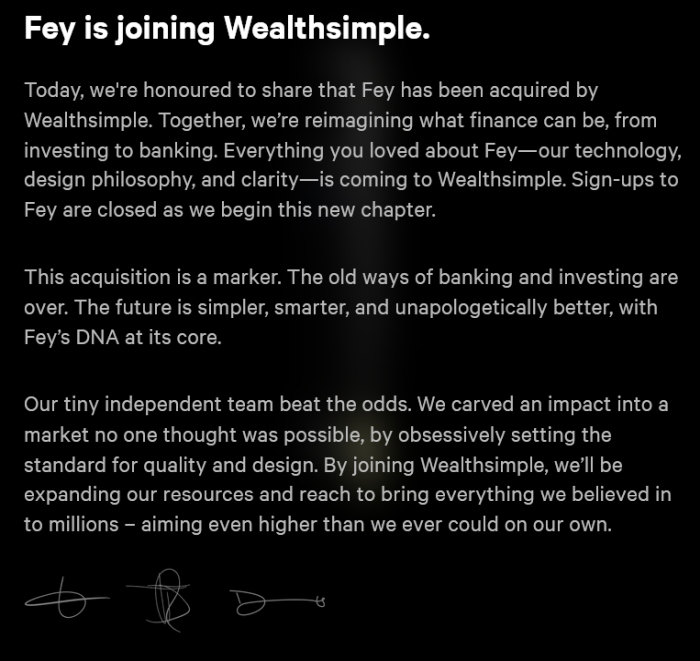
Image: Fey is joining Wealthsimple
On August 27, 2025, Wealthsimple announced the acquisition of Fey, a Montreal-based investment research startup founded in 2021 that built its reputation on elegant design and advanced AI trading tools. The financial terms of the deal weren't disclosed but it puts Wealthsimple in a position to offer millions of Canadians an enhanced trading experience, bridging the gap between simple apps and a more complex brokerage platform.
Wealthsimple now serves more than 3 million clients and manages over $84 billion CAD in assets, a 94% increase from the previous year. Earlier in 2025, Wealthsimple acquired San Francisco based platform Plenty, a wealth management platform for couples, as part of its strategy to expand capabilities and scale faster.
Fey emerged from the Montreal design studio Narative, founded by Thiago Costa, Dennis Brotzky, Thomas Russell, and Mack Mansouri. The team built Fey strategically with early venture backing from Maple VC, Inovia Capital, Yuri Sagalov of Wayfinder, and Abhinav Tiwari of Blank Ventures. Instead of a splashy launch, Fey garnished trader feedback on an invite-only access basis, which helped them refine features such as natural language stock screening, real-time earnings summaries, and a personalized news feed. Features that will soon become part of WS's self-directed investing platform.
As reported by BetaKit, Fey’s co-founders Costa, Brotzky, and Russell will join Wealthsimple’s self-directed investing group, and the Fey platform will shut down by September 30, with subscribers being refunded for any remaining balances.
For Wealthsimple’s 3 million clients, here's a look at how the integration of Fey's platform design and features will turn complex investing workflows into intuitive actions:
On Reddit, an early user described Fey as providing “a much nicer UI, the ability to sync portfolios across institutions, and quick access to key metrics when I didn’t have time to dig for them”.
Wealthsimple is aiming to create an all-in-one financial platform covering investing, trading, crypto, tax filing, and everyday banking services. Adding Fey’s research and design-first tools will help attract a younger generation of investors while strengthening its position against traditional brokerages and newer fintech challengers.
The National Crowdfunding & Fintech Association (NCFA Canada) is a financial innovation ecosystem that provides education, market intelligence, industry stewardship, networking and funding opportunities and services to thousands of community members and works closely with industry, government, partners and affiliates to create a vibrant and innovative fintech and funding industry in Canada. Decentralized and distributed, NCFA is engaged with global stakeholders and helps incubate projects and investment in fintech, alternative finance, crowdfunding, peer-to-peer finance, payments, digital assets and tokens, artificial intelligence, blockchain, cryptocurrency, regtech, and insurtech sectors. Join Canada's Fintech & Funding Community today FREE! Or become a contributing member and get perks. For more information, please visit: www.ncfacanada.org
| | |
|---|---|---|
| | |
AI Aug 27, 2025

Image: Freepik AI
For generations, investors have imagined a system that could analyze company filings, market news, and stock prices without bias, synthesize all the information, and generate transparent recommendations. Until now, this dream has remained out of reach. New research by BlackRock, the world's largest asset manager, finds that multi agent artificial intelligence may finally bring this vision closer to reality.
A collection of specialized large language model agents called AlphaAgents who collaborate and debate with each other have proven to outperform benchmarks in certain back tested cases and to provide explainable decision making trails that mirror investment committee discussions.
The system uses three unique agents with focused expertise to deliver a type of collective intelligence into portfolio construction.
Instead of outputting isolated judgments, the agents debate until they reach consensus which produces a stronger investment view aligned with specific risk profiles.
The BlackRock team tested AlphaAgents on 15 technology stocks between February and May 2024. In practical terms, the back test showed that multi agent reasoning can deliver superior returns in balanced mandates and greater stability in conservative ones.
Four portfolios were created. One for each single agent, plus a multi agent consensus portfolio. These were compared against an equally weighted benchmark with the results showing measurable gains and improvements.
With a neutral risk setting, the multi agent portfolio outperformed single agent portfolios and the benchmark on cumulative returns and rolling Sharpe ratios. A case example showed one stock gaining 13.56% in January 2024, far ahead of the 3.85% increase in the S&P 500.
Interestingly, using the risk averse setting, all agent portfolios underperformed the benchmark during a technology rally, but the multi agent portfolio still produced lower volatility and smaller drawdowns, demonstrating its value for downside protection.
The difference between a 13.56% stock return and a 3.85% market return in the same month illustrates why investors have long dreamed of such systems. AlphaAgents not only captured the upside but also flagged risks such as insider selling and negative operating margins.
For managers and advisors, this means decision support that is both measurable and transparent.
AlphaAgent debate logs are like committee notes, creating an audit trail that supports compliance and strengthens client conversations.
For regulators, the full record of data inputs and reasoning provides an unprecedented level of model oversight.
While there are back testing limitations of evaluating a mere four month window across 15 tech stocks, there's real evidence now that multi agent AI systems can produce superior ROI and risk management in risk neutral strategies. If integrated into live portfolios, these systems could in fact significantly alter equity investing.
The National Crowdfunding & Fintech Association (NCFA Canada) is a financial innovation ecosystem that provides education, market intelligence, industry stewardship, networking and funding opportunities and services to thousands of community members and works closely with industry, government, partners and affiliates to create a vibrant and innovative fintech and funding industry in Canada. Decentralized and distributed, NCFA is engaged with global stakeholders and helps incubate projects and investment in fintech, alternative finance, crowdfunding, peer-to-peer finance, payments, digital assets and tokens, artificial intelligence, blockchain, cryptocurrency, regtech, and insurtech sectors. Join Canada's Fintech & Funding Community today FREE! Or become a contributing member and get perks. For more information, please visit: www.ncfacanada.org
| | |
|---|---|---|
| | |
Aug 22, 2025

Source: Canva Editor
Folding in poker is one of the moves that, on the surface, looks so simple yet seems to bear a lot of mental weight. To anyone watching, it’s simply a player sliding some cards away from themselves.
To the person making the decision, it can seem like a defining moment wherein logic, emotion, and self-image are in conflict. The problem is not so much in the doing itself but in resolving the psychological push-and-pull that accompanies it.
The fold decision is hardly ever emotionless. In the quick pace of online poker or in real live games, loss aversion regularly wins. Humans innately dread losing more than they value winning the same amount, it tempts them to call just to “see” rather than get out when the odds are against them. Not finding out what an opponent had can leave an itch for closure, feeding regret and second-guessing well after the hand ends.
Finally, there’s the sunk cost fallacy. After investing time and chips, whether at a live table or in poker online games, leaving the table feels like throwing good money after bad. For competitive players, it inflates the challenge, folding can seem to be waving the white flag even though more often it is the discipline of a skilled strategist.
Folding is not viewed as a retreat but rather considered as the conservation of resources. Every chip saved is equivalent to gaining a chance to use that chip later from a better position. In tournaments, just saving by folding can make the difference between an early exit and staying in the game.
There is a psychological benefit, too. Every right fold strengthens the belief in one’s judgment and enhances the capacity to overcome impulsive urges. In the long run, success at poker depends on playing the right pots and not chasing every pot.
Practice and reflection make for good folding habits. Build a history of disciplined decisions by reviewing hands you stepped away from and testing your logic against the result over time; the pride evolves toward making the correct play instead of winning individual pots.
Breaks can play a role too. Emotional fatigue blunts decision-making, and all it takes is a few minutes off the table for things to become clear again. Folding, in this way, is a proactive choice toward retaining sharpness rather than one of giving up.
Firm decisions are an amalgam of reasoning with the management of feelings. Systematically collecting data on betting patterns, player tendencies, and position will surely create a clearer picture of the hand. Pot odds and probability calculations guide the part of the decision that is mathematical.
The math goes with the emotions. Angry math. Anxious math. Overconfident math. These emotional states directly influence how players apply calculations. Emotions skew judgment. People make decisions that logic would not accept. Players who think about decision quality rather than short-term results tend to play better in the inevitable ups and downs of the game.
Mindfulness keeps attention on the present hand, reduces distraction, and does not allow emotions from the previous outcome to carry over. Folding becomes easier to do what the situation demands when one does not develop an attachment to individual results- this should be viewed as a hand within a broader context rather than taking it as a personal test.
Self-review after play is also a very powerful tool. Patterns will begin to emerge away from the table that were impossible to see at the moment. It will often become apparent that the fold which felt so bad was, in fact, the correct decision.
Folding is an ironic form of instant regression, as it often propels a player forward in the future. It requires discipline, emotional maturity, and the humility to understand that the best decision need not always win the hand.
Those who accept this truth, live or online, seem to last longer, tilt less, and play with more satisfaction. At the end of the day, folding has less to do with throwing out cards than it does protecting your cutting edge.
The National Crowdfunding & Fintech Association (NCFA Canada) is a financial innovation ecosystem that provides education, market intelligence, industry stewardship, networking and funding opportunities and services to thousands of community members and works closely with industry, government, partners and affiliates to create a vibrant and innovative fintech and funding industry in Canada. Decentralized and distributed, NCFA is engaged with global stakeholders and helps incubate projects and investment in fintech, alternative finance, crowdfunding, peer-to-peer finance, payments, digital assets and tokens, artificial intelligence, blockchain, cryptocurrency, regtech, and insurtech sectors. Join Canada's Fintech & Funding Community today FREE! Or become a contributing member and get perks. For more information, please visit: www.ncfacanada.org
| | |
|---|---|---|
| | |
Crypto IPO | Aug 14, 2025

Image: Freepik AI
Bullish is a Cayman Islands based crypto exchange focused on institutional grade digital asset trading and market intelligence, and also the media owner that also operates CoinDesk. Bullish first tried to go public through a SPAC deal in 2022 during a difficult period for crypto markets but that plan was abandoned. The company waited for market conditions to improve before trying again.
By Q2 2025 sentiment toward both crypto and IPOs flipped positive. Supportive policy developments on stablecoin regulation from Washington helped stoke interest from big investors. At the same time Bitcoin was trading near $120,000 and other high profile fintech IPOs like Circle and Figma had delivered strong first day gains, fuelling expectations for Bullish.
Bullish priced its IPO at $37 per share which was above its revised range of $32 to $33 and well above its original $28 to $31 range. The company sold 30 million shares and raised about $1.11 billion at a valuation of $5.41 billion at the offer price. JPMorgan, Jefferies and Citigroup were among the underwriters. BlackRock and ARK Invest each indicated plans to invest up to $200 million.
The shares began trading on the NYSE under the ticker BLSH on August 13 2025. They opened at $90 and quickly climbed to $118, which led to multiple trading halts for volatility. By the close the stock was at $68, an increase of about 84% from the offer price, valuing the company near $10 billion.
Institutional interest in Bullish is significant. The company’s mix of a trading platform and media data outlet set it apart from competitors like Coinbase and Binance.
Also the timing of the IPO, expectations for an interest rate cut in September, a rising crypto market and signs of clearer regulation in the United States, all contributed to this success.
The National Crowdfunding & Fintech Association (NCFA Canada) is a financial innovation ecosystem that provides education, market intelligence, industry stewardship, networking and funding opportunities and services to thousands of community members and works closely with industry, government, partners and affiliates to create a vibrant and innovative fintech and funding industry in Canada. Decentralized and distributed, NCFA is engaged with global stakeholders and helps incubate projects and investment in fintech, alternative finance, crowdfunding, peer-to-peer finance, payments, digital assets and tokens, artificial intelligence, blockchain, cryptocurrency, regtech, and insurtech sectors. Join Canada's Fintech & Funding Community today FREE! Or become a contributing member and get perks. For more information, please visit: www.ncfacanada.org
| | |
|---|---|---|
| | |
Aug 14, 2025

Image: Freepik/pikisuperstar
In the competitive world of Canadian online casinos, attracting new players is only half the battle—keeping them engaged and satisfied is equally important. Loyalty and VIP programs are the industry’s answer to long-term player retention, offering rewards, perks, and exclusive benefits to those who play regularly.
These programs are more than just marketing tools; they’re a way for casinos to build relationships with players, enhance the gaming experience, and reward consistent participation.
A loyalty program in an online casino is a tiered rewards system where players earn points or credits based on their wagers and activity. Over time, these points can be exchanged for bonuses, free spins, cashback, or other rewards.
A VIP program is typically invite-only or reserved for high-stakes players. VIP status brings more personalized perks, often including account managers, faster withdrawals, and unique event invitations.
Canada’s online casino market is provincially regulated in some areas (like Ontario via iGaming Ontario) while offshore casinos also serve Canadian players. Both regulated and international platforms use loyalty and VIP programs to stand out in the competitive space.
While rewards are attractive, it’s essential for players to gamble responsibly. Canada offers several tools and services, including:
Loyalty and VIP programs in Canadian online casinos offer players more value for their time and money, creating a mutually beneficial relationship between player and operator. Whether it’s collecting points for free spins or enjoying the perks of an exclusive VIP tier, these programs add an extra layer of engagement to the gaming experience.
However, players should always weigh the rewards against their gambling budget, ensuring the pursuit of perks never overshadows responsible play.
The National Crowdfunding & Fintech Association (NCFA Canada) is a financial innovation ecosystem that provides education, market intelligence, industry stewardship, networking and funding opportunities and services to thousands of community members and works closely with industry, government, partners and affiliates to create a vibrant and innovative fintech and funding industry in Canada. Decentralized and distributed, NCFA is engaged with global stakeholders and helps incubate projects and investment in fintech, alternative finance, crowdfunding, peer-to-peer finance, payments, digital assets and tokens, artificial intelligence, blockchain, cryptocurrency, regtech, and insurtech sectors. Join Canada's Fintech & Funding Community today FREE! Or become a contributing member and get perks. For more information, please visit: www.ncfacanada.org
| | |
|---|---|---|
| | |
Regulatory Consultation | Aug 13, 2025

Image: Freepik/DC Studio
On August 12, 2025, the Canadian Investment Regulatory Organization (CIRO) announced proposed changes for consultation to update rules for Order Execution Only (OEO) dealers, which are digital-first platforms, such as Questrade, Wealthsimple Trade, MogoTrade, or RBC Direct Investing. The proposal would allow a wider range of tools for use, as long as safeguards like clear disclaimers and conflict avoidance measures are in place.
Currently, OEO dealers are allowed to let clients place trades but they are not allowed to provide investment advice. Current restrictions limit these dealers from offering features such as sample portfolios, self assessment tools, or certain educational supports, to avoid triggering “recommendations.”
Today, non CIRO fintechs and investor education organizations can offer self assessment tools, model portfolios, and interactive investor education features because they are not registered dealers. CIRO regulated dealers operate under strict rules, which can hold back innovation. The proposed changes could help close this gap by allowing regulated CIRO platforms to provide more engaging and competitive resources to DIY investors.
One motivation for the proposed rule change is the sharp increase of retail investors turning to social media, forums, and finfluencers for guidance. CIRO has warned that unverified online information can expose investors to serious risks. Expanding what regulated platforms can offer would give DIY investors more access to credible, compliant sources of information and reduce reliance on potentially misleading content.
CIRO is accepting comments on the proposal until November 10, 2025 and has made updating OEO guidance a priority for 2026. If adopted, these changes could reshape investor education in Canada by giving regulated platforms greater flexibility while maintaining essential protections.
The outcome of this proposal will determine how much flexibility regulated CIRO ealers have to innovate in investor and financial education. For fintech innovators and market participants, it's a sign that regulators are open to modernizing rules to better meet the needs of today’s self directed investors.
NCFA will continue to follow this development and share updates on how the final framework could influence the future of investor engagement.
The National Crowdfunding & Fintech Association (NCFA Canada) is a financial innovation ecosystem that provides education, market intelligence, industry stewardship, networking and funding opportunities and services to thousands of community members and works closely with industry, government, partners and affiliates to create a vibrant and innovative fintech and funding industry in Canada. Decentralized and distributed, NCFA is engaged with global stakeholders and helps incubate projects and investment in fintech, alternative finance, crowdfunding, peer-to-peer finance, payments, digital assets and tokens, artificial intelligence, blockchain, cryptocurrency, regtech, and insurtech sectors. Join Canada's Fintech & Funding Community today FREE! Or become a contributing member and get perks. For more information, please visit: www.ncfacanada.org
| | |
|---|---|---|
| | |


August 26th, 2025

January 4th, 2024

June 1st, 2021

September 9th, 2020

July 9th, 2018

January 3rd, 2018

September 25th, 2017

June 20th, 2017

May 10th, 2017

December 14th, 2016