




Karsten Wenzlaff, Advisor
August 26th, 2025
Karsten Wenzlaff is a Crowdfunding and Fintech Expert from Germany. He is Secretary-General of Digit[...]


BNPL | Nov 10, 2025

Image: Freepik/Halayalex
On November 10, 2025, PayPal announced the launch of its Pay in 4 installment plan in Canada, a no-fee, interest-free Buy Now Pay Later (BNPL) option designed to help shoppers manage spending during the holidays.
The rollout arrives just ahead of Black Friday, Cyber Monday, and Boxing Day, allowing Canadians to split eligible purchases from $30 to $1,500 into four equal payments over six weeks.
The service is available at millions of stores including Knix, Samsonite, Silk & Snow, The Home Depot Canada, and Ticketmaster, with automatic payments through debit, credit, or bank account and the option to pay early using the PayPal app or online account.
Pay in 4 gives Canadians more breathing room at a time when budgets are stretched and the cost of living remains high. It includes no sign-up fees, no late fees, and no hidden charges, while eligible purchases are protected under PayPal Purchase Protection.
According to PayPal’s 2025 Festive Spending Survey conducted by Leger including 1,500 adults, 60% of respondents who have never used BNPL said they would be encouraged to try it if there were no fees. The same survey found 74% of Canadians set a holiday budget, 72% plan shopping in advance, and 51% plan to spend the same as last year.
Michelle Gill, General Manager, Small Business and Financial Services, PayPal:
"PayPal has served Canadians for over 15 years and is one of the most trusted brands across the country. To meet demand for transparent and trusted payment options, PayPal's Pay in 4 helps Canadians manage cash flow without late fees or hidden costs. Businesses also benefit as those who offer PayPal BNPL offerings experience increased conversion and higher sales—both critical during peak holiday season."
Canada’s high household debt underscores why flexible, low-cost payment options are gaining traction. Statistics Canada data show that total household credit-market debt reached $3.07 trillion in Q1 2025, while the ratio of debt to disposable income climbed to 173.9% which means households owed about $1.74 for every $1 of disposable income. The household debt-service ratio, which measures the share of disposable income allocated to debt repayments, stood at 14.4%.
Canadians are devoting a large share of income to existing obligations. As mortgage renewals roll in at higher rates and everyday costs stay elevated, the ability to spread payments without added interest or fees could prove appealing. However, using these BNPL options requires discipline and can spiral out of control if used irresponsibly as installement plans can compound debt stress.
For Canadian retailers, Pay in 4 is integrated directly with PayPal’s existing checkout system, making it easy to activate. Merchants are paid in full at the time of purchase, while shoppers repay over six weeks.
PayPal reports that globally its BNPL offerings have a 90% approval rate and deliver an 80% higher average order value, suggesting that installment options can lift both conversion rates and aggregate value sizes during peak shopping periods.
PayPal is also partnering with Cadillac Fairview to host Pay in 4, Play in 4 holiday pop-ups at major malls in Toronto, Montreal, Calgary, and Vancouver. The events combine digital and in-person experiences, offering shoppers a chance to win prizes of up to $1,000 and further reinforcing awareness of the new payment option across multiple channels.
PayPal’s entry into Canada’s no-fee BNPL space brings new consumer credit alternatives to market. Competing platforms like Affirm, Klarna, and Afterpay have established awareness, but most still rely on some form of fee or interest revenue. PayPal’s approach is a competitive play emphasizing consumer trust and merchant performance instead of cost-based pricing.
It also boosts the case for embedded finance offerings where seamless integration of payment flexibility can improve both customer experience and sales outcomes. However, as household leverage continues to rise, policymakers and industry participants will be watching closely to ensure that convenience doesn’t outpace affordability. The sustainability of Canada’s BNPL growth will depend on transparency, responsible design, and the financial resilience of users.
 The National Crowdfunding & Fintech Association (NCFA Canada) is a financial innovation ecosystem that provides education, market intelligence, industry stewardship, networking and funding opportunities and services to thousands of community members and works closely with industry, government, partners and affiliates to create a vibrant and innovative fintech and funding industry in Canada. Decentralized and distributed, NCFA is engaged with global stakeholders and helps incubate projects and investment in fintech, alternative finance, crowdfunding, peer-to-peer finance, payments, digital assets and tokens, artificial intelligence, blockchain, cryptocurrency, regtech, and insurtech sectors. Join Canada's Fintech & Funding Community today FREE! Or become a contributing member and get perks. For more information, please visit: www.ncfacanada.org
 |  |  |
|---|---|---|
 |  |  |
Crypto | Nov 7, 2025

Image courtesy of AI
On November 5 2025, Ripple announced a $500 million strategic raise led by Fortress and Citadel Securities at a $40 billion valuation. The company positioned the funding round as confirmation of its recent trajectory and a way to deepen ties with financial partners after its strongest year on record.
Brad Garlinghouse, CEO Ripple:
“This investment reflects both Ripple’s incredible momentum, and further validation of the market opportunity we’re aggressively pursuing by some of the most trusted financial institutions in the world. We started in 2012 with one use case payments and have expanded that success into custody, stablecoins, prime brokerage and corporate treasury, leveraging digital assets like XRP. Today, Ripple stands as the partner for institutions looking to access crypto and blockchain.”
Ripple points to six acquisitions completed in just over two years that expand Ripple's ecosystem from a payments specialist to a broader institutional platform spanning custody, prime brokerage and corporate treasury.
On May 17, 2023 Ripple acquired Metaco for approx $250 million, adding an institutional custody stack and tokenization tooling that supports enterprise use cases.
On June 11, 2024 Ripple officially acquired Standard Custody and Trust Company (M&A price undisclosed), following regulatory approvals, expanding Ripple’s portfolio of licences and custody capabilities.
On April 8, 2025 Ripple acquired Hidden Road for $1.25 billion (now operating as Ripple Prime). The deal gives Ripple a global multi asset prime broker serving hundreds of institutional clients and positions RLUSD for collateral and cross margin uses.
Then on August 7, 2025 Ripple acquired Rail for $200 million, a Toronto based stablecoin payments platform, strengthening Ripple Payments with virtual accounts, cross border flows and back office automation.
On October 16, 2025 Ripple acquired GTreasury for $1 billion, opening up the corporate treasury market to Ripple’s infrastructure and customers that want to use stablecoins and tokenized deposits at scale.
And on November 3, 2025 Ripple acquired Palisade for an undisclosed amount, adding wallet and custody technology designed for real time institutional payments and treasury use cases.
The Rail acquisition anchors part of Ripple’s stablecoin payments build in Toronto, tipping the hat that Canada can be a node for institutional stablecoin flows. For Canadian banks, credit unions and large corporates, the combination of Rail for payments, GTreasury for treasury systems and Ripple Prime for brokerage creates an end to end platform that could change how liquidity, collateral and settlements move across borders and time zones.
For regulators, Ripple’s accumulation of more than seventy licences via Standard Custody's acquisition suggest a regulatory path where custody, treasury and brokerage converge. This raises familiar questions about prudential oversight and new ones about stablecoin collateral, cross margining and non bank market infrastructure that interfaces with core payment systems.
Ripple continues to prioritize licensing and compliance as part of its core strategy. When announcing the Standard Custody deal in February 2024, CEO Brad Garlinghouse said the acquisition “underscores Ripple’s ongoing commitment to working closely with regulators and maintaining the highest standards of compliance.” That focus on regulatory engagement gives institutions and policymakers a clearer sense of how Ripple plans to connect custody, brokerage, and treasury activities within today’s legal frameworks.
Ripple’s institutional expansion now focuses on integrating custody, payments, and treasury capabilities gained through its recent acquisitions. The company said these additions strengthen its position as a full-service provider for financial institutions, combining secure custody infrastructure, stablecoin payment tools, and prime brokerage access within one platform.
Brad Garlinghouse, CEO Ripple when announcin the GTreasury deal:
“For too long, money has been stuck in slow, outdated payments systems and infrastructure, causing unnecessary delays, high costs, and roadblocks to entering new markets problems that blockchain technologies are ideally suited to solve,”
The National Crowdfunding & Fintech Association (NCFA Canada) is a financial innovation ecosystem that provides education, market intelligence, industry stewardship, networking and funding opportunities and services to thousands of community members and works closely with industry, government, partners and affiliates to create a vibrant and innovative fintech and funding industry in Canada. Decentralized and distributed, NCFA is engaged with global stakeholders and helps incubate projects and investment in fintech, alternative finance, crowdfunding, peer-to-peer finance, payments, digital assets and tokens, artificial intelligence, blockchain, cryptocurrency, regtech, and insurtech sectors. Join Canada's Fintech & Funding Community today FREE! Or become a contributing member and get perks. For more information, please visit: www.ncfacanada.org
| | |
|---|---|---|
| | |
Stablecoins | Nov 4, 2025

On October 28, 2025, Visa CEO Ryan McInerney told investors in a Visa Q4 earnings call (22 page PDF) that the company is adding support for four stablecoins operating on four distinct blockchains across two currencies, with conversion to more than 25 fiat currencies. He said Visa’s stablecoin-linked card spend has quadrupled over the past year, with monthly settlement volumes reaching an annualized $2.5 billion. So now we can all expect to have access to embedded digital currency settlement directly into its global treasury and FX systems.
Visa’s public Onchain Analytics Dashboard reports more than US $9.6 trillion in adjusted transaction volume, over 10 billion transactions, and an average stablecoin supply above US $221 billion across Ethereum, Solana, Polygon, and Avalanche. The numbers confirm that fiat-backed stablecoins are already a growing part of daily global payments.
Based on Visa’s earlier pilot programs using USDC on Ethereum and Solana, it is reasonable to expect these networks to be among the four blockchains involved, though earnings call transcript doesn't name specific stablecoins or chains.
Visa’s expansion is a transition from testing digital currency settlement to making it part of its core infrastructure. The company is linking stablecoins to its global treasury and FX networks, allowing conversion between digital assets and traditional currencies without adding new intermediaries. So stablecoins will become programmable tools for cross-border settlement and liquidity management.
Ryan McInerney, Visa CEO:
“We are adding support for four stablecoins, running on four unique blockchains, representing two currencies, that we can accept and convert to over 25 traditional fiat currencies. Our digital currency work builds on our core competencies — connecting buyers and sellers, securing payments, and enabling interoperability across currencies and networks.”
Fintechs and financial institutions should take notice because Visa is not just planning to accept stablecoins as a form of payment, it's building a bridge between regulated banking infrastructure and onchain finance. Visa’s integration also provides a compliance template that shows how large-scale financial networks can handle digital assets safely within existing frameworks.
Visa’s financial results strengthen the case why stablecoin settlement is strategically important. According to Visa’s investor materials, cross-border payment volume grew 10% year over year in Q4 2025, driven by travel and international eCommerce. Total revenue reached US $9.2 billion, up 9%, with payment volume increasing 8% on a constant-dollar basis.
Stablecoins fit naturally into this picture. They can move value instantly across borders, reducing settlement friction and costs for businesses that operate in multiple currencies. For enterprises, corporates, and fintechs, Visa’s model offers a regulated approach to use stablecoins for treasury, payroll, and remittances at scale.
Visa’s partnerships with digital wallets, neobanks, and blockchain platforms extend its reach into Web3 commerce while maintaining the dispute resolution and identity safeguards that make card networks trusted globally.
McInerney emphasized continued collaboration with policymakers and central banks to ensure that new payment models meet regulatory expectations while delivering tangible economic benefits.
For Canada, Visa's approach of blending real world payments with programmable finance is a framework offering lessons on how to connect open banking, digital money regulation, and cross-border innovation at scale and under clear governance.
The National Crowdfunding & Fintech Association (NCFA Canada) is a financial innovation ecosystem that provides education, market intelligence, industry stewardship, networking and funding opportunities and services to thousands of community members and works closely with industry, government, partners and affiliates to create a vibrant and innovative fintech and funding industry in Canada. Decentralized and distributed, NCFA is engaged with global stakeholders and helps incubate projects and investment in fintech, alternative finance, crowdfunding, peer-to-peer finance, payments, digital assets and tokens, artificial intelligence, blockchain, cryptocurrency, regtech, and insurtech sectors. Join Canada's Fintech & Funding Community today FREE! Or become a contributing member and get perks. For more information, please visit: www.ncfacanada.org
| | |
|---|---|---|
| | |
Payments Report | Oct 30, 2025
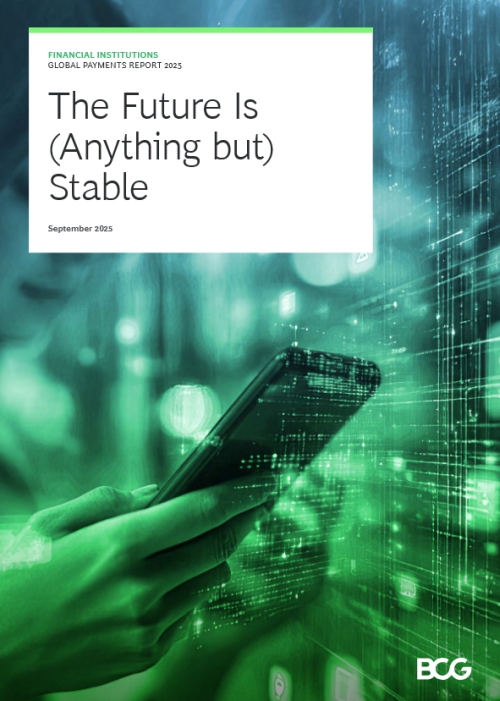
Image: The Future is (Anything but) Stable (BCG Global Payments 2025 report)
On Sept 22, 2025 the Boston Consulting Group (BCG) released the Global Payments Report 2025 titled 'The Future is (Anything but) Stable" (37 page PDF report) reported that worldwide payment revenues totalled about $1.9 trillion in 2024 and are expected to exceed $2.4 trillion by 2029.
Growth is slowing however from nearly 9% a year to around 4%, highlighting the end of a rapid growth period where payment providers earned more interest income on money moving through their systems. The next phase will be led by innovation, not momentum.
According to the report, the foundations of global payments are being rebuilt through real-time transactions, tokenized assets, and smarter compliance. For Canada, the domestic system is stable but slower than peers in Asia or Europe. Modernization can help ensure that Canadian fintechs and banks remain competitive as value begins to move across programmable digital networks.
These above trends describe a payments ecosystem that is no longer growing by size but by sophistication.
Between pages 9 and 13, the report explains that tokenization has moved from pilot projects to real adoption.
Stablecoins process over $26 trillion in yearly transactions and are being used for remittances, business payments, and treasury operations. The combined value of circulating stablecoins is close to $270 billion, with US dollar-linked tokens like USDT and USDC dominating.
Tokenized funds hold more than $3 billion in assets, and private credit tokenization has reached $10 billion. In addition, governments in Singapore, Hong Kong, and Europe are issuing digital bonds under clear frameworks such as MiCA.
More than 10 countries have live central bank digital currencies, and over 90% of central banks are testing or building them. Global banks including Citi, HSBC, and UBS are already piloting tokenized deposits connected to their main systems.
For Canada, tokenization could open the door to trusted digital assets that fit within the existing regulated structure. It allows for faster, safer movement of money and investment while maintaining transparency and oversight. By building policy alignment and open access, Canada can turn this technology into a tool for inclusion, without being left behind.
The report points to a global race to connect innovation with regulation. Countries that create clarity around digital assets, tokenized deposits, and real-time infrastructure will attract investment and improve access to capital. For Canada, this means progressing digital finance policy and expanding participation in global payment corridors. The combination of tokenized assets, instant settlement, and data-driven compliance could give Canadian participants a stronger role in international markets.
Canada is already making strides in payments innovation. The Bank of Canada and other regulators are working to bring more providers onto national infrastructure and exploring tokenisation and stablecoins. With the federal 2025 budget scheduled for early next week on November 4, there is hope that policymakers will signal clearer guidelines or incentives for stablecoins and digital assets that could boost competitiveness and access to capital for Canadian fintechs.
The National Crowdfunding & Fintech Association (NCFA Canada) is a financial innovation ecosystem that provides education, market intelligence, industry stewardship, networking and funding opportunities and services to thousands of community members and works closely with industry, government, partners and affiliates to create aa vibrant and innovative fintech and funding industry in Canada. Decentralized and distributed, NCFA is engaged with global stakeholders and helps incubate projects and investment in fintech, alternative finance, crowdfunding, peer-to-peer finance, payments, digital assets and tokens, artificial intelligence, blockchain, cryptocurrency, regtech, and insurtech sectors. Join Canada's Fintech & Funding Community today FREE! Or become a contributing member and get perks. For more information, please visit: www.ncfacanada.org
| | |
|---|---|---|
| | |
AI Partnership | Oct 28 2025
On October 28 2025, PayPal announced that it will adopt the Agentic Commerce Protocol and partner with OpenAI to bring shopping and paymentsdirectly into ChatGPT. The partnership links PayPal’s merchant network with ChatGPT users so people can buy and pay instantly using PayPal.
PayPal will add its wallet to ChatGPT’s Instant Checkout so people can pay with their balance, bank, or card.
The same buyer protection, tracking, and dispute tools that PayPal already offers will apply. PayPal will also handle card payments through OpenAI’s delegated payments API, taking care of routing and security. This API supports major card networks such as Visa and Mastercard, so users can pay with their preferred card while keeping PayPal’s protection and tracking features.
Starting in 2026, PayPal plans to add product catalogues from small businesses and larger brands so people can search and buy items in ChatGPT directly. PayPal will manage payment checks, merchant validation, and fraud protection in the background. You can learn more about OpenAI’s Agentic Commerce Protocol page.
This change could help Canadian fintechs and merchants reach new customers.
For the first time, shopping could happen entirely through a chat. Instead of clicking to a website, a person could ask ChatGPT for a product, view merchant options, and pay through PayPal in seconds.
Canadian merchants who already use PayPal could soon appear in ChatGPT’s shopping results, which might help smaller businesses connect to global buyers. It also gives users a glimpse at the future of how financial technology and artificial intelligence are starting to merge.
For Canadian fintechs, there's opportunity to design new tools for agent-led payments and business services. Developers could build smart payment gateways that connect chat platforms with accounting and invoicing systems, or create plug-ins that let small businesses manage orders and inventory through AI agents. There is also room for innovation in real-time fraud detection, digital identity layers that verify both buyers and sellers inside a chat, and lending tools that assess transaction data to offer instant credit decisions. These kinds of innovations could bring Canada to the forefront of safe, responsible, and flexible conversational finance.
Regulators, such as the Financial Consumer Agency of Canada and the Office of the Privacy Commissioner, may need to consider how consumer rules apply when a purchase happens in a conversation.
Agent led commerce seems destined to become a major new layer of the digital economy. If Canadian regulators, fintechs, and industry groups like NCFA collaborate early, Canada could establish guardrails and standards to make this new type of shopping and payments, fair, transparent and inclusive.
Success will depend on building trust, clear rules for data and disclosure, and reliable systems that protect both buyers and merchants. Conversational finance is upon us and could help Canada's fintech sector grow in a way that serves both innovation and consumers.
The National Crowdfunding & Fintech Association (NCFA Canada) is a financial innovation ecosystem that provides education, market intelligence, industry stewardship, networking and funding opportunities and services to thousands of community members and works closely with industry, government, partners and affiliates to create aa vibrant and innovative fintech and funding industry in Canada. Decentralized and distributed, NCFA is engaged with global stakeholders and helps incubate projects and investment in fintech, alternative finance, crowdfunding, peer-to-peer finance, payments, digital assets and tokens, artificial intelligence, blockchain, cryptocurrency, regtech, and insurtech sectors. Join Canada's Fintech & Funding Community today FREE! Or become a contributing member and get perks. For more information, please visit: www.ncfacanada.org
| | |
|---|---|---|
| | |
RPAA | Oct 21, 2025

Image: Freepik
On October 2025, the Bank of Canada (BoC) launched the first public Registry of Payment Service Providers (PSPs), a key milestone under the Retail Payment Activities Act (RPAA). The registry lists all PSPs formally registered to operate under the new retail payments framework. The database is updated regularly and can be accessed via the Bank’s official site at the PSP Registry.
The BoC also published an active list of PSP applicants currently under review, available at the applicants under review page. These applicants are subject to preliminary oversight requirements but are only required to meet full reporting obligations once registration is finalized.
According to the registry’s initial snapshot, a total of 320 PSPs have been registered to date. Of these, 259 (80.9%) are headquartered in Canada, while 43 (13.4%) are based in the United States, and 9 (2.8%) in the United Kingdom. The remainder represent smaller international participation from Singapore, Ireland, Brazil, Latvia, the Philippines, Switzerland, Belgium, and South Korea.
This mix shows that the RPAA’s first tranche of providers is mostly domestic, reflecting the strength of Canada’s homegrown fintech payments sector while integrating a limited number of major international players. The balance of local and foreign PSPs also highlights the regulatory gateway now established for cross-border payment innovation.
The combined data from the Bank of Canada’s PSP Registry and the applicants under review provides a broader picture of participation under the Retail Payment Activities Act, and deeper insight of the provider demand and distribution.
Canada continues to lead with the majority of registrations followed by the United States and the United Kingdom. This balance reflects both the maturity of domestic fintech operations and growing international engagement with Canada’s payments oversight framework.
The table data below summarized by country shows how Canada accounts for roughly 84% of all PSP entities registered or in review, while international applicants from the United States, the United Kingdom, and other jurisdictions signal increasing cross-border participation.
| Head office country | Registered PSPs | Applicants Under Review | Total PSP Entities | Share (%) |
| Canada | 259 | 1095 | 1354 | 84.26 |
| United States of America (the) | 43 | 105 | 148 | 9.21 |
| United Kingdom of Great Britain and Northern Ireland (the) | 9 | 30 | 39 | 2.43 |
| Singapore | 2 | 7 | 9 | 0.56 |
| Hong Kong | 0 | 7 | 7 | 0.44 |
| Latvia | 1 | 3 | 4 | 0.25 |
| United Arab Emirates (the) | 0 | 4 | 4 | 0.25 |
| Estonia | 0 | 3 | 3 | 0.19 |
| Lithuania | 0 | 3 | 3 | 0.19 |
| Spain | 0 | 3 | 3 | 0.19 |
| Nigeria | 0 | 2 | 2 | 0.12 |
| Cyprus | 0 | 2 | 2 | 0.12 |
| Isle of Man | 0 | 2 | 2 | 0.12 |
| Australia | 0 | 2 | 2 | 0.12 |
| Korea (the Republic of) | 1 | 0 | 1 | 0.06 |
| Poland | 0 | 1 | 1 | 0.06 |
| Yemen | 0 | 1 | 1 | 0.06 |
| Sweden | 0 | 1 | 1 | 0.06 |
| San Marino | 0 | 1 | 1 | 0.06 |
| Czechia | 0 | 1 | 1 | 0.06 |
| Netherlands (Kingdom of the) | 0 | 1 | 1 | 0.06 |
| Luxembourg | 0 | 1 | 1 | 0.06 |
| Malta | 0 | 1 | 1 | 0.06 |
| Malaysia | 0 | 1 | 1 | 0.06 |
| Kazakhstan | 0 | 1 | 1 | 0.06 |
| Israel | 0 | 1 | 1 | 0.06 |
| China | 0 | 1 | 1 | 0.06 |
| Belgium | 1 | 0 | 1 | 0.06 |
| India | 0 | 1 | 1 | 0.06 |
| Saint Vincent and the Grenadines | 0 | 1 | 1 | 0.06 |
| Japan | 0 | 1 | 1 | 0.06 |
| Denmark | 0 | 1 | 1 | 0.06 |
| Mauritius | 0 | 1 | 1 | 0.06 |
| Gibraltar | 0 | 1 | 1 | 0.06 |
| Ireland | 1 | 0 | 1 | 0.06 |
| Brazil | 1 | 0 | 1 | 0.06 |
| Philippines (the) | 1 | 0 | 1 | 0.06 |
| Switzerland | 1 | 0 | 1 | 0.06 |
| Cayman Islands (the) | 0 | 1 | 1 | 0.06 |
Registered PSPs are now under supervisory assessment by the Bank of Canada and must comply with RPAA requirements on operational risk management, safeguarding of end-user funds, and reporting. Additional guidance and summary documents are available under the Bank’s retail payments supervision.
The registry’s release coincides with the expansion of Payments Canada membership eligibility, effective September 29, 2025. Under this change, registered and supervised PSPs are now eligible to join Payments Canada, alongside credit union locals and clearing system operators overseen by the Bank. The update outlined in the Statement by the Minister of Finance, connects the RPAA framework with Canada’s broader payment system modernization goals.
The live PSP registry is a major step towards a transparent and accountable retail payments system designed to enhance trust and innovation. With a majority of Canadian fintechs now operating under Bank of Canada oversight.
As Senior Deputy Governor Carolyn Rogers noted in her recent remarks before the Canadian Club Toronto, competition is a critical force in improving productivity and efficiency across the economy.
While the new registry helps level the playing field by providing a formal pathway for smaller fintechs to operate alongside larger incumbents in a regulated environment, there is limited number of PSPs currently registered under the Retail Payment Activities Act raises questions about Canada’s ability to compete globally in payments innovation. With only 259 Canadian payment providers currently registered, the framework captures a small fraction of the fintech firms operating in the country.
Larger and more established companies are the most likely to meet the Bank of Canada’s supervision requirements, while smaller fintechs face higher barriers to entry. These include detailed operational risk controls, safeguarding of end-user funds, and ongoing reporting costs that can be more challenging to address for early stage businesses.
In other markets such as the United Kingdom and the European Union, regulators use tiered systems that allow smaller firms to start with lighter oversight and scale up as they grow. Canada does not yet have this flexibility with the RPAA a single registration and supervision framework for all payment service providers (PSPs). Without an adjustment, the current model could reduce competition and slow the growth of homegrown payment innovators, as global players expand into the Canadian market.
The Bank of Canada’s framework seems stable and transparent but expanding participation over time will be key to ensuring the RPAA supports Canada’s fintech competitiveness.
As more PSPs complete the review process, the registry will expand and evolve, providing clearer insight into Canada’s payments ecosystem. For fintech stakeholders, this signals that full RPAA implementation is moving from policy design to operational reality.
The National Crowdfunding & Fintech Association (NCFA Canada) is a financial innovation ecosystem that provides education, market intelligence, industry stewardship, networking and funding opportunities and services to thousands of community members and works closely with industry, government, partners and affiliates to create aa vibrant and innovative fintech and funding industry in Canada. Decentralized and distributed, NCFA is engaged with global stakeholders and helps incubate projects and investment in fintech, alternative finance, crowdfunding, peer-to-peer finance, payments, digital assets and tokens, artificial intelligence, blockchain, cryptocurrency, regtech, and insurtech sectors. Join Canada's Fintech & Funding Community today FREE! Or become a contributing member and get perks. For more information, please visit: www.ncfacanada.org
| | |
|---|---|---|
| | |
Oct 14, 2025

Image: Unsplash
As Canada maintains its position as a financial innovation engine, the continued growth of online payment methods shows how fintech is affecting people' daily lives. From digital wallets to fast transactions, Canadians now have access to a payment system known for its security, convenience, and technological advancement.
This digital-first wave has promoted adoption in a variety of industries, accelerating eCommerce growth and empowering entrepreneurs. Payment innovation is affecting not only Canadians' shopping patterns, but also their participation with the larger digital economy, thanks to a dynamic ecosystem backed by organizations such as the National Crowdfunding & Fintech Association of Canada (NCFA).
The fintech community has really driven the modernization of Canada’s payment infrastructure. Legacy institutions and startups are now collaborating to create user-friendly payment methods. This spirit of collaboration, promoted through NCFA conferences and regulatory discussions, keeps fostering innovation for consumers and businesses.
Several options have become really popular:
Interac e-Transfer: A key element of the Canadian payment scene, Interac allows those quick transfers between bank accounts. It’s reliable for both personal and business use, aligning closely with Canada’s strong banking standards.
Credit/Debit Cards: Visa, Mastercard, and Amex are still used for online purchases, especially with enhanced verification processes and tokenization that improve safety.
Digital Wallets: Platforms like Apple Pay, Google Pay, and PayPal give users the chance to pay with one click, combining accessibility and security through biometrics and encryption.
Prepaid/Virtual Cards: For more control over spending and privacy, these cards are increasingly used for online subscriptions and digital transactions.
These reflect the larger movement of digital transformation meeting consumer trust, where user experience is just as important as transaction speed.
Canadians are definitely comfortable with online payments, which now goes beyond just shopping. It’s also part of today's digital culture. When subscribing, funding creative projects, or accessing entertainment, smooth payment systems ensure you can access things immediately.
Secure, instant, and user-friendly payment gateways are the foundation of countless digital services that rely on fast processing and dependability. A consumer will expect to pay and access content within just seconds—a cultural shift to immediacy.
A need for efficiency also applies to Canada’s thriving entertainment industry. Many platforms now have payment systems that focus on user trust and an effortless experience. For example, Canadians who want digital entertainment often look for platforms where they can play the best online slots in Canada and payment systems enable smoother access to authentic, high-quality entertainment.
These examples show how fintech advancements improve the digital experience. As payment technologies advance, they enrich user experience and support the continuous growth of Canada's digital economy.
Canadians value trust and security. Payment innovations now tend to depend on sophisticated encryption techniques, fraud-prevention systems, and explicit user authorization. Fintech companies are working on striking a balance; letting folks use digital payments easily while also keeping their information safe.
New tech—think AI that spots fraud, using your fingerprint or face to verify who you are, and managing identity with tokens—is becoming normal in Canadian payments. All this fits into what fintech wants: making sure everyone's included, things are easy to use, and Canada stays known as a reliable fintech spot.
The National Crowdfunding & Fintech Association (NCFA Canada) is a financial innovation ecosystem that provides education, market intelligence, industry stewardship, networking and funding opportunities and services to thousands of community members and works closely with industry, government, partners and affiliates to create aa vibrant and innovative fintech and funding industry in Canada. Decentralized and distributed, NCFA is engaged with global stakeholders and helps incubate projects and investment in fintech, alternative finance, crowdfunding, peer-to-peer finance, payments, digital assets and tokens, artificial intelligence, blockchain, cryptocurrency, regtech, and insurtech sectors. Join Canada's Fintech & Funding Community today FREE! Or become a contributing member and get perks. For more information, please visit: www.ncfacanada.org
| | |
|---|---|---|
| | |


August 26th, 2025

January 4th, 2024

June 1st, 2021

September 9th, 2020

July 9th, 2018

January 3rd, 2018

September 25th, 2017

June 20th, 2017

May 10th, 2017

December 14th, 2016