




Karsten Wenzlaff, Advisor
August 26th, 2025
Karsten Wenzlaff is a Crowdfunding and Fintech Expert from Germany. He is Secretary-General of Digit[...]


Payment Research | Oct 3, 2025

Image: Canadian Payment Methods and Trends 2025 (Payments Canada)
On October 2, 2025, Payments Canada published the 12th edition of their annual Canadian Payment Methods and Trends Report. Canada processed 22.5 billion transactions worth $12.2 trillion in 2024, with payment activity growing 3% in both volume and value year over year, showing steady momentum toward digital-first payment transactions.
Donna Kinoshita, Chief Payments Officer at Payments Canada:
“Canada’s payment ecosystem is more diverse, dynamic and fast-evolving than ever before. Innovations like real-time payments, consumer-driven banking, embedded finance and agentic commerce will continue to reshape the future of how Canadians make purchases and payments.”
Digital payments: 86% of volume (up) and 77% of value (up)
Contactless: 13B transactions, 58% of all payments (up 11%)
Mobile contactless: 3.4B transactions (up 28%), forecast 5.7B by 2028
E-commerce: $77B, 6% of retail sales (steady growth), projected $96.7B by 2028
The dominance of digital meets consumer preference for convenience and embedded financial services. Contactless is now mainstream, and mobile wallets are moving beyond early adoption. For fintechs, this unlocks opportunities in secure wallet apps, tokenization, and AI-driven checkout. Regulators will need to ensure interoperability and protection against fraud as transaction volumes accelerate.
Credit cards: 7.5B transactions, 33% of total (up 6%)
Average transaction: $105
Cards in circulation: 112M (up 5%)
Revolving balances: 32% of Canadians carry debt, average $4,616 (up)
Credit cards are still popular, now tying debit at the point of sale. But rising delinquency and revolving debt highlight financial stress among consumers. For banks and fintech lenders, this means offering attractive card benefits while keeping an eye on rising credit risks. Policymakers should monitor household credit health to prevent instability as card usage expands.
AI shopping support appeals to 28% of Canadians, nearly 40% among ages 18–34
64% of business leaders are exploring agentic AI
Social commerce: 18% interest
Live commerce: 20% interest
Smart home/social device purchasing: 13% of Canadians monthly.
AI-driven shopping assistants have arrived (no longer hypothetical) and are evolving expectations for search, recommendation, and payments. Younger demographics are especially open to participate, giving fintechs and retailers early markets to test autonomous transaction models. The investment capital flowing in agentic AI is expected to grow automated payment flows, as regulatory frameworks will need to address accountability, transparency, and consumer trust.
Cash use: 2.5B transactions, 11% of volume (down)
Average transaction: $27
48% of Canadians still use cash weekly, 3.5 times on average
57% do not want a cashless society; only 11% fully cashless
Cash use continues to decline but is still deeply entrenched for millions of Canadians. The resistance to going cashless highlights that modernization must be inclusive. Fintech and banking players should design strategies that maintain cash access while scaling digital options. Policymakers need to safeguard vulnerable populations from exclusion in a rapidly digitizing system.
Total payments: +9% volume, +22% value
Online transfers: +175% volume, +219% value
Credit cards: +14% volume, +32% value
Prepaid cards: +13% volume, +31% value
EFT value: +48%
Cheque value: –24%
The five-year data confirms structural realignment with transfers, cards, and prepaid instruments are increasing, while cheques continue their decline. For fintechs, the scaling of online transfers signals opportunity in peer-to-peer and cross-border solutions. Regulators must continue to balance innovation with systemic resilience, especially as volumes move away from legacy instruments like cheques.
With $12.2T in transactions and one in three payments on credit cards, the system is expanding digital capacity, testing AI commerce, and experimenting with livestream and social shopping. For fintechs, banks, and regulators, the challenge is to harness innovation while ensuring resilience, access, and trust.
 The National Crowdfunding & Fintech Association (NCFA Canada) is a financial innovation ecosystem that provides education, market intelligence, industry stewardship, networking and funding opportunities and services to thousands of community members and works closely with industry, government, partners and affiliates to create aa vibrant and innovative fintech and funding industry in Canada. Decentralized and distributed, NCFA is engaged with global stakeholders and helps incubate projects and investment in fintech, alternative finance, crowdfunding, peer-to-peer finance, payments, digital assets and tokens, artificial intelligence, blockchain, cryptocurrency, regtech, and insurtech sectors. Join Canada's Fintech & Funding Community today FREE! Or become a contributing member and get perks. For more information, please visit: www.ncfacanada.org
 |  |  |
|---|---|---|
 |  |  |
Fintech | Oct 3, 2025

Image: Freepik/newelement
On September 26, 2025, the Globe and Mail released its 2025 Report on Business ranking of Canada’s Top Growing Companies. The annual list tracks Canadian firms based on three-year revenue growth, offering a quick snapshot of where innovation is scaling fastest (think revenue, headcount, growth).
This year’s ranking features a great group of fintech and digital finance firms that are impacting how Canadians borrow, pay, invest, insure, and embed financial services into everyday life.
| Rank | Company | Sector | Description |
| #3 | Gearlay | Web3 / Blockchain | Blockchain-based enterprise financial software |
| #4 | Float | Lending & Embedded Finance | SME finance and corporate card platform |
| #5 | veritree | ESG & Green Finance | Digital carbon credits and reforestation finance |
| #11 | Novisto | ESG & Green Finance | ESG disclosure, data, and reporting platform |
| #24 | FundMore | Lending & AI | Automated mortgage underwriting |
| #32 | Quandri | AI & Automation / Insurtech | Insurance automation bots |
| #39 | Autocorp.ai | AI & Lending | AI-powered auto retail finance |
| #44 | Helcim | Payments | Merchant payment processing |
| #57 | CapIntel | WealthTech | Digital platform for advisors and wealth managers |
| #62 | PomeGran | Digital Infrastructure | Broadband and connectivity backbone |
| #65 | BOXX Insurance | Insurtech | Cyber insurance and protection |
| #72 | SWTCH Energy | Payments Infra / Energy | EV charging + payments integration |
| #86 | Makeship | Alternative Finance / Crowdfunding | Creator crowdfunding platform |
| #108 | Fintel Connect | Web3 / Marketing | Performance marketing for fintechs and crypto |
| #110 | Justwealth | WealthTech | Robo-advisor portfolio management |
| #112 | HONK | Payments | Contactless mobility/parking payments |
| #119 | Merchant Growth | Lending & SME Finance | Working capital financing |
| #129 | MindBridge | AI & Regtech | AI anomaly detection and audit |
| #137 | Loans Canada | Lending & Alt Finance | Loan marketplace and credit scoring |
| #140 | PolicyMe | Insurtech | Digital-first life insurance |
| #149 | Zum Rails | Open Banking & Payments | Open banking and payments APIs |
| #158 | Trolley | Payments | Global payouts and compliance |
| #204 | FundThrough | Lending & Alt Finance | Invoice financing and cash flow optimization |
While the Globe and Mail ranking provides a valuable view of Canadian fintech growth, it is far from exhaustive. Many high-growth firms remain absent because they operate in stealth mode, choose not to disclose financial data, or do not meet eligibility thresholds. Early-stage innovators, companies with holding structures abroad, and ventures acquired by larger incumbents also fall outside the ranking.
For NCFA’s community, this means the list represents only part of the country’s dynamic ecosystem of fintech, Web3, AI, alternative finance, and digital-first ventures that are scaling globally. For a broader view of Canada’s financial tech innovation landscape, see NCFA’s fintech directory at https://fintechcanada.io/.
Canadian fintech companies are excelling in lending, payments, Web3, insurtech, ESG, AI, digital infrastructure, and many other subcategories. These companies mirror how regulation, access to capital, and collaboration between industry and government is critical to ensure Canadian fintechs continue to thrive in an increasingly globally competitive landscape.
The National Crowdfunding & Fintech Association (NCFA Canada) is a financial innovation ecosystem that provides education, market intelligence, industry stewardship, networking and funding opportunities and services to thousands of community members and works closely with industry, government, partners and affiliates to create aa vibrant and innovative fintech and funding industry in Canada. Decentralized and distributed, NCFA is engaged with global stakeholders and helps incubate projects and investment in fintech, alternative finance, crowdfunding, peer-to-peer finance, payments, digital assets and tokens, artificial intelligence, blockchain, cryptocurrency, regtech, and insurtech sectors. Join Canada's Fintech & Funding Community today FREE! Or become a contributing member and get perks. For more information, please visit: www.ncfacanada.org
| | |
|---|---|---|
| | |
Payments | Oct 2, 2025

Image: Ron Morrow, Executive Director, Bank of Canada (CPA The One Conference Sep 18, 2025)
On September 18, 2025, Ron Morrow, Executive Director of Payments Supervision at the Bank of Canada, delivered a speech at the CPA The One conference titled, "Making change Accelerating payments innovation". He spoke about a vision for Canada’s payments future, one where innovation, oversight, and competition intersect. Stronger oversight and modern payment rails will make the system more competitive and inclusive.
This article unpacks select key quotes and and highlights two sides of the coin for stakeholders to see both sides and the trade-offs that come with it. For Canada, the task now is not whether to act, but how to add momentum and keep pace in a global race.
“Almost 1,500 payment service providers are now required to register with the Bank under the Retail Payment Activities Act.”
For the first time, nearly fifteen hundred retail Payment Service Providers (PSPs) are being pulled into the regulatory fold. Supporters argue that this gives consumers and businesses more confidence when using new services and helps fintechs compete on equal footing with banks. By ending the perception that startups operate in a grey zone, it could make investment in the sector more attractive.
But compliance comes with costs, and many small firms run lean without a large legal or regulatory staff like banks. What may feel like light reporting to a large bank can feel like a heavy lift for a ten person startup. In the worst case, it could drive consolidation that narrows competition instead of expanding it.
“Our job is to make sure that innovation in the payments system can proceed in a way that is safe, sound and reliable.”
Safe to say that Canadians will only embrace new forms of payments if they trust them to work without interruption and to protect their money. Regulation that sets clear expectations can provide certainty for innovators, giving them a stable foundation to build on.
Yet safety can lead to an abundance of caution that could slow innovation. Other countries, from the UK to Singapore, have shown that regulators can allow pilots and sandboxes to move quickly while still managing risk. If Canada puts too much emphasis on stability, we'll fall behind in a global race where trust and speed both matter.
“We are working to expand access so that more providers can offer services directly through Canada’s core payment systems.”
Direct access to national infrastructure is potentially transformational. If fintechs can gain access without going through a big bank, they can offer faster and cheaper payments. This would lower costs for consumers, ignite competition, and open the door for creative new services in areas like cross border transactions.
The flip side is that these core systems were designed with large, well capitalized institutions in mind. Smaller entrants may not have the same buffers to handle liquidity shocks or technical breakdowns. One major failure could undermine confidence across the entire network. The challenge is designing an access model that widens competition without weakening stability. Payments Canada who is overseeing Canada's payments modernization has delayed implementation numerous times, and industry is frustrated. In May 2025 however, they announced that the technical build will be completed by Q3 2025 and they plan to test the system throughout 2026.
“Through our work with the BIS Innovation Hub, we are exploring the potential of new technologies such as tokenization and artificial intelligence.”
Engaging with international financial innovation hubs allows Canada to stay connected to the latest fintech and payments research, including stablecoins and tokenization. It also helps Canadian fintechs align with emerging global standards, making cross border scaling easier. Last June 2024, the BIS and Bank of Canada Launched the BIS Toronto Innovation Centre.
The real risk lies in harmonization at home. Canada’s financial system is driven by a concentrated banking sector and diverse regional economies, where inter-provincial differences can create barriers to trade and investment. If newly adopted financial technologies and related reforms aren't designed to work seamlessly across all provinces and territories, Canadian markets could become further fragmented with unwanted barriers and compliance costs. Canada needs to strengthen its internal market with more competition and innovation to be able to complete with strength globally.
“Payments innovation cannot be separated from broader efforts like open banking.”
If Canada completes payments modernization while also enabling consumers to share their financial data securely (open banking, consumer driven finance), the market could see a boon of new service models and tools that bring real competition to a system long dominated by incumbents.
Skepticism is very real though with Canada lacking the political will to finally implement open banking after promising it and studying it for years. Without binding timelines, many in the industry hear speeches like this one but actions speak louder the words. For fintechs, the question remains whether it is worth investing in solutions that depend on open banking when political momentum has not yet delivered results, or opt for new pathways. The latest is that open banking in Canada will land in 2026., with further delays will have significant consequences for innovation and consumer choice in Canada.
Ron Morrow’s speech delivers a clear vision and direction for modernizing Canada’s payments landscape. Expanded oversight, broader access to rails, and participation in global innovation networks all point to a more open and competitive future. If open banking also arrives in 2026, these reforms could unlock real benefits for consumers and fintechs alike. But the devil’s advocate cannot be ignored. Here's a streamlined version of Morrow's speech, 'Cashing in on Payments Innovation' (fingers crossed)
The National Crowdfunding & Fintech Association (NCFA Canada) is a financial innovation ecosystem that provides education, market intelligence, industry stewardship, networking and funding opportunities and services to thousands of community members and works closely with industry, government, partners and affiliates to create aa vibrant and innovative fintech and funding industry in Canada. Decentralized and distributed, NCFA is engaged with global stakeholders and helps incubate projects and investment in fintech, alternative finance, crowdfunding, peer-to-peer finance, payments, digital assets and tokens, artificial intelligence, blockchain, cryptocurrency, regtech, and insurtech sectors. Join Canada's Fintech & Funding Community today FREE! Or become a contributing member and get perks. For more information, please visit: www.ncfacanada.org
| | |
|---|---|---|
| | |
Blockchain | Sep 29, 2025

On September 29, 2025, Swift announced its blockchain-based ledger at Sibos 2025. The initiative brings together more than 30 financial institutions worldwide, including Royal Bank of Canada and TD Bank, to design and test a prototype with Consensys. The project is aimed at enabling real time, 24/7 cross-border payments to more than 200 countries and territories.
Javier Pérez-Tasso, Swift CEO:
“We provide powerful and effective rails today and are moving at a rapid pace with our community to create the infrastructure stack of the future. Through this initial ledger concept we are paving the way for financial institutions to take the payments experience to the next level with Swift’s proven and trusted platform at the centre of the industry’s digital transformation.”
Swift’s prototype will provide a secure log of transactions between banks that is updated in real time. The ledger will validate and sequence payments while using smart contracts to enforce agreed rules automatically. Unlike a public blockchain, this shared ledger is a permissioned infrastructure operated by Swift and its member banks. While it's blockchain-based in design, drawing on distributed ledger technology for resilience and transparency, it's not an onchain network like Ethereum.
Rather than creating new tokens itself, Swift’s role will be to provide the infrastructure for financial institutions and central banks to settle regulated tokenised value. By focusing on interoperability, Swift is designing the ledger so that it can operate alongside both traditional rails and emerging blockchain networks to reduce fragmentation and help financial institutions transition smoothly.
Also as a separate blockchain track, Swift is also experimenting with onchain migration of its messaging system using Ethereum Layer 2 Linea, as reported by The Block, which includes banks such as BNP Paribas and BNY. Swift is undergoing a parallel strategy to both upgrade existing rails while also preparing future digital rails.
The direct participation of RBC and TD gives Canada a seat at the table in Swift's financial infrastructure modernization initiatives. Their involvement means that Canadian banks intend to remain competitive globally as tokenised settlement gains traction. For Canada, the implications could be far reaching, making it easier for businesses to manage international trade and for capital to move efficiently across borders.
Swift’s work comes at a time when market forecasts suggest rapid growth in tokenised payments. Citi’s GPS report on stablecoins 2030 projects that stablecoin issuance could reach $1.9 trillion under a base case and as high as $4 trillion in a bull case by 2030, with transaction volumes approaching $100 trillion if stablecoins circulate at payment velocity.
The report also says stablecoins will likely coexist with tokenised deposits and bank-issued tokens, which may surpass them in scale.The question is whether Swift’s infrastructure approach will become the primary neutral rails that digital assets need to move securely across borders, or not.
After years of blockchain push-back denial, the launch of Swift’s blockchain ledger prototype is a key milestone in the modernization of global financial infrastructure. With RBC and TD among the participants, Canada is positioned within the group to contribute to the design and development of standards from the start. Digital assets and traditional financial networks seem to be converging at a global scale.
Other reads you may like:
The National Crowdfunding & Fintech Association (NCFA Canada) is a financial innovation ecosystem that provides education, market intelligence, industry stewardship, networking and funding opportunities and services to thousands of community members and works closely with industry, government, partners and affiliates to create aa vibrant and innovative fintech and funding industry in Canada. Decentralized and distributed, NCFA is engaged with global stakeholders and helps incubate projects and investment in fintech, alternative finance, crowdfunding, peer-to-peer finance, payments, digital assets and tokens, artificial intelligence, blockchain, cryptocurrency, regtech, and insurtech sectors. Join Canada's Fintech & Funding Community today FREE! Or become a contributing member and get perks. For more information, please visit: www.ncfacanada.org
| | |
|---|---|---|
| | |
CBDC and Stablecoins | Sep 29, 2025

Image: Freepik
On September 19, 2025, EU finance ministers reached a compromise on the digital euro roadmap, designed to reduce dependence on Visa and Mastercard. The plan gives governments a stronger role in any launch decision and sets limits on how much citizens can hold. For official policy context, see the EU Council’s digital euro page, which outlines objectives and implementation steps.
Just six days later, nine major European banks formed a consortium to launch a MiCA-compliant euro stablecoin, targeting a 2026 launch. The group includes ING, UniCredit, CaixaBank, Danske Bank, SEB, Raiffeisen Bank International, KBC, DekaBank, and Banca Sella. Their goal is to deliver instant payments, programmable settlement, and a regulated alternative to unbacked crypto tokens.
By anchoring the stablecoin in Europe’s MiCA framework, the banks are moving early to define how regulated tokenized money will work. MiCA sets clear standards for issuers on capital, governance, and reserve management. That clarity is drawing incumbents to commit capital and credibility.
The digital euro and the bank consortium stablecoin initiative both look to rebalance power in Europe’s payments market. Today, Visa and Mastercard process around two‑thirds of all European card transactions. Policymakers want to ensure Europe can clear and settle payments domestically without relying on foreign schemes.
The central bank digital currency (CBDC) and stablecoin initiatives also intersect with Wero, the new retail wallet developed under the European Payments Initiative. Wero is designed to give merchants and consumers a unified tool for instant payments across the euro area, and a tokenized euro would strengthen its value proposition. This alignment mirrors the Canadian Real‑Time Rail project, though Europe is tying its upgrades more explicitly to digital money.
A further motivation is market share. Euro stablecoins currently total only about €620 million outstanding, compared to nearly $300 billion for U.S. dollar stablecoins. Europe risks being sidelined if it does not accelerate adoption, as global trade and DeFi increasingly rely on dollar‑based tokens.
For fintechs, these initiatives open a regulated path to experiment with programmable money, cross‑border settlement, and retail wallets. Startups may be able to integrate stablecoin rails into remittances, treasury management, or point‑of‑sale services with legal certainty.
For banks, the picture is mixed. Deposit flight is a risk if customers shift balances into tokenized wallets. Yet the banks launching the consortium also stand to gain by controlling issuance, custody, and compliance, capturing value from tokenization.
Canada has taken a more cautious approach. The Bank of Canada has said there is “no compelling case” for a retail digital dollar and is prioritizing upgrades to payment infrastructure. Policymakers are also examining how to regulate stablecoins, with oversight currently split between federal and provincial authorities. See NCFA's analysis of Canada's stablecoin race entering a critical phase for a more detailed analysis.
Europe’s actions highlight lessons for Canada. Their dual‑track model of a CBDC combined with a bank‑led stablecoin consortium shows how sovereignty and innovation can be balanced. A digital loonie could serve as a public anchor, while regulated Canadian bank or fintech stablecoins could deliver speed and programmability. Equally important, MiCA demonstrates the power of legislative clarity, something Canada lacks as fragmented oversight slows momentum.
Europe’s urgency also stems from the fact that euro stablecoins represent a tiny fraction of the global market. Canada faces the same risk if stablecoin use grows but domestic frameworks stall, Canadians may increasingly rely on U.S. dollar tokens for payments, weakening monetary sovereignty. Europe is also linking its initiatives to Wero, its new retail wallet.
Canada could also add experiments to the rollout of its Real‑Time Rail, ensuring token‑based payments integrate with domestic upgrades. Although Canadians and payment stakeholders can't afford any more delays.
If Canada followed a similar approach as in Europe, payments could become faster and cheaper, and fintechs would gain new opportunities in programmable settlement and remittances. Banks could face pressure on deposits but would gain new business in custody and compliance. If Canada hesitates for much longer, the country risks dollarization via U.S. stablecoins, reducing control over payments and data governance.
The National Crowdfunding & Fintech Association (NCFA Canada) is a financial innovation ecosystem that provides education, market intelligence, industry stewardship, networking and funding opportunities and services to thousands of community members and works closely with industry, government, partners and affiliates to create aa vibrant and innovative fintech and funding industry in Canada. Decentralized and distributed, NCFA is engaged with global stakeholders and helps incubate projects and investment in fintech, alternative finance, crowdfunding, peer-to-peer finance, payments, digital assets and tokens, artificial intelligence, blockchain, cryptocurrency, regtech, and insurtech sectors. Join Canada's Fintech & Funding Community today FREE! Or become a contributing member and get perks. For more information, please visit: www.ncfacanada.org
| | |
|---|---|---|
| | |
Advocacy | Sep 26, 2025
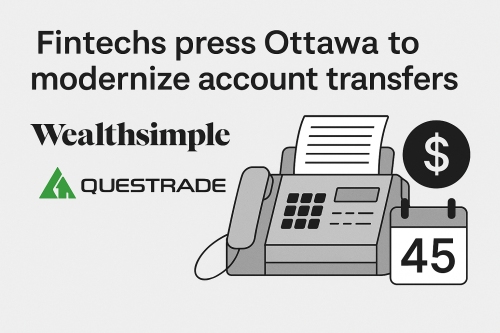
On August 12, 2025, Wealthsimple submitted its recommendations to the federal pre budget consultation, urging Ottawa to regulate how registered accounts such as RRSPs and TFSAs are transferred between financial institutions. The submission says rising transfer fees and weeks long delays undermines Canadians’ ability to manage their savings. Wealthsimple’s call was echoed by Questrade, which also urged stronger federal oversight.
Wealthsimple reported that between late 2024 and early 2025, the average transfer time was 19 days once paperwork was received. More than 13,000 transfers took longer than 45 days, and at any given time over $1 billion of client funds were stuck in transit, peaking at $2 billion in March. During this period, 45% of transfers were executed manually by the sending institution, specifically by fax and mailed cheques.
This outdated reliance on fax machines creates long delays that benefit incumbents. During this delay period, client capital is removed from their accounts by sending institutions (Read: Canadian incumbent banks), so it can be redeployed without clients receiving any benefit.
In fact, 15% of transfer requests were cancelled by clients due to the delays. Another way of putting this is investors are effectively providing interest free loans (to institutions) while paying more than $35 million in transfer fees.
Exit and transfer fees have grown from $0 to $75 a decade ago to an average of $150 per account in 2025.
With more than 40 million registered accounts in Canada, that adds up to hundreds of millions in annual costs.
Flat fees disproportionately harm younger Canadians. CRA data shows that the average TFSA balance for Canadians in their twenties is under $11,000, meaning a $150 fee can take more than 1% of their entire account.
By contrast, Canadians over 50, with TFSA balances above $25,000, are more likely to qualify for reimbursement programs offered by some institutions. Wealthsimple argues that this is a regressive structure that penalizes the very Canadians struggling most with affordability pressures.
The company itself does not charge clients who close or transfer out, and it has urged Ottawa to follow the example of other sectors such as telecom and air travel where hidden exit fees have been capped or eliminated.
The Canadian Investment Regulatory Organization (CIRO) has been studying the issue for years. CIRO's July 2025 White Paper on account transfers found that investor complaints over transfer delays have increased more than fivefold since 2015.
The paper reports widespread allegations that financial institutions intentionally slow transfers to retain business or to keep earning interest on client funds, with many investors stating that charges are too high or reimbursements are not honoured. This unnecessary friction harms consumers (and businesses alike).
CIRO has proposed modernizing the process with mandatory timelines, wider use of automation, and clearer requirements for firms to act diligently.
Wealthsimple’s pre-budget submission asks Ottawa the federal government who already regulates registered plans under the Income Tax Act to take similar steps in other industries to curb hidden fees.
From NCFA's perspective, fax machines and paper cheques are more than an inconvenience; they're systemic barriers to competition. Reform would not only protect consumers but also level the playing field for fintechs that rely on timely transfers to onboard new clients.
Why do Canadians and the government continue to accept an investment transfer system that still depends on fax machines, and why it takes pressure from fintechs to put the issue on the national agenda?
Other industries have modernized. Why has finance been allowed to remain stuck in the past? As Prime Minister Mark Carney puts it, “The premiers and I want to make Canada a global energy superpower and build the strongest economy in the G7.”
The National Crowdfunding & Fintech Association (NCFA Canada) is a financial innovation ecosystem that provides education, market intelligence, industry stewardship, networking and funding opportunities and services to thousands of community members and works closely with industry, government, partners and affiliates to create aa vibrant and innovative fintech and funding industry in Canada. Decentralized and distributed, NCFA is engaged with global stakeholders and helps incubate projects and investment in fintech, alternative finance, crowdfunding, peer-to-peer finance, payments, digital assets and tokens, artificial intelligence, blockchain, cryptocurrency, regtech, and insurtech sectors. Join Canada's Fintech & Funding Community today FREE! Or become a contributing member and get perks. For more information, please visit: www.ncfacanada.org
| | |
|---|---|---|
| | |
Stablecoin Research | Sep 23, 2025
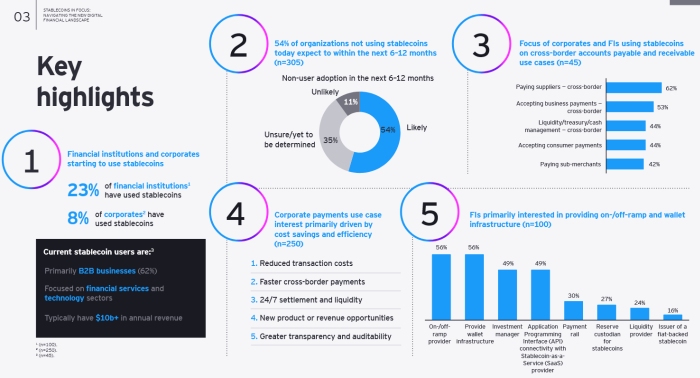
Image: Stablecoin Survey Research Highlights (EY Parthenon Sep 2025)
On September 15, 2025, EY-Parthenon released its latest stablecoin survey results, "Stablecoins: Adoption, Optimism, and Regulatory Clarity" (download 31 page PDF), covering 350 executives from corporates and financial institutions across the US, EMEA and other regions. Research takeaways confirm adoption is picking up speed, supposed by regulatory clarity by the GENIUS Act, recently signed into law.
Why is this happening? Approval of the U.S. GENIUS Act is a regulatory catalyst. Further, pilots are proving real value and corporate treasurers are under pressure to improve efficiency. The thinking is that organizations delaying adoption risk losing ground to competitors who are moving forward and benefiting from the lower cost and faster transactions of stablecoin technologies.
Why is everyone saving money by using stablecoins? The reason is straightforward. Traditional cross border payments involve multiple intermediaries, each adding fees and time. Stablecoins bypass these frictions and settles instantly, so the cost savings are structural (not incremental). For fintech providers, there's a growing opportunity to provide integration and risk management tools to help corporates adopt/use stablecoins and measure their effectiveness.
The reality is that we live and function in a global economy where delays can disrupt supply chains, so it's not surprising that corporates will adopt stablecoins for faster and more streamlined and predictable settlement solutions. This means that stablecoin adoption will likely strong and swift among B2B supplier and trade finance flows before expanding more widely into consumer payments.
In Canada, regulatory inaction is catching up with market momentum. On September 19, 2025, regulators like OSFI have warned the Prime Minister Mark Carney that Canada should accelerate federal stablecoin rules to avoid falling behind global peers. The Bank of Canada has echoed this call, saying stablecoins should be as safe and stable as the balance in your bank account. OSFI is already drafting a new framework to regulate stablecoin issuers, while domestic momentum is building as Tetra Digital Group secured $10M from Canadian banks and fintechs to launch a CAD stablecoin in 2026. Observers including investor John Ruffolo warn in his Looming Stablecoin Storm substack that without clear domestic rules, Canada risks ceding innovation, competitiveness and monetary sovereignty to jurisdictions that move faster.
Canadian corporates and fintechs need to plan not just for current global trends, but for a new local regulatory stablecoin framework. Firms are advised to engage with policymakers to create the right environment, build compliance ready infrastructure now and position for interoperability with USD pegged tokens and domestic stablecoin initiatives.Waiting could result in higher compliance costs, restricted access, and eventually a decline in market share.
Bottom line is banks understand that clients will demand stablecoin services and that failure to provide them risks their disintermediation. There's an intensifying race between traditional institutions and fintech challengers to capture stablecoin transaction flows.
Hybrid build and partner strategy. Corporates are demanding trust and compliance, while financial institutions know they cannot deliver the full stack alone. This means that partnerships between fintechs, banks and technology providers will determine how quickly stablecoin adoption scales.
Stablecoins are moving from pilot projects into enterprise strategy. Corporates see real cost savings and competitive advantage, while financial institutions are preparing to build services at scale to meet client demand. Regulation is beginning to catch up, led by the GENIUS Act in the US, but the global landscape is unbalanced while Canada’s fintech ecosystem is calling on the federal government to create and regulate a stablecoin framework to remain aligned and competitive.
The National Crowdfunding & Fintech Association (NCFA Canada) is a financial innovation ecosystem that provides education, market intelligence, industry stewardship, networking and funding opportunities and services to thousands of community members and works closely with industry, government, partners and affiliates to create aa vibrant and innovative fintech and funding industry in Canada. Decentralized and distributed, NCFA is engaged with global stakeholders and helps incubate projects and investment in fintech, alternative finance, crowdfunding, peer-to-peer finance, payments, digital assets and tokens, artificial intelligence, blockchain, cryptocurrency, regtech, and insurtech sectors. Join Canada's Fintech & Funding Community today FREE! Or become a contributing member and get perks. For more information, please visit: www.ncfacanada.org
| | |
|---|---|---|
| | |


August 26th, 2025

January 4th, 2024

June 1st, 2021

September 9th, 2020

July 9th, 2018

January 3rd, 2018

September 25th, 2017

June 20th, 2017

May 10th, 2017

December 14th, 2016