




Karsten Wenzlaff, Advisor
August 26th, 2025
Karsten Wenzlaff is a Crowdfunding and Fintech Expert from Germany. He is Secretary-General of Digit[...]


VoPay | Sep 22, 2025

Image: Freepik
On September 18, 2025, VoPay announced real time PayPal and Venmo payouts for businesses in Canada and the U.S. This innovative development comes as digital wallets are expanding rapidly.
Global wallet transaction value is forecasted to rise from about $8.3 trillion in 2025 to $19.7 trillion by 2030, nearly 19% CAGR. In addition to payout flexibility, users also want speed of course, with 61% of millennials showing preference for real-time payouts. Venmo alone processed $275 billion in 2023, about 18% of PayPal volume.
Hamed Arbabi, CEO of VoPay:
“At VoPay, we’re laser-focused on giving businesses access to every major financial rail and wallet through one embedded platform. Our collaboration with PayPal unlocks real-time PayPal and Venmo access for our clients, enabling them to expand choice, optimize operations, and deliver modern, inclusive customer experiences. This is a transformative step in making financial interactions faster, simpler, and universally accessible.”
VoPay’s update enables platforms to send funds to PayPal in Canada and the U.S. and to Venmo in the U.S. with a single API or portal. Recipients can be identified by email, phone number, or wallet handle, giving users wallet choice alongside bank transfers and virtual accounts. Compliance, reporting, settlement, and reconciliation are handled in one place, reducing manual work and errors.
Embedded finance helps companies run more smoothly by using automation and one set of APIs.
Canadian firms compete on how fast and reliably they move money. Wallet payouts lower failed attempts and shorten user wait times. Together with automation efficiencies and global reach, Canadian financial technology firms can now more easily raise the bar for user experience and operational strength.
According to this case study, a Canadian consumer lender modernized disbursements, repayments, and reconciliation with VoPay's suite of solutions. As a result, the company reported a 25% reduction in manual tasks and about 30% lower labour costs after automating. Weekly reconciliation dropped from 10 hours to near zero, and non sufficient funds processing fell from 20 hours a month to near none. These gains free up staff, reduce errors, and deliver faster funding to borrowers.
Instant payouts and wallet choice are becoming standard. Cross border support will matter more as platforms serve global workers and customers. Companies like VoPay that combine embedded finance, wallet rails, and cross border payouts in a single tech stack will be better positioned to scale, control costs, and meet rising client expectations.
 The National Crowdfunding & Fintech Association (NCFA Canada) is a financial innovation ecosystem that provides education, market intelligence, industry stewardship, networking and funding opportunities and services to thousands of community members and works closely with industry, government, partners and affiliates to create aa vibrant and innovative fintech and funding industry in Canada. Decentralized and distributed, NCFA is engaged with global stakeholders and helps incubate projects and investment in fintech, alternative finance, crowdfunding, peer-to-peer finance, payments, digital assets and tokens, artificial intelligence, blockchain, cryptocurrency, regtech, and insurtech sectors. Join Canada's Fintech & Funding Community today FREE! Or become a contributing member and get perks. For more information, please visit: www.ncfacanada.org
 |  |  |
|---|---|---|
 |  |  |
Payments Regulation | Sep 8, 2025
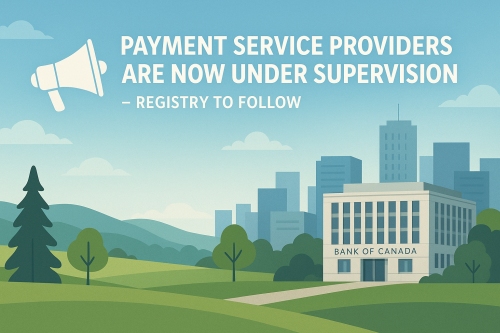
Today, September 8 2025 the Bank of Canada begins supervising payment service providers (PSPs) under the Retail Payment Activities Act (RPAA). It's the official start of Canada’s new oversight regime for retail payments. According to the Bank of Canada close to 1500 PSPs have applied for registration and those on the Applicant list are now legally required to comply with RPAA obligations.
Applicant PSPs must keep information current on PSP Connect and respond promptly to information requests from the Bank. These reporting duties now carry legal weight. The Bank has confirmed that it has the authority to deploy enforcement tools where necessary to ensure compliance and maintain the stability of Canada’s retail payments system.
The Bank will also update the Registry of PSPs on a rolling basis. This depends on the Department of Finance completing national security screenings and providing cleared names to the Bank. For applicants this means Registry inclusion will be phased over time rather than immediate.
The Bank also raised the ongoing tax issue linked to trust arrangements in a separate Letter to Industry. Some PSPs that keep interest earned on customer funds could face extra tax steps, like having to issue tax slips to customers. The Bank said it understands that PSPs may not yet be able to fully meet trust rules because of this and will accept proof that they are taking reasonable steps in the meantime.
The Bank also confirmed that PSPs will be charged supervision fees once the cost recovery rules are finalized. This will add another compliance cost when it comes into effect.
For fintech and payment firms in Canada the start of RPAA supervision is a major step. Compliance and reporting are now legal requirements and the Bank has the power to enforce them.
The phased Registry rollout highlights the national security checks that must be completed, while the temporary relief on the trust tax issue shows regulators are trying to be practical during the transition.
The National Crowdfunding & Fintech Association (NCFA Canada) is a financial innovation ecosystem that provides education, market intelligence, industry stewardship, networking and funding opportunities and services to thousands of community members and works closely with industry, government, partners and affiliates to create a vibrant and innovative fintech and funding industry in Canada. Decentralized and distributed, NCFA is engaged with global stakeholders and helps incubate projects and investment in fintech, alternative finance, crowdfunding, peer-to-peer finance, payments, digital assets and tokens, artificial intelligence, blockchain, cryptocurrency, regtech, and insurtech sectors. Join Canada's Fintech & Funding Community today FREE! Or become a contributing member and get perks. For more information, please visit: www.ncfacanada.org
| | |
|---|---|---|
| | |
European Fintech | Sep 8, 2025
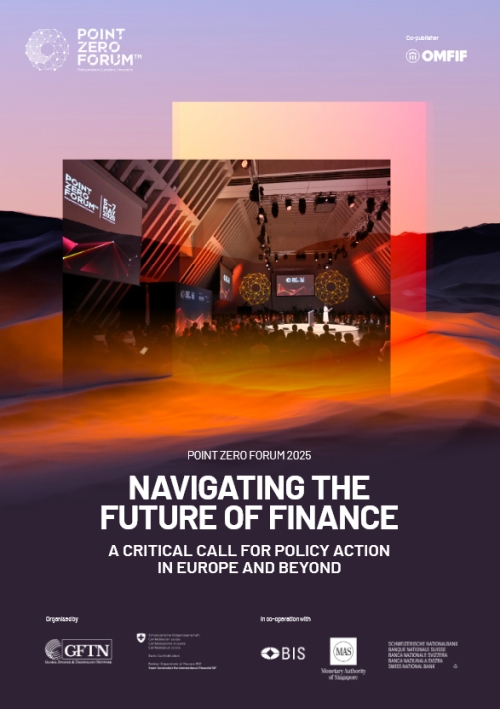
Image: Navigating the Future of Finance magazine (Point Zero Forum)
The 2025 Point Zero Forum (Jun 24-26) in Zurich drew 1,350 participants from 66 countries, including over 20% from public sector institutions. Across 121 sessions spanning 95 hours, 329 speakers explored the future of finance and technology. These numbers matter because the forum is where central banks, regulators, and institutions compare notes on what is implementable now, not just what's aspirational.
For Canadian fintechs, the conversations in Zurich are a warning and an opportunity. Europe is moving quickly to reset its financial infrastructure. Canada risks lagging unless it adapts. Read the post 2025 Point Zero Forum magazine, "A Critical Call for Policy Action in Europe and Beyond" (24 page PDF)
Offline payments and infrastructure security were considered a matter of national sovereignty, not just technology. Danmarks Nationalbank warned: “Without power, many offline payments methods aren’t viable,” linking payments directly to energy security.
The world’s largest stablecoin Tether confirmed it will leave Europe because of reserve and regulatory requirements. This shows that Europe is treating payments, AI, and data as part of its sovereignty strategy.
Canada has its own domestic payment systems operated by Payments Canada, but Canada still doesn't have live operating real-time retail payment rails. In cloud services, Canadian banks and fintechs are still dependent on American providers like AWS, Microsoft, and Google.
Central banks are now focused on tokenized settlement. The Swiss National Bank said: “Price stability is our main focus also in challenging times,” while the European Central Bank stressed that central bank money must remain “available and useful” in tokenized markets.
The Bank of England suggested that oversight of stablecoins may evolve as the “singleness of money” assumption is tested.
The Bank of Canada paused it's digital dollar research initiative. Europe and the U.K. are moving faster. Canadian fintechs should design tokenized solutions that can connect to global settlement networks, not just domestic payment systems.
The Basel framework assigns a 1,250% risk weight to exposures on public blockchains compared to standard weights for permissioned systems. That number explains why institutions are cautious about public chains even as liquidity scale requires them.
Solana’s Lily Liu argued that “the 5.5bn people on the internet” can only be reached through open infrastructure, while regulators noted that immutability makes reversals and sanctions enforcement difficult. The likely outcome is a dual architecture with permissioned networks for issuance and compliance, and public networks for liquidity and settlement.
Canadian institutions face the same Basel capital rules as peers in other markets. Without clear guidance on the use of public versus permissioned networks, Canadian fintechs may find it harder to connect to global liquidity pools.
68% of EU businesses say they struggle to understand their obligations under the EU AI Act, holding back investment. Global wealth manager, Julius Baer’s COO estimated that customer focused AI tools could generate revenue within 6 to 12 months.
At the forum, agentic AI systems were demoed handling insurance claims with observability features allowing human review. The key issue is still accountability with policymakers worrying about loss of control as AI systems become more autonomous.
Canada has not finalized its AI regulation but offers a voluntary AI code of conduct, giving fintechs some near term flexibility. But any deployment that scales internationally will need to comply with EU and U.S. standards. The strategic opportunity is to pilot auditable AI now while preparing for global regulatory alignment.
S&P projects global private equity will grow from $15 trillion in 2025 to $18 trillion by 2027. Citi and SIX Digital Exchange announced tokenized access to late-stage pre-IPO equities on SDX, launching in Q3 2025.
Tokenization will improve collateral usability and ownership visibility, but not resolve fundamental illiquidity or opaque valuations.
Canada has a growing private capital market but no regulated digital exchange on the scale of SIX. Canadian fintechs could position themselves as infrastructure providers for tokenized funds and secondary liquidity, complementing global platforms instead of competing directly.
At the forum, speakers pointed out that some carbon credits were issued for projects expected to reduce emissions over 30 years, even though the land rights lasted only 10 years. That kind of mismatch reduces trust in the market.
Bringing carbon credits into mainstream finance could help spread risk and attract more investment. But for the market to work, credits must be backed by strong certification, insurance to cover project failures, and common standards that everyone follows.
Canada has compliance carbon pricing systems, but its voluntary carbon credit market is smaller and less standardized compared to Europe and Asia. Canadian fintechs could carve out a leadership role by building platforms that prioritize data integrity and risk coverage.
Canada must decide whether to keep pace with progressing markets in Europe and Asia or risk being shut out of global settlement networks. If Europe can move from pilots to architecture, Canadian fintechs must not stand still.
The National Crowdfunding & Fintech Association (NCFA Canada) is a financial innovation ecosystem that provides education, market intelligence, industry stewardship, networking and funding opportunities and services to thousands of community members and works closely with industry, government, partners and affiliates to create a vibrant and innovative fintech and funding industry in Canada. Decentralized and distributed, NCFA is engaged with global stakeholders and helps incubate projects and investment in fintech, alternative finance, crowdfunding, peer-to-peer finance, payments, digital assets and tokens, artificial intelligence, blockchain, cryptocurrency, regtech, and insurtech sectors. Join Canada's Fintech & Funding Community today FREE! Or become a contributing member and get perks. For more information, please visit: www.ncfacanada.org
| | |
|---|---|---|
| | |
Aug 27, 2025

Image: Freepik AI
Canada is preparing for the launch of “Consumer-Driven Banking” in early 2026. This promises to be a system that will give people more control over how their financial data is shared. The main goal is to replace current risky practices, including screen scraping, with safe, consent-based data exchange. The government has made it its aim to focus on trust, clearer guidelines and regulations, to provide a system where security comes first, while still encouraging innovative services.
For more than 30 years, Interac has been the foundation of Canada’s payment system. The payment gateway is well-known for debit payments, ABMs, and the popular e-Transfer service. In 2024, Canadians sent more than one billion e-Transfers, transferring more than $132 billion.
The reach of Interac extends further than banks and credit unions. Its services are also used in online services. For instance, with online casino platforms, players rely on the same fast and trusted payments they use with their bank. The payment option allows players to access the same bonuses, gaming library, and promotions whether they use an e-wallet, cryptocurrencies, or traditional banking methods. With Interac e-transfer casinos, players can expect a fast, convenient, and highly secure way to fund their accounts with strong protections against fraud and theft.
Additionally, Interac is widely accepted for online purchases in Canada because it supports secure direct payments through Interac Online or Interac e-Transfer, which many online merchants and platforms integrate. This widespread trust and familiarity with Interac in everyday payments reflects the confidence Canadians place in its security and convenience. This acceptance and reputation for safe transactions make Interac an ideal foundation for supporting the secure, consent-based data sharing envisioned by Canada’s open banking framework
Interac already connects banks, credit unions, payment processors, and more than 1.4 million point-of-sale terminals across the country. It also has significant experience with APIs, tokenization, and authentication, which are exactly the kinds of tools that open banking requires.
Equally important is Interac’s reputation for security. With three decades of experience, Interac has well-established governance frameworks, security protocols, and operational standards. These can easily be adapted and extended to open banking APIs to accelerate compliance and risk management processes.
Standardized APIs are central to consumer-driven banking. Interac has already been running pilot projects with dozens of third-party providers that want to connect directly to financial data. The network includes shared services that are vital for open banking, such as identity verification, consent management, and secure data transfer.
It makes sense to use infrastructure that already exists. This could speed things up considerably. Instead of starting from scratch, Canada can build on a network that already processes millions of transactions every day. Interac’s reliability, low downtime, and widespread acceptance mean both banks and fintechs are more likely to support a model that is proven and trusted.
Interac’s experience helps reduce the time needed for open banking to become a reality. With ready-made standards and existing relationships across the financial sector, deployment can move faster than in countries that had to build new systems entirely. This is significant, given that the federal government has set early 2026 as the target date.
Interac also works closely with regulators. It advises on governance, security, and consumer protection, and it has teamed up with fintech incubators to test new applications in controlled environments. The focus has been on creating clear, transparent consent processes for consumers, ensuring people understand and control how their data is used.
In 2025, important steps were taken to prepare for rollout. Despite mixed reactions and backlash, Parliament passed legislation requiring accredited entities to use secure APIs, annual consent renewal for data sharing, and oversight by the Financial Consumer Agency of Canada. Major banks, including RBC and TD, continued expanding their API systems and entered new partnerships with fintechs to test services ahead of the launch.
Interac, for its part, strengthened its focus on fraud prevention. The appointment of David Bruyea as Group Head of Financial Crimes signalled an investment in protecting the system at a time when trust will be vital. With consumers still learning what consumer-driven banking means for them, Interac is positioning itself as the trusted partner that can balance innovation with security. Its long-standing role in Canadian finance, paired with ongoing developments in 2025, places it at the centre of the country’s move toward open banking in 2026.
The National Crowdfunding & Fintech Association (NCFA Canada) is a financial innovation ecosystem that provides education, market intelligence, industry stewardship, networking and funding opportunities and services to thousands of community members and works closely with industry, government, partners and affiliates to create a vibrant and innovative fintech and funding industry in Canada. Decentralized and distributed, NCFA is engaged with global stakeholders and helps incubate projects and investment in fintech, alternative finance, crowdfunding, peer-to-peer finance, payments, digital assets and tokens, artificial intelligence, blockchain, cryptocurrency, regtech, and insurtech sectors. Join Canada's Fintech & Funding Community today FREE! Or become a contributing member and get perks. For more information, please visit: www.ncfacanada.org
| | |
|---|---|---|
| | |
Aug 26, 2025

Image: Unsplash/PiggyBank
Two of Canada’s largest banks, RBC and BMO, are currently exploring the possibility of selling their joint payments processing venture, Moneris. If the deal follows through, it could potentially be valued at around $2 billion, which would be a record-breaking transaction in Canadian history.
At the moment, no final decision has been made yet because it’s still early days and discussions are still being held. However, the potential sale has already sparked considerable interest within the industry, given the size and importance of Moneris in Canada. The banks are said to be working with top financial advisors, including PJT Partners, RBC Capital Markets, and BMO Capital Markets, to evaluate their options.
Moneris currently generates about $700 million in annual revenue and serves about 325,000 merchant locations across the country. This basically means the company processes roughly one out of every three business transactions in Canada, which is proof of just how central it is to everyday commerce. If sold, Moneris would present a rare opportunity for investors to acquire a pretty decent share of Canada’s payments market.
Retail isn’t the only sector that relies on efficient payment systems, because industries like online gaming have also highlighted the demand for fast, reliable processing. According to gambling expert Matt Bastock, part of the reason fast cashout sites have become so popular among players is the growing demand for better payment systems and instant payouts. Like online casinos and many other sectors of the economy, more and more businesses are starting to rely on fast, reliable transactions to meet customer expectations and stay competitive.
Moneris was established in 2000 as a 50/50 joint venture between the Royal Bank of Canada (RBC) and the Bank of Montreal (BMO), at a time when card payments were the go-to for merchants. In the last two decades, the company has grown into one of Canada’s largest payment processors and a trusted name for businesses of all sizes.
With a commanding market share of about 33%, Moneris is more than just a routine asset; it’s also the backbone of payments processed in and around the whole country. Today, Moneris’ offerings cover mobile payments, e-commerce platforms, and integrated point-of-sale systems, making it a one-stop shop for most businesses.
The company has also been strategic in expanding its services through partnerships and acquisitions. In 2021, Moneris acquired Quebec-based UEAT, which is a platform that provides online ordering solutions for restaurants, as a way to cement its presence in the hospitality sector. More recently, in 2025, the company went into a partnership with Cardstream to strengthen its capabilities in e-commerce.
Should RBC and BMO move forward with the sale, it would mark a turning point in Canadian fintech history. The immediate impact on businesses and consumers might not be as harsh as most people expect it to be, as payment processing services will likely continue uninterrupted. However, under new ownership, Moneris could pursue more aggressive strategies, introduce new technologies, or even go beyond Canadian borders in the hopes of finding better opportunities.
This potential sale reflects the ongoing transformation of Canada’s financial services industry, where traditional banks are adapting to an era that is defined by fintech solutions. In fact, the Canadian fintech sector is growing three times faster than traditional finance. For stakeholders across the board (consumers, investors, and competitors), the coming months will be worth watching closely. The outcome will provide valuable insights into how things are going to change and how institutions like RBC and BMO intend to position themselves in the future.
Although payment processing operations are profitable and generate reliable cash flow, they also require ongoing investment in technology, which tends to be costly. For RBC and BMO, exiting their joint venture may allow them to refocus on their core banking operations, while leaving the demands of payment technology to specialized industry players.
On the other side of the equation, potential buyers (private equity investors or established payment companies) may find new ways to scale the business even further. Comparable moves have already been seen in and outside of Canada. For instance, TD Bank recently partnered with U.S.-based Fiserv for its merchant payments operations, opting to work with a dedicated payments provider instead of maintaining the business internally. Cases like these are good examples of how banks are rethinking their role in the ecosystem, often favouring partnerships or outright sales.
The National Crowdfunding & Fintech Association (NCFA Canada) is a financial innovation ecosystem that provides education, market intelligence, industry stewardship, networking and funding opportunities and services to thousands of community members and works closely with industry, government, partners and affiliates to create a vibrant and innovative fintech and funding industry in Canada. Decentralized and distributed, NCFA is engaged with global stakeholders and helps incubate projects and investment in fintech, alternative finance, crowdfunding, peer-to-peer finance, payments, digital assets and tokens, artificial intelligence, blockchain, cryptocurrency, regtech, and insurtech sectors. Join Canada's Fintech & Funding Community today FREE! Or become a contributing member and get perks. For more information, please visit: www.ncfacanada.org
| | |
|---|---|---|
| | |
Global Fintech Report | Aug 22, 2025
Image: Pulse of Fintech H1 2025, KPMG
According to the KPMG Pulse of Fintech H1 2025 report (67 page PDF) published in August 2025, global fintech investment in the first half of 2025 fell to $44.7 billion across 2,216 deals, recording the lowest H1 total since early 2020. Investors remain cautious about elevated risks around higher interest rates, capital costs, and geopolitical uncertainty. Q2 2025 was particularly weak, with $18.7 billion across 972 deals.
Investment in digital assets totalled $8.4 billion across 586 deals in H1 2025. Stablecoins attracted attention for payments and remittances in emerging markets, while tokenization platforms and infrastructure also captured capital. Circle's IPO anchored the sector’s strength, raising $1.1 billion with shares jumping 168% on day one.
AI continues to boost fintech investment. Capital flowed into both AI native startups and to incumbents embedding AI in credit scoring, fraud detection, and customer engagement. Investors prioritized business models that combined growth with efficiency and risk control. See NCFAs coverage of AI Fintechs attracting a 242% valuation premium
Regtech attracted $2.1 billion across 190 deals in H1 2025. Adoption of automated KYC, AML, and reporting tools continues to grow as financial institutions look for cost savings and regulatory agility. GenAI in risk and compliance
Insurtech raised $4.8 billion across 141 deals in H1 2025, which is already greater than all of 2024. Wealthtech funding reached $0.9 billion across 14 deals, with AI enabled platforms a recurring theme. Both sectors experienced consolidation as incumbents prefer acquisitions over building new capabilities.
Payments investment slowed to $4.6 billion across 242 deals in H1 2025, as investors grew more selective. But the sector is still foundational with capital being allocated to embedded finance, cross border platforms, and transaction monitoring. For Canada’s policy context see open banking delays and competitiveness and banks exiting merchant acquiring businesses like Moneris.
Cybersecurity specific fintech investment was just $0.1 billion across 26 deals in H1 2025. Despite heightened threat levels, most activity was concentrated at seed and early stages, reflecting investor caution toward scaling security focused fintechs.
Exit momentum is returning. Circle’s successful IPO may open the door for additional digital asset platforms to list in H2 2025, boosting the case for fintech exit activity after years of lack lustre listings.
For Canada, the data shows the window of opportunity for digital assets, AI, and regtech could attract investment with clear policy and infrastructure. The muted state of payments and open banking highlight gaps Canada must address to remain competitive. Clear rules, targeted support, and investment in digital infrastructure are critical to positioning Canadian fintech for growth in the second half of 2025 and beyond. See the crisis Canada and fintech cannot afford to waste
The National Crowdfunding & Fintech Association (NCFA Canada) is a financial innovation ecosystem that provides education, market intelligence, industry stewardship, networking and funding opportunities and services to thousands of community members and works closely with industry, government, partners and affiliates to create a vibrant and innovative fintech and funding industry in Canada. Decentralized and distributed, NCFA is engaged with global stakeholders and helps incubate projects and investment in fintech, alternative finance, crowdfunding, peer-to-peer finance, payments, digital assets and tokens, artificial intelligence, blockchain, cryptocurrency, regtech, and insurtech sectors. Join Canada's Fintech & Funding Community today FREE! Or become a contributing member and get perks. For more information, please visit: www.ncfacanada.org
| | |
|---|---|---|
| | |
Payments | Aug 21, 2025 | Last Updated Sep 21, 2026

Image: Freepik
On August 10, 2026, Francisco Partners agreed to acquire Moneris from RBC and BMO for approximately C$2 billion in cash, subject to regulatory approvals and closing conditions. Each bank is entitled to half of the proceeds. The agreement turns the potential sale first reported in 2025 into a signed change of control.
Moneris supports more than 325,000 points of commerce and handles roughly one in three transactions in Canada. RBC and BMO are selling their ownership interests, but both banks have established long term agreements to refer customers exclusively to Moneris.
RBC and BMO can therefore continue serving business customers and distributing Moneris payment services without owning the processor itself. Francisco Partners will own the company responsible for much of the merchant technology, payment acceptance and commerce infrastructure behind those relationships.
The Moneris sale also leaves the company's Canadian headquarters and technology infrastructure in place while ownership changes hands.
Canada's other major banks already use variations of this model.
In July 2025, TD partnered with Fiserv under a multi year managed services agreement. TD Merchant Solutions uses Fiserv payment processing, servicing and Clover products. Fiserv also agreed to acquire part of TD's merchant processing business covering approximately 3,400 merchant relationships and 30,000 locations.
Scotiabank works with Chase Payment Solutions for merchant services. National Bank refers commercial clients to Clover Canada, a Fiserv company, for payment processing and merchant technology.
Banks can keep the deposit account, lending, treasury services and customer relationship while specialist payment companies carry more of the technology and operating load.
Merchant acquiring now includes ecommerce, mobile acceptance, terminals, fraud controls, reporting, software integrations, inventory tools, analytics and faster settlement. Competing effectively requires continuous investment well beyond processing a card transaction.
Moneris itself is also becoming more than a traditional card processor.
In June 2026, the company expanded Konek pay by bank across Moneris Checkout and its API, giving merchants an online account to account payment option alongside cards.
Moneris has also added accounting integration with QuickBooks and technology that can connect AI agents with commerce tools. Merchant payment providers are now competing across checkout, accounting, data, software integration, fraud controls and business operations as well as payment acceptance.
Francisco Partners is acquiring both a large Canadian processing network and a merchant software platform with room to expand further into commerce technology.
Canada's national payment infrastructure has also advanced substantially since this article was first published.
The Real Time Rail rules and access framework is now approved. The RTR By-law and Rules came into force on August 24, 2026, establishing the legal and operating framework ahead of launch.
Payments Canada is targeting a Q4 2026 launch. Initial direct participants are scheduled to connect first, followed by additional participants and transaction volumes through 2027.
RTR is designed to support instant clearing and settlement around the clock with richer payment data. Payments Canada reported in August that 60% of Canadian businesses surveyed would use real time payments in specified situations. Supplier payments, government payments and domestic account to account transfers were among the identified use cases.
RTR is not a replacement for merchant acquiring or card networks. Banks, fintechs and payment providers still need to build payment initiation, fraud controls, reconciliation, merchant services and customer experiences around the rail.
Account to account products could give merchants another way to receive money and give payment companies another service to integrate into checkout, invoicing and business software.
Canada is also widening access to its national payment infrastructure.
Changes to the Canadian Payments Act expanded Payments Canada membership eligibility to qualifying payment service providers and other organizations that historically operated outside the core systems. The opening of Canada's payment infrastructure has already brought fintechs, PSPs and credit unions into systems once dominated almost entirely by banks.
The Retail Payment Activities Act framework adds regulatory oversight. Registered payment service providers are supervised by the Bank of Canada and must meet requirements covering operational risk, safeguarding funds, incident response and reporting.
Firms still need settlement arrangements, technical connections, fraud controls, liquidity, compliance and reliable operations before they can build competitive products on national payment infrastructure.
For fintech companies, there are more ways to compete around the merchant relationship without owning the underlying processor.
A commerce platform can combine payment acceptance with accounting, reconciliation, lending, payroll, inventory, loyalty and analytics while another company handles regulated payment processing. Banks can distribute these products without building every payment capability themselves.
For merchants, pricing, uptime, settlement timing, dispute handling, fraud protection, software integration, reporting and support matter more than who owns the processor.
Real time account to account payments should eventually add another option once RTR is operating and commercial products are available. Cards will continue to offer different acceptance, credit, rewards and consumer protection features, so merchants are likely to support several payment methods rather than replace one system outright.
RBC and BMO are selling Moneris while keeping exclusive referral relationships. TD uses Fiserv technology and has transferred part of its processing portfolio. Scotiabank works with Chase, while National Bank refers merchants to Clover.
At the same time, RTR is approaching launch and more regulated payment providers can participate in Canada's payment infrastructure.
Ownership of the processor is only one part of the market. Banks can control the commercial relationship, processors can run payment infrastructure, software companies can own the merchant workflow and fintechs can build services across those layers.
That gives new entrants more places to compete than the older model where merchant acquiring was concentrated inside a small number of bank owned networks.
If banks can keep the business customer without owning the payment processor, where will the most valuable part of the merchant relationship sit once real time payments and new account to account products become widely available?
Canada's payments market is opening while banks, processors and fintechs compete across different parts of the merchant relationship.
Francisco Partners has entered into a definitive agreement to acquire Moneris from RBC and BMO for approximately C$2 billion in cash. The transaction remains subject to regulatory approvals and other closing conditions.
RBC and BMO are selling their ownership interests in Moneris, but both banks have established long term agreements to refer customers exclusively to Moneris. Their business customers can therefore continue to use Moneris services after the transaction closes.
TD entered a multi year managed services relationship with Fiserv in 2025. TD Merchant Solutions uses Fiserv payment processing, servicing and Clover products. Fiserv also agreed to acquire part of TD's merchant processing portfolio covering approximately 3,400 merchant relationships and 30,000 locations.
Payments Canada is targeting Q4 2026. The RTR By-law and Rules came into force on August 24, 2026, and participant onboarding and transaction volumes are scheduled to increase in stages through 2027.
RTR is national infrastructure for instant account to account payments. It can support new payment products, but cards offer different acceptance, credit, rewards and consumer protection features. Banks, fintechs and payment companies will decide how RTR is incorporated into merchant and consumer services.
The sale separates ownership of a major Canadian payment processor from the banks distributing its services. Fintechs and software companies can compete around merchant software, payment integration, data and customer experience without owning the underlying processing network.
This article was originally published on August 21, 2025 and updated on September 21, 2026 using public company, regulatory and industry disclosures. The proposed Moneris acquisition remains subject to regulatory approvals and closing conditions. Payments Canada continues to target Q4 2026 for the initial Real Time Rail launch, and implementation timing may change. This content is for informational purposes only and does not constitute investment, financial or legal advice.
 The National Crowdfunding & Fintech Association (NCFA Canada) is a financial innovation ecosystem that provides education, market intelligence, industry stewardship, networking and funding opportunities and services to thousands of community members and works closely with industry, government, partners and affiliates to create a vibrant and innovative fintech and funding industry in Canada. Decentralized and distributed, NCFA is engaged with global stakeholders and helps incubate projects and investment in fintech, alternative finance, crowdfunding, peer-to-peer finance, payments, digital assets and tokens, artificial intelligence, blockchain, cryptocurrency, regtech, and insurtech sectors. Join Canada's Fintech & Funding Community today FREE! Or become a contributing member and get perks. For more information, please visit: www.ncfacanada.org
| | |
|---|---|---|
| | |


August 26th, 2025

January 4th, 2024

June 1st, 2021

September 9th, 2020

July 9th, 2018

January 3rd, 2018

September 25th, 2017

June 20th, 2017

May 10th, 2017

December 14th, 2016