





Karsten Wenzlaff, Advisor
August 26th, 2025
Karsten Wenzlaff is a Crowdfunding and Fintech Expert from Germany. He is Secretary-General of Digit[...]


Digital Banking | May 9, 2025
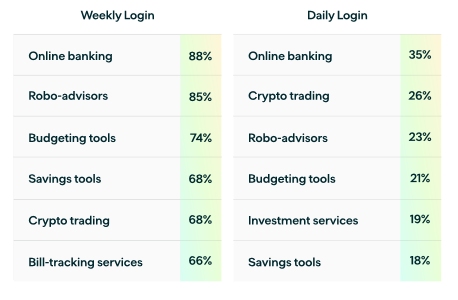
Image: Frequency of Use (Plaid x YouGov Money Talks survey report)
Between August 20-26th 2024, Plaid commissioned a national survey through the YouGov platform to understand how U.S. consumers bank, pay, and invest. The survey reveals insights of consumer preferences in digital finance, including trust in financial providers, app usage, payment methods, credit attitudes, and investment habits, based on weighted responses from 2,077 adults. Fintechs, digital finance platforms, and financial institutions need to stay up to date with the latest retail digital banking trends if they want to compete for consumer loyalty. Read 'Money Talks' (28 page PDF) report explaining these trends. Below we break-down key insights for NCFA's readers. Not yet subscribed? Sign-up for NCFA's weekly newsletter here.
Consumers continue to trust traditional banking institutions more than 100% digital platforms:
Trust and security go hand and hand, and overall, trust comes from perceived care and protection:
Consumers also shared who they rely on for financial well-being. The takeaway is that fintechs and advisory services must do more to be seen as helpful and caring, a useful partner in people’s financial lives.
Online banking is the most widely used financial tool: 99% percent of consumers are familiar with it, and 74% use it weekly.
Other commonly used tools include savings apps (68% weekly or daily), budgeting tools (85%), and peer-to-peer payment apps like Venmo or Zelle (used weekly by 50% of users). Roboadvisors are accessed more than once per week by (80%) of their users but only 1% of all consumers report using them regularly.
When asked what improvements they want most in financial apps:
60% of respondents said it is important to link their bank account with the financial apps they use.
Takeaway: Apps that are integrated, responsive, and secure are the most likely to be used often. Fintechs and banks that overcomplicate services or create friction in setup risk being overlooked, even if their offerings are advanced.
25% currently invest in cryptocurrency. Another 21% say they plan to invest in crypto or NFTs in the next year. These responder levels of engagement are equal to the 25% of people who say they will invest in stocks or trading platforms during the same period.
Crypto investors are not limiting their exposure:
Only 11% of respondents have used AI tools to support their investing decisions -> interestingly, this already exceeds the share of people using roboadvisors, suggesting that AI powered investment tools are gaining traction faster than traditional automated advice products.
Takeaway: Fintechs offering secure, easy to understand crypto access or AI investment tools can appeal to a growing investor base. Banks that avoid crypto are at risk of losing relevance with younger and self-directed investors.
Debit cards are now more commonly used than credit by younger adults. According to EY data cited in the report, 69% of Gen Z use debit cards daily or weekly. Many say they avoid credit cards because they do not want debt or do not qualify.
Buy now pay later (BNPL) services have grown 40% in usage since 2021.
Takeaway: Only 30% of respondents believe their credit score accurately reflects their financial health. 55% said they have been denied a loan due to a low score. These figures support growing interest in alternative data, such as cash flow and account history, for lending decisions.
Older adults are especially cautious. People aged 66 to 70 are 55% more likely to mistrust digital banks than those aged 22 to 25. Younger adults are more flexible. Among respondents aged 18 to 24, 36% said they would switch banks for a better digital payment experience.
Despite these trends, most people are not actively looking to change banks:
Consumers use different payment methods based on transaction size and age group:
To fund digital wallets:
Takeaway: Fintechs that want to increase adoption of pay by bank options must improve the experience. According to the report, 49% of users say they are likely to use pay by bank if the account linking process is easy.
Consumers want financial services that are clear, secure, and helpful, with trust remaining the most important factor in deciding whether to try a new app, share data, or switch banks. Traditional banks still hold an advantage in trust and reach but must modernize quickly. Fintechs have room to grow if they lead with transparency and value. Financial institutions that support financial goals and offer simple, connected experiences will stay relevant in 2025 (and beyond). Learn more about how consumers in the U.S. use, feel, bank, transact and acquire in 'Money Talks'.
 The National Crowdfunding & Fintech Association (NCFA Canada) is a financial innovation ecosystem that provides education, market intelligence, industry stewardship, networking and funding opportunities and services to thousands of community members and works closely with industry, government, partners and affiliates to create a vibrant and innovative fintech and funding industry in Canada. Decentralized and distributed, NCFA is engaged with global stakeholders and helps incubate projects and investment in fintech, alternative finance, crowdfunding, peer-to-peer finance, payments, digital assets and tokens, artificial intelligence, blockchain, cryptocurrency, regtech, and insurtech sectors. Join Canada's Fintech & Funding Community today FREE! Or become a contributing member and get perks. For more information, please visit: www.ncfacanada.org
 |  |  |
|---|---|---|
 |  |  |



August 26th, 2025

January 4th, 2024

June 1st, 2021

September 9th, 2020

July 9th, 2018

January 3rd, 2018

September 25th, 2017

June 20th, 2017

May 10th, 2017

December 14th, 2016

Leave a Reply