




Karsten Wenzlaff, Advisor
August 26th, 2025
Karsten Wenzlaff is a Crowdfunding and Fintech Expert from Germany. He is Secretary-General of Digit[...]


Apr 29, 2026 | NCFA Fintech Market Activity | Lending Consumer Credit And BNPL, Capital Markets And Funding
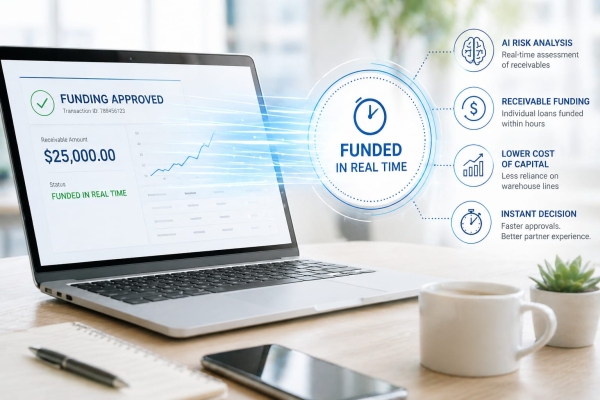
On Apr 29, 2026, VersaBank and FinanceIt Canada announce breakthrough in Real Time Structured Receivable Program pilot, an AI enabled funding model for point of sale finance receivables.
The change is in timing. Many point of sale lenders originate loans and then hold those receivables for 5 to 30+ days before financing them. VersaBank aims to fund individual receivables within hours. That shortens the gap between origination and funding and reduces the need for warehouse lines.
The program already operates at scale. VersaBank’s Structured Receivable Program portfolio exceeded CAD $4.4 billion as of Jan 31, 2026 and has grown at a 33% compound annual rate over the past five years. In the U.S., it completed more than US $310 million in fundings in its first year, above a US $290 million target.
The pilot with FinanceIt focuses on funding at or near the point of sale. FinanceIt originates consumer loans across home improvement, retail, and other merchant channels. If funding happens closer to origination, partners can reduce how long loans sit on balance sheet and lower the cost of carrying receivables.
This approach also changes how lending platforms access capital. Many point of sale and BNPL providers rely on warehouse facilities and forward flow agreements before selling loans into securitization or institutional channels. Shortening the time between origination and funding improves capital turnover and reduces reliance on those structures.
It's AI's decision support layer that's supporting faster decisions. VersaBank positions the program as using AI to assess and structure receivables in real time, allowing funding decisions without batch processing or manual review cycles.
David Taylor, President and CEO, VersaBank:
“This represents a breakthrough innovation in point-of-sale financing.”
It's the combination of faster decisioning and immediate access to capital. Funding can move closer to continuous, loan level decisions rather than batch processing. That allows capital to be deployed when a loan is approved instead of after it sits waiting in a pool. Over time, this leads to more precise pricing and better use of balance sheet capacity.
What happens when capital is deployed at the moment a loan is approved instead of days later, and which lenders are set up to operate at that speed?
Funding speed is becoming a core driver of economics in point of sale lending. When capital is deployed at origination, lenders can reduce costs and improve returns without taking on more credit risk.
 The National Crowdfunding & Fintech Association (NCFA Canada) is a financial innovation ecosystem that provides education, market intelligence, industry stewardship, networking and funding opportunities and services to thousands of community members and works closely with industry, government, partners and affiliates to create a vibrant and innovative fintech and funding industry in Canada. Decentralized and distributed, NCFA is engaged with global stakeholders and helps incubate projects and investment in fintech, alternative finance, crowdfunding, peer-to-peer finance, payments, digital assets and tokens, artificial intelligence, blockchain, cryptocurrency, regtech, and insurtech sectors. Join Canada's Fintech & Funding Community today FREE! Or become a contributing member and get perks. For more information, please visit: www.ncfacanada.org
 |  |  |
|---|---|---|
 |  |  |
Apr 28, 2026 | NCFA Insight | Artificial Intelligence And Data, Banking And Credit Infrastructure

On Apr 27, 2026, Customers Bank announced a multiyear collaboration with OpenAI to deploy AI across commercial banking operations. The bank has nearly $26 billion in assets and already has 75% of team members using OpenAI powered tools. Customers Bank even used an AI voice clone on its last earnings call. The bigger change is how the bank is deploying AI agents across lending, onboarding, and payments.
On its Q1 call, Customers reported more than 500 internal agents and custom GPTs, over 28,000 hours saved through AI enabled workflows, and productivity gains equal to almost 15 full time employees. Q1 results also show $69.7 million in net income available to common shareholders, total deposits up $813.9 million from Q4, and total loans up $609.0 million from Q4.
Sam Sidhu, President and CEO, Customers Bancorp
“We expect a fundamental re-engineering of how Customers Bank operates. We have spent the last year building the operational and governance infrastructure to deploy AI at scale. This strategic collaboration with OpenAI gives us the frontier models, engineering expertise, and ability to co-create a roadmap toward becoming an AI-native bank."
Customers Bank wants AI inside its operating model, with OpenAI engineers working directly with the bank to automate commercial lending, deposit onboarding, and payments. The bank’s cubiX platform already processes about $2 trillion in annual payments volume, giving the collaboration a live operating base, not a pilot or lab only environment.
During Q1 2026 earnings call, Sidhu disclosed that his prepared remarks had been delivered by an AI clone, not read by him. While it was sure to be a memorable call at that point, it's important if AI can represent management's voice in a public market setting, boards need rules for disclosure, script approval, recordkeeping, and accountability before the next experiment becomes normalized.
AI banking use cases aren't just theatre. Customers Bank wants to reduce its commercial loan closing from 30-45 days to about 7 days. It also wants complex commercial account opening to fall from more than a day to under 20 minutes. They are targeting the slowest, most expensive parts of commercial banking.
This is where smaller banks and fintechs should pay attention. AI in banking won’t be won by buying a model and asking staff to use it. The value comes from redesigning workflows around agents, then keeping humans on approvals, exceptions, and risk judgement. That requires clean data, mapped processes, audit trails, escalation rules, and ownership of each AI output.
There's a regulatory approach too. Investor relations, lending decisions, onboarding, and payments all require accountable systems. If an agent drafts, routes, ranks, or speaks, the bank's still on the hook for the result. The lesson is not “let AI run the bank.” It's use AI to remove friction, but keep governance strong enough to prove who approved what and why.
Can Customers Bank turn AI from a productivity tool into an AI enabled engine powering lending, deposits, and payments?
The National Crowdfunding & Fintech Association (NCFA Canada) is a financial innovation ecosystem that provides education, market intelligence, industry stewardship, networking and funding opportunities and services to thousands of community members and works closely with industry, government, partners and affiliates to create a vibrant and innovative fintech and funding industry in Canada. Decentralized and distributed, NCFA is engaged with global stakeholders and helps incubate projects and investment in fintech, alternative finance, crowdfunding, peer-to-peer finance, payments, digital assets and tokens, artificial intelligence, blockchain, cryptocurrency, regtech, and insurtech sectors. Join Canada's Fintech & Funding Community today FREE! Or become a contributing member and get perks. For more information, please visit: www.ncfacanada.org
| | |
|---|---|---|
| | |
Apr 28, 2026 | NCFA Insight | Risk Compliance And Regtech

Image: Freepik
On Apr 26, 2026, the CBC reported that Premier Wab Kinew announced at a weekend fundraiser that Manitoba plans to restrict youth access to social media and AI chatbots.
At the time of publishing, an official government release, bill or consultation paper wasn't available so treat this as early insight rather than a confirmed regulatory event (just yet). The stronger proof is already visible in global policy patterns, so it's only a matter of time.
Australia’s social media minimum age rules took effect on Dec 10, 2025, and eSafety reported that platforms had removed access to 4.7 million under 16 accounts across Australia by mid December 2025.
In Europe, the European Commission has published minor protection guidelines under the Digital Services Act, and the European Parliament has backed a minimum age of 16 for access to social media, video sharing platforms, and AI companions.
Given the trajectory and potential risks of AI, the debate isn't just about doom scrolling any more. It's fuelling a compliance market for age assurance, safer design, and AI access controls.
Australian government's rules put responsibility on age restricted platforms to take reasonable steps, not on parents to police every account. So age restrictions and assurance are now an infrastructure issue. A checkbox, self declared birth date, or parental reminder won't satisfy regulators when millions of accounts need to be assessed, restricted, or removed.
Children can get pulled into endless feeds, autoplay videos, harmful recommendations, bullying, sexual exploitation, self harm content, eating disorder content, and late night scrolling that cuts into sleep. That's why social media is getting the attention from lawmakers first. The bigger question for fintech and digital identity comes next. Once governments make platforms check age, the same requirement can spread to other digital services used by minors.
The EU hasn't implemented a social media ban on age just yet, but it's building the infrastructure that could support stricter controls. On July 14, 2025, the European Commission released an age verification app prototype under the Digital Services Act. The Commission says the app would let users prove they are over 18 when accessing restricted adult content while keeping control of other personal information, including their exact age and identity.
The Commission’s age verification page says the solution was technically ready for implementation as of Apr 15, 2026. The blueprint also gives platforms a practical build plan. It covers the technical specs, system design, data connections, and open source code needed to support age checks. Age assurance now has to protect children without creating a new privacy problem. Platforms need a trusted age signal. Users should not have to share a full identity file just to prove they meet an age limit.
The clearest policy clue comes from Europe’s treatment of AI companions. On Nov 26, 2025, the European Parliament voted 483 in favour, 92 against, and 86 abstentions on a non legislative report calling for a minimum age of 16 for social media, video sharing platforms, and AI companions, unless parents authorize access for users aged 13 to 16.
The same Parliament release cites research that 97% of young people go online every day, 78% of 13 to 17 year olds check their devices at least hourly, and one in four minors show problematic or dysfunctional smartphone use. It also cites 2025 Eurobarometer impact of digitalisation findings that more than 90% of Europeans see online child protection as urgent, including 93% for social media’s negative impact on mental health, 92% for cyberbullying, and 92% for restricting access to age inappropriate content.
Those numbers explain why AI gets pulled into the same debate. Doom scrolling rules target addictive design and harmful content discovery. AI companion rules target interaction, dependency, personalized responses, manipulation, and adult like conversations with minors. NCFA has already examined youth AI protection risks, including lawsuits involving generative AI and vulnerable users. Regulators are starting to connect age, vulnerability, consent, product design, and AI behaviour into one compliance problem.
The public debate may start with under 16 social media bans. The business reality runs deeper. Governments want digital services to know when a user is a child, adjust the experience, and prove that controls work. Age assurance is becoming part of digital trust infrastructure. AI makes the stakes higher because the product doesn't just offer access to content anymore. It talks back, adapts, remembers, and can build dependence. That's why kid risk now part of the compliance stack. Once age becomes a regulated access condition, the same logic can reach payments, gaming, lending, investing, AI assistants, marketplaces, app stores, and identity wallets.
The National Crowdfunding & Fintech Association (NCFA Canada) is a financial innovation ecosystem that provides education, market intelligence, industry stewardship, networking and funding opportunities and services to thousands of community members and works closely with industry, government, partners and affiliates to create a vibrant and innovative fintech and funding industry in Canada. Decentralized and distributed, NCFA is engaged with global stakeholders and helps incubate projects and investment in fintech, alternative finance, crowdfunding, peer-to-peer finance, payments, digital assets and tokens, artificial intelligence, blockchain, cryptocurrency, regtech, and insurtech sectors. Join Canada's Fintech & Funding Community today FREE! Or become a contributing member and get perks. For more information, please visit: www.ncfacanada.org
| | |
|---|---|---|
| | |
April 28, 2026

Appliances don’t usually die dramatically. They do something worse: they start misbehaving. The fridge is a bit warm in the back. The dishwasher cleans, but the glasses come out cloudy. The dryer still runs, but drying takes longer and longer. At first it is easy to shrug and think, “It is probably nothing. It is probably just the season.”
Then one day it stops working, or it damages something around it. And that is when “later” turns into a bigger bill, more hassle, and sometimes a safety issue.
When the decision finally becomes real, many homeowners choose timely diagnosis instead of guesswork. That is where Alpha Appliance repair comes in. The point is not to panic. The point is to catch the problem while it is still a repair, not a replacement plus cleanup.
Most appliances are built to tolerate minor problems. That sounds good until you realize what it really means: they will keep running while they are under stress.
A clogged drain does not stop a washer instantly. It drains slower, the pump works harder, and residue builds up. A fridge with weak cooling might keep food “good enough” for a week or two, while the compressor battles airflow problems. A dryer with restricted venting keeps heating and running longer until heat control gets stressed.
The machine keeps compensating. The parts pay the price.
People usually think about the appliance only. But when a breakdown is delayed, the failure often spreads beyond the original unit.
Here are a few common scenarios:
The repair might have been simple at the beginning. Later, the job becomes “fix the appliance and deal with what it did to everything around it.”
With kitchen and laundry appliances, the timeline is brutal. Food spoils. Laundry smells. Dishes don’t clean properly. And nobody wants to deal with that on a Tuesday night.
Delaying repair can turn minor performance issues into household problems:
Even when the appliance is not fully broken, the situation becomes harder to live with.
Cleaning a lint trap, wiping door gaskets, or clearing obvious debris is reasonable. But troubleshooting that jumps straight to parts guessing is where costs balloon.
The common pattern looks like this:
Some repairs need proper testing: checking sensors, airflow paths, heating performance, drain flow, electrical signals, or control behavior. Without that, people end up paying for trial and error.
Even when a warranty exists, coverage can depend on how the appliance was maintained and how the issue was addressed. Some warranties require documentation. If the problem escalates and the appliance fails completely, claim outcomes are not always as simple as people hope.
Also, the longer an issue runs, the more likely additional components get damaged. That can change the repair from “one part” to “whole system inspection,” and sometimes replacement starts to look like the only practical path.
There is a middle ground between ignoring the issue and immediately buying a new appliance. That plan looks like quick triage, then early diagnosis.
First, observe. When did it start? Is it every cycle or only sometimes? Does it happen with specific loads or temperatures? Any error code? Any unusual noise? Those details help the technician narrow the cause faster.
Second, stop feeding the problem. If the unit is clearly underperforming, rerunning cycles again and again may make the stress worse.
Third, book service while it is still stable. Many repairs become more expensive once the appliance fails completely or causes secondary damage.
Most appliance failures follow the same path. A component weakens. A blockage builds. A seal stops holding. A drain clogs. The appliance keeps working. And eventually, it either fails completely or damages something else.
The early stage is where you have options. You can often repair the cause, not just the symptom. Delay long enough and the cause may break additional parts, leaving fewer choices and more cost.
So the question is not “Should it be fixed?” It is “Why wait until it costs more?”
Most appliance repairs get postponed for the same reason: the machine hasn’t fully quit yet. It still runs, still heats, still spins, still sort of does the job. But that “sort of” phase is usually where the real damage quietly stacks up, because the appliance is compensating, overheating, straining motors, pushing water where it shouldn’t, or cycling far more than it was designed to.
Fixing a problem early is rarely about perfection. It’s about containment. A small leak stays a hose or seal instead of turning into swollen cabinetry and ruined flooring. A dryer that’s taking too long gets its airflow restored before heat cooks the internals. A fridge that can’t hold temperature gets attention before groceries become waste and the compressor gets punished for weeks. Waiting feels practical until it isn’t, and by then the repair is more expensive, the disruption is bigger, and the “quick fix” window is gone.
The National Crowdfunding & Fintech Association (NCFA Canada) is a financial innovation ecosystem that provides education, market intelligence, industry stewardship, networking and funding opportunities and services to thousands of community members and works closely with industry, government, partners and affiliates to create a vibrant and innovative fintech and funding industry in Canada. Decentralized and distributed, NCFA is engaged with global stakeholders and helps incubate projects and investment in fintech, alternative finance, crowdfunding, peer-to-peer finance, payments, digital assets and tokens, artificial intelligence, blockchain, cryptocurrency, regtech, and insurtech sectors. Join Canada's Fintech & Funding Community today FREE! Or become a contributing member and get perks. For more information, please visit: www.ncfacanada.org
| | |
|---|---|---|
| | |
Apr 28, 2026 | NCFA Fintech Insight | Capital Markets And Funding

Image: Freepik/DC Studio
On April 27, 2026, Prime Minister Mark Carney launched the Canada Strong Fund, calling it Canada’s first national sovereign wealth fund. Ottawa will seed the fund with $25B over three years and invest alongside private capital in Canadian projects tied to energy, critical minerals, infrastructure, advanced manufacturing, transport, data, telecommunications, and other national priorities.
The Canada Strong Fund is an attempt to change how Canada builds. The constraint isn't only capital. It's the shortage of investable assets that meet institutional standards on returns, timing, governance, approvals, and scale. Canada has capital but it has fewer projects that investors can underwrite with confidence compared to global peers.
The Rt. Hon. Mark Carney, Prime Minister of Canada:
"Through the Canada Strong Fund, all Canadians will have the opportunity to share directly in these benefits.”
Canada’s capital problem shows up as fewer productive assets and weaker productivity. Workers operate with fewer productive assets than peers in the United States and across the OECD. C.D. Howe Institute research shows that investment capital per worker is falling. In 2025, investment per worker in Canada is expected to be about 70% of the OECD average and about 55% of US levels.
The gap is larger in the areas that matter most for productivity. In 2024, Canada invested only about 41% as much as the US in machinery and equipment per worker, and about 32% as much as the US in intellectual property. Software investment per worker is about half US levels, while US research and development spending is roughly four times higher.
The gap is real and shows up in the economy. Canadian companies operate with fewer machines on the floor, less software across teams, and fewer systems they can scale. The Canada Strong Fund aims to close that gap by turning national priorities into projects investors can back with real capital.
The Canada Strong Fund will be seeded by the government with $25B over three years, but the outcome still depends on discipline.
Who's going to invest? Pension funds, infrastructure funds, banks, insurers, private credit, sovereign funds, and strategic corporates all have the capacity to deploy capital. Finance Canada says Canadian pension funds hold over $3T in assets.
Projects need to make money, get approved without long delays, and run with clear rules that keep politics out of investment decisions. Finance Canada says the fund will target market rate returns, operate at arm’s length through a Crown corporation, and focus mainly on equity investments. That helps align the fund with private investors. If execution slips, that alignment can break down quickly.
Alberta offers a provincial reference point launching the Heritage Savings Trust Fund in 1976, which grew from $1.5B to $31.9B by Dec 31, 2025. Over time, it also contributed more than $45.8B to public spending. That supported public priorities, but it limited compounding. A sovereign wealth fund cannot build long term national wealth if returns are regularly redirected to annual budgets.
Ottawa has also signalled a potential retail investment product that would allow Canadians to participate directly. Retail access requires clear disclosure, defined liquidity, strong suitability controls, and consistent reporting. Public participation raises the standard for execution.
On Apr 28, the federal government released the 2026 Spring Economic Update putting the Canada Strong Fund inside a broader build agenda. Capital is only one constraint. Canada also needs workers, approvals, governance, reporting, and project discipline.
Finance Canada says Team Canada Strong aims to recruit, train, and hire 80,000 to 100,000 skilled trade workers by 2030 to 2031. That matters because housing, infrastructure, energy, and major projects need enough skilled workers to turn capital into real assets.
For fintech and alternative finance, the practical role is retail access. If Canadians can invest in national projects, the experience needs to be simple, trusted, and clear. People need to know what they are buying, how risk is explained, how many flows in and out, and what kind of reporting they can expect after they invest.
Can Ottawa help build more productive assets while maintaining commercial discipline and public trust? If it can, the fund can help close Canada’s capital formation gap and give Canadians a direct stake in national wealth creation. If it cannot, Canada risks creating another financing structure that absorbs capital without improving how the country builds.
The National Crowdfunding & Fintech Association (NCFA Canada) is a financial innovation ecosystem that provides education, market intelligence, industry stewardship, networking and funding opportunities and services to thousands of community members and works closely with industry, government, partners and affiliates to create a vibrant and innovative fintech and funding industry in Canada. Decentralized and distributed, NCFA is engaged with global stakeholders and helps incubate projects and investment in fintech, alternative finance, crowdfunding, peer-to-peer finance, payments, digital assets and tokens, artificial intelligence, blockchain, cryptocurrency, regtech, and insurtech sectors. Join Canada's Fintech & Funding Community today FREE! Or become a contributing member and get perks. For more information, please visit: www.ncfacanada.org
| | |
|---|---|---|
| | |
Apr 28, 2026 | NCFA Insight | AI, Fintech And Productivity

AI Image: Jobs vs Compute
AI layoffs are becoming a capital allocation story. In April 2026, large firms across technology, retail, media, and financial services kept cutting roles while at the same time spending more on AI, automation, cloud infrastructure, and operating efficiency.
That doesn’t mean all layoffs are as a result of AI, but boards are asking a harder question now as they divert capital from labour to compute: where does the next dollar produce more output, people, platforms, or compute?
The numbers are getting harder to ignore. Big Tech AI spending could reach about $600 billion in 2026. Meta plans to cut about 10% of its workforce while guiding to $115 billion to $135 billion in capital spending driven largely by AI infrastructure. Microsoft is offering a voluntary employee buyout as it manages rising AI and cloud costs. Snap is cutting about 16% of full time staff. Nike is cutting about 1,400 jobs, with technology roles taking most of the impact.
The decision has been made in the boardroom. AI investment is competing with payroll, product teams, operations, and layers of management. Every job and role now has to show where it adds judgment, customer trust, regulatory knowledge, risk control, or revenue that automation can’t easily replace.
A fintech that can process more volume and scale without adding the same number of people has a better margin story. A fintech cost structure that needs a new team every time revenue grows will be under pressure fast.
AI usage and early labour strain is already appearing before every company announces formal cuts. Entry level roles in AI exposed fields are tightening first. That’s where the next generation of operators and compliance talent usually starts.
A recent Armstrong Economics commentary on AI costs raises a useful counterpoint: AI can reduce headcount pressure, but it doesn't remove cost. For example, the cost of compute, vendor fees, data cleanup, cybersecurity, audit trails, , human review and workflow redesign are all part of real ROI calculations. For fintechs and financial institutions, the acid test is whether the full process costs less, runs faster, and keeps risk under control.
That makes unit economics more important than AI headlines. If those metrics improve, AI is creating operating leverage. If they don't, the company may end up moving cost from payroll to infrastructure in the end.
Nike may be a clearer signal for Canada than Meta. Canada has fewer Meta sized AI infrastructure bets, but it has many established firms that added apps, data projects, digital teams, and customer platforms during the low rate years. Some of that work created real value. Some became expensive to maintain, hard to scale, or too slow to justify.
As a result, many companies are replacing older internal builds with leaner AI enabled stacks, vendor platforms, and automation tools that reduce operating cost. That’s the opening for fintech infrastructure. Companies still need modern payments, identity, credit, fraud controls, compliance tools, treasury, and customer finance.
They just don't want every capability built and staffed internally. Easier said than done but the option is goals and motivations are to buy proven tools, connect them faster, and reduce cost without adding another large costly operating layer. It’s removing friction from financial workflows. Faster onboarding. Cleaner risk checks. Less manual reconciliation. Better fraud detection. More useful cash flow data. Compliance that costs less to run.
The economics are are already visible. AI agents and return on intelligence in finance shows that 77% of financial institutions report positive ROI from AI, while nearly half plan to allocate more than half of their AI budgets to agent driven systems.
Productivity gains are now the baseline expectation, not the upside case. That changes how financial services teams are built and what gets funded.
There are limits, though. If companies eliminate too many junior roles, they risk weakening the talent pipeline. Financial services can’t automate accountability (can they?). Someone still needs to understand the customer, the regulation, and the risk.
Founders and investors should monitor operating metrics to understand where leverage is. Revenue per employee. Gross margin. Onboarding cost. Support cost. Compliance cost per customer. Fraud loss rates. A fintech that grows without adding headcount at the same pace stands out. One that talks about AI without showing better unit economics doesn’t.
Canada is earlier in this cycle, but the friction is starting to show. Statistics Canada reports that about 6% of AI adopting businesses say they've reduced employment due to AI, which suggests the adjustment is underway but not yet widespread. Firms are not always announcing large AI driven layoffs (publicly), but they are slowing hiring, tightening teams, and pushing more output through automation.
That pressure is also showing up in large Canadian incumbents, even when AI isn't named as the cause. Rogers is offering voluntary departure packages to about half of its workforce as it looks to reduce costs.
Canada also won’t follow the US pattern exactly. The country has fewer hyper-scaleup companies and less direct exposure to massive domestic AI infrastructure spending. Canadian companies are more likely to buy AI capability through partners than build it internally. That creates a different risk. The US may adjust faster. Canada may carry this margin and efficiency friction longer.
It's important because productivity remains a concern. Statistics Canada reports that business labour productivity declined in late 2025.
The labour story is not about pure job cuts but whose rebuilding their operating model and productivity structure. If large US firms trade headcount for compute, Canadian firms need to trade manual work and fragmented systems for better infrastructure.
The National Crowdfunding & Fintech Association (NCFA Canada) is a financial innovation ecosystem that provides education, market intelligence, industry stewardship, networking and funding opportunities and services to thousands of community members and works closely with industry, government, partners and affiliates to create a vibrant and innovative fintech and funding industry in Canada. Decentralized and distributed, NCFA is engaged with global stakeholders and helps incubate projects and investment in fintech, alternative finance, crowdfunding, peer-to-peer finance, payments, digital assets and tokens, artificial intelligence, blockchain, cryptocurrency, regtech, and insurtech sectors. Join Canada's Fintech & Funding Community today FREE! Or become a contributing member and get perks. For more information, please visit: www.ncfacanada.org
| | |
|---|---|---|
| | |
April 28, 2026

Clean water is one of those things people assume is handled in the background – until the tap starts smelling like a pool, the kettle fills with scale, or a boil-water advisory hits the news. That’s usually when the search for a reliable water treatment company begins, and it becomes obvious fast that not every outfit in this space deserves access to your main supply line.
The right water treatment company is not just a vendor. It becomes part of the building’s infrastructure, shaping what everyone drinks, cooks with, showers in, and feeds to equipment worth thousands. Choosing on price alone, or after one flashy demo at the kitchen table, is how homeowners and businesses end up with oversized systems, locked-in contracts, and almost no real improvement in water quality.
Here’s how to narrow the field without needing to become a chemist.
Any serious conversation about treatment should begin with: what’s actually in the water?
Before talking gear, look for a company that:
They should be able to show hardness, iron, manganese, pH, TDS, maybe specific metals or nitrates depending on the region. Then they should calmly explain what’s aesthetic (taste, staining, soap scum) and what’s a potential health concern.
If someone walks in and pushes the same big package they sold to “everyone in the area” without even asking for a sample, that’s not expertise. That’s inventory they’re trying to move.
A water system is plumbing and, often, electrical work tied directly into your main supply. This is not side-hustle territory.
A credible company will have:
Ask directly. Legitimate firms are used to those questions and have no problem answering them. Evasive answers here are a reason to stop the conversation.
Brand names and shiny housings don’t mean much if the guts haven’t been independently tested.
Questions worth asking:
A solid company answers simply and specifically. “This whole-house filter is certified to reduce chlorine and sediment to X level. For lead, you’d need this additional stage at the kitchen tap.” That kind of clarity shows they understand both the limits and strengths of their gear.
When explanations drift into “energizing” water, altering “structure” without data, or miracle magnets, it’s time to be skeptical.

Water testing can be a tool or a weapon. The difference is tone.
Reliable providers:
Watch out for:
If the entire conversation is built on panic and urgency, it’s probably not being driven by your best interests.
A water system has two price tags: the installation, and the long-term cost of keeping it running.
A good quote will:
Ask what a typical year of ownership looks like. How many cartridges? How often does media need to be changed or tanks serviced? Can simple filters be swapped by staff, or does everything require a technician?
High-pressure “today only” discounts, financing pushed harder than the technical discussion, or vague answers about future costs are all signs to slow down.
Performance depends as much on installation as on brand. The most advanced system will underperform if someone rushes it in a corner and leaves.
A reliable company will:
On support, ask:
If everything is smooth until the contract is signed and vague after that, expect trouble later.
Online reviews can be noisy, but patterns are useful.
Look for:
Then ask for a couple of references, ideally with similar water (city vs well) and similar building type (home, restaurant, plant). A quick call to a past customer asking, “Would you hire them again?” is more valuable than any brochure.
Commercial sites have more at stake: compliance, process reliability, and brand reputation.
For a business, a water treatment provider should also:
Here, the right partner behaves almost like a utility consultant, not just an equipment installer.
A few behaviours consistently predict regret later:
When something feels off in the first meeting, it usually doesn’t improve after money changes hands.
Choosing a water treatment company is less about filters and tanks and more about trust, clarity, and long-term thinking. Get those right, and water goes back to being what it should be in a home or business: reliable, unremarkable, and safe enough that nobody has to think twice before taking a sip.
The National Crowdfunding & Fintech Association (NCFA Canada) is a financial innovation ecosystem that provides education, market intelligence, industry stewardship, networking and funding opportunities and services to thousands of community members and works closely with industry, government, partners and affiliates to create a vibrant and innovative fintech and funding industry in Canada. Decentralized and distributed, NCFA is engaged with global stakeholders and helps incubate projects and investment in fintech, alternative finance, crowdfunding, peer-to-peer finance, payments, digital assets and tokens, artificial intelligence, blockchain, cryptocurrency, regtech, and insurtech sectors. Join Canada's Fintech & Funding Community today FREE! Or become a contributing member and get perks. For more information, please visit: www.ncfacanada.org
| | |
|---|---|---|
| | |


August 26th, 2025

January 4th, 2024

June 1st, 2021

September 9th, 2020

July 9th, 2018

January 3rd, 2018

September 25th, 2017

June 20th, 2017

May 10th, 2017

December 14th, 2016