




Karsten Wenzlaff, Advisor
August 26th, 2025
Karsten Wenzlaff is a Crowdfunding and Fintech Expert from Germany. He is Secretary-General of Digit[...]


ESG | Feb 14, 2025

Image: Planetary Health Check (1st Edition, Planetary Boundaries)
Planetary Boundaries Science published the inaugural edition of the 2024 Planetary Health Check, (view 96 page PDF report) that delivers a scientific assessment of the current state of mother earth, revealing urgent environmental challenges that are in need of sustainable finance strategies and investments. All of this points to the growing focus of sustainable finance, green fintech, and climate risk mitigation. Canadian policymakers, institutions, and financial technology startups have a key role in supporting the transition towards a sustainable economy.
It's important for financial leaders to recognize the biggest environmental challenges we collectively face today. Below are key statistics derived from the Planet Health Check 2024 report, along with select innovative Canadian fintech and climate tech companies working to solve these problems:
Canada is making it mandatory for businesses and financial institutions to disclose climate-related information. The federal government has introduced new rules based on the Task Force on Climate-related Financial Disclosures (TCFD) guidelines.
Canada has committed substantial funds to climate technology innovation, presenting a major investment opportunity:
The Planetary Health Check 2024 is (another) wake-up call for the financial industry. Canadian fintechs and investors have an opportuity to make a difference by focusing on climate-focused investments, green financial innovations, and sustainable business models. With billions in investment and grant opportunities already available, financial leaders can take advantage of growing climate tech opportunities and help Canada become a global leader in sustainable finance.
 The National Crowdfunding & Fintech Association (NCFA Canada) is a financial innovation ecosystem that provides education, market intelligence, industry stewardship, networking and funding opportunities and services to thousands of community members and works closely with industry, government, partners and affiliates to create a vibrant and innovative fintech and funding industry in Canada. Decentralized and distributed, NCFA is engaged with global stakeholders and helps incubate projects and investment in fintech, alternative finance, crowdfunding, peer-to-peer finance, payments, digital assets and tokens, artificial intelligence, blockchain, cryptocurrency, regtech, and insurtech sectors. Join Canada's Fintech & Funding Community today FREE! Or become a contributing member and get perks. For more information, please visit: www.ncfacanada.org
 |  |  |
|---|---|---|
 |  |  |
Funding | Feb 7, 2025

Image: Sergey Gorbunov
On February 6, 2025, the University of Waterloo announced that they received a generous $1 million USD ($1.4 million CAD) donation from Interop Labs, the team behind a leading Web3 company, Axelar, to boost artificial intelligence and blockchain research. The funding will expand Waterloo’s Computer Research Endowment and launch a new research lab called GENESIS Lab at the David R. Cheriton School of Computer Science. The lab will explore how AI and blockchain can work together and support 12 Ph.D. students and 6 undergraduates through a student led non-profit called Waterloo Blockchain.
University President Vivek Goel says the funding will help attract top research talent and push innovation forward. Raouf Boutaba, director of the Cheriton School of Computer Science, believes the partnership will increase Waterloo’s global influence in decentralized technology. This donation helps Waterloo stay ahead in emerging technologies and build on its history of producing top talent including the likes of Ethereum Co-founder Vitalik Buterin and Liam Horne (former CEO of Optimism Labs).
Sergey Gorbunov, CEO of Interop Labs, co-founder of Axelar protocol and associate professor at Waterloo:
"I believe we're at the beginnings of what will be known as a complete rewrite of modern computer systems. Superior capabilities powered by AI, coupled with global distribution and payments rails offered by blockchain systems, demand new attention to how systems are built and used. Waterloo is uniquely positioned to address these challenges, given its amazing talent, open innovation principles and track record."
Axelar (AXL token currently trading at $0.41) focuses on cross-chain interoperability which allows different blockchains to communicate with each other. The platform has facilitated over $10 billion in transfers and processed 2.5 million+ transactions across 69+ blockchains.
They partnered with Mastercard, Circle, and J.P. Morgan to explore blockchain financial systems and recently launched Mobius Development Stack, a tool for building apps that work across multiple blockchains.
By investing in AI and blockchain research, Interop Labs is paying forward the opportunities that helped shape their own success. In turn, the University of Waterloo will equip students and researchers with the tools to push boundaries, solve real world problems, and help create the future of decentralized systems, financial technology, and AI solutions around the world.
The National Crowdfunding & Fintech Association (NCFA Canada) is a financial innovation ecosystem that provides education, market intelligence, industry stewardship, networking and funding opportunities and services to thousands of community members and works closely with industry, government, partners and affiliates to create a vibrant and innovative fintech and funding industry in Canada. Decentralized and distributed, NCFA is engaged with global stakeholders and helps incubate projects and investment in fintech, alternative finance, crowdfunding, peer-to-peer finance, payments, digital assets and tokens, artificial intelligence, blockchain, cryptocurrency, regtech, and insurtech sectors. Join Canada's Fintech & Funding Community today FREE! Or become a contributing member and get perks. For more information, please visit: www.ncfacanada.org
| | |
|---|---|---|
| | |
Innovation | Feb 4, 2025

Image: Big Ideas 2025 Ark Invest
ARK Invest just dropped their annual Big Ideas 2025 report (148 page PDF) covering the disruptive tech trends that are game-changing industries and global economies. It provides insight into a lot of investment ideas backed with charts and data. Below are the highlights and compelling data points along with their fintech impact.
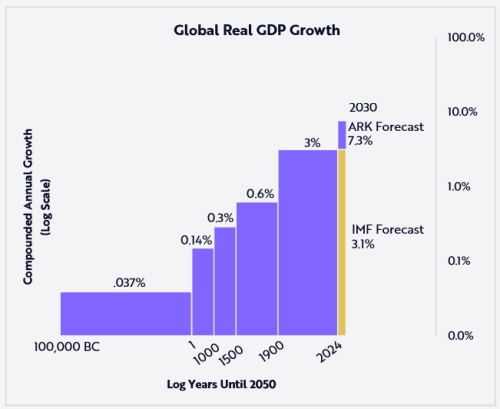
The interconnected fields of AI, robotics, blockchain, energy, and biotech are converging, creating new efficiencies, business models, economic growth, and investment opportunities at an unprecedented pace.
AI agents are changing industries by making decisions automatically, streamlining tasks, and helping people work more efficiently. These smart systems will play a big role in businesses, finance, and healthcare, as well as in everyday life as they improve customer service, digital marketing and provide automated financial advice.
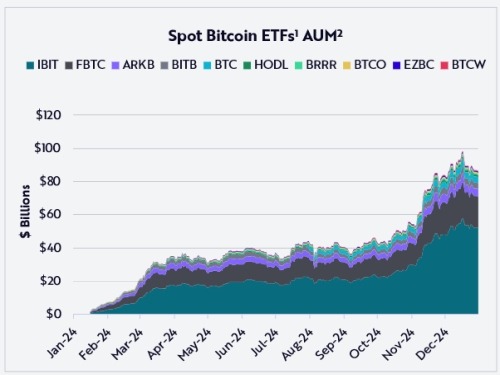
Spot Bitcoin ETF AUM Ark Invest Big Ideas 2025
Bitcoin’s evolution into a mainstream financial asset is being driven by institutional adoption, regulatory clarity, its role as a hedge against inflation, and store of wealth. ETFs and corporate adoption are solidifying its place in global finance. Bitcoin’s adoption will drive new financial products, including tokenized assets, decentralized finance (DeFi) lending, and institutional custody solutions.
Stablecoins are changing the way money moves across borders by making payments faster, cheaper, and more efficient than traditional banks. They connect cryptocurrency with regular money, making digital payments easier, helping more people access financial services, and influencing new rules for digital currencies.
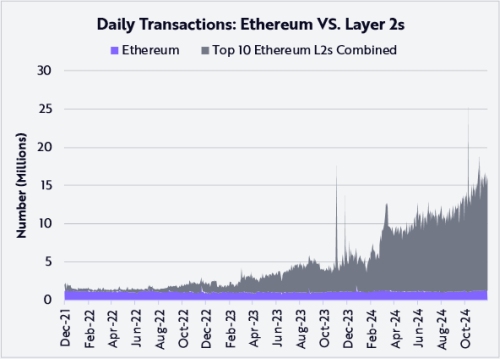
Image: Ethereum vs L2 Daily Transactions (Ark Invest, Big Ideas 2025)
Blockchain scalability will drive growth in DeFi, NFT markets, and enterprise blockchain adoption with solutions such as Layer 2 networks, rollups, and modular architectures are significantly lowering transaction costs and increasing network efficiency. This shift is paving the way for mainstream adoption of decentralized applications.
Autonomous vehicles (robotaxis) will reduce transportation costs, making personal car ownership less necessary, incentivize infrastructure investment and create new financing models for mobility-as-a-service platforms.
AI logistics and smart delivery systems are reducing costs and optimizing supply chain efficiency, creating opportunities in supply chain management solutions and financing of autonomous fleet operations.
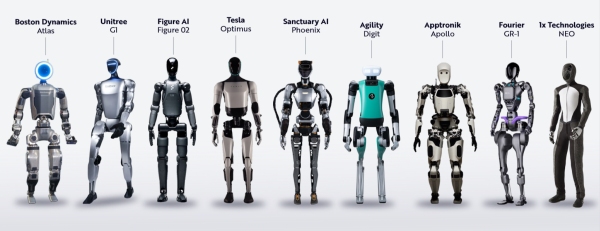
Image: Humanoid Robots Debuting Globally (Ark Invest, Big Ideas 2025)
The rise of AI humanoid robots is changing labour markets and improving manufacturing efficiency. Increased automation will drive investment in robotics startups, manufacturing solutions, and AI workforce solutions.
Breakthroughs in battery technology and renewable energy are reducing dependency on fossil fuels. The shift to decentralized energy creates opportunities in cleantech financing, energy trading, and carbon credit markets.
AI is improving quickly and moving toward Artificial General Intelligence (AGI), which will change how decisions are made, improve risk management, and create new investment opportunities in automation.
The accelerated growth, convergence and adoption of emerging technologies will require new regulatory frameworks, increased infrastructure investments, and a massive shift in market development strategies. Whether it’s the mainstreaming of digital assets or the advancement of artificial intelligence the future is arriving faster than we imagined, and those who adapt will be well positioned for whatever comes next.
The National Crowdfunding & Fintech Association (NCFA Canada) is a financial innovation ecosystem that provides education, market intelligence, industry stewardship, networking and funding opportunities and services to thousands of community members and works closely with industry, government, partners and affiliates to create a vibrant and innovative fintech and funding industry in Canada. Decentralized and distributed, NCFA is engaged with global stakeholders and helps incubate projects and investment in fintech, alternative finance, crowdfunding, peer-to-peer finance, payments, digital assets and tokens, artificial intelligence, blockchain, cryptocurrency, regtech, and insurtech sectors. Join Canada's Fintech & Funding Community today FREE! Or become a contributing member and get perks. For more information, please visit: www.ncfacanada.org
| | |
|---|---|---|
| | |
CBDCs | Feb 4, 2025

Image: Freepik/master1305
While Canada paused its retail CBDC project last year, the Bank of Canada (BoC) recently published a 35 page report on "Privacy-Enhancing Technologies (PETs) for CBDC Solutions" while the UK is advancing its digital pound initiative and has provided an update. Trump explicitly banned CBDCs in the U.S. due to privacy issues upon taking office. This article looks at each country's latest approach to compare and contrast.
As digital payments become more commonly accepted globally, central banks are rethinking the role of currencies in the digital age - aka, Central Bank Digital Currencies (CBDCs), which are largely about modernizing the infrastructure of the financial system. However, governments are approaching CBDCs differently, reflecting differences in monetary policy but also concerns about privacy, financial sovereignty, and security. There are two main use cases being researched including retail and wholesale.
You can think about Retail CBDCs as a 'digital dollar' which are designed for use by the general public to support daily transactions, savings, and digital payments. They promise to increase financial inclusion by providing easy access to digital financial services, even for individuals who are unbanked - meaning individuals/households that do not have access to traditional banking services such as savings/checking accounts or credit from a formal financial institution. Privacy protection and efficiency are key benefits but public trust in data security is paramount for retail CBDC success.
Wholesale CBDCs, on the other hand, are used by financial institutions for bank to bank transfers and could improve cross-border payments, reduce costs and enhance financial market stability. By optimizing interbank settlements, wholesale CBDCs can also strengthen liquidity management on a global scale.
A shared global concern is privacy protection. As digital currencies including CBDCs become more widely used, protecting sensitive financial data is essential other the financial system runs the risk of payment surveillance from hackers, bad actors, institutions, and government. Global cooperation between governments to ensure interoperability and compliance standards is critical, if CBDCs are to ever be adopted in a way that balances economic growth with financial privacy.
In September 2024, the Bank of Canada stopped its work on a retail CBDCs after researching them for several years (see: Bank of Canada’s Latest on CBDC Implementation) citing that most Canadians were not interested in using a digital Canadian dollar. But they are continuing to research PETs like zero-knowledge proofs (ZKPs) and homomorphic encryption that offer privacy solutions that keep user data kept confidential while still enabling financial activities such as compliance checks and fraud prevention.
The report acknowledges several limitations with PETs though including slower transaction speeds due to the complexity of encrypting/processing large volumes of data. More sophisticated software and compute resources are required, raising costs. There is also scalability concerns which are still in early development stages. Lastly, any PET must still meet compliance requirements like anti-money laundering (AML) and counter-terrorism financing (CFT) while preserving user privacy, which is still a difficult act to balance.
The Bank of England (BoE) is still working on the Digital Pound project to modernize the country's payment infrastructure and support financial inclusion as the usage of cash in the UK declines. On Jan 14, 2025 the BoE published a progress update on their findings.
In addition to the digital pound providing a secure and efficiency alternative to traditional payment systems, the BoE is exploring the potential to improve the efficiency of financial markets and cross-border payments, making the digital pound more versatile than just a retail transaction and savings tool.
One of their top priorities is tackling privacy concerns to gain public trust, and designing the digital pound to allow secure transactions while protecting personal data. Another challenge is interoperability with existing systems like credit cards and mobile payments. The digital pound has to integrate seamlessly for a smooth transition between traditional and digital finance. As more central banks investigate the potential of their own CBDCs, the UK's work on the digital pound project will certainly position them to take a leading role in crafting the future of digital currencies while maintaining their financial sovereignty.
In contrast to Canada and the UK, the U.S. has opted to ban CBDCs. On January 23, 2025, as part of the "Strengthening American Leadership in Digital Financial Technology" executive order, President Donald Trump effectively prohibited federal agencies from pursuing any sort of CBDC development largely over privacy and government control concerns (and desire to protect the existing financial infrastructure).
The U.S. government is however pursuing Stablecoins, seen more as a market driven solution that can offer the faster and cheaper benefits of digital currencies without the associated risks of a government issued form of digital money. This approach encourages more private sector innovation but raises questions about potential risks to consumers and financial stability.
Varying approaches to CBDCs and digital money highlight the complexities of balancing between financial innovation, privacy protection, and regulatory compliance. Global cooperation will be essential to address privacy concerns and ensure interoperability and security.
The National Crowdfunding & Fintech Association (NCFA Canada) is a financial innovation ecosystem that provides education, market intelligence, industry stewardship, networking and funding opportunities and services to thousands of community members and works closely with industry, government, partners and affiliates to create a vibrant and innovative fintech and funding industry in Canada. Decentralized and distributed, NCFA is engaged with global stakeholders and helps incubate projects and investment in fintech, alternative finance, crowdfunding, peer-to-peer finance, payments, digital assets and tokens, artificial intelligence, blockchain, cryptocurrency, regtech, and insurtech sectors. Join Canada's Fintech & Funding Community today FREE! Or become a contributing member and get perks. For more information, please visit: www.ncfacanada.org
| | |
|---|---|---|
| | |
Report | Jan 30, 2025

Image: State of UK Equity Crowdfunding (Beauhurst)
According to the latest Beauhurst post on "State of Equity Crowdfunding in the UK", £324 million was raised in 2024, tracking a notable decline from its peak of £773 million in 2021. The total number of crowdfunding rounds also dropped to 297 last year, the lowest on record since 2014. Despite these challenges, investment crowdfunding is still an essential funding source for startups, and new innovations are arriving to adapt to this reality and change investor behaviours.
It's been over a decade since the crowdfunding sector hit markets to provide both companies and investors with access and opportunity to invest in private companies via regulated platforms like Crowdcube and Seedrs. The chart below shows the last decade in equity crowdfunding investment volumes:
Arguably, several factors have contributed to the downturn in UK equity crowdfunding, such as:
New incentives and innovations are emerging to help rejuvenate the sector.
1. Regulatory Adjustments for Easier Fundraising
The Financial Conduct Authority (FCA) approved changes last year after consulting on the new Public Offers and Admissions to Trading Regulations regime (POATRs) aimed at making it easier for companies to raise funds to be implemented by H1 2025. One key change is increasing the threshold for issuing prospectuses in secondary fundraisings from 20% to 75% of a company’s issued share capital. Before, if a company wanted to issue new shares and raise funds from investors, they had to provide a detailed legal prospectus if they were selling more than 20% of their existing shares. Now, that threshold has been raised to 75% so fewer companies will need to go through the costly and time consuming process. This change will help growing businesses to attract more investment more efficiently, helping them scale. Also see new regime for public offer platforms.
2. Growth of Secondary Markets
Investors are increasingly gaining access to more liquidity and deals on secondary markets. Platforms such as Crowdcube and Republic Europe now facilitate secondary sales, which allows early investors to sell (some of) their equity before a company reaches an IPO or acquisition. This change is aimed at addressing the lack of liquidity, one of the biggest challenges in equity crowdfunding markets.
3. Crowdfunding as a Strategic Scale-up Expansion Tool
Some types of established companies use equity crowdfunding for not just capital but also as a way to engage their customers. For example, Gocycle used equity crowdfunding to introduce its new range of e-bikes to secure investment and strengthen brand loyalty at the same time.
1. Sunswap raised £17.3 million (Developing zero emission transport refrigeration systems)
2. Plum raised £2.7 million then raised £16 million series B shortly after (Fintech platform helping users automate saving and investments)
3. MishiPay raised £3.3 million (Retail payment solution, scan and pay via mobile devices)
4. WatchHouse raised £7.17 million (High-end coffee chain expanding across London)
The UK equity crowdfunding sector is in a period of transition. Even though capital and deal volumes have declined in recent years, new regulatory changes and evolving incentives offer potential for renewed growth. The FCA’s changes to fundraising rules, the rise of secondary markets, and the strategic use of crowdfunding by more established companies could reinvigorate investor interest.
The National Crowdfunding & Fintech Association (NCFA Canada) is a financial innovation ecosystem that provides education, market intelligence, industry stewardship, networking and funding opportunities and services to thousands of community members and works closely with industry, government, partners and affiliates to create a vibrant and innovative fintech and funding industry in Canada. Decentralized and distributed, NCFA is engaged with global stakeholders and helps incubate projects and investment in fintech, alternative finance, crowdfunding, peer-to-peer finance, payments, digital assets and tokens, artificial intelligence, blockchain, cryptocurrency, regtech, and insurtech sectors. Join Canada's Fintech & Funding Community today FREE! Or become a contributing member and get perks. For more information, please visit: www.ncfacanada.org
| | |
|---|---|---|
| | |
AI | Jan 27, 2025

Image courtesy of Freepik AI
On January 27, 2025 the Competition Bureau of Canada published the results of its consultation on artificial intelligence (AI) and competition on March 20 based on inputs from 28 stakeholders from global tech firms to startups, academics and consumer advocacy groups, outlining key issues and opportunities of AI in Canada. The findings highlight a pressing need for Canada to balance innovation with fair competition.
Stakeholders agree that AI is a game-changer in business, forging innovation in sectors like finance, healthcare, and transportation, and opening up endless possibilities but it also brings real challenges that Canada needs to address head on. AI relies on access to high quality data, compute power and specialized expertise making it challenging for smaller businesses to enter the space or compete.
Perhaps the biggest concern is the dominance of AI by a handful of large big tech companies like Google, Amazon and Microsoft who control most of the AI infrastructure like data centers, supercomputers and AI chips. This concentration of power isn't new to Canada who is fine with a handful of large banks controlling the majority of the country's financial assets. While Canada has many AI players such as Cohere (Canadian government invested $240 million), Element AI (sold to ServiceNow in U.S.), Waabi, Peak Power, Tenstorrent, Deep Genomics (see CVCA post on growth of Canadian AI by investment mapped), and is recognized for its strong AI research leaders, they do not necessarily operate at the same scale as the likes of big U.S. or Chinese tech companies like OpenAI or Google. As with all forms of high concentration of power, it creates significant barriers for innovative startups and smaller firms to access the resources to train and deploy competitive AI models, however this could change with DeepSeek's disruption. Will Canadian AI firms be able to compete effectively globally, if they are dwarfed in size by their competitor's resources.
Large players could also control the AI supply chain by not allowing smaller competitors to access the infrastructure and tech needed to develop AI systems. Exclusive partnership agreements could also adversely impact competition. Could large players shut off access to critical AI inputs in a type of tariff trade war?
Last December 2024, the Canadian government announced the Canadian Sovereign AI Compute Strategy, a $2 billion investment over 5 years aimed at reducing the reliance on foreign tech giants and strengthen Canada's AI infrastructure but will it be enough when the U.S. has launched a $500 billion Stargate AI infrastructure project?
AI tools such as algorithmic pricing can unintentionally lead to anti competitive practices, when for example, a system automatically adjusts prices to align with competitors - price collusion that's hard to detect and regulate.
The report talks about accountability when AI systems become more autonomous and complex, who is responsible for the outcome of their decisions. While not a new point, the risk is a legal and ethical challenge where AI generates biased or harmful decisions. Think for example a loan approval of auto hiring process.
Another major concern of course is the distribution of misinformation and rise of fake AI generated content like deepfakes, fake reviews etc that mislead consumers, damage trust, and give unscrupulous businesses an unfair/unethical business advantage.
The recommendations in the report are quite high level and scattered throughout the report but here they are in a simple format.
The consultation makes one thing clear. AI offers enormous potential for Canada but its benefits won’t be evenly shared unless Canada takes deliberate and strategic action.
The Competition Bureau’s AI and competition consultation report stressed the importance for Canada to address big tech dominance, support Canadian innovation, and ensure fairness in the AI market. The Canadian Sovereign AI Compute Strategy is promising but must come with robust policies, global collaboration, and targeted investments to level the playing field.
The National Crowdfunding & Fintech Association (NCFA Canada) is a financial innovation ecosystem that provides education, market intelligence, industry stewardship, networking and funding opportunities and services to thousands of community members and works closely with industry, government, partners and affiliates to create a vibrant and innovative fintech and funding industry in Canada. Decentralized and distributed, NCFA is engaged with global stakeholders and helps incubate projects and investment in fintech, alternative finance, crowdfunding, peer-to-peer finance, payments, digital assets and tokens, artificial intelligence, blockchain, cryptocurrency, regtech, and insurtech sectors. Join Canada's Fintech & Funding Community today FREE! Or become a contributing member and get perks. For more information, please visit: www.ncfacanada.org
| | |
|---|---|---|
| | |
AI White Papers | Jan 23, 2025

Image: AI in Financial Services - White Paper (WEF Jan 2025)
The World Economic Forum has just published a flagship series of AI related white papers that capture how AI in the world of 2025 is unfolding in financial services, cybersecurity, competitiveness, and energy paradox. Yes, picture this -- a Canadian entrepreneur launches a new fintech platform that can accurately predicts financial trends with a higher degree of accuracy than ever before. A global cybersecurity network defends deepfake frauds in real-time. Across borders, countries work together to create a shared AI playbook while industries try to solve AI's high energy demands. This article looks at some of the key takeaways but be sure to read the full reports which are easily digestible with each report less than 30 pages in length.
In today's financial services sector, AI is seen as a growth engine and not just a tool for automating tasks. AI spending in financial services reached $35 billion in 2023 and is projected to hit $97 billion by 2027, significantly changing customer experiences and streamlining operations.
Generative AI is enabling financial firms to automate up to 39% of routine tasks, improving personalization and accuracy in customer interactions. Fraud detection is also a key area of service.
70% of financial executives see AI as directly tied to revenue growth. For fintech companies, this signals an opportunity to innovate with small language models and generative tools, reshaping how products are developed and delivered.
Learn more --> Download AI in Financial Services
In the age of AI, cybersecurity is a high stakes game and essential. Deepfake scams surged by 223% in 2024, including a $25 million fraud ploy using a synthetic video of a corporate executive.
AI tools are stepping up to counter these threats. AI powered fraud detection algorithms are increasingly used to verify digital content and detect anomalies. These AI defence systems are also used to combat phishing attacks and a wide range of cyberattacks in real time.
Cybercrime costs to reach $10.5 trillion globally by 2025 without proactive change.
Learn more --> Download AI in Cybersecurity
Only a few countries have the resources to dominate AI globally by going it alone. As a result, regional collaboration is driving innovation in many smaller and mid-sized countries who pool resources to establish common frameworks and reach common goals. For example, Canada’s is collaborating with the EU on ethical AI frameworks to streamline regulatory processes and promote shared standards.
Data sharing initiatives are key for smarter ecosystems and must be designed fairly to uphold human rights and inclusivity. There is a shared responsibility for data equity requiring collaboration across governments, the private sector and academia to reach beneficial outcomes for communities globally. An example of data collaboration is the UAE's 'Jais' model that includes both standard and diverse Arabic regional dialects which improves linguistic accessibility. Another example is Cohere's Aya dataset which represents 114 languages, which serves as a digital language bank to support more inclusive AI research and applications.
Data governance is becoming increasingly complex and collaboration on global data sharing agreements is critical in fostering trust in AI and overcoming regulatory and accessibility obstacles.
Collaborative AI hubs such as regional centers in Europe and Asia are increasingly enabling cross-sector and regional synergies, and are fuelled with combined resources, expertise, and funding which collectively allows smaller countries/organizations to access leading AI inputs and applications.
Learn more --> Download AI Competitiveness via Collaboration
In 2024, AI data centers accounted for approximately 1% of global electricity use, and its projected to rise to over 2% by 2026 and potentially reach 3% by 2030. While the benefits of AI is outstanding, its energy demands are alarming and in need of innovative solutions to resolve.
AI-optimized cooling systems can reduce data center electricity consumption by up to 15%. Also energy efficient AI chip technologies are being developed that can potentially reduce overall electricity consumption by 20-30%.
Advanced frameworks for sustainable energy use and cross border data sharing, such as the European Union's Data Act, show how to align AI adoption with climate goals. The 'energy paradox' requires policies and solutions that balance innovation with sustainability.
Learn more --> Download AI's Energy Paradox
AI is here today and completely rewriting almost every facet of our lives. In 2024, 85% of Fortune 500 companies said that they are deploying AI in at least one critical business function. AI driven robotics are increasing production efficiency by 15% and can reduce errors by 50%. As described by NFX, the AI agent evolution is quickly moving from chatbot generalist to AI first companies. The WEF as part of it's flagship white paper series on AI in 2025 has even produced a report on seeing 'AI in Action', download Beyond Experimentation to Transform Industry" for more case studies and examples of how the AI is driving the future.
The National Crowdfunding & Fintech Association (NCFA Canada) is a financial innovation ecosystem that provides education, market intelligence, industry stewardship, networking and funding opportunities and services to thousands of community members and works closely with industry, government, partners and affiliates to create a vibrant and innovative fintech and funding industry in Canada. Decentralized and distributed, NCFA is engaged with global stakeholders and helps incubate projects and investment in fintech, alternative finance, crowdfunding, peer-to-peer finance, payments, digital assets and tokens, artificial intelligence, blockchain, cryptocurrency, regtech, and insurtech sectors. Join Canada's Fintech & Funding Community today FREE! Or become a contributing member and get perks. For more information, please visit: www.ncfacanada.org
| | |
|---|---|---|
| | |


August 26th, 2025

January 4th, 2024

June 1st, 2021

September 9th, 2020

July 9th, 2018

January 3rd, 2018

September 25th, 2017

June 20th, 2017

May 10th, 2017

December 14th, 2016