




Karsten Wenzlaff, Advisor
August 26th, 2025
Karsten Wenzlaff is a Crowdfunding and Fintech Expert from Germany. He is Secretary-General of Digit[...]


AI | Nov 18, 2025

AI generated image
On November 17, 2025, a Reuters report on Bezos taking an operating role at Project Prometheus stated that Jeff Bezos will return to an operating job as co-chief executive of a new artificial intelligence company called Project Prometheus. The new venture has raised $6.2 billion in early stage funding, partly from Bezos, which makes it one of the best financed startups globally.
The company focuses on artificial intelligence for engineering and manufacturing in computers, automobiles and spacecraft, moving frontier AI from pure text/image/voice tools and into factories, vehicles and hardware design. For Canadian fintech firms, banks and regulators, connecting data, machines and capital in new physical AI ways forces fresh thinking about AI innovation, opportunity, and competitiveness.
Jeff Bezos left his chief executive role at Amazon in 2021 to spend more time on Blue Origin and other ventures. Now he decides to lead operations again at Project Prometheus together with Vik Bajaj, a physicist and chemist who helped build Google X projects and later helped found Verily and Foresite Labs. A team that links deep science, hardware and long term capital.
Several media outlets report that the company already employs around one hundred specialists from OpenAI, DeepMind and Meta. This is the type of recruitment drive for founders who are all in, so Project Prometheus is definitely not a side project, as they look to build a flagship platform that will advanced AI systems for the physical economy. Canadian companies who currently work on industrial AI, climate solutions or financial infrastructure now compete with Bezos and Bajaj's vision and funding scale when they pitch global investors.
The company aims to build models that learn from digital data and from the behaviour of real machines. These models can support design and production for chips, vehicles and spacecraft. They can also connect with logistics networks, maintenance data and energy systems. This approach turns AI into a tool that strives to understand how real assets move, trade and operate.
Canada needs to pay close attention because our industrial base still anchors much of our export story. Statistics Canada says that in 2023 about 7% of businesses with five or more employees used AI tools, up from 4% in 2021, in the Statistics Canada analysis of AI use by Canadian businesses. This number may look small now but it's only going to grows steadily.
Canada also brings global strengths that matter for this new era. A CIFAR and Deloitte analysis of Canada AI talent and funding shows Canada ranks third in the G7 for per capita venture funding for AI companies and leads the group in AI talent concentration growth. This combination of rising adoption, research depth and capital formation gives Canada a strong hand.
Project Prometheus will strengthen the link between AI, machines and markets. When an AI system designs a satellite, a vehicle platform or an energy module, it also creates new information for trade finance, insurance pricing and project valuation. Fintech firms that support equipment finance, trade and logistics, carbon markets or space related infrastructure will need to understand both software and engineering. This convergence creates new opportunities for Canadian platforms that work with industrial data, supply chain finance, carbon measurement or advanced insurance models.
A BIS Financial Stability Institute paper on AI and third party risk explains that the concentration of cloud and AI service providers in a few large technology firms strengthens the case for direct oversight frameworks for those providers. That warning applies directly to any bank or fintech firm that relies on a small set of AI platforms like Project Prometheus.
Canadian supervisors already look closely at these questions. An OSFI and FCAC risk report on AI uses and risks in financial institutions shows how model errors, cyber threats and dependence on outside providers raise real concerns. The report also lays out practical steps that institutions can take through stronger governance, clear accountability and regular testing. This guidance becomes more important as companies like Project Prometheus build AI tools that influence real assets. In those cases financial institutions do more than install software. They connect their balance sheets to systems that interact with factories, power grids and space infrastructure.
Banks and fintech firms in Canada face a world where big AI companies connect software to machines, logistics and energy networks. Most financial institutions cannot build systems on that scale but they can build or fine tune smaller AI models that reflect their own data, their own customers and their own risk frameworks. They can also enter partnerships with large AI providers with clear conditions that protect their control over data, risk models and client outcomes.
Canada's federal Budget 2025 (just won confidence vote) strengthens this landscape because it funds national industrial projects that modernize energy systems, critical minerals, advanced manufacturing and trade corridors. Canada lists the first round of Major Projects Office proposals in a detailed announcement of initial national industrial projects under consideration. The federal plan builds on that list with a second tranche of new large scale projects in clean energy, transportation and processing.
These investments create the physical base that real economy AI systems need. When Canada strengthens energy supply, logistics networks and advanced manufacturing, it gives domestic fintechs, lenders and asset managers room to design AI powered financial products tied to real projects in Canada. This connection matters because AI that shapes chips, satellites or factory layouts increases demand for project finance, equipment leasing, structured credit and supply chain platforms. Canadian fintechs can step into those roles when they align their products with national industrial priorities and work with banks, regulators and investors to support the firms that build in the physical economy.
Project Prometheus spotlights AIs new phase where software, machines and finance converge. Canada already holds strong cards in AI research, talent, and new generational industrial investment projects, but those strengths will matter only if fintech firms, banks, regulators, government, and investors act together. They need to push adoption inside Canadian firms, align regulation with innovation and design funding models that support ambitious industrial AI projects at home.
 The National Crowdfunding & Fintech Association (NCFA Canada) is a financial innovation ecosystem that provides education, market intelligence, industry stewardship, networking and funding opportunities and services to thousands of community members and works closely with industry, government, partners and affiliates to create a vibrant and innovative fintech and funding industry in Canada. Decentralized and distributed, NCFA is engaged with global stakeholders and helps incubate projects and investment in fintech, alternative finance, crowdfunding, peer-to-peer finance, payments, digital assets and tokens, artificial intelligence, blockchain, cryptocurrency, regtech, and insurtech sectors. Join Canada's Fintech & Funding Community today FREE! Or become a contributing member and get perks. For more information, please visit: www.ncfacanada.org
 |  |  |
|---|---|---|
 |  |  |
Token Sales | Nov 13, 2025

Image: Freepik/diana.grytsku
On November 10, 2025 Coinbase announced the launch of its new 2025 end-to-end token sales platform, with the goal is to make token launches more open, fair, and easy to understand, while helping projects build real communities and stable markets. The news is the return of U.S. retail access to public token sales for the first time since 2018, triggered by both market demand and a pro-crypto U.S. Securities and Exchange Commission (SEC) who now says that most crypto tokens are not securities, a complete pivot from the Gensler years when regulators focused mainly on enforcement.
Coinbase’s new model aims to redefine how tokens are launched and distributed by emphasizing fairness, compliance, and long-term project stability. Instead of fast paced selling campaigns that reward a small group of insiders and large buyers, Coinbase is implementing an algorithm that fills smaller requests first, giving retail users increased access to participate. Similarly, here you can find Coinbase black friday deals. This sale window remains open for a set period, usually about a week, and then once closed, allocations are finalized. This ensures a balanced distribution and greater transparency in how tokens reach users.
Every issuer must share verified information about its team, tokenomics, and goals before the sale begins. Coinbase requires a 6 month lock-up period for issuers and their affiliates, which prevents early sell-offs and maintains market trust. These requirements strengthen accountability and align with the platform’s focus on transparent and compliant token issuance.
Coinbase’s design also rewards true community participation. Users who hold tokens beyond the first 30 days receive higher priority in future sales, discouraging short-term speculation (a type of loyalty benefit). For issuers, the model offers exposure to Coinbase’s global retail base and a transparent way to build exchange liquidity over time.
Coinbase has confirmed that Monad (MON) will be the first project to use the new platform, with its token sale scheduled for November 17–22, 2025. A key test of how a compliant, exchange led distribution can work in practice.
The design directly addresses problems seen during the 2017–2018 ICO boom, when many projects raised funds without meeting disclosure or compliance standards. Coinbase’s structured, transparent model supports fair access for users while maintaining clear accountability for issuers.
| Component | ICO Era (2017–2018) | Coinbase Model (2025) |
| Regulatory Clarity | Operated in uncertain areas with little oversight. Many projects later faced SEC actions | Built under SEC guidance that most tokens are not securities, supported by clear disclosures and verified governance |
| Access and Distribution | First-come systems rewarded speed and capital. Retail participation declined as regulators tightened oversight after widespread enforcement against unregistered ICOs, leading most platforms to limit token sales to accredited investors | Algorithm fills smaller requests first, expanding access and allowing U.S. retail buyers to join under defined limits |
| Issuer Accountability | Founders could sell immediately after launch and there were few restrictions or audits | 6 month issuer lock-up and Coinbase approval for any resale, keeping incentives aligned with buyers |
| Market Integrity | Tokens often listed quickly and traded on hype, leading to volatile price swings | Sales connect directly to Coinbase’s exchange roadmap, adding structure and steady liquidity over time |
| User Protection | Few safeguards or verified disclosures; frequent fraud cases | Verified project details, transparent sale process, and checks that reward real users over short-term traders |
Coinbase’s token sale model operates under the U.S. Securities and Exchange Commission’s current interpretation that most tokens are not securities when issued transparently and tied to legitimate network utility. This approach aligns with the SEC’s Project Crypto initiative, which promotes responsible innovation, fair access, and clear disclosure standards for digital assets.
In contrast, Canada maintains a more restrictive policy framework. Under current Canadian rules, most token sales are considered securities offerings unless they clearly fall outside investment contract criteria. The foundational guidance remains the CSA Staff Notice 46-308 – Securities Law Implications for Offerings of Tokens, which sets out how tokens may qualify as securities depending on their structure, purpose, and how they are marketed to participants.
Also, the Canadian Securities Administrators hosts an investor advisory titled Buying and Selling Crypto Assets, which cautions that token sales and trading platforms must comply with registration and disclosure requirements. Unlike the U.S., where retail investors are now permitted to participate in regulated public token sales, Canadian participation remains limited to accredited or exempt investors.
It's clear that the two markets are taking different paths. The United States is moving toward a system that rewards transparency and practical utility, while Canada’s framework continues to prioritize investor protection via restriction. Over time, Canada may need to modernize its regulatory approach to encourage innovation and maintain competitiveness in the global digital asset economy.
It was also recently discovered that Coinbase is moving it's legal incorporation from Delaware to Texas, as detailed in a report on the company’s shift to Texas corporate law. Texas offers a more innovation-friendly business environment and growing digital asset economy. Overall, Coinbase's new token sale model could help define how token distribution evolves worldwide, offering a practical roadmap for compliance with retail access.
The National Crowdfunding & Fintech Association (NCFA Canada) is a financial innovation ecosystem that provides education, market intelligence, industry stewardship, networking and funding opportunities and services to thousands of community members and works closely with industry, government, partners and affiliates to create a vibrant and innovative fintech and funding industry in Canada. Decentralized and distributed, NCFA is engaged with global stakeholders and helps incubate projects and investment in fintech, alternative finance, crowdfunding, peer-to-peer finance, payments, digital assets and tokens, artificial intelligence, blockchain, cryptocurrency, regtech, and insurtech sectors. Join Canada's Fintech & Funding Community today FREE! Or become a contributing member and get perks. For more information, please visit: www.ncfacanada.org
| | |
|---|---|---|
| | |
Digital Assets | Nov 12, 2025
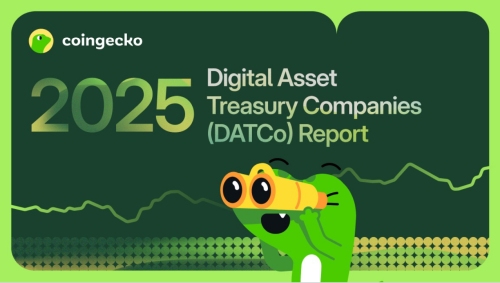
On November 5, 2025 CoinGecko published a comprehensive 2025 Digital Asset Treasury Companies Report unveiling the trends, rankings and strategies of mainly public companies that are increasingly adding digital assets to their balance sheets.
The report outlines three types of public DATCos including (1) Crypto mining firms (i.e., MARA Holdings), (2) Pure play firms whose sole purpose is to accumulate crypto assets (i.e., Strategy or Bitcoin Treasury Corp), and (3) Companies with crypto reserves (i.e., Bitfarms Ltd), with the full source data being available in the report along with CoinGecko's Treasuries Tracker (NB: includes government holdings in rankings).
CoinGecko’s data shows the number of Digital Asset Treasury Companies expanding from just 4 in early 2020 to 142 by October 2025. Total holdings rose from about $30 million to $137.3 billion USD, more than doubling in 2025 alone.
Bitcoin represents about 82.6 % of total holdings, Ethereum 13.2 %, and Solana 2.1 %, with the rest spread among smaller tokens. The United States leads with 60 companies; Canada ranks second with 19, reflecting its strong base of listed miners and crypto firms.
The takeaway is that public companies are increasingly adding digital assets to their balance sheet. Below are highlights of the ins and outs of how they do it, and some lessons learned.
CoinGecko traces Strategy’s transformation from a software company into the world’s largest corporate Bitcoin holder. Since pivoting in August 2020, Strategy has acquired about 640,800 BTC, roughly 3 % of total Bitcoin supply, and now manages holdings exceeding $70 billion USD.
The company funded these purchases through a mix of equity offerings, bond issuances, and preferred shares. Its stock has traded at premiums to its Bitcoin net asset value during parts of 2024, underlining investor appetite for exposure to corporate crypto reserves.
CoinGecko tracks at least $42.7 billion USD in new crypto purchases by DATCos between January and October 2025, with more than half occurring in the third quarter. Bitcoin accounted for roughly 70 % of total spend, Ethereum for 18 %, and Solana led among smaller allocations.
This acceleration reflects growing comfort with digital assets as long-term treasury instruments rather than short-term speculative holdings.
As of November 2025, Strategy leads with $70.7 billion USD in Bitcoin. BitMine Immersion ranks second with combined Ethereum and Bitcoin holdings of $12.9 billion USD, followed by Sharplink, a major Ethereum holder.
The top group also includes Marathon Digital, Riot Platforms, Coinbase, Galaxy Digital, and Tesla. Together, the top 15 account for most corporate-owned digital assets.
Three Canadian-listed firms, Galaxy Digital, Hut 8 Mining, and Bitfarms Ltd., remain among the most significant international participants, confirming Canada’s status as a leader in Bitcoin and Ethereum treasury adoption. Both Galaxy Digital and Hut 8 are listed as U.S. firms on the tracker but they are registered and originated in Canada.
Bitcoin treasuries held by DATCos now total about 1.03 million BTC, equal to 4.9 % of total Bitcoin supply. Strategy alone holds roughly 61.5 % of that amount.
Ethereum holdings across DATCos reached 4.7 million ETH, or 3.9 % of supply, with BitMine Immersion responsible for about 69 % of the total.
Solana treasuries rose to 15.9 million SOL, about 2.9 % of supply. Forward Industries’ $1.65 billion purchase of 6.8 million SOL in September 2025 represents nearly half of all corporate Solana reserves.
CoinGecko documents four key financing methods that DATCos have been using to acquire crypto assets:
Together, these options spotlight structured financing strategies that balance investor access with risk control.
mNAV compares a company’s market capitalization to the value of its crypto holdings, which acts as a sustainability barometer. When mNAV falls below 1.0, raising new equity dilutes shareholders rather than adding value.
CoinGecko found several DATCos near or below that threshold in late 2025. As a result some companies paused new acquisitions, while others turned to preferred shares or buybacks to stabilize their valuations.
CoinGecko’s report offers several clear lessons from 2025’s wave of funding stress and consolidation among crypto treasury companies.
When a company’s share price falls and its mNAV drops near or below 1.0, equity financing becomes uneconomical. Semler Scientific (SMLR) faced this in mid-2025, as weak stock performance made new issuance impossible and a shareholder vote to authorize preferred shares failed.
With no viable financing options left, Semler merged with Strive in September 2025. Consolidation often becomes the only path forward when market access closes.
After the merger Semler relied on preferred equity but its combined valuation still dropped by about 80 %, showing that preference structures help liquidity but not long-term confidence.
Across all DATCos, outstanding debt stood near $12.7 billion USD, which is modest compared with roughly $200 billion USD in crypto assets, leaving space for responsible borrowing to reduce reliance on stock issuance.
Companies use buybacks or issue preference shares to support valuations when mNAV weakens. ETHZilla even sold Ethereum in October 2025 to fund a buyback (a rare reversal of the usual accumulation pattern).
Several DATCos saw share prices surge briefly after announcing digital asset strategies, then retreat as fundamentals reasserted themselves. Some cases drew regulator scrutiny for pre-announcement trading. Companies should not base treasury policy on short-lived market premiums.
Strategy’s perpetual preferred shares attract investors through structured yields, but questions remain when dividends are financed by new share issuance. Transparent funding disclosure maintains credibility.
At a time when Canada's policymakers are creating stablecoin rules, it can learn from these global cases by allowing fair-value accounting for digital assets, enabling multiple funding tools, and setting clear disclosure standards. Canada’s listed mining and fintech firms already play a leading role in corporate crypto adoption. Yet few non-mining public companies have introduced digital reserves.
By updating accounting rules, modernizing treasury disclosure, and piloting a Digital Treasury Sandbox, regulators could enable more smaller scale companies with well-governed asset allocations to improve competitiveness and financial resilience. Digital assets are now a recognized part of global corporate finance. Bitcoin remains the anchor, while Ethereum and Solana continue to gain traction.
The National Crowdfunding & Fintech Association (NCFA Canada) is a financial innovation ecosystem that provides education, market intelligence, industry stewardship, networking and funding opportunities and services to thousands of community members and works closely with industry, government, partners and affiliates to create a vibrant and innovative fintech and funding industry in Canada. Decentralized and distributed, NCFA is engaged with global stakeholders and helps incubate projects and investment in fintech, alternative finance, crowdfunding, peer-to-peer finance, payments, digital assets and tokens, artificial intelligence, blockchain, cryptocurrency, regtech, and insurtech sectors. Join Canada's Fintech & Funding Community today FREE! Or become a contributing member and get perks. For more information, please visit: www.ncfacanada.org
| | |
|---|---|---|
| | |
Policy | Nov 11, 2025

Image: Relative labour productivity Canada vs US (Source: CSLS 2025)
The Centre for the Study of Living Standards released a November 2025 report titled, "Can a Lack of Pro-Productivity Policies Explain the Secular Decline in Canada’s Productivity Growth?", outlining why Canada’s productivity growth has stalled even as macroeconomic policy remains stable. The study finds that steps in the 2025 federal budget while positive, will not by themselves reverse the long slowdown. The authors argue that deeper structural change is needed to rebuild the foundations of business investment and innovation in Canada.
The report traces much of the post 2015 slowdown to long term structural and global factors that are as a result of how past policy choices influenced business behaviour. Verified causes that reduced the total investment per worker and limited productivity even as macro conditions stayed the same include:
Evidence from major institutions supports this view. The analysis in the OECD 2025 Economic Survey of Canada and the IMF 2024 Article IV consultation finds that Canada’s productivity gap reflects long standing frameworks that influence how firms invest and compete. These findings show that the challenge is structural, a long term misalignment between national policy intent and firm level behaviour.
The recently announced Budget 2025 aims to address parts of Canada's productivity, innovation and competition gaps. It includes improvements to the Scientific Research and Experimental Development program by increasing the annual expenditure limit for the enhanced credit to $6 million, restoring eligibility for capital expenditures, and extending eligibility to Canadian public corporations. These measures target investment in intangible assets and innovation, the areas identified as weak.
The budget also commits over $1 billion in resources over five years for AI compute and quantum computing while proposing a TechStat program to track technology adoption, as described in the digital infrastructure plan.
Finally, the budget also advances open banking and stablecoin rules that can improve competition and trust.
Productivity growth depends on what happens inside firms, how they invest, adopt technology, and organize production. Canada’s frameworks have been stable but haven't created strong enough conditions for private reinvestment in digital and intangible assets.
When policy creates the right incentives and financial infrastructure removes friction, investment decisions shift. That alignment between public objectives and private behaviour is where lasting productivity growth emerges.
Canada’s weakness lies in underinvestment in intangible assets such as software, data, intellectual property, and organizational know how. Past tools have not reversed this pattern and Canada needs to reward reinvestment in intangible and digital assets. NCFA has argued for tax credits that mobilize private capital for innovation for years including in an open letter to government during the COVID 19 pandemic, urging government to collaborate with fintechs while proposing investment tax credits to crowd in private capital.
The United Kingdom’s Enterprise Investment Scheme (EIS) offers a clear example of how targeted tax relief can mobilize private capital into early-stage ventures. Since its launch in 1994, the EIS has attracted over £30 billion of private investment into more than 53,000 small and growing companies, according to HM Revenue & Customs.
The EIS program provides individual investors with income tax relief of up to 30% on investments in qualifying startups, along with capital gains deferrals. Analysts credit it with strengthening the UK’s innovation ecosystem and building one of the world’s most active early-stage funding markets.
Reducing interprovincial barriers and boosting competition are valuable but not sufficient on their own. The next step is to modernize how policy and firm level decisions connect. Fintechs can help turn policy into practice by improving access to capital, ensuring reliable and interoperable data, and scaling innovation across the economy. That's how Canada can turn structural reform into more practical and realized productivity gains.
The National Crowdfunding & Fintech Association (NCFA Canada) is a financial innovation ecosystem that provides education, market intelligence, industry stewardship, networking and funding opportunities and services to thousands of community members and works closely with industry, government, partners and affiliates to create a vibrant and innovative fintech and funding industry in Canada. Decentralized and distributed, NCFA is engaged with global stakeholders and helps incubate projects and investment in fintech, alternative finance, crowdfunding, peer-to-peer finance, payments, digital assets and tokens, artificial intelligence, blockchain, cryptocurrency, regtech, and insurtech sectors. Join Canada's Fintech & Funding Community today FREE! Or become a contributing member and get perks. For more information, please visit: www.ncfacanada.org
| | |
|---|---|---|
| | |
AI Agent Research | Nov 10, 2025

Image: McKinsey and Google Cloud AI in Finance 2025 report covers
November 2025 research from McKinsey's The State of AI in 2025 and Google's The ROI of AI in Financial Services reveal that the way banks measure value from AI is changing. Instead of chasing fast gains from early generative tools, the financial sector is moving toward agentic AI platforms that produce steady operational returns and stronger control over risk and cost.
Google’s global financial services study found that 77% of firms report positive ROI from generative AI this year, matching last year’s figure. The data point indicates that the return base has stabilized after an initial surge (not stagnation or decline). Among responders reporting higher revenue, 51% saw growth (6%-10%), while 30% achieved gains above 10%. These numbers dipped slightly year over year, pointing to a normalization phase as programs scale.
The same study found that:
Spending priorities have shifted decisively:
McKinsey’s global findings confirm this rotation:
High performers stand out whose choices correlate directly with both revenue growth and cost reductions.
Benefits are appearing fastest in software engineering, IT, customer service, and marketing. The McKinsey report found that organizations deploying AI across these functions experienced:
• Average productivity gains of 15%-30% in service and technology teams
• Cost decreases of up to 12% in customer operations and risk processing
• Deployment cycles reduced to three to six months, down from an average of twelve months in 2023
• Revenue growth between 6%-10% for over half of financial institutions using AI in production
• Improved fraud detection accuracy by up to 20%, especially among banks integrating multi-agent risk models
Organizations combining workflow redesign with governance and human oversight achieve higher and more consistent ROI than those focused only on model performance.
According to Google and McKinsey's 2025 AI in finance research reports, AI has entered a new phase. The early boom in generative tools has given way to a steadier phase of operational performance driven by agents. The majority of institutions are already realizing returns, but the next iteration of value capture will come from how well they govern, measure, and scale these systems. Canada’s Opportunity In Efficient Reasoning AI its competitive edge, using discipline, design, and data to turn intelligence into growth.
The National Crowdfunding & Fintech Association (NCFA Canada) is a financial innovation ecosystem that provides education, market intelligence, industry stewardship, networking and funding opportunities and services to thousands of community members and works closely with industry, government, partners and affiliates to create a vibrant and innovative fintech and funding industry in Canada. Decentralized and distributed, NCFA is engaged with global stakeholders and helps incubate projects and investment in fintech, alternative finance, crowdfunding, peer-to-peer finance, payments, digital assets and tokens, artificial intelligence, blockchain, cryptocurrency, regtech, and insurtech sectors. Join Canada's Fintech & Funding Community today FREE! Or become a contributing member and get perks. For more information, please visit: www.ncfacanada.org
| | |
|---|---|---|
| | |
Artificial Intelligence | Nov 7, 2025
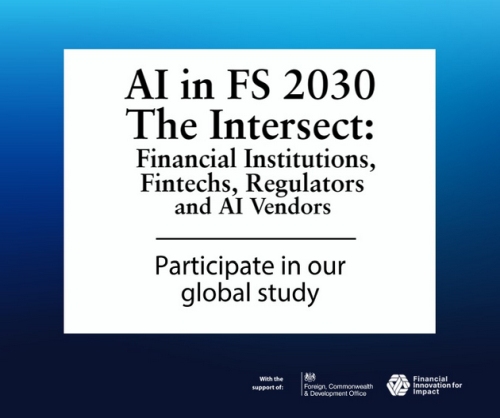
On November 4, 2025 the Cambridge Centre for Alternative Finance (CCAF) at Cambridge Judge Business School launched the AI in Financial Services 2030 Global Survey in collaboration with the World Bank, International Monetary Fund, Bank for International Settlements, and the World Economic Forum.
The National Crowdfunding & Fintech Association of Canada (NCFA) is happy to support this initiative as a survey partner inviting all professionals working in fintechs, banks, and other financial institutions to share their insights on how artificial intelligence is being planned, adopted, and managed across the sector. The survey takes about 25 minutes and explores governance, strategy, technology use, risk, and expectations for how AI will influence financial services by 2030.
This global initiative aims to build the most complete evidence base on AI’s real-world use in financial services. Findings will inform international policy and guide how innovation and regulation can support trust, access to capital, and sustainable growth.
By contributing, respondents will help ensure that fintech perspectives and diverse experiences are reflected in the data driving decisions at both policy and industry levels. The results will provide valuable benchmarks for AI adoption and readiness across different markets and institutions.
Take part in the Industry Survey for Fintechs and Financial Institutions: Access the AI in Financial Services 2030 Industry Survey
Other versions of the survey are available for regulators and AI vendors.
AI is moving incredibly fast, and this study gives everyone in the financial sector a chance to ground the conversation in real data and practical experience. By taking part, you’re helping ensure that future innovation in finance is guided by insight, accountability, and inclusion, values shared across the NCFA community.
The National Crowdfunding & Fintech Association (NCFA Canada) is a financial innovation ecosystem that provides education, market intelligence, industry stewardship, networking and funding opportunities and services to thousands of community members and works closely with industry, government, partners and affiliates to create a vibrant and innovative fintech and funding industry in Canada. Decentralized and distributed, NCFA is engaged with global stakeholders and helps incubate projects and investment in fintech, alternative finance, crowdfunding, peer-to-peer finance, payments, digital assets and tokens, artificial intelligence, blockchain, cryptocurrency, regtech, and insurtech sectors. Join Canada's Fintech & Funding Community today FREE! Or become a contributing member and get perks. For more information, please visit: www.ncfacanada.org
| | |
|---|---|---|
| | |
CIX | Nov 6, 2025

Image courtesy of CIX
Applications have officially opened for the 2026 CIX Startup Awards, one of Canada’s most respected platforms for emerging and growth-stage companies. Run by the Canadian Innovation Exchange (CIX), the program celebrates leading tech startups that that create commercial or social value. A panel of more than 100 North American investors selects the winners, giving founders direct access to some of the most influential decision-makers in the industry.
Recognition through CIX can change everything for a young company. 78% of past winners that were raising capital secured funding within six months, and 86% within a year. On top of that, award recipients reported gaining roughly 35% more customers and partnerships globally after being featured. Those are the kinds of outcomes that make CIX a launchpad rather than just another award.
CIX is open to startups that are incorporated and headquartered in Canada. Companies must be privately held and not listed on any exchange. To be eligible, startups should have a strong technology foundation and a functional prototype or product already in the market. The company’s founder or CEO must also be available to present in person at the summit.
Each winning startup is invited to present live at CIX Summit 2026 in downtown Toronto on March 25, 2026. The experience includes exclusive one-on-one investor meetings, three complimentary passes to the summit, and a dedicated meeting table to connect with potential partners and clients. Winners are permanently listed on the CIX website and often featured in national media, expanding their credibility and visibility far beyond the event itself.
CIX has earned its reputation as a gateway to investors and growth. While it's great to be recognized, it's about visibility, validation, and opportunity. For many founders, presenting at CIX is the moment when their startup story reaches the right audience. With no cost to apply and a process that takes about twenty minutes, the upside is significant. If you’re building something innovative and ready to take the next step, this is your chance to get noticed.
The National Crowdfunding & Fintech Association (NCFA Canada) is a financial innovation ecosystem that provides education, market intelligence, industry stewardship, networking and funding opportunities and services to thousands of community members and works closely with industry, government, partners and affiliates to create a vibrant and innovative fintech and funding industry in Canada. Decentralized and distributed, NCFA is engaged with global stakeholders and helps incubate projects and investment in fintech, alternative finance, crowdfunding, peer-to-peer finance, payments, digital assets and tokens, artificial intelligence, blockchain, cryptocurrency, regtech, and insurtech sectors. Join Canada's Fintech & Funding Community today FREE! Or become a contributing member and get perks. For more information, please visit: www.ncfacanada.org
| | |
|---|---|---|
| | |


August 26th, 2025

January 4th, 2024

June 1st, 2021

September 9th, 2020

July 9th, 2018

January 3rd, 2018

September 25th, 2017

June 20th, 2017

May 10th, 2017

December 14th, 2016