





Karsten Wenzlaff, Advisor
August 26th, 2025
Karsten Wenzlaff is a Crowdfunding and Fintech Expert from Germany. He is Secretary-General of Digit[...]


Crowdfunding | Release | Jul 11, 2024

Image: CCA Crowdfunding Genome (July 2024)
Denver, Colorado, July 11, 2024 - Today, the "Crowdfunding Genome", a visualization tool and ecosystem report, was launched by Crowdfund Capital Advisors (CCA), a global authority in investment crowdfunding research, data, and analysis. This data research highlights the best cities for entrepreneurship and crowdfunding innovation while providing insights into startup ecosystems across the country.
A visualization tool developed by CCA, the Crowdfunding Genome provides access to comprehensive crowdfunding data insights unveiling the inner workings of startup ecosystems. Using sophisticated analytics and exclusive investment crowdfunding data, it evaluates a number of variables that affect and rank startup performance, such as fundraising amounts, investor participation, and entrepreneurial conditions of the sector. The Genome also comes with a complimentary 'Investment Crowdfunding Ecosystem Report 2024' that explores the results.
According to the Crowdfunding Genome, Phoenix/Scottsdale is currently the nation's top startup ecosystem based on a number of variables contributing to the region's top ranking:

CCA Crowdfunding Genome Phoenix Scottsdale July 2024
Phoenix/Scottsdale entrepreneurs have effectively used crowdsourcing to support their businesses, creating an example that other areas might follow.
Sherwood Neiss, Principal at CCA:
"We are thrilled to see Phoenix/Scottsdale recognized as the top startup ecosystem for 2024. This accolade is a testament to the region's vibrant entrepreneurial community and the effectiveness of crowdfunding in driving business growth. It is another proof point that startups need not be located in Silicon Valley to prosper."
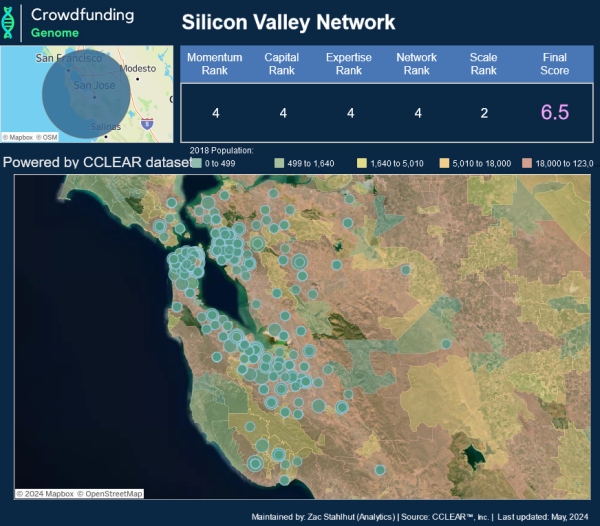
CCA Crowdfunding Genome Silicon Valley network
According to the Crowdfunding Genome, California is the ideal state for startups and is still at the forefront of investment and innovation with over $262 million raised from 654 deals across 540 issuers. A total of 248,748 checks written, average size $1,054. Because of its talent concentration, easy access to venture financing, and progressive laws, the state offers an ideal environment for the development of new businesses.
"For the 8th consecutive year, California is recognized as the best state for startups," added Neiss. "The state’s ecosystem provides unparalleled opportunities for entrepreneurs to scale and succeed. It is exciting to see the broad application of investment crowdfunding for California entrepreneurs."
The Crowdfunding Ecosystem 2024 Report reveals several emerging trends in the crowdfunding space:
The Crowdfunding Genome by the Crowdfund Capital Advisors democratizes access to industry bench-marking information, promoting a more open and effective investing environment. It provides thorough insights into the functioning and potential of startup ecosystems across the United States, enabling investors, entrepreneurs, and policymakers to make well-informed decisions.
 The National Crowdfunding & Fintech Association (NCFA Canada) is a financial innovation ecosystem that provides education, market intelligence, industry stewardship, networking and funding opportunities and services to thousands of community members and works closely with industry, government, partners and affiliates to create a vibrant and innovative fintech and funding industry in Canada. Decentralized and distributed, NCFA is engaged with global stakeholders and helps incubate projects and investment in fintech, alternative finance, crowdfunding, peer-to-peer finance, payments, digital assets and tokens, artificial intelligence, blockchain, cryptocurrency, regtech, and insurtech sectors. Join Canada's Fintech & Funding Community today FREE! Or become a contributing member and get perks. For more information, please visit: www.ncfacanada.org
 |  |  |
|---|---|---|
 |  |  |
Reg A | Jun 17, 2024

Image: Freepik/rawpixel.com
As reported on Crowdfund Insider, on June 13, 2024, Sherwood Neiss, a pioneering voice in the investment crowdfunding field, responded to a Wall Street Journal (WSJ) piece criticizing Regulation A (Reg A) crowdfunding. The WSJ story raised concerns about Reg A's effectiveness and honesty, which Neiss strongly defended, citing the regulation's role in democratizing access to capital.
Regulation A provides an exemption from registration for public offerings. Regulation A has two offering tiers: Tier 1, for offerings of up to $20 million in a 12-month period, and Tier 2, for offerings of up to $75 million. Companies with offers of up to $20 million can choose to proceed under Tier 1 or Tier 2 standards.
This rule enables corporations to offer and sell securities to the public without meeting the stringent standards of a full public offering, making it an appealing choice for startups and small businesses. Among the many checks and balances, companies who use this exemption to raise capital, to fuel the launch or growth of their business, must submit documentation to the Securities and Exchange Commission so that the offering can be "qualified" and approved so that they can raise money online through an intermediary or directly on their own platform.
The Wall Street Journal article opined about the challenges with Regulation A.
Sherwood Neiss, a principal at Crowdfund Capital Advisors and a well-known personality in the equity crowdfunding industry (who has also served as an advisor to NCFA since 2017), responded in depth to the WSJ report - you can read his response here. Neiss, who has helped shape global equity crowdfunding regulations, gave a counter-narrative stressing Reg A's positive influence. Neiss runs a data aggregator business so his insights are backed by significant data collection and analysis, so it's more of an accurate picture than anecdotal evidence.
Neiss mentions that investment crowdfunding has had a $7 billion economic impact - that's growing and pretty significant in our opinion. He also pointed out that these investments do more than just raise capital; they stimulate local economies, create jobs, and support diverse entrepreneurs including women and minorities far more than traditional venture capital.
He continues to say that there have been 8,500 offerings and more than $2 billion raised indicating that equity crowdfunding is growing at scale. Neiss attacks the WSJ for cherry-picking examples to present a bad picture, claiming that the vast majority of businesses benefit tremendously from these chances. This broad perspective demonstrates the potential for major innovation and economic contributions from these early-stage businesses. This all contrasts with the WSJ's portrayal.
Neiss addresses concerns about investor protection by highlighting the stringent requirements under Reg CF and Reg A, such as audited financial statements and mandatory annual reports. These measures enhance transparency and investor safety, countering the WSJ's implications of lax oversight.
"Unlike Regulation D (Reg D) offerings, Reg CF and Reg A impose stringent requirements to protect investors. Issuers under Reg A are mandated to provide audited financial statements and adhere to rigorous SEC disclosure requirements. Additionally, Reg CF issuers must provide annual reports to keep investors informed—another layer of transparency absent in Reg D offerings. In both these offerings, retail investors are capped at how much they can risk."
Neiss advocates for a balanced view that takes into account the inherent risks in all types of startup funding, including traditional techniques such as venture capital and angel investments. He emphasizes the democratizing effect of equity crowdfunding, which makes investment opportunities available to a broader audience beyond accredited investors.
"Your article needs to acknowledge the high failure rates of startups funded through traditional avenues such as VC and angel investments under Reg D."
While obstacles still exist, the law has clearly created new ways for small firms and entrepreneurs to acquire funding. As the sector evolves, stakeholders must work together to address concerns, strengthen protections, and promote a balanced narrative. It is equally crucial to acknowledge and celebrate the successes and possibilities of such regulations. By promoting openness, education, and balanced reporting, the crowdfunding community may contribute to a more inclusive and effective capital-raising landscape.
The National Crowdfunding & Fintech Association (NCFA Canada) is a financial innovation ecosystem that provides education, market intelligence, industry stewardship, networking and funding opportunities and services to thousands of community members and works closely with industry, government, partners and affiliates to create a vibrant and innovative fintech and funding industry in Canada. Decentralized and distributed, NCFA is engaged with global stakeholders and helps incubate projects and investment in fintech, alternative finance, crowdfunding, peer-to-peer finance, payments, digital assets and tokens, artificial intelligence, blockchain, cryptocurrency, regtech, and insurtech sectors. Join Canada's Fintech & Funding Community today FREE! Or become a contributing member and get perks. For more information, please visit: www.ncfacanada.org
| | |
|---|---|---|
| | |
Capital Raising | May 13, 2024

Image: Freepik/jcomp
The Ontario Securities Commission (OSC) has published three new interim class orders to foster capital formation, offering targeted relief and clear directives to specific groups within Ontario’s financial ecosystem. Effective May 9, 2024, these orders address not-for-profit angel investor groups, early-stage businesses, and streamline reporting processes under the self-certified investor prospectus exemption. Here, we break down the essential features and limitations of each order, clarifying their purpose, target audience, and anticipated impact on the markets.
Grant Vingoe, Chief Executive Officer of the OSC:
“New and growing businesses play an essential role in our economy, contributing to job creation and driving productivity gains through innovation and competition. These initiatives reflect the OSC’s commitment to fostering the conditions for growth and innovation in Ontario’s capital markets without compromising investor protection, as outlined in our recently released strategic plan.”
Leslie Byberg, Executive Vice President, Strategic Regulation:
“The OSC TestLab initiatives will provide important insights as we work to support access to finance at all stages of business growth. The data and information collected will help inform future policymaking, including promoting access to capital for early-stage businesses in Ontario while also ensuring investor protections.”
These interim class orders from the OSC are designed to reduce regulatory impediments and support innovative financing structures. Each order is crafted with specific features and limitations to ensure the balance between capital formation and investor protection. As these initiatives unfold, they are anticipated to help improve Ontario’s economic landscape by enabling more capital-raising pathways for early-stage businesses.
The National Crowdfunding & Fintech Association (NCFA Canada) is a financial innovation ecosystem that provides education, market intelligence, industry stewardship, networking and funding opportunities and services to thousands of community members and works closely with industry, government, partners and affiliates to create a vibrant and innovative fintech and funding industry in Canada. Decentralized and distributed, NCFA is engaged with global stakeholders and helps incubate projects and investment in fintech, alternative finance, crowdfunding, peer-to-peer finance, payments, digital assets and tokens, artificial intelligence, blockchain, cryptocurrency, regtech, and insurtech sectors. Join Canada's Fintech & Funding Community today FREE! Or become a contributing member and get perks. For more information, please visit: www.ncfacanada.org
| | |
|---|---|---|
| | |
Regulation Crowdfunding Report | May 9, 2024

Image: SEC, Office of the Advocate for Small Business Capital Formation
The Securities and Exchange Commission (SEC), Office of the Advocate for Small Business Capital Formation (OASB) published a report by researcher Melody Cheng called "Women and Minority-owned Businesses in Regulation Crowdfunding' showcasing the increasing trend of how Regulation Crowdfunding (Reg CF) is reshaping the demographics of access capital, moving away from traditional venture capital and angel investment avenues.
The policy recommendations from the SEC report on minority and women activity under Reg CF include strategies aimed at boosting participation and providing ongoing support for these groups of entrepreneurs.
These recommendations are intended to remove barriers and enhance the ability of minority and women entrepreneurs to access and benefit from crowdfunding opportunities, thus promoting a more inclusive entrepreneurial ecosystem.
As policymakers and industry stakeholders continue to refine these platforms, the potential for fostering a more equitable business environment looks promising.
The National Crowdfunding & Fintech Association (NCFA Canada) is a financial innovation ecosystem that provides education, market intelligence, industry stewardship, networking and funding opportunities and services to thousands of community members and works closely with industry, government, partners and affiliates to create a vibrant and innovative fintech and funding industry in Canada. Decentralized and distributed, NCFA is engaged with global stakeholders and helps incubate projects and investment in fintech, alternative finance, crowdfunding, peer-to-peer finance, payments, digital assets and tokens, artificial intelligence, blockchain, cryptocurrency, regtech, and insurtech sectors. Join Canada's Fintech & Funding Community today FREE! Or become a contributing member and get perks. For more information, please visit: www.ncfacanada.org
| | |
|---|---|---|
| | |
Reg A+ | April 2, 2024

Image: Freepik
The Jumpstart Our Business Startups (JOBS) Act of 2012 introduced Reg A+, enabling companies to raise up to $75 million from both accredited and non-accredited investors offering businesses a significant runway for growth through online solicitation. Reg A+ represents a flexible and accessible means for smaller companies to access investment capital markets, balancing the need for capital formation with investor protection measures. Learn more: SECs page on Reg A/A+
The Reg A+ journey comes with regulatory intricacies, high costs, and operational challenges that demand attention and strategic planning. Below are some insights based on an issuer's firsthand experience based on an interview conducted by our colleagues at Crowdfund Insider in the U.S..
With its dual-tier system allowing significant raises of up to $75 million, Reg A+ is a blend of opportunity and regulatory oversight, fostering an environment where startups and SMEs can thrive.
The National Crowdfunding & Fintech Association (NCFA Canada) is a financial innovation ecosystem that provides education, market intelligence, industry stewardship, networking and funding opportunities and services to thousands of community members and works closely with industry, government, partners and affiliates to create a vibrant and innovative fintech and funding industry in Canada. Decentralized and distributed, NCFA is engaged with global stakeholders and helps incubate projects and investment in fintech, alternative finance, crowdfunding, peer-to-peer finance, payments, digital assets and tokens, artificial intelligence, blockchain, cryptocurrency, regtech, and insurtech sectors. Join Canada's Fintech & Funding Community today FREE! Or become a contributing member and get perks. For more information, please visit: www.ncfacanada.org
| | |
|---|---|---|
| | |
Policy | March 13, 2024

Image: Unsplash/Alexander Mils
The House of Representatives has recently passed the Expanding Access to Capital Act, an important piece of legislation sponsored by Patrick McHenry, which aims to streamline and enhance the funding process for entrepreneurs and startups.
The bill was approved with a vote of 212 to 205, reflecting a division along party lines. Fifteen Representatives abstained from voting. Although the bill did not receive support from Democrats, the final version of the legislation included several amendments proposed by Democratic members. Although the House has passed the legislation, its reception in the Senate remains uncertain. Before becoming law, legislation must pass through several stages, including potential amendments and approvals by different legislative bodies (e.g., the Senate in the United States). Until it is finalized and enacted, the exact provisions and their implications 'may' change.
The Expanding Access to Capital Act introduces several regulatory changes aimed at democratizing investor participation by making it easier for a broader range of investors to engage in the funding of startups and small businesses, such as:
As we await its final approval and implementation, the outlook for entrepreneurs seeking to bring new ideas to market is decidedly more optimistic, signaling a shift towards a more accessible and dynamic financial ecosystem. These regulatory changes are designed to create a more inclusive investment ecosystem, where more individuals have the opportunity to invest in startups and small businesses.
By lowering barriers to entry and making it easier for companies to raise capital, the Expanding Access to Capital Act aims to foster a more vibrant and diverse economic landscape. Canadian capital markets and regulators are you listening?
The National Crowdfunding & Fintech Association (NCFA Canada) is a financial innovation ecosystem that provides education, market intelligence, industry stewardship, networking and funding opportunities and services to thousands of community members and works closely with industry, government, partners and affiliates to create a vibrant and innovative fintech and funding industry in Canada. Decentralized and distributed, NCFA is engaged with global stakeholders and helps incubate projects and investment in fintech, alternative finance, crowdfunding, peer-to-peer finance, payments, digital assets and tokens, artificial intelligence, blockchain, cryptocurrency, regtech, and insurtech sectors. Join Canada's Fintech & Funding Community today FREE! Or become a contributing member and get perks. For more information, please visit: www.ncfacanada.org
| | |
|---|---|---|
| | |
March 4, 2024

In today’s dynamic business landscape, having an advanced IT infrastructure is essential for staying competitive. Upgrading technology enhances efficiency, strengthens data security, and supports expansion efforts. However, the financial commitment for such upgrades is significant, demanding careful planning and strategic financial management.
Considering IT infrastructure upgrades necessitates a detailed evaluation of your organization’s current and future needs. Despite the substantial investment, a well-timed upgrade can significantly improve productivity and operational efficiency.
Read on to learn how to effectively finance your business’s IT infrastructure upgrades and begin your journey toward technological advancement.
Financing your business’s IT infrastructure upgrades is a pivotal step toward future-proofing your operations and enhancing efficiency. Selecting the right financing option can make a significant difference in the implementation and success of these technological improvements.
Below are some key avenues to consider when looking to fund your IT infrastructure upgrades:
It’s crucial to assess each option’s fit with your business’s financial health and growth strategy. Interest rates, repayment terms, and the overall impact on your company’s cash flow are key factors to consider. Some options offer lower upfront costs, while others provide more flexibility or non-repayable funding, depending on your eligibility.
Maximizing financial advantages through tax incentives and depreciation is a strategic approach to managing the costs associated with IT infrastructure upgrades. These tax benefits can substantially lower the effective cost of new technology investments, making it easier for businesses to implement necessary updates.
Below are key strategies to consider:
Engaging with a tax professional to explore these options can provide tailored advice, ensuring your business maximizes its tax benefits. This step is crucial for understanding the specific qualifications for each incentive and how they apply to your investments in IT infrastructure.

Turning to unconventional funding sources like crowdfunding and angel investors can offer your business a unique opportunity to finance IT infrastructure upgrades without relying solely on traditional loans or capital reserves.
Below are insights into these innovative financing avenues:
By exploring these options, you gain access to funding that can be more flexible than traditional loans and might not require collateral. However, it’s essential to consider that both methods involve sharing information about your project with the public or potential investors, which could affect your business in various ways.
Financing IT infrastructure upgrades requires a multifaceted approach that balances innovation with financial prudence. Whether through traditional loans, leasing, government incentives, tax benefits, or tapping into the power of crowdfunding and angel investors, businesses have various tools to support technological advancement.
Each option presents advantages and considerations, emphasizing the importance of a strategy tailored to your business’s unique needs and goals. Embrace these opportunities to enhance your operational efficiency and secure a competitive edge in the digital era.
The National Crowdfunding & Fintech Association (NCFA Canada) is a financial innovation ecosystem that provides education, market intelligence, industry stewardship, networking and funding opportunities and services to thousands of community members and works closely with industry, government, partners and affiliates to create a vibrant and innovative fintech and funding industry in Canada. Decentralized and distributed, NCFA is engaged with global stakeholders and helps incubate projects and investment in fintech, alternative finance, crowdfunding, peer-to-peer finance, payments, digital assets and tokens, artificial intelligence, blockchain, cryptocurrency, regtech, and insurtech sectors. Join Canada's Fintech & Funding Community today FREE! Or become a contributing member and get perks. For more information, please visit: www.ncfacanada.org
| | |
|---|---|---|
| | |



August 26th, 2025

January 4th, 2024

June 1st, 2021

September 9th, 2020

July 9th, 2018

January 3rd, 2018

September 25th, 2017

June 20th, 2017

May 10th, 2017

December 14th, 2016
