




Karsten Wenzlaff, Advisor
August 26th, 2025
Karsten Wenzlaff is a Crowdfunding and Fintech Expert from Germany. He is Secretary-General of Digit[...]


Oct 28, 2025

Image: Freepik AI
On October 27 2025, Anthropic announced new finance upgrades for Claude Sonnet 4.5 that make it work more deeply inside everyday finance tasks. The update adds an Excel integration, real time data connections, and built in tools that automate work usually done by analysts. These features strengthen its Claude for Financial Services product that was first introduced in July 2025, as they try to woo banks, asset managers, insurers, and fintech companies directly.
External validation from Vals AI’s Finance Agent benchmark, where Claude achieved 55.3% accuracy on tasks designed for financial analysts (Read: algorithms may be coming for your job soon). The benchmark covers 537 finance-specific questions that test reasoning, modelling, and data interpretation.
1. The first is Claude for Excel, which allows people to work with Claude directly inside Microsoft Excel. Claude can read, modify, and create spreadsheets, perform analysis, and trace the origin of each number. The integration is designed to save time while keeping audit trails and data checks intact.
2. The second feature is a set of live data connections. Claude can now pull information from several licensed financial sources. Anthropic confirmed new data links to Aiera (earnings insights), Third Bridge (expert research), Chronograph (private equity data), Egnyte (secure data rooms), LSEG (market analytics see partnership between Anthropic and LSEG), Moody’s (credit intelligence), and MT Newswires (market news).
3. The third addition is a group of Agent Skills that automate repetitive finance work. These include comparable company analysis, discounted cash flow models, due diligence summaries, company profiles, earnings analyses, and initiating coverage reports. Each task produces transparent outputs that can be verified back to original data sources.
These new tools will accelerate embedding AI into professional finance workflows. Excel still remains the favourite tool for global financial analysis, and integrating Claude into that environment changes how teams manage data and reporting. By connecting to trusted financial sources under strict compliance rules, Claude allows institutions to automate tasks such as modelling and research while maintaining full transparency and control.
It can cut repetitive manual work, improve accuracy through verifiable data sourcing, and enable faster decision making. The combination of AI and live financial data could also give smaller firms the same analytical capacity as large institutions, provided they apply proper data governance and oversight.
Anthropic’s continued investment in transparency, auditability, and security aligns with the needs of Canada’s regulated financial ecosystem and supports a more productive and competitive environment for both incumbents financial institutions and fintech innovators.
 The National Crowdfunding & Fintech Association (NCFA Canada) is a financial innovation ecosystem that provides education, market intelligence, industry stewardship, networking and funding opportunities and services to thousands of community members and works closely with industry, government, partners and affiliates to create aa vibrant and innovative fintech and funding industry in Canada. Decentralized and distributed, NCFA is engaged with global stakeholders and helps incubate projects and investment in fintech, alternative finance, crowdfunding, peer-to-peer finance, payments, digital assets and tokens, artificial intelligence, blockchain, cryptocurrency, regtech, and insurtech sectors. Join Canada's Fintech & Funding Community today FREE! Or become a contributing member and get perks. For more information, please visit: www.ncfacanada.org
 |  |  |
|---|---|---|
 |  |  |
Regulation | Oct 27, 2025

Image courtesy of AI
On October 7, 2025, SEC Chair Paul Atkins talked about major changes to the Wells process in an SEC keynote address to the A A Sommer Jr Lecture at Fordham School of Law, including a new enforcement framework built around due process and transparency. Atkins described the Wells process as a safeguard that prevents the Commission from becoming “policeman, prosecutor, judge, and jury all in one.” He also emphasized that enforcement should focus on actual misconduct and investor harm rather than minor or technical violations.
The reforms include doubling the time allowed for responses, expanding access to testimony and investigative materials, and offering meetings with senior enforcement leadership before a recommendation is made. A BakerHostetler analysis and Dechert commentary confirm that these measures address years of criticism that the process was opaque, one-sided and unfair.
By aligning the Wells process with constitutional principles of fairness and proportionality, the SEC is signaling a more predictable approach that could encourage compliance and reduce costly disputes.
Few sectors highlight the importance of fair process more than digital assets. In 2024 and 2025, the SEC issued several Wells notices that dominated headlines and influenced global sentiment toward crypto markets (aka regulatory crackdown). NCFA covered how these actions impacted both perception and investment, such as the various Wells notices received that preceded litigation to Coinbase (March 2023), Robinhood (May 2024), and Uniswap Labs (April 2024), each becaming examples of what critics called “regulation by enforcement.”
The market reaction was usually immediate and swift. Share prices fell sharply after each announcement, venture funding slowed, and token listings became more conservative. The consistent theme across these cases was the lack of procedural clarity, leaving firms to interpret opaque standards that often changed after the fact. Not all inquiries ended with penalties. The SEC’s decision to close its stablecoin investigation in the Paxos BUSD (July 2024), suggested that avoiding enforcement was possible in limited cases.
Atkins planned changes come amid an administration that has declared support for digital assets and innovation and issued a series of policy reversals and case dismissals since taking office, including a full unconditional pardon for Binance founder, CZ most recently. The new government enacted the country's first comprehensive stablecoin law, the GENIUS Act, forming a statutory foundation for reserve-backed tokens. In February 2025, U.S. crypto czar Sacks outlined a coordinated plan for risk based supervision and technology neutral rules. Together these measures announced by the SEC signal a coordinated push by the administration toward fairness, predictability and genuine regulatory clarity.
Two weeks after Atkins’ address, as reported by Politico, the Trump administration announced plans to nominate Michael Selig as chair of the Commodity Futures Trading Commission who brings experience in digital asset policy and his focus on aligning derivatives oversight with technological modernization.
If confirmed, Selig’s appointment could enhance coordination between the CFTC and SEC on digital assets and tokenized products. A combined regulatory environment based on fairness, due process, and interagency cooperation that could stabilize U.S. market confidence after years of policy divergence and frustrated investors and innovators.
Regulatory predictability is essential for innovation and investment. When enforcement processes are clear and timelines are known, firms can allocate resources more effectively between compliance and product development (and not moving goal posts).
The Wells process reforms and the CFTC nomination together are clear signs that the days of regulating crypto by fear and enforcement are over. If implemented as anticipated, these policies could restore the trust between market participants and regulators, a prerequisite for sustainable capital formation. Impacted fintech leader should update internal playbooks to reflect the new Wells response timeline, including the opportunity for earlier meetings and white paper submissions.
Boards can establish governance protocols based on four week response periods and expect data-driven engagement with enforcement staff. For investors, a fairer U.S. digital asset environment could deepen capital pipelines and improve valuations in the digital finance sector.
For continued updates on regulatory developments and their implications for fintech and digital markets, subscribe to NCFA’s weekly newsletter for verified analysis and insights.
The National Crowdfunding & Fintech Association (NCFA Canada) is a financial innovation ecosystem that provides education, market intelligence, industry stewardship, networking and funding opportunities and services to thousands of community members and works closely with industry, government, partners and affiliates to create aa vibrant and innovative fintech and funding industry in Canada. Decentralized and distributed, NCFA is engaged with global stakeholders and helps incubate projects and investment in fintech, alternative finance, crowdfunding, peer-to-peer finance, payments, digital assets and tokens, artificial intelligence, blockchain, cryptocurrency, regtech, and insurtech sectors. Join Canada's Fintech & Funding Community today FREE! Or become a contributing member and get perks. For more information, please visit: www.ncfacanada.org
| | |
|---|---|---|
| | |
NCFA Canada | Oct 27, 2025
Toronto, Canada and Dubai, UAE – October 27, 2025 – The National Crowdfunding & Fintech Association of Canada (NCFA), a non-profit fintech network, and TheBlock, a Dubai-based virtual asset hub, today announced a strategic partnership to expand cross-border collaboration, education, and adoption of tokenized real-world assets (RWA).
This partnership creates a bridge between Canada’s fintech and investor community and Dubai’s growing hub for tokenized assets. By combining NCFA’s network of entrepreneurs, investors, regulators, and industry leaders with TheBlock’s expertise in tokenization and capital markets, the collaboration will help firms explore opportunities in RWA, broaden investor participation, and better understand global adoption trends.
Craig Asano, NCFA’s founder and CEO:
“Education and collaboration are central to this initiative. By working with TheBlock, we can help firms explore tokenization use cases, engage more effectively with international investors, and build confidence in this fast-evolving market.”
Farbod Sadeghian, CEO of TheBlock, added:
“Our mission is to open global pathways for firms and innovators to participate in tokenization. By Canada’s fintech ecosystem to international markets where adoption is advancing quickly, we’re creating practical opportunities for companies to explore, experiment, and grow.”
As tokenization and real-world assets power digital finance, education and global collaboration are critical to ensure firms, investors, and policymakers are equipped for the transition. NCFA and TheBlock will co-develop initiatives such as joint knowledge programs, workshops, and ecosystem-building events to support this evolution.
The National Crowdfunding & Fintech Association of Canada (NCFA) is a non-profit fintech ecosystem that supports and amplifies fintech, alternative, digital, and AI-driven finance globally. NCFA provides education, market intelligence, advocacy, networking, and funding opportunities to entrepreneurs, investors, regulators, and innovators.
TheBlock is a Dubai-based virtual asset hub focused on tokenization, capital readiness, advisory, and ecosystem building. With a mission to connect global markets and foster adoption of real-world assets through tokenization, TheBlock provides education, programs, and services to companies, investors, and innovators shaping the future of finance.
The National Crowdfunding & Fintech Association (NCFA Canada) is a financial innovation ecosystem that provides education, market intelligence, industry stewardship, networking and funding opportunities and services to thousands of community members and works closely with industry, government, partners and affiliates to create aa vibrant and innovative fintech and funding industry in Canada. Decentralized and distributed, NCFA is engaged with global stakeholders and helps incubate projects and investment in fintech, alternative finance, crowdfunding, peer-to-peer finance, payments, digital assets and tokens, artificial intelligence, blockchain, cryptocurrency, regtech, and insurtech sectors. Join Canada's Fintech & Funding Community today FREE! Or become a contributing member and get perks. For more information, please visit: www.ncfacanada.org
| | |
|---|---|---|
| | |
Crypto | Oct 24, 2025

Image courtesy of AI
On October 23, 2025, as reported by AP News U.S. President Donald Trump issued a full and unconditional pardon to Changpeng Zhao, a Canadian citizen and founder of Binance, the world’s largest crypto exchange. The decision cleared Zhao’s 2023 conviction under U.S. anti–money laundering and sanctions laws.
According to the White House, Trump “exercised his constitutional authority” to issue the pardon, describing Zhao’s prosecution as part of “the Biden Administration’s war on cryptocurrency.” The news arrived amid a record Bitcoin record high above $120,000 earlier in July, showing renewed investor optimism in the digital asset market.
The pardon comes as global regulators assess how to balance enforcement with innovation. For Canadian fintechs, it raises questions about regulatory predictability and competitiveness. Under the current U.S. administration, regulatory enforcement appears more forgiving toward large crypto platforms, which could influence global investment decisions.
In Canada, regulators fined Binance $6 million CAD for anti–money laundering violations and Binance compliance failures in Canada.
The pardon reintroduces uncertainty over how enforcement consistency (or inconsistency) impacts capital allocation and market trust. Transparent, consistent oversight is still vital to sustaining trust and access to global markets.
Zhao’s Canadian citizenship links Canada directly to one of the most influential figures in crypto. After serving nearly four months in prison and paying a $50 million fine, Zhao retained his stake in Binance while appointing Richard Teng as CEO.
In a statement, Zhao said he was “deeply grateful for today’s pardon and to President Trump for upholding America’s commitment to fairness, innovation, and justice,” adding that he would “do everything we can to help make America the Capital of Crypto.”
As the perceived regulatory risk lowers in the U.S. due to regulatory clarity, there's renewed optimism among institutional investors. For Canadian investors, a more predictable U.S. outlook could improve confidence in cross-border partnerships if compliance frameworks remain strong.
With the pardon now in place, Binance may renew expansion in the U.S. under current CEO Richard Teng who has emphasized compliance, transparency, and rebuilding trust with regulators worldwide. Analysts note that the pardon “could pave the way for the firm’s return and reintegration into the American market.”
The Trump pardon of Changpeng Zhao is another key moment in the global crypto narrative. For Canada, it highlights the importance of credible, consistent oversight as markets respond to pro-crypto U.S. policy signals. Renewed institutional attention to digital assets could open doors for compliant fintechs, but long-term success will depend on maintaining transparency, sound governance, and global coordination.
The National Crowdfunding & Fintech Association (NCFA Canada) is a financial innovation ecosystem that provides education, market intelligence, industry stewardship, networking and funding opportunities and services to thousands of community members and works closely with industry, government, partners and affiliates to create aa vibrant and innovative fintech and funding industry in Canada. Decentralized and distributed, NCFA is engaged with global stakeholders and helps incubate projects and investment in fintech, alternative finance, crowdfunding, peer-to-peer finance, payments, digital assets and tokens, artificial intelligence, blockchain, cryptocurrency, regtech, and insurtech sectors. Join Canada's Fintech & Funding Community today FREE! Or become a contributing member and get perks. For more information, please visit: www.ncfacanada.org
| | |
|---|---|---|
| | |
OurCrowd | Oct 22, 2025
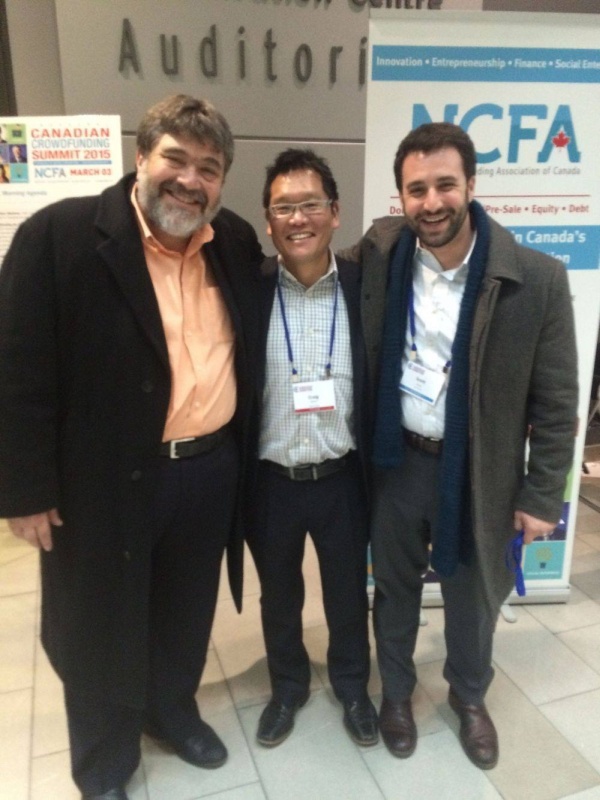
Image: Inaugural Canadian Crowdfinance Summit 2015, NCFA Craig Asano with Jon Medved CEO OurCrowd
On October 21 2025, as reported by several news outlets, OurCrowd announced on Tuesday that Founding CEO Jon Medved will move into the role of Chairman after being diagnosed with ALS, also known as Lou Gherig’s disease. OurCrowd named Cali Chill as Acting CEO and COO, a long-time executive who has led investment operations. Medved will stay active by focusing on strategy, global partnerships, and support for portfolio companies.
In his conversation with Calcalist, Medved said that after thirteen years leading the company this change was necessary but that he continues to work full days.
“A few months ago, I was hospitalized and diagnosed with ALS, a serious and terrible disease. Everything still works, but it’s very difficult for me to breathe. I’m improving and fighting it, and I still work eight to ten hours a day, which allows me to continue treatment.”
OurCrowd began in 2013 when new rules under the JOBS Act opened doors for online investment. The platform connected smaller accredited investors with venture deals that were once limited to big institutions. Under Medved’s leadership, it grew into one of the world’s largest tech investment networks, backing companies such as Anthropic, Databricks, Groq, and SpaceX.
As reported by Crowdfund Insider, OurCrowd now reports more than 2.6 billion USD in commitments across 500 portfolio companies and 68 funds with 240,000 registered investors from 195 countries.
Cali Chill said he is honoured to lead at this time and credited Medved for building the culture that drives the company. He said that by offering curated access to venture opportunities, OurCrowd bridges the gap between institutional investors and individuals who want professional access to global startups. Medved said he will keep pushing to democratize venture investing and use artificial intelligence to reach a wider community of investors.
Medved has been a returning keynote speaker at NCFA Canada events over the years, such as the 2015 Canadian Crowdfinance Summit and FFCON19: Fearless. He was known for his inspiring energy, storytelling, and ability to connect people. After his talks, crowds would often follow him as he handed out business cards and traded ideas with founders and investors. He was highly sought after and a regular guest in leading media outlets where he spoke about Israel’s technology ecosystem, global venture markets, and innovation trends. His stories about Israel’s startup culture and how necessity sparked resilience left a strong mark on the Canadian innovation community.
One memorable example came during his keynote at CCS 2015, when Medved made a spontaneous commitment on stage to open a Canadian office for OurCrowd. Within months, the firm delivered on that promise, establishing operations in Toronto and announcing a 1 million USD investment in Influitive, a Toronto-based advocate marketing leader. Ontario’s Minister of Economic Development at the time, Brad Duguid, described the move as "a landmark step for Canada’s growing technology and venture capital scene".
Even now as Jon manages ALS, he continues to work and inspire others. He remains a powerful voice for founders, investors, and countries building inclusive capital markets. His determination to keep working through adversity shows the same spirit that made OurCrowd a global success. On behalf of NCFA, we wish all the best for Jon and his team during this time.
The National Crowdfunding & Fintech Association (NCFA Canada) is a financial innovation ecosystem that provides education, market intelligence, industry stewardship, networking and funding opportunities and services to thousands of community members and works closely with industry, government, partners and affiliates to create aa vibrant and innovative fintech and funding industry in Canada. Decentralized and distributed, NCFA is engaged with global stakeholders and helps incubate projects and investment in fintech, alternative finance, crowdfunding, peer-to-peer finance, payments, digital assets and tokens, artificial intelligence, blockchain, cryptocurrency, regtech, and insurtech sectors. Join Canada's Fintech & Funding Community today FREE! Or become a contributing member and get perks. For more information, please visit: www.ncfacanada.org
| | |
|---|---|---|
| | |
Fintech Competition | Oct 21, 2025

Image: Freepik/kues1
On October 8 2025, QED Investors and Oliver Wyman released Seizing the Bank Charter Moment (37 page PDF), tracking that fintechs filed more than 20 charter applications in 2025 (3x the number in 2023). The analysis found that obtaining a charter reduced funding costs by 150 to 300 basis points and improved net interest margins by 2 to 4%, driven by access to insured deposits and direct payment rails.
Also, on October 16 2025, Innovate Finance published Challenger Banks: A British Success Story (28 page PDF) confirming that UK challengers now hold about 25% of SME business current accounts and provide 60% of SME lending, up from under 5% seven years earlier.
The report found that fintechs with a bank charter earn an average return on equity of 14 to 16%, compared with 9 to 10% for those still operating as non-banks. The analysis outlined three main ways fintechs can hold a charter: (1) Full national bank charter; (2) Industrial loan company model that allows more flexibility for parent investors; and (3) Limited-purpose charter that does not take deposits but still falls under direct supervision.
The report shows that about 20 new applications had been filed by fintechs and new entrants, at the time of publishing. The Financial Technology Association said this renewal of new fintech charter bank activity can help increase competition. FDIC officials noted that the total number of US banks has fallen from roughly 8,500 in 2008 to 4,500 today, strengthening the case to restore market entry options.
For growing fintechs, the economic break-even point for considering the bank charter pathway is around $5 billion in assets and a return on equity above 12%. Meaning beyond that level, the cost savings from having a charter more than offset the added compliance and capital requirements. Even with about $50 to $100 million in new capital requirements and $8 to $12 million in yearly compliance costs, the charter still provides a net advantage.
As an aside, the lower cost of capital for chartered banks comes from structure, not size. Non-banks depend on wholesale funding or partner-bank arrangements that add about 1.5 to 3% to their cost of money because these funds are not insured. And chartered banks fund mainly through insured deposits, giving them a built-in advantage even after paying for regulatory oversight.
Innovate Finance report shows that challenger and specialist banks increased their small business lending to £110 billion in 2024 (about $140 billion CAD), which is 4.5% higher than the year before. The British Business Bank reports that these banks now provide about 60% of all lending to UK small and medium-sized enterprises (SMEs), a significant achievement.
However, the report warns that upcoming rules under Basel 3.1 and the Small Domestic Deposit Taker (SDDT) regime could make it harder for smaller banks to lend. They estimate that the new rules could reduce small business lending by up to £44 billion, which they describe as a potential tax on growth. Their Think Challenger proposal calls for more balanced regulation so that smaller, well-managed banks can continue to support small firms and customers while staying safe and sound.
This UK's experience offers clear lessons for Canada; that clear and fair (proportionate) rules can encourage innovation and competition while maintaining trust and stability in the system.
For larger banks, the benefits of collaboration are also visible. Institutions that work with challenger banks or fintechs on digital credit and data analytics see 10 to 15% faster deposit growth compared with those that compete alone.
In July 2025, the federal government began consulting on how to update the country’s deposit insurance system. Open banking including accreditation rules are expected to appear in the fall budget. The Retail Payment Activities Act (RPAA) is now fully in effect, bringing both domestic and international payment firms under the supervision of the Bank of Canada. Together these steps strengthen oversight but do not yet create a path for fintechs to operate as full banks.
For policymakers, both reports referenced in this article are evidence that fair and proportionate rules for capital and licensing help increase competition and small business lending without creating extra risk. Canada could adopt a tiered model where smaller fintech lenders meet simpler capital and reporting standards based on their size and activities, while full deposit-taking banks continue to meet the higher bar.
Canada doesn't yet have a charter pathway for fintechs or smaller non-bank lenders. Introducing a proportionate licensing framework with a transparent and time-bound review process would improve predictability, attract investment, and show that Canada is open to fintech banking innovation.
For fintech founders, timing, a level playing field and the ability to innovate and compete without structural barriers now matters. For investors, the valuation gap is becoming clear. In the US, fintech banks with charters trade at about 1.6 times book value, compared with 1.1 times for similar lenders without charters. A well-defined Canadian charter model could close that gap and attract more long-term domestic investment into fintech banking.
The simple truth is when proportionate rules are clear and scaled to risk, competition improves, credit costs go down, and innovation thrives. The UK and US results show that proportionate regulation produces measurable gains in lending and economic resilience. Canada now has a short window in 2025 to enable domestic fintechs a fair chance to grow and succeed at home.
The National Crowdfunding & Fintech Association (NCFA Canada) is a financial innovation ecosystem that provides education, market intelligence, industry stewardship, networking and funding opportunities and services to thousands of community members and works closely with industry, government, partners and affiliates to create aa vibrant and innovative fintech and funding industry in Canada. Decentralized and distributed, NCFA is engaged with global stakeholders and helps incubate projects and investment in fintech, alternative finance, crowdfunding, peer-to-peer finance, payments, digital assets and tokens, artificial intelligence, blockchain, cryptocurrency, regtech, and insurtech sectors. Join Canada's Fintech & Funding Community today FREE! Or become a contributing member and get perks. For more information, please visit: www.ncfacanada.org
| | |
|---|---|---|
| | |
Oct 20, 2025

Image: Freepik/wirestock, Reykjavik
Are you planning to extend your business reach to Iceland, known for its innovative economy and tech-savvy population? Are you searching for an efficient way to communicate with Icelandic contacts without facing the high costs associated with international dialing? Or maybe you're interested in maintaining your privacy while engaging with this unique market? Virtual numbers, particularly those provided by Virtnum.com, offer a remarkable solution, allowing for smooth, secure communication channels with Iceland. Let's dive into the advantages of utilizing an Icelandic virtual number through Virtnum.com and how it can significantly enhance your communication strategy.
In the global marketplace, creating a local presence can dramatically enhance your business's credibility and accessibility. An Icelandic virtual number allows you to establish this presence, making it easier and more affordable for individuals in Iceland to reach you. This local approach not only facilitates better communication but also strengthens your brand's reputation within the Icelandic community. Virtnum.com ensures that this critical connection is both straightforward and effective, aiding your successful entry into the Icelandic market.
In today’s interconnected world, protecting your personal and business communications is crucial. Opting for an Icelandic virtual number through Virtnum.com is a strategic step in safeguarding your privacy. This approach allows you to interact within the Icelandic market while keeping your actual contact information confidential. This level of privacy is invaluable, ensuring peace of mind for both individuals and businesses looking to explore or expand in Iceland.
Virtnum.com is dedicated to providing a user-friendly experience, ensuring that acquiring and utilizing an Icelandic virtual number is hassle-free. There’s no need for physical SIM cards or complicated setups; your virtual number is ready to use almost immediately. Moreover, the ability to forward calls to any device ensures that you remain connected to your Icelandic contacts, no matter where your travels or business may take you.
Adopting an Icelandic virtual number from Virtnum.com is a cost-effective choice. It enables you to avoid expensive international call fees, allowing you and your Icelandic associates to enjoy local call rates. This affordability is particularly advantageous for businesses and individuals aiming for frequent communication with Iceland without incurring significant costs.
Beginning your journey to enhanced connectivity in Iceland is seamless with Virtnum.com. Simply visit their website, choose the Icelandic virtual number that best suits your needs, and follow the easy setup instructions. With Virtnum.com’s dependable service and dedicated customer support, you're assured a smooth and effective experience from the outset.
An Icelandic virtual number from Virtnum.com is more than just a tool for communication; it’s a strategic asset for anyone looking to engage effectively with Iceland.
Whether your goals involve business expansion, privacy enhancement, or streamlined communication, Virtnum.com provides a powerful, user-friendly platform to meet your needs. Embrace the future of communication with an Icelandic virtual number from Virtnum.com and open new doors to opportunities in Iceland today.
The National Crowdfunding & Fintech Association (NCFA Canada) is a financial innovation ecosystem that provides education, market intelligence, industry stewardship, networking and funding opportunities and services to thousands of community members and works closely with industry, government, partners and affiliates to create aa vibrant and innovative fintech and funding industry in Canada. Decentralized and distributed, NCFA is engaged with global stakeholders and helps incubate projects and investment in fintech, alternative finance, crowdfunding, peer-to-peer finance, payments, digital assets and tokens, artificial intelligence, blockchain, cryptocurrency, regtech, and insurtech sectors. Join Canada's Fintech & Funding Community today FREE! Or become a contributing member and get perks. For more information, please visit: www.ncfacanada.org
| | |
|---|---|---|
| | |


August 26th, 2025

January 4th, 2024

June 1st, 2021

September 9th, 2020

July 9th, 2018

January 3rd, 2018

September 25th, 2017

June 20th, 2017

May 10th, 2017

December 14th, 2016