




Karsten Wenzlaff, Advisor
August 26th, 2025
Karsten Wenzlaff is a Crowdfunding and Fintech Expert from Germany. He is Secretary-General of Digit[...]


Tokenization | Nov 3, 2025

Image: Freepik/lifeforstock
On November 3, 2025, speaking at Hong Kong FinTech Week 2025 (Nov 3-7), Standard Chartered Group CEO Bill Winters told attendees that the bank is working with regulators and infrastructure providers across Asia to make tokenized settlements operational.
“Our belief, which I think is shared by the leadership of Hong Kong, is that pretty much all transactions will settle on blockchains eventually, and that all money will be digital,” adding that institutional adoption is now driving the market.
Digital currency momentum is building across Asia. According to Quartr, during Standard Chartered’s Q3 2025 earnings call, he emphasized that blockchain and tokenized asset infrastructure are “a core part of our payments and securities business strategy.” The bank’s venture arm SC Ventures has invested in settlement platforms and digital asset custody providers in Hong Kong, Singapore, and the UAE to prepare for institutional scale.
Hong Kong’s digital finance policy is moving from experimentation to scale. The Securities and Futures Commission (SFC) circular on expanding virtual asset trading platform services removes earlier barriers for banks and licensed exchanges to issue and custody tokenized securities under supervision. It also aligns with Hong Kong’s new stablecoin licensing regime, which took effect on August 1 2025, creating a pathway for licensed entities to offer regulated stablecoins towards broader public access.
Hong Kong Monetary Authority chief executive Eddie Yue unveiled the city’s Fintech 2030 strategy built on four pillars. Data, AI, Resilience, and Tokenization (DART) and announced the next phase of the Project Ensemble pilot (read his full speech here).
The pilot now extends beyond proof-of-concept to real transactions in tokenized deposits and money-market funds between major banks and corporates. Yue said tokenization will make bond settlement and trade finance “faster, cheaper, and safer” while preparing the city for cross-border interoperability.
Hong Kong’s strategic approach shows how regulatory clarity and infrastructure readiness can draw investment and accelerate industry innovation. The model offers a blueprint for Canada to move beyond regulatory sandboxes and innovation hubs toward supervised tokenized settlement and digital-asset custody frameworks built into the financial system.
For Canadian fintechs and banks, staying competitive will depend on how quickly policymakers complete payment modernization, establish clear rules for stablecoins and tokenized assets, and open Payments Canada’s systems to more participants through the Real-Time Rail.
Remember, Standard Chartered is already building tokenized-finance capabilities across Asia. Institutions will need to update their core systems to benefit from faster cross-border and digital settlement and to connect with the growing global networks for tokenized finance.
The SFC and HKMA frameworks create one of the world’s most coordinated environments for institutional blockchain adoption and banks like Standard Chartered are positioning themselves to capitalize on that alignment.
 The National Crowdfunding & Fintech Association (NCFA Canada) is a financial innovation ecosystem that provides education, market intelligence, industry stewardship, networking and funding opportunities and services to thousands of community members and works closely with industry, government, partners and affiliates to create a vibrant and innovative fintech and funding industry in Canada. Decentralized and distributed, NCFA is engaged with global stakeholders and helps incubate projects and investment in fintech, alternative finance, crowdfunding, peer-to-peer finance, payments, digital assets and tokens, artificial intelligence, blockchain, cryptocurrency, regtech, and insurtech sectors. Join Canada's Fintech & Funding Community today FREE! Or become a contributing member and get perks. For more information, please visit: www.ncfacanada.org
 |  |  |
|---|---|---|
 |  |  |
AI Licensing | Nov 3, 2025

Image: Freepik/rawpixel.com
On October 31 2025, Getty Images and Perplexity announced a global multi-year agreement that gives Perplexity permission to display Getty’s creative and editorial photos within its AI search tools. The partnership uses Getty’s API to bring licensed images directly into Perplexity’s results with clear credits and links to the original source.
It’s one of the first major deals between an AI company and a content rights holder, an example of how licensing can help AI platforms respect creators while improving the quality of what users see.
Jessica Chan, Head of Content and Publisher Partnerships at Perplexity:
“Getty Images shares our belief that the future of AI‑powered discovery requires respecting the creators behind the content. Attribution and accuracy are fundamental to how people should understand the world in an age of AI"
Perplexity has faced several plagiarism and scraping allegations during the past year, including incidents involving Getty photos that appeared without license. The new agreement resolves those issues by providing legitimate access under clear terms.
Nick Unsworth, Vice President Strategic Development at Getty Images:
"This agreement paves the way for a productive and collaborative partnership between our companies, where we will work together to improve attribution of our contributors' work and Getty Images’ high‑quality creative and editorial content will enhance Perplexity’s platform.”
Attribution does not grant any rights, and any reuse or commercial application still requires a separate license from Getty Images. There is no indication of sublicensing or user-level permissions in any official material.
The Perplexity–Getty deal is a win-win where a structured licensing partnership can strengthen trust and reduce copyright exposure while improving the user experience. For Getty, the deal adds a new business stream in AI search.
For Perplexity, it helps rebuild credibility after a year of public criticism while following through on stronger commitment to transparency and proper credit for creators. This partnership also builds on the company’s earlier initiative to share value with content creators through its 80/20 revenue-sharing program for publishers.
Being transparent about where information comes from builds confidence with users and regulators. As Canada develops its own rules for AI and copyright, partnerships like this one show how respecting creators can go hand in hand with innovation.
The National Crowdfunding & Fintech Association (NCFA Canada) is a financial innovation ecosystem that provides education, market intelligence, industry stewardship, networking and funding opportunities and services to thousands of community members and works closely with industry, government, partners and affiliates to create a vibrant and innovative fintech and funding industry in Canada. Decentralized and distributed, NCFA is engaged with global stakeholders and helps incubate projects and investment in fintech, alternative finance, crowdfunding, peer-to-peer finance, payments, digital assets and tokens, artificial intelligence, blockchain, cryptocurrency, regtech, and insurtech sectors. Join Canada's Fintech & Funding Community today FREE! Or become a contributing member and get perks. For more information, please visit: www.ncfacanada.org
| | |
|---|---|---|
| | |
Fintech | Oct 30, 2025
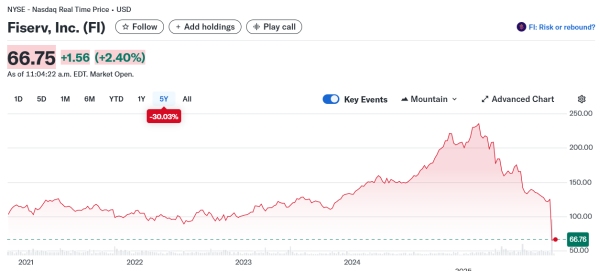
Image: Fiserv (FI) (Yahoo Finance Chart, Oct 31, 2025)
What triggered Fiserv’s record stock crash?
On October 29 2025, Fiserv Inc.’s stock plunged 44 percent in a single trading day after management sharply cut revenue and earnings forecasts. The Forbes report confirmed that guidance for full year organic revenue dropped to roughly 3.5% to 4.5% (down from 10%), and adjusted earnings per share fell to about $8.50 to $8.60 (previous range near $10.25).
Outlets called it the company's worst trading day on record, while Reuters reported that roughly $30 billion USD in market value was wiped out.
The Financial Times reported that some of Fiserv’s problems came from its business in Argentina. The company had invested heavily there to grow its payments and merchant services, but rising inflation and unstable policies hurt results.
Yahoo Finance verified that quarterly adjusted earnings were $2.04 per share on $4.92 billion in revenue, both falling short of analyst estimates, and that management’s revised guidance signalled weaker growth into 2026.
The speed and scale of the decline caught analysts off guard and the abrupt reversal in management guidance spooked investor confidence more than the revenue miss itself.
The credibility hit reflects a governance gap and not a market anomaly. Canadian financial institutions face a similar risk. When boards and risk teams depend too much on vendors’ optimistic projections, they can be caught off guard when results fall short. Honest forecasts, active oversight, and clear accountability are essential to maintain trust.
The slowdown of Fiserv’s merchant processing as noted by Reuters, raised red flags because it showed how much of the global financial ecosystem depends on a handful of vendors for core services.
Canadian credit unions and regional banks operate within similar limits, relying on few providers for payments, fraud monitoring, and digital banking infrastructure. A major vendor’s disruption could ripple through daily operations.
Fintechs should avoid relying on a single provider for critical services. Where possible, they should use multiple vendors or include clear backup and continuity plans in core contracts. A stable vendor network is now part of staying resilient, not just managing costs.
MarketWatch linked Fiserv’s current struggles to its 2019 First Data merger, which left the company with high debt and overlapping systems.
Many Canadian institutions are undergoing similar digital transformations. The Fiserv experience shows that modernization without aligned governance and risk planning can backfire.
Further with respect to Argentina, expanding into fast growing but unpredictable markets can look appealing, but without strong local plans and risk controls, it can backfire when conditions change.
Banks should aim to strike the balance between innovation, cutting costs, and building long term strength. Fintechs on the other hand need to be realistic and transparent with financial reporting and growth goals. Making promises that can’t be met damages trust faster than any technical problem.
Fiserv is undergoing a strategic reset. In a release, the Fiserv appointed Paul Todd as CFO effective October 31, named Takis Georgakopoulos and Dhivya Suryadevara as co-presidents effective December 1, and refreshed its board under new independent chair Gordon Nixon. Two directors will step down on January 1 2026 as part of a governance overhaul. Whether these measures restore confidence remains uncertain.
The National Crowdfunding & Fintech Association (NCFA Canada) is a financial innovation ecosystem that provides education, market intelligence, industry stewardship, networking and funding opportunities and services to thousands of community members and works closely with industry, government, partners and affiliates to create aa vibrant and innovative fintech and funding industry in Canada. Decentralized and distributed, NCFA is engaged with global stakeholders and helps incubate projects and investment in fintech, alternative finance, crowdfunding, peer-to-peer finance, payments, digital assets and tokens, artificial intelligence, blockchain, cryptocurrency, regtech, and insurtech sectors. Join Canada's Fintech & Funding Community today FREE! Or become a contributing member and get perks. For more information, please visit: www.ncfacanada.org
| | |
|---|---|---|
| | |
Payments Report | Oct 30, 2025
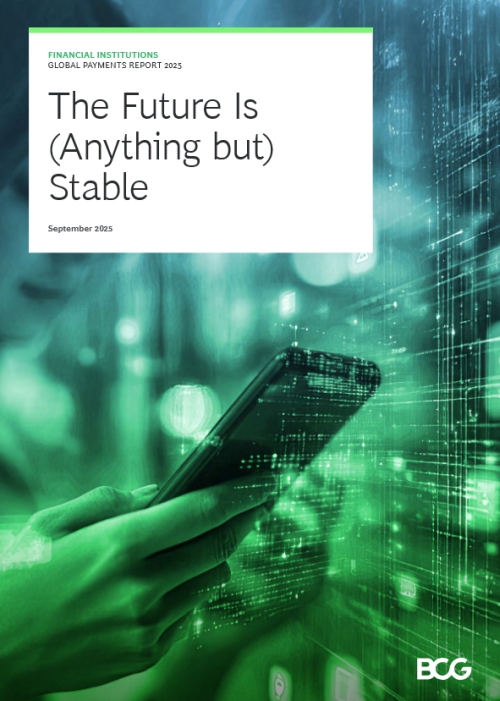
Image: The Future is (Anything but) Stable (BCG Global Payments 2025 report)
On Sept 22, 2025 the Boston Consulting Group (BCG) released the Global Payments Report 2025 titled 'The Future is (Anything but) Stable" (37 page PDF report) reported that worldwide payment revenues totalled about $1.9 trillion in 2024 and are expected to exceed $2.4 trillion by 2029.
Growth is slowing however from nearly 9% a year to around 4%, highlighting the end of a rapid growth period where payment providers earned more interest income on money moving through their systems. The next phase will be led by innovation, not momentum.
According to the report, the foundations of global payments are being rebuilt through real-time transactions, tokenized assets, and smarter compliance. For Canada, the domestic system is stable but slower than peers in Asia or Europe. Modernization can help ensure that Canadian fintechs and banks remain competitive as value begins to move across programmable digital networks.
These above trends describe a payments ecosystem that is no longer growing by size but by sophistication.
Between pages 9 and 13, the report explains that tokenization has moved from pilot projects to real adoption.
Stablecoins process over $26 trillion in yearly transactions and are being used for remittances, business payments, and treasury operations. The combined value of circulating stablecoins is close to $270 billion, with US dollar-linked tokens like USDT and USDC dominating.
Tokenized funds hold more than $3 billion in assets, and private credit tokenization has reached $10 billion. In addition, governments in Singapore, Hong Kong, and Europe are issuing digital bonds under clear frameworks such as MiCA.
More than 10 countries have live central bank digital currencies, and over 90% of central banks are testing or building them. Global banks including Citi, HSBC, and UBS are already piloting tokenized deposits connected to their main systems.
For Canada, tokenization could open the door to trusted digital assets that fit within the existing regulated structure. It allows for faster, safer movement of money and investment while maintaining transparency and oversight. By building policy alignment and open access, Canada can turn this technology into a tool for inclusion, without being left behind.
The report points to a global race to connect innovation with regulation. Countries that create clarity around digital assets, tokenized deposits, and real-time infrastructure will attract investment and improve access to capital. For Canada, this means progressing digital finance policy and expanding participation in global payment corridors. The combination of tokenized assets, instant settlement, and data-driven compliance could give Canadian participants a stronger role in international markets.
Canada is already making strides in payments innovation. The Bank of Canada and other regulators are working to bring more providers onto national infrastructure and exploring tokenisation and stablecoins. With the federal 2025 budget scheduled for early next week on November 4, there is hope that policymakers will signal clearer guidelines or incentives for stablecoins and digital assets that could boost competitiveness and access to capital for Canadian fintechs.
The National Crowdfunding & Fintech Association (NCFA Canada) is a financial innovation ecosystem that provides education, market intelligence, industry stewardship, networking and funding opportunities and services to thousands of community members and works closely with industry, government, partners and affiliates to create aa vibrant and innovative fintech and funding industry in Canada. Decentralized and distributed, NCFA is engaged with global stakeholders and helps incubate projects and investment in fintech, alternative finance, crowdfunding, peer-to-peer finance, payments, digital assets and tokens, artificial intelligence, blockchain, cryptocurrency, regtech, and insurtech sectors. Join Canada's Fintech & Funding Community today FREE! Or become a contributing member and get perks. For more information, please visit: www.ncfacanada.org
| | |
|---|---|---|
| | |
Oct 30, 2025

Estonia has become one of the most attractive EU hubs for crypto businesses: digital-first processes, e-Residency, and clear MiCA-aligned rules make it ideal for launching compliant exchanges, wallets and custody services.
Thanks to this, obtaining a crypto license in Estonia is profitable, fast, and legal.
Prifinance leverages this environment to deliver end-to-end support - from company formation and AML/KYC frameworks to regulatory communication and post-authorization compliance.
|
Advantages of working with Prifinance |
Numbers |
| Experience in international consulting | 30 years |
| Completed projects | 10,000+ |
| Crypto licenses obtained | 400+ |
| Supported jurisdictions | 40 |
| Successful cases on complex requirements (including MiCA) | 100+ |
| Lawyers, auditors, and consultants | 100+ |
This track record ensures brand reliability and practical experience when you scale in Europe.
A MiCA-compliant Estonian license (CASP/VASP) gives lawful access to the EU market with passporting rights, clear consumer protections, and harmonised reporting requirements. You need this license when your project: accepts fiat/crypto from users, offers custody or wallet services, executes crypto-to-fiat or crypto-to-crypto trades, processes remittances, or markets token sales to EU residents.
Beyond legal permission, the license demonstrates institutional-grade governance - strict KYC, continuous transaction monitoring, secure IT architecture, and appointed compliance officers - which improves access to banking, liquidity partners and institutional clients. These elements are crucial at launch and become non-negotiable as trading volumes, AML scrutiny, or institutional relationships grow.
Why Estonia - practical benefits
We prioritise your brand and market credibility from day one. That means not only preparing an application that satisfies regulators, but also shaping how counterparties and clients perceive you: professional legal structure, transparent ownership, robust compliance policies, auditor-ready documentation, and clear public-facing materials.
Our offering includes: company incorporation in Estonia, preparation of AML/KYC and internal control manuals, recruitment and registration of key personnel, technical security checklists, liaising with the FIU/FSA, and post-license support. By pairing compliance with marketable governance, we help your brand convert regulatory compliance into a competitive asset.
Prifinance works with major banking and fintech partners and maintains long-term relationships with thousands of international clients.
Our partners include leading financial and technology companies such as CIM Banque, Commerzbank, Payoneer, OCBC Bank, Binance, Mashreq, Odav Print, Montify, and Blockchain Life.
Our client feedback and case experience show smooth licensing processes and effective post-license support - a practical advantage when regulators request clarifications or audits.
Visit https://prifinance.com/en/cryptocurrency-license/ to request a tailored licensing plan, get a cost estimate, and start the application process: Prifinance provides full-cycle support for Estonia CASP/VASP applications and post-authorization compliance. Send a request through our site to receive a personalized proposal.
The National Crowdfunding & Fintech Association (NCFA Canada) is a financial innovation ecosystem that provides education, market intelligence, industry stewardship, networking and funding opportunities and services to thousands of community members and works closely with industry, government, partners and affiliates to create aa vibrant and innovative fintech and funding industry in Canada. Decentralized and distributed, NCFA is engaged with global stakeholders and helps incubate projects and investment in fintech, alternative finance, crowdfunding, peer-to-peer finance, payments, digital assets and tokens, artificial intelligence, blockchain, cryptocurrency, regtech, and insurtech sectors. Join Canada's Fintech & Funding Community today FREE! Or become a contributing member and get perks. For more information, please visit: www.ncfacanada.org
| | |
|---|---|---|
| | |
Prediction Markets | Oct 29, 2025

Image: NHL Calder Memorial Trophy example (Polymarket)
On October 22, 2025, the National Hockey League (NHL) announced new multi-year partnerships with Kalshi and Polymarket. It's the first time a major sports league has given prediction markets an official seat at the table.
Both Kalshi and Polymarket will use official NHL data, league marks, and broadcast rights to let fans interact with games through regulated financial platforms. The partnerships show how fintech innovation is breaking into unexpected territory, and why responsible design and governance matters just as much as bold ideas.
Think of a prediction market as a meeting point between finance and curiosity.
People can trade small contracts based on real-world outcomes, such as who will win this year's Stanley Cup or a playoff series? How many goals a team might score? Or whether a player reaches a milestone? The prices of those contracts is based on supply and demand, so they reflect what the crowd believes will happen.
Kalshi operates under the U.S. Commodity Futures Trading Commission (CFTC), while Polymarket began as a blockchain experiment using the Polygon network and USDC stablecoin.
For fans, prediction markets turn watching into participation.
For fintechs, it validates that with the right mix of data, incentives, and community interactions financial tools can become part of mainstream entertainment when framed responsibly. Innovation when paired with trust can educate and expand access, too.
Behind the excitement sits a serious legal question. Kalshi is fighting a federal battle with the New York State Gaming Commission, which insists that its contracts are a form of unlicensed sports wagering. Kalshi argues otherwise. Other regulators in places like Massachusetts and Nevada have voiced similar concerns. Each ruling is a test of whether innovation can coexist with public accountability. The company says federal law gives the CFTC authority, not state gaming boards.
Polymarket’s path has been anything but linear. After paying a $1.4 million CFTC fine in 2022 for operating without registration, the firm earned approval to relaunch in the U.S. in 2025 by acquiring QCEX exchange with a CFTC license.
By changing from a fully decentralized model to one that aligns with compliance standards, Polymarket demonstrated how they could innovate within regulatory frameworks. Now it sits alongside Kalshi as an NHL partner. A fintech built on blockchain that's earned institutional trust by embracing regulation, instead of resisting it.
As covered by the Sports Business Journal, the NHL didn’t jump in blindly. Reports show the NHL consulted regulators and examined consumer protections before agreeing to the partnerships.
Even so, the American Gaming Association called the deal “deeply troubling” (subscription required) warning that fans could confuse regulated markets with gambling. That tension captures a bigger issue facing every fintech today. That is how to innovate responsibly while protecting users. The NHL partnership suggests that fintechs can scale mainstream by demonstrating to regulators And customers that innovation and safety can coexist.
For Canada, the NHL partnership is a glimpse into what the future of participatory finance could look like. Canadian regulators have already been exploring frameworks for digital assets, open banking, and tokenized finance.
Prediction markets fit naturally into that conversation. If handled properly, they could open new avenues for retail engagement and capital formation while reinforcing Canada’s reputation for responsible fintech growth.
Prediction markets are moving from the edges of crypto into the center of participatory commerce. By partnering with Kalshi and Polymarket, the NHL is betting not only on fan enthusiasm but on fintech’s capacity to build trust through transparency. For Canada’s fintech community, the moment reinforces a truth long advocated by NCFA, when innovation, regulation, and inclusion advance together, everyone gains.
The National Crowdfunding & Fintech Association (NCFA Canada) is a financial innovation ecosystem that provides education, market intelligence, industry stewardship, networking and funding opportunities and services to thousands of community members and works closely with industry, government, partners and affiliates to create aa vibrant and innovative fintech and funding industry in Canada. Decentralized and distributed, NCFA is engaged with global stakeholders and helps incubate projects and investment in fintech, alternative finance, crowdfunding, peer-to-peer finance, payments, digital assets and tokens, artificial intelligence, blockchain, cryptocurrency, regtech, and insurtech sectors. Join Canada's Fintech & Funding Community today FREE! Or become a contributing member and get perks. For more information, please visit: www.ncfacanada.org
| | |
|---|---|---|
| | |
AI Partnership | Oct 28 2025
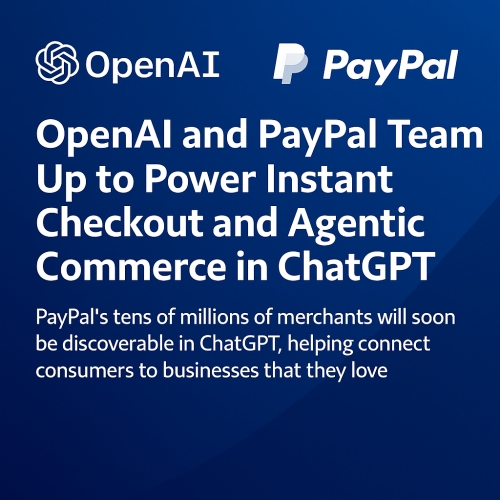
On October 28 2025, PayPal announced that it will adopt the Agentic Commerce Protocol and partner with OpenAI to bring shopping and paymentsdirectly into ChatGPT. The partnership links PayPal’s merchant network with ChatGPT users so people can buy and pay instantly using PayPal.
PayPal will add its wallet to ChatGPT’s Instant Checkout so people can pay with their balance, bank, or card.
The same buyer protection, tracking, and dispute tools that PayPal already offers will apply. PayPal will also handle card payments through OpenAI’s delegated payments API, taking care of routing and security. This API supports major card networks such as Visa and Mastercard, so users can pay with their preferred card while keeping PayPal’s protection and tracking features.
Starting in 2026, PayPal plans to add product catalogues from small businesses and larger brands so people can search and buy items in ChatGPT directly. PayPal will manage payment checks, merchant validation, and fraud protection in the background. You can learn more about OpenAI’s Agentic Commerce Protocol page.
This change could help Canadian fintechs and merchants reach new customers.
For the first time, shopping could happen entirely through a chat. Instead of clicking to a website, a person could ask ChatGPT for a product, view merchant options, and pay through PayPal in seconds.
Canadian merchants who already use PayPal could soon appear in ChatGPT’s shopping results, which might help smaller businesses connect to global buyers. It also gives users a glimpse at the future of how financial technology and artificial intelligence are starting to merge.
For Canadian fintechs, there's opportunity to design new tools for agent-led payments and business services. Developers could build smart payment gateways that connect chat platforms with accounting and invoicing systems, or create plug-ins that let small businesses manage orders and inventory through AI agents. There is also room for innovation in real-time fraud detection, digital identity layers that verify both buyers and sellers inside a chat, and lending tools that assess transaction data to offer instant credit decisions. These kinds of innovations could bring Canada to the forefront of safe, responsible, and flexible conversational finance.
Regulators, such as the Financial Consumer Agency of Canada and the Office of the Privacy Commissioner, may need to consider how consumer rules apply when a purchase happens in a conversation.
Agent led commerce seems destined to become a major new layer of the digital economy. If Canadian regulators, fintechs, and industry groups like NCFA collaborate early, Canada could establish guardrails and standards to make this new type of shopping and payments, fair, transparent and inclusive.
Success will depend on building trust, clear rules for data and disclosure, and reliable systems that protect both buyers and merchants. Conversational finance is upon us and could help Canada's fintech sector grow in a way that serves both innovation and consumers.
The National Crowdfunding & Fintech Association (NCFA Canada) is a financial innovation ecosystem that provides education, market intelligence, industry stewardship, networking and funding opportunities and services to thousands of community members and works closely with industry, government, partners and affiliates to create aa vibrant and innovative fintech and funding industry in Canada. Decentralized and distributed, NCFA is engaged with global stakeholders and helps incubate projects and investment in fintech, alternative finance, crowdfunding, peer-to-peer finance, payments, digital assets and tokens, artificial intelligence, blockchain, cryptocurrency, regtech, and insurtech sectors. Join Canada's Fintech & Funding Community today FREE! Or become a contributing member and get perks. For more information, please visit: www.ncfacanada.org
| | |
|---|---|---|
| | |


August 26th, 2025

January 4th, 2024

June 1st, 2021

September 9th, 2020

July 9th, 2018

January 3rd, 2018

September 25th, 2017

June 20th, 2017

May 10th, 2017

December 14th, 2016