




Karsten Wenzlaff, Advisor
August 26th, 2025
Karsten Wenzlaff is a Crowdfunding and Fintech Expert from Germany. He is Secretary-General of Digit[...]


UK Open Banking | Oct 16, 2025

On October 6, 2025, the FCA published a research note on open banking and open finance in the UK providing the most comprehensive update since the 2017 Open Banking Implementation Entity framework. The FCA report confirms that open banking has become a core part of the UK financial system, delivering measurable gains in innovation, competition, and consumer outcomes while setting a clear path towards open finance.
The FCA reports 13.3 million active users in March 2025 including individuals and businesses.
During early 2025 there were over 23 million one off open banking payments and about 3.7 million variable recurring payments in March.
There are more than 240 regulated third party providers active in the market.
The numbers show that most people start by using open banking for simple payments, then they move on to apps that help them manage money. These tools make it easier to track spending, combine accounts, and manage business cash flow. What began as a way to share data safely is now part of everyday financial life.
The FCA links the regulatory model to outcomes that people and firms feel and understand. API payments lower acceptance costs for many merchants, clear faster in regular use cases, and have lower charge-back risk.
Users of open banking tools report stronger confidence in managing money, better visibility over credit, and simpler product comparisons.
A growing share of regulated payment initiation and data services is now provided by non-bank firms. This is exactly what regulators aimed for, which is fair competition made possible by shared standards and clear oversight.
In April 2024, KPMG published a report on the roadmap to open finance in the UK. Now the FCA and HM Treasury are preparing an official Open Finance Roadmap for publication in early 2026.
Pilot activity is under way in mortgages, pensions, and small business lending. The technical stack is being upgraded so that systems use the same data format as ISO 20022. This lets APIs from different products connect and share information more easily.
Regulators are also testing shared rules for who is responsible if something goes wrong, and new dashboards that help people see and control which companies can use their financial data.
Commercial variable recurring payments are a key part of open banking’s next phase. They let customers authorize businesses to take payments automatically when conditions are met, such as usage or subscription activity, without having to reapprove each transaction. The UK Finance Wave 2 report on commercial variable recurring payments shows that adoption depends on clear business rules, predictable pricing, and consumer trust. It estimates that recurring payments could save merchants around £1.5 billion a year in processing costs while improving user convenience.
The report also points out that success will rely on creating fair commercial frameworks that balance innovation and stability. Clear incentives for both banks and payment providers can help recurring payments scale, lower operating costs, and give consumers more choice over how and when they pay.
The FCA’s benchmarking compares progress across Brazil, Mexico, Australia, Singapore, the United Arab Emirates, and Canada.
Brazil has a nationwide open finance network across multiple product types with mandatory participation.
Mexico continues to develop its framework with a measured, regulator led approach.
Australia extends the Consumer Data Right into energy and telecom.
Singapore and the United Arab Emirates use structured sandboxes and staged licensing to build interoperability.
Canada is recognized for policy design progress and oversight planning as implementation begins.
The common thread is that progress accelerates when governance is clear, standards are usable, incentives are aligned, and protections are visible.
The UK model brings competition policy, innovation policy, and consumer protection into one framework. Access is enforceable. Participants are certified. Interfaces are standard.
These choices lower barriers to entry and invite new financial intermediaries. Smaller providers compete on experience, cost, and transparency while trust in security remains high.
As open finance develops, success is measured by consumer value, SME productivity, and long term competitiveness. Effective regulation designed for growth becomes a national asset.
Open banking in the UK is about 7 years ahead of Canada's implementation, assuming Canada is still on track to implement phase 1 of open banking in 2026 (some have been told to expect Open Banking updates to be included in the Fall economic statement announced on November 4, but will it include an implementation timeline? Time will tell). The 2025 FCA update shows what can be achieved when regulation, technology, and market incentives pull in the same direction.
Open banking in the UK didn't reach scale overnight. It was built through coordinated governance, working standards, and consistent oversight. The move to open finance will test each jurisdiction’s balance of innovation and protection.
With the right structure, regulation can accelerate innovation, expand competition, and deliver lasting value across the financial system.
 The National Crowdfunding & Fintech Association (NCFA Canada) is a financial innovation ecosystem that provides education, market intelligence, industry stewardship, networking and funding opportunities and services to thousands of community members and works closely with industry, government, partners and affiliates to create aa vibrant and innovative fintech and funding industry in Canada. Decentralized and distributed, NCFA is engaged with global stakeholders and helps incubate projects and investment in fintech, alternative finance, crowdfunding, peer-to-peer finance, payments, digital assets and tokens, artificial intelligence, blockchain, cryptocurrency, regtech, and insurtech sectors. Join Canada's Fintech & Funding Community today FREE! Or become a contributing member and get perks. For more information, please visit: www.ncfacanada.org
 |  |  |
|---|---|---|
 |  |  |
Crypto | Oct 16, 2025

Image: Pixabay/Ashley Jackson
On October 15, 2025, Bloomberg News reported that Massachusetts Institute of Technology graduates James and Anton Peraire-Bueno are on trial in Manhattan for allegedly stealing about US $25 million from Ethereum traders using a complex Maximal Extractable Value (MEV) strategy.
The case could have significance in how U.S. law treats algorithmic blockchain activity in the future. The brothers have pleaded not guilty, arguing that their actions were lawful in an unregulated market and that their alleged victims used similar tactics.
Prosecutors said in April 2023 the Peraire-Bueno brothers created bait transactions to lure automated trading bots that use a practice called sandwiching. A sandwich attack happens when a bot places a buy order before and a sell order after a large user transaction, capturing a profit while driving up the price. Though widely criticized as manipulative, sandwiching is not illegal.
According to prosecutors, the brothers learned how to exploit a flaw in MEV Boost (open-source Ethereum software) to see and rearrange transactions before they were confirmed. By using this access, they allegedly turned the tables on the bots and redirected millions of dollars to their own accounts. Prosecutors called the act a “high-speed bait and switch” and said the brothers’ goal was to rip people off.
Defense lawyers for the brothers argue that the Peraire-Buenos simply outsmarted the bots in a free and open market. They described the strategy as “wildly successful” but legitimate within the competitive crypto space. The defense says the funds were voluntarily traded away by the bots and that the prosecution’s decision to side with their main alleged victim, Savannah Technologies, doesn't mean a crime occurred.
An Israeli crypto trading firm Savannah claims it lost US $13 million when its bots were targeted. Its CEO David Yakira is expected to testify per Bloomberg's trial coverage and also reflected in the case docket. The rest of the missing US $12 million was from unidentified traders.
The case has divided developers, traders, and researchers. Ethereum Foundation researcher Dankrad Feist said “stealing from a thief is still theft,” referring to sandwich attackers. Others in the community argue that what the brothers did was a fair play in a secretive, high speed ecosystem with no established rules.
Matt Cutler CEO of Blocknative, said the brothers “tricked someone into doing a sandwich that should have been safe by the rules of the network.” He mentioned that it was a bug in the software that made it unsafe, highlighting how fragile some blockchain systems can be when technical flaws meet trading incentives.
The Peraire-Bueno trial is being watched closely across the fintech and blockchain sectors because it will test whether exploiting code vulnerabilities amounts to fraud. It also raises the question of how far traditional legal concepts like intent and theft can stretch into decentralized and automated markets. The outcome could establish a new precedent for the future of decentralized finance and blockchain governance, where innovation and regulation often collide.
The National Crowdfunding & Fintech Association (NCFA Canada) is a financial innovation ecosystem that provides education, market intelligence, industry stewardship, networking and funding opportunities and services to thousands of community members and works closely with industry, government, partners and affiliates to create aa vibrant and innovative fintech and funding industry in Canada. Decentralized and distributed, NCFA is engaged with global stakeholders and helps incubate projects and investment in fintech, alternative finance, crowdfunding, peer-to-peer finance, payments, digital assets and tokens, artificial intelligence, blockchain, cryptocurrency, regtech, and insurtech sectors. Join Canada's Fintech & Funding Community today FREE! Or become a contributing member and get perks. For more information, please visit: www.ncfacanada.org
| | |
|---|---|---|
| | |
CZ | Oct 14, 2025

Image: Freepik/wirestock
Changpeng Zhao (known as CZ) pleaded guilty in November 2023 to a single count of violating the Bank Secrecy Act after U.S. authorities found Binance had failed to maintain effective anti-money laundering controls. He stepped down as CEO and was sentenced in April 2024 to four months in federal prison while paying a $50 million fine. Binance also paid $4.3 billion to settle related charges with the Department of Justice and other agencies.
In May 2025, Zhao stated publicly that he had applied for a presidential pardon from Donald Trump. The U.S. Senate Banking Committee confirmed the filing’s existence in a letter dated May 15, 2025, asking the Department of Justice and the White House to clarify whether the request was being considered. The senators cited potential conflicts of interest tied to Trump family business ventures connected to crypto ventures associated with Binance.
On October 10, 2025, journalist Charles Gasparino reported on X that White House discussions about a possible pardon were “heating up.” The New York Post followed with a story two days later describing alleged internal debates over optics as the Trump administration manages several crypto-related policy files.
The article references unnamed sources close to both Zhao and Trump, who claim the president is sympathetic to Zhao’s case but mindful of potential conflicts due to family business interests in the crypto sector.
No formal statement from the White House, the Department of Justice, Binance, or Zhao’s legal team has confirmed these discussions. The White House press office maintains a standard position of not commenting on active or potential pardons. Therefore, these claims remain based only on Gasparino's report and subsequent media coverage.
Even without confirmation, the story matters because a pardon could erase Zhao’s criminal record, reopening the possibility for U.S. financial institutions to engage with Binance or its affiliates under less restrictive compliance terms.
It could also influence broader perceptions of how the U.S. balances enforcement with innovation across the $4 trillion global digital asset market. The Senate Banking Committee’s letter highlights bipartisan concern about transparency in how executive clemency intersects with crypto business interests, and spotlights growing concerns between pro-market reform vs accountability for compliance gaps in digital finance.
As of October 14, 2025, verified information is limited to Zhao’s conviction, sentencing, fines, and his publicly acknowledged pardon petition. Otherwise, there is no public record or filing in the Office of the Pardon Attorney showing that any pardon has been granted or is under formal review.
Until official confirmation appears, the case stands as a reminder that anonymous political reporting must be treated cautiously, especially if it could affect markets and trust in financial governance.
The National Crowdfunding & Fintech Association (NCFA Canada) is a financial innovation ecosystem that provides education, market intelligence, industry stewardship, networking and funding opportunities and services to thousands of community members and works closely with industry, government, partners and affiliates to create aa vibrant and innovative fintech and funding industry in Canada. Decentralized and distributed, NCFA is engaged with global stakeholders and helps incubate projects and investment in fintech, alternative finance, crowdfunding, peer-to-peer finance, payments, digital assets and tokens, artificial intelligence, blockchain, cryptocurrency, regtech, and insurtech sectors. Join Canada's Fintech & Funding Community today FREE! Or become a contributing member and get perks. For more information, please visit: www.ncfacanada.org
| | |
|---|---|---|
| | |
Cybersecurity | Oct 14, 2025

Image: Freepik
The 2025 Nobel Prize in Economics was awarded to Joel Mokyr, Philippe Aghion, and Peter Howitt for showing that economies grow when they reward new ideas, open competition, and constant renewal. Their work (and recognition) explains why some economies continue to grow while others stall, or how innovation drives prosperity.
Joel Mokyr’s research reveals that progress depends on how societies treat knowledge. When Europe opened up to new ideas, rulers across Europe competed to attract inventors, scientists, and thinkers. They funded experiments, founded academies, and allowed freedom to publish and debate. This open culture created trust and collaboration, which led to faster discovery. Insight is that innovation takes off when knowledge is shared, incentives are aligned with progress, and institutions reward learning rather than control.
Philippe Aghion and Peter Howitt built the modern model that explains how this process sustains itself. Their work on creative destruction shows that growth happens when new firms and technologies replace outdated ones. Productivity increases even as some firms exit the market. They demonstrated that competition and innovation are not opposites but partners. Economies that encourage entry and tolerate failure grow faster because resources move to better ideas. Insight is that protection slows progress, but experimentation drives renewal.
Sounds familiar, right?
A popular LinkedIn post by a specialist in regulatory policy Martyn Hopper, interpreted these Nobel insights into a practical framework for today's economies. In his aptly titled LinkedIn post, “Regulating for Growth”.
Hopper explained that innovation only turns into prosperity when three things work together:
When these conditions are in place, disruption becomes productive renewal. When they are missing, it produces dislocation, stagnation, and political frustration.
Hopper’s key insight reframes regulation itself. He says the real challenge is not cutting rules but designing them to direct energy toward innovation rather than rent-extraction (read: siphoning off profits for benefit).
Regulation is the architecture that decides who can participate, how capital flows, and whether progress is rewarded or resisted. It determines whether a system produces creation or protection, renewal or capture. This makes regulation one of the most powerful economic tools for growth.
As Canada has it's back up against the wall in terms of innovation and competition policy (despite recent shifting winds), the Nobel findings and Hopper's sensibilities, business leaders and policymakers have clear takeways.
The best performing economies are those that combine competitive markets with policies that support transition. For policymakers, the lesson is that regulation must make innovation easier, not riskier. It must reward entry and experimentation, ensure fair access to finance, and help communities absorb change. Sustained success comes from openness, agility, and willingness to reinvest in new ideas. Remember, a system without the ability to expel old and add new will eventually die on the vine.
Growth is designed through the choices made about who can compete, how ideas are financed, and how regulation treats innovation. When those choices are right, economies attract investment, scale technology faster, and sustain higher productivity.
For Canada’s fintech and financial innovation community, these insights are especially timely. NCFA’s advocacy for proportionate rules, open and fair competition, and technology-driven productivity and inclusion innovation aligns directly with the Nobel research and Hopper’s interpretation.
Canada's challenge is evolving from purely risk management towards opportunity design. Regulators can accelerate innovation by creating flexible entry routes for new players, supporting data-driven compliance, and directing finance toward startups and scale-ups that drive transformation.
It's about injecting newness and opportunity which in turn will build resilience. When innovation is supported by sound regulation, it strengthens the economy’s ability to adapt, protects consumers, and expands access to capital.
Fintech, open banking, and AI can be powerful enablers of this change if the regulatory system is built for learning and collaboration rather than delay and protectionism.
The Nobel Committee recognized that growth doesn't happen by accident. It's built through systems that enable innovation, reward competition, and manage transition. Martyn Hopper’s framework shows what that looks like in practice. Smart regulation channels capital to new ideas, supports those affected by change, and keeps markets open for renewal. For Canada’s fintech sector, this is the roadmap to back that turns creative disruption into long-term competitiveness, productivity, and inclusion.
The National Crowdfunding & Fintech Association (NCFA Canada) is a financial innovation ecosystem that provides education, market intelligence, industry stewardship, networking and funding opportunities and services to thousands of community members and works closely with industry, government, partners and affiliates to create aa vibrant and innovative fintech and funding industry in Canada. Decentralized and distributed, NCFA is engaged with global stakeholders and helps incubate projects and investment in fintech, alternative finance, crowdfunding, peer-to-peer finance, payments, digital assets and tokens, artificial intelligence, blockchain, cryptocurrency, regtech, and insurtech sectors. Join Canada's Fintech & Funding Community today FREE! Or become a contributing member and get perks. For more information, please visit: www.ncfacanada.org
| | |
|---|---|---|
| | |
Oct 14, 2025
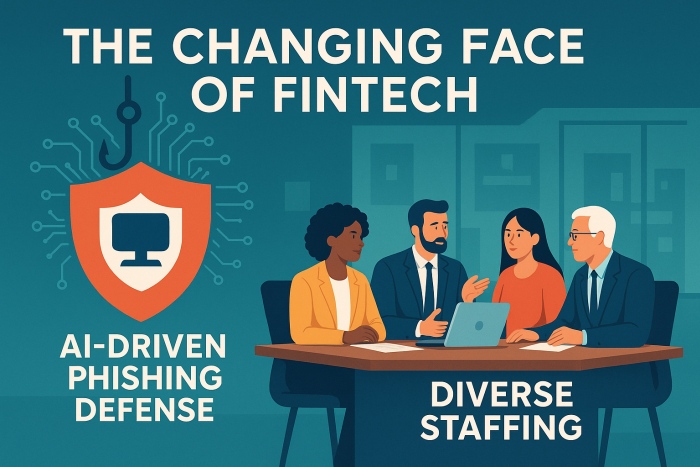
The world of fintech moves faster than most industries.
Every week brings a new regulation, an emerging technology, or a cyber threat that can change the way startups operate.
Among all these moving parts, two factors stand out as game-changers: AI-driven phishing defense and diverse staffing.
At first glance, they may seem unrelated—one is a tech safeguard, the other a people strategy—but in reality, they’re deeply connected.
Diverse staffing means building teams that represent different backgrounds, cultures, genders, and perspectives.
It’s not just about filling quotas; it’s about creating a mix of thinkers who can see problems and opportunities from multiple angles.
In fintech, where innovation and security are crucial, having diverse minds at the table helps companies anticipate risks others might overlook.
I once worked with a startup that struggled to understand why their mobile banking app wasn’t resonating with certain communities.
After bringing in a multicultural design team, they realized that small UI details—like language tone and icon choices—were alienating non-native English speakers.
Once those adjustments were made, engagement skyrocketed.
Diverse staffing isn’t a buzzword—it’s a direct path to resilience and creativity.
Startups that prioritize inclusivity create stronger internal networks and make better, faster decisions.
Phishing attacks have become one of the biggest threats to fintech.
Hackers no longer rely on sloppy scams; they use advanced AI tools to mimic authentic company communications.
In one incident I witnessed, a financial startup received what appeared to be a vendor invoice email.
The tone, logo, and even the metadata looked legitimate—but it was a targeted phishing attempt powered by AI-generated content.
Because one employee noticed subtle inconsistencies, the company avoided a potential breach worth millions.
That awareness came from training sessions led by a culturally diverse security team that understood how different communication styles could be exploited in phishing attacks.
Their unique insights into language nuances helped them spot what others missed.
AI phishing defense systems rely on machine learning to detect abnormal patterns—strange email origins, inconsistent phrasing, or odd click behavior.
But machines alone can’t interpret every context correctly.
That’s where diverse staffing bridges the gap.
People from different linguistic and cultural backgrounds can identify red flags that AI may misinterpret.
For instance, an employee fluent in multiple languages might recognize that an email claiming to be from a French client used incorrect business etiquette or spelling conventions.
A cybersecurity engineer from another region might catch phishing attempts that play on local banking jargon.
This mix of perspectives strengthens the AI’s learning loop—feeding it richer, more nuanced data to detect future threats.
Customers in fintech trust brands that understand their specific needs and communication styles.
When users see themselves represented in a company’s workforce, that trust deepens.
A diverse team doesn’t just improve cybersecurity—it enhances customer relationships and global reach.
Take digital payment startups expanding into international markets.
Having employees who understand local financial systems, traditions, and risk perceptions can make product launches smoother.
This firsthand knowledge ensures compliance with cultural expectations and helps prevent unintentional errors that could trigger regulatory scrutiny.
When I consulted for a mid-sized fintech company, their hiring process focused almost entirely on technical skills.
They had brilliant engineers, but their cybersecurity incidents kept rising.
Once they diversified their recruitment—bringing in specialists from different regions, languages, and genders—everything changed.
The team’s brainstorming sessions became more dynamic, and phishing simulations revealed a 40% improvement in detection rates.
Their success wasn’t accidental.
Diverse staffing created an environment where people felt empowered to question assumptions and propose unconventional ideas.
That mindset proved invaluable for strengthening AI defense systems and developing smarter internal training modules.
AI can process massive amounts of data faster than any person, but it lacks intuition.
Humans—especially those with varied experiences—excel at reading emotional cues, tone, and intent.
For example, a phishing email designed to mimic urgency might trick a machine’s keyword filter but feel “off” to a human reader.
A multicultural security team understands that emotional manipulation looks different across cultures.
In some regions, scammers use politeness and flattery; in others, they exploit authority and hierarchy.
Combining AI’s analytical power with these human instincts creates a more holistic defense system.
Startups thrive when teams move quickly, communicate openly, and challenge each other’s thinking.
Diversity encourages all three.
When employees come from different walks of life, discussions become richer, and blind spots get smaller.
It’s no surprise that companies with inclusive leadership outperform competitors in innovation and market growth.
In one fintech accelerator program, a group of startups was asked to pitch AI-based security solutions.
The winning team wasn’t the one with the most funding or tech power—it was the one with members from six countries and a balanced gender ratio.
Their final product succeeded because it accounted for human error, cultural behavior, and ethical considerations that others ignored.
To integrate diversity and AI defense effectively, fintech startups should:
Tomorrow’s fintech ecosystem won’t rely solely on firewalls and encryption—it will depend on the collective intelligence of humans and machines.
Diverse staffing ensures that AI systems are trained with better context and that decision-making remains human-centered.
This hybrid model of defense and inclusion isn’t just ethical; it’s strategic.
The startups that blend AI technology with human diversity won’t just survive—they’ll lead.
They’ll build systems that can outsmart cybercriminals, earn global trust, and adapt faster than ever before.
Innovation in fintech is no longer just about coding speed or funding size.
It’s about who’s sitting at the table, what experiences they bring, and how they collaborate with technology.
AI phishing defense provides the armor, but diverse staffing builds the strength behind it.
When those two forces align, fintech startups transform from vulnerable targets into resilient, future-ready organizations.
The National Crowdfunding & Fintech Association (NCFA Canada) is a financial innovation ecosystem that provides education, market intelligence, industry stewardship, networking and funding opportunities and services to thousands of community members and works closely with industry, government, partners and affiliates to create aa vibrant and innovative fintech and funding industry in Canada. Decentralized and distributed, NCFA is engaged with global stakeholders and helps incubate projects and investment in fintech, alternative finance, crowdfunding, peer-to-peer finance, payments, digital assets and tokens, artificial intelligence, blockchain, cryptocurrency, regtech, and insurtech sectors. Join Canada's Fintech & Funding Community today FREE! Or become a contributing member and get perks. For more information, please visit: www.ncfacanada.org
| | |
|---|---|---|
| | |
AI Ethics | Oct 10, 2025

Image: Freepik
On October 7, 2025, AP news reported that Deloitte Australia has agreed to refund part of a $440,000 AUD government contract for not disclosing the use of AI and delivering a 237 page welfare report to the Department of Employment and Workplace Relations (DEWR) that was riddled with AI generated errors, fabricated quote, non-existing sources and incorrect legal references.
Deloitte Australia subsequently returned part of its fee and reissued a corrected report with full disclosure that AI had been used while correcting the identified errors, raising questions around how oversight can keep pace with growing enterprise AI adoption.
According to the Guardian's analysis of Deloitte's AI mistake, the DEWR report was first published in July 2025, and not until several months later did University of Sydney researcher Chris Rudge first detect the fake academic references embedded throughout Deloitte’s report. He described the contents as clearly AI generated, such as strange book titles and misattributed legal quotes.
Senator Barbara Pocock later criticized the firm’s use of AI saying, "[Deloitte] misused AI and used it very inappropriately: misquoted a judge, used references that are non-existent”.
Shame on Deloitte. Bigger shame on Govt: $440k contract for rubbish work: “Deloitte has admitted to using generative AI for a core analytical task; but it failed to disclose this in the first place.” pic.twitter.com/QLM1Y4kp3u
— Barbara Pocock (@BarbaraPocock) October 5, 2025
The Deloitte case shows how unchecked automation can weaken confidence in institutions that depend on verified data and transparent reporting. For fintechs and financial institutions, it reinforces that every AI-assisted process from compliance to portfolio analysis needs accountable oversight and clear audit trails.
"Oversight can be human, automated, or hybrid, but it must always be explainable and verifiable."
Canadian regulators are also under pressure to ensure that AI tools used in finance meet standards of traceability and accountability. Embedding disclosure requirements, validation checkpoints, and auditable review logs can prevent governance breakdowns before they escalate.
Consulting and financial firms that apply AI ethically and responsibly will maintain (and grow) their credibility, while those that don’t risk lasting damage to their reputation. According to news reports, at least the report recommendations were in tact. Accountability is the real audit.
The National Crowdfunding & Fintech Association (NCFA Canada) is a financial innovation ecosystem that provides education, market intelligence, industry stewardship, networking and funding opportunities and services to thousands of community members and works closely with industry, government, partners and affiliates to create aa vibrant and innovative fintech and funding industry in Canada. Decentralized and distributed, NCFA is engaged with global stakeholders and helps incubate projects and investment in fintech, alternative finance, crowdfunding, peer-to-peer finance, payments, digital assets and tokens, artificial intelligence, blockchain, cryptocurrency, regtech, and insurtech sectors. Join Canada's Fintech & Funding Community today FREE! Or become a contributing member and get perks. For more information, please visit: www.ncfacanada.org
| | |
|---|---|---|
| | |
Crypto | Oct 10, 2025

Image: Freepik
On October 9, 2025, Luxembourg’s Finance Minister Gilles Roth confirmed that the Luxembourg's Intergenerational Sovereign Wealth Fund (FSIL) will invest 1% of its portfolio in Bitcoin ETFs. Symbolic and strategic, this is the first time a Eurozone state wealth fund has officially allocated capital to Bitcoin. According to a June 2025 FSIL report, the fund is valued around €764 million (US$887 million) and will allocate roughly €7–9 million to Bitcoin exposure through exchange traded funds as part of the 2026 national budget plan.
The FSIL was created in 2014 to preserve national wealth for future generations and currently maintains a conservative allocation of 53% in government bonds and 46% in equities. A 2025 amendment to its framework allowed up to 15% in alternative assets including crypto.
Treasury Director Bob Kieffer said, “To avoid operational risks, the exposure to Bitcoin has been taken through regulated ETF products,” a compliant structure that's transparency while reducing custody risk. He described the 1% allocation as a balance between innovation and prudence. The move supports Luxembourg’s goal to position itself as a European hub for digital finance under the EU’s Markets in Crypto Assets (MiCA) framework, a key policy area for fintech competitiveness. In 2022, the BIS advised banks to limit Bitcoin exposure at 1% of reserves.
Luxembourg’s decision sets it apart from other Eurozone nations. While European central banks have avoided holding Bitcoin directly, smaller countries like Georgia and non EU members such as Bhutan have included Bitcoin in sovereign portfolios. Norway’s $1.9 trillion wealth fund holds indirect exposure through public companies, and the United States recently allowed seized Bitcoin into the federal strategic reserve. Luxembourg’s ETF approach is a practical signal for governments seeking regulated crypto exposure.
Bitcoin ETFs worldwide now manage over US$164.79 billion (about 7% of total Bitcoin market capitalization) as a result of growing institutional participation through regulated products.
Luxembourg’s ETF investment is aligned with its reputation for financial innovation and prudent governance. For crypto stakeholders, it's validation that Bitcoin can be treated as an investable reserve asset under regulatory supervision. This precedent could influence policy approaches across Europe as sovereign funds explore digital diversification within ESG and MiCA frameworks.
The National Crowdfunding & Fintech Association (NCFA Canada) is a financial innovation ecosystem that provides education, market intelligence, industry stewardship, networking and funding opportunities and services to thousands of community members and works closely with industry, government, partners and affiliates to create aa vibrant and innovative fintech and funding industry in Canada. Decentralized and distributed, NCFA is engaged with global stakeholders and helps incubate projects and investment in fintech, alternative finance, crowdfunding, peer-to-peer finance, payments, digital assets and tokens, artificial intelligence, blockchain, cryptocurrency, regtech, and insurtech sectors. Join Canada's Fintech & Funding Community today FREE! Or become a contributing member and get perks. For more information, please visit: www.ncfacanada.org
| | |
|---|---|---|
| | |


August 26th, 2025

January 4th, 2024

June 1st, 2021

September 9th, 2020

July 9th, 2018

January 3rd, 2018

September 25th, 2017

June 20th, 2017

May 10th, 2017

December 14th, 2016