




Karsten Wenzlaff, Advisor
August 26th, 2025
Karsten Wenzlaff is a Crowdfunding and Fintech Expert from Germany. He is Secretary-General of Digit[...]


FT Partners Crypto and Blockchain Update | Oct 9, 2025
Source: Financial Technology Partners
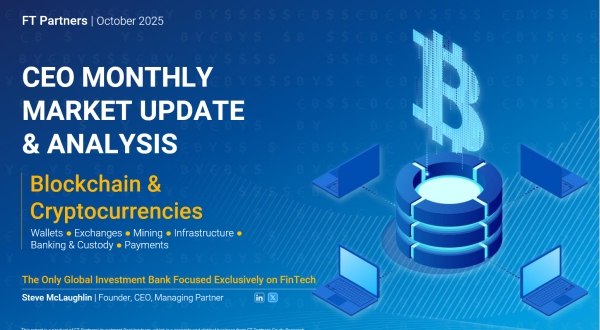
Financial Technology Partners (FT Partners) October 2025 Crypto and Blockchain Update shows that capital is flowing back into regulated digital asset infrastructure.
The Financial Technology Partners (FT Partners) October 2025 Blockchain and Cryptocurrencies Monthly report shows that digital asset M&A and financing activity has rebounded, led by exchanges, custody networks, and compliance technology. Institutional demand is piling into the market as regulated entities capture a growing share of capital and deal flow, with climbing valuations across regulated segments.
The FTP report data indicates that infrastructure remains the strongest and most resilient part of the market. Custody systems, settlement networks, and tokenization technology are attracting the largest investments as firms position to meet higher institutional and compliance standards. Transactions through 2025 is proof of how global players are consolidating around regulated platforms, liquidity access, and cross-border interoperability.
Ripple Labs acquired Standard Custody & Trust for $120 million in January, expanding its regulated tokenization and trust charter capabilities.
In April, Fireblocks raised $150 million at a $10 billion valuation to scale enterprise-grade custody and settlement systems. Komainu attracted $25 million in strategic investment during the same month to strengthen its institutional custody platform and compliance integrations.
May brought a $100 million raise for Anchorage Digital to expand its regulated digital asset banking and custody operations.
BitGo followed in June with a $100 million Series C round at a $1.75 billion valuation to deepen institutional tokenization services.
By September, Galaxy Digital acquired GK8 for $44 million, adding institutional self-custody and wallet management capabilities.
WonderFi completed a $100 million merger with Coinsquare and Bitbuy in January, forming one of Canada’s largest regulated crypto trading platforms.
Then later in March, Robinhood acquired WonderFi for C$250 million (around US$179 million), uniting Coinsquare and Bitbuy under its global exchange network.
Coinbase expanded twice, acquiring Circle’s European operations in February to enhance stablecoin settlement systems, then Deribit in August for $2.9 billion in cash and stock to extend crypto derivatives trading and clearing.
Chainalysis closed a $200 million Series F in June at a $4.2 billion valuation to expand blockchain intelligence and compliance monitoring.
A month later, Elliptic raised $50 million in a Series D extension to develop new anti–financial-crime tools for banks and exchanges.
Circle completed its acquisition of Archblock in February, integrating cross-chain USDC routing and compliance layers.
In May, Tether acquired Bitfinex Securities’ minority stake to reinforce its regulated token issuance network.
Ripple invested $285 million in August to expand global tokenization and CBDC settlement projects.
Kraken Ventures launched a $200 million fund in July focused on blockchain infrastructure and fintech platforms.
FT Partners’ 2025 data confirm that regulated infrastructure has become the foundation of digital finance. Valuations for infrastructure and compliance platforms now exceed eight times revenue, while consumer trading firms remain below four.
That spread shows that investors see real value in predictable, institutionally integrated systems rather than volatile retail flows. Institutional adoption continues through regulated products such as spot Bitcoin ETFs, tokenized funds, and custody-integrated settlement rails.
These channels represent a transition from speculative trading to reliable yield generation. Capital is rewarding throughput, compliance, and interoperability the same factors that define successful cross-border fintech models.
Growth will continue through robust compliance-oriented networks linking tokenized assets, stablecoins, and regulated exchanges. 2025 transactions signal global alignment toward clearer regulatory frameworks across Canada, Europe, and the United States. Taken together, these developments are building a more mature, data-driven digital finance ecosystem that's preparing for institutional scale.
 The National Crowdfunding & Fintech Association (NCFA Canada) is a financial innovation ecosystem that provides education, market intelligence, industry stewardship, networking and funding opportunities and services to thousands of community members and works closely with industry, government, partners and affiliates to create aa vibrant and innovative fintech and funding industry in Canada. Decentralized and distributed, NCFA is engaged with global stakeholders and helps incubate projects and investment in fintech, alternative finance, crowdfunding, peer-to-peer finance, payments, digital assets and tokens, artificial intelligence, blockchain, cryptocurrency, regtech, and insurtech sectors. Join Canada's Fintech & Funding Community today FREE! Or become a contributing member and get perks. For more information, please visit: www.ncfacanada.org
 |  |  |
|---|---|---|
 |  |  |
Digital Banking | Oct 7, 2025

Image: Freepik/rawpixel.com
On October 2, 2025, Netherland-based digital banking experience platform Plumery announced Canada ready features for credit unions and is working with Vancouver-based Aequilibrium on the implementation for Canadian institutions. The release covers payments and transfers including Interac e-Transfer, support for Canadian savings and lending products, business banking tools, and bilingual English and French, privacy, data residency, and accessibility features.
In Jan 2025, Toronto-based credit union Central 1 said that Intellect Design Arena would take over its digital banking after its 2024 review. On March 3, 2025, the transfer took effect, and Intellect took over Forge, MemberDirect, and related web and mobile products while Central 1 continued to provide underlying infrastructure services. As a result, credit unions that previously used Forge now need to choose their next digital banking platform.
Plumery and Aequilibrium have built a localized version tailored to Canadian banking norms. The platform supports bill payments, cheque deposits, Interac e-Transfer, savings and lending products such as GICs and mortgages, business banking tools like bulk payments and payroll, and compliance capabilities including bilingual English and French support, data residency, privacy adherence, and accessibility features. These Canada specific digital banking capabilities are available out of the box.
Plumery's digital banking platform can be branded by the financial institution, allowing credit unions to use their own design and member experiences while using Plumery’s building blocks. They say its approach can reduce switching costs/risks by offering Canada specific features from day one while avoiding unnecessary disruption.
The partnership with Aequilibrium helps with compliance, user experience, and integration while keeping institutions in control of their brand and roadmap. For members, this can mean faster everyday banking, smoother transfers, and interfaces designed for how Canadians bank.
Ben Goldin, CEO and Founder of Plumery:
"With Forge winding down, Canadian institutions have a rare opportunity to modernise on their own terms, rather than being tied to outdated systems. Our platform provides an immediate, future ready option that puts control back in the hands of credit unions. By working with Aequilibrium, we are combining global banking innovation with local expertise to deliver experiences that meet the unique needs of Canadian credit unions’ members."
Plumery says its Canada edition is available now and that it is in conversations with several credit unions evaluating alternatives to Forge.
The National Crowdfunding & Fintech Association (NCFA Canada) is a financial innovation ecosystem that provides education, market intelligence, industry stewardship, networking and funding opportunities and services to thousands of community members and works closely with industry, government, partners and affiliates to create aa vibrant and innovative fintech and funding industry in Canada. Decentralized and distributed, NCFA is engaged with global stakeholders and helps incubate projects and investment in fintech, alternative finance, crowdfunding, peer-to-peer finance, payments, digital assets and tokens, artificial intelligence, blockchain, cryptocurrency, regtech, and insurtech sectors. Join Canada's Fintech & Funding Community today FREE! Or become a contributing member and get perks. For more information, please visit: www.ncfacanada.org
| | |
|---|---|---|
| | |
Oct 7, 2025

Image: Freepik/tonodiaz
The Indian stock market is often a reflection of investor sentiment, company fundamentals, and broader macroeconomic shifts. One of the indicators investors watch closely is the 52-week high and low levels of stocks. A stock trading near its 52-week low often sparks curiosity: Is it a bargain buy or a falling knife?
ITC has long been considered a safe bet for conservative investors. But with the stock hovering close to its 52-week low, the pressing question is: Should ITC be on your radar now? In this blog, we will explore whether investors should consider buying ITC stock at its 52-week low.
The stocks near 52 week low is the lowest price at which a stock has traded in the past year. For many investors, this is a signal that the stock may be undervalued. However, it could also indicate deeper structural challenges or declining investor confidence.
Hence, before considering ITC, it’s essential to look at its fundamentals, recent developments, and industry dynamics.
ITC has diversified revenue streams from cigarettes to FMCG, hotels, and agri-exports, which have helped it remain resilient, though growth in its non-cigarette business segments has been slower than rivals like HUL or Nestlé.
As of September 2025,the ITC share price is trading close to its 52-week low of ₹390.15, currently hovering around ₹410.65. It is still far below its 52-week peak of ₹528.50. In comparison to the broader index and its Nifty FMCG peers, it has underperformed with a decline of almost 15% in the last year.
There are several factors behind the ITC share falling to its 52-week low levels. Some of those reasons are:
Investors often rotate out of defensives like FMCG into higher-growth sectors (IT, auto, banks) when markets are bullish.
Compared to FMCG peers, ITC’s topline expansion remains moderate, particularly in branded foods and hotels.
After its multi-year rally (2021-2023), profit booking has amplified near-term declines.
Cigarettes remain under heavy scrutiny due to taxation and health regulations. Any potential tax hikes impact sentiment.
The company recently announced the demerger of its hotel business, which led to mixed reactions from the market.

ITC Near 52 Week Low
With ITC close to its 52-week low, investors may find it to be a risky but appealing entry point. The following is a discussion of the causes of both cases:
A stock hitting its 52-week low should not be the sole reason to buy or sell; it’s a signal that requires deeper analysis. In ITC’s case, while regulatory risks and slower growth weigh on sentiment, its dividend yield, diversified business, and defensive nature make it a strong option for conservative investors.
Therefore, ITC should be on the radar of those investors who seek stability, regular dividends, and a defensive play, and investors who are chasing aggressive growth and fast-moving stocks should not consider investing in ITC at its 52-week low share price.
The National Crowdfunding & Fintech Association (NCFA Canada) is a financial innovation ecosystem that provides education, market intelligence, industry stewardship, networking and funding opportunities and services to thousands of community members and works closely with industry, government, partners and affiliates to create aa vibrant and innovative fintech and funding industry in Canada. Decentralized and distributed, NCFA is engaged with global stakeholders and helps incubate projects and investment in fintech, alternative finance, crowdfunding, peer-to-peer finance, payments, digital assets and tokens, artificial intelligence, blockchain, cryptocurrency, regtech, and insurtech sectors. Join Canada's Fintech & Funding Community today FREE! Or become a contributing member and get perks. For more information, please visit: www.ncfacanada.org
| | |
|---|---|---|
| | |
Social Enterprise | Oct 7, 2025

Image: Freepik/creativeart
As reported by Devex on October 3, 2025, RemitHope is redefining how diaspora remittances fund local impact across Africa. A fintech-powered social enterprise and new digital giving platform founded by philanthropist Tsitsi Masiyiwa is transforming how remittances and local donations flow into African community development.
The platform’s launch follows the July fire at Mount Selinda Orphanage in Zimbabwe, which became RemitHope’s first campaign. In less than three weeks, over 1,000 donors from ten countries contributed $40,000, instantly doubled through matching funds to more than $81,000 to rebuild the orphanage, proving the platform’s model. Donations currently sit at over $81,500.
According to verified data from the World Bank, global remittance flows reached $685 billion in 2024, surpassing both foreign direct investment and overseas development assistance. The rise of platforms like RemitHope demonstrates how fintech can turn personal remittance flows into community scale development capital.
Founder Masiyiwa, who is also the co-founded Higherlife Foundation and Delta Philanthropies, described the goal as channeling diaspora generosity toward self sustaining, African led impact. As she said at launch:
“Now, as the aid from the Global North dwindles, we are stepping up. My audacious goal? $50 million in the next five years.”
RemitHope blends crowdfunding, remittance technology, and philanthropic matching. Each donation from diaspora or local givers is instantly doubled by partner foundations, currently Delta Philanthropies based in Zimbabwe (UK registered) and Higherlife Foundation.
This creates a direct incentive for micro giving, where even a $5 contribution becomes $10 expanding reach and impact. The platform enables donors to give through mobile payment channels such as EcoCash and is exploring integration with everyday transactions like ticket purchases or mobile top ups.
Every partner organization is vetted for transparency, governance, and measurable outcomes. Campaigns typically target around $10,000 per project, ensuring funds go directly to specific community priorities. It reframes remittances as an alternative finance mechanism bridging charity and investment.
The first wave of users includes grassroots community groups from thirteen countries, many in rural areas that typically fall outside formal aid pipelines. These organizations gain visibility through the platform, bypassing grant bureaucracy and connecting directly to diaspora and domestic donors.
The funding mix in the Mount Selinda case is revealing: about 900 local donors used EcoCash for small contributions, while around 100 diaspora donors contributed larger amounts, often over $50. This blend of micro local and macro diaspora support shows how new models of digital trust and peer giving are forming across borders.
Masiyiwa’s five year, $50 million target is backed by a vision that goes beyond charity. RemitHope is building infrastructure for African led giving that turns remittance networks into sustainable impact capital. The platform’s long term plan includes integrating data driven impact tracking, digital identity verification, and traceable giving records to strengthen accountability and transparency.
The founders see it as a catalyst for regional collaboration, a model of Africans funding Africans that redefines philanthropy as investment in capacity and innovation.
As operational head Musa Muleya said, “The question was what can we do as Africans to solve African problems.” That ethos aligns with NCFA’s advocacy for inclusive, technology driven financial ecosystems that bridge public trust with private initiatives.
For Canadian context, diaspora focused fintechs such as LemFi, which raised $53 million in January 2025, are expanding remittance and mobile finance infrastructure for African immigrants.
Platforms such as CAF Canada and Myriad Canada provide cross border philanthropic frameworks that could integrate similar matching or community led approaches. These examples show how Canadian fintech and charitable infrastructure could help scale Africa led innovation responsibly, aligning with Canada’s Africa Strategy for inclusive growth.
Many similar conversations could be overhead at the inaugural 2025 Canadian-Africa Fintech Summit where NCFA partnered to help support the development of a Canada-Africa fintech bridge that fosters cross-border collaboration, innovation, economic development and investment.
RemitHope remittances are a collaborative funding mechanism for social innovation. It's part of a new movement in Africa towards self-reliance and inclusive, locally-led social enterprise that strengthens trust and transparency between donors and recipients.
For Canada’s fintech and social finance ecosystem, it's a powerful model of cross border collaboration that merges technology, accountability, and community empowerment.
The National Crowdfunding & Fintech Association (NCFA Canada) is a financial innovation ecosystem that provides education, market intelligence, industry stewardship, networking and funding opportunities and services to thousands of community members and works closely with industry, government, partners and affiliates to create aa vibrant and innovative fintech and funding industry in Canada. Decentralized and distributed, NCFA is engaged with global stakeholders and helps incubate projects and investment in fintech, alternative finance, crowdfunding, peer-to-peer finance, payments, digital assets and tokens, artificial intelligence, blockchain, cryptocurrency, regtech, and insurtech sectors. Join Canada's Fintech & Funding Community today FREE! Or become a contributing member and get perks. For more information, please visit: www.ncfacanada.org
| | |
|---|---|---|
| | |
AI Regulation | Oct 6, 2025

The European Union’s transparency and copyright rules for general purpose AI models formally took effect on August 2, 2025. Enforcement faced resistance from industry and calls for delay but regulators seem intent on sticking with the original timelines.
Global tech leaders such as, OpenAI, Microsoft, Google, Anthropic, and Amazon have signed the EU Code of Practice for General Purpose AI Models, a framework quickly emerging as the new benchmark for responsible AI and a blueprint for innovators in Canada’s fintech and technology ecosystem.
The EU AI Act, published as Regulation (EU) 2024/1689 in the Official Journal of the European Union, moved into its second phase of implementation this summer. The new rules apply to general purpose AI models (GPAI) trained on large-scale data that can generate text, images, and audio. These models must now meet defined transparency and documentation requirements to operate in the European market.
In July 2025, the European Commission released the Code of Practice for General Purpose AI Models, available on its AI transparency portal. Although its voluntary, the Code itself translates the Act’s broad principles into operational commitments that technology providers can follow, and is becoming a global reference for responsible AI development.
The Code asks developers to be clear about how their AI systems are built. They must publish short summaries of training data and explain the steps taken to reduce bias and misinformation. It marks the first time transparency in AI has been defined as a regulated standard rather than a voluntary goal.
It also sets new expectations for how copyrighted material is handled. Companies must confirm that training data was obtained legally and that rights holders who chose to opt out were respected. They are encouraged to build safeguards that stop AI models from reproducing protected content and to keep a public channel open for complaints.
Finally, the Code highlights safety and security as core responsibilities. Models that use very large amounts of computing power must undergo risk assessments, maintain strong cybersecurity protections, and keep records of any misuse or technical incidents. This brings AI oversight closer to the risk management standards already used in finance.
The European Commission’s list of signatories includes OpenAI, Microsoft, Google, Anthropic, Amazon, IBM, and Mistral AI. Their participation gives the voluntary Code practical weight and sends a message that transparency and accountability are compatible with innovation.
Meta has not signed, citing uncertainty about enforcement and consistency across European member states. It shows the divide between companies moving early to align with transparency and those waiting for further legal clarification. Early signatories are setting examples that others may have to follow once regulation tightens.
Companies that publish their data summaries and risk documentation not only comply with regulation but also strengthen their position with investors and partners. For companies that can responsibly demonstrate how they legally sourced their data to train their models, it can influence purchasing decisions in regulated sectors like finance, health, and insurance.
For AI developers, transparent practices can also lead to improved internal knowledge. Knowing exactly what data was used to train a system and where risks exist improves quality and helps teams innovate with confidence. Transparency is evolving from a compliance task into a type of competitive strategy.
Canada’s Artificial Intelligence and Data Act (AIDA) was part of Bill C-27, which died on the Order Paper when Parliament was prorogued in January 2025. For now, Canada's Voluntary Code of Conduct on the Responsible Development and Management of Advanced Generative AI Systems is still Canada's main AI policy reference. The Code is endorsed by companies such as Cohere, OpenText, BlackBerry, and Telus, and encourages transparency and human oversight in the use of generative AI. While not legally binding, it mirrors much of the EU’s direction and provides a practical foundation for organizations preparing for future legislation.
Canadian firms that sell or integrate AI systems in the European market must already comply with the EU AI Act transparency and copyright rules. The regulation applies outside the EU as well, meaning any company offering AI services or products in Europe must meet the same standards as European providers. This includes publishing training data summaries, documenting data sources, and ensuring lawful use of copyrighted material. For fintechs and technology companies, aligning early with EU standards is not just about compliance. It can help position them as credible and trusted partners in markets that increasingly link transparency with competitiveness.
AI transparency and innovation are now hand in hand in the EU. While enforcement of the new framework will happen gradually, the market impact is immediate with companies now competing not only on performance but on integrity. Companies building transparency into product design, investor communications, and risk management will benefit by transforming responsible AI from an obligation to a strength.
The National Crowdfunding & Fintech Association (NCFA Canada) is a financial innovation ecosystem that provides education, market intelligence, industry stewardship, networking and funding opportunities and services to thousands of community members and works closely with industry, government, partners and affiliates to create aa vibrant and innovative fintech and funding industry in Canada. Decentralized and distributed, NCFA is engaged with global stakeholders and helps incubate projects and investment in fintech, alternative finance, crowdfunding, peer-to-peer finance, payments, digital assets and tokens, artificial intelligence, blockchain, cryptocurrency, regtech, and insurtech sectors. Join Canada's Fintech & Funding Community today FREE! Or become a contributing member and get perks. For more information, please visit: www.ncfacanada.org
| | |
|---|---|---|
| | |
AI Innovation | Oct 2, 2025

Image captured from Sora 2 Demo Reel
on September 30, 2025, OpenAI released Sora 2 in a new Sora app (iOS only, no Android version for now), introducing synchronized audio, improved physical realism and cameo features. The rollout is invite only in the United States and Canada according to the Sora app access details. It includes built-in checks so organizations can track where videos come from and how they are used.
Sora 2 generates video with synchronized voices and sound effects and it produces motion scenes in a more natural and consistent way, making explainers, onboarding, and campaign videos feel more real.
The Sora app also uses a feed where teams can scroll work, remix content, and follow creators. It's designed for consumer use but can also support professional workflows as outlined in Getting started with the Sora app.
Here's some independently created videos created with Sora 2 to check it out:
Cameos and likeness features raise privacy issues in Canada, so organizations need clear opt-in consent, easy ways to withdraw it, short data retention, and secure handling of faces and voices, following the OPC’s biometrics Aug 2025 guidance.
Financial institutions should govern Sora under third party and technology risk controls and map the vendor to the expectations in OSFI Technology and Cyber Risk Management including governance, operations, and incident practices.
Adoption of artificial intelligence is rising across Canada. In the second quarter of 2025 Statistics Canada reported 12.2% of businesses using AI to produce goods or deliver services and the finance and insurance sector reported strong usage during this period.
You can preview synchronized dialogue and cinematic motion in the official Sora 2 demo reel to align teams on expected quality and use cases.
Sora 2 shows how fast generative video is moving from lab demos to real tools available in Canada. For fintechs and banks, this is not only about cutting costs or making faster videos, but about driving innovation in how financial services communicate, educate, and build trust. By experimenting now with synchronized audio and provenance-checked video, Canadian innovators can stay ahead of global competitors.
The National Crowdfunding & Fintech Association (NCFA Canada) is a financial innovation ecosystem that provides education, market intelligence, industry stewardship, networking and funding opportunities and services to thousands of community members and works closely with industry, government, partners and affiliates to create aa vibrant and innovative fintech and funding industry in Canada. Decentralized and distributed, NCFA is engaged with global stakeholders and helps incubate projects and investment in fintech, alternative finance, crowdfunding, peer-to-peer finance, payments, digital assets and tokens, artificial intelligence, blockchain, cryptocurrency, regtech, and insurtech sectors. Join Canada's Fintech & Funding Community today FREE! Or become a contributing member and get perks. For more information, please visit: www.ncfacanada.org
| | |
|---|---|---|
| | |
Digital Asset Regulation | Oct 1, 2025

Image: Freepik
On September 29, 2025, the U.S. Securities and Exchange Commission (SEC, Corporate Finance Division) issued a no action letter for DoubleZero that addresses how decentralized physical infrastructure networks (DePIN) should be treated under securities law.
The SEC's staff concluded that tokens earned by providing infrastructure services did not need to be registered as securities. Commissioner Hester Peirce reinforced this position in a follow-up statement, where she described DePIN tokens as rewards for real work rather than investments reliant on others’ managerial efforts.
DePIN refers to decentralized physical infrastructure networks where people contribute bandwidth, storage, mapping, or energy and receive tokens in return. These networks create open marketplaces for infrastructure and reduce reliance on centralized ownership.
Peirce (aka Crypto mom) described this approach as a new way to organize services using blockchain technology. She argued that tokens functioning as rewards for services are economically distinct from securities and that forcing all blockchain models into securities law could suppress innovation.
DoubleZero avoided the pitfalls of speculative fundraising from token sales marketed with profit expectations. Instead of pre-selling tokens to investors, its 2Z token was earned by participants who contributed infrastructure services, such as bandwidth, storage, and node operation.
The SEC staff stated that it would not recommend enforcement if tokens were distributed under the programmatic model presented by counsel. The relief granted was narrow and applied only to the programmatic model where tokens were distributed automatically to contributors per present conditions.
The letter also made clear that different facts could lead to a different outcome. You can read DoubleZero's response to the no-action letter here.
In the vein of avoiding token fundraising and keeping distributions tied to real services, networks that reward participants for sharing unused internet bandwidth, provide hard drive capacity, or feed energy into microgrids could potentially align with this reasoning. Other applications might include mapping and geospatial services, where users are rewarded for validated data contributions.
By contrast, projects that conduct presales or ICOs with promises of speculative returns, rely heavily on centralized managerial efforts, or direct most tokens to investors rather than active participants are less likely to qualify. The SEC emphasized that the economic reality must be compensation for work or services, not profit expectations.
While Canada hasn't yet issued specific guidance for DePIN tokens, the DoubleZero letter offers a comparison that Canadian entrepreneurs and policymakers can evaluate when distinguishing between functional reward tokens and investment contracts.
It's another clear acknowledgement from the SEC that not all tokens should be treated as securities. For builders, it shows how models tied to infrastructure participation can be designed to avoid speculative classification.
The National Crowdfunding & Fintech Association (NCFA Canada) is a financial innovation ecosystem that provides education, market intelligence, industry stewardship, networking and funding opportunities and services to thousands of community members and works closely with industry, government, partners and affiliates to create aa vibrant and innovative fintech and funding industry in Canada. Decentralized and distributed, NCFA is engaged with global stakeholders and helps incubate projects and investment in fintech, alternative finance, crowdfunding, peer-to-peer finance, payments, digital assets and tokens, artificial intelligence, blockchain, cryptocurrency, regtech, and insurtech sectors. Join Canada's Fintech & Funding Community today FREE! Or become a contributing member and get perks. For more information, please visit: www.ncfacanada.org
| | |
|---|---|---|
| | |


August 26th, 2025

January 4th, 2024

June 1st, 2021

September 9th, 2020

July 9th, 2018

January 3rd, 2018

September 25th, 2017

June 20th, 2017

May 10th, 2017

December 14th, 2016