




Karsten Wenzlaff, Advisor
August 26th, 2025
Karsten Wenzlaff is a Crowdfunding and Fintech Expert from Germany. He is Secretary-General of Digit[...]


February 20, 2026 | Global Fintech Funding Research

Image: Freepik
On February 18, 2026, KPMG released Pulse of Fintech H2 2025 reporting global fintech investment reached $116B in 2025, up from $95.5B in 2024, while total deal count fell to 4,719, the lowest level in eight years. That combo tells the real story. More money shows up, but it doesn’t spread out. It stacks into fewer companies, fewer rounds, and more pressure on proof.
KPMG’s regional totals show how concentrated 2025 really was. The Americas pulled in $66.5B across 2,409 deals, with the United States at $56.6B across 1,977 deals. Canada sits inside the Americas corridor where the biggest pools of capital live, but that also means Canadian fintechs compete head to head with scaled US plays for the same investor attention.
The report shows Canadian venture capital fintech investment dropped from $9.9B in 2024 to $2.4B in 2025. A few large late stage rounds can dominate totals in a smaller market, so timing matters. Still, perception isn't great and Canada can’t rely on one breakout year to carry credibility and market confidence.
EMEA recorded $29.2B across 1,484 deals.
ASPAC came in at $9.3B across 763 deals.
Exit value more than doubled to $104.4B in 2025 from $46.8B in 2024, and exit deal count rose to 486 from 438. Stronger exits recycle capital and resets valuation benchmarks. It won’t lift every company but it can improve the mood for 2026 if momentum holds.
KPMG shows payments investment totals $19.2B in 2025 compared with $20.4B in 2024, while deal count falls from 655 to 542. The segment stayed large, but investors picked winners.
The report also flags continued payments traction in emerging markets in H2 2025, with South America standing out, supported by instant payments regimes such as Brazil’s Pix and Argentina’s Transferencias 3.
For Canadian payments firms, this isn’t about chasing every corridor. It’s about owning a clear wedge. If you can show strong fraud outcomes, fast settlement, clean reconciliation, and deep enterprise integration, you stand a chance in a market that rewards proof. If you can’t, you’ll get stuck in the crowded middle.
Digital assets and currencies investment rose from $11.2B across 1,584 deals in 2024 to $19.1B across 1,199 deals in 2025. Dollars r0se while deals fell, which usually means institutions backed fewer, larger infrastructure outcomes. KPMG points to stablecoins, corporate participation, and regulatory clarity as drivers going into 2026. KPMG also highlights growing interest in asset tokenization, including money market funds and real estate.
Canada’s opportunity sits in the infrastructure layer. Regulated custody, compliant settlement, strong controls, and enterprise tokenization tooling can travel across borders. Delays cost builders time, and time costs them market position and money.
Investment in AI driven fintech rose from $12.1B in 2024 to $16.8B in 2025, while deal count rose from 1,183 to 1,334. This is one of the few areas where both dollars and deal flow grew. Still, KPMG notes corporates often partner directly with large tech and AI providers, which raises the bar for specialist fintechs.
Canadian AI fintech teams can’t just say they use AI. They’ve got to show what it changes. Lower fraud losses, faster underwriting, better collections, fewer false positives, and lower service cost. If the numbers don’t move, the story won’t land with investors/buyers.
Insurtech rebounded from $2.9B in 2024 to $8.6B in 2025 while deal volume slipped to a 10 year low of 291 deals. KPMG linked much of the rebound to two outlier transactions, including the $2.6B acquisition of Next Insurance and the $2.5B take private of Sapiens International. That’s the lesson. A handful of transactions can drive the headline while most companies still fight for small checks.
Cybersecurity investment fell to $0.7B in 2025 from $0.9B in 2024, and deal count fell to 72 from 93. At the same time, rapid change driven by AI is increasing the focus on data security because automation depends on trusted data. Banks are consolidating data into protected lakes to support advanced automation and exploring new security models to reduce operating cost while improving outcomes.
This funding dip means larger buyers and platforms are taking more control. Canadian security focused fintechs need to sell enterprise outcomes that tie directly to risk reduction and operational cost.
Regtech investment dropped from $6.8B in 2024 to $4.9B in 2025 while deal count rose from 431 to 519. That pattern often means smaller rounds and cautious checks. The report also describes large banks investing more in internal AI driven compliance tools, which can reduce third party budgets for point solutions.
Canadian regtech firms should focus on selling what banks can’t build quickly, such as shared utilities, cross institution data networks, workflow embedded reporting, and tooling that reduces total compliance cost at scale.
Wealthtech investment fell to $1.4B in 2025 from $4.9B in 2024 while deal count stayed almost flat at 57 in 2025 versus 58 in 2024. KPMG highlights a Canadian bright spot in Wealthsimple who secured about US $538M (CAD $750M) in an equity funding round in H2 2025, and was just awarded CIX Summit's 2026 Innovator of the Year award. That shows global capital still backs Canadian category leaders when they reach scale and earn trust.
Canada faces the challenge of global capital concentrating while Canada’s totals reset from $9.9B to $2.4B. That creates a narrative risk if Canada doesn’t produce repeatable scale outcomes. The upside sits in the same places global capital is leaning into. Payments still attracts large dollars even as investors consolidate. Digital assets funding returns through stablecoins and tokenization infrastructure. AI fintech attracts both dollars and deal flow when it improves real operating results.
Canada needs to stay focused and practical. Build infrastructure grade companies, prove measurable outcomes early, and tie growth to regulated adoption. That’s where the bigger checks go when fewer companies are getting funded.
 The National Crowdfunding & Fintech Association (NCFA Canada) is a financial innovation ecosystem that provides education, market intelligence, industry stewardship, networking and funding opportunities and services to thousands of community members and works closely with industry, government, partners and affiliates to create a vibrant and innovative fintech and funding industry in Canada. Decentralized and distributed, NCFA is engaged with global stakeholders and helps incubate projects and investment in fintech, alternative finance, crowdfunding, peer-to-peer finance, payments, digital assets and tokens, artificial intelligence, blockchain, cryptocurrency, regtech, and insurtech sectors. Join Canada's Fintech & Funding Community today FREE! Or become a contributing member and get perks. For more information, please visit: www.ncfacanada.org
 |  |  |
|---|---|---|
 |  |  |
Feb 19, 2026 | NCFA Fintech Market Activity | CIX Summit

Image: Michael Katchen, Co-founder and CEO, Wealthsimple
On February 19 2026, Elevate named Wealthsimple Innovator of the Year for 2026 CIX Summit, who achieved a banner record year that included assets under administration doubling from $50B to more than $100B, 650,000 new clients, and more than 3 million Canadians served.
The release ties the award to three proof points that matter for founders and investors who care about durable scale.
First, it says Wealthsimple raised $750M in equity financing at a $10B post money valuation in October 2025 while maintaining profitability.
Second, it highlighted product expansion that moved beyond a single wedge, including 24/5 trading for US stocks, new trading tools including margin and expanded options strategies, plus a credit card.
Third, it points to distribution outcomes, including capturing 35% of all First Home Savings Accounts opened in Canada and ranking among the top three institutions in the country for net deposits.
Lisa Zarzeczny, CEO, Elevate:
“Wealthsimple exemplifies the bold innovation and execution that the CIX Innovator of the Year award celebrates. Their commitment to using technology to democratize access to sophisticated financial tools is exactly the kind of innovation Canada needs more of. We’re thrilled to honour their achievements and hear from Mike at CIX Summit about how they’re continuing to push boundaries in an industry ripe for disruption.”
This award lands in a moment where Canadian consumers keep moving toward digital first money management, and incumbents keep responding with pricing and product changes like options fee changes and real gold investing, plus competitive positioning where challenger platforms push directly at big bank margins. Those tracks connect cleanly to what CIX rewards here, which is compounding execution across product, distribution, and balance sheet strength.
In addition to Innovator of the Year award, see all 14 CIX 2026 startup award winners across early, emerging, and growth categories.
Mike Katchen is scheduled to accept the award and speak at CIX Summit 2026 on March 25 2026 at the Design Exchange in Toronto, alongside curated startup presentations and investor meetings, according to the release. NCFA is sharing a 20% community partner discount on CIX Summit passes for its community. Use CIXNCFA20 for 20% off. CIX publishes ticket options and event logistics on its official ticket page. Register with NCFA and save.
If a fintech can add hundreds of thousands of clients while it doubles assets, raises late stage capital, and expands into credit, what becomes the real incumbent moat in Canada next, distribution, product depth, or trust?
Awards do not build companies, but they do spotlight operating models that work. Congratulations to Michael Katchen and the entire Wealthsimple team for leading fintech in Canada across a number of fronts. Well deserved!
The National Crowdfunding & Fintech Association (NCFA Canada) is a financial innovation ecosystem that provides education, market intelligence, industry stewardship, networking and funding opportunities and services to thousands of community members and works closely with industry, government, partners and affiliates to create a vibrant and innovative fintech and funding industry in Canada. Decentralized and distributed, NCFA is engaged with global stakeholders and helps incubate projects and investment in fintech, alternative finance, crowdfunding, peer-to-peer finance, payments, digital assets and tokens, artificial intelligence, blockchain, cryptocurrency, regtech, and insurtech sectors. Join Canada's Fintech & Funding Community today FREE! Or become a contributing member and get perks. For more information, please visit: www.ncfacanada.org
| | |
|---|---|---|
| | |
Feb 18, 2026 | NCFA Fintech Market Activity | Tokenization and Digital Assets

Image: Freepik
On February 18 2026, WLFI announced a strategic collaboration with Apex Group covering over $3.5 trillion in serviced assets, with a planned pilot to explore using WLFI’s USD1 stablecoin for tokenized asset subscriptions, distributions, and redemptions.
Apex Group operates in 52 countries and explains the work and partnership as a way to bring regulated stablecoin infrastructure into fund administration workflows, with the stated goal of streamlining settlement and improving operational efficiency for institutional clients.
The collaboration also extends beyond cash movement. Parties will evaluate ways to make WLFI assets, including real estate and infrastructure holdings, available on the London Stock Exchange Group Digital Market Infrastructure platform, subject to applicable regulations and requirements. The Apex Group will also explore making assets tokenized using Apex Digital 3.0 available through WLFI’s planned mobile app, which the release says will support digital asset management and connections to bank accounts and wallets.
Zach Witkoff, Chief Executive Officer and Co Founder, World Liberty Financial:
“Working with Apex Group allows us to demonstrate USD1’s tremendous utility within capital markets infrastructure. This collaboration accelerates our mission to make WLFI assets accessible at the most established financial services platforms globally.”
The release also describes WLFI as inspired by President Donald J. Trump. The link to a political brand raises the stakes for how market participants evaluate governance, oversight, counterparty risk, and reputational exposure, especially when the use case touches institutional fund servicing rather than retail trading. Early WLFI token sales generated significant investor demand and capital commitments, positioning the ecosystem as both a funding vehicle and an emerging digital asset platform.
For tokenized funds, the operational promise is clear. Subscriptions and redemptions create predictable and repetitive money movement. A stablecoin rail can compress settlement timelines, tighten reconciliation loops, and reduce dependency on multi step bank handoffs, if the controls meet the standard that allocators and regulators expect.
If administrators can run clean tokenized fund flows on stablecoin rails, other administrators, custodians, and infrastructure providers will feel pressure to offer equivalent settlement options, or to partner with providers that already can. That competition will centre on who can deliver reliability, auditability, safeguards, and integration speed.
Peter Hughes, Founder and Chief Executive Officer, Apex Group:
“Our clients are increasingly interested in blockchain based solutions that deliver tangible benefits and cost savings. This collaboration with World Liberty Financial lets us examine how USD1 and stablecoin infrastructure can modernize our platform and services, while providing the edge to support our clients as digital asset integration becomes standard practice.”
If stablecoins start handling fund subscriptions and redemptions at scale, do administrators become the main gatekeepers that decide which stablecoin rails earn institutional trust?
The National Crowdfunding & Fintech Association (NCFA Canada) is a financial innovation ecosystem that provides education, market intelligence, industry stewardship, networking and funding opportunities and services to thousands of community members and works closely with industry, government, partners and affiliates to create a vibrant and innovative fintech and funding industry in Canada. Decentralized and distributed, NCFA is engaged with global stakeholders and helps incubate projects and investment in fintech, alternative finance, crowdfunding, peer-to-peer finance, payments, digital assets and tokens, artificial intelligence, blockchain, cryptocurrency, regtech, and insurtech sectors. Join Canada's Fintech & Funding Community today FREE! Or become a contributing member and get perks. For more information, please visit: www.ncfacanada.org
| | |
|---|---|---|
| | |
February 18, 2026

Image AI generated
Canadian cryptocurrency investors operate within a strictly regulated and highly secure environment. The Canadian Securities Administrators (CSA) and FINTRAC have established rigorous standards for digital platforms. Investors should choose exchanges registered with Canadian regulators like CSA or CIRO. Top exchanges use cold storage and strong authentication to help protect user assets. Every investor should understand the regulatory landscape before committing their hard-earned capital. Safety remains the primary concern for Canadians participating in the evolving digital economy.
Bitbuy remains a premier choice for Canadian investors seeking maximum regulatory security. The exchange is registered with CIRO and the OSC to serve Canadian investors. Security protocols include keeping over 90 percent of user assets in cold storage via regulated custodians. Bitbuy holds crypto in its integrated crypto wallet with Coinbase, BitGo, and Tetra as trusted custodial partners. This structure ensures that your digital assets remain safe from unauthorized external access. The exchange has successfully processed billions in trades without experiencing a major hack. Investors benefit from a platform that mimics the security of traditional banking institutions. Bitbuy represents a benchmark for safety within the competitive Canadian cryptocurrency trading landscape.
NDAX provides a robust trading environment by prioritizing rigorous security certifications and compliance. The Calgary-based exchange holds a SOC2 Type II certification for its internal controls. This standard proves that their security systems meet high global data protection requirements. NDAX keeps most crypto offline with multi‑signature cold wallets using Ledger Vault security. It restricts transfers by allowing withdrawals only to whitelisted, verified wallet addresses. These tools empower users to maintain granular control over their own account safety. NDAX is registered with FINTRAC and follows Canada’s anti‑money‑laundering rules. Low trading fees do not compromise the professional security standards maintained by NDAX. This platform is ideal for those who value transparency and high technical safety.
Coinbase has solidified its position in Canada by obtaining a Restricted Dealer license. As a publicly traded entity, the company undergoes frequent audits and financial reviews. They offer a secure interface that integrates seamlessly with Canadian banking through Interac. Security features include mandatory two-factor authentication and advanced biometric login for mobile apps. Coinbase supports strong authentication options, including hardware‑compatible 2FA. Other crypto platforms, such as DeFi trading apps and an online casino that accepts crypto, also implement similar security and verification measures to protect users’ funds. These measures drastically reduce the risk of account takeovers from unauthorized entities. The platform stores the vast majority of customer funds in secure offline vaults. Coinbase collects and reports crypto tax information under CARF as required by law. This global giant offers localized reliability for Canadians looking for a trusted name.
Wealthsimple offers a simplified approach for investors who prefer an all-in-one financial app. The platform is a member of the Canadian Investment Regulatory Organization for safety. Wealthsimple uses robust compliance and security controls for crypto, consistent with other investments. Wealthsimple holds client crypto in trust with multiple regulated custodians, including Gemini. For instance, Wealthsimple monitors crypto transactions for suspicious activity using industry analytics tools. This proactive monitoring detects suspicious activity and reduces potential fraud risks. Assets are protected by cold storage solutions that are disconnected from the internet. The app provides a familiar and secure gateway for traditional investors entering crypto. Wealthsimple ensures that every digital trade follows the strict guidelines of Canadian law.
Selecting a platform in 2026 requires a focus on regulation and technical safety. Canadian investors should prioritize exchanges that maintain registration with the CSA or CIRO. Most regulated Canadian crypto platforms now use cold storage and multi‑signature wallets for protection. Tools such as hardware 2FA and transaction monitoring provide essential layers of digital defense. As the CRA implements new reporting frameworks, compliance has become a primary requirement.
Reliable platforms offer a balance between user convenience and robust institutional-grade security protocols. Every Canadian should perform due diligence before depositing funds into any digital wallet. Understanding these core principles ensures a safer experience within the modern crypto economy. Choosing regulated partners helps protect a financial future against the various emerging cyber threats. Secure investing remains the most effective way to participate in this growing market.
The National Crowdfunding & Fintech Association (NCFA Canada) is a financial innovation ecosystem that provides education, market intelligence, industry stewardship, networking and funding opportunities and services to thousands of community members and works closely with industry, government, partners and affiliates to create a vibrant and innovative fintech and funding industry in Canada. Decentralized and distributed, NCFA is engaged with global stakeholders and helps incubate projects and investment in fintech, alternative finance, crowdfunding, peer-to-peer finance, payments, digital assets and tokens, artificial intelligence, blockchain, cryptocurrency, regtech, and insurtech sectors. Join Canada's Fintech & Funding Community today FREE! Or become a contributing member and get perks. For more information, please visit: www.ncfacanada.org
| | |
|---|---|---|
| | |
Feb 10, 2026 | NCFA Fintech Market Activity | Alternative Finance and Capital Markets
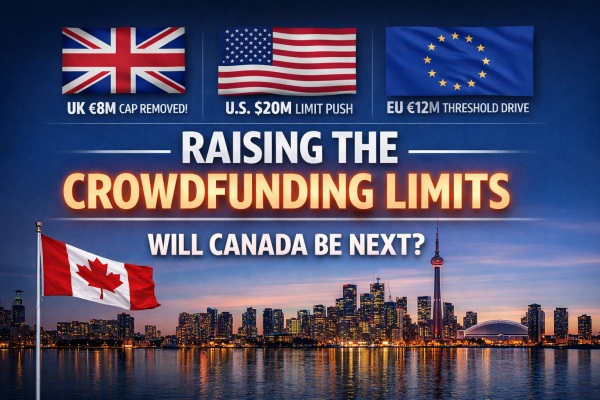
On February 10 2026, UK POP rules go live, removing the old prospectus trigger that made large public raises expensive, slow, and out of reach for many private companies.
For years, UK companies faced a hard line. If a business raised more than €8 million in securities from the public in a year, it had to produce a full prospectus (NB: the UK retained that euro-denominated threshold in its domestic framework post-brexit). Crowdcube says that prospectus costs could cost more than £250,000 and take months, which pushed many companies away from public community rounds even when demand existed.
Under the Public Offer Platform regime, raises above £5 million now run through a regulated POP, and the regime removes the upper fundraising cap for those offers (No more funding caps). Raises under £5 million remain outside the POP requirement, but regulated execution and investor protection expectations still apply.
Platforms now carry more responsibility for diligence, disclosure quality, and investor safeguards. That shifts the burden from a giant issuer document to a supervised platform process that can move faster.
The UK is not alone. In the United States, Crowdfund Capital Advisors submitted a $20M Reg CF petition asking the SEC to raise the Regulation Crowdfunding cap from $5M to $20M. In Europe, the European Digital Finance Association are pushing to increase the ECSP threshold from €5m to €12m.
After years of advocating, Canada finally harmonized nationally its startup-crowdfunding exemption in 2021, but regulators have kept the issuer cap conservative. Under National Instrument 45 110, eligible issuers can raise up to $1.5m in a 12 month period, which a growing company can quickly outgrow and end up soon looking for more funding via heavier paths for larger rounds. If the government wants to prioritize funding scape-ups, they should take another look at increasing equity crowdfunding caps in Canada to be in line with global peers.
This funding cap tension isn't new. In fact NCFA has been advocating for the OSC and CSA to raise issuer funding caps for years. In 2017 for example, NCFA petitioned to raise caps to modernize equity crowdfunding in Ontario. In 2019, $5m cap formed part of NCFA's recommendations to reduce regulatory burden and unlock growth capital. Again in 2020, during national harmonization discussions, NCFA advocated to modernize NI 45 110 including increasing caps to $5 million so the framework could match real funding needs in a digital economy.
Now with the UK FCA removing prospectus triggers and the US and EU push for higher caps, there may be a new policy window for Canada's equity crowdfunding participants to petition yet again. If other jurisdictions support $10m to $20m community rounds under platform oversight, Canada needs to decide whether it wants founders scaling here or structuring growth capital elsewhere.
A higher ceiling, including a path toward $5m and beyond, would better match growth stage reality while keeping platform level investor protection front and centre. The global direction of travel now strengthens the case for a renewed Canadian push grounded in data, experience, and competitiveness.
If regulated platforms can run larger public offers without a prospectus wall in the UK, what should Canada do next, raise the ceiling, create a platform lane for larger rounds, or keep the cap and accept that growth capital routes around Canada?
One practical takeaway stands out. POP style rules treat the platform as the compliance spine, not the issuer. That design can cut cost and time while still demanding clear disclosures, suitability controls, and due diligence at the point of sale. While Canada doesn't necessarily need to copy the UK, it does need a credible path for larger community rounds that doesn't force founders into a prospectus sized bill before they have the scale to absorb it.
The National Crowdfunding & Fintech Association (NCFA Canada) is a financial innovation ecosystem that provides education, market intelligence, industry stewardship, networking and funding opportunities and services to thousands of community members and works closely with industry, government, partners and affiliates to create a vibrant and innovative fintech and funding industry in Canada. Decentralized and distributed, NCFA is engaged with global stakeholders and helps incubate projects and investment in fintech, alternative finance, crowdfunding, peer to peer finance, payments, digital assets and tokens, artificial intelligence, blockchain, cryptocurrency, regtech, and insurtech sectors. Join Canada's Fintech & Funding Community today FREE! Or become a contributing member and get perks. For more information, please visit: www.ncfacanada.org
| | |
|---|---|---|
| | |
February 17 2026 | Equity Crowdfunding and Retail Investors

Image: Freepik/pressfoto
On February 16 2026, multiple UK reports say BrewDog has hired advisers to explore a potential sale after years of losses and slower growth. As a result, about 220,000 Equity for Punks retail shareholders may lose money depending on deal structure and payout priority.
Do you remember the Equity for Punks BrewDog story from years past? It was a story of community empowerment in the early days of the equity crowdfunding movement. NCFA and established partners like Crowdfund Insider tracked that momentum, such as when when BrewDog plans a $50M US equity crowdfunding round. The story today however offers practical lessons about capital structure, liquidity, and investor protection.
BrewDog built one of the most visible equity crowdfunding programs in the world through Equity for Punks. The model gave everyday consumers direct exposure to private company ownership and it proved that brand and community could mobilize serious capital.
In 2017 however, BrewDog took a major private equity investment from TSG Consumer Partners. Reporting in The Guardian describes preferential rights that sit ahead of common shareholders in a sale. That structure now drives the risk for small shareholders in the current sale process, based on how the deal structure affects what retail shareholders receive in a sale. The core point is simple. Structure governs outcomes in private markets.
Phil Halsey (47) invested about £2,500, starting in the second cash call in 2011:
“It’s extremely disappointing that it’s gone this way,” said Halsey. “The last time you could have done some form of cashing out was about a year and a half ago.”
1. Capital stack always decides the payout. Retail investors often focus on brand, traction, and growth narrative. Professional investors focus first on the capital stack. If a preferred investor holds liquidation preferences or other senior rights, that investor receives sale proceeds first. Common shareholders receive what remains. In a strong exit everyone wins. In a weaker exit, common shareholders may receive little or nothing. Investors should read share class terms and understand exactly where they sit before they invest.
2. Liquidity risk shows up at the worst time. Equity crowdfunding expands access, but it rarely guarantees a clean exit path. If investors rely on one big liquidity event, timing risk becomes real. Investors should treat these positions as long duration holdings. Founders and platforms should design credible liquidity pathways where rules allow, because trust grows when investors understand how they can eventually exit.
3. Growth narratives do not replace unit economics. The sale process follows years where BrewDog reported losses. When costs rise and category growth cools, expansion heavier models feel pressure quickly. Investors should challenge founders and operators on the road to profitability, not just the top line story. Founders should align growth with durable margins, because narrative alone doesn't protect valuation.
4. Community builds momentum but it does not hedge downside. Equity for Punks turns customers into owners and it proves that community capital can scale a consumer brand. That impact remains real. Yet community alignment does not override contractual rights in a sale. Retail investors should value perks and participation for what they are, and they should separate those benefits from expected financial return.
BrewDog's case encourages retail investors to have more mature conversations about disclosure, investor education, and deal structure literacy. For Canada, the case reinforces why clear explanations of share classes, payout priority, and realistic liquidity expectations are important for investor protection and long term market credibility.
The National Crowdfunding & Fintech Association (NCFA Canada) is a financial innovation ecosystem that provides education, market intelligence, industry stewardship, networking and funding opportunities and services to thousands of community members and works closely with industry, government, partners and affiliates to create a vibrant and innovative fintech and funding industry in Canada. Decentralized and distributed, NCFA is engaged with global stakeholders and helps incubate projects and investment in fintech, alternative finance, crowdfunding, peer-to-peer finance, payments, digital assets and tokens, artificial intelligence, blockchain, cryptocurrency, regtech, and insurtech sectors. Join Canada's Fintech & Funding Community today FREE! Or become a contributing member and get perks. For more information, please visit: www.ncfacanada.org
| | |
|---|---|---|
| | |
Feb 17, 2026 | NCFA Fintech Market Activity | Payroll and HR Tech

Image: Freepik
On February 17 2026, Nmbr announced the Collage Payroll launch, positioning it as the first benefits connected HR platform in Canada to embed payroll inside its HR workflow. Collage says customers can onboard employees once, manage time off and timesheets, and sync HR, payroll, and benefits data through a single login.
Collage says it began partnering with Nmbr in 2024 to build payroll directly inside its HR and benefits workflow (see embedded finance). Then in September 2024, Nmbr announced that they raised CAD $7.6M for Embedded Payroll in Canada. An early rollout in 2025 showed traction, with clients ranging from one to hundreds of employees already using the embedded payroll functionality.
The announcement also calls out real operating pain being solved. Research says nearly a third of businesses spend more than 30 hours a week managing data across payroll and other systems. Collage and Nmbr are betting that fewer handoffs reduces admin burden, lowers compliance risk, and cuts the error rate that shows up every time a hire, pay change, benefits update, or termination forces duplicate data work.
Mark Bluvshtein, Chief Executive Officer, Collage, and Vice President of HR Solutions at People Corporation:
“Payroll has been the number one request from our customers for years. Even when HR and payroll systems work closely together, businesses still feel the friction of managing two platforms. Bringing payroll directly into Collage allows us to finally deliver a single system that manages it all, reducing complexity and giving employers far greater control.”
Nmbr positions itself as payroll infrastructure rather than a standalone payroll brand. Nmbr handles core payroll requirements including payments, compliance, and data accuracy, so platforms can ship payroll inside their own products without rebuilding the hardest pieces from scratch. Noteworthy that Nmbr’s founding team previously helped build and scale Humi, while Collage points to leadership experience across Wave and Humi.
Simon Bourgeois, Chief Executive Officer, Nmbr:
“Payroll is one of the most complex systems a business can run, which is why so few companies have tried to build it themselves. By partnering with Collage, we’re enabling payroll to be built the right way, fully embedded, compliant, and designed for Canadian businesses. This partnership shows what’s possible when modern payroll infrastructure meets a platform that deeply understands HR and benefits.”
As more HR platforms embed payroll, what becomes the differentiator for employers, accuracy and compliance controls, speed of implementation, or the ability to bundle payroll with benefits and other people operations workflows without extra vendors?
Embedded payroll changes the competitive map for HR platforms in Canada. If payroll lives inside the HR and benefits workflow, employers stop treating payroll as a separate purchasing decision and start treating it as a built in capability. That dynamic rewards platforms that control the end-to-end workflow and can keep payroll accurate across provinces, remittances, and reporting cycles.
The National Crowdfunding & Fintech Association (NCFA Canada) is a financial innovation ecosystem that provides education, market intelligence, industry stewardship, networking and funding opportunities and services to thousands of community members and works closely with industry, government, partners and affiliates to create a vibrant and innovative fintech and funding industry in Canada. Decentralized and distributed, NCFA is engaged with global stakeholders and helps incubate projects and investment in fintech, alternative finance, crowdfunding, peer-to-peer finance, payments, digital assets and tokens, artificial intelligence, blockchain, cryptocurrency, regtech, and insurtech sectors. Join Canada's Fintech & Funding Community today FREE! Or become a contributing member and get perks. For more information, please visit: www.ncfacanada.org
| | |
|---|---|---|
| | |


August 26th, 2025

January 4th, 2024

June 1st, 2021

September 9th, 2020

July 9th, 2018

January 3rd, 2018

September 25th, 2017

June 20th, 2017

May 10th, 2017

December 14th, 2016