




Karsten Wenzlaff, Advisor
August 26th, 2025
Karsten Wenzlaff is a Crowdfunding and Fintech Expert from Germany. He is Secretary-General of Digit[...]


February 18 2026 | NCFA Market Insight | Digital Assets And Payments
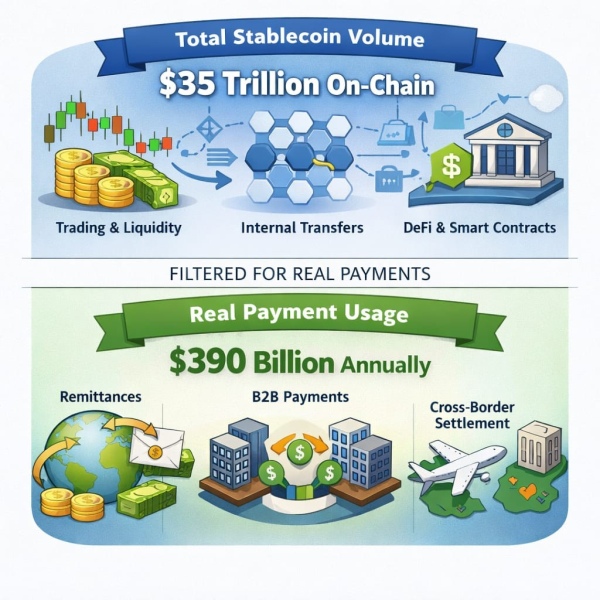
On February 18 2026, McKinsey stablecoin transaction analysis reported that stablecoins accounted for up to $35T in annual on chain transaction volume, yet most of that activity doesn't represent real world payments.
McKinsey and Artemis estimate that actual stablecoin payments run at about $390B annually (about 0.02% of global payments volume), after filtering out trading, internal exchange movements, liquidity management, and automated smart contract loops.
Public blockchains record value movement with precision, but they don't label intent. A single economic action can trigger multiple on chain steps, and large pools of stablecoins can move between wallets inside the same exchange or custodian without representing end user commerce. McKinsey uses raw volume as a starting point, not a proxy for adoption, and the methodology section explains how the team tags payment like patterns while excluding activity that reflects market structure rather than payments.
CoinDesk echoes the same measurement problem by reporting that stablecoins moved about $35T in transfers while only about 1% ties to genuine payments such as remittances and payroll. Payments industry coverage also confirms that stablecoin usage in payments is growing, yet most current activity still concentrates in internal or trading adjacent flows.
Market trackers help validate scale but they don't classify intent. CoinMarketCap aggregates stablecoin market cap and trading volume across listed tokens, which helps you track stablecoin liquidity concentration and market growth, not payments versus non payments.
Stablecoin payments represent one slice of stablecoin utility, so a payments only lens understates what stablecoins do across trading, treasury movement, DeFi collateral, and settlement workflows.
At the same time, a raw volume lens overstates payment adoption. The right reporting approach breaks stablecoin activity into functional buckets and tracks each bucket with the data source that fits it. For payments, intent classification and tagging matter. For liquidity and market structure, market cap and trading metrics matter. For payment segmentation, the underlying research partner publishes its own breakdowns that support the McKinsey approach.
If you build payment rails, you should not pitch adoption using raw on chain volume. You should show where real payment flows concentrate, how fast those flows grow, and what integration path turns that activity into revenue.
If you sell to financial institutions, you should map stablecoin opportunity to specific payment problems such as cross border B2B settlement, payroll, and corridor based remittances, then quantify addressable volume using intent filtered benchmarks like the McKinsey and Artemis estimates.
If you track policy or competitiveness, you should treat stablecoins as a measurement case study. Blockchain data looks transparent, yet it still requires more granular classification, assumptions, and cross checks to translate value movement into economic activity.
If the market keeps quoting $35T as proof of payment adoption, who sets the standard for intent based stablecoin reporting so Canada can measure real productivity and competition impact with confidence
 The National Crowdfunding & Fintech Association (NCFA Canada) is a financial innovation ecosystem that provides education, market intelligence, industry stewardship, networking and funding opportunities and services to thousands of community members and works closely with industry, government, partners and affiliates to create a vibrant and innovative fintech and funding industry in Canada. Decentralized and distributed, NCFA is engaged with global stakeholders and helps incubate projects and investment in fintech, alternative finance, crowdfunding, peer-to-peer finance, payments, digital assets and tokens, artificial intelligence, blockchain, cryptocurrency, regtech, and insurtech sectors. Join Canada's Fintech & Funding Community today FREE! Or become a contributing member and get perks. For more information, please visit: www.ncfacanada.org
 |  |  |
|---|---|---|
 |  |  |
February 25 2026 | Feature | Payments And Market Structure

On February 24 2026, Stripe’s 2025 annual letter confirmed $1.9 trillion in payment volume, up 34% year over year and equivalent to roughly 1.6% of global GDP.
This year's annual update reinforces Stripe’s position as core digital infrastructure, not just a merchant tool. Stripe reported that more than half of the Fortune 100 now use its platform, alongside millions of startups and scaleups. Stripe is accelerating adoption across marketplaces, SaaS platforms, and AI native businesses.
It also disclosed that revenue from its billing, tax, and invoicing products is approaching a $1 billion annual run rate. It's a significant number because it reflects diversification away from transaction fees toward higher margin software and financial operations services.
The company’s valuation rose to $159 billion via a recent tender offer, underscoring investor confidence despite tighter capital markets across fintech. Stripe’s letter stressed disciplined growth with improved profitability and cost management while still maintaining strong product expansion.
The letter devoted significant attention to AI driven business formation. Stripe reported a surge in AI startups using the platform to launch global businesses faster, often generating revenue within days of incorporation, demonstrating Stripe’s role as an infrastructure provider embedded at the earliest stages of company creation.
Stripe also pointed to increased adoption of programmable billing, usage based pricing, and embedded financial workflows, trends closely aligned with software led commerce and the agent economy.
These data points confirm that payments growth increasingly tracks software distribution rather than traditional retail expansion.
Techcrunch reported via Bloomberg reporting that Stripe is interested in acquiring all or part of PayPal, pushing consolidation pressure across payments. While discussions are still unofficially confirmed, the strategic logic is clear. Stripe dominates developer first infrastructure while PayPal retains global consumer wallet reach and brand recognition.
The merger and acquisition combination would create one of the most comprehensive financial platforms spanning checkout, wallets, subscriptions, identity, and merchant services across online and offline commerce.
Payment providers are moving toward financial operating system models. The goal is to own customer onboarding, transaction processing, revenue management, compliance, and treasury workflows within a unified platform.
Such an evolution echoes themes explored in PayPal’s instant checkout integration with conversational AI, where payments become embedded directly inside digital experiences rather than appearing as a separate step.
As platforms expand vertically, competitive advantage moves from pricing to ecosystem depth, data visibility, and developer integration.
Stripe’s growth trajectory holds direct relevance for Canada. Many Canadian startups rely on Stripe for global payments, subscription infrastructure, and cross border expansion. The company’s expanding product stack increases dependency but also enables Canadian founders to reach global markets without building their own payments infrastructure.
Also, consolidation (risk) will create opportunities for Canadian fintechs specializing in compliance automation, treasury intelligence, identity infrastructure, and vertical specific payments to build differentiated layers on top of global rails.
If payment infrastructure providers evolve into full financial operating systems, will future fintech innovation depend more on building differentiated layers on top of global rails than competing directly with them?
The implication for founders and investors is that infrastructure ownership and ecosystem depth will define the next competitive cycle. Fintech innovation increasingly occurs through orchestration of financial services rather than standalone payment processing.
The National Crowdfunding & Fintech Association (NCFA Canada) is a financial innovation ecosystem that provides education, market intelligence, industry stewardship, networking and funding opportunities and services to thousands of community members and works closely with industry, government, partners and affiliates to create a vibrant and innovative fintech and funding industry in Canada. Decentralized and distributed, NCFA is engaged with global stakeholders and helps incubate projects and investment in fintech, alternative finance, crowdfunding, peer-to-peer finance, payments, digital assets and tokens, artificial intelligence, blockchain, cryptocurrency, regtech, and insurtech sectors. Join Canada's Fintech & Funding Community today FREE! Or become a contributing member and get perks. For more information, please visit: www.ncfacanada.org
| | |
|---|---|---|
| | |
Feb 24, 2026 | NCFA Fintech Market Activity | Alternative Finance And Home Equity Sharing

House rich, cash poor? Home equity sharing
On February 10 2026, The Home Equity Partners (HEQ) reported surpassing $10M in managed home asset value within its first year, highlighting early traction for home equity sharing agreements as Canadian households search for ways to access liquidity without taking on new debt.
The Toronto-based fintech became operational in May 2025 and offers homeowners capital in exchange for a share of future home value rather than interest payments. Homeowners receive funds today and settle later when the property is sold or refinanced.
That structure positions home equity sharing as a complement to traditional options such as HELOCs or refinancing. The difference is simple. Homeowners don't add interest bearing debt. They share both potential appreciation and downside risk with the provider.
This isn't only a mortgage stress product. It appeals to homeowners who feel house rich but cash constrained, including:
HEQ's model lands in a market where housing affordability remains under sustained pressure. CMHC’s latest housing supply gaps report says a return to affordability levels last seen in 2019 requires building about 430,000 to 480,000 new housing units per year over the next decade, roughly double the current pace. But supply shortages and higher borrowing costs continue to limit traditional refinancing options for many homeowners, increasing interest in ways to access home equity without selling the property.
Data tracking mortgage carrying costs shows many households face elevated payment ratios relative to income, with housing costs absorbing a growing share of disposable income across major Canadian cities. Read this Bank of Canada staff analysis about the typical Consumer's path to mortgage delinquency.
The company says its early portfolio reflects growing interest from homeowners seeking liquidity without increasing monthly obligations. While the $10 million figure remains modest relative to Canada’s housing market, it's an early sign that new financial products can tie directly to residential assets.
For fintech operators, the approach blends property finance, alternative lending logic, and long term investment exposure. Investors receive participation in home value changes, while homeowners gain flexibility that traditional credit products cannot always provide.
The structure also introduces new considerations. Pricing transparency, valuation methods, exit timing, consumer awareness and education will impact adoption and regulatory attention as the model expands.
If mortgage renewals and affordability pressure continue to strain Canadian households, will equity sharing evolve into a mainstream financing option or remain a niche tool for homeowners seeking flexibility without additional debt?
The National Crowdfunding & Fintech Association (NCFA Canada) is a financial innovation ecosystem that provides education, market intelligence, industry stewardship, networking and funding opportunities and services to thousands of community members and works closely with industry, government, partners and affiliates to create a vibrant and innovative fintech and funding industry in Canada. Decentralized and distributed, NCFA is engaged with global stakeholders and helps incubate projects and investment in fintech, alternative finance, crowdfunding, peer-to-peer finance, payments, digital assets and tokens, artificial intelligence, blockchain, cryptocurrency, regtech, and insurtech sectors. Join Canada's Fintech & Funding Community today FREE! Or become a contributing member and get perks. For more information, please visit: www.ncfacanada.org
| | |
|---|---|---|
| | |
Feb 23, 2026 | NCFA Market Activity | DAOs

On February 22 2026, Jupiter DAO closes the Net Zero Emissions option vote, moving JUP toward a supply tightening direction and a buyback first treasury posture. On chain reporting shows about 75% support for the Net Zero Emissions option and states the vote concluded at 7:00 PM ET. During the voting window, on chain analysis reports more than 24.5k votes recorded within the first 48 hours, with more than 13k individual voters backing the Proceed with Jupuary option by raw voter count, while the Net Zero Emissions option leads by voting weight at more than 73.9% during that same early period, on a voting distribution analysis that breaks down wallet counts and voting weight.
The proposal says net new emissions move from about 1.2B JUP to effectively zero, if the DAO approves the package. The proposal also states it postpones Jupuary and returns 700M tokens to the Community Cold Multisig, and it states Jupiter routes 50% of on chain revenues to open market buybacks. Jupiter already burns 3B tokens and it states founders lock tokens, including a founder lock to 2030.
Legacy allocations shape why the DAO focuses on offsets. On chain analysis reports Mercurial stakeholders receive 5% of total supply or 350m tokens, with about 182m vested by February 2026 and 168m remaining to unlock, also on the voting distribution analysis that quantifies the Mercurial allocation and vesting status.
Maker uses surplus auctions where the system auctions surplus Dai for MKR and then burns the MKR received from the winning bid, which contracts MKR supply, as described in Maker Protocol documentation on the Flapper surplus auction mechanism.
Aave documentation states the Aave DAO operates a buyback program funded by protocol revenue with a $50 million annual budget and weekly purchases that range from $250,000 to $1.75 million, with tokens sent to the DAO Ecosystem Reserve rather than burned, on Aave protocol documentation describing the buyback program budget and execution.
The proposal turns token governance into capital policy that stakeholders can measure. It targets a defined dilution outcome by moving net new emissions from about 1.2B JUP to effectively zero, and it pairs that supply stance with a stated rule that routes 50% of on chain revenues to buybacks. That combination gives the market a simple scoreboard, emissions near zero plus ongoing buy pressure funded by revenue, not inflation.
Early vote analysis shows more than 24.5k votes within 48 hours and it shows a divergence where the Jupuary option leads by raw voter count while Net Zero Emissions leads by voting weight. Token weighted voting aligns outcomes with economic exposure, but it can widen the gap between how many people show up and who decides. Fintech builders can reduce that gap with delegation tooling, transparent quorum logic, and reporting practices that make governance outcomes feel earned.
Offsets move sell pressure from the open market to treasury management. The proposal describes a treasury approach that aims to neutralize known future sell flows tied to vesting and distribution decisions, which creates a new execution test, the treasury must manage price, timing, and credibility in public. That's the same category of operational accountability that capital markets packaging requires.
Canada adds a practical lens because Canadian fintechs increasingly package products for institutional distribution where buyers demand explicit mechanics and predictable governance. Ledn’s Bitcoin backed ABS deal entering institutional markets shows how an institutional wrapper forces defined rules and clear investor expectations. Tokenized finance teams can apply that same discipline to emissions rules, treasury authority, and public reporting so partners can underwrite the model rather than debate it.
If a token stops emitting, who pays for growth and liquidity next, users through fees, builders through treasury, or the market through higher risk premiums?
The National Crowdfunding & Fintech Association (NCFA Canada) is a financial innovation ecosystem that provides education, market intelligence, industry stewardship, networking and funding opportunities and services to thousands of community members and works closely with industry, government, partners and affiliates to create a vibrant and innovative fintech and funding industry in Canada. Decentralized and distributed, NCFA is engaged with global stakeholders and helps incubate projects and investment in fintech, alternative finance, crowdfunding, peer-to-peer finance, payments, digital assets and tokens, artificial intelligence, blockchain, cryptocurrency, regtech, and insurtech sectors. Join Canada's Fintech & Funding Community today FREE! Or become a contributing member and get perks. For more information, please visit: www.ncfacanada.org
| | |
|---|---|---|
| | |
Feb 23, 2026 | NCFA Fintech Market Activity | Digital Assets Blockchain And Tokenization

On February 20 2026, Ledn announced the first ever investment grade asset backed securities transaction in the digital asset industry, placing Bitcoin secured consumer loans into a capital markets format designed for institutional fixed income buyers.
Reporting on presale ratings and collateral detail indicates the transaction totalled about $188M and referenced a collateral pool of 5,441 Bitcoin backed consumer loans secured by 4,078.87 Bitcoin with an aggregate presale collateral value near $330M. S&P Global Ratings assigned preliminary ratings to two tranches, signalling that crypto secured loan performance can be assessed within traditional credit frameworks.
An asset backed security (ABS) pools loans and converts expected borrower payments into tradable bonds. In this structure, the underlying assets are Bitcoin collateralized consumer loans, which places operational emphasis on custody safeguards, liquidation triggers, valuation discipline, and reporting transparency.
For additional background on how crypto backed loans operate at the borrower level, this Fintech Fridays episode, Bitcoin backed loans and putting your crypto to work, provides context with Ledn Co-founder Mauricio Di Bartolomeo.
The Ledn issuance positions securitization as a funding diversification path. Instead of relying only on balance sheet capital or warehouse facilities, loan originators can distribute credit risk to bond investors, expanding lending capacity without requiring traditional bank balance sheet support.
Structure changes market access. A crypto lending desk can fund loans directly, but a rated ABS wrapper introduces buyers who operate under fixed income mandates and portfolio risk frameworks. That development moves crypto secured credit closer to mainstream credit market infrastructure.
The transaction also reinforces operational expectations. Securitization forces clarity around collateral custody, margin maintenance, liquidation speed, valuation timing, and stress scenario performance. If these controls prove reliable in market cycles, securitized crypto credit could evolve into a recognized institutional allocation sleeve.
Ledn represents a Canadian founded crypto finance platform now operating globally. Prior milestones include Tether investing in Ledn to expand crypto credit access and Ledn receiving VASP regulatory approval in the Cayman Islands, which together strengthen its institutional positioning and reporting posture.
If institutional investors begin treating crypto secured ABS pools as a defined allocation sleeve, Canadian originated platforms that demonstrate transparent collateral management and disciplined underwriting could gain access to funding channels that operate beyond domestic banking constraints.
If securitized crypto credit continues to mature, the competitive edge may hinge less on yield and more on collateral governance, transparency, and investor distribution relationships.
Crypto secured lending is beginning to compete not only on returns, but on structure, reporting discipline, and institutional investability.
The National Crowdfunding & Fintech Association (NCFA Canada) is a financial innovation ecosystem that provides education, market intelligence, industry stewardship, networking and funding opportunities and services to thousands of community members and works closely with industry, government, partners and affiliates to create a vibrant and innovative fintech and funding industry in Canada. Decentralized and distributed, NCFA is engaged with global stakeholders and helps incubate projects and investment in fintech, alternative finance, crowdfunding, peer-to-peer finance, payments, digital assets and tokens, artificial intelligence, blockchain, cryptocurrency, regtech, and insurtech sectors. Join Canada's Fintech & Funding Community today FREE! Or become a contributing member and get perks. For more information, please visit: www.ncfacanada.org
| | |
|---|---|---|
| | |
February 20, 2026 | NCFA Fintech Whisperer Weekly Intelligence | Regulation And Policy, Artificial Intelligence And Data, Payments And Money Movement, Digital Assets Blockchain And Tokenization, Risk Compliance And Regtech

Image: Freepik
This live weekly NCFA intelligence page tracks financial technology developments that significantly affect how fintechs build, sell, raise capital, and operate under scrutiny. Coverage prioritizes Canada and includes global events that directly influence competitive conditions, market access, and execution realities across fintech sectors. This page will be updated throughout the week with market movers in a live format and then each week we'll close the prior week's contents in prep for the upcoming week, and continue on a rolling basis. (Missed prior week's Fintech Whisperer? (December 6-12, 2025, December 13-19, 2025, January 1-9, 2026, January 10-16, 2026, January 17-23, 2026, January 24-30, 2026, January 31-February 6, 2026, February 7-13, 2026).
This is a procurement and capital boost for defence not seen in decades. Fintechs that help defence suppliers get paid faster, manage cash under milestone contracts, and prove tight controls on funds and data have a generational opportunity with real distribution next quarter. See defence push: Montreal joins provincial bids for global DSR bank platform
This is a money and proof moment for insurtech. Founders selling automation into carriers and brokers should expect buyers to ask for hard baseline metrics, verified before and after results, and fast integration plans this quarter because the market now funds teams that tie automation to combined ratio math and measurable cost takeout.
The UK is embedding crypto firms inside the existing Financial Services and Markets Act framework used for banks, investment firms, and other regulated financial institutions. Firms will likely need stronger governance, clearer business models, defined senior management accountability, and enough financial resources to pass a full authorisation assessment. This tends to favour well capitalized firms that can build institutional grade compliance and risk management from the start.
Tariff volatility shouldn't come as a surprise to anyone and still important to note that this does not take tariffs off the table. Founders and investors should assume trade cost risk still moves through other statutes and policy tools, so the teams that win next quarter make cash forecasting, FX, and settlement controls easier to run when pricing and demand change overnight.
This locks in the timeline banks plan around. Founders selling credit, underwriting, treasury, capital markets, or risk tooling into federally regulated institutions should expect earlier capital impact questions and tighter evidence requests in the next quarter because partners align product decisions to November 2026 and January 2027 effective dates long before final publication.
BoC's action should put every payments and wallet provider on notice. Partners should ask sharper questions about where customer funds sit, who controls access, how fast you can prove balances, and how you recover when something breaks. Teams that can answer those questions with evidence keep distribution moving when scrutiny rises. Feb 27, 2026 Update: The Bank of Canada issues a revised order that allows XTM to resume retail payment activities under court supervised monitoring (a controlled restart).
This can open practical opportunities into German buyers and programs, but only for teams that can pass strict security and governance reviews. Fintechs using AI should expect tougher diligence on where models run, how data moves, how vendors get controlled, and how incidents get handled. If you can show that evidence quickly, you may shorten procurement cycles and avoid months of back and forth. Large buyers tend to follow the standards governments back when they buy software at scale.
This is how stablecoins get real distribution, through bank grade plumbing that owns the hard parts. The next quarter gets more competitive for cross border payments and FX because buyers will compare everyone against always on settlement plus clean, provable books, not just a faster rail.
This is what a real time payments stack looks like when a credit union commits to execution. Vendors selling into credit unions should plan for tighter requirements on open APIs, core and digital banking integration, automated balancing, and exception handling in the next quarter because buyers now expect one platform to run multiple rails without adding operational headcount.
This partnership puts telecom scale on the same path as regulated payouts. If you want in, plan for a buyer that starts by stress testing your operations, not your pitch. Bring evidence you can trace every $ end to end, spot problems fast, reverse or recover cleanly, and keep service levels steady when volume spikes or fraud pressure rises. The teams that win make risk controls feel invisible to users while giving partners real time confidence that money moves exactly as promised.
Founders selling treasury and payments infrastructure should expect tougher questions on reconciliation, exception handling, and control ownership in the next quarter because a bundled PSP sets a higher baseline for speed and operational calm.
This is a real bridge into institutional credit rails. Founders building crypto credit, collateral, custody, and risk tooling should expect tougher questions next quarter on liquidation rules, collateral segregation, reporting, and investor grade controls, because rated structures pull crypto lending into the same discipline set as mainstream ABS.
This tightens delivery expectations for banks and their vendors. Payments and onboarding fintechs should expect stricter timelines and stronger evidence demands next quarter because partial coverage can trigger enforcement.
This week shows the market continuing to get stricter and more operational. OSFI closes the CAR 2027 consultation and puts bank capital planning on a fixed runway. The Bank of Canada order against XTM puts wallets and payments providers back under a microscope on safeguarding and access controls. Modern Treasury pushes more buyers toward one provider that owns rails, reporting, and controls. Desert Financial’s move into FedNow, RTP, and Visa Direct shows how fast credit unions now expect real time payments to work at scale. mea Platform’s $50M round reinforces that capital still rewards insurance automation when it ties directly to combined ratio math. The PSR fine in the UK makes clear that payments safety controls ship on deadline, or regulators step in.
NCFA offers various curated resources to help founders and investors stay current on developments that impact fintech markets, subscribe to NCFA weekly newsletter updates, view a rundown of current fintech news and insights, or dive into the latest fintech industry research.
The National Crowdfunding & Fintech Association (NCFA Canada) is a financial innovation ecosystem that provides education, market intelligence, industry stewardship, networking and funding opportunities and services to thousands of community members and works closely with industry, government, partners and affiliates to create a vibrant and innovative fintech and funding industry in Canada. Decentralized and distributed, NCFA is engaged with global stakeholders and helps incubate projects and investment in fintech, alternative finance, crowdfunding, peer-to-peer finance, payments, digital assets and tokens, artificial intelligence, blockchain, cryptocurrency, regtech, and insurtech sectors. Join Canada's Fintech & Funding Community today FREE! Or become a contributing member and get perks. For more information, please visit: www.ncfacanada.org
| | |
|---|---|---|
| | |
February 20, 2026 | NCFA Market Activity | Policy and Regulation

On February 20 2026, the U.S. Supreme Court tariff ruling found President Trump overstepped authority when invoking emergency powers to impose tariffs, delivering a 6 to 3 decision that impacts trade policy expectations across North America.
The ruling removes one of the most aggressive tariff pathways by confirming that emergency powers cannot serve as a broad trade policy tool. However, other legal authorities remain available, meaning tariff risk does not disappear. Policymakers in Ottawa have already begun reviewing the decision’s implications as cross border supply chains remain exposed to policy shifts.
Canada has already experienced tariff volatility during earlier policy cycles. April 2025 tariff impacts on Canadian businesses highlights how sudden trade actions disrupted pricing, inventory planning, and SME financing decisions. Separate analysis of Canada’s tariff trade tensions and economic spillovers shows how cross border friction affects supply chains and investment confidence even when exemptions exist.
The latest ruling may remove one legal foundation for tariffs, but uncertainty remains as governments retain alternative tools. For Canadian exporters and importers, planning risk continues to dominate strategic decision making.
Recent trade data reflects tariff driven disruption across the Canada United States corridor. Statistics Canada indicators show softening export volumes and declining imports during escalation periods, spotlighting how policy uncertainty can translate into pricing pressure, inventory swings, and capital allocation challenges for businesses operating internationally.
If tariff policy remains unpredictable despite judicial limits, will exporters accelerate adoption of embedded treasury, automated FX, and digital trade finance tools as core resilience infrastructure?
Tariffs apply to goods, yet financial effects surface across payments, FX settlement, and liquidity management. Companies facing trade uncertainty typically increase hedging activity, rely more heavily on short term working capital, and demand faster reconciliation to manage cash exposure.
The Supreme Court decision restores an important legal boundary but doesn't end tariff uncertainty. Political pressure around industrial policy and trade protection remains elevated, suggesting continued volatility in cross border commerce.
For Canada’s fintech ecosystem, the news may strengthens the role of fintech platforms focused on cross border payments, FX automation, trade finance digitization, and SME liquidity tools. Firms that help businesses forecast cash flow, manage currency risk, and access capital faster become operational buffers against geopolitical volatility.
You may also like:
Canada Confronts a Changing World at Davos 2026
Does CUSMA Support Fintech Services Across Borders?
The National Crowdfunding & Fintech Association (NCFA Canada) is a financial innovation ecosystem that provides education, market intelligence, industry stewardship, networking and funding opportunities and services to thousands of community members and works closely with industry, government, partners and affiliates to create a vibrant and innovative fintech and funding industry in Canada. Decentralized and distributed, NCFA is engaged with global stakeholders and helps incubate projects and investment in fintech, alternative finance, crowdfunding, peer-to-peer finance, payments, digital assets and tokens, artificial intelligence, blockchain, cryptocurrency, regtech, and insurtech sectors. Join Canada's Fintech & Funding Community today FREE! Or become a contributing member and get perks. For more information, please visit: www.ncfacanada.org
| | |
|---|---|---|
| | |


August 26th, 2025

January 4th, 2024

June 1st, 2021

September 9th, 2020

July 9th, 2018

January 3rd, 2018

September 25th, 2017

June 20th, 2017

May 10th, 2017

December 14th, 2016