




Karsten Wenzlaff, Advisor
August 26th, 2025
Karsten Wenzlaff is a Crowdfunding and Fintech Expert from Germany. He is Secretary-General of Digit[...]


June 10, 2026 | NCFA Insight | Regulation And Policy, Capital Markets And Market Infrastructure

On June 10, 2026, the CFTC opened public consultation on proposed prediction market rules and the related 267-page pre-publication rule document. The proposal would create a formal review process for event contracts that touch sensitive areas such as gaming, war, terrorism, assassination, or unlawful activity.
The market is now large enough to force a real line-drawing exercise. The CFTC says total trading volume across registered prediction markets exceeded $25 billion in 2025. That remains small beside the roughly $31 trillion notional value of the broader futures market the agency regulates, but it is no longer a niche category.
The proposal targets event contracts covered by Section 5c(c)(5)(C) of the Commodity Exchange Act. The CFTC wants to amend Regulation 40.11, add Appendix F to part 40, define when a contract “involves” a listed activity, define “gaming,” and apply public interest factors to each contract under review.
Currently, a registered exchange can self-certify a contract, and contracts may begin trading quickly. The proposed framework gives the CFTC a 90-day review period for contracts that may involve one of the listed activities. The agency can request that trading pause during review, but the proposal says prediction markets are not required to follow that request. Some contracts could trade during review and later be blocked or delisted if the CFTC finds them contrary to the public interest.
The public interest test is practical. The CFTC would look at price discovery, information value, market integrity, and whether the platform can supervise the contract. That puts contract design, settlement data, surveillance, and trader controls at the centre of the review.
Sports are a key test case. The proposal treats contracts based on broad, objective sports outcomes more favourably, including final scores, point differentials, win-loss results, tournament advancement, team or individual statistics, and season-long performance metrics. The CFTC says these contracts can create useful price information when they use objective settlement criteria and are supported by suitable oversight and coordination with sports integrity bodies.
The CFTC is stricter around contracts tied to player injuries, officiating decisions, youth sports, cheating incentives, and misconduct. Injury contracts can create harmful incentives and expose medical information. Officiating contracts can put pressure on a small number of identifiable decision makers. Youth sports markets raise participant protection concerns.
DraftKings highlights why this rulemaking is needed commercially. Barron’s reports that annualized consumer trading volume on DraftKings Predictions reached $1.3 billion, up 24% from April 2026. Annualized total trading volume reached $3.1 billion, up 34%. Note, the numbers are early and based on company data.
DraftKings brings sports users, mobile distribution, pricing, promotions, and live event engagement. Kalshi and Polymarket bring event contracts, exchange style trading, collateral, liquidity, and surveillance. The CFTC proposal now pulls those models into the same regulatory conversation.
The user experience may look similar on a phone, but the rulebooks are different. Sportsbooks operate under gaming law. Prediction markets argue they are federally regulated event contract markets that support price discovery and information aggregation. The CFTC proposal tests where that argument holds, especially when sports contracts that are towing the line of integrity.
NCFA recently looked at trust questions around Polymarket influencer payments, including disclosure, paid promotion, and market credibility after a market goes live. The CFTC proposal moves the issue upstream. It asks which markets should be allowed to list in the first place.
Canada should watch closely. DraftKings already operates in Ontario’s regulated iGaming market, while prediction markets continue to test the line between financial contracts, gaming products, and information markets. The U.S. approach won't cleanly transfer into Canada, but it gives Canadian regulators, exchanges, fintechs, and other stakeholders an early view of the policy questions surrounding the table..
Will sports prediction markets become regulated financial products, sportsbook extensions, or a new category that forces regulators to redraw the line between trading, gaming, and market information?
 The National Crowdfunding & Fintech Association (NCFA Canada) is a financial innovation ecosystem that provides education, market intelligence, industry stewardship, networking and funding opportunities and services to thousands of community members and works closely with industry, government, partners and affiliates to create a vibrant and innovative fintech and funding industry in Canada. Decentralized and distributed, NCFA is engaged with global stakeholders and helps incubate projects and investment in fintech, alternative finance, crowdfunding, peer-to-peer finance, payments, digital assets and tokens, artificial intelligence, blockchain, cryptocurrency, regtech, and insurtech sectors. Join Canada's Fintech & Funding Community today FREE! Or become a contributing member and get perks. For more information, please visit: www.ncfacanada.org
 |  |  |
|---|---|---|
 |  |  |
June 10, 2026 | NCFA Story Intelligence | Capital Markets And Funding
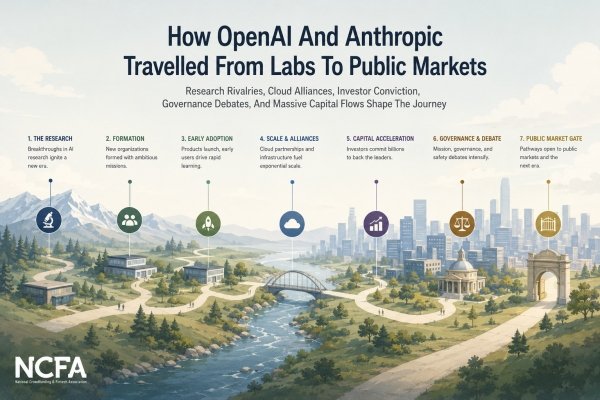
On June 8, 2026, OpenAI confirmed it submitted a confidential S-1 to the U.S. Securities and Exchange Commission. One week earlier, Anthropic disclosed its own confidential draft registration statement for a proposed IPO.
The filings are the trigger, not the story. The story is how frontier AI moves from research labs and safety debates into consumer adoption, cloud alliances, investor conviction, copyright fights, government interest, near trillion dollar private valuations, and the public market gate.
OpenAI starts with a promise that sounds almost incompatible with public markets.1 In 2015, it begins as a nonprofit AI research company with a mission tied to broad public benefit, not shareholder return. That tension does not matter much while the work sits inside research circles. It matters once OpenAI becomes strategically important.
Anthropic comes from inside the same argument.2 Founded in 2021 by former OpenAI researchers, including Dario Amodei, Anthropic builds its identity around reliable, interpretable, and steerable AI systems. It is not just another model company. It is a different answer to a question OpenAI helped make unavoidable.
ChatGPT turns frontier AI into a public habit.3 The late 2022 launch changes the audience almost overnight. Students, founders, developers, workers, executives, and investors start testing advanced AI directly. Reuters later reports ChatGPT reached an estimated 100 million monthly active users in January 2023.4
Claude takes the quieter enterprise path.5 It does not create the same consumer spectacle, but Anthropic leans into reliability, predictable deployment, and safety as commercial positioning. Trust becomes part of the product, especially for organizations that need governance controls before they scale AI usage.
Microsoft turns OpenAI into one of the largest strategic bets in technology.6 The relationship gives OpenAI more than capital. Azure becomes part of its operating foundation, with cloud infrastructure, enterprise distribution, and credibility arriving at a moment when many buyers are still trying to understand what generative AI can become.
Anthropic attracts a different group of believers. Google backs the company. Amazon commits billions and makes Anthropic central to its AI strategy, while AWS becomes Anthropic's primary cloud and training partner.7 Spark Capital and Menlo Ventures remain part of the journey as Anthropic grows from safety focused startup into one of OpenAI's strongest challengers.
OpenAI remains the company everyone else measures against. ChatGPT gives OpenAI distribution, developer attention, and brand recognition. Microsoft's partnership gives it reach into enterprise software. That combination makes OpenAI powerful, but it also makes dependency risk more visible for large buyers.
Anthropic becomes strategically useful because it is different. Claude's role in enterprise productivity and financial workflows shows how a trust first product can become a real alternative. When Microsoft brings Claude into Office productivity, the message is practical: even OpenAI's most important partner wants more than one AI supplier in the stack.
OpenAI's success creates a new constraint. The company is no longer trying to prove that people will use frontier AI. ChatGPT already answered that question. OpenAI now has to fund the compute, deployment, developer usage, and enterprise adoption needed to keep the flywheel turning.
Anthropic faces the same pressure through Claude demand. Its Series H announcement points to global enterprise adoption, expanded compute capacity, Amazon, Google, Broadcom, SpaceX, and chip partners including Micron, Samsung, and SK hynix.8 The company's careful brand does not reduce its need for industrial scale infrastructure.
OpenAI's rise brings copyright and publisher pressure with it. The more useful the models become, the more valuable the training inputs appear. News organizations, authors, artists, and creators increasingly ask how their work contributes to model capability and who captures the value created from it.
Anthropic faces the same ownership question through Reddit. The Reddit lawsuit against Anthropic puts training data claims, platform rights, and AI accountability into the story. The issue is not only whether AI can learn from the web. It is who gets a say when web content becomes commercial fuel.
OpenAI's control questions become public in 2023.9 The board removes Sam Altman, then reverses course after pressure from employees, customers, investors, and partners. The episode is brief, but it changes how people read the company. Governance becomes part of valuation risk.
Anthropic's safety stance faces real world tests. Its product identity is tied to reliability and responsible deployment, but governments, enterprises, and defence buyers want more capability. The tension between safety commitments and state power is already visible in AI ethics, state power, and red lines.
OpenAI's March 2026 financing makes the capital story impossible to ignore.10 The company closes $122B USD in committed capital at an $852B USD post money valuation. The round is anchored by Amazon, NVIDIA, and SoftBank, with continued participation from Microsoft. SoftBank co leads alongside a16z, D. E. Shaw Ventures, MGX, TPG, and accounts advised by T. Rowe Price Associates.
Anthropic's May 2026 Series H shows the same private market scale.11 The company raises $65B USD at a $965B USD post money valuation. Altimeter Capital, Dragoneer, Greenoaks, and Sequoia Capital lead the round, with Capital Group, Coatue, D1 Capital Partners, GIC, ICONIQ, and XN also co leading. Amazon's prior commitment remains part of the picture, along with Google, Broadcom, SpaceX, and chip partners.
OpenAI follows on June 8 and keeps timing open.12 The company confirms it submitted a confidential S-1 but says it has not decided when to go public. Public markets become an option, while OpenAI keeps weighing what may be easier to do as a private company.
Anthropic reaches the IPO gate first on June 1.13 The filing does not set share count or price. It gives the company the option to move after SEC review, market conditions, and other factors.
Different origins. Different philosophies. Different investor groups. Different commercialization paths. Yet both companies arrive at the same gate.
The IPO filings don't end the frontier AI story. They mark the point where a decade of research, product adoption, infrastructure buildout, governance conflict, investor conviction, and public policy pressure begins meeting public markets.
For NCFA, this is where Story Intelligence connects to the Financial Innovation Map. The opportunity set includes private market liquidity, tokenized pre IPO access, AI infrastructure finance, prediction markets around IPO timing and valuation, disclosure standards, and investor protection for companies that may become public only after private markets have already priced much of the upside.
OpenAI and Anthropic followed different paths, attracted different allies, and made different decisions along the way. Yet both arrived at the same gate. That may say as much about the economics of frontier AI as it does about the companies themselves.
What part of the story stood out most to you?
Share this story → Explore related intelligence → Subscribe
The National Crowdfunding & Fintech Association (NCFA Canada) is a financial innovation ecosystem that provides education, market intelligence, industry stewardship, networking and funding opportunities and services to thousands of community members and works closely with industry, government, partners and affiliates to create a vibrant and innovative fintech and funding industry in Canada. Decentralized and distributed, NCFA is engaged with global stakeholders and helps incubate projects and investment in fintech, alternative finance, crowdfunding, peer-to-peer finance, payments, digital assets and tokens, artificial intelligence, blockchain, cryptocurrency, regtech, and insurtech sectors. Join Canada's Fintech & Funding Community today FREE! Or become a contributing member and get perks. For more information, please visit: www.ncfacanada.org
| | |
|---|---|---|
| | |
June 10, 2026 | NCFA Fintech Market Activity | Digital Assets Blockchain and Tokenization

On June 9, 2026, Eric Richmond joined Coinbase as Country Director and CEO of Coinbase Canada, giving the global crypto exchange a Canadian lead who has worked across trading, custody, regulation, and partnerships.
Shakepay named Richmond General Counsel and Head of Business Development in 2024, where his mandate covered legal, public policy, regulatory affairs, partnerships, new markets, and financial product opportunities. His earlier work also connects to Coinsquare and Tetra Trust’s regulated Canadian digital asset infrastructure, which now includes CADD, Canada’s first CAD-backed stablecoin issued by a regulated financial institution.
Coinbase Canada already has payment rails and regulatory standing. Coinbase's August 2023 Canadian launch gave Canadian users access to Interac e-Transfers through Peoples Trust, with Coinbase saying Interac was its most requested Canadian feature and that more than half of Canadian deposits in the prior month used Interac e-Transfer. In April 2024, Coinbase was approved as a Restricted Dealer in Canada, adding Canadian regulatory standing to its payment rail foundation.
Competition is tightening in the Canadian crypto market. Robinhood completed its WonderFi acquisition on June 1, 2026, bringing Bitbuy and Coinsquare into its Canadian platform strategy. Robinhood says Canadian customers will be invited into the Robinhood app, crypto trades will carry a flat 0.5% CAD trade fee, and WonderFi adds about 300,000 funded customers to Robinhood’s international base. Robinhood’s entry and Wealthsimple’s IPO Access launch are part of the current retail finance fight over access, pricing, loyalty, and who owns the customer relationship.
The Canada test is product access. Robinhood can use WonderFi as an entry point for a wider consumer finance app. Coinbase has a different challenge. It has to bring global crypto infrastructure into Canada in ways that fit local rules and user expectations. In 2023, Coinbase suspended USDT, DAI, and RAI trading for Canadian users shortly after launch, showing how Canadian rules can shape product availability even for large global platforms. That history matters now because Coinbase’s global strategy is tied more closely to USDC, Base, wallets, developer tools, stablecoin payments, and onchain financial infrastructure.
Canadian crypto adoption is real, but still shallow. Bank of Canada research found Bitcoin awareness near 93% in 2023, while ownership was about 9.9% overall and median holdings were about Can$500. Ownership was much higher among Canadians aged 18 to 34 at 19.1%. That leaves room for Coinbase, Robinhood, Wealthsimple, Shakepay, Kraken, Newton, NDAX and others to grow, with platforms competing on trust, funding rails, fees, custody, stablecoin access, and regulatory clarity.
Coinbase is moving beyond trading. Its Q1 2026 results say Coinbase holds more than 25% of total USDC in circulation, Base processed 62% of global onchain stablecoin transaction volume, and x402 has processed more than 100 million payments, with more than 99% completed using USDC. NCFA has also covered how Shopify, Coinbase, and Stripe are pushing USDC payments into mainstream commerce. Richmond’s job is to localize that broader infrastructure story for a Canadian market where crypto awareness is high, but deeper adoption still has to be earned.
Can Coinbase turn Canadian regulatory credibility, Interac rails, custody experience, USDC, Base, and global onchain infrastructure into local market share before Robinhood converts WonderFi into a broader retail finance platform?
The National Crowdfunding & Fintech Association (NCFA Canada) is a financial innovation ecosystem that provides education, market intelligence, industry stewardship, networking and funding opportunities and services to thousands of community members and works closely with industry, government, partners and affiliates to create a vibrant and innovative fintech and funding industry in Canada. Decentralized and distributed, NCFA is engaged with global stakeholders and helps incubate projects and investment in fintech, alternative finance, crowdfunding, peer-to-peer finance, payments, digital assets and tokens, artificial intelligence, blockchain, cryptocurrency, regtech, and insurtech sectors. Join Canada's Fintech & Funding Community today FREE! Or become a contributing member and get perks. For more information, please visit: www.ncfacanada.org
| | |
|---|---|---|
| | |
Jun 10, 2026

Alternative payment methods are moving from checkout extras to core infrastructure in Canadian online markets. For consumers and businesses, the useful question is no longer whether a payment feels modern, but whether it is fast, lawful and protected.
Canada’s regulated online sectors include financial apps, marketplaces, public-sector payments and provincially regulated iGaming. Each sector has different rules, yet they are all facing the same pressure: people expect simple digital payments, while regulators expect clear consent, strong identity checks and proper safeguarding of funds.
Credit cards still matter, but they no longer carry the whole online-payment experience. Payments Canada’s 2025 data shows how broad the shift in payment habits has become. Canada recorded 22.5 billion retail payment transactions worth $12.2 trillion in 2024, with digital payments making up 86% of transaction volume. Online transfers were the fastest-growing method, rising 16% by volume and 23% by value, while Interac reported 1.4 billion e-Transfer transactions in 2024. Bank of Canada survey data adds the consumer view: 46% of respondents had used e-Transfer for a purchase in the past year, compared with 35% for mobile payments and 21% for digital-wallet apps.
The shift away from cards also creates an opening for account-to-account payments. They can lower friction where a card is expensive, unavailable or unsuitable. They are also useful in sectors where a platform needs proof that the person paying is tied to the bank account being used. That is why payment design now overlaps with identity, compliance and customer support.
The biggest legal change is the Retail Payment Activities Act. The Bank of Canada now supervises payment-service providers that perform retail payment functions, with registration, operational-risk rules and end-user fund protection all part of the framework. From September 2025, registered providers have had to meet risk-management and safeguarding requirements.
Open banking, or consumer-driven banking, is the next piece. Budget 2025’s banking changes included updates on the Real-Time Rail and planned write access by mid-2027, allowing consumers to direct certain banking actions through the framework. For regulated online sectors, that points toward safer data-sharing and, eventually, payment initiation with clearer consent.
As much as adding more payment methods is a compliance decision for any regulated operator, it’s also a product decision. The easier you can make it for customers to deposit money, the better, providing you can ensure each option meets standards in anti-money-laundering rules, record-keeping, privacy obligations and customer-fund controls.
It also has to be understandable. If a withdrawal takes three business days, users need to know that before they deposit. If a payment is final, the platform needs stronger warnings, better fraud controls and a sensible dispute process. Fast payments improve trust when they are predictable; they damage trust when users cannot see what is happening.
Provincially regulated iGaming shows the point clearly because payment checks sit close to age verification, identity checks and account controls. Players need lawful access, operators need clean audit trails and regulators need confidence that money is moving through approved systems. Payment methods are part of that wider control environment.
That is where comparison resources can be useful when they explain the mechanics rather than simply ranking offers. Casino.org’s guide to eCheck casinos in Canada shows which reviewed sites support eChecks, how deposits and withdrawals usually work, what minimum deposits apply and what processing times readers should expect. Used carefully, that kind of guide helps readers compare payment fit, speed and limits before choosing how to fund an account.
As Jemma McColgan, Casino.org’s Senior Content Editor puts it, “eCheck casinos in Canada offer key benefits I'm looking for in terms of safety and speed. My funds are protected by my bank’s security and policies, and transfers are a direct communication between the casino and my bank account. There’s no middleman other than electronic check verification”.
Canada’s payment-modernization agenda will make speed a larger baseline expectation. Canada’s Real-Time Rail is targeting a Q4 2026 launch, with testing before go-live. The value is not only instant movement. It is also richer payment data, better reconciliation and the potential for more competition.
The same trend appears in open banking. A recent open-banking commercialization roadmap described how read access comes first, while payment initiation is expected later. That staged rollout is important because safe payments need more than speed. They need accreditation, consent dashboards, liability rules and common technical standards.
For consumers, the safe approach is also a practical one. Check whether the platform is regulated in your province or sector. Check who processes the payment. Check whether the method supports deposits and if you can offer withdrawals too. Also look at fees and processing times, not forgetting to investigate what happens if a transaction is delayed or rejected.
For businesses, the checklist is deeper. They need vendor due diligence, privacy review, fraud monitoring, reconciliation planning and a clear complaints path. A Canadian Press report on a shift in Canadian banking noted how open banking could make it easier to manage accounts, compare products and switch providers. That promise only works if payment choices are built on trust.
The National Crowdfunding & Fintech Association (NCFA Canada) is a financial innovation ecosystem that provides education, market intelligence, industry stewardship, networking and funding opportunities and services to thousands of community members and works closely with industry, government, partners and affiliates to create a vibrant and innovative fintech and funding industry in Canada. Decentralized and distributed, NCFA is engaged with global stakeholders and helps incubate projects and investment in fintech, alternative finance, crowdfunding, peer-to-peer finance, payments, digital assets and tokens, artificial intelligence, blockchain, cryptocurrency, regtech, and insurtech sectors. Join Canada's Fintech & Funding Community today FREE! Or become a contributing member and get perks. For more information, please visit: www.ncfacanada.org
| | |
|---|---|---|
| | |
Jun 10, 2026

User expectations toward online platforms have changed significantly in recent years. Easy navigation, fast access to content, and a clear presentation of available features are now among the most important factors when evaluating a digital service. At the same time, multilingual support, well-organized content, and account management tools have become increasingly important. As a result, casinos are adapting to these expectations by focusing on usability and accessibility. The https://betscore.com/ca/ platform operates in an environment where user-friendly design, efficient functionality, and convenient access across devices play an important role in the overall perception of an online casino.
One of the first things users notice is how information is presented. A well-structured menu system, easy access to primary functions, and logical categorization help create a smoother browsing process. When content is organized effectively, users can locate the sections they need more quickly without unnecessary steps. Clear layouts also contribute to a more intuitive environment, reducing the time required to become familiar with the platform.
Modern online casino platforms often serve users from different regions and backgrounds. Providing multiple language options allows users to interact with the platform in a way that feels more natural and comfortable. Accessibility also extends beyond language, including readable layouts, straightforward navigation, and consistent presentation of information. These features help make the platform easier to use for a broader audience.
Mobile usage continues to grow, making smartphone and tablet compatibility a priority for digital platforms. Users increasingly expect the same level of functionality on mobile devices as they receive on desktop computers. Fast-loading pages, responsive layouts, and simple navigation contribute to a more efficient mobile environment. A platform such as Casino Betscore, that performs consistently across devices, can better accommodate changing user habits and preferences.
Easy account management is another factor that contributes to overall usability. Users value quick access to account details, preferences, and security settings without having to navigate through multiple pages. When these features are clearly organized and easy to locate, routine account management becomes more efficient. This can improve overall satisfaction and reduce unnecessary complexity during everyday use.
User expectations continue to rise as digital services evolve. Casino Betscore operates in a space where speed, accessibility, clear design, multilingual support, and mobile compatibility are becoming increasingly important.
Online casino users often compare platforms based on how easily they can access information and navigate available features. As the industry continues to develop, user-friendliness remains one of the most important factors influencing how an online platform is perceived and evaluated.
The National Crowdfunding & Fintech Association (NCFA Canada) is a financial innovation ecosystem that provides education, market intelligence, industry stewardship, networking and funding opportunities and services to thousands of community members and works closely with industry, government, partners and affiliates to create a vibrant and innovative fintech and funding industry in Canada. Decentralized and distributed, NCFA is engaged with global stakeholders and helps incubate projects and investment in fintech, alternative finance, crowdfunding, peer-to-peer finance, payments, digital assets and tokens, artificial intelligence, blockchain, cryptocurrency, regtech, and insurtech sectors. Join Canada's Fintech & Funding Community today FREE! Or become a contributing member and get perks. For more information, please visit: www.ncfacanada.org
| | |
|---|---|---|
| | |
June 9, 2026 | NCFA Fintech Market Activity | Payments And Market Infrastructure

On June 9, 2026, Lloyds launched Lloyds Accept, a new suite of payment tools powered by Stripe and built into Lloyds' Business Account for UK small businesses.
The launch puts fintech payment infrastructure inside a major bank's SME account relationship. Lloyds says the service gives business customers access to in person payments, online payments, invoicing, payment links, and reporting from one account environment.
Lloyds brings the customer base and banking relationship, while Stripe brings merchant payment infrastructure, onboarding, acceptance, and developer led tools. Lloyds Banking Group says it serves 26 million customers, giving Stripe access to a large UK banking channel without competing for every merchant relationship directly.
Stripe's 2025 annual update confirms that businesses on its platform generated $1.9 trillion in total payment volume, up 34% from 2024. The company also expanded UK products in 2024, including Pay by Bank and business financing, showing expansion into account based payments, working capital, and SME financial operations.
Lloyds is adding specialist payment infrastructure inside its own SME banking relationship instead of building every part itself. Payment acceptance is the visible feature, but onboarding, reconciliation, reporting, fraud controls, financing, and embedded workflows create the larger infrastructure opportunity. Canadian banks are also partnering for merchant payment infrastructure, which shows the same bank fintech execution pattern in another market.
So where is the value accumulating? Banks still control the customer account, balance sheet, trust, and distribution channel. Infrastructure providers increasingly control the operations that powers day to day business activity. That creates practical opportunities around merchant onboarding, payment operations, treasury tools, fraud controls, and business automation, which connect naturally to NCFA’s Financial Innovation Map.
As banks rely more on specialist infrastructure partners, who will own the most valuable parts of the SME relationship? The account, the payment workflow, the operating data, or the tools that help small businesses manage cash flow.
The National Crowdfunding & Fintech Association (NCFA Canada) is a financial innovation ecosystem that provides education, market intelligence, industry stewardship, networking and funding opportunities and services to thousands of community members and works closely with industry, government, partners and affiliates to create a vibrant and innovative fintech and funding industry in Canada. Decentralized and distributed, NCFA is engaged with global stakeholders and helps incubate projects and investment in fintech, alternative finance, crowdfunding, peer-to-peer finance, payments, digital assets and tokens, artificial intelligence, blockchain, cryptocurrency, regtech, and insurtech sectors. Join Canada's Fintech & Funding Community today FREE! Or become a contributing member and get perks. For more information, please visit: www.ncfacanada.org
| | |
|---|---|---|
| | |
June 9, 2026 | NCFA Fintech Market Activity | Lending Consumer Credit And BNPL

On June 9, 2026, Coinbase announced that it's expanding the role of USDC inside its financial ecosystem by a new Coinbase One Card program that allows eligible customers to secure a credit card with USDC held on the platform. Coinbase says the card can serve customers who might not qualify for a traditional unsecured credit card while continuing to participate in the Coinbase ecosystem.
The product adds another use case to a stablecoin that already supports trading, payments, transfers, rewards, and savings. Coinbase's documentation confirms the USDC security deposit model, where customers use USDC as collateral to secure their credit line.
The launch also highlights how fintech infrastructure providers are helping digital asset platforms expand into traditional financial products. According to a Cardless case study, Coinbase uses Cardless to power card program infrastructure, application workflows, servicing, and payment experiences. First Electronic Bank issues the card and American Express provides network access. The arrangement allows Coinbase to focus on customer acquisition, account balances, rewards, and product design while specialized partners handle card infrastructure and issuance.
Coinbase already has significant card activity to build from. In its Q4 2025 shareholder letter, the company reported nearly $800 million in cumulative Coinbase One Card spend and approximately $3,000 in average monthly spend per cardholder. The same filing reported $17.8 billion in average USDC balances held across Coinbase products.
The strategy aligns with the effort to make digital assets usable beyond trading. Earlier this year, Coinbase partnered with Better to bring crypto assets into mortgage workflows, allowing qualified borrowers to use digital assets during the home financing process. Together with the new card program, Coinbase is steadily expanding how digital asset balances can support borrowing, spending, and credit access.
The scale behind that strategy continues to grow across industry. Circle reported in its Q1 2026 results that USDC reached $77.0 billion in circulation and processed $21.5 trillion in onchain transaction volume during the quarter. As stablecoin infrastructure matures, questions around collateral design, credit access, and lending increasingly connect to broader discussions around tokenized collateral and cash.
If stablecoins can secure credit, platforms with large customer balances gain a new way to compete for lending relationships. The bigger question is whether consumers increasingly view stablecoin holdings as spending power, borrowing collateral, and financial reserves rather than simply digital payment assets?
The National Crowdfunding & Fintech Association (NCFA Canada) is a financial innovation ecosystem that provides education, market intelligence, industry stewardship, networking and funding opportunities and services to thousands of community members and works closely with industry, government, partners and affiliates to create a vibrant and innovative fintech and funding industry in Canada. Decentralized and distributed, NCFA is engaged with global stakeholders and helps incubate projects and investment in fintech, alternative finance, crowdfunding, peer-to-peer finance, payments, digital assets and tokens, artificial intelligence, blockchain, cryptocurrency, regtech, and insurtech sectors. Join Canada's Fintech & Funding Community today FREE! Or become a contributing member and get perks. For more information, please visit: www.ncfacanada.org
| | |
|---|---|---|
| | |


August 26th, 2025

January 4th, 2024

June 1st, 2021

September 9th, 2020

July 9th, 2018

January 3rd, 2018

September 25th, 2017

June 20th, 2017

May 10th, 2017

December 14th, 2016