





Karsten Wenzlaff, Advisor
August 26th, 2025
Karsten Wenzlaff is a Crowdfunding and Fintech Expert from Germany. He is Secretary-General of Digit[...]


Financing | Sep 12, 2025

Image: Freepik
More Fintech IPO activity is back on the radar as the market window reopens after a quiet stretch. NCFA has already highlighted IPO ambitions from companies like Circle, eToro, Klarna, and Gemini in our post on 10 Fintech and Crypto IPOs 2025 Boom or Bubble. This week offers two new developments as Figure (FIGR) completed its Nasdaq debut yesterday, and Lendbuzz (LBZZ) files for IPO for artificial intelligence in finance.
On September 11, Figure Technology Solutions IPO raised US$787.5 million by selling 31.5 million shares at US$25 each. The stock opened at US$44 and closed at US$31.11, a 24% gain over the offering price.
Pricing came in above the increased range of US$20–22 with strong investor demand. FIGR is currently trading at US$7.34B
Founded in 2018, Figure built its model on the Provenance blockchain to originate and manage loans. It started with home equity lines of credit (HELOCs) and has expanded into personal loans, student refinancing, and digital asset markets. Their ambition is to transform how financial products are issued and traded by using blockchain settlement infrastructure.
For investors, the Figure debut shows that blockchain-enabled lending platforms can attract significant public market support. The strong first day debut performance, pricing above the raised range, and a revenue model that combines lending with fee-based infrastructure indicates that markets are open and positive on scalaling blockchain finance.
Comparable Canadian firms might include Ledn, Nesto, Mogo, Pine or Perch. Global peers include SoFi, UpStart, or Rocket Mortgage.
On September 12, Lendbuzz filed for a US IPO with a filing that showed 38% revenue growth to US$172.9 million in the first half of 2025 compared with US$125.4 million the year before. Net income rose to US$11.1 million from US$5.6 million, showing a fintech with scale and profitability. Comparable Canadian players include Canada Drives or Clutch.
The company has originated more than US$4B in loans and is backed by Goldman Sachs and MUFG. It has strengthened its funding base through securitizations, including a US$266M transaction in July 2025 and more than US$2.1B of completed asset-backed transactions to date.
Lendbuzz's filing scope shows how artificial intelligence can unlock new credit markets. By underwriting auto loans for borrowers with little or no credit history, the company is targeting underserved but financially active consumers. It will be interesting to track how its AI models manage risk as loan volumes grow over time.
These IPOs show how blockchain lending and AI powered finance niches like auto are moving into public markets with credible scale. Canadian fintechs need to keep in mind that global markets are rewarding fintechs that address inefficiencies in credit and capital markets, useful benchmarks for innovators preparing for their own future public listings.
 The National Crowdfunding & Fintech Association (NCFA Canada) is a financial innovation ecosystem that provides education, market intelligence, industry stewardship, networking and funding opportunities and services to thousands of community members and works closely with industry, government, partners and affiliates to create aa vibrant and innovative fintech and funding industry in Canada. Decentralized and distributed, NCFA is engaged with global stakeholders and helps incubate projects and investment in fintech, alternative finance, crowdfunding, peer-to-peer finance, payments, digital assets and tokens, artificial intelligence, blockchain, cryptocurrency, regtech, and insurtech sectors. Join Canada's Fintech & Funding Community today FREE! Or become a contributing member and get perks. For more information, please visit: www.ncfacanada.org
 |  |  |
|---|---|---|
 |  |  |
Initial Public Offering | Sep 11, 2025
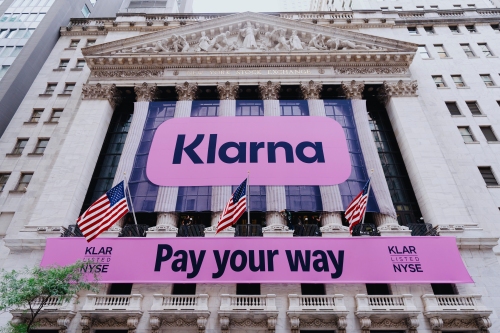
Image from Klarna IPO pricing announcement
Klarna’s debut on the New York Stock Exchange showed that investor interest in buy now pay later remains strong. The Swedish payments company priced its IPO at $40 per share, above the expected $35 to $37 range. Shares opened at $52 before closing at $46.40, a gain of about 16% on Klarna's debut, a market value of around $17.5 billion and raised proceeds of $1.37 billion, according to Reuters IPO coverage.
In 2021, Klarna was valued at $45.6 billion when SoftBank invested heavily, only to fall to $6.7 billion in a 2022 down round. The company’s new valuation is proof of a rebound and investor interest in fintech's open IPO window, although still well below its pandemic-era peak.
Klarna joins other fintechs who have jumped through the IPO window recently, such as Circle and Bullish. Klarna's registration statement filed with the SEC detailed its current scale at 111 million active consumers, 790,000 merchants, and operating in 26 countries.
Significantly, Klarna disclosed that 99% of consumer loans extended in 2024 were repaid on time, much better than the U.S. credit card delinquency rate of 3.05% for the same period. These repayment figures were key in reassuring investors about the resilience of the buy now pay later (BNPL) model.
Buy now pay later continues to expand. U.S. online purchases using BNPL services reached $82.4 billion in 2024, up 9.9% from the previous year. By August 2025, volumes had already hit $56.3 billion.
Klarna, Affirm, and Afterpay dominate the market, but the model has faced criticism that it encourages overspending and exposes providers to consumer defaults. Klarna’s repayment performance, documented in SEC filings, is now one of its key competitive advantages as it enters the scrutiny of public markets.
For fintech, Klarna’s IPO demonstrates that investors in the current climate are willing to fund growth companies with credible metrics, helping restore momentum after a period of political and market uncertainty earlier this year.
Sebastian Siemiatkowski CEO Klarna framed the IPO as a chance to build stronger ties with U.S. consumers. With a merchant base that includes major retailers, Klarna is positioning itself as a mainstream payments company rather than just a niche credit provider. Investors will be tracking closely, future quarterly financials, credit quality data, and U.S. adoption rates.
Klarna’s valuation may remain far below its 2021 peak, but the company’s NYSE IPO confirms that public market investors see value in the buy now pay later model at global scale, and are willing to back its growth.
The National Crowdfunding & Fintech Association (NCFA Canada) is a financial innovation ecosystem that provides education, market intelligence, industry stewardship, networking and funding opportunities and services to thousands of community members and works closely with industry, government, partners and affiliates to create aa vibrant and innovative fintech and funding industry in Canada. Decentralized and distributed, NCFA is engaged with global stakeholders and helps incubate projects and investment in fintech, alternative finance, crowdfunding, peer-to-peer finance, payments, digital assets and tokens, artificial intelligence, blockchain, cryptocurrency, regtech, and insurtech sectors. Join Canada's Fintech & Funding Community today FREE! Or become a contributing member and get perks. For more information, please visit: www.ncfacanada.org
| | |
|---|---|---|
| | |
Klarna | Sep 3, 2025

Image: Klarna IPO 2025
On Sep 2, 2025, global digital bank and Klarna announced the launch of its initial public offering (IPO) targeting a $14 billion valuation, with shares expected to begin trading on the New York Stock Exchange under the symbol KLAR this week, once the SEC approves its registration. Klarna calls itself a global digital bank and flexible payments provider in its IPO filing, but buy now pay later (BNPL) is still its main business and the focus of regulatory scrutiny.
The company disclosed an offering of 34,311,274 ordinary shares, including 5,555,556 new shares from Klarna and 28,755,718 from selling shareholders. The underwriters have a 30 day option to purchase up to 5,146,691 additional shares. The expected price range is $35 to $37 per share, which would give Klarna a valuation of up to $14 billion if priced at the top end.
The majority of the shares in this deal are being sold by existing shareholders. Klarna itself will only receive proceeds from the 5.6 million new shares it issues, while selling shareholders will capture the remainder. Goldman Sachs, J.P. Morgan, and Morgan Stanley are lead underwriters.
Klarna paused its U.S. IPO in April 2025 citing tariff uncertainty and market volatility, then revived the listing as IPO conditions improved over the summer. The company had also explored a direct listing in 2021 but didn't proceed, later raising funds at a $6.7 billion valuation in 2022.
Klarna has invested directly in Canada, and deepened its roots here by opening a technology hub in Toronto focused on engineering and product development. NCFA reported on this this expansion closely in this article Klarna’s meteoric rise in the Canadian financial ecosystem. In Canada, BNPL activity is beginning to appear on credit reports.
As of June 30, 2025, Klarna reported 111 million active consumers and 790,000 merchants across 26 countries. The United States is its largest market, with 34 million users and over 30,000 merchants.
The Consumer Financial Protection Bureau issued an interpretive rule in May 2024 that classified buy now pay later lenders as credit card providers under Regulation Z, which was meant to extend credit card style protections such as dispute rights and refunds. Under the Trump administration the agency itself has been weakened through layoffs, budget cuts and rollbacks of Biden era protections. In March 2025 the CFPB announced its intent to revoke the rule, and by May 2025 it had stated it would not prioritize enforcement.
For Klarna and its 34 million American users, the 'dormant status' of the BNPL rule lowers compliance costs and regulatory risk at a critical time, as it allows the company to present a clear growth case to public investors. At the same time though, investors in Klarna's IPO should weigh both the short term relief and long term political uncertainty, given that a future administration could revive the proposed BNPL credit card style protections.
Klarna is not alone. Several fintech peers have already gone public this year, offering a snapshot of how investors are valuing the sector. The wave of fintech IPOs are after years of light activity but beyond pent up demand signals that fintech markets are maturing and scaling into evolving financial markets globally. Chime, Circle, and eToro illustrate both successes and setbacks.
| Company | Ticker | IPO Date | IPO Price | Current Price (Sep 3, 2025) | Change |
| Chime Financial | CHYM | Jun 12, 2025 | $27.00 | $24.40 | –9.6% |
| Circle Internet Group | CRCL | Jun 5, 2025 | $31.00 | $119.80 | +286.5% |
| eToro Group | ETOR | May 14, 2025 | $52.00 | $46.63 | –10.3% |
| Klarna | KLAR (pending) | Sep 2025 | $35–$37 | Not yet listed | N/A |
| Figure Technologies | FIGR (pending) | Sep 2025 (planned) | $18–$20 | Not yet listed | N/A |
Klarna’s performance will set another benchmark for how diversified platforms blending BNPL, banking, and payments are valued by public investors.
The National Crowdfunding & Fintech Association (NCFA Canada) is a financial innovation ecosystem that provides education, market intelligence, industry stewardship, networking and funding opportunities and services to thousands of community members and works closely with industry, government, partners and affiliates to create a vibrant and innovative fintech and funding industry in Canada. Decentralized and distributed, NCFA is engaged with global stakeholders and helps incubate projects and investment in fintech, alternative finance, crowdfunding, peer-to-peer finance, payments, digital assets and tokens, artificial intelligence, blockchain, cryptocurrency, regtech, and insurtech sectors. Join Canada's Fintech & Funding Community today FREE! Or become a contributing member and get perks. For more information, please visit: www.ncfacanada.org
| | |
|---|---|---|
| | |
Aug 12, 2025

Image: Freepik/konstantinraketa
In today’s agile market, small-scale producers, from custom cabinetry makers to furniture artisans and self-employed tradespeople, seek ways to deliver personalized products efficiently. Simultaneously, fintech innovators explore smarter, faster ways to fund projects and manage payments. At the intersection, digital fabrication and digital finance find a powerful synergy: CNC routers enable precise, scalable customization, while fintech platforms provide flexible, real-time funding and billing solutions.
Computer Numerical Control (CNC) routers translate digital design files into exact cuts, curves, and engravings in wood. For a small workshop, that means complex geometries or one-off pieces, like bespoke furniture, unique signage, or tailored cabinetry, become accessible with minimal manual effort. A wood CNC machine reduces setup times and material waste, enabling entrepreneurs to quickly respond to customer specs. A solo artisan can offer premium customization while keeping a lean production footprint.
The ability to switch from one design to another in minutes empowers tradespeople to embrace truly customer-centric workflows. Digital design iterations happen faster. When a client asks for a tweak, like a curved edge, an inlay, or a specific dimension, the operator adjusts the CAD model, sends it to the machine, and begins production almost immediately.
Fintech platforms, especially those supporting crowdfunding, invoice financing, or embedded payments, give creators fast access to capital. There’s an opportunity for more Canadian businesses to do so, as only about 13% leverage fintech for financing. When a client commits, funding can flow before production begins. Tradespeople can unlock working capital without resorting to traditional loans.
Imagine a crowdfunding page for a limited line of custom wood furniture: backers pledge in advance, securing funding for material purchase and labour. Alternatively, invoice-financing platforms let makers issue digital invoices and receive up to 80–90% of the amount within days, sustaining cash flow as production ramps up.
Additionally, fintech billing solutions automate payments tied to production milestones. For example: 20% due upon design approval, 50% at the start of CNC routing, and 30% on delivery. Smart contracts or API-driven billing systems manage this sequencing transparently, reducing administrative burdens for solo makers and ensuring clients only pay when work progresses.
Fintech investors looking to support small-business ecosystems should take note. The convergence of CNC-driven customization and just-in-time funding opens scalable opportunities. Platforms can integrate with maker marketplaces, offering pre-financing or microloans tied to incoming orders.
Small business owners can leverage this model too. A carpentry studio, for example, could invest in a CNC router and partner with a fintech platform to take customized orders with small down payments. The system processes financing, the machine produces, and billing flows automatically, improving margins, reducing cash conversion cycles, and expanding service offerings.
The convergence of CNC-based digital fabrication and fintech-enabled funding models is transforming personalization in woodwork from a luxury into an accessible, scalable business strategy. Entrepreneurs, self-employed tradespeople, fintech investors, and small business owners can all benefit from this synergy. CNC routers unlock rapid customization and automation. Fintech platforms deliver the flexible funding and billing infrastructure needed to deliver work just in time and manage cash flow effectively.
In an industry that values both craftsmanship and speed, this integration empowers creators to bring tailored solutions to market with lean operations and encourages fintech innovators to build financial products that support the makers shaping our homes and infrastructure.
The National Crowdfunding & Fintech Association (NCFA Canada) is a financial innovation ecosystem that provides education, market intelligence, industry stewardship, networking and funding opportunities and services to thousands of community members and works closely with industry, government, partners and affiliates to create a vibrant and innovative fintech and funding industry in Canada. Decentralized and distributed, NCFA is engaged with global stakeholders and helps incubate projects and investment in fintech, alternative finance, crowdfunding, peer-to-peer finance, payments, digital assets and tokens, artificial intelligence, blockchain, cryptocurrency, regtech, and insurtech sectors. Join Canada's Fintech & Funding Community today FREE! Or become a contributing member and get perks. For more information, please visit: www.ncfacanada.org
| | |
|---|---|---|
| | |
Fintech Report | July 30, 2025

Image: BCG QED Report Scaled Winners, Emerging Disruptors (Cover)
The latest analysis from BCG and QED Partners in a report titled, "Fintech's Next Chapter: Scaled Winners and Emerging Disruptors" (38 page PDF), shows that fintech companies currently capture just 3% of global banking and insurance revenues, leaving substantial room to grow.
The study frames this stage around two groups. The scaled winners are fewer than 100 companies generating more than $500 million in annual revenue. They account for most of the sector’s revenues and are now focused on profitability, compliance and expansion into adjacent services.
The emerging disruptors are thousands of smaller companies between $50 to $500 million in revenue. They are fast moving, often AI native, and are working in underserved markets and niches. Some of these emerging disruptors are well on their way to becoming the next generation of scaled winners.
In 2024, global fintech revenues increased 21% compared with 13% the previous year. Segments such as deposits grew 23%, trading and investment 21% and insurance 40%. This growth is happening while valuations and funding have recovered. In the first quarter of 2025, equity funding was 34% higher than a year earlier and valuations improved by 10%.
Earnings margins improved by 4% points to reach 16% in 2024. 69% of public fintechs are profitable, up from less than half the year before, and 35% now meet the rule of 40. Valuations are being driven by these fundamentals. Forward revenue growth and profitability explain half of the variation in valuations. Size and research and development spending explain another 39%.
Fintechs generate 3% of banking and insurance revenues. Penetration is as high as 14% in payments but under 1% in insurance, leaving a large gap for future growth. Payments still make up 55% of scaled fintech revenues (see image below), followed by challenger banks at 15%, crypto trading at 7% and buy now pay later at 4%.

Image: Distribution of Scaling fintechs 2024 BCG report 'Scaled Winners, Emerging Disruptors'
New AI models can act as autonomous agents that execute payments, preapprove loans, rebalance portfolios and anticipate risk exposures. Fintechs that are AI native receive 49% of all equity funding even though their seed rounds are smaller. Over the past three years, $32 billion has gone to B2B fintechs and $30 billion to financial infrastructure providers, with most of this capital flowing to AI powered models.
Large institutions are piloting tokenized bonds and funds. Tokenizing assets can remove up to $20 billion in intermediary costs every year, shorten settlement times and broaden access. Progress depends on clear regulatory frameworks and infrastructure ready for institutional standards.
After years of rapid expansion, challenger banks are focusing on core markets. 92 of them are now profitable and 24 generate more than $500 million in revenue. Geographic distribution of scaled fintech revenue remains uneven with 52% from the United States, 10% each from Asia Pacific excluding China and from Latin America, and 1% from the Middle East and Africa.
Fintech originated loans total $500 billion while private credit funds manage $1.7 trillion. There is a $280 billion gap in capital deployment, and partnerships between private credit funds and fintech lenders are set to grow quickly. Strong funding conditions in early 2025 support this trend.
B2B payments, treasury and workflow automation are still underdeveloped. Deposit related revenues grew 23% in 2024, ahead of the 21% industry growth rate. Insurtech fintechs grew by 40% over the same period, driven by distribution and brokerage models. These segments are becoming the growth engines for disruptors.
There are still 150 private fintechs founded before 2016 that have each raised more than $500 million and have not yet gone public, showing that investors are still ready to back scale-up stories.
The report highlights fintechs need to choose whether they are on a path to becoming a scaled winner or emerging disruptor. Canadian fintechs and NCFA members should prioritize sustainable growth in home markets before pursuing global expansion.
AI native products will be the key differentiator. Companies that engage early with regulators on AI and digital asset rules will be better positioned as these markets evolve. Partnerships with private credit funds can provide growth in lending. B2B automation and modernization of financial infrastructure are major opportunities.
The National Crowdfunding & Fintech Association (NCFA Canada) is a financial innovation ecosystem that provides education, market intelligence, industry stewardship, networking and funding opportunities and services to thousands of community members and works closely with industry, government, partners and affiliates to create a vibrant and innovative fintech and funding industry in Canada. Decentralized and distributed, NCFA is engaged with global stakeholders and helps incubate projects and investment in fintech, alternative finance, crowdfunding, peer-to-peer finance, payments, digital assets and tokens, artificial intelligence, blockchain, cryptocurrency, regtech, and insurtech sectors. Join Canada's Fintech & Funding Community today FREE! Or become a contributing member and get perks. For more information, please visit: www.ncfacanada.org
| | |
|---|---|---|
| | |
BNPL | July 23, 2025

Image: Freepik
On July 18, 2025, the Financial Conduct Authority (FCA) published their approach to regulating Deferred Payment Credit (DPC), otherwise known as 'Buy Now Pay Later' (BNPL), or interest free credit service if repaid in twelve or fewer instalments within 12 months.
From July 15, 2026, third party lenders that provide DPC to finance purchases must be authorised by the FCA. Merchants that offer their own DPC directly and broking activity remain outside scope.
The FCA says its approach is proportionate and designed to reduce consumer harm without creating unnecessary burdens. It relies on the Consumer Duty to deliver good outcomes while adding specific rules where gaps exist. The aim is to build trust in DPC, support financial resilience, and promote sustainable economic growth.
DPC lending has expanded rapidly from £0.06 billion in 2017 to more than £13 billion in 2024. The FCA Financial Lives Survey reports that 20% of UK adults or about 10.9 million people used DPC in the twelve months to May 2024.
BNPL is growing fast and because it's been exempt from regulation, borrowers may not receive enough information before taking on debt and some lending may be unaffordable (akin to payday lenders?). The FCA notes that DPC users are more likely to be in financial difficulty than the average broader population.
Complete the online response form for CP25/23 or email: cp25-23@fca.org.uk
The FCA's proposed rules look to reduce avoidable harm from missed payments and unclear terms while maintaining access to short term interest free credit, for those who can afford it. With 20% of the adult UK population using DPC/BNPL in the last 12 months, it's near time that the FCA's rules are in market for consultation. It is designed to boost trust and bring sustainable economic growth to the sector.
The National Crowdfunding & Fintech Association (NCFA Canada) is a financial innovation ecosystem that provides education, market intelligence, industry stewardship, networking and funding opportunities and services to thousands of community members and works closely with industry, government, partners and affiliates to create a vibrant and innovative fintech and funding industry in Canada. Decentralized and distributed, NCFA is engaged with global stakeholders and helps incubate projects and investment in fintech, alternative finance, crowdfunding, peer-to-peer finance, payments, digital assets and tokens, artificial intelligence, blockchain, cryptocurrency, regtech, and insurtech sectors. Join Canada's Fintech & Funding Community today FREE! Or become a contributing member and get perks. For more information, please visit: www.ncfacanada.org
| | |
|---|---|---|
| | |
July 8, 2025
There’s a moment, right after your mortgage renews at a higher rate, when the math stops making sense. Your payment jumps. Your paycheck doesn’t. The person at the bank tells you to “come in and review your options,” which usually means: sit down while we explain why nothing can be done.
So you wait. You budget harder. You juggle. You convince yourself this is just part of being a grown-up.
It’s not.
What’s actually happening is this: traditional banks are slow because they’re built that way. And as rates climb, more Canadians are realizing they don’t need to stick with outdated models to get a mortgage, or fix the one they already have.
According to Canada’s Financial Literacy Strategy 2021‑2026, improving access to digital financial tools and increasing consumer confidence is a national priority, because traditional banks haven’t kept pace with how people earn and manage money.
Banks still rely on rigid systems and slow internal approvals. They’re structured for predictability, not agility. If you freelance, run a business, drive for a delivery app, or piece together multiple income streams, you already know how hard it is to get approved.
Fintech lenders, on the other hand, are built for modern financial realities. They use real-time data, consider broader income patterns, and process applications quickly. According to McKinsey & Company, only 13% of Canadian banking consumers currently use fintech services, compared to 32% in the UK and 42% in the U.S.—a gap that reflects how far behind traditional lenders remain.
Fintech platforms streamline the process. Their systems are digital end-to-end. Approvals are faster. Decisions are based on your full financial picture, not just a salary checkbox on a form.
This speed matters. A faster process means you can act before your rate increases again. It means you can consolidate debt before your credit score dips further. You can refinance before stress becomes crisis.
If your mortgage payment jumped after a renewal, you’re not alone. Many Canadians are facing steep monthly increases, often several hundred dollars more than before.
A fintech broker can help you refinance, extend your amortization, or roll in high-interest debts to reduce pressure. In many cases, they can also help you access equity that’s already in your home. With the right approach, that equity becomes a financial tool, not just untouchable value on paper.
One such option is a home equity loan from 360Lending. Their digital-first process connects you with competitive offers tailored to your financial situation, without the delays or rigid criteria of traditional lenders.
These solutions aren’t just for tech bros or crypto investors. They’re for contractors, nurses, new parents, anyone whose income doesn’t follow a perfectly predictable path. What used to be a one-size-fits-all process is finally becoming more personalized.
Marketplace models are especially useful here. Borrowers aren’t limited to one offer from one bank. Instead, lenders compete, and the borrower chooses what fits.
If your mortgage no longer fits, the problem might not be you. It might be the system you’re using to fix it.
Banks move slowly because they’re built to. Fintech lenders move faster because they’re expected to. That difference isn’t just about convenience. It’s about survival.
You don’t need more meetings. You need forward motion.
The National Crowdfunding & Fintech Association (NCFA Canada) is a financial innovation ecosystem that provides education, market intelligence, industry stewardship, networking and funding opportunities and services to thousands of community members and works closely with industry, government, partners and affiliates to create a vibrant and innovative fintech and funding industry in Canada. Decentralized and distributed, NCFA is engaged with global stakeholders and helps incubate projects and investment in fintech, alternative finance, crowdfunding, peer-to-peer finance, payments, digital assets and tokens, artificial intelligence, blockchain, cryptocurrency, regtech, and insurtech sectors. Join Canada's Fintech & Funding Community today FREE! Or become a contributing member and get perks. For more information, please visit: www.ncfacanada.org
| | |
|---|---|---|
| | |


August 26th, 2025

January 4th, 2024

June 1st, 2021

September 9th, 2020

July 9th, 2018

January 3rd, 2018

September 25th, 2017

June 20th, 2017

May 10th, 2017

December 14th, 2016