




Karsten Wenzlaff, Advisor
August 26th, 2025
Karsten Wenzlaff is a Crowdfunding and Fintech Expert from Germany. He is Secretary-General of Digit[...]


BNPL | July 5, 2025

Image: Freepik/Rawpixel.com
As reported by BNN Bloomberg on July 3, 2025, Equifax Canada now includes data from select Buy Now Pay Later (BNPL) providers in its credit files. This includes on-time and late payments, as well as outstanding balances.
More and more Canadians are using BNPL services, which offer flexible installment payments on everyday purchases but this short term convenience will eventually have long term consequences like influencing loan approvals. The new data is not yet a direct input to all credit scores, it may only be a matter of time that the information is visible to lenders and may influence decisions.
Historically, most BNPL activity in Canada went unreported. According to the BNN report, TransUnion Canada is also preparing to add BNPL data to a separate section of its credit reports. Although the data isn't scored yet, it will be viewable by underwriters. The changes mirror developments in the U.S. where Equifax USA confirmed that it accepts BNPL data and allows it to impact credit scores if providers report accounts in a way that meets industry standards.
For Canadian borrowers, the inclusion of BNPL activity in credit files brings both potential benefits and new risks.
On the positive side, borrowers who consistently repay BNPL loans on time could build a stronger credit file over time, especially those with a limited credit history. This could support future loan approvals if Canadian credit scoring models evolve to include the scope of this data. Including BNPL in credit reporting may also encourage a more disciplined approach to paying back BNPL loans.
However, there are growing concerns.
Many borrowers still assume BNPL is separate from credit. A 2023 pilot study by the Financial Consumer Agency of Canada found that 34% of users had more than one active BNPL plan. Missed payments or excessive usage, such as multiple files/accounts could signal financial stress and raise red flags during preapprovals and refinancing applications, even if traditional credit scores remain unchanged.
Borrowers should now treat BNPL accounts as serious credit obligations. That means avoiding overlapping plans, making payments on time, and regularly reviewing credit reports.
Real estate professionals and lenders may want to update client checklists to ask about BNPL usage and monitor any accounts that appear in bureau files. While some reporting remains optional, the trend is clearly moving toward broader inclusion.
BNPL is no longer invisible to Canadian lenders. Credit bureaus are adjusting their systems, and reporting standards are catching up. That means short term purchases can now shape long term credit outcomes. For condo buyers and those applying for major financing, staying ahead of this trend is essential. Responsible BNPL use may help build a stronger file. Poor management, even on small purchases, could now stand in the way of future (client) approvals.
 The National Crowdfunding & Fintech Association (NCFA Canada) is a financial innovation ecosystem that provides education, market intelligence, industry stewardship, networking and funding opportunities and services to thousands of community members and works closely with industry, government, partners and affiliates to create a vibrant and innovative fintech and funding industry in Canada. Decentralized and distributed, NCFA is engaged with global stakeholders and helps incubate projects and investment in fintech, alternative finance, crowdfunding, peer-to-peer finance, payments, digital assets and tokens, artificial intelligence, blockchain, cryptocurrency, regtech, and insurtech sectors. Join Canada's Fintech & Funding Community today FREE! Or become a contributing member and get perks. For more information, please visit: www.ncfacanada.org
 |  |  |
|---|---|---|
 |  |  |
Crypto Adoption | June 27, 2025
Image: Freepik/studiogstock
For the first time, cryptocurrency is being considered in U.S. mortgage financing. On June 25, 2025, the Federal Housing Finance Agency (FHFA) told Fannie Mae and Freddie Mac to prepare proposals that would let homebuyers include crypto assets when being assessed for their mortgage applications.
In a public post on X, FHFA Director Bill Pulte said this change supports the U.S. goal of becoming a global leader in crypto. The order allows crypto to be included as a financial reserve, meaning lenders could soon treat some digital assets the same way they treat cash or stocks when reviewing mortgage risk. This is not a new rule yet but it's the start of a planning phase where the agencies will write and review draft policies.
After significant studying, and in keeping with President Trump’s vision to make the United States the crypto capital of the world, today I ordered the Great Fannie Mae and Freddie Mac to prepare their businesses to count cryptocurrency as an asset for a mortgage.
SO ORDERED pic.twitter.com/Tg9ReJQXC3
— Pulte (@pulte) June 25, 2025
Remarkable to see the crypto sentiment change so rapidly in the United States. This latest change reflects the wider effort by U.S. officials to include digital assets in traditional finance. An article in Barron’s noted that reserve rules may apply to bitcoin, ether, and other widely held tokens. The Washington Post also reported concerns about volatility, especially with some tokens rising or falling by 40% or more in a single day.
While this directive applies only in the United States, it sends a strong message. If crypto is accepted in mainstream mortgage reviews, financial technology firms in Canada may start building new tools to support similar models. That could include connecting wallets to mortgage applications or building credit models that accept tokenized savings.
For Canadian fintechs focused on lending, payments, or digital identity, this is an early signal of significant changes to come. With more Canadians holding crypto, pressure will likely grow for Canadian regulators to respond or risk falling behind global standards. That's what happens when your a country deemed 'fast follower'.
The National Crowdfunding & Fintech Association (NCFA Canada) is a financial innovation ecosystem that provides education, market intelligence, industry stewardship, networking and funding opportunities and services to thousands of community members and works closely with industry, government, partners and affiliates to create a vibrant and innovative fintech and funding industry in Canada. Decentralized and distributed, NCFA is engaged with global stakeholders and helps incubate projects and investment in fintech, alternative finance, crowdfunding, peer-to-peer finance, payments, digital assets and tokens, artificial intelligence, blockchain, cryptocurrency, regtech, and insurtech sectors. Join Canada's Fintech & Funding Community today FREE! Or become a contributing member and get perks. For more information, please visit: www.ncfacanada.org
| | |
|---|---|---|
| | |
BNPL | June 17, 2025
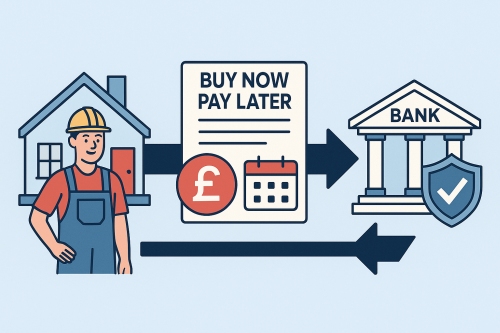
On June 16, 2025, the UK HM Treasury published a policy update that says 'domestic premises suppliers' (aka door to door vendors or companies that provide goods or services in a customer's home) no longer need to be licensed as credit brokers to offer Buy Now Pay Later (BNPL) services. The change to BNPL regulation is aimed at supporting smaller businesses without weakening consumer protections. This exemption includes services like home improvement consultations, kitchen installations, in-home services like cleaning or fitness, or any other sale that takes place during a visit to the customer's home.
Many industry stakeholders warned that requiring a credit broker license for these types of businesses isn't necessary and overly burdensome. The government agreed because these in-home suppliers do not offer financial services as their primary business activity. Instead, the typically introduce customers to a single BNPL lender as part of a product or service sale. Additionally, regulators realized that the risk of consumer harm in these cases is relatively low since the financial exposure sits with the BNPL lender who is regulated, not the seller, and felt that requiring small businesses to apply and maintain broker requirements is disproportionate to their role.
While the sellers are now exempt, BNPL lenders will still be fully regulated under the new rules, and must perform creditworthiness and affordability checks and comply with FCA Consumer Duty requirements. They must also ensure that purchases made using BNPL are protected under Section 75 of the Consumer Credit Act 1974, and that customers have access to the UK’s Financial Ombudsman Service to address complaints.
The full BNPL regulatory framework in the UK is expected to come into force by mid-2026, including secondary legislation to implement the exemption for in-home sellers.
Canada doesn't currently have a dedicated national BNPL regulatory framework. It also doesn't require BNPL sellers to have a credit-brokering license. The Financial Consumer Agency of Canada (FCAC) continues to monitor the sector but doesn't directly regulate BNPL lending. Oversight is through a mix of provincial consumer protection laws and federal rules related to money laundering and data privacy.
In Ontario as an example, BNPL offerings must comply with the Consumer Protection Act, which requires clear disclosures and restricts misleading marketing. If a provider handles payments, they may also need to register as a money services business under federal law.
As BNPL continues to grow, pressure is building for regulators to provide clearer guidance. The UK’s model may offer a useful reference for policymakers looking to balance access to BNPL services while protecting Canada's evolving credit sector.
The National Crowdfunding & Fintech Association (NCFA Canada) is a financial innovation ecosystem that provides education, market intelligence, industry stewardship, networking and funding opportunities and services to thousands of community members and works closely with industry, government, partners and affiliates to create a vibrant and innovative fintech and funding industry in Canada. Decentralized and distributed, NCFA is engaged with global stakeholders and helps incubate projects and investment in fintech, alternative finance, crowdfunding, peer-to-peer finance, payments, digital assets and tokens, artificial intelligence, blockchain, cryptocurrency, regtech, and insurtech sectors. Join Canada's Fintech & Funding Community today FREE! Or become a contributing member and get perks. For more information, please visit: www.ncfacanada.org
| | |
|---|---|---|
| | |
May 27, 2025

Image: Unsplash/Mathieu Stern
Struggling with debt in Canada? You're not alone.
The combination of increasing living costs and ongoing economic challenges has led to more Canadians than ever before looking for ways to obtain financial assistance. A consumer proposal has become a widely accepted solution for financial relief in Canada.
A consumer proposal is a legally binding process that allows you to settle your debts for less than what you owe, while providing protection from creditors. A consumer proposal has become the top choice for Canadians who want to manage their debts without filing for bankruptcy.
This article examines the operational aspects of consumer proposals and their advantages compared to other debt solutions while explaining why many Canadians find them to be the best option when facing financial hardship.
Canadian residents have access to consumer proposals which function as legal debt resolution arrangements only available in Canada. A consumer proposal represents an official written contract between you and your debt holders which enables you to pay back a portion of your debt within a fixed timeframe.
Here's what makes consumer proposals unique:
Recent statistics show consumer proposals made up 78.8% of all consumer insolvency filings in Canada for the year ending March 31, 2025 which shows a slight reduction from 79.0% in the earlier period.
What does this tell us?
A growing number of Canadians now select consumer proposals as their main method of debt relief instead of bankruptcy. The shame associated with bankruptcy and the wish to repay some debt portion make consumer proposals a more appealing debt relief choice.
The process of filing a consumer proposal follows the Bankruptcy and Insolvency Act rules and requires management by a Licensed Insolvency Trustee (LIT).
Consumer insolvencies rose by 20.5% in January 2025 compared to December 2024. The January total of consumer insolvencies reached 11,196 which corresponds to an average of about 361 daily filings.
The increased number of filings underscores the continued financial difficulties faced by Canadians even though the economy shows signs of improvement. Consumer proposals now serve as essential financial rescue solutions for people who want to prevent experiencing the harsh outcomes of bankruptcy.
What causes Canadian debtors to favour consumer proposals as their primary debt relief option?
There were 78.9% consumer proposal filings and 21.1% bankruptcy filings among all insolvency cases during the 12-month period ending January 31, 2025. Canadian debtors now favour consumer proposals more than bankruptcy as their primary debt relief solution.
The key differences include:
For Canadians dealing with financial struggles asset preservation including homes becomes especially important. Homeowners with equity should consider consumer proposals because of this one important feature.
Not everyone can file a consumer proposal. To qualify, you must:
The number of consumer insolvencies grew by 3.8% from January 2024 to January 2025 and reached a 12.3% increase when compared to January 2019 before the pandemic. More Canadians are now requiring debt relief options such as consumer proposals due to the increasing number of people experiencing financial distress.
The consumer proposal filing process requires completion of multiple essential steps.
New Brunswick and Quebec saw the highest year-over-year consumer insolvency increases with rates at 9.8% and 9.2% respectively. The geographic differences in economic impact indicate that different Canadian regions face varying levels of financial stress.
Consumer proposals share common traits with financial solutions by offering both positive and negative aspects.
Benefits:
Drawbacks:
The MNP Consumer Debt Index which tracks Canadians' financial health fell to 79 points in early 2025 marking the second-lowest level yet as people became increasingly worried about their personal finances despite lower interest rates. Economic uncertainty led 76% of New Brunswickers to reduce their spending or delay major purchases.
The growing number of consumer insolvencies demonstrates continuous financial stress caused by unrelenting high living costs and burdensome household debt. Licensed Insolvency Trustees provide necessary professional advice to evaluate options such as consumer proposals.
Business insolvencies rose by 7.6% from December 2024 to January 2025 which represents a 45.2% increase above pre-pandemic levels signaling wider economic stress. The economic difficulties Canadians face today are reflected in widespread economic patterns.
Why are consumer proposals increasingly popular? They offer:
Consumer proposals present important benefits to a wide range of Canadians who are facing debt difficulties. Through legally binding arrangements debt can be reduced while crucial assets stay protected from bankruptcy.
The data shows that Canadian debtors now most frequently choose consumer proposals for debt relief. As economic pressures build, maintaining a full understanding of available choices becomes essential for making knowledgeable financial choices.
Evaluate these key factors before deciding on any course of action:
A Licensed Insolvency Trustee should be consulted when you are thinking about filing a consumer proposal. A Licensed Insolvency Trustee can evaluate your financial situation at no cost and guide you through determining if a consumer proposal suits your unique situation.
Remember: People who look for assistance early usually experience more positive results and have access to additional solutions. Explore your debt relief options before your financial situation becomes unmanageable.
The National Crowdfunding & Fintech Association (NCFA Canada) is a financial innovation ecosystem that provides education, market intelligence, industry stewardship, networking and funding opportunities and services to thousands of community members and works closely with industry, government, partners and affiliates to create a vibrant and innovative fintech and funding industry in Canada. Decentralized and distributed, NCFA is engaged with global stakeholders and helps incubate projects and investment in fintech, alternative finance, crowdfunding, peer-to-peer finance, payments, digital assets and tokens, artificial intelligence, blockchain, cryptocurrency, regtech, and insurtech sectors. Join Canada's Fintech & Funding Community today FREE! Or become a contributing member and get perks. For more information, please visit: www.ncfacanada.org
| | |
|---|---|---|
| | |
May 13, 2025

Image: Pexels/RDNE Stock project
Looking for the perfect loan in Canada?
Borrowers in Canada face a challenging task when they attempt to find their way through the dense network of available loan services. Understanding the basic principles of loans is necessary because interest rates and lending criteria continue to change over time.
And here's the thing...
Since approximately 60% of Canadian mortgages will need renewal in 2025 and 2026 the current moment presents an ideal opportunity to learn about your loan options and make well-informed decisions about loans in Canada. Mortgage holders should gain financial relief as lower interest rates reduce their financial burden.
This complete resource enables you to explore Canadian loans while finding the most suitable option for your needs.
The Canadian loan market provides multiple borrowing choices to address different financial requirements. Knowledge of different loan types enables borrowers to make better financial choices.
Personal loans function as flexible financial resources suitable for nearly any financial need. They typically come in two forms:
Personal loans have a relatively simple application process which allows for quicker approval than mortgage applications. Non-mortgage loans with chartered banks in Canada rose by 1.1% in January 2025 which resulted in $7.3 billion added value after experiencing a 2.1% reduction in December 2024.
Mortgages remain the primary loan type for the majority of Canadians. Mortgages exist to assist individuals in buying homes or properties.
In Canada, mortgages are classified into:
According to current data projections 60% of Canadian mortgages will reach renewal during the years 2025 and 2026 while reduced interest rates provide relief to borrowers.
Selecting the optimal loan involves analyzing multiple essential factors.
Before applying for any loan, clearly define:
By conducting this assessment you can determine which loan types will most effectively satisfy your requirements.
The total cost of your loan depends heavily on the applied interest rates. The Canadian credit market will experience growth in 2025 as lower interest rates and inflation drive expansion. Borrowers seeking beneficial loan terms will likely benefit from this current trend.
Look beyond the advertised rate and consider:
According to Fitch Ratings Canada will face an economic recession in 2025 which will affect both loan demand and interest rates.
Your monthly payments along with the total interest you'll pay depend on the duration of your loan term.
The final price of your loan can be affected by various additional costs beyond just the interest rates.
By understanding lender evaluation criteria you can both increase your likelihood of approval and negotiate better loan terms.
The standard loan approval procedure includes several essential steps.
The strength of your credit score determines both your loan approval chances and the rates of interest you will be charged.
These techniques will enable you to obtain improved loan conditions.
Reputable financial institutions and predatory lenders operate within the lending market. Your financial wellbeing relies on taking steps to protect yourself.
Stay vigilant for these indicators of predatory lending practices.
Canadian borrowers benefit from federal and provincial laws which provide protections by ensuring certain protections in place.
Financial technology has revolutionized the Canadian loan market while introducing various benefits and obstacles.
To use Canadian loan services effectively you must research available options and match them to your financial requirements. Proper research of loan options combined with term comparison and application preparation enables you to make educated decisions about borrowing money.
Remember that:
A thorough comprehension of the Canadian loan landscape enables you to save thousands of dollars throughout your loan period while achieving your financial goals with greater efficiency.
The National Crowdfunding & Fintech Association (NCFA Canada) is a financial innovation ecosystem that provides education, market intelligence, industry stewardship, networking and funding opportunities and services to thousands of community members and works closely with industry, government, partners and affiliates to create a vibrant and innovative fintech and funding industry in Canada. Decentralized and distributed, NCFA is engaged with global stakeholders and helps incubate projects and investment in fintech, alternative finance, crowdfunding, peer-to-peer finance, payments, digital assets and tokens, artificial intelligence, blockchain, cryptocurrency, regtech, and insurtech sectors. Join Canada's Fintech & Funding Community today FREE! Or become a contributing member and get perks. For more information, please visit: www.ncfacanada.org
| | |
|---|---|---|
| | |
Capital Markets | April 23, 2025

Image: Freepik
On April 21, 2025, U.S.-based alternative finance provider NewCo Capital Group announced the official launch of its Canadian operations. The expansion to Canada is fuelled by a strategic partnership with Bizcap, a global business lender in Australia, New Zealand, the UK, and Singapore.
Since launching in 2020, NewCo Capital Group has provided over $2 billion USD in funding to more than 45,000 businesses worldwide. They boast a Trustpilot score of 4.8/5, and now offer small and medium-sized enterprises (SMEs) fast access to working capital right across Canada.
Omer Navon, Director of Operations for NewCo Canada:
"The uptick in demand we've seen across Canada since our initial rollout has been both strong and consistent. We've built the infrastructure to scale efficiently across all provinces and territories, including Quebec, ensuring businesses receive timely access to capital with the same level of speed, service, and reliability that defines NewCo's model."
NewCo Capital Group specializes in providing non-banking lending solutions for small businesses (no equity financing options), such as on-demand access to pre-approved working capital and receivables-based financing. Their focus is on speed and flexibility to support SME growth.
Small businesses need to keep all funding options on the table, given that capital is a key barrier for growth. NewCo Capital Group's expansion into Canada offers a tech driven funding solution that provides low friction liquidity, pushing the bar for modern SME lending.
The National Crowdfunding & Fintech Association (NCFA Canada) is a financial innovation ecosystem that provides education, market intelligence, industry stewardship, networking and funding opportunities and services to thousands of community members and works closely with industry, government, partners and affiliates to create a vibrant and innovative fintech and funding industry in Canada. Decentralized and distributed, NCFA is engaged with global stakeholders and helps incubate projects and investment in fintech, alternative finance, crowdfunding, peer-to-peer finance, payments, digital assets and tokens, artificial intelligence, blockchain, cryptocurrency, regtech, and insurtech sectors. Join Canada's Fintech & Funding Community today FREE! Or become a contributing member and get perks. For more information, please visit: www.ncfacanada.org
| | |
|---|---|---|
| | |
M&A and Financing | April 22, 2025

FundThrough acquires Ampla and cecures a $25M Series B equity investment, led by Klister Credit Corp.
Toronto-based financial invoicing technology firm FundThrough announced on April 22, 2025, the strategic acquisition of U.S.-based Ampla Technologies along with $25 million in new equity funding to grow its platform. This achievement builds on prior milestones including the acquisition of BlueVine's invoice factoring business in 2021, and a $10 million commitment in 2020 to help Canadian businesses during the early days of the pandemic.
From day one, FundThrough's mission to help small and medium sized businesses get access to money they've already earned quicker, has been a great success. They advance cash based on unpaid invoices, giving businesses the working capital they need to pay suppliers, make payroll, and process new orders without having to wait weeks or months for larger customers to pay.
A key strength of their model is how easily it integrates into how businesses already work. FundThrough's platform uses a permission-based, secure connection into various accounting software applications like QuickBooks or Xero, and analyzes invoice data to identify outstanding customer payments, triggering automated funding offers designed to reduce the strain of long payment cycles. Since launching, the company has funded over $2.7 billion in invoices of which 85% supports U.S customers.
Ampla Technologies is a U.S. fintech providing consumer brands with working capital, banking, corporate cards, and analytics. They've managed over $5 trillion in transaction volume and originated over $2 billion in credit. By incorporating Ampla's tech into FundThrough's stack, the combined platform will offer more AI powered tools to help small businesses assess risk, improve cash flow forecasting, and access credit faster.
Steven Uster, CEO of FundThrough:
“Now, Ampla’s technology significantly enhances FundThrough’s AI-powered model, enabling us to level the playing field further. With Ampla, we can scale faster, enhance our credit underwriting and monitoring processes, and help even more businesses solve their number one pain point, cash flow."
Alongside Ampla's acquisition, FundThrough announced closure of a $25 million Series B equity round, led by Canadian Klister Credit Corp with other investors including Canadian Business Growth Fund and Urbana Corporation. New funds will support future acquisitions and the ongoing expansion into U.S. and Canadian markets and improve the platforms AI capabilities.
John Phillips, President of Klister:
“FundThrough’s track record over the past years of uncertainty is impressive. My increased investment reflects my confidence in the FundThrough team’s continuing focus on serving this important market.”
This acquisition shows how fintech is changing the way small businesses manage cash flow. Traditional financing can often takes weeks to process and may require credit checks or collateral. FundThrough uses verified invoice data and AI-driven analytics to give small businesses faster access to the money they’re owed. As more companies deal with long payment terms from large buyers, this kind of invoice funding helps level the playing field.
It gives small and medium-sized businesses more control over their cash flow, without the delays of traditional banking. FundThrough’s growth also highlights how Canadian fintech companies are expanding into the U.S. by offering digital first financial tools and smarter funding solutions to help businesses stay competitive.
The National Crowdfunding & Fintech Association (NCFA Canada) is a financial innovation ecosystem that provides education, market intelligence, industry stewardship, networking and funding opportunities and services to thousands of community members and works closely with industry, government, partners and affiliates to create a vibrant and innovative fintech and funding industry in Canada. Decentralized and distributed, NCFA is engaged with global stakeholders and helps incubate projects and investment in fintech, alternative finance, crowdfunding, peer-to-peer finance, payments, digital assets and tokens, artificial intelligence, blockchain, cryptocurrency, regtech, and insurtech sectors. Join Canada's Fintech & Funding Community today FREE! Or become a contributing member and get perks. For more information, please visit: www.ncfacanada.org
| | |
|---|---|---|
| | |


August 26th, 2025

January 4th, 2024

June 1st, 2021

September 9th, 2020

July 9th, 2018

January 3rd, 2018

September 25th, 2017

June 20th, 2017

May 10th, 2017

December 14th, 2016