




Karsten Wenzlaff, Advisor
August 26th, 2025
Karsten Wenzlaff is a Crowdfunding and Fintech Expert from Germany. He is Secretary-General of Digit[...]


Mar 19, 2026 | NCFA Fintech Market Activity | Payments Operations And AI
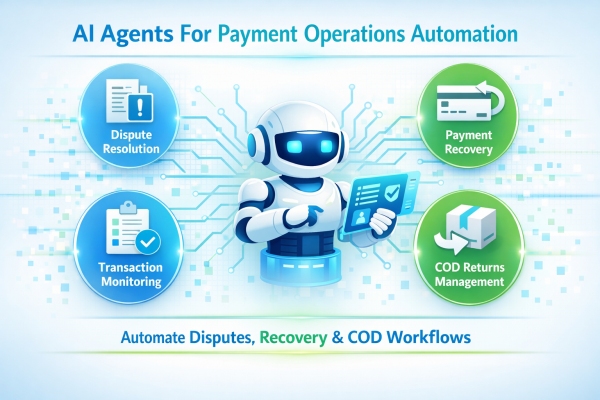
On Mar 12 2026, Razorpay launched Agent Studio, a product it says lets businesses build and run AI agents across payment and post payment workflows. Razorpay says the system is built on Anthropic’s Claude Agent SDK.
Based in Bengaluru, India, Razorpay was founded in 2014 and has grown into one of India’s largest payment platforms. The company says it supports millions of businesses, reaches more than 300 million end consumers, and processes about $180 billion in annualized payment volume. Its stack spans payment acceptance, processing, disbursements, payouts, and business banking through RazorpayX.
Agent Studio targets the operational layer that sits around those flows. In its launch post, Razorpay lists agents for dispute response, subscription recovery, abandoned cart follow up through WhatsApp or email, settlement summaries delivered through messaging, and cashflow forecasting over a 3 to 7 day window. It also includes tools for cash on delivery orders, such as identifying and analyzing returns sent back to the seller.
These workflows cost merchants and payment teams money every day. Disputes create losses and take time to resolve. Failed recurring payments reduce revenue. Abandoned carts lower completed purchases. Cash on delivery returns add shipping and handling costs. Razorpay is building automation around these problem areas, not just the payment itself.
The company is also introducing a no code agent builder in beta and plans to open the system to third party agents. That points to a setup where merchants choose automation for specific tasks across the payment lifecycle, instead of relying only on bundled platform features.
This extends Razorpay’s recent work on AI driven payments, including its earlier work with NPCI on agentic payments to enable AI driven transaction flows. The focus now moves to what happens after a payment, where recovery, customer support, and problem cases still rely heavily on manual work.
Acceptance rates and pricing are still important for PSPs and merchant platforms. Operational efficiency is becoming part of the core value proposition, especially where it directly improves recovery and reduces cost.
If agents handle disputes, recovery, reporting, and cash on delivery losses, does competition start to favour the provider that cuts the most cost for merchants, not just the one with the lowest processing price?
 The National Crowdfunding & Fintech Association (NCFA Canada) is a financial innovation ecosystem that provides education, market intelligence, industry stewardship, networking and funding opportunities and services to thousands of community members and works closely with industry, government, partners and affiliates to create a vibrant and innovative fintech and funding industry in Canada. Decentralized and distributed, NCFA is engaged with global stakeholders and helps incubate projects and investment in fintech, alternative finance, crowdfunding, peer-to-peer finance, payments, digital assets and tokens, artificial intelligence, blockchain, cryptocurrency, regtech, and insurtech sectors. Join Canada's Fintech & Funding Community today FREE! Or become a contributing member and get perks. For more information, please visit: www.ncfacanada.org
 |  |  |
|---|---|---|
 |  |  |
Mar 18, 2026 | NCFA Fintech Market Insight | Payments And Consumer Finance And Tax

On Mar 17 2026, H&R Block Canada revealed tipping survey results putting new numbers behind a growing consumer reaction to tip prompts at checkout. Two thirds of Canadians or 67% say Canada should abolish tipping culture. Another 93% say they feel annoyed when a card machine prompts for a tip in places where tipping was not previously expected, and 89% say tipping is out of hand and is applied to goods and services they do not think warrant tipping.
This backlash isn't just frustration. It's now changing behaviour and pushing customers away.
The survey also connects tipping culture to tax and compliance.
H&R Block’s 2025 survey found 84% of Canadians know tips are taxable income, but 47% assume people are not declaring all tips. The evolution from paying/receiving cash tips to digital tips changes how income shows up for tax purposes, especially when tips flow through employers and platform operators.
Digital tipping changes the paper trail. When tips move through a card terminal or POS system and the business pays them out through payroll, the tip can show up like other income on a paycheque, with deductions such as tax, EI, or CPP applied before the employee receives it and then reflected on tax slips. That is different from cash tips left on a table, where the worker has to track and report them. Gig work is different again. Even when an app collects tips and passes them on, gig workers are often treated as self employed, so they still have to report the full amount themselves at tax time.
This is a payments design problem that's now hitting brand trust. The tip prompt is part of the checkout experience, and the checkout experience is increasingly built and configured through payment processors, point of sale providers, and embedded finance stacks. When consumers feel pressured, they blame the merchant, but they also blame the payment flow. The numbers show that tip prompts can create real revenue risk for merchants if 41% of customers are willing to avoid tip pushing businesses.
For fintechs selling point of sale and payment tools, this is an opening to compete on trust and customer experience. Firms that give merchants better controls, clearer disclosure, and safer defaults can reduce backlash while still supporting gratuities where they make sense.
Fintechs that serve gig platforms (or merchants) can help by making tip reporting clearer in worker dashboards and by separating tip flows in a way that matches how income is treated.
Merchants will tune tip prompts more carefully because customer resentment is measurable. Payment platforms will face more pressure to treat tip design as a trust issue, not a digital cash lever. Regulators and tax authorities will face more questions about consistency and clarity as tipping moves further into digital rails.
If 67% of Canadians want tipping abolished and 41% avoid tip pushing businesses, do payment platforms start competing on tip prompt design the same way they compete on fees and checkout conversion?
The National Crowdfunding & Fintech Association (NCFA Canada) is a financial innovation ecosystem that provides education, market intelligence, industry stewardship, networking and funding opportunities and services to thousands of community members and works closely with industry, government, partners and affiliates to create a vibrant and innovative fintech and funding industry in Canada. Decentralized and distributed, NCFA is engaged with global stakeholders and helps incubate projects and investment in fintech, alternative finance, crowdfunding, peer-to-peer finance, payments, digital assets and tokens, artificial intelligence, blockchain, cryptocurrency, regtech, and insurtech sectors. Join Canada's Fintech & Funding Community today FREE! Or become a contributing member and get perks. For more information, please visit: www.ncfacanada.org
| | |
|---|---|---|
| | |
Mar 18, 2026 | NCFA Insight | Digital Assets And Tokenization
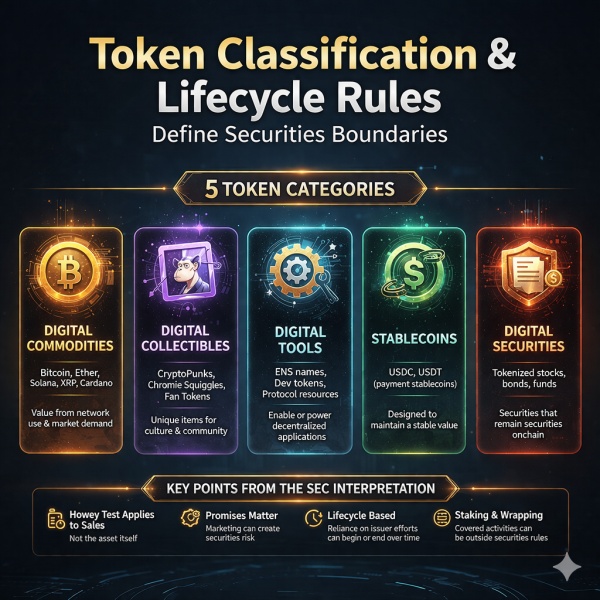
On Mar 17, 2026, the U.S. Securities and Exchange Commission issued a formal interpretation on how federal securities laws apply to certain crypto assets and certain crypto asset transactions with aligned support from the CFTC read the SEC’s March 17 press release on the joint crypto interpretation (and Fact Sheet).
This is a significant U.S. digital asset policy interpretation because it gives the market something it's lacked for a long time: a public classification system, a public lifecycle test, and public treatment of core activities such as staking, wrapping, and airdrops.
The old question of 'is it a security?' no longer sits only at the token level.
The SEC now says the answer can depend on the category of asset, the way it is sold, the promises around it, and whether those promises still matter later in the market.
The release classifies crypto assets into five categories based on characteristics, uses, and functions: (1) digital commodities, (2) digital collectibles, (3) digital tools, (4) stablecoins, and (5) digital securities. It's a framework that crypto firms can actually use in product design, listing review, and compliance planning.
Some of the examples are worth noting. In the published interpretation, the SEC lists Aptos, Avalanche, Bitcoin, Bitcoin Cash, Cardano, Chainlink, Dogecoin, Ether, Hedera, Litecoin, Polkadot, Shiba Inu, Solana, Stellar, Tezos, and XRP as examples of digital commodities. It says these assets gain value from how the network operates and from market supply and demand, not from a team whose efforts drive profit expectations.
On collectibles, it points to CryptoPunks, Chromie Squiggles, Fan Tokens, WIF, and VCOIN.
On tools, it cites Ethereum Name Service domain names and CoinDesk’s Microcosms NFT Consensus Ticket.
The point is not that every asset that looks similar gets a free pass, and the SEC is now saying publicly that many crypto assets are not securities in themselves.
The SEC separates the token from how it is sold. It applies the Howey test to the transaction, not just the asset. A token that is not a security can still be sold as part of an investment contract if a team’s promises create an expectation of profit.
The interpretation then separates the asset from the contract and explains how that link can end. A non security token is no longer subject to an investment contract once buyers no longer rely on the issuer’s promises.
This can happen in two ways. The issuer fulfills what it said it would build, such as delivering functionality or completing roadmap milestones. Or the issuer abandons those efforts, making it unreasonable for the market to keep relying on them. In both cases, the investment contract can fall away, even though the issuer may still face anti fraud liability for earlier statements.
This directly addresses the secondary market problem. A token’s status in later trading does not depend only on how it was launched. It also depends on whether buyers still rely on the issuer’s promises at that point in time.
The SEC ties securities treatment directly to what issuers say. Statements in agreements, websites, whitepapers, and social media can create a reasonable expectation of profit.
That risk increases when issuers make explicit promises tied to roadmaps, milestones, funding plans, and how their work will drive value.
Token design and marketing cannot be separated. If the sales narrative links price appreciation to team execution, the offering can be treated as an investment contract.
For founders and counsel, that is the message. Product design, legal design, and communications design now need to be built together from day one.
The SEC says covered protocol staking activities don't involve securities transactions when structured as described. It covers self staking, custodial and non custodial staking, delegated and nominated staking, and liquid staking.
The interpretation is that rewards and penalties come from protocol rules, not from a team managing profits. That includes liquid staking models where users receive tokens tied to their staked position. If returns come from how the network operates, not from a promoter’s decisions, the activity is less likely to be treated as a securities transaction. That gives exchanges, custodians, and staking providers clearer ground for product design.
The SEC also says wrapping a non security crypto asset doesn't create a security when the wrapped token is redeemable one for one, the underlying asset stays locked for the holder, and value comes from that underlying asset. This supports cross chain use, custody design, and token mobility.
It also confirms that certain airdrops do not involve an investment of money under the Howey Test when recipients do not give anything in return. Common uses include rewarding early users, supporting governance, and building network participation. This does not make all airdrops safe, but it gives builders a clearer framework to separate distribution from securities risk.
The SEC aligns its position on stablecoins with the GENIUS Act. It says qualifying payment stablecoins issued by permitted issuers will not be securities once the law is in force. It also states that some covered stablecoins already fall outside securities treatment under its interpretation. This gives issuers and institutions clearer direction on how stablecoins are treated at the federal level.
Tokenized securities get a clear boundary. A security remains a security whether it is issued offchain or onchain. The SEC describes both issuer led tokenization and third party tokenization of existing assets. In both cases, moving an asset onchain may improve issuance and settlement, but it does not change its legal status.
This interpretation affects different parts of the market in different ways.
This interpretation shows what a more usable framework looks like in practice. While it doesn't solve every unanswered question, it's helpful and moves the debate from slogans to structure. Markets develop faster when participants can classify assets, model lifecycle risk, and design products in lie with public rules instead of trying to read the regulator’s mind from old enforcement cases.
The SEC doesn't replace the Howey Test but it makes Howey more operational for crypto markets. That's the real change. The release gives the industry a public map for classification, a public test for when securities treatment begins and ends, and public treatment of activities that sit at the center of token network design. If you're looking for more of a legal analysis here.
The National Crowdfunding & Fintech Association (NCFA Canada) is a financial innovation ecosystem that provides education, market intelligence, industry stewardship, networking and funding opportunities and services to thousands of community members and works closely with industry, government, partners and affiliates to create a vibrant and innovative fintech and funding industry in Canada. Decentralized and distributed, NCFA is engaged with global stakeholders and helps incubate projects and investment in fintech, alternative finance, crowdfunding, peer-to-peer finance, payments, digital assets and tokens, artificial intelligence, blockchain, cryptocurrency, regtech, and insurtech sectors. Join Canada's Fintech & Funding Community today FREE! Or become a contributing member and get perks. For more information, please visit: www.ncfacanada.org
| | |
|---|---|---|
| | |
Mar 18, 2026 | NCFA Fintech Market Activity | Banking Distribution And Market Expansion

On Mar 17 2026, BMO announced a multi year expansion of new financial centers in the United States, adding more than 130 locations in California and about 15 in Arizona over the next five years. BMO already operates more than 220 financial centers in California, so the new build represents growth of more than 50% in that state.
Seven California financial centers are scheduled to open in 2026, with three in Greater Los Angeles, two in the Bay Area, and two in San Diego. In Arizona, the bank plans to expand in Phoenix and Tucson.
BMO is betting on distribution by putting more capital behind in person, advice led banking in high growth U.S. markets at a time when many firms still talk as if digital channels alone will carry the next phase of growth.
BMO describes each new site as a modern financial advice hub covering personal and business banking, commercial banking, and wealth management. It is expanding to deepen relationships, cross sell more products, and win over higher value clients who still want face to face advice for borrowing, business growth, and wealth decisions.
This also shows that branch strategy is splitting by market. Some regions still face access pressure from branch closures, which NCFA has covered in rural cash access, while banks such as BMO are still adding physical advice hubs in faster growing urban markets.
That's the strategic point. Digital tools lower servicing cost, but physical distribution remains important when banks compete for trust, complex financial needs, and local business relationships.
BMO is also signalling confidence in the long term value of U.S. regional expansion. The bank says the new network across California and Arizona is expected to support hundreds of jobs over five years, while also investing in renovations and relocations across its existing footprint.
If TradFi banks invest in physical centers for advice, trust, and higher value relationships in growing urban markets is it because digital banking plus AI services are at risk of missing the mark?
In growth markets, a physical footprint can still be a customer acquisition and advisory asset if the banking experience moves from transaction counter to relationship hub.
The National Crowdfunding & Fintech Association (NCFA Canada) is a financial innovation ecosystem that provides education, market intelligence, industry stewardship, networking and funding opportunities and services to thousands of community members and works closely with industry, government, partners and affiliates to create a vibrant and innovative fintech and funding industry in Canada. Decentralized and distributed, NCFA is engaged with global stakeholders and helps incubate projects and investment in fintech, alternative finance, crowdfunding, peer-to-peer finance, payments, digital assets and tokens, artificial intelligence, blockchain, cryptocurrency, regtech, and insurtech sectors. Join Canada's Fintech & Funding Community today FREE! Or become a contributing member and get perks. For more information, please visit: www.ncfacanada.org
| | |
|---|---|---|
| | |
Mar 17, 2026 | NCFA Insight | Banking Regulation And Digital Assets

The debate is heating up over crypto and fintech access to US banking infrastructure since actions already taken by the Office of the Comptroller of the Currency (OCC) on Dec 12 2025 to conditionally approve five national trust bank charters for the following crypto firms: First National Digital Currency Bank, Ripple National Trust Bank, BitGo Bank & Trust, Fidelity Digital Assets, and Paxos Trust Company. These charters allow firms to operate under federal oversight for custody and payments without taking deposits.
On Mar 17 2026, the Wall Street Journal reported that regulators are considering expanded crypto bank access, points to further expansion along this path rather than a new standalone rule. The direction is reinforced by guidance such as the OCC bulletin on digital asset and stablecoin activities, which shows regulators are already defining how non traditional firms operate within the federal banking perimeter.
It's significant because national trust charters give firms a way to scale across the US without relying on fragmented state licensing. They provide a regulated path into custody, payments, and fiduciary services under a single federal supervisor, without becoming full service deposit taking banks.
Traditional banking groups are pushing back. In a statement opposing OCC conditional approval of five national trust bank charters, the Bank Policy Institute (BPI) said the decision left “substantial unanswered questions” about how these firms would operate and be supervised. BPI has also filed specific objections to trust charter applications, including its opposition to Connectia Trust’s national trust bank application and its opposition to BitGo Trust’s conversion to a national trust bank.
The concern is regulatory parity. Banks argue that if crypto and fintech firms can access core custody and payments infrastructure through trust charters without taking deposits, they may gain entry to important parts of the banking system without facing the same balance sheet requirements as full service banks. That tension is at the center of the policy debate. Who gets access to regulated infrastructure, and under what conditions.
The US isn't waiting for a new trust charter rule. It's progressing through approvals, guidance, and case by case decisions that give some firms a clearer path into regulated custody, payments, and fiduciary services under federal oversight.
A national trust charter can reduce dependence on fragmented state licensing, improve credibility with institutional partners, and make it easier to build around regulated payment and custody infrastructure. But know that the regulatory bar isn't low. Firms pursuing this path still need strong governance, compliance, risk controls, and operating discipline. Access is possible, but it is conditional.
Canada is taking a different approach. In the US, the trust charter debate is about whether crypto and fintech firms can enter deeper into the banking system through a federal charter pathway. In Canada, the main stablecoin related framework sits inside securities and crypto trading platform oversight, not bank chartering. Canadian regulators use the term value referenced crypto assets (see CSA Staff Notice 21 333) and sets conditions around reserves, disclosure, redemption rights, assurance, and platform controls before these assets can be offered to clients. That means the US debate is mainly about institutional status and access to banking infrastructure, while the Canadian debate is mainly about asset eligibility and client protection on regulated platforms.
In Feb 2026, OSFI announced a targeted fast track approval framework for new entrants that will launch in June 2026 and give eligible applicants a quicker, clearer, and more predictable path into the federal system. The initial scope includes provincial credit unions seeking federal status and firms with technologically innovative or emerging banking models.
The real question is not whether crypto firms become banks. It is whether regulators create a consistent operating standard for firms that want access to core financial infrastructure without becoming full service deposit taking institutions.
The National Crowdfunding & Fintech Association (NCFA Canada) is a financial innovation ecosystem that provides education, market intelligence, industry stewardship, networking and funding opportunities and services to thousands of community members and works closely with industry, government, partners and affiliates to create a vibrant and innovative fintech and funding industry in Canada. Decentralized and distributed, NCFA is engaged with global stakeholders and helps incubate projects and investment in fintech, alternative finance, crowdfunding, peer-to-peer finance, payments, digital assets and tokens, artificial intelligence, blockchain, cryptocurrency, regtech, and insurtech sectors. Join Canada's Fintech & Funding Community today FREE! Or become a contributing member and get perks. For more information, please visit: www.ncfacanada.org
| | |
|---|---|---|
| | |
Mar 17, 2026 | NCFA Market Insight | AI And Operating Model Reset

On Mar 16 2026, reports that Meta may cut 20% or more of its workforce alongside plans for up to $135 billion in AI related capital spending point to an emerging pattern in how large technology firms operate in the era of AI. Companies are increasing AI investment while reducing headcount and restructuring teams to improve efficiency. Multiple large firms now follow the same pattern.
The sequence is becoming consistent across large technology and fintech firms, and the playbook is as follows.
Increase AI and infrastructure spend.
Reduce or flatten headcount.
Reassign work to automation.
Improve margins and operating leverage.
Rinse and repeat as necessary
Markets reward this because cost discipline becomes visible.
Meta is not alone.
While expanding AI infrastructure, Amazon has cut several hundred roles across AWS and other units.
Google cut hundreds of roles across Assistant, hardware, and engineering teams as it reallocates resources toward AI priorities.
Microsoft cut about 3% of its workforce while continuing to increase AI investment across cloud and enterprise products.
Dominoes? AI spending rises while workforce structures tighten around a new cost model.
And last month, fintech showed the same logic.
Block cut more than 4000 roles in an AI led cost reset while repositioning around automation and efficiency. Investors now expect fintech firms to translate AI into margin improvement, not just new features.
Payments, lending, and financial operations are structured workflows, which makes them easier to redesign around automation.
Fewer headlines at scale but the playbook is apparent.
Shopify requires teams to justify hiring against AI capability. Teams must show AI cannot do the work before adding people.
The new operating model mirrors fewer hires, higher output per employee, and clearer cost control.
The immediate impact of AI is not revenue growth. It is cost structure.
AI increases capital spending while reducing labour intensity, which alters operating leverage across digital businesses.
In fintech, this shows up as:
* automated fraud detection replacing manual review
* automated underwriting reducing analyst workload
* AI support systems replacing large service teams
The cost per decision falls. That is the first advantage.
This pattern will likely not stop at just large tech firms.
Public fintech and payments companies are now under similar pressure to show that AI improves efficiency.
Firms with large cost bases and heavy reliance on manual processes are the most exposed. That includes payments platforms, neobanks, and global processors where margins depend on operational scale.
Companies such as PayPal, Adyen, and other listed payment firms face imminent change. Investors will look for evidence that AI reduces cost per transaction, improves fraud outcomes, and increases operating leverage.
The question is no longer whether these firms use AI. It is whether AI measurably improves their cost structure.
Meta contemplating mass job cuts at scale further highlight a clear cost reset that's defining how digital businesses operate. Amazon, Google, and Microsoft reinforce the pattern. Block shows how it applies in fintech. Shopify demonstrates how it's taking up mental space and decisioning in Canada.
The National Crowdfunding & Fintech Association (NCFA Canada) is a financial innovation ecosystem that provides education, market intelligence, industry stewardship, networking and funding opportunities and services to thousands of community members and works closely with industry, government, partners and affiliates to create a vibrant and innovative fintech and funding industry in Canada. Decentralized and distributed, NCFA is engaged with global stakeholders and helps incubate projects and investment in fintech, alternative finance, crowdfunding, peer-to-peer finance, payments, digital assets and tokens, artificial intelligence, blockchain, cryptocurrency, regtech, and insurtech sectors. Join Canada's Fintech & Funding Community today FREE! Or become a contributing member and get perks. For more information, please visit: www.ncfacanada.org
| | |
|---|---|---|
| | |
March 17, 2026

You’re eager to become a certified coach, but you might find yourself hesitating due to concerns about cost, time commitment, or necessity.
You’re not alone in these doubts. Many coaches question what the International Coaching Federation (ICF) certification actually means and how it can benefit them. To help you make an informed decision, we’ll set the record straight by demystifying common myths about ICF certification and sharing the truth.
Many believe this. While anyone can call themselves a coach, an ICF credential, whether you take ICF coaching in Switzerland or elsewhere, makes it easy to build credibility with potential coaching clients.
The ICF established these standards for a reason. Credentialed coaches have:
An ICF credential tells clients, peers, and organizations that you’re serious in the coaching field.
Life coaching often comes to mind when you hear the word “coaching.” However, the ICF coaching campus goes beyond that. ICF credential holders work across these specialties:
The ICF welcomes anyone from all walks of life, like therapists, HR professionals, and stay-at-home moms, to make successful transitions into professional coaching. ICF sees coaching as an indispensable tool for self-discovery, self-reflection, and personal and professional growth.
Some think coaches must have all the answers and tell clients what to do. This is simply false.
Professional coaching means helping clients find their own solutions, not telling them what to do. Certified coaches use active listening, powerful questioning, and deep empathy to guide clients through their development.
The ICF defines coaching as teaming up with clients in a thought-provoking and creative process. Your role as a coach is to see your clients as naturally creative, whole, and resourceful, and support the entire process. This makes coaching different from consulting, therapy, and training. Understanding the difference is important if you want to enter the coaching profession.
Some coaches hesitate because they believe certification is too complicated. In reality, the process is structured and manageable.
This is how the coaching journey looks:
This journey builds your confidence and competence brick by brick.
Skeptics may argue that a coaching credential is only good on paper. However, the documented benefits of having a coaching certification can be hard to ignore.
The coaching field experiences massive growth, with a 54% surge in certified coaches since 2019. The ICF said the industry has been growing globally, with ICF members working in over 140 countries.
The European Mentoring and Coaching Council also recognizes that ICF-established standards are benchmarks for professional growth in the coaching industry. This results in higher rates, more contracts, stronger trust from coaching clients, and great personal and professional fulfillment.
If you want to become a coach, Coach Campus makes certification achievable. You'll learn from programs focused on real-world results.
Coach Campus supports you at every step in your coaching journey. You'll gain foundational skills and advanced development. Whether you aim to build a thriving coaching career or be a recognized leader, Coach Campus will help you reach your goals.
These myths about ICF certification will persist if you don't open yourself up to becoming a successful coach. Working your way up to becoming an ICF-certified coach begins with one decision you need to make to turn your life around.
The National Crowdfunding & Fintech Association (NCFA Canada) is a financial innovation ecosystem that provides education, market intelligence, industry stewardship, networking and funding opportunities and services to thousands of community members and works closely with industry, government, partners and affiliates to create a vibrant and innovative fintech and funding industry in Canada. Decentralized and distributed, NCFA is engaged with global stakeholders and helps incubate projects and investment in fintech, alternative finance, crowdfunding, peer-to-peer finance, payments, digital assets and tokens, artificial intelligence, blockchain, cryptocurrency, regtech, and insurtech sectors. Join Canada's Fintech & Funding Community today FREE! Or become a contributing member and get perks. For more information, please visit: www.ncfacanada.org
| | |
|---|---|---|
| | |


August 26th, 2025

January 4th, 2024

June 1st, 2021

September 9th, 2020

July 9th, 2018

January 3rd, 2018

September 25th, 2017

June 20th, 2017

May 10th, 2017

December 14th, 2016