




Karsten Wenzlaff, Advisor
August 26th, 2025
Karsten Wenzlaff is a Crowdfunding and Fintech Expert from Germany. He is Secretary-General of Digit[...]


Feb 18, 2026 | NCFA Fintech Market Activity | Tokenization and Digital Assets

Image: Freepik
On February 18 2026, WLFI announced a strategic collaboration with Apex Group covering over $3.5 trillion in serviced assets, with a planned pilot to explore using WLFI’s USD1 stablecoin for tokenized asset subscriptions, distributions, and redemptions.
Apex Group operates in 52 countries and explains the work and partnership as a way to bring regulated stablecoin infrastructure into fund administration workflows, with the stated goal of streamlining settlement and improving operational efficiency for institutional clients.
The collaboration also extends beyond cash movement. Parties will evaluate ways to make WLFI assets, including real estate and infrastructure holdings, available on the London Stock Exchange Group Digital Market Infrastructure platform, subject to applicable regulations and requirements. The Apex Group will also explore making assets tokenized using Apex Digital 3.0 available through WLFI’s planned mobile app, which the release says will support digital asset management and connections to bank accounts and wallets.
Zach Witkoff, Chief Executive Officer and Co Founder, World Liberty Financial:
“Working with Apex Group allows us to demonstrate USD1’s tremendous utility within capital markets infrastructure. This collaboration accelerates our mission to make WLFI assets accessible at the most established financial services platforms globally.”
The release also describes WLFI as inspired by President Donald J. Trump. The link to a political brand raises the stakes for how market participants evaluate governance, oversight, counterparty risk, and reputational exposure, especially when the use case touches institutional fund servicing rather than retail trading. Early WLFI token sales generated significant investor demand and capital commitments, positioning the ecosystem as both a funding vehicle and an emerging digital asset platform.
For tokenized funds, the operational promise is clear. Subscriptions and redemptions create predictable and repetitive money movement. A stablecoin rail can compress settlement timelines, tighten reconciliation loops, and reduce dependency on multi step bank handoffs, if the controls meet the standard that allocators and regulators expect.
If administrators can run clean tokenized fund flows on stablecoin rails, other administrators, custodians, and infrastructure providers will feel pressure to offer equivalent settlement options, or to partner with providers that already can. That competition will centre on who can deliver reliability, auditability, safeguards, and integration speed.
Peter Hughes, Founder and Chief Executive Officer, Apex Group:
“Our clients are increasingly interested in blockchain based solutions that deliver tangible benefits and cost savings. This collaboration with World Liberty Financial lets us examine how USD1 and stablecoin infrastructure can modernize our platform and services, while providing the edge to support our clients as digital asset integration becomes standard practice.”
If stablecoins start handling fund subscriptions and redemptions at scale, do administrators become the main gatekeepers that decide which stablecoin rails earn institutional trust?
 The National Crowdfunding & Fintech Association (NCFA Canada) is a financial innovation ecosystem that provides education, market intelligence, industry stewardship, networking and funding opportunities and services to thousands of community members and works closely with industry, government, partners and affiliates to create a vibrant and innovative fintech and funding industry in Canada. Decentralized and distributed, NCFA is engaged with global stakeholders and helps incubate projects and investment in fintech, alternative finance, crowdfunding, peer-to-peer finance, payments, digital assets and tokens, artificial intelligence, blockchain, cryptocurrency, regtech, and insurtech sectors. Join Canada's Fintech & Funding Community today FREE! Or become a contributing member and get perks. For more information, please visit: www.ncfacanada.org
 |  |  |
|---|---|---|
 |  |  |
Feb 18, 2026 | NCFA Fintech Market Activity | Payments and Remittances

Image: Freepik
On February 17 2026, OwlTing announced the launch of OwlPay Cash targeting the $230B US outbound remittance market, introducing a retail remittance app built on Visa Direct rails and supported by US money transmitter licences across 40 states.
OwlPay Cash enables local currency payouts directly into eligible bank accounts and launches with five remittance corridors Mexico, India, Colombia, Peru, and Argentina, with plans to expand to 26 regions, including Canada. Cross River Bank is mentioned as a US settlement partner.
Visa Direct integration allows push to account transfers that can settle near real time where supported. OwlTing positions the product around fee transparency, removal of monthly charges, and improved delivery speed compared to traditional SWIFT based transfers.
This puts OwlTing into a competitive field shaped by digital remittance leaders such as Wise and Remitly, both of which emphasize transparent FX pricing and fast digital delivery. Wise promotes mid market exchange rates and variable delivery speeds depending on funding method and corridor. Remitly offers tiered speed options across bank deposit and cash pickup channels. OwlTing’s differentiation rests on Visa Direct rails and corridor focus, but price execution and delivery reliability will determine competitiveness.
For Canadian fintechs, the implications are direct. Canada consistently ranks among the world’s larger remittance markets, with strong outbound flows to Asia, Latin America, and Africa. If US based apps normalize faster push payments and cleaner fee disclosure, Canadian providers will face rising consumer expectations. Platforms serving newcomers, gig workers, and cross-border small businesses will need to match or exceed that standard.
Darren Wang, Founder and CEO, OwlTing Group:
“For too long, cross-border payments have burdened U.S. immigrants and freelancers supporting families abroad with high costs and slow speed.”
If Visa Direct powered remittance apps scale in the United States, will Canadian fintechs compete on speed, FX pricing transparency, corridor specialization, or integrated financial services?
Remittance economics are tightening. Card network push rails reduce settlement friction. Regulated banking partners add compliance credibility. Canadian operators that rely on slower correspondent banking flows may face margin compression if similar models expand north or partner locally.
The National Crowdfunding & Fintech Association (NCFA Canada) is a financial innovation ecosystem that provides education, market intelligence, industry stewardship, networking and funding opportunities and services to thousands of community members and works closely with industry, government, partners and affiliates to create a vibrant and innovative fintech and funding industry in Canada. Decentralized and distributed, NCFA is engaged with global stakeholders and helps incubate projects and investment in fintech, alternative finance, crowdfunding, peer to peer finance, payments, digital assets and tokens, artificial intelligence, blockchain, cryptocurrency, regtech, and insurtech sectors. Join Canada's Fintech & Funding Community today FREE! Or become a contributing member and get perks. For more information, please visit: www.ncfacanada.org
| | |
|---|---|---|
| | |
Feb 18, 2026 | NCFA Fintech Market Activity | Payments Infrastructure

On Feb 17 2026, Nuvei announced a partnership with Nautilus Plus to power omnichannel payments across its Quebec gym network and integrated digital platform, Ultime Fit.
The integration was completed in six weeks, a fraction of the typical six-month cycle for omnichannel payment rollouts. Nuvei’s modular payment infrastructure now handles point-of-sale, mobile, and online transactions in a unified flow, aligning billing, reconciliation, and member onboarding across the physical and digital experience.
Phil Fayer, Chair and CEO of Nuvei said the speed of delivery reflects a shared focus on improving member experiences.
"Delivering a fully omnichannel integration at this pace is extremely rare, and it shows what is possible when both teams are equally committed and aligned. We are proud to support a Canadian brand that brings real innovation and meaningful lifestyle change to the fitness community."
Martin Légaré, President and CEO at Nautilus Plus, added that seamless payments for both gym members and Ultime Fit users were essential for delivering a consistent experience.
For Nuvei, this engagement demonstrates practical enterprise payments impact in a sector where high volume and diversity of channels, such as in-person, subscription, and digital content, all demand consistent reconciliation and predictable cash flow and settlement times. Merchants that unify payment flows reduce operational friction and improve financial insights, which matters for weekly cash reporting and monthly accrual accounting.
Nuvei recently secured shareholder approval for its $6.3B Advent International buyout approval, reinforcing its transition into private ownership.
Unified omnichannel payment platforms reduce reconciliation complexity and can strengthen merchant economics. When fintech infrastructure providers deliver rapid, reliable integrations, what operational and competitive advantages can smaller verticals, like fitness and wellness, unlock compared with players on legacy payment stacks?
For fintech builders and operators, this partnership demonstrates how integrated payments can serve both physical and digital channels with a single platform, improving predictability and member experience without sacrificing controls.
The National Crowdfunding & Fintech Association (NCFA Canada) is a financial innovation ecosystem that provides education, market intelligence, industry stewardship, networking and funding opportunities and services to thousands of community members and works closely with industry, government, partners and affiliates to create a vibrant and innovative fintech and funding industry in Canada. Decentralized and distributed, NCFA is engaged with global stakeholders and helps incubate projects and investment in fintech, alternative finance, crowdfunding, peer-to-peer finance, payments, digital assets and tokens, artificial intelligence, blockchain, cryptocurrency, regtech, and insurtech sectors. Join Canada's Fintech & Funding Community today FREE! Or become a contributing member and get perks. For more information, please visit: www.ncfacanada.org
| | |
|---|---|---|
| | |
Feb 17, 2026 | NCFA Fintech Market Activity | AI and Developer Infrastructure

Freepik Two AI agents celbrating new years
On Feb 5 2026, OpenAI launched GPT 5.3 Codex and on the same day competitor Anthropic launched Claude Opus 4.6 both major updates that evolve AI assisted software development from helpful autocomplete towards longer running agent style work that can plan, review, and debug across real codebases.
OpenAI describes GPT 5.3 Codex as its most capable agentic coding model so far and says it runs 25% faster than the prior generation while combining stronger coding performance with improved reasoning for professional workflows. This update matters in practice because speed changes behaviour. When a model returns usable work faster, teams try more tasks, run tighter loops, and start trusting the agent with bigger pieces of the build.
Anthropic frames Opus 4.6 as an upgrade to its smartest model and says it improves planning, sustains agentic tasks for longer, operates more reliably in larger codebases, and gets better at code review and debugging so it catches its own mistakes. Anthropic also says Opus 4.6 includes a 1M token context window in beta, which points straight at the enterprise reality of sprawling repositories and long technical histories that never fit cleanly into small prompts.
Once AI coding agents start handling larger chunks of work, the bottleneck (read human programmers) changes from writing code to proving that the code is safe, compliant, and traceable. For fintechs and financial institutions, that means stronger SDLC controls, tighter review gates, clearer model use policies, and improved audit trails and incident response.
Development teams that treat agent output like a black box will create new operational risk. Teams that treat AI agents like a new developer class with strict controls can amplify delivery speed without losing accountability.
As AI coding agents mature, the competitive edge goes from model novelty to measurable enterprise output, reinforcing the ROI thesis around return on intelligence in finance. The winners will not be the teams that generate the most code. The winners will be the teams that ship faster while keeping controls intact, then turn that delivery speed into better products, lower operating cost, and tighter feedback loops with customers.
With every new update and release, every dev tool vendor and cloud provider deepens their own agent workflows, raising pricing pressure, and the fight for default placement inside IDEs, repos, CI pipelines, and enterprise procurement. If your stack standardizes on one agent layer, switching later will feel like migrating a core platform, not swapping a plugin.
For Canadian fintechs weighing build versus buy, the question isn't whether to use coding agents. The question is how to build an operating model around them. Practical guidance on building enterprise AI agents can help teams decide what stays in house, what stays vendor managed, and what governance needs to exist before agents touch regulated codepaths.
AI coding agents continue to get more capable and are becoming embedded in more real workflows. When your team adopts one as a daily builder, what controls will you require so you can move faster without weakening security, testing discipline, and auditability?
For fintech builders, the near term edge comes from shipping faster while keeping standards high, and from choosing an AI developer stack that doesn't trap you with a single vendor later.
The National Crowdfunding & Fintech Association (NCFA Canada) is a financial innovation ecosystem that provides education, market intelligence, industry stewardship, networking and funding opportunities and services to thousands of community members and works closely with industry, government, partners and affiliates to create a vibrant and innovative fintech and funding industry in Canada. Decentralized and distributed, NCFA is engaged with global stakeholders and helps incubate projects and investment in fintech, alternative finance, crowdfunding, peer-to-peer finance, payments, digital assets and tokens, artificial intelligence, blockchain, cryptocurrency, regtech, and insurtech sectors. Join Canada's Fintech & Funding Community today FREE! Or become a contributing member and get perks. For more information, please visit: www.ncfacanada.org
| | |
|---|---|---|
| | |
Feb 10, 2026 | NCFA Fintech Market Activity | Alternative Finance and Capital Markets
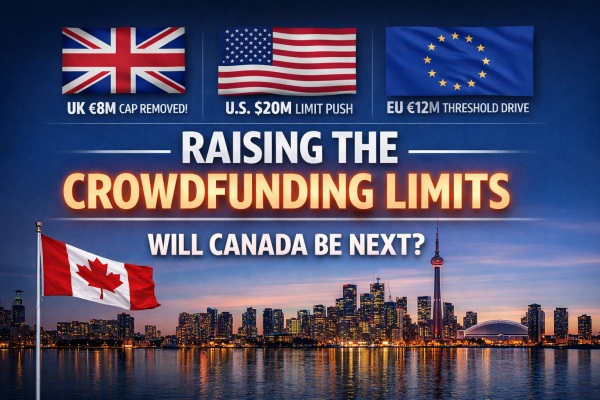
On February 10 2026, UK POP rules go live, removing the old prospectus trigger that made large public raises expensive, slow, and out of reach for many private companies.
For years, UK companies faced a hard line. If a business raised more than €8 million in securities from the public in a year, it had to produce a full prospectus (NB: the UK retained that euro-denominated threshold in its domestic framework post-brexit). Crowdcube says that prospectus costs could cost more than £250,000 and take months, which pushed many companies away from public community rounds even when demand existed.
Under the Public Offer Platform regime, raises above £5 million now run through a regulated POP, and the regime removes the upper fundraising cap for those offers (No more funding caps). Raises under £5 million remain outside the POP requirement, but regulated execution and investor protection expectations still apply.
Platforms now carry more responsibility for diligence, disclosure quality, and investor safeguards. That shifts the burden from a giant issuer document to a supervised platform process that can move faster.
The UK is not alone. In the United States, Crowdfund Capital Advisors submitted a $20M Reg CF petition asking the SEC to raise the Regulation Crowdfunding cap from $5M to $20M. In Europe, the European Digital Finance Association are pushing to increase the ECSP threshold from €5m to €12m.
After years of advocating, Canada finally harmonized nationally its startup-crowdfunding exemption in 2021, but regulators have kept the issuer cap conservative. Under National Instrument 45 110, eligible issuers can raise up to $1.5m in a 12 month period, which a growing company can quickly outgrow and end up soon looking for more funding via heavier paths for larger rounds. If the government wants to prioritize funding scape-ups, they should take another look at increasing equity crowdfunding caps in Canada to be in line with global peers.
This funding cap tension isn't new. In fact NCFA has been advocating for the OSC and CSA to raise issuer funding caps for years. In 2017 for example, NCFA petitioned to raise caps to modernize equity crowdfunding in Ontario. In 2019, $5m cap formed part of NCFA's recommendations to reduce regulatory burden and unlock growth capital. Again in 2020, during national harmonization discussions, NCFA advocated to modernize NI 45 110 including increasing caps to $5 million so the framework could match real funding needs in a digital economy.
Now with the UK FCA removing prospectus triggers and the US and EU push for higher caps, there may be a new policy window for Canada's equity crowdfunding participants to petition yet again. If other jurisdictions support $10m to $20m community rounds under platform oversight, Canada needs to decide whether it wants founders scaling here or structuring growth capital elsewhere.
A higher ceiling, including a path toward $5m and beyond, would better match growth stage reality while keeping platform level investor protection front and centre. The global direction of travel now strengthens the case for a renewed Canadian push grounded in data, experience, and competitiveness.
If regulated platforms can run larger public offers without a prospectus wall in the UK, what should Canada do next, raise the ceiling, create a platform lane for larger rounds, or keep the cap and accept that growth capital routes around Canada?
One practical takeaway stands out. POP style rules treat the platform as the compliance spine, not the issuer. That design can cut cost and time while still demanding clear disclosures, suitability controls, and due diligence at the point of sale. While Canada doesn't necessarily need to copy the UK, it does need a credible path for larger community rounds that doesn't force founders into a prospectus sized bill before they have the scale to absorb it.
The National Crowdfunding & Fintech Association (NCFA Canada) is a financial innovation ecosystem that provides education, market intelligence, industry stewardship, networking and funding opportunities and services to thousands of community members and works closely with industry, government, partners and affiliates to create a vibrant and innovative fintech and funding industry in Canada. Decentralized and distributed, NCFA is engaged with global stakeholders and helps incubate projects and investment in fintech, alternative finance, crowdfunding, peer to peer finance, payments, digital assets and tokens, artificial intelligence, blockchain, cryptocurrency, regtech, and insurtech sectors. Join Canada's Fintech & Funding Community today FREE! Or become a contributing member and get perks. For more information, please visit: www.ncfacanada.org
| | |
|---|---|---|
| | |
Feb 17, 2026 | NCFA Fintech Market Activity | Payroll and HR Tech

Image: Freepik
On February 17 2026, Nmbr announced the Collage Payroll launch, positioning it as the first benefits connected HR platform in Canada to embed payroll inside its HR workflow. Collage says customers can onboard employees once, manage time off and timesheets, and sync HR, payroll, and benefits data through a single login.
Collage says it began partnering with Nmbr in 2024 to build payroll directly inside its HR and benefits workflow (see embedded finance). Then in September 2024, Nmbr announced that they raised CAD $7.6M for Embedded Payroll in Canada. An early rollout in 2025 showed traction, with clients ranging from one to hundreds of employees already using the embedded payroll functionality.
The announcement also calls out real operating pain being solved. Research says nearly a third of businesses spend more than 30 hours a week managing data across payroll and other systems. Collage and Nmbr are betting that fewer handoffs reduces admin burden, lowers compliance risk, and cuts the error rate that shows up every time a hire, pay change, benefits update, or termination forces duplicate data work.
Mark Bluvshtein, Chief Executive Officer, Collage, and Vice President of HR Solutions at People Corporation:
“Payroll has been the number one request from our customers for years. Even when HR and payroll systems work closely together, businesses still feel the friction of managing two platforms. Bringing payroll directly into Collage allows us to finally deliver a single system that manages it all, reducing complexity and giving employers far greater control.”
Nmbr positions itself as payroll infrastructure rather than a standalone payroll brand. Nmbr handles core payroll requirements including payments, compliance, and data accuracy, so platforms can ship payroll inside their own products without rebuilding the hardest pieces from scratch. Noteworthy that Nmbr’s founding team previously helped build and scale Humi, while Collage points to leadership experience across Wave and Humi.
Simon Bourgeois, Chief Executive Officer, Nmbr:
“Payroll is one of the most complex systems a business can run, which is why so few companies have tried to build it themselves. By partnering with Collage, we’re enabling payroll to be built the right way, fully embedded, compliant, and designed for Canadian businesses. This partnership shows what’s possible when modern payroll infrastructure meets a platform that deeply understands HR and benefits.”
As more HR platforms embed payroll, what becomes the differentiator for employers, accuracy and compliance controls, speed of implementation, or the ability to bundle payroll with benefits and other people operations workflows without extra vendors?
Embedded payroll changes the competitive map for HR platforms in Canada. If payroll lives inside the HR and benefits workflow, employers stop treating payroll as a separate purchasing decision and start treating it as a built in capability. That dynamic rewards platforms that control the end-to-end workflow and can keep payroll accurate across provinces, remittances, and reporting cycles.
The National Crowdfunding & Fintech Association (NCFA Canada) is a financial innovation ecosystem that provides education, market intelligence, industry stewardship, networking and funding opportunities and services to thousands of community members and works closely with industry, government, partners and affiliates to create a vibrant and innovative fintech and funding industry in Canada. Decentralized and distributed, NCFA is engaged with global stakeholders and helps incubate projects and investment in fintech, alternative finance, crowdfunding, peer-to-peer finance, payments, digital assets and tokens, artificial intelligence, blockchain, cryptocurrency, regtech, and insurtech sectors. Join Canada's Fintech & Funding Community today FREE! Or become a contributing member and get perks. For more information, please visit: www.ncfacanada.org
| | |
|---|---|---|
| | |
Feb 16, 2026 | NCFA Fintech Market Activity | Funding and Capital Markets

On February 12 2026, according to Reuters fintech brokerage and clearing firm Clear Street postponed its US IPO after downsizing its planned public offering.
Earlier in February, Clear Street had marketed 23.8 million shares at $40 to $44 per share, targeting a raise of up to $1.05B and a valuation as high as $11.8B. However, the latest reporting indicates due to market volatility and investor demand conditions, not a change in the company's core strategy, the company reduced the size of the deal to approximately $364M before ultimately postponing the offering. The scale of the adjustment is significant.
Clear Street reported estimated 2025 net revenue in the range of $1.04B to $1.06B, up from $463.6M the prior year. That type of growth profile would normally support strong IPO momentum. The pullback shows how sensitive public market pricing is when risk appetite tightens.
It's not just a US story. Canadian public markets have faced similar pressure. Reuters reporting earlier this year noted that the Toronto Stock Exchange saw only two IPOs and 55 delistings in 2025, even as the S&P TSX Composite rose 29%.
However, recent reporting on Canada’s IPO market revival outlook points to improving economic confidence heading into 2026 after a muted 2025 cycle.
Canadian IPO momentum may be rebuilding, but institutional investors on both sides of the border remain focused on revenue durability, capital efficiency, and realistic pricing. Market windows are opening selectively, not broadly.
For Canadian fintechs considering a public listing, the lesson is calibration, not delay. Public markets appear more receptive again, but pricing discipline and governance strength now carry more weight than growth alone.
If public markets reprice risk this fast, what proof points must fintechs demonstrate to defend valuation under pressure, revenue quality, capital efficiency, or market share durability?
Clear Street’s postponed IPO doesn't close the door on fintech listings. It reinforces that in 2026, timing and pricing discipline matter as much as growth.
The National Crowdfunding & Fintech Association (NCFA Canada) is a financial innovation ecosystem that provides education, market intelligence, industry stewardship, networking and funding opportunities and services to thousands of community members and works closely with industry, government, partners and affiliates to create a vibrant and innovative fintech and funding industry in Canada. Decentralized and distributed, NCFA is engaged with global stakeholders and helps incubate projects and investment in fintech, alternative finance, crowdfunding, peer to peer finance, payments, digital assets and tokens, artificial intelligence, blockchain, cryptocurrency, regtech, and insurtech sectors. Join Canada's Fintech & Funding Community today FREE! Or become a contributing member and get perks. For more information, please visit: www.ncfacanada.org
| | |
|---|---|---|
| | |
The National Crowdfunding & Fintech Association (NCFA Canada) is a financial innovation ecosystem that provides education, market intelligence, industry stewardship, networking and funding opportunities and services to thousands of community members and works closely with industry, government, partners and affiliates to create a vibrant and innovative fintech and funding industry in Canada. Decentralized and distributed, NCFA is engaged with global stakeholders and helps incubate projects and investment in fintech, alternative finance, crowdfunding, peer-to-peer finance, payments, digital assets and tokens, artificial intelligence, blockchain, cryptocurrency, regtech, and insurtech sectors. Join Canada's Fintech & Funding Community today FREE! Or become a contributing member and get perks. For more information, please visit: www.ncfacanada.org
| | |
|---|---|---|
| | |
The National Crowdfunding & Fintech Association (NCFA Canada) is a financial innovation ecosystem that provides education, market intelligence, industry stewardship, networking and funding opportunities and services to thousands of community members and works closely with industry, government, partners and affiliates to create a vibrant and innovative fintech and funding industry in Canada. Decentralized and distributed, NCFA is engaged with global stakeholders and helps incubate projects and investment in fintech, alternative finance, crowdfunding, peer-to-peer finance, payments, digital assets and tokens, artificial intelligence, blockchain, cryptocurrency, regtech, and insurtech sectors. Join Canada's Fintech & Funding Community today FREE! Or become a contributing member and get perks. For more information, please visit: www.ncfacanada.org
| | |
|---|---|---|
| | |


August 26th, 2025

January 4th, 2024

June 1st, 2021

September 9th, 2020

July 9th, 2018

January 3rd, 2018

September 25th, 2017

June 20th, 2017

May 10th, 2017

December 14th, 2016