




Karsten Wenzlaff, Advisor
August 26th, 2025
Karsten Wenzlaff is a Crowdfunding and Fintech Expert from Germany. He is Secretary-General of Digit[...]


Fintech Innovation | Nov 14, 2025

Image: Freepik/jcomp
On November 14 2025, numerous outlets such as MarketWatch, PYMTS and Nasdaq reported Robinhood Markets and Gopuff introduced a pilot program allowing select users to order physical cash delivered directly to their door. Cash home delivery is also mentioned on Robinhood's banking page here. Coverage of the cash delivery pilot notes that Robinhood Gold users can request up to $500 in cash for a small delivery fee, with expansion to other cities expected in 2026.
This service shows how digital finance and physical cash can work together, expanding traditional banking limits. Gen Z consumers, though mostly digital first, still use cash in limited social and tipping situations. Their focus on convenience, control, and safety fits with on demand delivery.
Delivering cash brings new challenges in security, anti money laundering, and consumer protection. It also raises questions for regulators about whether cash delivery is a financial service or simply a delivery task.
The pilot is based in the United States, but Canadian fintechs are likely watching closely. Even though cash use is dropping, it still matters for many people (stickiness of cash). A similar approach could work in large cities like Toronto or Vancouver, where younger consumers use digital tools but sometimes need cash. The main innovation is about trust and convenience, both of which are key in a competitive financial market.
For Canadian regulators and startups, this is a chance to look at new ways to provide access to cash using technology that fits with digital wallets. Verified reporting from Nasdaq on the Robinhood Gopuff collaboration shows that this initiative is designed as a customer friendly fintech trial rather than a major banking shift (yet).
Although this pilot is not available in Canada, it draws attention to similar challenges here. NCFA’s earlier reporting on rural bank closures and the KOHO Canada Post partnership demonstrate that financial inclusion depends on reliable local service and creative use of technology. Having said that, Canada Post has its own money management problems, with sustained multi-year operating losses due to the decline of physical mail, a hit to expanding cash access. That is why new partnerships between fintech and delivery providers may be needed to keep service available in remote areas.
Then there's also Neo Financial in Calgary, a three-peat winner on Deloitte's Fast 50 enterprise growth category, launched by the people who built SkipTheDishes deliver service. Ronbinhood's pilot could stoke that mix of fintech and delivery experience, hinting at what might come next. A future where getting your money could be as simple as ordering a meal.
This partnership shows how fintech and physical delivery can meet real world needs. If the pilot works, more companies could test similar options in North America. For NCFA readers, it highlights how innovation, inclusion, and access come together in consumer finance, and how even younger users still value choice and control over their money.
 The National Crowdfunding & Fintech Association (NCFA Canada) is a financial innovation ecosystem that provides education, market intelligence, industry stewardship, networking and funding opportunities and services to thousands of community members and works closely with industry, government, partners and affiliates to create a vibrant and innovative fintech and funding industry in Canada. Decentralized and distributed, NCFA is engaged with global stakeholders and helps incubate projects and investment in fintech, alternative finance, crowdfunding, peer-to-peer finance, payments, digital assets and tokens, artificial intelligence, blockchain, cryptocurrency, regtech, and insurtech sectors. Join Canada's Fintech & Funding Community today FREE! Or become a contributing member and get perks. For more information, please visit: www.ncfacanada.org
 |  |  |
|---|---|---|
 |  |  |
Token Sales | Nov 13, 2025

Image: Freepik/diana.grytsku
On November 10, 2025 Coinbase announced the launch of its new 2025 end-to-end token sales platform, with the goal is to make token launches more open, fair, and easy to understand, while helping projects build real communities and stable markets. The news is the return of U.S. retail access to public token sales for the first time since 2018, triggered by both market demand and a pro-crypto U.S. Securities and Exchange Commission (SEC) who now says that most crypto tokens are not securities, a complete pivot from the Gensler years when regulators focused mainly on enforcement.
Coinbase’s new model aims to redefine how tokens are launched and distributed by emphasizing fairness, compliance, and long-term project stability. Instead of fast paced selling campaigns that reward a small group of insiders and large buyers, Coinbase is implementing an algorithm that fills smaller requests first, giving retail users increased access to participate. Similarly, here you can find Coinbase black friday deals. This sale window remains open for a set period, usually about a week, and then once closed, allocations are finalized. This ensures a balanced distribution and greater transparency in how tokens reach users.
Every issuer must share verified information about its team, tokenomics, and goals before the sale begins. Coinbase requires a 6 month lock-up period for issuers and their affiliates, which prevents early sell-offs and maintains market trust. These requirements strengthen accountability and align with the platform’s focus on transparent and compliant token issuance.
Coinbase’s design also rewards true community participation. Users who hold tokens beyond the first 30 days receive higher priority in future sales, discouraging short-term speculation (a type of loyalty benefit). For issuers, the model offers exposure to Coinbase’s global retail base and a transparent way to build exchange liquidity over time.
Coinbase has confirmed that Monad (MON) will be the first project to use the new platform, with its token sale scheduled for November 17–22, 2025. A key test of how a compliant, exchange led distribution can work in practice.
The design directly addresses problems seen during the 2017–2018 ICO boom, when many projects raised funds without meeting disclosure or compliance standards. Coinbase’s structured, transparent model supports fair access for users while maintaining clear accountability for issuers.
| Component | ICO Era (2017–2018) | Coinbase Model (2025) |
| Regulatory Clarity | Operated in uncertain areas with little oversight. Many projects later faced SEC actions | Built under SEC guidance that most tokens are not securities, supported by clear disclosures and verified governance |
| Access and Distribution | First-come systems rewarded speed and capital. Retail participation declined as regulators tightened oversight after widespread enforcement against unregistered ICOs, leading most platforms to limit token sales to accredited investors | Algorithm fills smaller requests first, expanding access and allowing U.S. retail buyers to join under defined limits |
| Issuer Accountability | Founders could sell immediately after launch and there were few restrictions or audits | 6 month issuer lock-up and Coinbase approval for any resale, keeping incentives aligned with buyers |
| Market Integrity | Tokens often listed quickly and traded on hype, leading to volatile price swings | Sales connect directly to Coinbase’s exchange roadmap, adding structure and steady liquidity over time |
| User Protection | Few safeguards or verified disclosures; frequent fraud cases | Verified project details, transparent sale process, and checks that reward real users over short-term traders |
Coinbase’s token sale model operates under the U.S. Securities and Exchange Commission’s current interpretation that most tokens are not securities when issued transparently and tied to legitimate network utility. This approach aligns with the SEC’s Project Crypto initiative, which promotes responsible innovation, fair access, and clear disclosure standards for digital assets.
In contrast, Canada maintains a more restrictive policy framework. Under current Canadian rules, most token sales are considered securities offerings unless they clearly fall outside investment contract criteria. The foundational guidance remains the CSA Staff Notice 46-308 – Securities Law Implications for Offerings of Tokens, which sets out how tokens may qualify as securities depending on their structure, purpose, and how they are marketed to participants.
Also, the Canadian Securities Administrators hosts an investor advisory titled Buying and Selling Crypto Assets, which cautions that token sales and trading platforms must comply with registration and disclosure requirements. Unlike the U.S., where retail investors are now permitted to participate in regulated public token sales, Canadian participation remains limited to accredited or exempt investors.
It's clear that the two markets are taking different paths. The United States is moving toward a system that rewards transparency and practical utility, while Canada’s framework continues to prioritize investor protection via restriction. Over time, Canada may need to modernize its regulatory approach to encourage innovation and maintain competitiveness in the global digital asset economy.
It was also recently discovered that Coinbase is moving it's legal incorporation from Delaware to Texas, as detailed in a report on the company’s shift to Texas corporate law. Texas offers a more innovation-friendly business environment and growing digital asset economy. Overall, Coinbase's new token sale model could help define how token distribution evolves worldwide, offering a practical roadmap for compliance with retail access.
The National Crowdfunding & Fintech Association (NCFA Canada) is a financial innovation ecosystem that provides education, market intelligence, industry stewardship, networking and funding opportunities and services to thousands of community members and works closely with industry, government, partners and affiliates to create a vibrant and innovative fintech and funding industry in Canada. Decentralized and distributed, NCFA is engaged with global stakeholders and helps incubate projects and investment in fintech, alternative finance, crowdfunding, peer-to-peer finance, payments, digital assets and tokens, artificial intelligence, blockchain, cryptocurrency, regtech, and insurtech sectors. Join Canada's Fintech & Funding Community today FREE! Or become a contributing member and get perks. For more information, please visit: www.ncfacanada.org
| | |
|---|---|---|
| | |
Alternative Assets | Nov 12, 2025
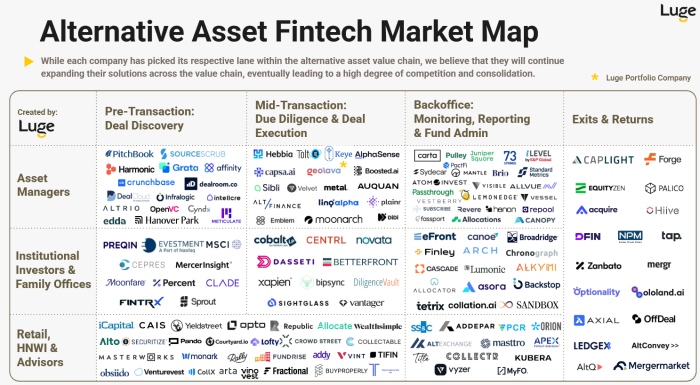
Image: State of Alternative Assets: A Fintech Perspective (Luge Capital, Nov 2025)
On November 11, 2025 Luge Capital published an informative report titled "2025 State of Alternative Assets: A Fintech Perspective'. Global Alternative Assets (Alts or AltAssets) reached $19 trillion in 2023 and could grow to $33 trillion by 2030, per the report's analysis of verified data from Preqin, BCG, and Deloitte.
Private equity and private credit stand out as the biggest categories but behind this growth, fintech companies are quietly rebuilding how money is raised, managed, and circulated across private investments.
Laviva Mazhar, a Principal at Luge Capital and Author of the report, compares what's happening today to the early computerization of trading desks. Manual processes are being replaced by connected systems that make private markets work more smoothly.
New companies are designing tools that handle every step of the process, from AI-supported deal sourcing and due diligence to data collection and performance reporting. The report names Canoe Intelligence (U.S.), 73 Strings (India), and Mantle (Canada) among the firms setting new benchmarks for automation.
Large players such as BlackRock, iCapital, and Hamilton Lane are also expanding through partnerships and acquisitions, bringing these innovations into the mainstream.
Private equity assets under management reached $5.8 trillion in 2023, while private credit is expected to reach $2.6 trillion by 2029. The number of U.S. companies backed by private equity has climbed 490% since 2000, validating how deep private capital is supporting business growth.
Company buyouts or public companies being taken private off the stock market increased 32% year over year, pointing to strong investor appetite for longer-term ownership. Across North America $297 billion has flowed into 7,300 private Canadian companies since 2013, backed by the shared strength of regional investment ecosystems.
Luge reports that 86% of institutional investors already allocate to alternatives, but individual investors are beginning to play a larger role. Assets from the wealth channel in the U.S. are projected to more than double to $3 trillion by 2029.
Fintech platforms like iCapital (U.S.), Yieldstreet (U.S.), and Opto Investments (U.S.) are developing digital pathways that make it easier for people to participate in funds once reserved for large institutions. This growing inclusion is one of the strongest patterns Luge identifies across the market.
According to Luge, the biggest opportunities now lie in the systems that connect private markets together. These include data sharing networks, portable investor identity tools, and liquidity platforms for secondary trading. The report also highlights a new class of software that helps fund managers handle onboarding, compliance, and reporting in one place. These initiatives are setting the stage for a more open and efficient investment environment.
Fintech companies that make it easier to access capital, reduce paperwork, and build trust are helping the global economy work better. This focus mirrors NCFA Canada’s commitment to supporting innovation, inclusion, and competitiveness through responsible market design that benefits investors, businesses, and communities alike. Download Luge Capital's latest report on the State of Alternative Assets in 2025 and/or subscribe to NCFA's weekly newsletter.
The National Crowdfunding & Fintech Association (NCFA Canada) is a financial innovation ecosystem that provides education, market intelligence, industry stewardship, networking and funding opportunities and services to thousands of community members and works closely with industry, government, partners and affiliates to create a vibrant and innovative fintech and funding industry in Canada. Decentralized and distributed, NCFA is engaged with global stakeholders and helps incubate projects and investment in fintech, alternative finance, crowdfunding, peer-to-peer finance, payments, digital assets and tokens, artificial intelligence, blockchain, cryptocurrency, regtech, and insurtech sectors. Join Canada's Fintech & Funding Community today FREE! Or become a contributing member and get perks. For more information, please visit: www.ncfacanada.org
| | |
|---|---|---|
| | |
Digital Money | Nov 12, 2025

Image: Freepik/Pikisuperstar
On November 12, 2025, J.P. Morgan announced that it had become the first major bank to issue a USD deposit token on a public blockchain. The new JPM Coin (ticker JPMD) allows institutional clients to send and receive funds instantly using Base, the Ethereum Layer 2 network developed by Coinbase.
The project follows successful testing in June of this year with B2C2, Coinbase, and Mastercard, which achieved real-time issuance and redemption of the token. The initiative is led by Kinexys by J.P. Morgan, the bank’s blockchain division that has built digital financial infrastructure since 2015.
J.P. Morgan’s motivation goes beyond efficiency. By placing regulated deposits directly on a public chain, the bank is positioning itself for the next era of interoperable digital finance. Its clients can now settle cross-border trades, treasury flows, and digital asset transactions onchain, with the reliability and security of a regulated deposit. This model combines bank-grade security with blockchain’s speed and transparency.
Rather than competing with stablecoins, J.P. Morgan is building a framework where traditional deposits become programmable financial instruments, integrated with smart contracts.
The launch shows how large banks are implementing strategies for digital money. For global institutions, it reduces the friction of moving funds across time zones and platforms, offering constant access to liquidity and settlement.
By offering instant, always-on settlement and programmable deposits backed by a regulated bank, J.P. Morgan is setting a new standardfor how traditional finance can participate safely in the digital asset economy while maintaining oversight and trust.
For Canada, J.P. Morgan’s approach provides a clear case study as the Office of the Superintendent of Financial Institutions (OSFI) and the Bank of Canada (BoC) advance their own stablecoin policy framework. If Canada adopts similar standards for CAD-denominated deposit tokens, it could enable cheaper, faster settlements while maintaining full regulatory oversight.
There's also an opportunity for Canadian fintechs to collaborate with banks on compliant blockchain payment rails. Domestic players like Interac and major banks may soon face competitive pressure if global stablecoin transactions become a new standard. This type of regulatory model would allow Canadian financial institutions to issue tokenized deposits that preserve trust while keeping innovation local.
Once Canadian regulators establish clarity around digital deposits, the cost of settlement could fall dramatically. Current payment systems such as e-Interac and card networks, rely on intermediaries that add delay and cost. Regulated tokens could settle value directly between wallets within seconds, removing several layers of friction.
While this could reduce traditional fee income, it also supports innovation and opens new business models.
Banks could earn from providing liquidity, token custody, or smart contract services. Fintechs could integrate programmable money into real-time lending, payroll, or cross-border commerce.
If Canada aligns with international standards, the combination of stable onchain settlement and regulatory assurance could strengthen national competitiveness and attract global capital.
J.P. Morgan’s entry into public blockchain payments proves that regulated institutions can safely participate in decentralized finance while meeting compliance standards. The ability to move regulated value instantly across borders could help Canadian firms compete globally, expand access to capital, and reinforce confidence in digital finance.
The National Crowdfunding & Fintech Association (NCFA Canada) is a financial innovation ecosystem that provides education, market intelligence, industry stewardship, networking and funding opportunities and services to thousands of community members and works closely with industry, government, partners and affiliates to create a vibrant and innovative fintech and funding industry in Canada. Decentralized and distributed, NCFA is engaged with global stakeholders and helps incubate projects and investment in fintech, alternative finance, crowdfunding, peer-to-peer finance, payments, digital assets and tokens, artificial intelligence, blockchain, cryptocurrency, regtech, and insurtech sectors. Join Canada's Fintech & Funding Community today FREE! Or become a contributing member and get perks. For more information, please visit: www.ncfacanada.org
| | |
|---|---|---|
| | |
Digital Assets | Nov 12, 2025
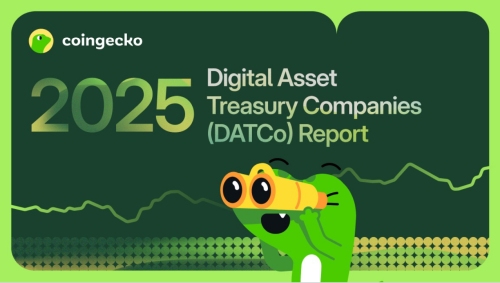
On November 5, 2025 CoinGecko published a comprehensive 2025 Digital Asset Treasury Companies Report unveiling the trends, rankings and strategies of mainly public companies that are increasingly adding digital assets to their balance sheets.
The report outlines three types of public DATCos including (1) Crypto mining firms (i.e., MARA Holdings), (2) Pure play firms whose sole purpose is to accumulate crypto assets (i.e., Strategy or Bitcoin Treasury Corp), and (3) Companies with crypto reserves (i.e., Bitfarms Ltd), with the full source data being available in the report along with CoinGecko's Treasuries Tracker (NB: includes government holdings in rankings).
CoinGecko’s data shows the number of Digital Asset Treasury Companies expanding from just 4 in early 2020 to 142 by October 2025. Total holdings rose from about $30 million to $137.3 billion USD, more than doubling in 2025 alone.
Bitcoin represents about 82.6 % of total holdings, Ethereum 13.2 %, and Solana 2.1 %, with the rest spread among smaller tokens. The United States leads with 60 companies; Canada ranks second with 19, reflecting its strong base of listed miners and crypto firms.
The takeaway is that public companies are increasingly adding digital assets to their balance sheet. Below are highlights of the ins and outs of how they do it, and some lessons learned.
CoinGecko traces Strategy’s transformation from a software company into the world’s largest corporate Bitcoin holder. Since pivoting in August 2020, Strategy has acquired about 640,800 BTC, roughly 3 % of total Bitcoin supply, and now manages holdings exceeding $70 billion USD.
The company funded these purchases through a mix of equity offerings, bond issuances, and preferred shares. Its stock has traded at premiums to its Bitcoin net asset value during parts of 2024, underlining investor appetite for exposure to corporate crypto reserves.
CoinGecko tracks at least $42.7 billion USD in new crypto purchases by DATCos between January and October 2025, with more than half occurring in the third quarter. Bitcoin accounted for roughly 70 % of total spend, Ethereum for 18 %, and Solana led among smaller allocations.
This acceleration reflects growing comfort with digital assets as long-term treasury instruments rather than short-term speculative holdings.
As of November 2025, Strategy leads with $70.7 billion USD in Bitcoin. BitMine Immersion ranks second with combined Ethereum and Bitcoin holdings of $12.9 billion USD, followed by Sharplink, a major Ethereum holder.
The top group also includes Marathon Digital, Riot Platforms, Coinbase, Galaxy Digital, and Tesla. Together, the top 15 account for most corporate-owned digital assets.
Three Canadian-listed firms, Galaxy Digital, Hut 8 Mining, and Bitfarms Ltd., remain among the most significant international participants, confirming Canada’s status as a leader in Bitcoin and Ethereum treasury adoption. Both Galaxy Digital and Hut 8 are listed as U.S. firms on the tracker but they are registered and originated in Canada.
Bitcoin treasuries held by DATCos now total about 1.03 million BTC, equal to 4.9 % of total Bitcoin supply. Strategy alone holds roughly 61.5 % of that amount.
Ethereum holdings across DATCos reached 4.7 million ETH, or 3.9 % of supply, with BitMine Immersion responsible for about 69 % of the total.
Solana treasuries rose to 15.9 million SOL, about 2.9 % of supply. Forward Industries’ $1.65 billion purchase of 6.8 million SOL in September 2025 represents nearly half of all corporate Solana reserves.
CoinGecko documents four key financing methods that DATCos have been using to acquire crypto assets:
Together, these options spotlight structured financing strategies that balance investor access with risk control.
mNAV compares a company’s market capitalization to the value of its crypto holdings, which acts as a sustainability barometer. When mNAV falls below 1.0, raising new equity dilutes shareholders rather than adding value.
CoinGecko found several DATCos near or below that threshold in late 2025. As a result some companies paused new acquisitions, while others turned to preferred shares or buybacks to stabilize their valuations.
CoinGecko’s report offers several clear lessons from 2025’s wave of funding stress and consolidation among crypto treasury companies.
When a company’s share price falls and its mNAV drops near or below 1.0, equity financing becomes uneconomical. Semler Scientific (SMLR) faced this in mid-2025, as weak stock performance made new issuance impossible and a shareholder vote to authorize preferred shares failed.
With no viable financing options left, Semler merged with Strive in September 2025. Consolidation often becomes the only path forward when market access closes.
After the merger Semler relied on preferred equity but its combined valuation still dropped by about 80 %, showing that preference structures help liquidity but not long-term confidence.
Across all DATCos, outstanding debt stood near $12.7 billion USD, which is modest compared with roughly $200 billion USD in crypto assets, leaving space for responsible borrowing to reduce reliance on stock issuance.
Companies use buybacks or issue preference shares to support valuations when mNAV weakens. ETHZilla even sold Ethereum in October 2025 to fund a buyback (a rare reversal of the usual accumulation pattern).
Several DATCos saw share prices surge briefly after announcing digital asset strategies, then retreat as fundamentals reasserted themselves. Some cases drew regulator scrutiny for pre-announcement trading. Companies should not base treasury policy on short-lived market premiums.
Strategy’s perpetual preferred shares attract investors through structured yields, but questions remain when dividends are financed by new share issuance. Transparent funding disclosure maintains credibility.
At a time when Canada's policymakers are creating stablecoin rules, it can learn from these global cases by allowing fair-value accounting for digital assets, enabling multiple funding tools, and setting clear disclosure standards. Canada’s listed mining and fintech firms already play a leading role in corporate crypto adoption. Yet few non-mining public companies have introduced digital reserves.
By updating accounting rules, modernizing treasury disclosure, and piloting a Digital Treasury Sandbox, regulators could enable more smaller scale companies with well-governed asset allocations to improve competitiveness and financial resilience. Digital assets are now a recognized part of global corporate finance. Bitcoin remains the anchor, while Ethereum and Solana continue to gain traction.
The National Crowdfunding & Fintech Association (NCFA Canada) is a financial innovation ecosystem that provides education, market intelligence, industry stewardship, networking and funding opportunities and services to thousands of community members and works closely with industry, government, partners and affiliates to create a vibrant and innovative fintech and funding industry in Canada. Decentralized and distributed, NCFA is engaged with global stakeholders and helps incubate projects and investment in fintech, alternative finance, crowdfunding, peer-to-peer finance, payments, digital assets and tokens, artificial intelligence, blockchain, cryptocurrency, regtech, and insurtech sectors. Join Canada's Fintech & Funding Community today FREE! Or become a contributing member and get perks. For more information, please visit: www.ncfacanada.org
| | |
|---|---|---|
| | |
Financing | Nov 11, 2025

Image: Freepik/rawpixel.com
On November 6 2025, Canadian founded DealMaker announced that it has secured $20 million USD in equity and debt financing led by Information Venture Partners and CIBC Innovation Banking. The company recently opened new U.S. headquarters in New York City in April of this year. DealMaker says funds will support product innovation, AI deployment, and market expansion as the company continues to innovate how issuers connect directly with investors (aka investment crowdfunding).
DealMaker’s model is built around direct-to-investor offerings, allowing startups, growth stage companies, and pre-IPO issuers to raise funds without intermediaries. The company has now powered over 900 offerings and processed more than 1.5 million individual investments, representing over $2.3 billion raised.
By combining digital onboarding, payments, and investor relations tools, DealMaker positions itself as a single platform for issuers seeking efficiency and transparency in capital formation. While its current operations are centered in the United States, DealMaker’s origins and investor ties highlight the role Canadian fintech expertise continues to play in North American capital markets.
Rebecca Kacaba, DealMaker Co-Founder & CEO:
"This round allows us to accelerate the deployment of AI across our product line, capitalize on emerging ownership models across professional and collegiate sports, and deliver greater value to our customers. This positions DealMaker to be a market leader in a rapidly growing sector where more and more companies-from startups to the hottest IPOs are prioritizing retail investors."
The capital will accelerate the rollout of AI across its platform and strengthen products such as DealMaker Sports, its new division connecting retail investors to sports ownership opportunities.
DealMaker Sports enables leagues, teams, and athletes to tap into their own communities for capital by converting fans into investors. With a platform built for speed, checkout is mobile-friendly and brands get real-time analytics on who’s investing and why. Raise under exemptions like Reg CF, Reg A+ and Reg D, whether you’re targeting $500 K or $50 M and build loyalty, revenue and growth all at once.
As AI becomes embedded in every part of financial infrastructure, platforms like DealMaker could help reduce friction, lower costs, and expand access to retail participation. For Canadian fintechs, DealMaker's success reinforces the importance of building scalable, compliant, and investor-centric solutions that can compete globally while supporting innovation and inclusion.
The National Crowdfunding & Fintech Association (NCFA Canada) is a financial innovation ecosystem that provides education, market intelligence, industry stewardship, networking and funding opportunities and services to thousands of community members and works closely with industry, government, partners and affiliates to create a vibrant and innovative fintech and funding industry in Canada. Decentralized and distributed, NCFA is engaged with global stakeholders and helps incubate projects and investment in fintech, alternative finance, crowdfunding, peer-to-peer finance, payments, digital assets and tokens, artificial intelligence, blockchain, cryptocurrency, regtech, and insurtech sectors. Join Canada's Fintech & Funding Community today FREE! Or become a contributing member and get perks. For more information, please visit: www.ncfacanada.org
| | |
|---|---|---|
| | |
Policy | Nov 11, 2025

Image: Relative labour productivity Canada vs US (Source: CSLS 2025)
The Centre for the Study of Living Standards released a November 2025 report titled, "Can a Lack of Pro-Productivity Policies Explain the Secular Decline in Canada’s Productivity Growth?", outlining why Canada’s productivity growth has stalled even as macroeconomic policy remains stable. The study finds that steps in the 2025 federal budget while positive, will not by themselves reverse the long slowdown. The authors argue that deeper structural change is needed to rebuild the foundations of business investment and innovation in Canada.
The report traces much of the post 2015 slowdown to long term structural and global factors that are as a result of how past policy choices influenced business behaviour. Verified causes that reduced the total investment per worker and limited productivity even as macro conditions stayed the same include:
Evidence from major institutions supports this view. The analysis in the OECD 2025 Economic Survey of Canada and the IMF 2024 Article IV consultation finds that Canada’s productivity gap reflects long standing frameworks that influence how firms invest and compete. These findings show that the challenge is structural, a long term misalignment between national policy intent and firm level behaviour.
The recently announced Budget 2025 aims to address parts of Canada's productivity, innovation and competition gaps. It includes improvements to the Scientific Research and Experimental Development program by increasing the annual expenditure limit for the enhanced credit to $6 million, restoring eligibility for capital expenditures, and extending eligibility to Canadian public corporations. These measures target investment in intangible assets and innovation, the areas identified as weak.
The budget also commits over $1 billion in resources over five years for AI compute and quantum computing while proposing a TechStat program to track technology adoption, as described in the digital infrastructure plan.
Finally, the budget also advances open banking and stablecoin rules that can improve competition and trust.
Productivity growth depends on what happens inside firms, how they invest, adopt technology, and organize production. Canada’s frameworks have been stable but haven't created strong enough conditions for private reinvestment in digital and intangible assets.
When policy creates the right incentives and financial infrastructure removes friction, investment decisions shift. That alignment between public objectives and private behaviour is where lasting productivity growth emerges.
Canada’s weakness lies in underinvestment in intangible assets such as software, data, intellectual property, and organizational know how. Past tools have not reversed this pattern and Canada needs to reward reinvestment in intangible and digital assets. NCFA has argued for tax credits that mobilize private capital for innovation for years including in an open letter to government during the COVID 19 pandemic, urging government to collaborate with fintechs while proposing investment tax credits to crowd in private capital.
The United Kingdom’s Enterprise Investment Scheme (EIS) offers a clear example of how targeted tax relief can mobilize private capital into early-stage ventures. Since its launch in 1994, the EIS has attracted over £30 billion of private investment into more than 53,000 small and growing companies, according to HM Revenue & Customs.
The EIS program provides individual investors with income tax relief of up to 30% on investments in qualifying startups, along with capital gains deferrals. Analysts credit it with strengthening the UK’s innovation ecosystem and building one of the world’s most active early-stage funding markets.
Reducing interprovincial barriers and boosting competition are valuable but not sufficient on their own. The next step is to modernize how policy and firm level decisions connect. Fintechs can help turn policy into practice by improving access to capital, ensuring reliable and interoperable data, and scaling innovation across the economy. That's how Canada can turn structural reform into more practical and realized productivity gains.
The National Crowdfunding & Fintech Association (NCFA Canada) is a financial innovation ecosystem that provides education, market intelligence, industry stewardship, networking and funding opportunities and services to thousands of community members and works closely with industry, government, partners and affiliates to create a vibrant and innovative fintech and funding industry in Canada. Decentralized and distributed, NCFA is engaged with global stakeholders and helps incubate projects and investment in fintech, alternative finance, crowdfunding, peer-to-peer finance, payments, digital assets and tokens, artificial intelligence, blockchain, cryptocurrency, regtech, and insurtech sectors. Join Canada's Fintech & Funding Community today FREE! Or become a contributing member and get perks. For more information, please visit: www.ncfacanada.org
| | |
|---|---|---|
| | |


August 26th, 2025

January 4th, 2024

June 1st, 2021

September 9th, 2020

July 9th, 2018

January 3rd, 2018

September 25th, 2017

June 20th, 2017

May 10th, 2017

December 14th, 2016