




Karsten Wenzlaff, Advisor
August 26th, 2025
Karsten Wenzlaff is a Crowdfunding and Fintech Expert from Germany. He is Secretary-General of Digit[...]


CBDC and Stablecoins | Sep 29, 2025

Image: Freepik
On September 19, 2025, EU finance ministers reached a compromise on the digital euro roadmap, designed to reduce dependence on Visa and Mastercard. The plan gives governments a stronger role in any launch decision and sets limits on how much citizens can hold. For official policy context, see the EU Council’s digital euro page, which outlines objectives and implementation steps.
Just six days later, nine major European banks formed a consortium to launch a MiCA-compliant euro stablecoin, targeting a 2026 launch. The group includes ING, UniCredit, CaixaBank, Danske Bank, SEB, Raiffeisen Bank International, KBC, DekaBank, and Banca Sella. Their goal is to deliver instant payments, programmable settlement, and a regulated alternative to unbacked crypto tokens.
By anchoring the stablecoin in Europe’s MiCA framework, the banks are moving early to define how regulated tokenized money will work. MiCA sets clear standards for issuers on capital, governance, and reserve management. That clarity is drawing incumbents to commit capital and credibility.
The digital euro and the bank consortium stablecoin initiative both look to rebalance power in Europe’s payments market. Today, Visa and Mastercard process around two‑thirds of all European card transactions. Policymakers want to ensure Europe can clear and settle payments domestically without relying on foreign schemes.
The central bank digital currency (CBDC) and stablecoin initiatives also intersect with Wero, the new retail wallet developed under the European Payments Initiative. Wero is designed to give merchants and consumers a unified tool for instant payments across the euro area, and a tokenized euro would strengthen its value proposition. This alignment mirrors the Canadian Real‑Time Rail project, though Europe is tying its upgrades more explicitly to digital money.
A further motivation is market share. Euro stablecoins currently total only about €620 million outstanding, compared to nearly $300 billion for U.S. dollar stablecoins. Europe risks being sidelined if it does not accelerate adoption, as global trade and DeFi increasingly rely on dollar‑based tokens.
For fintechs, these initiatives open a regulated path to experiment with programmable money, cross‑border settlement, and retail wallets. Startups may be able to integrate stablecoin rails into remittances, treasury management, or point‑of‑sale services with legal certainty.
For banks, the picture is mixed. Deposit flight is a risk if customers shift balances into tokenized wallets. Yet the banks launching the consortium also stand to gain by controlling issuance, custody, and compliance, capturing value from tokenization.
Canada has taken a more cautious approach. The Bank of Canada has said there is “no compelling case” for a retail digital dollar and is prioritizing upgrades to payment infrastructure. Policymakers are also examining how to regulate stablecoins, with oversight currently split between federal and provincial authorities. See NCFA's analysis of Canada's stablecoin race entering a critical phase for a more detailed analysis.
Europe’s actions highlight lessons for Canada. Their dual‑track model of a CBDC combined with a bank‑led stablecoin consortium shows how sovereignty and innovation can be balanced. A digital loonie could serve as a public anchor, while regulated Canadian bank or fintech stablecoins could deliver speed and programmability. Equally important, MiCA demonstrates the power of legislative clarity, something Canada lacks as fragmented oversight slows momentum.
Europe’s urgency also stems from the fact that euro stablecoins represent a tiny fraction of the global market. Canada faces the same risk if stablecoin use grows but domestic frameworks stall, Canadians may increasingly rely on U.S. dollar tokens for payments, weakening monetary sovereignty. Europe is also linking its initiatives to Wero, its new retail wallet.
Canada could also add experiments to the rollout of its Real‑Time Rail, ensuring token‑based payments integrate with domestic upgrades. Although Canadians and payment stakeholders can't afford any more delays.
If Canada followed a similar approach as in Europe, payments could become faster and cheaper, and fintechs would gain new opportunities in programmable settlement and remittances. Banks could face pressure on deposits but would gain new business in custody and compliance. If Canada hesitates for much longer, the country risks dollarization via U.S. stablecoins, reducing control over payments and data governance.
 The National Crowdfunding & Fintech Association (NCFA Canada) is a financial innovation ecosystem that provides education, market intelligence, industry stewardship, networking and funding opportunities and services to thousands of community members and works closely with industry, government, partners and affiliates to create aa vibrant and innovative fintech and funding industry in Canada. Decentralized and distributed, NCFA is engaged with global stakeholders and helps incubate projects and investment in fintech, alternative finance, crowdfunding, peer-to-peer finance, payments, digital assets and tokens, artificial intelligence, blockchain, cryptocurrency, regtech, and insurtech sectors. Join Canada's Fintech & Funding Community today FREE! Or become a contributing member and get perks. For more information, please visit: www.ncfacanada.org
 |  |  |
|---|---|---|
 |  |  |
Report | Sep 25, 2025

Image: Top 200 Women Powered UK Businesses (report cover)
On September 16, 2025, J.P. Morgan and Beauhurst published the fifth annual Top 200 Women-Powered U.K. Businesses Report (Download 75 page PDF report), showcasing the scale and growth of female-founded and led enterprises in Britain. Since the inaugural edition, the number of women-powered businesses has more than doubled, rising from 6,085 in 2021 to 15,795 in 2025, representing 30.4% of all high-growth companies compared with just 18.3% four years ago.
The data shows that women-powered companies are growing faster than the broader high-growth ecosystem, which expanded by 56.1% over the same period. Regional analysis highlights London and the South East as hubs, with 4,916 and 2,124 women-powered firms respectively. In Wales, women-powered businesses now account for 32.7% of the high-growth firms, the highest proportion of any U.K. region.
Venture capital hit a record high, making up 21.9% of all deals, while women-powered businesses were slightly higher at 22.3%.
Equity crowdfunding has proven itself as transformational, driving the highest number of deals across the U.K.’s high-growth ecosystem. Since 2015, there have been 3,647 equity crowdfunding deals, of which 802 were women-powered fundraises, making it the leading investment route for female-founded and led businesses.
Entrepreneurs are increasingly attracted to equity crowdfunding because it provides access to early-stage capital often unavailable through traditional VC, combined with strong community backing and investor engagement. Two investment crowdfunding platforms stand out:
Over the last five years, equity investment in women-powered businesses grew nearly 97% from £2.29 billion in 2021 to £4.51 billion in 2025.
Exits also tell a updated story. After dipping in 2023, women-led companies generated £5.23 billion in disclosed exits in 2024, compared with £6.74 billion for male-led firms, creating one of the closest splits on record.
Charlotte Bobroff, Head of U.K. Women & Wealth:
"Women are surpassing milestones like never before, and their rapid rise is having a sizable impact on our overall economic output.”
Melis Kahya Akar, Managing Director at General Atlantic, noted persistent capital gaps. She added that investors have a responsibility to foster networks and mentorship:
“According to the World Bank, [women-led businesses] receive just 3% of global VC funding. When women do attract capital, they tend to raise smaller amounts than their male-led equivalents. The result is that fewer women-led businesses reach the later growth stage, at which we usually look to invest.
Representation matters, but there is currently a lack of visible role models, peers and mentors for women entrepreneurs. Only 11% of Fortune 500 CEOs are women, and while this is an increase on previous years, the relative scarcity can act as a deterrent for other women.”
The report highlights fintech and other digital sectors as among the most active areas for women-powered businesses.
In 2024, Software-as-a-Service, online retail, data provision, AI, and fintech were leading sectors for equity deal activity. Data-driven firms led by women have grown sharply, with deal activity in data provision rising from 233 in 2020 to 302 in 2024.
The doubling of female-led high-growth firms, growing access to capital, record-setting exits, and strong representation in fintech and digital-first sectors point to structural change. Download the full report
The National Crowdfunding & Fintech Association (NCFA Canada) is a financial innovation ecosystem that provides education, market intelligence, industry stewardship, networking and funding opportunities and services to thousands of community members and works closely with industry, government, partners and affiliates to create aa vibrant and innovative fintech and funding industry in Canada. Decentralized and distributed, NCFA is engaged with global stakeholders and helps incubate projects and investment in fintech, alternative finance, crowdfunding, peer-to-peer finance, payments, digital assets and tokens, artificial intelligence, blockchain, cryptocurrency, regtech, and insurtech sectors. Join Canada's Fintech & Funding Community today FREE! Or become a contributing member and get perks. For more information, please visit: www.ncfacanada.org
| | |
|---|---|---|
| | |
Stablecoins | Sep 25, 2025

On September 24, 2025, Stablecorp announced a $5 million CAD strategic round led by FTP Ventures to accelerate the rollout of its Canadian dollar stablecoin, QCAD. The financing builds on $2.5M investment by Coinbase Ventures earlier this year on July 2, 2025, and arrives as policymakers in Canada and the United States sharpen oversight of stablecoin issuers.
If that wasn't enough, one day later on September 25, DeFi Technologies announced a strategic investment and commercial partnership with Stablecorp, reinforcing QCAD’s role as compliant infrastructure for cross-border settlement, digital markets, and e-commerce.
Stablecoins are becoming core payment rails globally. In Canada, the Office of the Superintendent of Financial Institutions is drafting a new framework for stablecoin issuers, while the Bank of Canada has urged PM Carney to consider establishing a federal stablecoin framework to help Canada remain competitive in digital assets which are becoming more popular.
The Retail Payments Activities Act took effect on September 8, 2025, now requiring payment service providers to register with the Bank of Canada, creating a compliance base for CAD-denominated digital money. NCFA has previously reported that Canada’s stablecoin race is entering a critical phase, with domestic fintechs pushing to compete with foreign issuers. In the United States, the GENIUS Act passed in June 2025, setting strict standards for reserves, audits, and issuer oversight.
Chainalysis estimates $2.5T in stablecoin transfers over the past year. McKinsey analysis suggests gross annual stablecoin settlement volumes now exceed $27T, pointing to rapid adoption across capital markets and payments.
QCAD is fully backed 1:1 with Canadian dollar reserves, held in an arms-length trust under independent oversight. Stablecorp provides daily transparency reports and monthly third-party attestations, addressing one of the largest concerns regulators have raised around stablecoins. This design allows QCAD to be used in trust-based use cases, such as cross-border trade settlement, on-chain foreign exchange, and tokenized asset markets.
With the Bank of Canada pausing its retail CBDC work, private CAD stablecoins structured for compliance are positioned to fill immediate demand across e-commerce, payroll, and supplier payments.
The $5 million raise was led by FTP Ventures, whose founder Fred Pye described digital dollars as the most efficient payment rail yet devised. Stablecorp also attracted participation from Coinbase Ventures, Circle Ventures, and Side Door Ventures, signaling strong institutional support.
On September 25, DeFi Technologies joined as both investor and partner, announcing plans to develop QCAD-integrated products through Valour, streamline liquidity with Stillman Digital, and build a post-quantum security roadmap with BTQ.
These steps broaden QCAD’s use cases, deepen liquidity for mint and redeem flows, and create recurring revenue streams through fees and spreads.
Kesem Frank, Stablecorp CEO:
"This is another important step in scaling QCAD for the benefit of all Canadians. It is imperative that Canada takes its place as a significant and strategic market for the growth of the digital asset economy, and our development of a trusted and compliant Canadian dollar stablecoin is a critical piece of that puzzle. Our backing by industry majors signals a shared vision for a multi-currency, easy to access, and regulated digital financial system."
Previous NCFA coverage shows how Canadian banks and fintechs are backing regulated stablecoins, and globally, large institutions such as Citi and Bank of America are preparing to issue their own stablecoins under advancing regulation. This convergence of capital and compliance shows how the stablecoin market is entering a new phase of mainstream adoption.
The combined announcements highlight how regulatory clarity and capital investment are converging around Canadian dollar stablecoins. Canada’s trade with the United States, valued at more than C$1 trillion annually, provides a strong corridor for QCAD adoption. Beyond North America, Canada is diversifying trade with partners in Europe, Asia, Africa, and Latin America, where settlement costs and delays limit competitiveness.
A compliant CAD stablecoin can lower transaction frictions and unlock new efficiencies for exporters, importers, and service providers. With domestic CBDC efforts paused, well-regulated stablecoins like QCAD are an immediate solution to modernizing Canada’s payment and settlement infrastructure.
The National Crowdfunding & Fintech Association (NCFA Canada) is a financial innovation ecosystem that provides education, market intelligence, industry stewardship, networking and funding opportunities and services to thousands of community members and works closely with industry, government, partners and affiliates to create aa vibrant and innovative fintech and funding industry in Canada. Decentralized and distributed, NCFA is engaged with global stakeholders and helps incubate projects and investment in fintech, alternative finance, crowdfunding, peer-to-peer finance, payments, digital assets and tokens, artificial intelligence, blockchain, cryptocurrency, regtech, and insurtech sectors. Join Canada's Fintech & Funding Community today FREE! Or become a contributing member and get perks. For more information, please visit: www.ncfacanada.org
| | |
|---|---|---|
| | |
VoPay | Sep 22, 2025

Image: Freepik
On September 18, 2025, VoPay announced real time PayPal and Venmo payouts for businesses in Canada and the U.S. This innovative development comes as digital wallets are expanding rapidly.
Global wallet transaction value is forecasted to rise from about $8.3 trillion in 2025 to $19.7 trillion by 2030, nearly 19% CAGR. In addition to payout flexibility, users also want speed of course, with 61% of millennials showing preference for real-time payouts. Venmo alone processed $275 billion in 2023, about 18% of PayPal volume.
Hamed Arbabi, CEO of VoPay:
“At VoPay, we’re laser-focused on giving businesses access to every major financial rail and wallet through one embedded platform. Our collaboration with PayPal unlocks real-time PayPal and Venmo access for our clients, enabling them to expand choice, optimize operations, and deliver modern, inclusive customer experiences. This is a transformative step in making financial interactions faster, simpler, and universally accessible.”
VoPay’s update enables platforms to send funds to PayPal in Canada and the U.S. and to Venmo in the U.S. with a single API or portal. Recipients can be identified by email, phone number, or wallet handle, giving users wallet choice alongside bank transfers and virtual accounts. Compliance, reporting, settlement, and reconciliation are handled in one place, reducing manual work and errors.
Embedded finance helps companies run more smoothly by using automation and one set of APIs.
Canadian firms compete on how fast and reliably they move money. Wallet payouts lower failed attempts and shorten user wait times. Together with automation efficiencies and global reach, Canadian financial technology firms can now more easily raise the bar for user experience and operational strength.
According to this case study, a Canadian consumer lender modernized disbursements, repayments, and reconciliation with VoPay's suite of solutions. As a result, the company reported a 25% reduction in manual tasks and about 30% lower labour costs after automating. Weekly reconciliation dropped from 10 hours to near zero, and non sufficient funds processing fell from 20 hours a month to near none. These gains free up staff, reduce errors, and deliver faster funding to borrowers.
Instant payouts and wallet choice are becoming standard. Cross border support will matter more as platforms serve global workers and customers. Companies like VoPay that combine embedded finance, wallet rails, and cross border payouts in a single tech stack will be better positioned to scale, control costs, and meet rising client expectations.
The National Crowdfunding & Fintech Association (NCFA Canada) is a financial innovation ecosystem that provides education, market intelligence, industry stewardship, networking and funding opportunities and services to thousands of community members and works closely with industry, government, partners and affiliates to create aa vibrant and innovative fintech and funding industry in Canada. Decentralized and distributed, NCFA is engaged with global stakeholders and helps incubate projects and investment in fintech, alternative finance, crowdfunding, peer-to-peer finance, payments, digital assets and tokens, artificial intelligence, blockchain, cryptocurrency, regtech, and insurtech sectors. Join Canada's Fintech & Funding Community today FREE! Or become a contributing member and get perks. For more information, please visit: www.ncfacanada.org
| | |
|---|---|---|
| | |
Report | Sep 19, 2025
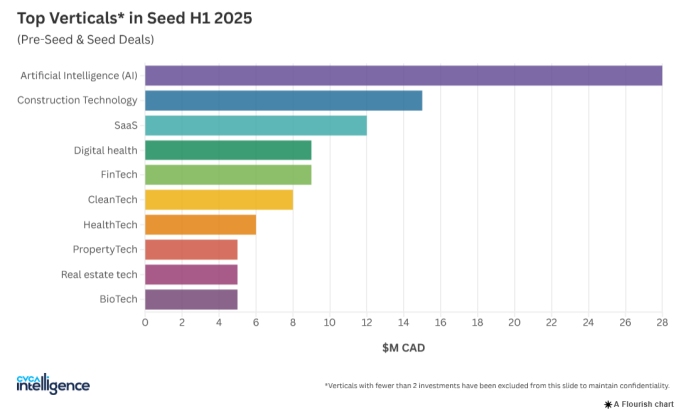
Image: H1 2025 Seed Investing in Canada by Vertical (CVCA Intelligence)
On September 11, 2025, the Canadian Venture Capital and Private Equity Association released its latest report, "The Current State of Seed Investing in Canada", covering tracked investment activity in the first half of 2025. The report recorded $297M invested across 133 seed stage deals in H1 2025.
1. Is seed capital still flowing in Canada, or has the tap run dry?
It's still flowing but selectively. There were 133 rounds worth $297M in H1 2025. The average cheque was $3M, the same as 2024 and down from the $4.09M peak in 2023. But total capital already reached $297M in just six months, equal to all of last year. For entrepreneurs, this means investors are still active but expect clearer proof points before committing. Traction and defensible technology are key.
Ontario pulled in $115.1M across 36 seed deals, nearly 40% of the total. Quebec followed with $66.1M, while Alberta and BC contributed $32.4M and $28.5M. PEI landed a single $6.3M seed round. If you are outside Ontario and Quebec, you may need a lead investor from one of those provinces to close a strong round.
AI is the leader at $24M across 12 seed deals. Construction tech ($15M across 2 deals) and SaaS ($12M across 4 deals) follow. Founders building in other sectors must benchmark carefully. For example, Fintech raised about $9M across pre seed and seed combined, making it harder to get noticed without a compelling angle.
AI again tops the list with $3.9M, followed by digital health at $2.5M. These are modest totals compared to seed, but they set the stage for the next generation of seed deals. Pre seed founders should expect smaller, milestone driven rounds focused on proving product market fit and lining up accelerators, early angels, and alternative finance options like investment crowdfunding.
US investors joined only 27.9% of Canadian seed deals in H1 2025, down from 35.9% in 2023. That is nearly a 30% relative decline. This means Canadian VCs and early stage angels and retail investors are the main gatekeepers at seed. Entrepreneurs should build domestic investor relationships first and then US and global investment pathways.
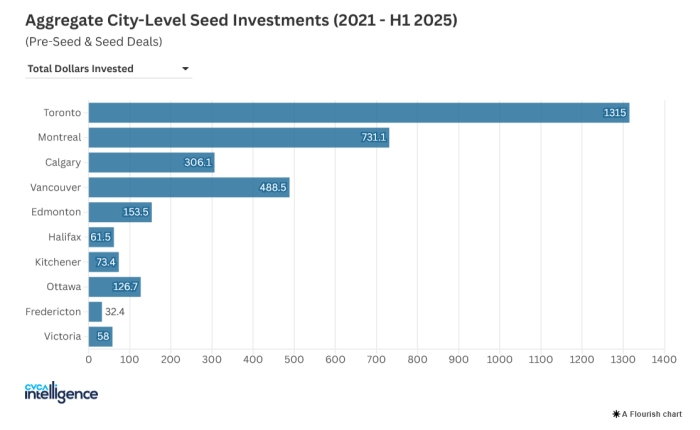
Image: Seed Investments 2021-2025 H1 (CVCA Intelligence)
They have stabilized with the average seed cheque was $3M in H1 2025, unchanged from 2024 but down from $4.09M in 2023. Total deployment hit $297M in H1 2025, already at the full year 2024 level. For investors, that means steady ownership opportunities but faster deal flow.
Ontario ($115.1M across 36 deals) and Quebec ($66.1M across 18 deals) dominate. Alberta ($32.4M) and BC ($28.5M) offer steady but smaller pipelines. For investors, this concentration could means better syndication opportunities in Ontario and Quebec, but higher competition as well.
AI’s $24M across 12 deals makes it the clear leader. SaaS ($12M across 4 deals) provides repeatable playbooks, while construction tech ($15M across 2 deals) indicates appetite for capital intensive bets. Fintech’s about $9M across pre seed and seed shows it remains investable. Portfolios tilted to AI and SaaS, with selective bets in construction and fintech, balance growth with diversification.
Pre seed AI ($3.9M) and digital health ($2.5M) dollars point to pipelines feeding into seed in the next 12 to 18 months. Investors positioning at pre seed should focus on these categories as feeders into later stage strength.
With US participation down to 27.9% from 35.9% last year, a nearly 30% relative decline, Canadian investors are leading more rounds. Other foreign investors ticked up to 10.5%. As a result, early rounds are relying more on domestic syndicates but Series A and B rounds will still require US follow on capital. Investors need to reserve capital and cultivate cross border relationships early.
Seed investment in Canada is concentrating in AI and Ontario while running ahead of last year’s pace. For entrepreneurs, it means tighter pitches and focusing on hubs where money is flowing. For investors, it means disciplined bets on AI and SaaS, while keeping an eye on steady sectors like fintech to diversify portfolios.
The National Crowdfunding & Fintech Association (NCFA Canada) is a financial innovation ecosystem that provides education, market intelligence, industry stewardship, networking and funding opportunities and services to thousands of community members and works closely with industry, government, partners and affiliates to create aa vibrant and innovative fintech and funding industry in Canada. Decentralized and distributed, NCFA is engaged with global stakeholders and helps incubate projects and investment in fintech, alternative finance, crowdfunding, peer-to-peer finance, payments, digital assets and tokens, artificial intelligence, blockchain, cryptocurrency, regtech, and insurtech sectors. Join Canada's Fintech & Funding Community today FREE! Or become a contributing member and get perks. For more information, please visit: www.ncfacanada.org
| | |
|---|---|---|
| | |
Sep 18, 2025

Image courtesy of AI
Freight factoring turns unpaid freight bills into immediate cash, giving trucking businesses financial stability when payments are delayed. Instead of waiting weeks for brokers or shippers, carriers receive funds within a day.
This financial solution keeps trucks running by covering fuel, payroll, insurance, and maintenance without borrowing. For carriers of all sizes, freight factoring ensures steady cash flow and stronger business growth.
Freight factoring is a financial service where trucking companies sell their unpaid invoices to a factoring company for immediate cash. It removes the long waiting period that brokers and shippers often impose.
The factoring company advances most of the invoice value upfront, usually between 80% and 95%. Once the broker pays the invoice, the remaining balance is released after fees.
This process gives carriers quick access to working capital without taking on debt. It ensures steady cash flow for expenses like fuel, repairs, and payroll.
Freight factoring mainly comes in two forms, and the difference lies in who carries the risk if a broker or shipper fails to pay. Both options are widely used in trucking, but the right choice depends on a carrier’s risk tolerance and budget.
In recourse factoring, the carrier is responsible if the broker or shipper does not pay the invoice. This option usually comes with lower fees, which makes it more affordable for small trucking businesses that want to save on costs.
In non-recourse factoring, the factoring company takes on the risk if a broker defaults because of bankruptcy or insolvency. Since the factor assumes more risk, the fees are higher, but carriers gain extra protection against non-payment.
Freight factoring serves a wide range of businesses in the trucking industry. Each type of company benefits differently depending on its size, expenses, and payment cycles.
Independent drivers use factoring to cover immediate costs like fuel, meals, and maintenance. Since one unpaid invoice can disrupt cash flow, factoring keeps their trucks running without interruption.
Fleets with fewer than 10 trucks depend on factoring to manage payroll, insurance, and repairs. Steady access to funds allows them to accept new contracts and expand operations with confidence.
Carriers with 10–50 trucks face higher expenses such as compliance fees, driver benefits, and fuel surcharges. Factoring ensures that these fleets maintain liquidity while scaling up.
Bigger carriers usually have stronger reserves but still factor selectively. They often use it when working with unfamiliar brokers or during slower payment cycles.
New trucking businesses rarely qualify for bank loans due to limited credit history. Factoring gives them immediate working capital to cover fuel, permits, and their first loads.
Some freight brokers use factoring so they can pay carriers quickly while waiting for shipper payments. This strengthens their relationships with carriers and keeps loads moving smoothly.
Carriers hauling refrigerated freight, flatbeds, or oversized loads often factor invoices to balance higher operating costs. Since these loads carry more risk, faster payments reduce financial pressure.
For any of these groups, choosing the best factoring freight company makes a significant difference, because the right partner offers fair rates, transparent contracts, and dependable funding.
The biggest cost in freight factoring is the discount rate, which usually falls between 1% and 5% of the invoice. How much a carrier pays depends on the broker’s credit, the number of invoices factored, and the agreement in place.
Beyond discount rates, there are other charges that come into play. Transaction fees, wire transfers, and reserve holdbacks are common, and together they reduce the final payout a carrier receives.
Some factoring companies add extra costs like monthly minimums or cancellation penalties. That’s why reading the full contract before signing is key to keeping factoring affordable in the long run.
Freight factoring and bank loans both provide access to money, but they work very differently. The main differences lie in approval, funding speed, debt responsibility, and flexibility.
With freight factoring, approval is based on the creditworthiness of the broker or shipper, not the trucking company. Bank loans, on the other hand, depend heavily on the carrier’s credit history and financial statements.
Factoring companies usually advance funds within 24 hours of receiving paperwork. Bank loans can take weeks or even months to process, which delays access to working capital.
Factoring is not a loan, so it doesn’t add debt to the carrier’s balance sheet. Bank financing creates a liability that must be repaid with interest, regardless of when brokers pay.
Carriers can choose which invoices to factor, giving them more control over their cash flow. Bank loans lock companies into fixed repayment schedules, leaving less room to adjust when business conditions change.

Image: Freepik/aleksandarlittlewolf
Selecting the right factoring partner makes a big difference in how smoothly cash flow is managed. A good company offers fair rates, transparent terms, and support that fits the needs of a trucking business.
Work with a factoring company that specializes in trucking. Industry-focused providers understand freight paperwork, broker risks, and payment timelines better than general financiers.
Look closely at how much money is advanced upfront, which is usually between 80% and 95%. A higher advance means quicker access to working capital, but it’s important to balance it with the fees charged.
Ask for a complete breakdown of all costs before signing. Discount rates, transaction fees, and potential hidden charges should all be clear and easy to understand.
Short-term or flexible agreements give carriers more freedom. Long-term contracts with penalties can trap businesses and make factoring less cost-effective.
Some factoring companies provide added value like free fuel cards, credit checks on brokers, or dispatch support. These extras can save both time and money while strengthening daily operations.
Freight factoring gives trucking businesses a steady way to turn unpaid invoices into immediate cash. It removes the uncertainty of long payment cycles and helps carriers focus on running their operations.
From owner-operators to large fleets, factoring works as a flexible solution for covering expenses like fuel, payroll, and maintenance. The choice between recourse and non-recourse factoring depends on how much risk a company is willing to carry.
Finding the right partner makes all the difference in how effective factoring becomes. A reliable factoring company with fair rates and clear terms turns cash flow management into a tool for stability and growth.
The National Crowdfunding & Fintech Association (NCFA Canada) is a financial innovation ecosystem that provides education, market intelligence, industry stewardship, networking and funding opportunities and services to thousands of community members and works closely with industry, government, partners and affiliates to create aa vibrant and innovative fintech and funding industry in Canada. Decentralized and distributed, NCFA is engaged with global stakeholders and helps incubate projects and investment in fintech, alternative finance, crowdfunding, peer-to-peer finance, payments, digital assets and tokens, artificial intelligence, blockchain, cryptocurrency, regtech, and insurtech sectors. Join Canada's Fintech & Funding Community today FREE! Or become a contributing member and get perks. For more information, please visit: www.ncfacanada.org
| | |
|---|---|---|
| | |
Regulation | Sep 18, 2025
On September 17, 2025, the U.S. Securities and Exchange Commission (SEC) approved generic exchange listing standards for Commodity-Based Trust Shares. This decision means that exchanges can now list new products without filing for case by case approvals, including those backed by digital assets.
This policy update is arguably the most significant since the SEC’s approval of spot bitcoin ETFs earlier this year, and is anticipated to accelerate the rollout of digital asset funds across U.S. markets.
Commodity Based Trust Shares are exchange traded products that hold physical assets like metals or digital assets, instead of being regulated under the Investment Company Act of 1940. Under the new rules, this means that digital assets can be listed more quickly if they meet certain standards.
The new framework effectively creates a fast track for digital asset ETFs. Before every product required a Section 19(b) filing with reviews that could stretch for months.
To qualify, the product must either track an asset traded on a market that is part of the Intermarket Surveillance Group with data sharing agreements, be linked to a regulated futures contract that has been trading for at least six months, or have at least 40% of its portfolio in a single commodity already covered by another listed product.
The SEC stressed that even though these products are not investment companies, they must still publish key disclosures, including their holdings and daily net asset value, similar to ETFs.
In addition to the new generic listing standards, the SEC also approved two specific applications that will give investors more ways to gain regulated exposure to crypto assets:
Not all commissioners agreed. Commissioner Caroline Crenshaw warned that generic standards could change responsibility for investor protection. Read the formal statement 'Passing the Buck' by Commissioner Caroline Crenshaw for her concerns about speed and scrutiny in volatile markets.
Market observers expect a wave of new filings.
For investors, more products mean greater choice and a need to understand custody, valuation, and disclosures.
For fintechs and asset managers, shorter timelines create room for innovation in fund design, multi asset strategies, and derivatives.
Commissioner Hester Peirce welcomed the decision as overdue. In her statement on the approval , she noted that generic listing standards “eliminate the need for prior SEC approval under Section 19(b)” and would reduce time and resources required to bring new products to market. Peirce acknowledged past delays and court rulings that pushed the SEC to open a path for spot crypto ETPs, and she emphasized that the new rules provide alternative eligibility criteria beyond surveillance sharing agreements. She argued that the streamlined process will benefit investors, issuers, market participants, and the Commission itself by increasing predictability and efficiency.
Canada approved the first spot bitcoin ETF in 2021, but most digital asset funds are still reviewed case by case. By approving new generic exchange listing standards, the United States has adopted a scalable model that could influence regulators globally.
If Canada doesn't modernize its framework, fintech innovators and investor capital could drain south where products can launch faster. Aligning with an efficient standard could help maintain Canada’s leadership in fintech while ensuring investor protections.
The National Crowdfunding & Fintech Association (NCFA Canada) is a financial innovation ecosystem that provides education, market intelligence, industry stewardship, networking and funding opportunities and services to thousands of community members and works closely with industry, government, partners and affiliates to create aa vibrant and innovative fintech and funding industry in Canada. Decentralized and distributed, NCFA is engaged with global stakeholders and helps incubate projects and investment in fintech, alternative finance, crowdfunding, peer-to-peer finance, payments, digital assets and tokens, artificial intelligence, blockchain, cryptocurrency, regtech, and insurtech sectors. Join Canada's Fintech & Funding Community today FREE! Or become a contributing member and get perks. For more information, please visit: www.ncfacanada.org
| | |
|---|---|---|
| | |


August 26th, 2025

January 4th, 2024

June 1st, 2021

September 9th, 2020

July 9th, 2018

January 3rd, 2018

September 25th, 2017

June 20th, 2017

May 10th, 2017

December 14th, 2016