





Karsten Wenzlaff, Advisor
August 26th, 2025
Karsten Wenzlaff is a Crowdfunding and Fintech Expert from Germany. He is Secretary-General of Digit[...]


The Globe and Mail | Michael King and Craig Asano | May 30, 2018

With interest rates on the rise and the Canadian banks moving up lending rates, the higher cost and reduced availability of credit will affect all Canadian businesses, like a rising tide lifting all boats. Inevitably some boats will be swamped and sink, particularly if they are smaller and more vulnerable.
One set of borrowers at greater risk are Canada’s 1.14 million small businesses, defined as companies that employ up to 99 workers. Statistics Canada reports that small businesses represented 98 per cent of all businesses, employed 70 per cent of workers, and generated 30 per cent of each province’s GDP on average. This category includes startups and high-growth firms, which represent Canada’s best hope for job creation and economic growth.
As credit becomes less available, small businesses face a difficult choice of cutting back on investment or turning to more expensive borrowing, such as credit cards or payday loans. Either option is bad.
Fortunately, small businesses now have an alternative source for loans called peer-to-peer (P2P) lending. These online platforms match borrowers and investors directly and can provide loans cheaper and faster than traditional sources. How can that be? The answer is technology.
Taking a step back, small businesses are financed differently than big ones. Most Canadian startups have neither the credit history nor the collateral to secure a bank loan. Statscan reports that more than 80 per cent of startups rely on alternative funding sources such as the entrepreneurs’ savings and personal loans taken out by owners. Only 45 per cent can access credit from financial institutions and 19 per cent receive trade credit from suppliers.
Technology is disrupting this paradigm. P2P lending platforms allow businesses (and individuals) to take out a loan online with the funds crowdsourced by investors who pool their savings to fund loans. Traditionally only financial institutions were set up to screen borrowers and allocate credit. But technologies such as the internet, cloud computing, data analytics and artificial intelligence have opened this asset class to new lenders such as your neighbour or a fellow business owner.
Canada’s first P2P platform, Lending Loop, was launched in late 2015 – a decade after this model was pioneered in Britain by Zopa. Last month, Lending Loop passed $20-million in loans funded on its platform by more than 20,000 Canadian investors. While $20-million is impressive, it is still only a sliver of the $95-billion of credit outstanding to Canadian small businesses as reported by Statscan.
The average small business borrower on Lending Loop’s platform is borrowing $75,000 to $100,000 for three to five years. While interest rates vary substantially, P2P loans typically start at around 6 per cent with an average interest rate of 12 per cent, significantly lower than a credit card. These loans are used to finance inventory and equipment, or to hire new employees.
The Canadian P2P lending market got a boost this month when the Ontario government announced it would contribute $3-million over the next two years to loans funded on Lending Loop’s platform. The Ontario government will fund up to 10 per cent of small business loans, supporting funding of $30-million.
Besides the obvious benefit to small businesses, Ontario’s announcement was important for two reasons. First, Ontario has drawn attention to P2P lending as an alternative funding source and raised awareness among businesses to accelerate adoption. And second, by partnering with a fintech startup, Ontario is leading by example and giving a boost to entrepreneurs working to democratize finance.
Here are four more steps that Canadian policy makers can take to promote P2P lending:
First, Canada should follow Britain and adopt new P2P lending regulations, as opposed to shoehorning this sector under existing equity regulations. New regulations should ensure the cost of due diligence borne by lenders is proportionate to the investment risk.
Second, retail investor caps for P2P lending should be raised over time if this asset class is proven to be low risk, increasing the pool of funds available to meet the needs of small businesses.
Third, the federal government should partner with industry to provide more education for investors and small businesses. This effort should include data collection and benchmarking to allow researchers to establish what is working and what is not.
Fourth, Canada should adopt Britain’s mandatory referral program. Banks that reject a small-business loan must refer unsuccessful applicants to a government portal that connects them with alternative lenders who may be able to assist them.
Our hope is that Canadian politicians recognize that promoting innovation means more than cutting ribbons and offering tax credits. It is about plugging holes in a leaky financial system and adding wind to the sails of small businesses to move them forward.
 The National Crowdfunding & Fintech Association of Canada (NCFA Canada) is a cross-Canada non-profit actively engaged with cryptocurrency, blockchain, crowdfunding, alternative finance, fintech, P2P, ICO, and online investing stakeholders globally. NCFA Canada provides education, research, industry stewardship, services, and networking opportunities to thousands of members and subscribers and works closely with industry, government, academia, community and eco-system partners and affiliates to create a strong and vibrant crowdfunding and fintech industry. Join Canada's Fintech & Funding Community today FREE! Or become a contributing member and get perks. For more information, please visit: ncfacanada.org
NCFA Canada | By Gary Buisansky | May 11, 2018

It's not every day we wake up to hear that the Ontario Government has committed to a loan of 3 million Dollars for small business. A market woefully underserved by traditional lenders.
Beyond the benefit this will have for small business, it provides testimony to the National Crowdfunding & Fintech Association of Canada’s continued advocacy for financial and regulatory support to the sector. (You can read the NCFA’s March 2018 submission to Finance Canada here and Lifting the Veil on Peer to peer Lending in Q1 2016 here).
As an industry, while we navigate the regulatory hurdles, there are some lessons we can take away from this, to better help ourselves and the Canadian market. There are also several Canadian success stories which we should not lose sight of. AI, Crypto currency and blockchain, are all thriving in Canada.
Lending Loop, an active member of the NCFA, has been making the news lately with an announced 2-year pilot project partnership with the Ontario Government for a $3 million loan.
If you're not familiar with Lending Loop, it fills an important void in the market, connecting small businesses and Canadian retail investors, willing to lend to them.
Through the Lending Loop platform, small companies can finance loans at reasonable rates, often within days of their loan application.
These borrowers face very real challenges securing funding in the Canadian market with debt finance to SME's considered very risky. Where loans are made, they usually come with eyewatering interest rates, reflecting their often-limited track record, lack of financial information and availability of collateral.
Loans provided by Lending Loop will now have a 10% government participation, with the government portion of the loan amount treated like any other; the principle amount will be repaid together with interest.
The anchor investment by the Ontario Government will enable total funding of around $30 million to Ontario's SME's providing welcome relief to an under banked market and provide leveraged economic benefit into the broader economy.
This is a clear win for all parties. But what can the greater fintech community learn from this success?
Cato Pastoll, CEO and Co-Founder of Lending Loop, makes the point that fintech companies underestimate the importance of government relationships, particularly those in the startup phase. He suggests:
"It’s up to you to educate the regulators about your business and what societal benefits it provides. You need to make yourself heard. For the most part, fintech entrepreneurs do not make it a priority to try work with government.
It can be vital, particularly in regulated industries, to find the time and make the effort. The government’s role is to hear the challenges industries and people are facing and want to understand the dynamics of the market".
In his experience, regulators and government only hear part of the story and if fintech does not speak up, then regulators are left with only the incumbents viewpoint.
In a study released in December last year, the Canadian Competition- Bureau, observed:
"...other jurisdictions have more welcoming and innovation‑conducive regulatory environments than Canada. The United Kingdom, the United States, Singapore, Germany, Australia and Hong Kong have been identified as leading fintech hubs based on talent, funding availability, government policy and demand for fintech".
This contrasts with the position in Canada, where regulatory gaps, uncertainty and lack of consistency across provinces prevail.
An 11-point plan has been proposed, that includes harmonizing regulation across geographic boundaries, and identifying a fintech policy lead for Canada. These solutions would go a long way to addressing key roadblocks in the growth and development of Canadian fintech. Additionally, Craig Asano, Executive Director of the NCFA, makes the point that:
“To help verify Canada’s competitive position relative to other jurisdictions, additional resources and support are needed for data collection and education. This will help quantify the number of fintech companies, capital investments, financings and loan volumes of new funding models, and the time and cost spent on compliance.
The Canadian government is extremely well placed to support the sector. The Business Development Bank of Canada (BDC) is the largest VC fund in the country with over $1 billion in capital under management. Most Canadian VC funds have government money, either directly through BDC investing in the funds or indirectly through funds of funds that in turn invest in VC's.
The significance of government involvement and ability to support and foster a sustainable fintech sector, with market confidence is critical. The C.D. Howe Institute makes the case for a suite of recommendations that, if adopted, will better position Canada to take advantage of its investments in the technological revolution that is underway throughout the economy.
While Canada makes use of regulatory sandboxes to help start-ups test new products or services in a controlled environment, there is room to improve the model. Unlike competitor countries including the UK and Australia, which offer flexible and proportional regulatory frameworks, Canada follows a more paternalistic model.
Cato Pastoll says the Canadian model has it the wrong way around.
In Canada one must adjust your business to fit in with the existing regulatory models rather than forcing regulators to figure out how best to regulate.
Getting this right is critical in his view, particularly if we are going to compete with other countries.
What this requires is a mind shift followed by active dialogue between stakeholders and industry to work out a better framework for regulatory sandboxes.
That said, there are some areas of fintech where accelerator programs and innovation hubs are showing strong results.
KPMG International in their Pulse of Fintech Q4'17 Report, highlights AI as a major driver of innovation in the Americas, particularly in the US and Canada.
It refers to Canada as, "a hotbed for fintech innovation", and goes on to say that Canada’s participation in the space is getting more notice with world-class fintech hubs in Canada rapidly maturing with increased attention from US investors.
Crypto currency and blockchain related ventures are also recognizing Canada as a friendly jurisdiction. With strong investor appetite available, crypto mining companies, Hut 8 Mining, BitFury and HIVE have all come to market to capital through the TSX-V.
More recently, the Ontario Securities Commission consented to the listing of the first Canadian Bitcoin ETF on the TSX under the ticker, HBLK which invests in companies involved in blockchain and distributed ledger technologies.
And over the past few days, Huobi a Singapore-based bitcoin exchange, (and the world’s number three exchange by 24-hour volume), has stated its intention to expand its operations to Toronto.
General Manager of Huobi, Ross Zhang stated;
"Canada is emerging as a leading blockchain nation, and Toronto is set to become one of the next most active blockchain hubs across North America".
This serves to demonstrate that If Canada is to capitalize on the wave of fintech opportunity washing our shores, we need to act swiftly and get our regulatory house in order.
Without the need to reinvent the wheel, we can borrow from global best practices. We must continue to lobby for a unified regulatory framework and insist that the Federal Government champion fintech. Fintech after all has the wherewith-all to make a marked difference in our economy.

Gary Buisansky is a freelance writer for NCFA and founder of Coin My Copy which specializes in writing marketing content, including white papers, website copy, articles and case studies for fintech and traditional finance companies.
The National Crowdfunding & Fintech Association of Canada (NCFA Canada) is a cross-Canada non-profit actively engaged with cryptocurrency, blockchain, crowdfunding, alternative finance, fintech, P2P, ICO, and online investing stakeholders globally. NCFA Canada provides education, research, industry stewardship, services, and networking opportunities to over 1700+ members and works closely with industry, government, academia, community and eco-system partners and affiliates to create a strong and vibrant crowdfunding and fintech industry. Join Canada's Fintech & Funding Community today FREE! Or become a contributing member and get perks. For more information, please visit: ncfacanada.org
Digital Journal - FrontFundr Release | April 9, 2019

Investment crowdfunding is an alternative source for companies seeking capital to grow their businesses.
Craig Asano, Founder and CEO of the National Crowdfunding and Fintech Association, NCFA Canada said. "We are thrilled to see the growth of FrontFundr and congratulate them on reaching the $10 million milestone! It clearly demonstrates the availability and potential of investment crowdfunding capital to support the growth of Canadian businesses."
Investment crowdfunding is an alternative source for companies seeking capital to grow their businesses. Partly available in some Provinces it was fully legalized in 2015. Crowdfunding not only allows Canadians to invest in private companies, from as little as $100, but it allows companies access to capital and a community of stakeholders. A recent example, and part of the $10 million raise, is Red Mountain, that enabled people to own a piece of a ski hill in British Columbia, Canada. Over $2,500,000 was raised through the campaign, from 742 backers, many of whom gained perks such as lift passes as well as shares.
FrontFundr is an online investing platform that empowers Canadians to find and make direct investments in the private companies they believe in - and become stakeholders in their future. FrontFundr's online exempt market dealer (EMD) status plus its modern technology lets users across Canada easily invest in innovative growth businesses in under 12 minutes and starting from $250. Own your share.
View source: here
The National Crowdfunding & Fintech Association of Canada (NCFA Canada) is a cross-Canada non-profit actively engaged with both social and investment crowdfunding, alternative finance, fintech, P2P, ICO, and online investing stakeholders across the country. NCFA Canada provides education, research, industry stewardship, and networking opportunities to over 1600+ members and works closely with industry, government, academia, community and eco-system partners and affiliates to create a strong and vibrant crowdfunding and fintech industry in Canada. For more information, please visit: ncfacanada.org
Locavesting | Staff Writer | March 16, 2018

Some Americans may envy Canada’s charming president and progressive politics, but when it comes to investment crowdfunding, the two countries are in the same boat.
In an appeal to government regulators this week, Canadian crowdfunding and financial tech advocates called out an “urgent need for regulatory changes and government support” for Canada’s entrepreneurial and capital raising ecosystem. That includes streamlining the country’s crowdfunding regulations and educating the public about the laws.
“Entrepreneurs are reluctant to start up in Canada due to the high costs (relative to a small financing), and significant ongoing regulatory burdens. Investors are inhibited by caps on investment and limited education about the benefits and downside risks of crowdfunding and other exempt financings. This pushes many talented entrepreneurs and investors to overseas jurisdictions that better understand (and support) innovation and the economic potential of start-ups and small businesses,” writes the National Crowdfunding & FinTech Association (NCFA), a nonprofit Canadian trade group.
In Canada, online capital-raising rules vary by province, and efforts to “harmonize” the laws have fallen short.
The U.S. is in a slightly better position. The U.S. crowdfunding industry falls under a single federal framework, the 2012 JOBS Act. However, 34 states have passed intrastate laws that can vary greatly.
But U.S. complaints are similar in other regards, including the need to improve burdensome regulations and educate the public about the new laws.
Of particular note, the NCFA decried the lack of support and incentives for education.
“Introducing new requirements/exemptions without a robust ongoing educational program is like asking new drivers to follow a road that contains no ‘signs’, without maps,” writes the NCFA.
In a 2017 survey by the NCFA, over 70% of respondents said more education was required to attract more investors to crowdfunding. A lack of awareness and education around crowdfunding laws is frequently cited as the number one challenge in the U.S. as well.
Data collection and analysis is also lacking, according to the NCFA.
Encouraging Investors
One area where Canada stands out may be in offering tax incentives for investors, although not specifically in conjunction with crowdfunding. The report doesn’t mention it, but some Canadian provinces, such as New Brunswick, have long offered tax incentives for local investors that have been held up as a model for the U.S.
The NCFA warns that, without action, Canada risks falling further behind in global competitiveness and financial innovation. They cite an Ernst & Young “Fintech Adoption Index” that put Canada near the bottom of global fintech adoption rates, at just 18 percent. The U.S. clocked in at 33%, the average adoption rate, trailing countries such as Australia (37%), the UK (42%), India (52%) and China (69%).
The NCFA concludes with recommendations, including streamlining the regulations and potentially adopting British Columbia’s more preferable framework. It also advocated for regulatory “sandboxes” that allow for controlled financial experimentation—an idea that has been implemented in the U.K. and proposed in the U.S.
CrowdfunInsider | JD Alois | Mar 14, 2018
 Last week during the National Crowdfunding and Fintech Association of Canada’s annual event, FFCON2018, there was a single presentation that provided a state of Fintech in Canada. Professor Michael King, from the Scotiabank Digital Banking Lab @ Ivey Business School, delivered an excellent synopsis of what’s working and what’s not.
Entitled “the Current State of Fintech in Canada: The Good, The Bad and The Ugly,” King’s deck bulleted out both the high and the low.
Canada is growing Fintech startups. There is more than 800 today which is pretty respectable for a smaller country.
Areas of prominence include Blockchain, AI, Payments, peer to peer and more.
There is an increasing number of incubators and accelerators to promote sector growth, plus recognition by universities and other support sectors that Fintech is of strategic importance.
Traditional financial institutions have been slow to adopt Fintech innovation or partner with emerging disruptive financial firms. King provided a painful, but probably not a unique example, where a traditional bank required 120+ signatures to partner with Fintech firm.
 The National Crowdfunding & Fintech Association of Canada (NCFA Canada) is a cross-Canada non-profit actively engaged with both social and investment crowdfunding, alternative finance, fintech, P2P, ICO, and online investing stakeholders across the country. NCFA Canada provides education, research, industry stewardship, and networking opportunities to over 1600+ members and works closely with industry, government, academia, community and eco-system partners and affiliates to create a strong and vibrant crowdfunding industry in Canada. For more information, please visit: ncfacanada.org
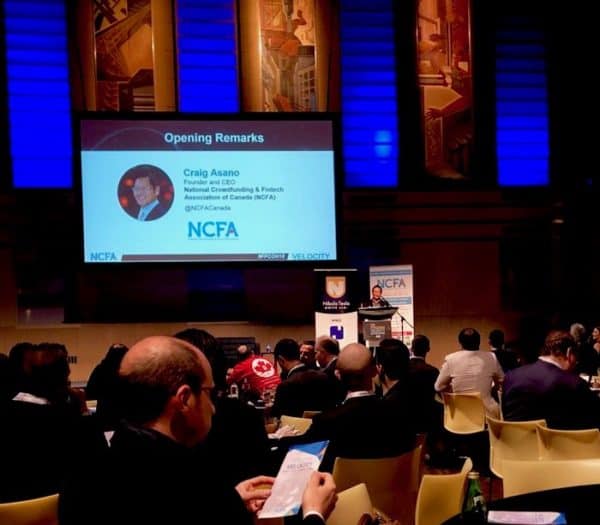
This past week, the National Crowdfunding and Fintech Association of Canada(NCFA) held its annual event in Toronto that saw over 500 participants join to discuss Fintech from around the world. FFCON18 Velocity covered the wide-ranging spectrum of current topics in the realm of alternative finance including Blockchain, cryptocurrency and other forms of financial innovation. The event was appropriately held in the Design Exchange in downtown Toronto – the former home of the Toronto Stock Exchange.
The NCFA always puts on a good event bringing together a diverse group of industry participants including investors, entrepreneurs, platforms and public officials – including provincial regulators. Crowdfund Insider was pleased to be involved in the annual event. Today, we are sharing just a few of the interesting quotes we heard while participating in FFCON18.
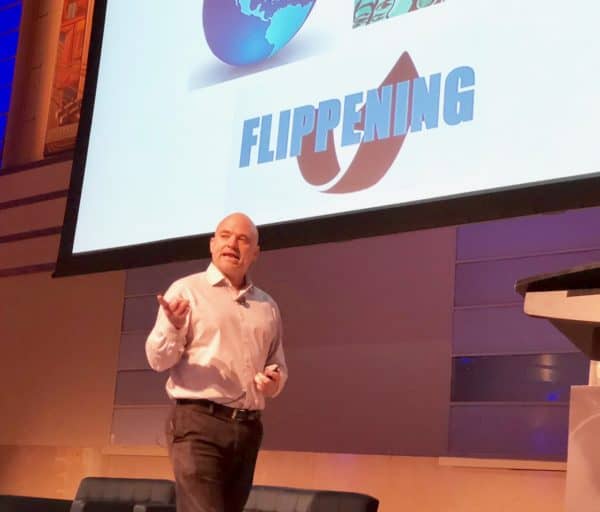
“Nobody knows anything. We are at the very beginning. It is going to be different from anything anyone is thinking right now.”
“Bitcoin has lost the race to be a currency but it is going to be a great store of value. A better gold.”
“I am a believer in utility tokens but security tokens are going to be bigger.”
“Regulators have two options: Regulators can roll out the red tape or roll out the red carpet. The genie is already out of the bottle.” – Lou Kerner, CryptoOracle

“When Ripple got started they were not exactly sure where to apply their technology.” – Diana Adachi, CEO of Pegasus Fintech
CSE aims to be Canada’s first blockchain platform for trade clearing and settlement
OSC approves Canada’s first blockchain ETF
The National Crowdfunding Association of Canada (NCFA Canada) is a cross-Canada non-profit actively engaged with both social and investment crowdfunding, alternative finance, fintech, P2P, ICO, and online investing stakeholders across the country. NCFA Canada provides education, research, industry stewardship, and networking opportunities to over 1600+ members and works closely with industry, government, academia, community and eco-system partners and affiliates to create a strong and vibrant crowdfunding industry in Canada. For more information, please visit: ncfacanada.org
CBCnews | Makda Ghebreslassie | Jan 4, 2018
 An award-winning idea to build a pedal-powered washing machine has hit some snags and its inventor is facing questions about what's taking so long. But one expert has told CBC Toronto stories like this are common and are even to be expected before a new product finally makes it to store shelves.
Yi Jiang, the creator of the Drumi — an electricity-free, foot-powered washing machine — has experienced many challenges taking his product from mock-up to market.
"It's just taking us so much time and energy to figure out how to make things work," he said.
The prototype won the national James Dyson Award in 2015.
It's a compact washing machine, operated by a pedal, that can hold about two kilograms of clothing. That's usually three to five items.
All that is required is water, detergent, sanitizer and a few minutes of your foot pushing the pedal to spin the drum that holds the clothes.
Jiang gained financial support for the concept with pre-orders on the crowdfunding site Indigogo and his company's website.
Walter Sanchez says he came across the Drumi while reading an article about inventions that could make a difference in your life.
"I was attracted to that concept of having an item that is easily accessible to me that would make an otherwise tedious task more appealing and more functional and efficient," he said.
In May of 2016, he went on the website for Jiang's company, Yirego, and pre-ordered it for $265 plus tax and shipping.
Sanchez says the website indicated pre-orders would be shipped out by the end of the year but that kept being pushed back.
He says he emailed Yirego last April and was told they did not know when the product would be shipped out and they would keep him informed.
But Sanchez says eventually all communication, including the company's monthly updates on its website came to a halt.
"The product doesn't get delivered and no one is returning your calls and there are no updates, so as a consumer it raises a lot of concern because three hundred and whatever dollars is not chump change for a lot of us," he said.
Jiang says the plan was to have the actual product shipped to customers by 2016 but that deadline has come and gone.

Yi Jiang says he was inspired to create the Drumi after having negative experiences with public laundromats. 'It's not just about the cost and the time consumption, it's also about the energy and the way that people are using it,' he says. (Makda Ghebreslassie/CBC News)
The delay, he says is partly due to redesigning the Drumi, adding new features and meeting manufacturing standards.
Jiang says because he was creating a whole new product with no electrical parts, off-the-shelf components were not an option.
He even had to design and produce basic parts like the springs the machine needs.
"It's like a concept car. You can't drive around a concept car," Jiang said.
But while his team works on improving the product, customers who pre-ordered are left waiting.
After sending several messages this past spring, Sanchez said the company finally contacted him and provided him with the refund he requested in October.
"The way the situation was handled, I think it was poor," said Sanchez.
Many of the challenges faced by the inventor of the DRUMI and its clients are very common, says Daryl Hatton, the CEO of FundRazr and the director of the National Crowdfunding Association of Canada.
Hatton says people choosing to get behind products on crowdfunding sites need to fully understand what they are committing to.
"They will have to be patient because it frequently takes longer than they want. There's a chance that they might not ever get it. It's possible that the entrepreneur might fail and it won't work," he said.
"You're backing a venture and a concept and an idea more than just a purchase. There's risk involved," he said.
Hatton said there are things that entrepreneurs like Jiang can do to help ease the concerns of their clients.
"The number one advice is to over communicate and demonstrate the progress being made," he said.
The National Crowdfunding Association of Canada (NCFA Canada) is a national non-profit actively engaged with social and investment crowdfunding, alternative finance, fintech, peer-to-peer (P2P), initial coin offerings (ICO), and online investing stakeholders across the country. NCFA Canada provides education, research, industry stewardship, networking opportunities and services to thousands of community members and works closely with industry, government, academia and eco-system partners and affiliates to create a vibrant and innovative fintech and online financing industry in Canada. For more information, please visit: ncfacanada.org



August 26th, 2025

January 4th, 2024

June 1st, 2021

September 9th, 2020

July 9th, 2018

January 3rd, 2018

September 25th, 2017

June 20th, 2017

May 10th, 2017

December 14th, 2016
